window.dataLayer = window.dataLayer || []; function gtag(){dataLayer.push(arguments);} gtag('js', new Date()); gtag('config', 'UA-206511945-1');
Search
Categories
Uncategorized

Automated Marketing & Loyalty: 2026 Salon & Spa Guide

What if your next repeat visit began with one well-timed message and a reward that felt genuinely worthwhile? Automated Marketing & Loyalty Programs can help connect those moments when they match client needs and fit your salon or spa’s daily workflow.

Follow-up matters, but sending messages between appointments, managing operations, and serving clients leaves little time for manual marketing. A generic offer may not give someone a compelling reason to return. Industry research reports that 73% of clients are more likely to choose a salon or spa with a loyalty or membership program. The opportunity is there, but the approach needs to feel relevant and be measured.

This guide explains how to pair timely communication with meaningful rewards, assess whether your efforts support repeat business, and choose a practical setup. You’ll also see how client management, online booking, marketing, and loyalty can work together through Encore Salon & Spa Software, helping you create a more consistent client journey with less manual effort.

Key Takeaways

  • Connect communication and rewards across the client journey, from the first interaction to a future return.
  • Compare points, visit-based rewards, and non-discount recognition to find an approach clients can understand and your team can manage.
  • Use Automated Marketing & Loyalty Programs to make client communication more consistent while keeping rewards relevant.
  • Start with one business goal and one client group, then explain program terms clearly to clients and staff.
  • See how Encore brings marketing and loyalty capabilities into a broader platform that includes client management and online booking.

What Automated Marketing & Loyalty Programs Mean for Salons

Salon relationships are built in person, but they continue between appointments. A useful update, a timely follow-up, or recognition of a client’s continued visits can keep that relationship active without relying on staff to remember every task. Automated Marketing & Loyalty Programs bring together two distinct activities: planned communication and meaningful recognition.

Marketing automation uses software to support repeatable communication workflows. It can help organize messages and client information, but it doesn’t replace professional judgment or the personal attention clients value. The overview What is Marketing Automation? explains the broader concept and its applications. For a salon or spa, the practical question is how to make each communication useful and appropriate, not simply how to send more messages.

How do automated marketing and loyalty programs differ?

Think of marketing automation as the communication process and a loyalty program as the value or recognition offered to clients. For example, a salon might plan a message with relevant service information for a color client, while separately recognizing clients who continue to book over time. The business decides what to say, when it makes sense to say it, and how clients receive the recognition.

Client information can make both activities more relevant. Service history and booking preferences can help a team avoid sending a broad promotion that doesn’t fit a client’s needs. That context can also help staff recognize ongoing relationships in a way that feels sincere. Record only useful details, keep them current, and put the client experience first.

Why does the combination matter in a salon or spa?

Appointment-based businesses have natural points of connection: a client discovers the business, books, receives a service, and decides whether to return. Consistent communication can make those transitions clearer. A helpful follow-up can keep a client engaged after a visit, while a relevant reward can offer an added reason to continue the relationship.

Neither element works well if it feels impersonal. Frequent messages can become noise, and a reward with complicated rules may not feel valuable. Keep communications purposeful, explain recognition clearly, and let staff bring their knowledge of clients into the relationship. Software can organize the process, but the human welcome, consultation, and service remain essential.

Marketing keeps the conversation timely; loyalty gives clients a meaningful reason to continue it. Together, they can support a connected client journey without treating every person as if they have the same needs. Encore brings automated marketing and loyalty capabilities into salon and spa management software alongside client management and online booking. Explore salon software features to see how these capabilities fit into business management.

How Marketing Automation and Loyalty Connect Across the Client Journey

A client’s experience doesn’t begin and end in the salon chair. It moves through discovery, booking, service, follow-up, and the decision to return. When client records, appointment context, communication, and loyalty participation are organized around that journey, each interaction can feel more connected. The aim isn’t to automate every moment. It’s to help your team keep useful details accessible and communicate with care.

Where can marketing and loyalty meet in a client journey?

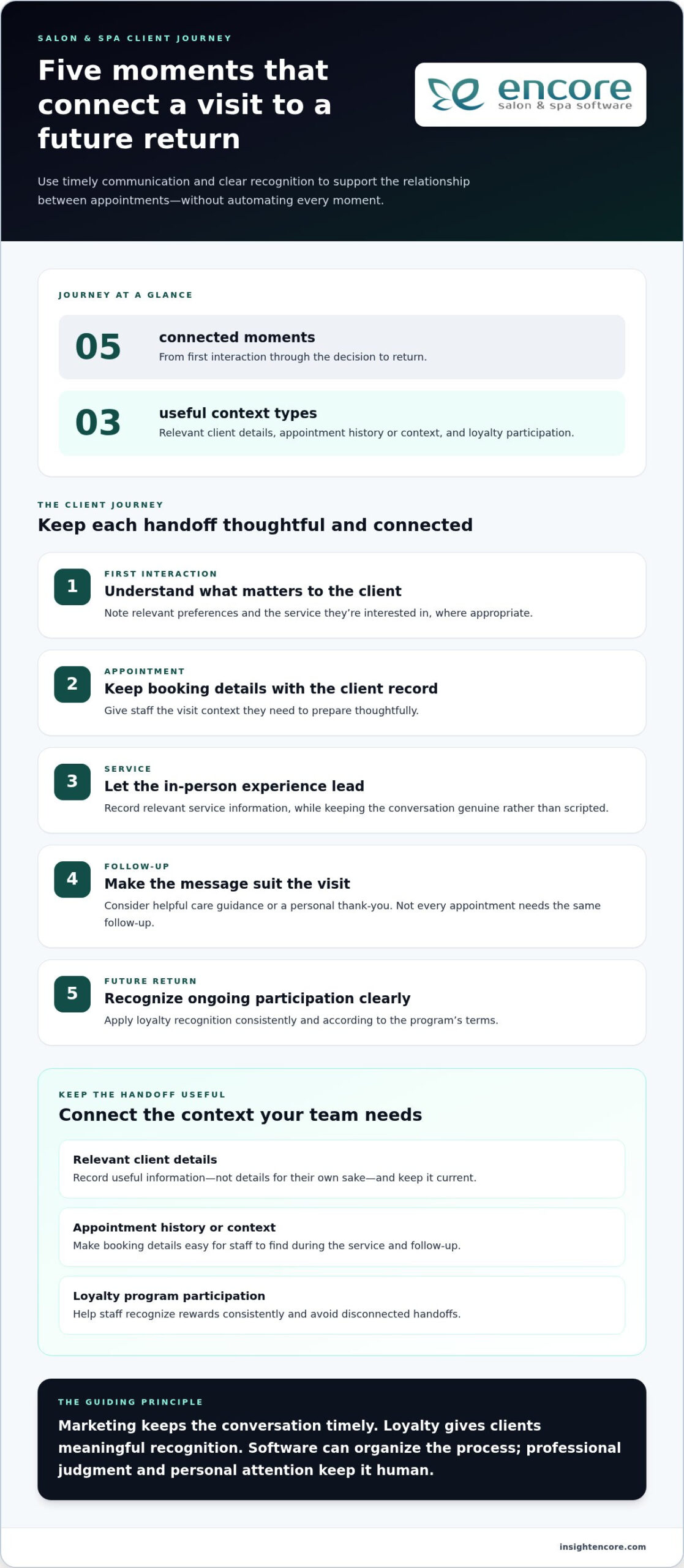
Picture a first-time client who finds your salon, books a consultation, receives a service, and considers their next visit. A simple journey map helps your team identify what information and support matter at each step:

  • First interaction: Note the client’s preferences and the service they’re interested in, where appropriate.
  • Appointment: Keep booking details connected to the client’s record so staff can prepare with the visit’s context in mind.
  • Service: Record relevant service information, then let the in-person experience lead. A genuine conversation is more valuable than a scripted exchange.
  • Follow-up: Decide whether a helpful message, such as care guidance or a personal thank-you, suits the visit. Don’t assume every appointment needs the same follow-up.
  • Future return: Recognize ongoing participation in a loyalty program clearly and consistently, according to its terms.

The handoff matters. When booking details are easy for the team to find during the service, staff can carry that context into follow-up. A salon client booking portal guide can help you consider how online booking fits into the wider experience, from choosing an appointment to arriving prepared.

What should salon owners keep connected?

Start with the information your team needs to serve clients thoughtfully: relevant client details, appointment history or context, and loyalty program participation. The point isn’t to collect information for its own sake. Make useful context available when it can improve a conversation or help staff provide a more consistent experience.

Disconnected records can lead to generic communication. A client might receive an offer that doesn’t reflect their services, or staff may not know whether a reward has already been recognized. Agree on what information the team records, where it belongs, and how staff keep it current. A shared process makes handoffs easier without requiring a complicated journey design.

Encore brings client management, online booking, automated marketing, and loyalty capabilities into a broader business-management platform. Explore the client management features as you consider how organized records can support daily operations. Explore Encore to see how these tools could fit your business.

How to Judge Whether a Salon Loyalty Program Is Worthwhile

A loyalty program should feel worthwhile to clients and manageable for your team. Before choosing a reward, ask whether clients will understand its value, staff can explain the rules, and you can track participation. The best fit depends on your services, client habits, and capacity to run the program consistently, not on how elaborate it looks.

Which loyalty approach fits your clients and business?

Each approach balances clarity, perceived value, and administration differently. Use this comparison to narrow your options:

  • Points: Clients accumulate points through defined activity and redeem them for a stated reward. This can offer flexibility, but earning and redemption rules need to be easy to follow and maintain.
  • Visit-based rewards: Clients receive recognition after a set number of visits or services. The idea is simple to explain, but the program needs a clear way to record progress and define which visits count.
  • Non-discount recognition: A business can acknowledge continued participation without making a price reduction the focus. This may feel personal, but the recognition still needs to matter to clients and be delivered consistently.

Consider your service mix and booking patterns. If clients tend to return for similar services, a straightforward visit-based structure may be easier to explain. If they use a wider range of services, a flexible points model may suit them, provided the team can administer it accurately. Non-discount recognition can complement either approach, but it needs a clear purpose too. Keep the terms brief: explain how clients participate, what counts, and how they receive recognition. If staff need a lengthy explanation, simplify the rules.

How can a business tell whether the program is helping?

Set a baseline before launch so you have a fair point of comparison. Choose a period that reflects your normal appointment patterns, then track a small set of measures consistently:

  • Repeat visits: Track whether participating clients return and compare the pattern with your baseline.
  • Redemptions: Note how often clients use rewards and which types they choose.
  • Client response: Record questions, feedback, and signs that clients understand or value the offer.
  • Team workload: Notice whether tracking and explaining the program fits comfortably into daily operations.

Redemption shows that a reward was used. It doesn’t, by itself, show that the program prompted a meaningful return visit. Compare behavior over time and consider whether clients might have booked again without the reward. Avoid treating correlation as proof that the program caused a change.

Program activity shows participation; repeat behavior helps show whether the program is supporting the relationship. Salesforce has cited a broad estimate that customer acquisition can cost at least six times more than retention. Treat that as general research, not a salon-specific benchmark or a prediction of what your own program will achieve. Judge Automated Marketing & Loyalty Programs using your own records, client feedback, and the effort required to keep the program clear and consistent.
Automated Marketing & Loyalty: 2026 Salon & Spa Guide

How to Launch Automated Marketing and Loyalty Without Overwhelming Clients

A manageable launch starts with focus, not a long list of campaigns. Choose one business goal and one client group, then build a process your staff can explain and maintain. For example, you might focus on keeping clients who book a particular service connected between visits. Keep the first version small enough to review and adjust.

What should a practical launch sequence include?

Before setting anything up, write down how your team currently handles client follow-up and rewards. This gives you a starting point and helps reveal manual steps or confusing handoffs. Then follow a straightforward sequence:

  1. Choose a measurable objective. Decide what you want to learn or improve, such as whether a specific client group returns after a service. Record the current process or baseline so you can compare later.
  2. Set simple program rules. Define how clients participate, what recognition they can receive, and which terms they need to understand. Keep the explanation brief enough for staff to share consistently.
  3. Prepare the client-facing language. Draft a clear message that sounds like your business. Make sure staff know how to answer common questions and where to find program details.
  4. Review responses and refine. Look at participation, client feedback, and any confusion your team encounters. Adjust the message or rules based on what you observe before adding another client group or idea.

This sequence lets you test the experience as well as the offer. A program that looks simple on paper still needs to work at the front desk, during a busy appointment day, and in the way clients understand it.

How can automation stay personal and respectful?

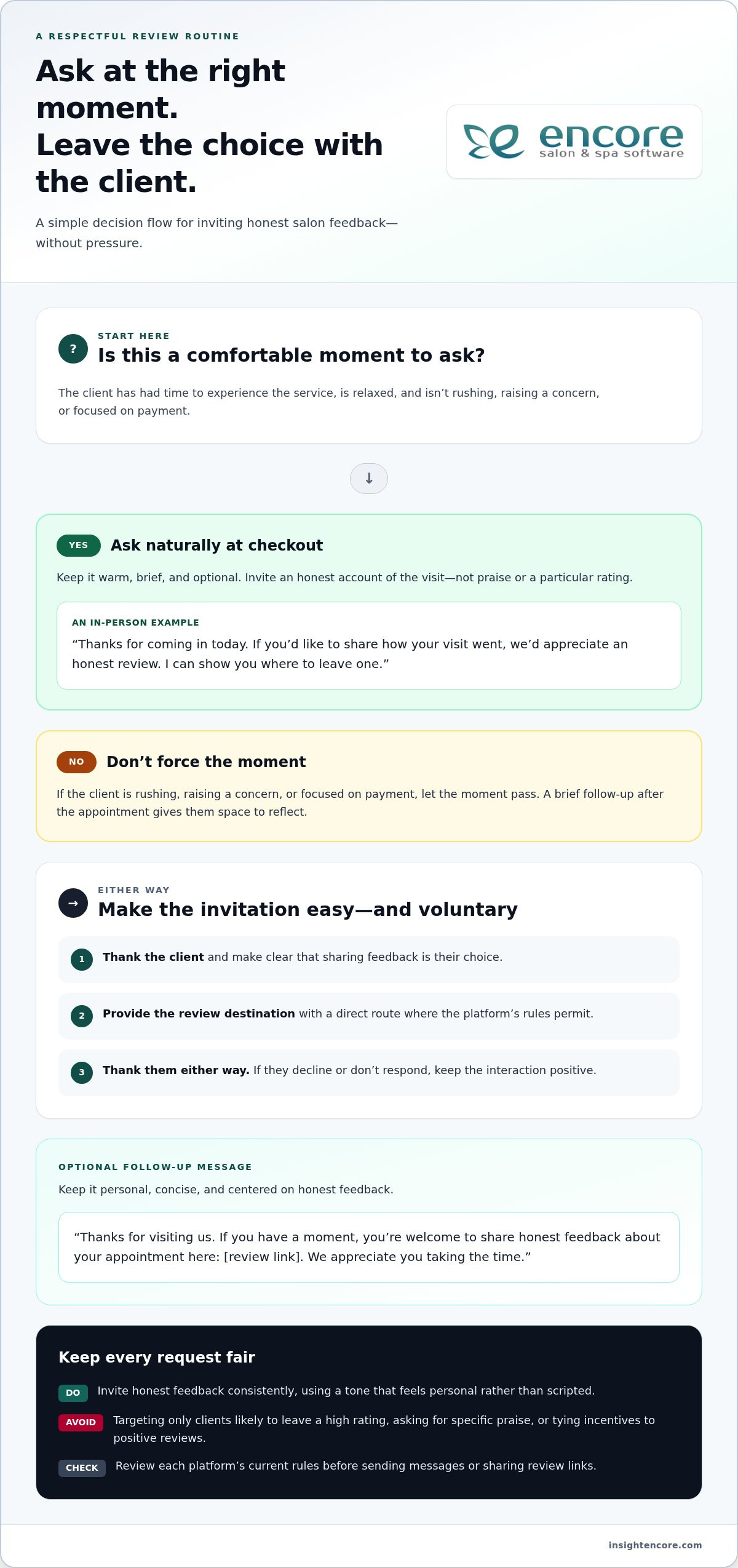
Automation should make useful communication easier to manage, not become a reason to contact clients more often. Before sending a message, ask whether it’s relevant to the recipient, clear about its purpose, and consistent with the service they receive in person. If it adds no useful information or value, leave it out.

Keep the language warm and direct. Use familiar wording, explain why you’re contacting the client, and describe any reward in plain terms. Review messages regularly so details stay accurate as services or program rules change. Let staff use their judgment too. A planned workflow can support consistency, while a personal conversation is still the right choice for questions or individual client needs.

Start with the smallest version that lets you learn. A measured rollout gives your team room to build confidence and gives clients a clear, comfortable experience. Encore brings automated marketing and loyalty capabilities into a broader salon and spa management platform, alongside client management and online booking.

Explore how Encore can support your business

How Encore Brings Salon Marketing and Loyalty Into Business Management

Marketing and rewards are easier to manage when considered alongside the daily work of running a salon or spa. Encore Salon & Spa Software is an all-in-one management platform with automated marketing and loyalty capabilities, as well as client management, online booking, gift card management, and point-of-sale transactions. This broader context helps owners consider how client communications and recognition fit into daily operations instead of treating them as separate tasks.

How does Encore fit into salon and spa operations?

Appointment-based businesses rely on clear client and booking information to organize the client experience. Encore Salon & Spa Software brings client management and online booking into the same broader software offering as marketing and loyalty. These capabilities support planning client communications and rewards, while the business chooses messages and program terms that suit its clients.

Encore Salon & Spa Software also serves barber shops, tattoo studios, massage businesses, and pet grooming businesses, alongside salons and spas. Each business has different needs, so consider how the management tools relate to the way your team books appointments and maintains client relationships. The Encore Salon & Spa Software overview provides salon-specific platform context.

Keep gift cards distinct from loyalty rewards. A gift card represents stored value that can be purchased or given to someone, while a loyalty program recognizes ongoing client participation according to its terms. Both can be part of a client-focused business, but they serve different purposes. Encore Salon & Spa Software includes gift card management alongside its marketing and loyalty capabilities.

What is a sensible next step for your business?

Before adopting new tools, take stock of your current process. Where does your team record client information? How do you handle follow-up? Can staff explain existing rewards consistently? These questions help identify what’s working and where manual steps or disconnected records create extra effort.

Next, consider how marketing and rewards fit with your client-management needs. A useful solution should support the way your business organizes client details and appointments while keeping communication clear and manageable. Start with the needs you’ve identified, such as more organized records or a more consistent approach to client recognition. Then consider how the platform’s relevant capabilities could support those priorities without assuming every feature or workflow is necessary for your business.

Encore Salon & Spa Software’s Automated Marketing & Loyalty Programs are part of a broader management platform for appointment-based businesses. Salon and spa owners can consider marketing, loyalty, booking, and client management together while keeping decisions about the client experience in their hands.

See how Encore fits your business

Build a Client Experience You Can Keep Improving

Your next step doesn’t need to be a full campaign calendar or a complex rewards structure. Choose one moment in the client relationship where a clearer, more thoughtful touchpoint could help. Decide what you want clients to understand or do, then make the experience easy for your team to deliver consistently.

As you put Automated Marketing & Loyalty Programs into practice, leave room to learn. Pay attention to client questions, staff feedback, and whether the process fits naturally into daily work. Use those observations to make small adjustments before expanding your approach. Progress comes from building a system that feels useful to clients and manageable for your business, not from adding more messages or rules.

Explore Encore’s marketing and loyalty tools

Build a more organized, personal client experience at a pace that works for your team. Explore Encore for your business.

Frequently Asked Questions

Is automated marketing useful for a small salon?

Yes, Automated Marketing & Loyalty Programs can help a small team keep routine client communication from slipping during busy days. Start with one purpose, such as sharing useful service information with a defined client group. Review the wording before using it, then note whether clients respond or ask questions. The goal is to make repeatable tasks easier, not to replace staff conversations or personal service.

Can a salon loyalty program work without discounts?

Yes, a salon can recognize client engagement without making price cuts the main reward. For example, a business might acknowledge a client milestone or offer an experience-based benefit that suits its services and capacity. Consider what clients would find meaningful and what staff can deliver consistently. Keep participation terms straightforward, and explain what recognition clients can expect.

How often should a salon send automated marketing messages?

There isn’t one schedule that works for every salon or client group. Separate practical appointment information from promotional communication, then consider whether each planned message has a clear purpose. A service update may be useful, while another general offer soon afterward may feel unnecessary. Review replies, unsubscribes, and client feedback where available, and adjust the schedule if people seem confused or overwhelmed.

Do clients need an app to participate in a salon loyalty program?

No, a separate app isn’t automatically required. The participation method depends on how the salon designs its program and what its software supports. Some businesses may explain progress in person or use another straightforward way to record participation. Tell clients how to join, track their status, and receive rewards. A simple process is easier to understand.

How much should a salon offer as a loyalty reward?

There’s no universal reward amount that fits every salon. Consider the cost of delivering the benefit, the value clients may place on it, and whether it fits comfortably within your service business. Compare a lower-cost recognition idea with a more substantial benefit before setting the program terms. Track participation and redemptions over time, but don’t assume reward use alone means clients are returning more often.

What happens if clients do not use their loyalty rewards?

Low redemption doesn’t automatically mean the program has failed. Check whether clients know they’re enrolled, understand how to use a reward, and can recall the terms when they’re ready to book. Staff can note common questions during checkout or service conversations. If clients aren’t clear on the benefit, improve how it’s explained before changing the reward itself. Make one adjustment at a time so you can see what helps.

Disclaimer

This article is general in nature and may contain errors, please verify all claims with your sales rep

Categories
Uncategorized

Salon Business Plan Template 2026: Build a Clear, Practical Plan

What if your salon business plan did more than fill a folder and actually helped you decide what to do next? Starting with a blank document can make it hard to connect your salon concept, ideal clients, daily operations, and financial assumptions. A practical salon business plan template 2026 gives you a clear structure for working through those decisions, including the services you’ll offer, how clients will book, and what your salon needs to operate.

It’s normal to feel unsure about projections while you’re still shaping the business. The goal isn’t to predict every outcome perfectly. It’s to make your assumptions visible, understand how they fit together, and update them as your salon develops.

This step-by-step guide will help you outline your concept and customer base, assess your market, map services and operations, and organize startup costs, revenue expectations, and ongoing expenses. Use it as a working document, not a one-time exercise. Revisit it when your services, staffing, bookings, or costs change.

Key Takeaways

  • Use the salon business plan template 2026 to connect your concept, customers, services, operations, and financial assumptions.
  • Build a customer profile worksheet around real needs, service preferences, location, and booking habits. Separate research findings from assumptions.
  • Compare service categories, delivery formats, staffing, and booking workflows to keep your service mix aligned with your salon concept.
  • Organize your financial plan in sequence, from startup costs and revenue assumptions to recurring expenses and cash flow.
  • Turn the plan into a working roadmap by tracking sources, dates, owners, and next actions, then revisiting it when the business changes.

Start Your Salon Business Plan 2026 With a Focused Concept

A salon business plan connects your concept, customers, operations, and financial assumptions. It gives each decision a place in the bigger picture: who you want to serve, what you’ll offer, how the salon will run, and what resources the business needs. If you’re new to planning, this overview of a business plan explains its role and common components.

Start with the salon you intend to build, not a generic description of the beauty industry. Name your format, service focus, location or service area, and the experience you want clients to have. For example, a studio specializing in color services will plan its appointments, staffing, and customer experience differently from a full-service salon offering hair, nails, and other treatments. Those specifics make the rest of the plan more useful.

Write an executive summary that explains the salon at a glance

Your executive summary should give readers a concise understanding of the business. Draft it after completing the other sections so it reflects your research and forecast, rather than untested promises. Describe the concept, intended customers, core services, and business goals. Explain the experience you plan to deliver with practical details, such as your consultation style, appointment format, or planned services.

Copy-ready prompt: “[Salon name] will be a [salon format] in [location or service area], serving [intended customers and their needs]. Its core services will include [services]. Customers can expect [distinctive, practical experience]. The business aims to [goals]. It is planning to [funding need, if applicable], based on a forecast that estimates [brief financial highlights].” Leave the funding and financial highlights blank until you’ve built the forecast. Then check that each statement matches the details elsewhere in your plan.

Define the salon model before filling in the rest

Choose a working model that reflects how clients will access your services and how the salon will operate. A full-service salon may offer several service categories under one roof, while a specialty studio may focus on a narrower set of treatments. An independent stylist may work alone; another business may have a team or use a chair or booth rental arrangement. Treat these as planning choices and describe the one that fits your idea.

  • Format: What kind of salon or studio are you planning?
  • Service focus: Which core services fit the concept, and what experience will they create?
  • Business stage: Is this plan for a new launch, expansion, ownership change, or review of an existing operation?
  • Location: Where will you operate, and what local requirements apply to the business and practitioners?

State your location and research the requirements for that jurisdiction, since rules can vary. Keep the salon business plan template 2026 grounded in its planning context: date your estimates and research, identify assumptions, and revisit them when the location, services, staffing, or circumstances change. A dated plan is easier to review than one that treats early estimates as permanent facts.

Build a Salon Market and Marketing Plan Around Real Customers

A useful market plan starts with people, not broad claims about what “everyone” wants from a salon. Identify the customer groups your concept is designed to serve, the needs behind their service choices, and how they may find and book with you. Separate what you’ve learned through research from what you’re still assuming. That distinction helps you make decisions without presenting a guess as a fact.

Describe your target customers and local market

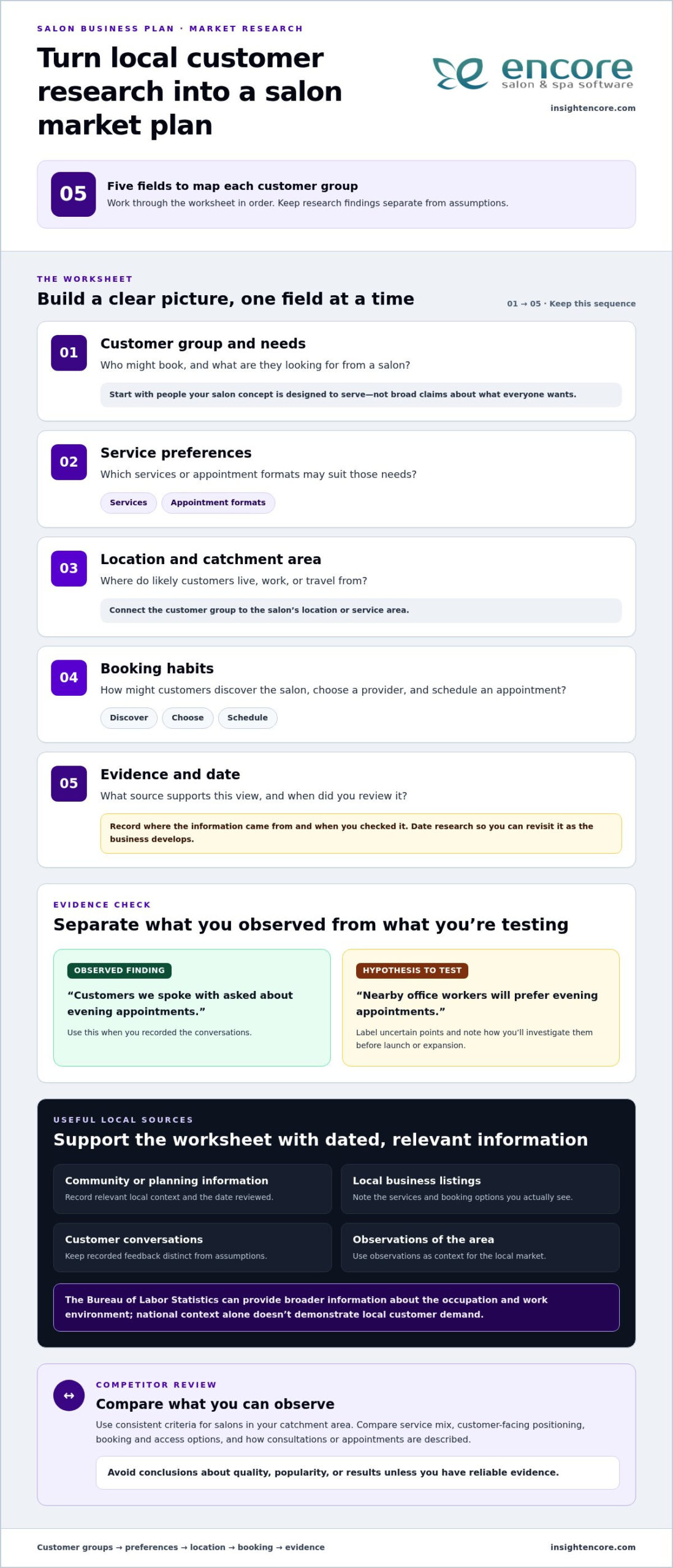
Use this worksheet for each customer group you’re considering. Be specific enough to connect the group to your services and location.

  • Customer group and needs: Who might book, and what are they looking for from a salon?
  • Service preferences: Which services or appointment formats may suit those needs?
  • Location and catchment area: Where do likely customers live, work, or travel from?
  • Booking habits: How might they discover the salon, choose a provider, and schedule an appointment?
  • Evidence and date: What source supports this view, and when did you review it?

For local context, record relevant sources such as dated community or planning information, local business listings, customer conversations, and your observations of the area. When comparing online listings, note the services and booking options you actually see, and when you reviewed them. The Bureau of Labor Statistics can provide broader information about the occupation and work environment, but national context alone doesn’t demonstrate local customer demand.

Separate findings from hypotheses. For example, “customers we spoke with asked about evening appointments” is an observed finding if you recorded those conversations. “Nearby office workers will prefer evening appointments” is a hypothesis to test. Label each statement and note how you’ll investigate uncertain points before launch or expansion.

Compare competitors and clarify your position

Review salons in your catchment area using consistent criteria and information you can observe. Compare their service mix, customer-facing positioning, booking and access options, and the way they describe consultations or appointments. Avoid conclusions about quality, popularity, or results unless you have reliable evidence. The goal isn’t to copy another salon. It’s to understand what clients can already choose and define how your concept will differ.

Summarize your position in one clear customer-facing sentence: “We help [customer group] get [service or experience] through [specific approach].” Keep it grounded in what your salon plans to deliver, not an unsupported claim that it’s the best or only option.

Turn positioning into a focused marketing plan

Choose activities that fit how your intended clients discover and revisit salons. Include how clients will move from finding your business to choosing a service and booking an appointment. For each activity, record an owner, a review date, and a measure, such as inquiries, first-time appointments, referral bookings, repeat visits, or promotion redemptions.

  • Discovery: Keep local listings and service information accurate, and share useful salon content through suitable channels.
  • Referrals: Give satisfied clients a simple way to recommend the salon and track referral bookings.
  • Repeat visits: Plan follow-up and retention activities that suit your services and appointment cycle.
  • Promotions: Set a clear purpose, audience, and review date before offering a promotion.

In your salon business plan template 2026, treat each marketing idea as something to review, not a guaranteed result. Compare activity with the measures you chose, keep what supports your goals, and revise what doesn’t. Encore’s automated marketing, loyalty programs, and gift card management can support the marketing activities you choose to include in your salon’s operations.

Choose Salon Services, Staffing, and Workflows That Fit the Concept

Your service menu shapes more than what clients can book. It affects the people, time, supplies, space, and daily processes your salon needs. Build the menu around your concept and the customer needs you’ve identified, then check that each service fits your staffing and schedule. The Small Business Administration’s business-plan guidance also emphasizes connecting key plan details rather than treating each choice in isolation.

Select a service mix and explain how it supports the salon

Use this comparison worksheet to assess each proposed category. Add a row for each service and note what it requires before including it in your launch menu.

Service category: [Service] | Delivery format: [In-salon, appointment, walk-in, or other] | Staffing approach: [Owner, employee, commission, or renter] | Customer access: [How clients find and book it]

Customer need and concept fit: [Need served and how this service supports the salon’s promise] | Resources and dependencies: [Staff skills, space, equipment, products, or other requirements] | Timing: [Launch priority or possible later addition]

For example, a specialty salon might prioritize a focused set of related services rather than add unrelated options just to make the menu longer. State why each service belongs and what it depends on. If you don’t yet have evidence of demand, label it as an assumption and set a review date. This keeps an early idea from quietly becoming a fixed forecast.

Match staffing and appointment workflows to the business model

Compare staffing approaches based on the experience and operating structure you want, not on a universal “best” model. Employee teams can support shared workflows; commission arrangements connect compensation to service work; booth rental gives independent professionals their own operating arrangement; an owner-operated salon relies heavily on the owner’s available time. Record who handles each task and how the approach fits the planned services. Research jurisdiction-specific requirements separately.

Next, map the customer journey as distinct steps. An appointment-led salon plans capacity around scheduled services; a walk-in model needs a process for arrivals and waiting; a mixed model must account for both. For each service, estimate appointment length and available working hours, and note the assumptions behind each estimate. Review the salon staff utilization rate alongside booking capacity, but don’t treat every open hour as a bookable service hour. Consultations, transitions, and other duties take time too.

  1. Booking: Capture service, timing, and appointment details.
  2. Consultation: Confirm the client’s needs and planned service.
  3. Service delivery: Assign the right staff member and time.
  4. Checkout: Record the transaction and any relevant product sale.
  5. Follow-up: Document the next step, such as a rebooking reminder.

In your salon business plan template 2026, identify an owner for each workflow step and the system that supports it. Online booking, client records, inventory tracking, and point-of-sale tools can form part of the operational plan. Encore provides these tools to support salon workflows. Revisit staffing and capacity assumptions when the menu, schedule, or customer demand changes.

Salon Business Plan Template 2026: Build a Clear, Practical Plan

Use a Salon Financial Plan Template to Connect Assumptions

A financial plan becomes useful when each estimate traces back to an operating choice. Your service mix informs appointment capacity; capacity and booking assumptions inform revenue; and the costs of delivering those services shape cash needs. Treat figures as planning scenarios, not promises. Build cautious, expected, and stronger cases to see how changes in bookings, costs, or timing may affect the plan.

Estimate startup needs and recurring salon expenses

Separate one-time setup costs from ongoing expenses. Research costs for your location and business model, then record a source and date beside every estimate. A note such as “supplier quote, reviewed [date]” makes it easier to revisit an assumption later.

  • One-time setup: premises preparation [estimate, source, date]; equipment [estimate, source, date]; opening supplies and inventory [estimate, source, date]; launch activity [estimate, source, date].
  • Recurring expenses: rent and occupancy [estimate, source, date]; staffing [estimate, source, date]; supplies replenishment [estimate, source, date]; systems and payment costs [estimate, source, date]; ongoing marketing and other operating costs [estimate, source, date].

Separate fixed commitments, such as a regular lease payment, from costs that may change with service volume, such as product use. Use categories that reflect your actual plan rather than an invented industry average. A solo operator and a staffed salon, for example, may have different staffing and premises assumptions. Make sure your estimates match the model you’ve chosen.

Connect service capacity to revenue and cash-flow assumptions

Build the forecast in sequence. First, list services, planned prices, and the time each appointment requires. Then estimate available bookable time after allowing for breaks, administration, and other duties. Apply an expected booking assumption to that capacity, and show how many appointments or services you expect to complete. Keep each input visible. An open appointment slot is not a confirmed booking.

Use this five-step worksheet to connect the figures:

  1. Startup costs: Total one-time setup items and note when payments are expected.
  2. Revenue assumptions: Connect services and planned prices to available capacity and expected bookings.
  3. Operating expenses: List recurring fixed costs and costs that vary with activity.
  4. Cash flow: Map when money is expected to come in and when bills and setup costs are due.
  5. Review: Compare cautious, expected, and stronger cases, then record the source, date, and owner of each key assumption.

Break-even worksheet: Planned costs for the period [ ]; expected revenue per completed service [ ]; estimated services needed to cover planned costs [ ]; assumptions and review date [ ]. Break-even means revenue covers the costs included in your plan. It isn’t a profit target or a guarantee. A salon profit margin checklist can also help you examine how operating choices relate to profitability.

As your salon operates, compare actual bookings, transactions, and expenses with your assumptions. Online booking, client records, inventory tracking, and point-of-sale tools can help organize the activity you review. Encore Salon & Spa Software brings these capabilities together, along with integrated credit card processing. Keep the salon business plan template 2026 adjustable, and update the forecast when services, staffing, or costs change.

Explore Encore for salon operations

Turn Your Salon Business Plan Into a Working 2026 Roadmap

A finished plan is a starting point, not a document to file away. Use it to guide decisions, then update it when the business changes. Before sharing it or acting on it, check that the executive summary matches your customer, service, operations, and financial sections. If the summary promises a service the operating plan doesn’t support, or the forecast relies on bookings your schedule can’t accommodate, resolve the mismatch first.

Review the plan before sharing or acting on it

Run through this checklist to make the plan clear, grounded, and ready to use:

  • Owners: Name who is responsible for each action and assumption.
  • Evidence: Record the source behind important market findings and estimates.
  • Assumptions: Label what you still need to test instead of presenting it as confirmed.
  • Dates: Add when each source was reviewed and when the assumption should be revisited.
  • Next actions: Specify the task, owner, and review date so an idea becomes a practical step.

For each key assumption, keep a short note such as “expected appointment demand, based on [source or reasoning], owned by [person], review by [date].” The salon management software features you choose should also match workflows documented in the plan, rather than being selected without a clear operational need.

Use salon software to support planned workflows

Revisit your plan after a meaningful change, such as adding or removing services, changing staffing, seeing a sustained shift in demand, or adjusting operating priorities. You don’t need to rewrite every section each time. Update the affected assumptions, then check how the change affects capacity, costs, customer access, and financial expectations. Date each revision so you can distinguish the current plan from earlier estimates.

Make sure the systems you use support the daily steps you’ve mapped. Online booking supports appointment scheduling; client management organizes client records; inventory tracking helps you account for products; and point-of-sale tools record checkout transactions. These details matter because the plan is only practical if the workflows behind it can be carried out consistently.

Encore Salon & Spa Software brings together online booking, client management, inventory tracking, and point-of-sale transactions, along with integrated credit card processing, automated marketing, loyalty programs, and gift card management. Match these capabilities to the tasks your salon plans to handle, and document how the tools fit into your workflow. Software can support salon operations, while decisions about your services, team, and customer experience remain part of your plan.

Keep the salon business plan template 2026 as a working reference. Set a recurring review date that suits your business, and revisit it sooner when an important change calls for a fresh look. If Encore’s salon management capabilities fit the workflows you’ve planned, explore how they can support your day-to-day operations.

Put Your Salon Plan Into Motion

Your plan doesn’t need to answer every question before you begin. Choose one assumption to test next, such as which services to prioritize or how clients will book, and give that step an owner and review date. Small, tracked decisions help turn the salon business plan template 2026 into a practical guide you can adjust as you learn.

As you put the plan into action, consider whether your daily systems fit the workflows you’ve mapped. Encore Salon & Spa Software includes online appointment booking and client management, along with inventory tracking, point-of-sale transactions, and integrated credit card processing. These tools support the operational tasks in your plan while your salon’s goals and choices remain your own.

Explore Encore Salon & Spa Software

Start with the next clear step, review what you learn, and let your plan develop alongside your salon. Explore Encore Salon & Spa Software to see how its booking, client management, inventory, and point-of-sale tools can support your planned workflows.

Frequently Asked Questions

Can I use a salon business plan template for a booth-rental or solo stylist business?

Yes. Adapt the template to the business you actually operate. An independent stylist can describe their services, customer base, workspace arrangement, booking process, and business responsibilities, including which tasks they handle themselves. Keep a shared-space or booth-rental arrangement distinct from an employee model, since responsibilities and expenses may differ. Base financial assumptions on the stylist’s own income and costs, not on figures copied from a full-service salon plan.

Do I need a business plan if my salon is already open?

Yes. A plan can help an operating salon clarify priorities, assess a new service, consider a staffing change, or prepare for growth. Start with current information rather than treating launch estimates as permanent. Before adding a service, for example, compare the idea with your current schedule, customer feedback, and available resources. Note what has changed, then update the sections that will help you make the decision.

How long should a salon business plan be?

There’s no single required length for every use. A working plan should explain your salon concept, customers, operations, and financial assumptions clearly without becoming difficult to review. Focus on useful detail, not page count. If you’re preparing the plan for a lender, landlord, or another audience, tailor its depth and supporting documents to that audience’s stated requirements. A concise plan can still be thorough when its evidence and assumptions are clear.

Can a salon business plan guarantee a loan or business success?

No. A plan can organize your salon concept, show how your assumptions connect, and communicate the preparation behind your decisions, but it can’t guarantee financing or business results. Decisions depend on factors beyond the document, and projections are estimates rather than promises. Use available evidence, be clear about uncertainty, and revise estimates as operating information becomes available. Treat the plan as a decision-making tool, not a certain prediction of what will happen.

How often should I update my salon business plan?

Review it on a regular schedule and whenever a meaningful change affects the business. A new service mix, staffing arrangement, location, or shift in customer demand may change the assumptions behind your plan. You don’t need to rewrite every section each time. Check which details no longer reflect current conditions, record the important changes, and assign someone to complete the next review by a specific date.

What financial information should I gather before completing a salon plan?

Gather the information that supports your estimates, including proposed services and prices, expected appointment capacity, startup needs, recurring expenses, and available cash-flow information. The details you need depend on your salon’s stage and location, so research local costs instead of relying on generic figures. If you don’t yet have exact numbers, label estimates clearly, note how you arrived at them, and revisit them before making commitments.

Is a salon business plan template useful when I am still researching my idea?

Yes. A salon business plan template 2026 can help you identify what you still need to learn before settling on a concept or committing resources. Use it to keep open questions, research sources, and assumptions together, rather than treating early guesses as established facts. For example, record what you need to find out about potential customers or workspace options, then update those sections as your research develops.

Disclaimer

This article is general in nature and may contain errors, please verify all claims with your sales rep

Categories
Uncategorized

Barbershop Performance Dashboard: Metrics That Drive Better Decisions in 2026

What if a full appointment book is masking your barbershop’s biggest opportunity? A packed Saturday can look like success, but it won’t tell you whether clients are returning, chairs are being used consistently, or each visit is supporting healthy revenue. A barbershop performance dashboard brings those signals into view when you focus on the right measures and interpret them together.

If booking, client, sales, and inventory information lives in separate places, it’s easy to miss patterns or react to a single number without context. You don’t need to track everything. You need a focused set of indicators that answers practical questions about your shop. Connected tools for booking, client management, transactions, and inventory can give you a broader view of daily operations.

This guide covers which revenue, client, and operational metrics deserve attention, how to interpret changes against your shop’s schedule and goals, and how to turn what you learn into practical next steps. You’ll also find a repeatable review routine to make performance data useful in everyday decisions, not just another report to glance at.

Key Takeaways

  • Build a barbershop performance dashboard around decisions you need to make, not numbers that look impressive but offer no clear next step.
  • Organize measures across revenue, appointments, client relationships, and inventory to spot where closer attention may help.
  • Read results against comparable periods and changes in your schedule or service mix before deciding what they mean.
  • Use a steady review routine to turn patterns into a small number of practical actions and follow up on what changes.
  • Connect booking, client records, sales, and inventory tools to create a clearer view of daily operations.

What a Barbershop Performance Dashboard Should Help You See

Bookings may sit in one place, sales in another, and client or inventory details somewhere else. When you’re piecing together the shop’s performance between appointments, scattered figures can be frustrating. A barbershop performance dashboard is a focused view of selected business measures that helps you understand what’s happening and decide what to do next. It’s not a wall of numbers. It’s a way to connect daily activity to decisions you can influence.

Think of a dashboard as the shop’s operating picture. Booking records can show demand and gaps in the schedule. Completed services and sales transactions show what actually happened, while client records can reveal whether guests are returning. Inventory records add context by showing which products are moving and which may need attention. Together, these sources can help explain a change that a single figure can’t.

The goal is to track useful signals, not every available count. A large social following or a high number of appointments booked might look impressive, but neither tells you whether those bookings are completed or clients come back. Give a measure space on your dashboard when it answers a real business question and points toward an action.

Which daily questions should the dashboard answer?

Start with questions that connect shop activity to choices you can make. For demand, ask whether upcoming bookings are filling the hours and days you want to staff. If certain periods are consistently quiet, you might adjust scheduling or consider a targeted promotion. For completed services, compare appointments on the book with visits completed. A gap may prompt you to review cancellations, reminders, or the time set aside between services.

For sales activity, look at what guests purchased alongside their services. If service sales are steady but retail activity changes, explore product visibility or staff recommendations before changing your inventory. For returning clients, review whether guests book their next visit or come back over time. That pattern can help you decide where follow-up or rebooking conversations deserve more attention.

Keep the time frame in mind. One unusually busy day may reflect a holiday, a local event, or a schedule change. One quiet day may be just that, one day. Treat it as context to investigate, not proof of a lasting trend. Look for a pattern across comparable periods before making a bigger change.

Dashboard, report, and KPI: what is the difference?

A report gives you detailed records to examine, such as individual transactions or appointment histories. A dashboard presents a concise overview of selected measures, making it easier to notice what deserves a closer look. A business dashboard can be organized in different ways, but its purpose is to make important information easier to monitor and use.

A KPI, or key performance indicator, is a measure tied to an important business objective, such as improving repeat visits. A raw operational count records activity; a KPI shows whether that activity is helping meet a goal. A count tells you what happened; a KPI helps you judge whether it moved the business toward an objective. That distinction keeps your dashboard focused on decisions, not just data.

Which Barbershop Performance Metrics Belong on Your Dashboard?

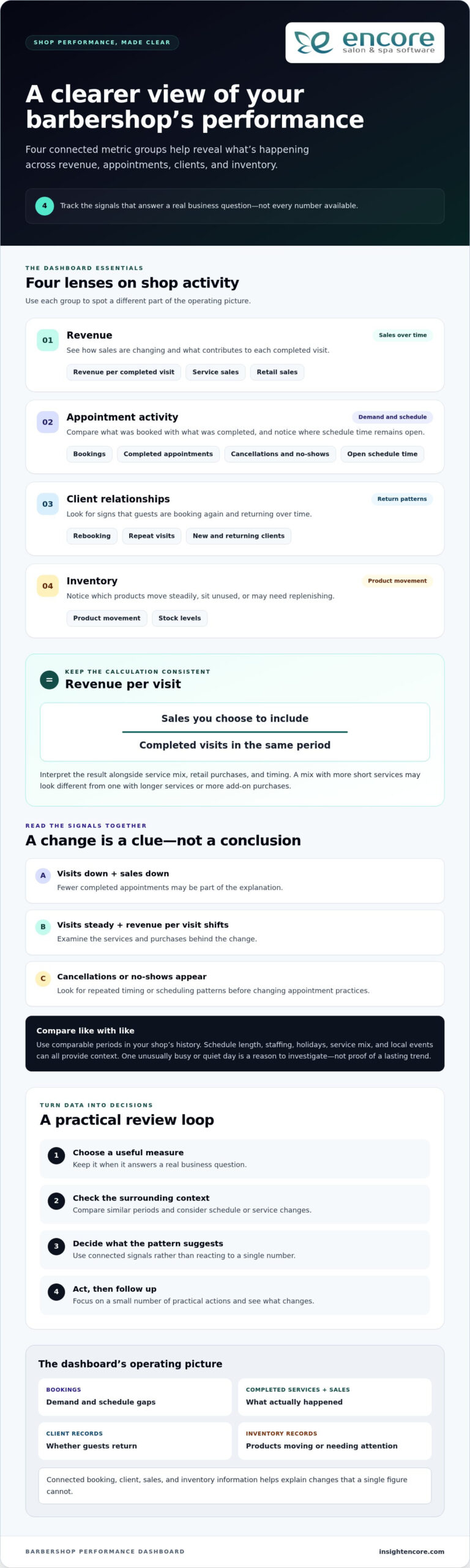
A useful barbershop performance dashboard gives you a balanced view, not a crowded collection of numbers. Choose a small group of measures across revenue, appointment activity, client relationships, and inventory. For each one, know what question it answers and what decision it might inform. A metric without a clear purpose adds noise instead of helping you manage the shop.

  • Revenue: Track sales over time, revenue per completed visit, and the mix of service and retail sales.
  • Appointment activity: Review bookings, completed appointments, cancellations, no-shows, and open time in the schedule.
  • Client relationships: Watch rebooking and repeat-visit patterns, including how new and returning clients contribute to activity.
  • Inventory: Look at product movement and stock levels to notice items that sell steadily, sit unused, or may need replenishing.

Revenue and appointment indicators to interpret together

Revenue per visit can show whether the value generated by each completed appointment is changing. Calculate it consistently by dividing the sales you choose to include by completed visits for the same period. Then interpret the result alongside service mix, retail purchases, and timing. A period with more short services may produce a different average than one with longer services or more add-on purchases. Keep the calculation consistent so comparisons remain meaningful.

Pair the revenue figure with appointment activity. If completed visits fall and sales fall with them, fewer appointments may be part of the explanation. If visits stay steady but revenue per visit shifts, examine the services and purchases behind the change. Compare similar days or periods in your own shop’s history rather than applying a universal target. Schedule length, staffing, holidays, and changes in the services offered can all affect the result.

Cancellation patterns need the same care. Review cancellations and no-shows in relation to bookings, and look for repeated timing or scheduling patterns before changing policies or appointment practices. One cancellation is an event; a recurring pattern is a reason to investigate.

Client and inventory signals that reveal patterns

Rebooking and repeat visits help you understand whether clients are returning and how consistently they do so. A change may relate to service timing, availability, or the way the next appointment is offered. Use client records to explore the pattern, then choose a practical response, such as making rebooking part of checkout conversations. Keep staff utilization distinct from shop-wide appointment measures: the former focuses on an individual barber’s working time, while the latter looks across the shop’s schedule and capacity. For a closer look at the staff measure, see this barbershop staff utilization guide.

Inventory movement adds context to sales. If a product’s sales change, consider whether client demand shifted, purchasing changed, or the item was unavailable when guests wanted it. Compare sales activity with inventory records before adjusting orders. No single measure explains the whole story. Together, these signals help you decide what deserves a closer look and what action is worth testing.

How to Read Dashboard Results Without Misleading Yourself

A dashboard shows what changed, but it can’t explain the cause on its own. Read each measure in context before adjusting prices, staffing, or promotions. Upcoming bookings are a leading indicator: they offer a view of demand that may turn into future work. Completed appointments and sales are lagging results: they show what has already happened. Comparing the two can help you see whether a shift in bookings is showing up in completed business, but allow enough time for the results to develop.

Compare like with like before drawing conclusions

Choose comparable periods, such as the same weekdays across two time windows, rather than comparing a full week with a partial one. Check whether opening hours, staffing, available services, or local events changed. A holiday week may follow a different pattern from a regular week, and a new service mix can shift average sales without indicating a problem. Be cautious with small samples. A single comparison can point to a question, but it rarely proves what caused the change.

Turn a metric change into a useful question

Suppose completed sales are lower than in the prior comparison period. The cause could be fewer appointments, more cancellations, shorter hours, a different mix of services, or a change in retail purchases. Each explanation suggests a different follow-up. Check booking records, completed appointments, and transaction details before deciding whether to change a schedule, price, or promotion.

A metric is a clue to investigate, not a diagnosis of what’s wrong. Use a change to guide your next question, then look for supporting evidence. Connected booking, client, point-of-sale, and inventory records make that review more grounded. Encore’s software features include tools across these operational areas, helping shops keep relevant information connected to daily work.

Signal Possible explanations Follow-up question
Upcoming bookings are down Fewer repeat bookings, reduced availability, seasonal demand, or a shorter booking window Are comparable days and booking lead times also lower?
Completed visits are steady, but sales have shifted Different service mix, changes in add-on purchases, or altered transaction patterns Which services or items account for the change?
Cancellations have increased A particular day, time, service, or booking pattern may be contributing Do appointment records show a recurring pattern or just a brief fluctuation?
Product sales have changed Shifting guest demand, purchase timing, or product availability Do inventory records support the same pattern?

For a barbershop performance dashboard to support sound decisions, keep the comparison method consistent and note important changes alongside the figures. If the signal persists and related records point in the same direction, you have a stronger basis for action. If they don’t, keep observing rather than making a costly change based on one reading.

Barbershop Performance Dashboard: Metrics That Drive Better Decisions in 2026

Build a Simple Barbershop Dashboard Review Routine

A barbershop performance dashboard becomes useful when you review it consistently and connect what you see to a next step. Keep the process light enough to fit around the work of running the shop. You don’t need a long meeting or a complicated scorecard. A focused check-in, consistent definitions, and a clear record of follow-up can turn scattered figures into a routine you can maintain.

Start with a small, decision-focused scorecard

Choose measures that match your current priorities, such as filling appointment gaps, understanding repeat visits, or reviewing retail movement. For every measure, write down its definition, where its information comes from, and the period you’ll review. This prevents the same label from being calculated differently each time. Add one sentence about the decision it supports, such as, “This measure helps us decide whether to adjust coverage during quiet appointment periods.”

Then follow a repeatable sequence:

  1. Choose the question. Name the operating issue you want to understand before opening the figures.
  2. Select the measures. Use only the indicators that help answer that question, and keep their definitions consistent.
  3. Review the pattern. Compare the chosen period with a relevant prior period, noting changes in hours, staffing, or services.
  4. Record an action. Decide whether to investigate further, try a practical adjustment, or keep watching the trend.

Move from review to action and follow-up

Close each review with a brief note: what you observed, what you’ll do next, who owns the action, and when you’ll revisit it. For example, if appointment gaps appear repeatedly during a particular time, review staffing coverage or booking availability. Assign one person to follow through, even if that person is the owner. Clear responsibility helps turn a useful observation into a completed task.

Pick a cadence that fits your operating rhythm. A short weekly check can help you notice near-term changes in bookings or cancellations, while a monthly review gives you more room to assess repeat visits, sales patterns, and inventory movement. These are starting points, not fixed rules. If a measure changes slowly, review it over a longer period; if it affects daily scheduling, a more frequent glance may make sense.

At the next check-in, ask whether the action changed the pattern you were watching. If it did, decide whether to continue or make the adjustment part of normal operations. If it didn’t, revisit your assumption before repeating the same step. Avoid adding another metric simply because it’s available. Add one only when it answers a real operating question or helps you make a decision with more confidence.

Explore Encore Barber Software

Use Barbershop Management Software to Connect the Operating Picture

A useful review depends on having relevant operating information available when you need it. If appointments, client details, sales, and inventory are recorded in separate places, it can take extra effort to understand how one part of the shop relates to another. Barbershop management software can bring these everyday activities into one platform, giving you a more organized foundation for reviewing how the business is operating.

Connect everyday records to better-informed decisions

Booking records help you examine appointment activity, such as how the schedule fills and which periods have open time. Client management records add context about guest history and return visits. Consider them together: booking activity shows what’s planned, while client records can help you understand who is coming back and how often.

Point-of-sale transactions provide a record of completed sales. Inventory records add information about product movement. Looking at both can help you ask useful questions: Did product sales change along with inventory movement? Are there items that appear to be moving differently than expected? The records don’t make the decision for you, but they give you relevant details to investigate before changing purchasing or sales practices.

These connections matter when you’re reviewing a barbershop performance dashboard. Encore’s barber shop software brings together tools for online booking, client management, point-of-sale transactions, and inventory tracking. Having these management activities in one platform helps organize information you can use to review daily operations and investigate performance changes.

Choose tools that fit the way your barbershop operates

Start with the work your shop needs to manage. Consider how you handle booking, client information, transactions, and inventory today. Then assess whether a software platform supports those workflows and makes the information easier to keep organized and review. Bringing relevant management activities together can reduce the need to piece together the operating picture from unrelated records.

The right setup should support your real routine, not add complexity for its own sake. A shop focused on appointment flow may start by keeping booking activity organized; another may prioritize client records or product tracking. Define what information you need to review and how it will support a decision. Then use the same definitions and review periods over time so comparisons remain useful.

Software is one part of effective operations. Staff communication, service standards, and clear day-to-day processes matter too. For practical ideas beyond the numbers, explore this barbershop management tips guide. Together, consistent operating practices and organized records can make it easier to spot questions worth investigating.

If you’re ready to bring booking, client management, sales, and inventory activities into a more organized workflow, take a look at Encore’s barber shop software.

Explore Encore Barber Software

Make Your Next Review a Step Toward Better Decisions

Your next step doesn’t need to be a major overhaul. Choose one operating question you want to answer, decide which figures can help, and note one action to test. A barbershop performance dashboard becomes more useful as that simple habit helps you learn what deserves attention and what can wait. Keep the process grounded in your shop’s goals, and let the evidence guide the next adjustment.

Encore has supported salon and barber shop businesses since 1991, with specialized software for barber shops. If you’re ready to explore management tools that can support your shop’s day-to-day work, take a look at Encore as a practical next step.

Try Encore for your barbershop

Keep asking clear questions, reviewing what changes, and building on what you learn. Your next decision can start with one useful signal.

Frequently Asked Questions

What is a barbershop performance dashboard?

A barbershop performance dashboard is a compact way to keep important business measures visible so you can decide what deserves attention. For example, an owner preparing for a staffing discussion might look at upcoming appointment demand alongside recent completed visits. The dashboard doesn’t explain every change by itself. Its value is helping you identify a useful question, then find the records or context needed to investigate it.

Which KPIs should a barbershop track?

Track the measures that help you manage a current priority. If you’re trying to understand quiet appointment periods, you might review bookings and completed visits for those time slots. If you’re focused on repeat business, consider rebooking or return-visit measures. Define each measure the same way every time, and compare it with your shop’s own history. A figure is more useful when you know what decision it can inform.

How often should a barbershop owner review performance metrics?

Choose a review rhythm you can maintain and match it to the decision at hand. A quick weekly look may help you notice upcoming schedule gaps, while a longer comparison can be more helpful for assessing a gradual change in client visits. Avoid changing the review window from one check-in to the next. Keep a short note of what you observed and what you plan to revisit, so each review builds on the last.

Can barbershop software help track business performance?

Yes. Barbershop software can organize records that support performance reviews, including online bookings, client information, point-of-sale transactions, and inventory activity. Encore offers specialized software for barber shops with these management tools. Use the records to examine specific questions, such as whether a scheduling change coincides with a shift in completed appointments. Software can help organize business information, but you still need context to interpret what a change means.

What should I do if my barbershop metrics suddenly change?

First check that you’re comparing the same type of period and using the same calculation. Then look for a practical explanation in the records. If sales shift, for example, check whether the number of completed appointments or the mix of services also changed. Note what you find and choose a proportionate next step, such as watching the pattern for another review period. One unexpected result is a reason to investigate, not automatically to overhaul your process.

How much does a barbershop performance dashboard cost?

There isn’t one cost that applies to every dashboard or software setup. The amount depends on the solution and the tools your barbershop chooses. Consider which activities you need to manage, what’s included in the option you’re evaluating, and whether it suits your shop’s workflow. Compare pricing information for the options you’re considering with the needs you’ve identified.

Is a performance dashboard useful for a one-chair barbershop?

Yes, if it helps you make a practical decision without creating unnecessary admin. A solo barber might use a small scorecard to understand which appointment periods are hardest to fill or whether clients are booking their next visit. Start with information you already record during daily work. If a measure doesn’t lead to a useful question or action, leave it off. A simple review habit can be more manageable than a complicated tracking system.

Disclaimer

This article is general in nature and may contain errors, please verify all claims with your sales rep
Categories
Uncategorized

Reducing Client Wait Times in a Salon: A Practical 2026 Guide

Asking your team to move faster is one of the quickest ways to make a busy salon feel more stressful. Reducing client wait times in a salon starts with fixing the appointment flow, not rushing the service. When clients arrive on time but still wait, and small delays ripple through the day, the problem often lies in the handoffs and scheduling around each appointment.

You shouldn’t have to choose between keeping the day on track and giving every client the attention they deserve. A calmer schedule begins with understanding where waiting starts, whether it’s an unrealistic service duration, a slow transition, or a booking pattern that leaves too little breathing room. Once you can see the bottleneck, you can choose a practical fix that fits your services and staffing.

This guide will help you spot common sources of avoidable waiting, make changes without overloading your team, and keep clients informed and welcomed when delays happen. We’ll also look at how online booking and client management tools can support a more organized appointment flow, while recognizing that smooth service still depends on thoughtful day-to-day workflows.

Key Takeaways

  • Define the wait clearly by comparing each appointment’s scheduled start with when service actually begins.
  • Track delays by service, day, time, and handoff to uncover patterns instead of guessing at the cause.
  • Compare schedule buffers, service-time estimates, staffing coordination, and client communication to find a fix that suits your salon.
  • Make reducing client wait times in a salon manageable by testing one workflow change at a time and assigning clear responsibilities.
  • Use online booking and client management tools to support an organized flow, while keeping staffing and service routines in view.

Reducing client wait times in a salon starts with finding where delays begin

A late start can unsettle a client who planned their day around an appointment, put pressure on the stylist, and push the next booking off schedule. But “the salon is running behind” doesn’t explain where the delay began. Before changing the schedule or asking anyone to work faster, trace what happened from the client’s expected start time to the moment service actually began.

Salon wait time is the gap between a client’s expected service start and the actual start. It’s an operational signal that shows where appointment flow needs attention. To understand that signal, separate the wait into stages: before check-in, after arrival, between service handoffs, and at checkout. A client may be welcomed promptly but wait for a consultation, or finish their service on time but spend longer than expected settling the bill. Each points to a different part of the day.

Record what the client is waiting for, not just how late the appointment is. A delayed start might come from the previous service running long, a stylist needing consultation time, or a transition that depends on another team member. That distinction helps you focus on the process instead of treating every delay as a performance problem.

Which salon waits frustrate clients most?

A waiting-room delay and a late service start can feel different. A client may arrive at the scheduled time and see their stylist still finishing with someone else, or they may be checked in promptly but wait before the consultation begins. Uncertainty can make either pause feel longer, especially if the client doesn’t know what’s happening. Track check-in, consultation, processing, and checkout separately to see where time is spent and where a simple explanation could improve the experience.

What causes appointment delays to snowball?

One service that takes longer than planned can shift the next appointment, then the one after it. The cause might be a complex service, a late arrival, a walk-in added to an already full schedule, or a handoff that relies on a shared chair or team member. Delays can also reflect normal differences in service needs, not poor staff performance. Look for recurring patterns before deciding what to change.

It can help to think of the salon as a series of connected arrivals and services. Queueing Theory studies how waiting lines form, offering a useful way to consider how appointment timing and available staff interact. You don’t need a mathematical model to begin: note when each wait occurs, what was happening just before it, and whether later appointments were affected. That gives you a clearer starting point for reducing client wait times in a salon without rushing the work clients came in for.

Measure salon wait times to pinpoint the real bottleneck

Once you know where a client’s wait occurs, record it consistently. Start with three timestamps for each appointment: the scheduled service start, the actual service start, and service completion. Together, they show whether the issue is a late start, a service running long, or both.

Scheduled start, actual start, and service completion reveal whether a salon bottleneck begins before service, during the appointment, or at a transition. Keep the measures distinct. Scheduled-to-actual start time shows how late the service begins, while arrival-to-service-start time shows how long the client waits after reaching the salon. If a client arrives early or late, that context helps you interpret both figures fairly.

Which wait-time measures should a salon track?

Alongside those timestamps, count how often services begin late, not just the average delay. An average can look manageable even if the same service or time slot repeatedly starts behind. Note the service type, day, time, and relevant handoff, such as waiting for a consultation or a shared station. Keep the record focused on operations by avoiding unnecessary personal information.

A simple log can include:

  • Scheduled start, client arrival, actual start, and completion time.
  • Service category and the day or time slot.
  • Whether the appointment started late and the operational reason, if known.

Keep the definitions consistent across the team. For example, decide whether “actual start” means the consultation begins or the hands-on service begins, then use that same point every time. Otherwise, two staff members may record different events and make the results difficult to compare.

How can managers interpret the patterns?

Look for repeated peaks, not conclusions based on one unusual day. Compare similar services and shifts, since a complex appointment and a quick trim may involve different steps. If late starts cluster around a particular handoff or time slot, investigate that part of the workflow before changing the whole schedule. Comparing these patterns with your salon staff utilization rate can also help you understand how staff capacity lines up with demand.

Choose an observation window that covers the salon’s normal range of days, shifts, and services. A few weeks can be a useful starting point, but extend the tracking if the period misses a busy day or includes an unusual disruption. The goal is a representative picture, not a perfect dataset. Record the same measures throughout, and avoid changing several scheduling practices while you’re building the baseline.

Then summarize the results by service type, day, time, and handoff. A high average delay may point to a broad scheduling mismatch; frequent small delays in one slot may call for a more targeted adjustment. This gives you evidence to guide the next step in reducing client wait times in a salon, rather than asking the team to move faster without knowing what’s causing the wait.

Compare salon wait-time fixes before changing the schedule

Once you’ve identified where delays recur, match the solution to the cause. Adding time everywhere may protect the schedule, but it can also leave avoidable gaps. Packing appointments closer together may appear efficient, yet even small variations in service time can quickly push later clients behind. Choose a targeted adjustment that supports quality service and fits the way your salon works.

Consider the effort and trade-off of each option:

  • Schedule buffers: Add breathing room around services that regularly run over or need a more involved transition. This is simple to test, but broad buffers may create unused time.
  • Service-duration estimates: Review the time allowed for different services against observed durations. Updating estimates can improve the fit, though the team may need to revisit them as service needs vary.
  • Staffing coordination: Clarify who handles consultations, shared stations, or other handoffs during busy periods. This can address workflow gaps, but requires clear team communication.
  • Client communication: Set realistic expectations about appointment timing and explain delays promptly. This won’t remove the underlying bottleneck, but it can reduce uncertainty while the salon addresses it.

When do buffers and appointment-duration changes help?

Use your recorded service times to identify where a modest allowance may help, rather than adding the same buffer to every booking. A complex consultation or a transition between services may need different time from the hands-on appointment itself. The trade-off is capacity: protect time where variation is real, but avoid turning the entire schedule into idle space.

If a service routinely takes longer than its booking duration, update the estimate and observe what changes. If only certain appointments run over, consider whether consultation needs, finishing steps, or preparation explain the difference. More accurate durations can help clients select a suitable slot and give staff a schedule that better reflects the work. Avoid shortening estimates just to fit more appointments; tighter scheduling can magnify the effect of normal variation.

How should a salon balance walk-ins and booked appointments?

Walk-ins can serve clients who want flexibility, but accepting them when staff are fully committed may delay people with bookings. A designated walk-in period or capacity can make demand easier to manage, while protecting booked slots prioritizes appointments already on the schedule. Either approach needs a clear boundary so the team can make consistent decisions.

Set expectations honestly. If a walk-in can’t begin right away, explain that timing depends on service availability rather than promising immediate attention. Online booking can help clients choose from available appointment times instead of relying on a call or arriving without a slot. A clear salon client booking portal can support that choice, but it won’t resolve staffing or service-flow issues on its own.

There’s no single fix for reducing client wait times in a salon. Compare the likely benefit, effort, and trade-off, then test the option that best matches the delay pattern you observed.

Reducing Client Wait Times in a Salon: A Practical 2026 Guide

Reduce salon waiting with a practical workflow improvement plan

A useful improvement plan doesn’t need a major schedule overhaul. Start with a recurring bottleneck you’ve observed, make one focused change, and review what happens. Keeping the test small helps you see whether the change addressed the cause or simply moved the delay somewhere else.

Choose one bottleneck, test one change, and compare the same measures before and after. Your team can adapt this sequence to the salon’s services and staffing:

  1. Choose the pattern. Select a recurring issue, such as a certain appointment type regularly starting late or a specific handoff slowing down the next service.
  2. Assign ownership. Decide who greets and checks in clients, who updates the schedule when timing changes, and who coordinates service transitions. Clear roles reduce confusion during busy periods.
  3. Test one adjustment. For example, revise the time allowed for a service that often runs over, or give one team member responsibility for communicating schedule changes.
  4. Review the results. Compare the same start-time and completion measures you used for your baseline. Keep, adjust, or reverse the change based on what the records show and what staff experience.

This gives everyone a shared action sequence: spot the pattern, name an owner, try one change, and review the evidence. It keeps the focus on improving the flow rather than asking the team to rush through services or absorb a poorly planned schedule.

How can a salon test a schedule change?

Use the delay pattern from your observations to choose a change that addresses its likely cause. If a particular service repeatedly overruns, adjust its scheduled duration rather than adding time to every appointment. Keep other practices steady during the trial, then compare the same measures from similar services, days, and shifts. If the pattern doesn’t improve, revisit the cause before expanding the change.

What should staff say when a client is waiting?

Acknowledge the delay promptly, apologize for the wait, and share a realistic update if the team has one. If timing is still uncertain, say so rather than guessing at a new start time. For example: “I’m sorry we’re running behind. We’re checking the schedule and will update you as soon as we have a clearer estimate.” A warm, direct message helps clients feel seen without promising a time the team can’t meet.

Agree on who gives updates and how schedule changes reach the rest of the team. The person at check-in may not know what’s happening in the service area, so establish a simple handoff for sharing current timing. Consistency matters: clients should receive a clear update, not conflicting estimates from different staff members. Small communication habits can make an unavoidable delay feel more considered while the team works on its underlying cause.

With a repeatable test and clear ownership, reducing client wait times in a salon becomes a practical workflow effort, not a demand to work faster.

Explore Encore salon software

Use salon software to support a more organized client flow

Once you’ve identified which parts of the day create friction, consider whether software could simplify the administrative work around appointments. Online booking can present available appointment times so clients can choose a suitable slot without relying on staff to coordinate every booking manually. That can make appointment selection more organized, but it won’t fix a schedule that underestimates service time or lacks enough capacity.

Software supports the flow. Your service timings, staffing decisions, and communication practices still shape the client experience. If an appointment routinely takes longer than its scheduled slot, a booking tool won’t create the missing time. Likewise, a system can help organize information and transactions, but staff still need clear responsibilities for service transitions and updates when the day runs behind.

Which software capabilities can support appointment flow?

Think about the practical steps in a client visit. Online appointment booking lets clients select from the availability you present. Client management helps staff access client records as they prepare for scheduled visits. Point-of-sale tools support transactions at checkout, making this part of the visit easier to organize. Together, these capabilities can support the appointment journey without replacing the team’s day-to-day workflow.

Encore salon software brings online booking, client management, point-of-sale transactions, and integrated credit card processing together. Match each capability to a specific friction point. If the team spends time coordinating appointment requests, online booking may help. If staff need a more organized way to manage client information, client management can support their preparation. If checkout adds friction, point-of-sale transactions and integrated credit card processing can help organize that part of the visit.

Keep schedule design and client communication in your improvement plan. These tools support booking, client information, and transactions, while your team remains responsible for service timing, capacity, and the flow between appointments.

How can a salon decide whether to explore software?

Start with the recurring administrative task that takes time or creates confusion, then define what a better process would look like. For example, your goal might be to let clients select from available appointment times online or make client records easier for staff to access when preparing for visits. A clear goal makes it easier to assess whether a software change matches the salon’s needs.

Next, connect the capability to the workflow. Identify who will use it, which step it supports, and what still requires a staff decision. Then review whether the process feels more organized without assuming that software alone will reduce delays. This keeps the focus on a practical fit, not on adding technology for its own sake.

Reducing client wait times in a salon takes realistic service timing, appropriate capacity, and consistent communication. Software can support those efforts by organizing booking, client information, and checkout, while your team remains responsible for the service flow.

Explore Encore salon software

Build a calmer appointment day, one step at a time

Better appointment flow doesn’t require a perfect schedule from day one. Choose one recurring delay to address, make a focused adjustment, and give your team a clear way to keep clients informed. Small, thoughtful changes can help create a visit that feels more welcoming for clients and more manageable for staff, without rushing the service.

If administrative friction is part of the problem, Encore brings online booking, client management, and point-of-sale transactions together to support an organized client journey. Encore’s parent company, Syntec Business Systems, was founded in 1991. These tools can support your process, while your team’s service timing and communication remain essential to reducing client wait times in a salon.

Keep learning from each appointment, and build a salon flow that gives both your clients and your team room to feel at ease.

Try Encore salon software

Frequently Asked Questions

How can I reduce client wait times in a salon?

Start by identifying the point where appointments most often lose time, then make one manageable change. For example, if consultations frequently delay hands-on work, decide who will conduct them and how that time fits into the booking. Tell the team what to watch during the trial, such as whether later appointments still start behind. This keeps reducing client wait times in a salon focused on a fix the team can observe and maintain.

What is an acceptable wait time at a salon?

There’s no universal wait-time limit that suits every salon, service, or client. Set expectations around the appointment experience your salon can reliably provide, then pay attention to whether clients understand what’s happening if the schedule shifts. A brief wait with a clear explanation may feel different from an unexplained delay. Review client feedback alongside appointment records, and use recurring concerns to refine your service standards rather than relying on one fixed number of minutes.

Can appointment scheduling software reduce salon wait times?

It can help organize appointment selection when it offers online booking, but it can’t correct every source of delay. For instance, online availability may reduce back-and-forth booking coordination, while an appointment duration that doesn’t match the service can still throw off the day. Identify the administrative task causing friction before changing tools. Then decide what success should look like, such as fewer manual booking exchanges, while separately addressing staffing, timing, and service handoffs.

How do salons prevent appointments from running late?

Salons can reduce avoidable overruns by matching booking details to the service planned and preparing for known steps before the client arrives. If a booking may involve an add-on or a more involved consultation, clarify the plan early so the appointment isn’t unexpectedly extended. Keep transitions clear, too: the next team member should know when their part begins. Preserve realistic service time, because squeezing appointments together can spread one overrun across the schedule.

Should a salon leave buffer time between appointments?

Use buffers where your schedule shows a specific need, rather than inserting the same gap after every service. A consultation-heavy appointment or a transition that requires resetting a station may benefit from added flexibility. But widespread gaps can limit appointment availability without addressing the actual cause of delays. Try a targeted allowance on the relevant service or time slot, then compare how the day flows before deciding whether to keep or adjust it.

How should a salon handle a client who is waiting?

Acknowledge the wait directly and let the client know what you can say with confidence. For example: “I’m sorry for the delay. We’re checking the timing and will update you when we have a clearer estimate.” Don’t offer a start time just to reassure them if you’re unsure. If the estimate changes, share another update rather than leaving the client to ask. A respectful tone and consistent information help maintain trust during an imperfect day.

Do walk-ins increase wait times for salon clients with appointments?

They can, particularly if a walk-in takes a stylist or station already needed for a booked service. The effect depends on the service requested and the capacity available at that moment. Set a clear rule for accepting walk-ins, such as only offering them when they fit without displacing booked appointments. Explain that availability depends on the day’s schedule, and give walk-in clients a realistic expectation rather than implying they can be seen immediately.

Disclaimer

This article is general in nature and may contain errors, please verify all claims with your sales rep

Categories
Uncategorized

Salon Owner Dashboard App: A 2026 Buying Guide

What makes the best salon owner dashboard app useful isn’t the number of charts. It’s whether the information helps you decide what to do next. When bookings, client details, inventory, and sales sit in separate tools, it’s harder to get a clear picture of the day. A long feature list doesn’t make the right choice any clearer.

Look beyond booking. A helpful system should make relevant business activity easier to review and connect that visibility with the work you need to manage. To compare options, start with the decisions you make regularly, then identify what information would help you make them. This keeps you focused on what your salon needs, rather than features you may never use.

This guide explains which business information is worth reviewing, how to compare dashboard capabilities, and how to assess whether software fits your daily workflow. We’ll look at booking, client management, inventory, point of sale, and marketing as parts of salon operations. Encore brings these capabilities together for beauty and wellness businesses, so you can evaluate the platform against the way your salon runs, not just its dashboard label.

Key Takeaways

  • Distinguish between reviewing information on a dashboard and the operational tools that record appointments, sales, and client activity.
  • Focus on business signals that help answer real management questions across appointments, clients, sales, inventory, and marketing.
  • Compare each salon owner dashboard app by workflow fit, usability, relevant capabilities, and how it handles everyday salon needs.
  • Test common tasks with the people who will use the system instead of judging it by dashboard design alone.
  • Assess how Encore’s booking, client management, inventory, and point-of-sale capabilities fit your salon’s daily workflow.

What should a salon owner dashboard app help you see?

A dashboard is a place to review selected business information and use it to guide decisions. It can bring key signals into view, but the charts aren’t the business itself. Appointments, sales, client activity, and stock information first need to be recorded in the underlying software. They’re useful only when those records are accurate and relevant to the questions you’re trying to answer.

A dashboard is the review surface; salon management software is the operational system that records and supports the work behind what you see. That distinction matters when comparing tools. A polished display can look helpful, but it won’t tell you much if the information behind it is incomplete or disconnected from your daily processes.

Which salon decisions can a dashboard support?

Start with decisions you make repeatedly, then identify the business activity that could inform them. Appointment information, for example, can help you review the day’s schedule and consider whether available time is being used as intended. A useful signal prompts a next question, such as whether the schedule needs attention, rather than encouraging you to react to every change.

Client and inventory information can support other kinds of planning. A client record can help staff review service history before a return visit or plan follow-up. Stock information can help you spot items that need attention before they interrupt routine work. Customer appointment management software covers core functions such as booking and scheduling, which are part of the operational information a salon may want to review.

  • Appointments: What does the schedule suggest about daily capacity and workflow?
  • Clients: What service history or follow-up details are useful for the next interaction?
  • Inventory: Which stock decisions need attention to keep routine services moving?

These are prompts, not a universal scorecard. A solo stylist, a multi-staff salon, and a spa may need different information to make sound decisions. Focus on what you’ll do with a signal, not how attractive it looks as a chart.

Dashboard app or salon management platform: what is the difference?

A dashboard helps you review information. A salon management platform supports the work that creates it, such as managing bookings, client records, inventory, and point-of-sale transactions. Some products combine both roles; others focus on only part of the workflow. Capabilities vary, so look at what each system actually does instead of assuming the word “dashboard” guarantees particular screens, reports, or measures.

Encore is a salon and spa software platform with operational tools for booking, client management, inventory, and point-of-sale activity. Explore its salon software features to see how its workflows fit your business. A salon owner dashboard app is most useful when the information you review connects clearly to the operations your team needs to manage.

Which salon dashboard metrics and capabilities deserve attention?

The most useful information is what helps you make a decision. A salon owner dashboard app may present appointment, client, sales, inventory, and marketing activity, but not every salon needs to review every measure. A solo stylist may focus on upcoming bookings and client follow-up, while a larger team may also review sales activity and stock routines. Start with the questions you need answered, then assess whether the software makes the relevant information clear.

A metric is actionable only when you understand what it measures, where the information comes from, and which time period it covers. Before relying on a number, check its definition, date range, filters, and source. A booking total might refer to appointments made during a period or appointments scheduled to take place during it. Those answer different questions. Clear definitions help you compare like with like instead of reacting to a figure that looks precise but means something else.

Appointment and client visibility

Check how easily you can find upcoming bookings and understand the schedule. Can you focus on a particular day, team member, or service when that view matters to your workflow? Treat this as a usability check, not evidence that the software calculates capacity or performance measures.

Client profiles and service histories can help staff prepare for returning clients and plan appropriate follow-up. Consider whether the information your team needs is straightforward to locate and maintain. If a system includes performance reporting, assess those claims separately from basic appointment visibility, and understand how each reported figure is defined.

Sales, inventory, and marketing visibility

Point-of-sale activity, inventory, marketing, and loyalty programs support different operational questions. You might review sales transactions as part of a regular business check-in, keep stock decisions connected to inventory records, or manage client communications and loyalty activity alongside other salon work. The right combination depends on your services, team roles, and routines. Prioritize capabilities that support those tasks instead of choosing a tool simply because it lists many metrics.

Encore brings booking, client management, inventory, point-of-sale transactions, integrated card processing, automated marketing, and loyalty programs together for beauty and wellness businesses. Explore the salon and spa software features in relation to the work you want to manage. This gives you a practical way to evaluate platform fit without assuming a particular dashboard screen, report, or metric is included.

  • Appointments: Check whether booking information is easy to review in the views your team needs.
  • Clients: Consider how service history supports preparation and follow-up.
  • Sales and stock: See whether transaction and inventory tools fit your regular review routine.
  • Marketing: Assess whether marketing and loyalty activity belongs in the same operational workflow.

Keep your first evaluation focused. Choose a few real management questions, then see whether the system’s available information and tools help you address them. If you’re considering Encore, explore Encore as an option for your salon’s workflow.

How to compare salon owner dashboard apps without getting distracted by feature lists

A long list of features can make every option look capable. A more useful comparison starts with your salon’s actual work: what your team does often, which decisions take time, and where information gets hard to find. Apply the same criteria to each option, including Encore. That keeps your evaluation focused on workflow fit rather than the number of items on a product page.

A practical salon software comparison checklist

Choose a simple rating scale, such as “fits,” “partly fits,” and “doesn’t fit,” then use it consistently. Base each rating on a task you can describe, not an assumption about what a feature name means. If staff need several workarounds to complete a routine task, note that too. Ease of use matters because a tool helps only when the people responsible for the work can use it comfortably.

Comparison area What to assess Useful question
Workflow fit Booking, client management, inventory, and point-of-sale tasks Can the team handle its common tasks in a clear sequence?
Usability Steps, navigation, and ease of finding relevant information Can the intended users complete routine work without unnecessary steps?
Relevant features Functions that match your service mix and management needs Does each feature solve a real operational need?
Support expectations Available training, access arrangements, and routine support Do the support and learning options suit how your salon operates?

Distinguish what’s included from what you’re inferring. A system may list booking, inventory, or client tools without showing how they work together in everyday use. Review the product’s capabilities, then test representative tasks where possible. For instance, follow a booking through the steps your team uses and consider how client details or a point-of-sale transaction fit into that process. Don’t treat a dashboard label as proof of specific reports or data connections.

Questions to ask before choosing a dashboard app

As you evaluate each option, identify which records feed each displayed figure or summary, how often information is updated, and how filters or date ranges affect its meaning. Consider how staff access is managed, what learning options are available, and what routine support looks like. These details help you compare both the visible information and the process behind it.

  • Booking: Does the workflow match how appointments are created and managed?
  • Client management: Can staff maintain and use client information as part of service?
  • Inventory: Does stock management fit the salon’s regular routines?
  • Point of sale: Can transactions fit naturally into the client visit?

Use this same checklist to assess Encore Salon & Spa Software. Encore combines booking, client management, inventory, and point-of-sale capabilities, making those operational workflows useful comparison points. A strong fit supports your salon’s real tasks, gives staff a manageable way to complete them, and makes its information clear enough to use with confidence.

Salon Owner Dashboard App: A 2026 Buying Guide

How to assess fit for your salon, team, and daily workflow

A salon owner dashboard app should suit the way your business runs, not just look clear in a product demonstration. Before comparing systems, write down who handles bookings, client records, stock, and transactions, along with the decisions you make most often. Note where information lives now and where routine tasks slow down. This gives you a practical picture of what a new system needs to support.

Match software to your salon’s operating model

Your setup shapes what “good fit” means. A single-location salon may prioritize a straightforward daily schedule, while a team with multiple staff may need clear workflows for shared responsibilities. Independent renters may have different needs around managing their own bookings and client records. Consider your service mix, too. A business that tracks products or handles varied transactions may place more weight on inventory and point-of-sale workflows than one with different priorities.

Map the work from start to finish. For a typical client visit, consider how an appointment is booked, how staff find relevant client details, whether inventory plays a role, and how the transaction is handled. The goal is to identify the steps software needs to support without adding avoidable friction. Encore offers specialized solutions for salons and other beauty and wellness businesses, including chair and booth renters, so compare the capabilities that relate to your operating model.

Plan a realistic evaluation before committing

Choose representative tasks and invite the people who perform them to assess each option using the same criteria. Ask a staff member who handles bookings to walk through a typical scheduling task; have the person responsible for stock or transactions review their routine. Testing consistent tasks makes systems easier to compare fairly, while staff feedback can reveal steps an owner might not notice.

Look beyond the demonstration. Identify which records would need to move, which current habits may change, and what time or guidance the team would need to get comfortable with new routines. These are planning questions, not assumptions about any particular implementation process. Pay attention to everyday usability: can users find the information they need, understand the next step, and complete the task without confusion?

  • Document: List recurring tasks, decision needs, users, and services before evaluating software.
  • Test: Have relevant staff complete realistic tasks rather than judging a system by its dashboard appearance.
  • Plan: Note records, routines, and team learning that may need attention during a transition.

If staff scheduling and capacity are central to your evaluation, define the management question first. For example, decide whether you want to understand how scheduled time relates to your team’s work, rather than assuming a software label tells the whole story. Then assess whether the information and workflow available in each system support that question. The right choice depends on your service mix, users, and daily priorities.

Use the same workflow-based criteria to assess Encore Salon Software alongside other options. Its booking, client management, inventory, and point-of-sale capabilities give you operational areas to consider against your salon’s needs.

Explore Encore for your salon’s workflow

Choose a salon dashboard app that connects visibility with action

The right choice isn’t necessarily the app with the fullest dashboard. Look for a system that helps you understand relevant business information and supports the work your team needs to do next. A salon owner dashboard app is a good fit when its available information, operational capabilities, and day-to-day workflows make sense together for your business.

Before deciding, return to the tasks and questions you identified during your evaluation. Can the system support the workflows your salon depends on? Is the information your team needs understandable? Can the people who will use it manage routine tasks comfortably? These practical points matter more than an impressive feature list or an attractive display.

When an all-in-one salon platform may be a better fit

If booking, client management, inventory, and transactions are spread across separate routines, consider whether a platform covering those operational areas could make everyday work easier to manage. Bringing capabilities together may reduce the need to move between disconnected tools, although the exact workflow depends on how the system’s functions work in practice. Evaluate how each task is handled instead of assuming that “all-in-one” means every process is automatically connected.

Encore offers salon and spa software alongside solutions for barbers, nail salons, tattoo studios, and chair or booth renters. These options give beauty and wellness businesses operational capabilities to assess against their service mix and team structure. Compare the plan details and included capabilities with the tasks your business needs to manage.

Take the next step with a focused product evaluation

Make a short list of essential tasks, such as managing bookings, maintaining client information, handling inventory, or processing transactions. Compare each task with the capabilities available in Encore’s salon software, then consider whether the workflow suits your staff and business priorities. Keep the decision grounded in fit: the best option is the one that addresses your actual needs and is practical for your team to use.

You don’t need to settle every question at once. A focused evaluation of common tasks can help you see whether the platform’s operational tools belong in your salon’s workflow, without assuming specific dashboard screens or reporting functions. Encore has focused on software for beauty and wellness businesses since 1991, offering a platform to consider against your evaluation criteria.

Ready to explore whether Encore fits the way your salon works?

Try Encore now

Turn your next software decision into a practical test

Before choosing a salon owner dashboard app, pick one recurring decision you’d like to handle with more confidence. Write down what information you need, who uses it, and what action might follow. Use that question to guide your product evaluation. This keeps the next step manageable and gives your team a clear way to judge whether a system supports important work.

A useful evaluation doesn’t need to answer every question at once. Start with a familiar task and notice whether the process makes sense to the people who’ll use it. If the information is clear and the workflow suits your salon, you’ll have a stronger basis for deciding whether to explore further. If it isn’t, you’ll know what needs a closer look.

Try Encore now

Focus on the work your salon does every day, then choose software that supports it. Explore Encore’s salon software to evaluate its fit for your team.

Frequently Asked Questions

What should a salon owner dashboard app show?

A salon owner dashboard app should make information for regular decisions easy to find and understand. Depending on your priorities, that could include upcoming appointments, client activity, sales transactions, or inventory records. Check what each figure represents and whether you can narrow it to a useful date range or team member. A focused view is more helpful than a crowded screen full of numbers you won’t use.

How do I choose the best dashboard app for my salon?

Match the software to real tasks your salon handles, then involve the people who perform them. For example, have a receptionist try a booking task and a staff member who handles stock review an inventory task. Compare how each option supports those activities, how easy it is to learn, and whether its capabilities suit your services. The best fit is the one your team can use consistently.

Can a salon dashboard app track appointments, sales, and inventory?

Some salon software includes tools for appointments, point-of-sale transactions, and inventory, but available functions differ by system. Encore Salon & Spa Software includes online booking, point-of-sale transactions, and inventory management capabilities. Before relying on a displayed total or summary, understand which records it uses and what period it covers. For example, distinguish appointments booked during a month from appointments scheduled to happen during that month.

Is a salon dashboard app different from salon management software?

Often, yes. “Dashboard” usually refers to a way to view selected information, while salon management software supports daily activities such as scheduling, managing client records, and processing transactions. Some platforms combine operational tools with ways to review business information, but labels alone don’t establish which functions are included. Look at the tasks the system supports and how information is entered, updated, and accessed by your team.

Do small salons need a business dashboard app?

Not necessarily. A small salon may be able to manage its priorities with a simple schedule and reliable records, while a dashboard can be useful if it saves time finding information or makes a recurring decision easier. Consider how often you need to review appointments or stock. If a separate app adds little value, prioritize software that supports essential work without unnecessary complexity.

Can salon software help me understand business performance?

Salon software can help organize business records, and reporting or analytics tools may help you review performance when the system offers them. Start with a focused question, such as whether a change in bookings coincides with a change in sales. Check that the information covers the same time period and uses consistent definitions. A total doesn’t explain itself; context helps you decide what it means.

What should I check before switching to a salon dashboard app?

Before switching, list the records you rely on, the tasks your team completes, and the information they need during a client visit. Identify what may need to be transferred or re-entered, and decide who will help staff learn the new workflow. Test typical tasks before making a choice, including correcting a booking or finding a client record. A small, realistic evaluation can reveal practical issues that a feature list won’t show.

Disclaimer

This article is general in nature and may contain errors, please verify all claims with your sales rep
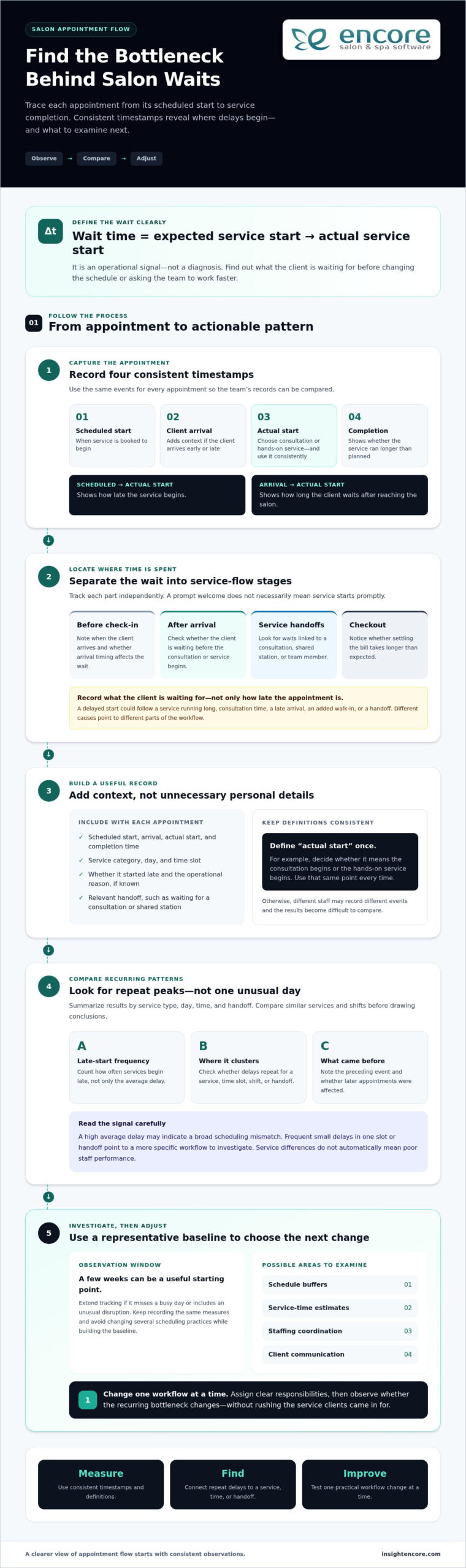
Categories
Uncategorized

How to Protect Client Data in a Salon: A Practical 2026 Guide

A shared tablet left open between appointments can expose client information just as easily as a more complex security problem. Contact details, booking notes, allergy information, photos, and payment activity may pass through several hands and systems during a busy day. Knowing how to protect client data in a salon starts with understanding those everyday workflows and making them easier to manage.

You don’t need to be a cybersecurity expert to protect client information. Start by identifying which details need extra care, who needs access, and where information is stored. Clear routines help your team handle client data consistently and reduce avoidable risks.

This guide shows you how to map where client data is collected and used, set practical safeguards for staff and shared devices, and assess software and payment workflows. You’ll also learn how to prepare a straightforward response plan for a possible incident. The goal is clear responsibilities, better day-to-day control, and routines your salon team can follow.

Key Takeaways

  • Start with a practical inventory of the client details your salon collects, from booking information to service notes and payment-related data.
  • Trace how information moves between booking, consultation, checkout, and follow-up to spot where extra copies or access points may appear.
  • Learn how to protect client data in a salon with everyday safeguards such as individual staff accounts, screen locks, updates, and secure backups.
  • Put a repeatable routine in place by assigning responsibilities, setting access rules, and building short data-handling steps into daily salon procedures.
  • Use a clear checklist to compare software capabilities with your salon’s own data-handling practices and responsibilities.

How to protect client data in a salon starts with knowing what you collect

A practical inventory is a useful first step. List what your salon collects, where each item is kept, who uses it, and why it’s needed. This gives you a basis for deciding what to retain, what to limit, and which everyday routines need stronger safeguards.

Client data includes more than names and phone numbers. It can include appointment history, service preferences, consultation notes, photos, and payment-related information. A salon data inventory records these information types, their locations, who uses them, and their purpose. This connects the broader idea of information privacy to practical decisions your team makes every day.

Which client details should a salon identify first?

Follow a client’s journey from booking to follow-up. At each step, note what information is collected and whether it appears on paper, a staff device, in email or messaging tools, or in salon software. Record why you need each item and which roles use it. If there’s no clear purpose, consider whether you need to collect or retain it.

  • Booking: Name, contact details, appointment time, and service requested.
  • Consultation and service: Preferences, service history, and notes needed to provide the requested treatment.
  • Payment: Transaction-related information handled during checkout. Identify where this information is recorded, without copying sensitive payment details into general notes.
  • Follow-up: Contact details or preferences used for appointment reminders and relevant client communications.

Not every detail needs the same level of care. A preferred appointment time is useful service information. Notes about an allergy, skin condition, or other health-related detail are more sensitive and deserve tighter access. Photos can also reveal personal information, especially when they identify a client or document a condition. Keep sensitive notes limited to what’s needed to provide the service, and explain to staff why they must handle them carefully.

Where can salon client information be exposed?

Many exposure risks arise during ordinary workflow moments. An unattended screen may let someone nearby view a client record; a shared login makes it harder to tell who accessed information. A misplaced consultation form can expose details on paper, while a lost device may put saved messages or files at risk. Use your inventory to identify where these situations could occur in your salon.

  • Accidental disclosure: Discussing a client’s personal details where others can hear, or sending a message to the wrong recipient.
  • Lost or misplaced items: Leaving forms, printed schedules, or devices in an unsecured area.
  • Weak account access: Reusing logins or keeping an account active after someone no longer needs access.
  • Suspicious messages: A message that pressures staff to open an attachment, share a password, or reveal client information.

Record each risk beside the information and location it affects. This creates a practical map of workflow issues and helps you choose safeguards that address the risks your team actually faces.

How salon client data moves through booking, service, and payment workflows

Client information often moves through several systems during an appointment. A guest may submit contact details and service preferences through an online booking form, then provide more information during a consultation. Staff may refer to the details in a client record, use a payment tool at checkout, and send a follow-up by email or text. Each handoff can create another copy or access point.

Walk through a typical appointment as a team. Identify what you collect at booking, what you add during the service, what’s needed at checkout, and what you use for follow-up. Keep only details that support the service or an ongoing client relationship. For example, a stylist may need a relevant service preference, but that information doesn’t also need to be copied into a calendar note, an email, and a personal phone.

Keep online booking questions focused on arranging the appointment and preparing for the service. When clients can see what a form asks and why, the information request is easier to understand. Salon software that brings booking and client-management tasks together can help your team organize where information is handled rather than relying on disconnected records.

How to map client information across salon systems

List the tools involved at each stage, including scheduling, client records, payment processing, email, and text messages. For each tool, note the staff roles that need it and the information they use. Then look for duplicate records, such as contact details stored in both a booking system and a shared spreadsheet. Removing unnecessary copies makes information easier to manage and reduces the number of places staff need to check.

Keep the review straightforward. The NIST Cybersecurity Framework offers organizations a structured way to think about managing cybersecurity risk. A salon can use the same practical approach: identify where information moves, who handles it, and which procedures can reduce avoidable exposure.

How to keep payment information in the right workflow

Set a clear boundary around payment information. Use the designated payment process for transactions, and keep routine client notes focused on service preferences and appointment history. Don’t put full card details in service notes, spreadsheets, email, or unsecured forms. If a client record needs to reflect a completed transaction, record only what your workflow requires, not sensitive payment details.

Make the handoff clear: the team member taking payment should use the salon’s designated payment workflow, while other staff should see only information needed for their role. Encore’s integrated credit card processing connects payment activity with salon operations. Software is only one part of responsible data handling, so pair the tools you use with clear staff practices and written procedures.

Once you’ve mapped the client journey, review each handoff and decide where to simplify it. To see how a connected workflow could fit your salon, explore Encore’s salon software as part of your broader data-management routine.

Which salon data safeguards matter most? Compare practical controls

Useful safeguards address specific risks, have someone responsible for them, and fit naturally into salon routines. Start with access: client information should be available to people who need it for their duties, not automatically to everyone on the team. Review access when someone changes roles or leaves, and remove permissions that are no longer needed.

Use these practical controls as a starting point:

  • Individual staff accounts: Help identify who used a system and make access easier to adjust. Separate accounts let a receptionist use booking details while a stylist can access the service information needed for appointments.
  • Strong authentication: Makes accounts harder to access with guessed or reused passwords. Each staff member should use a strong, unique password, with multi-factor authentication enabled for important accounts where it’s available.
  • Screen locking: Helps prevent someone nearby from viewing an open client record. Staff should lock the front-desk computer or secure a tablet whenever they step away, even briefly.
  • Software updates: Help keep devices and applications current. Assign someone to review update prompts and follow the salon’s process for applying them rather than leaving updates indefinitely.
  • Secure backups: Provide a way to recover important business information if records are lost or unavailable. Decide who oversees backups, where they’re kept, and how the salon will check that its recovery process works.

What access and device controls should salon teams use?

Begin with the accounts and devices staff use each day. Avoid shared credentials wherever individual accounts are supported. Shared logins make it difficult to connect actions to a person or promptly change one person’s access. Set a screen-lock habit for computers, tablets, and phones, and store mobile devices securely between uses. Keep the rules short enough to follow during a busy shift.

Make these measures part of regular salon administration rather than a one-time setup. Choose someone to review accounts and device practices when staff responsibilities change, and include the review in the salon’s routine checks.

How should salons assess software and payment tools?

Compare a tool’s actual capabilities with the procedures your salon needs. Review how the software handles access settings, data exports, support requests, and privacy documentation. Consider how staff will use each feature, too. Encore’s salon software brings operational functions together in one platform, but tools support a protection routine; they don’t replace staff practices or oversight.

For payment tools, understand how payment handling is separated from ordinary client records, and identify the payment processor and related documentation. Don’t assume a feature is a safeguard without understanding how it works in your workflow. Protecting client data in a salon means combining appropriate tools with clear access rules, trained staff, and regular review.

To review how salon workflows could fit together, explore Encore’s salon software as part of your broader approach.

How to Protect Client Data in a Salon: A Practical 2026 Guide

How to put salon client-data protection into practice with staff

A good routine should work on a busy day, not just look thorough on paper. Give staff short steps they can follow while opening the salon, booking clients, checking out appointments, and closing. To put client-data protection into practice, assign clear owners and make it easy for team members to ask questions or report a concern.

  1. Keep the inventory current. Record the client information your salon uses, where it’s held, its purpose, and which roles need it. Update the record when you add a tool or change a workflow.
  2. Assign owners. Name the person responsible for staff accounts, devices, paper records, and routine reviews. Staff should know who can approve access changes and who receives incident reports.
  3. Set access by role. Give each person access suited to their work duties, then review it when responsibilities change. Remove access that’s no longer needed rather than relying on everyone to remember old permissions.
  4. Train the team. Explain the everyday steps for handling client details, checking requests, and reporting anything unusual. Keep instructions specific to the tools and situations staff actually encounter.
  5. Review routinely. Check whether the procedures are being followed and still fit the salon’s workflow. Use changes in staff, devices, or software as prompts for an extra review.

How to train salon staff to handle client information

Use brief examples instead of abstract warnings. Show staff how to keep conversations private, store printed forms, lock screens, check message recipients, and report a lost device. Before sharing appointment or account details, they should verify the person’s identity using the salon’s agreed process. Give everyone one clear internal contact for questions and concerns, and encourage prompt reporting without blame.

Keep instructions close to the task. A booking checklist can remind staff to verify a client’s details; a checkout prompt can remind them to keep payment handling within the designated workflow. Short, visible reminders are easier to follow consistently than a long policy no one can find during a busy shift.

What should a salon do if client data may be exposed?

Act calmly and follow a written sequence. The priorities are to limit further access, preserve useful details about what happened, and involve the right people. Don’t guess about the cause or make promises to clients before the salon has established the facts.

  1. Contain the issue. Secure the affected account, device, or records. For a suspicious message, don’t click links or forward it widely; report it through the salon’s internal process.
  2. Document what’s known. Note when the issue was noticed, what happened, which systems or information may be involved, and what steps have already been taken. Preserve relevant messages or records.
  3. Notify responsible leadership. Contact the designated owner promptly so the salon can coordinate its response and decide on next steps.
  4. Seek appropriate advice. A qualified adviser can help assess notification duties that apply in the salon’s jurisdiction and circumstances.

Clear roles, practical training, and a calm response plan make data protection a shared routine rather than one person’s task.

Explore Encore for your salon

How to choose salon software that supports responsible client-data practices

Software shapes how client details move through your salon, but no platform can replace clear staff responsibilities and everyday procedures. Use a consistent checklist to compare what a product does with the way your team books appointments, manages client records, takes payments, and responds to concerns. This helps you choose tools that fit your operation without treating software as a security guarantee.

What questions help compare salon software data practices?

Start with the information your salon needs and the people who use it. Review product documentation and support processes to understand how the workflow fits your procedures. Focus on practical details, not broad security language.

  • Information: What client details does each workflow collect, and can your team keep forms focused on what’s needed?
  • Staff access: What access roles or account settings are available, and how will you review permissions when staff duties change?
  • Data handling: Where does client information appear across booking, records, payments, and follow-up? Can your team avoid unnecessary copies?
  • Exports and records: How are client records exported, and what documentation explains the process?
  • Support and account recovery: What support process applies to account or access issues, and how can staff recover access appropriately?

Compare the answers with your salon’s written procedures. For example, if the team has a process for reporting a lost device, make sure staff understand which software accounts or records could be affected and who handles the next step. Product capabilities should support routines your team can maintain, not add steps no one owns.

How can salon software fit into a wider protection plan?

Consider the whole workflow, not one feature in isolation. Encore combines online booking, client management, and payment workflows in salon-management software. Bringing these operational functions together can help your team organize where information is handled. Access rules, staff training, device practices, and regular reviews remain essential parts of the plan.

Map a platform’s actual functions against your salon’s needs. Make sure staff know how to use the relevant workflows, keep the information they collect purposeful, and include the software in routine account and procedure reviews. If you change systems or add a feature, revisit staff instructions so the day-to-day process stays clear.

Choosing software is one part of protecting client data in a salon. Pair useful tools with responsible habits: limit unnecessary collection, train staff, manage access, and establish how to report a concern. A good fit should make daily operations easier to organize while supporting procedures your salon can follow consistently.

Try Encore for your salon

Make your next data-protection step part of the routine

Protecting client information doesn’t require a perfect system on day one. Choose one improvement your team can put into practice now, such as reviewing who can access client records or making the lost-device reporting process easier to find. Assign someone to own that step, then build on it as your salon’s workflows change. A small action staff repeat is more useful than a complicated policy that stays unread.

Protecting client data in a salon is an ongoing part of salon management: keep responsibilities clear, revisit routines, and adjust when tools or staff roles change. Encore’s salon-management platform brings together tools for daily salon operations, including online booking, client management, and payment processing. Explore Encore to see how its software can support the way your team organizes those operations.

Try Encore for your salon

Start with one practical change, assign someone to own it, and help your team build stronger data-handling habits over time.

Frequently Asked Questions

What client information should a salon keep confidential?

Keep identifying, contact, appointment, payment-related, and personal service information private. This includes details that may seem routine, such as a client’s appointment schedule, as well as more sensitive consultation notes or photos. A caller asking whether someone has an appointment shouldn’t automatically receive confirmation. Set a simple rule for what staff can share, with whom, and how to check that a request is legitimate.

How can a salon protect client data from staff misuse?

Make appropriate use of client records part of the salon’s staff expectations. Explain that looking up a client out of curiosity, discussing their information socially, or using contact details for personal reasons isn’t acceptable. Limit access to work needs, and have a manager review account activity if a concern arises and the system provides that information. A clear reporting route helps staff raise concerns early rather than trying to handle them alone.

Is salon booking software safe for client information?

Booking software can help organize client information, but safety depends on the product, its configuration, and how the salon uses it. Before relying on a system, review its privacy information, account recovery process, access options, and data-handling practices. Make sure staff know how to use the booking workflow correctly, too. Don’t treat a convenient online form as a reason to request details that aren’t needed for the appointment.

Can a salon store client payment card details in its records?

Don’t copy full card numbers or security codes into client notes, spreadsheets, email, or paper forms. Use the salon’s designated payment workflow instead, and follow the instructions provided for that process. Keep appointment and service records separate from payment credentials. If staff need to reference a transaction later, use the appropriate transaction record rather than retaining sensitive card details in a general client profile.

What should a salon do if client information is accidentally shared?

Tell the salon’s designated manager or privacy lead promptly, even if the message went to only one unintended recipient. Preserve the message and note what was shared, when it happened, and who may have received it. Don’t forward the information to more people while investigating. The responsible lead can assess the circumstances, decide what immediate steps are appropriate, and seek qualified advice about any notification duties that may apply.

How often should salons review client-data access?

Review access whenever a staff member changes duties, leaves, or needs temporary access for a specific task. Also include account permissions in a recurring management check, so dormant accounts and unnecessary access don’t linger unnoticed. For example, a manager can review the staff list alongside other routine administrative records. The right schedule depends on how the salon operates, but role changes should always prompt a timely review.

Does salon software alone protect client data?

No. Software can support organized workflows, but it can’t ensure staff follow good practices or secure every device and paper record. A locked account won’t prevent someone from sharing a password, and a useful booking form can still collect more information than the service requires. Combine software with clear staff expectations, careful device handling, limited collection, and a process for raising concerns. That’s a practical foundation for protecting client data in a salon.

Disclaimer

This article is general in nature and may contain errors, please verify all claims with your sales rep

Categories
Uncategorized

Tattoo Artist Booking and Deposit Software: A 2026 Buyer’s Guide

What if the biggest booking headache isn’t finding an open slot, but keeping every detail connected after a client reaches out? The right tattoo artist booking and deposit software can help move an inquiry toward a confirmed appointment while keeping client details, scheduling, and payment activity organized.

If you’re juggling repeated messages between appointments, unclear deposit records, or a calendar that doesn’t fit custom tattoo requests, you’re not alone. A smoother process takes more than an online scheduler. It needs a clear way to handle the steps around each appointment without adding another layer of admin.

This guide compares tattoo-focused tools and broader studio platforms by their booking, deposit, payment, and client-management workflows. You’ll see what to consider as an individual artist or multi-artist studio, and how Encore’s tattoo studio software brings online booking, client management, integrated credit card processing, and point-of-sale transactions into a broader management workflow. Use these criteria to find a practical path from first inquiry to organized appointment records.

Key Takeaways

  • Choose tattoo artist booking and deposit software that supports the full client journey, not just calendar appointments.
  • Map the steps from inquiry to follow-up so you can decide where client references, placement details, and payment records belong.
  • Compare booking flow, intake, deposit records, payments, reminders, and artist calendars against your studio’s actual needs.
  • Document your current policies, test common booking scenarios, and introduce the new process in clear steps.
  • Explore how Encore’s tattoo studio software brings online booking, client management, integrated credit card processing, and point-of-sale tools into a broader studio workflow.

Why tattoo artists need booking and deposit software beyond a calendar

A calendar shows when you’re busy. It doesn’t explain why an appointment needs a consultation, which design reference a client sent, or whether the booking has reached the next step. Tattoo artist booking and deposit software helps coordinate inquiries, appointments, client details, and payment records so essential context doesn’t get lost across messages, notes, and separate tools.

Booking software manages appointment requests and the details attached to them; a general-purpose calendar mainly records scheduled time. That difference matters for tattoo artists. A custom piece may need discussion before you can estimate the session or reserve enough time. A flash design may be ready to book, but the client still needs to choose an artist and appointment slot.

The work itself shapes the booking process. A client’s idea, placement, size, and reference images can affect what happens before an appointment is confirmed. Learning more about the history and process of tattooing offers helpful context for why the design and the client’s plans matter. Your booking process should gather relevant details rather than treat every request as a simple calendar event.

Where a tattoo appointment begins: inquiry, consultation, or flash booking

Custom work often starts with an inquiry and may call for a consultation before an appointment is scheduled. Ready-to-book flash can follow a shorter path. Distinct appointment types help set expectations and reserve suitable time. Asking for useful details early, such as the design idea, placement, approximate size, and reference images, can reduce follow-up messages and help the artist understand the request.

Keep intake focused. Ask for what helps you decide the next step, not so much that clients struggle to get started. A consultation request might ask about the concept and preferred placement. For flash, the client may need to identify the design and preferred availability. The goal is a useful starting point, not a final creative decision made through a form.

What a deposit changes in the booking experience

A deposit is part of an artist’s booking policy, not a universal fixed amount or rule. State the terms clearly before a client commits, including how the deposit relates to the appointment and what happens if plans change. Clear language helps clients understand what they’re agreeing to and reduces avoidable payment misunderstandings.

Deposit tracking is one part of the client record, not a substitute for managing the appointment and client relationship. Artists also need to find the booking date, request details, relevant conversation, and payment activity together or through a consistent process. A dedicated tattoo studio software workflow can bring booking and client management into a broader business setup, while payment tools support transaction administration. Include the deposit status and related appointment details in the recordkeeping process you use to apply your studio’s policy.

Before choosing a tool, consider whether it can help you:

  • Separate custom inquiries, consultations, and ready-to-book appointments.
  • Keep client details and booking context easy to retrieve.
  • Record payment activity clearly alongside appointment information.

That’s the difference between filling a calendar and managing a client journey. The best fit supports your actual process, from the first message to the appointment record and follow-up.

How tattoo booking and deposit software connects each client step

A connected booking journey gives both the client and artist a clear next step, from the first request to post-appointment follow-up. Tattoo artist booking and deposit software can help organize that journey, but the workflow should reflect your studio’s policies rather than force every client through the same process.

A practical client journey might look like this:

  1. Open the booking page. The client sees available appointment types, artist options, and instructions for starting a request.
  2. Submit the inquiry. They share contact details and relevant project information, such as the idea, preferred placement, approximate size, and reference images.
  3. Complete a review or consultation step. The artist reviews the request and decides whether to discuss the design, schedule a consultation, or move toward an appointment.
  4. Confirm the appointment. Once timing and booking terms are clear, the client receives the confirmed date, time, artist, and any next steps.
  5. Get appointment follow-up. A reminder can restate practical details, while post-appointment communication supports a consistent client experience.

From booking request to confirmed appointment

Intake should help you make a decision. Ask for details that affect review or scheduling, but avoid collecting information that doesn’t move the request forward. A custom piece may need a reference and consultation, while a flash booking may need a design choice and preferred time. Make the request status clear so clients know whether they’ve submitted an inquiry or secured an appointment.

Availability also needs to be easy to understand. If a request still requires artist review, make that clear rather than presenting it as a confirmed slot. For a multi-artist studio, identify the intended artist in the booking record and make calendar changes visible to the people managing appointments. This keeps client conversations connected to the schedule.

Deposit records, payment processing, and appointment follow-up

Set deposit steps according to your own policy. A useful record may include the deposit status, the related appointment, the client, and any payment reference needed to reconcile the transaction. Keep the terms visible before the client commits, including how the studio handles changes, cancellations, and payment timing. Clear expectations matter more than applying a one-size-fits-all rule.

Payment processing and deposit tracking are related, but they aren’t identical. A processor handles a transaction; the studio also needs a reliable way to understand what that transaction relates to and where it stands. Keep records consistent with your policy and use reminders to repeat confirmed appointment details, not introduce new terms. Guidance from the National Environmental Health Association on public health and tattoo regulations can also inform how a studio organizes relevant client communication and practices.

Connected records reduce administrative handoffs by keeping the request, appointment, client details, and payment context easier to follow.

Encore brings online booking, client management, and integrated credit card processing into a broader studio workflow. Its tattoo studio software can be part of that operational picture. Take a closer look at Encore to explore how the client journey can fit your processes.

How to compare tattoo booking software for deposits and studio needs

The best fit is the system that follows your actual booking policy without making you enter the same information in multiple places. Use tattoo artist booking and deposit software to compare complete workflows, not just feature counts. Start with the steps every booking needs, then separate must-haves from conveniences that would be helpful but aren’t essential to your studio.

Use this scorecard to compare tools against your process. Mark each item essential, optional, or unnecessary before evaluating options.

Workflow area What to assess Priority question
Booking flow Request, review, consultation, and confirmation steps Can the client tell whether a request is pending or confirmed?
Intake Design details, placement, references, and contact information Can you collect the details needed to review a request without overloading the form?
Deposit records Status and connection to the relevant client and appointment Can you find the record needed to apply your policy or resolve a question?
Payments Transaction records and fit with existing payment routines Does payment administration fit how your studio tracks appointments and business activity?
Reminders Appointment details and timing of client communication Can reminders support your process without creating confusing or duplicate messages?
Artist calendars Availability, appointment ownership, and schedule changes Can each artist or studio coordinator understand who is booked and when?

Keep the priority test grounded in daily work. If clients need to submit a custom concept before you schedule, intake and request review may be essential. If you book directly from set availability, a shorter booking flow may matter more. Reminders or deeper reporting can be optional if your current process already handles those needs well.

Which deposit and payment controls deserve a closer look?

Check whether deposit records can be tied to the right client and appointment, and whether the status is clear enough to support your policy. Consider how the system records payment activity alongside your usual business routines. Client-facing terms should be easy to understand, especially around rescheduling. A tool that processes payments but leaves you reconciling scattered notes may add work instead of removing it.

Does the software fit custom work and multiple artists?

Test a custom request from the client’s perspective. Can they provide the information you need, and can you review it without copying details into another system? For a shared studio, assess whether the schedule makes artist availability and appointment responsibility clear. A solo artist may need a simpler setup, while a team may value shared visibility and organized client records. Needs differ, so avoid adding complexity for features your workflow won’t use.

Encore’s tattoo studio software brings online booking and client management together with integrated credit card processing and point-of-sale transactions. Use the same scorecard to assess how those broader tools fit your studio’s day-to-day administration, and include deposit records and terms in your workflow comparison. The right system should reduce handoffs, not create duplicate data entry.

Tattoo Artist Booking and Deposit Software: A 2026 Buyer’s Guide

How to choose and introduce tattoo booking software without disrupting clients

A new system should make the booking process easier to follow, not leave clients wondering where to send a request or whether an appointment is confirmed. Before switching, map your existing process and decide what needs to change. A thoughtful rollout gives artists time to learn the workflow and clients a clear path to follow.

Use this sequence to introduce tattoo artist booking and deposit software with fewer surprises:

  • Document current policies. Write down how your studio handles deposits, cancellations, rescheduling, consultations, and appointment confirmation.
  • Configure the booking steps. Set up the request path and intake around how artists review work, including any distinctions between custom requests and other appointment types.
  • Test the journey. Try common scenarios from both the client and artist sides before directing clients to the new process.
  • Announce the change. Share the booking link and explain what clients should expect, including where to submit requests and how confirmation works.

Make the transition manageable. You can introduce the new process to incoming inquiries first, then guide returning clients to it as appointments come up. Keep existing conversations easy to reference during the change so clients don’t have to repeat details they’ve already shared.

Set clear booking and deposit expectations before launch

Start with the studio’s written policy, not the software settings. Decide what clients need to know about deposits, cancellations, rescheduling, and consultations, then use the same wording in booking instructions and artist communication. Put the relevant terms where clients can read them before submitting or confirming a request. Plain language helps people understand the next step and gives staff a consistent reference when questions arise.

Be specific about the process without making the booking page feel like a contract clients have to decode. For example, distinguish a request awaiting artist review from a confirmed appointment. Explain what action the client should take if they need to ask about a schedule change. Keep the policy wording consistent with your actual studio records.

Test the booking experience from both sides

Walk through the process on mobile and desktop before sharing it. Submit a custom request, try a reschedule, and update an artist’s calendar. Check that intake details remain attached to the correct client and appointment, and that staff can tell what needs review. Invite artists or coordinators to test the workflow too; their feedback can reveal confusing steps before the process becomes standard.

During testing, look for duplicate work. If someone must copy the same client details into a calendar, payment record, and separate notes, simplify the process where possible. Connected day-to-day tools should support the way your studio handles bookings and records. Encore brings online booking, client management, integrated credit card processing, and point-of-sale transactions into a broader management workflow. Consider how those tools can fit your operations alongside your studio’s deposit and payment routines.

How Encore supports a more connected tattoo studio workflow

Booking is only one part of running a tattoo studio. Artists also need to keep client information organized, manage appointment activity, and handle payments through the wider business. Encore’s tattoo studio software brings online booking and client management into a broader platform that also includes point-of-sale tools and integrated credit card processing. These tools give an artist or studio a more connected way to manage day-to-day operations.

When comparing tattoo artist booking and deposit software, look at how booking and payment administration fit together with your studio’s deposit policy. A system can support appointments and transactions as part of a wider workflow, while your written policy defines how deposits are handled.

Bring tattoo bookings and client management into one workflow

Online booking helps organize how appointments enter the studio, while client management supports the records artists use to understand and manage client relationships. They serve different purposes, but work best as parts of a consistent process. When appointment and client information are easier to locate, artists spend less time searching across separate notes and conversations.

Payment administration is another part of that picture. Integrated credit card processing supports transaction workflows, while point-of-sale tools relate to broader studio operations. Encore’s integrated credit card processing gives studios payment capability alongside other business tools. Consider how those records fit your existing routines for reviewing appointments and tracking business activity.

Decide whether Encore fits your tattoo studio

Encore’s tattoo studio software brings booking and client-management tools into a broader business platform. A solo artist can organize booking and client records within the same management workflow. A studio with multiple artists can assess how the platform fits its appointment coordination and point-of-sale routines. The right fit depends on which tasks you want to manage together and where your current process creates repeated work.

As you assess the fit, map your steps from inquiry through appointment and payment. Identify which details need to stay connected, which tools your team already relies on, and where you want a clearer view of client and appointment information. Then compare those needs with Encore’s online booking, client management, integrated credit card processing, and point-of-sale capabilities. Include your deposit procedures in the workflow you use to manage appointments and payment records.

A connected platform can be a practical next step if you want booking and studio-management tasks to sit within a broader workflow. Explore how Encore can fit the way your tattoo studio operates.

Try Encore now

Make your next booking workflow easier to manage

Your next step doesn’t have to be a sweeping overhaul. Notice where your current process takes extra effort, then decide which part would benefit most from a clearer routine. The right tattoo artist booking and deposit software should support the way you work while keeping client expectations and studio policies clear.

Encore offers specialized tattoo studio software with online booking, client management, and integrated credit card processing as part of a broader business platform. Founded in 1991, Encore brings experience in software for service businesses. Consider how those tools could fit your day-to-day operations and how your studio’s deposit policy fits into its booking and payment routines.

Try Encore now

A more organized process can give you more room to focus on the craft and the people behind each appointment. Try Encore now to explore its tattoo studio software for your business.

Frequently Asked Questions

What should tattoo artists look for in booking and deposit software?

Look for a system that fits your studio’s process and keeps essential booking information easy to find. With tattoo artist booking and deposit software, assess how it handles custom inquiries, appointment changes, client records, payment activity, and staff access. Before choosing, walk through a real booking from the artist’s perspective: Can you quickly see what needs attention, who owns the next step, and which details are relevant to the appointment?

How much deposit should a tattoo artist require?

There’s no single deposit amount that fits every artist or project. Set a policy that reflects your booking approach, the work involved, and the time you’re reserving, then explain it clearly before a client commits. For example, you might define different terms for a consultation and a longer custom session. Keep the policy consistent across client conversations and appointment records, and review it if your services or scheduling practices change.

Can tattoo booking software collect deposits online?

Some booking systems support online deposit collection, but capabilities vary. Separate the steps in your evaluation: Can the client pay online, can the transaction be connected to the relevant appointment, and can you identify its status later? Online booking and integrated credit card processing are useful capabilities to assess alongside deposit collection. Encore offers online booking and integrated credit card processing, so compare those tools with your deposit-handling workflow.

Is tattoo booking software different from regular appointment scheduling software?

It can be. General scheduling tools often focus on choosing a time, while tattoo appointments may require a request to be reviewed before a session is set. Consider whether the system can accommodate separate paths for a consultation, custom project, or appointment that’s ready to book. The practical test is whether the artist can preserve useful project context without forcing clients through irrelevant fields or relying on scattered messages.

What happens if a tattoo client reschedules after paying a deposit?

Your written policy should explain how a reschedule affects the deposit, and the studio should apply that policy consistently. When a client asks to change dates, update the appointment record and note the deposit’s status in relation to the new booking. Keep the client informed about the revised time and any action needed from them. This creates a clear history for both the client and the artist if questions come up later.

Can a tattoo studio use one booking system for multiple artists?

Yes, a studio can use one system if it supports the team’s scheduling needs. Before adopting it, decide how clients choose an artist, who can update each calendar, and how staff will identify the artist responsible for a booking. A shared system can give coordinators a common view, while each artist still needs clear ownership of their appointments. Test a schedule change to see how the update appears to the team.

Disclaimer

This article is general in nature and may contain errors, please verify all claims with your sales rep
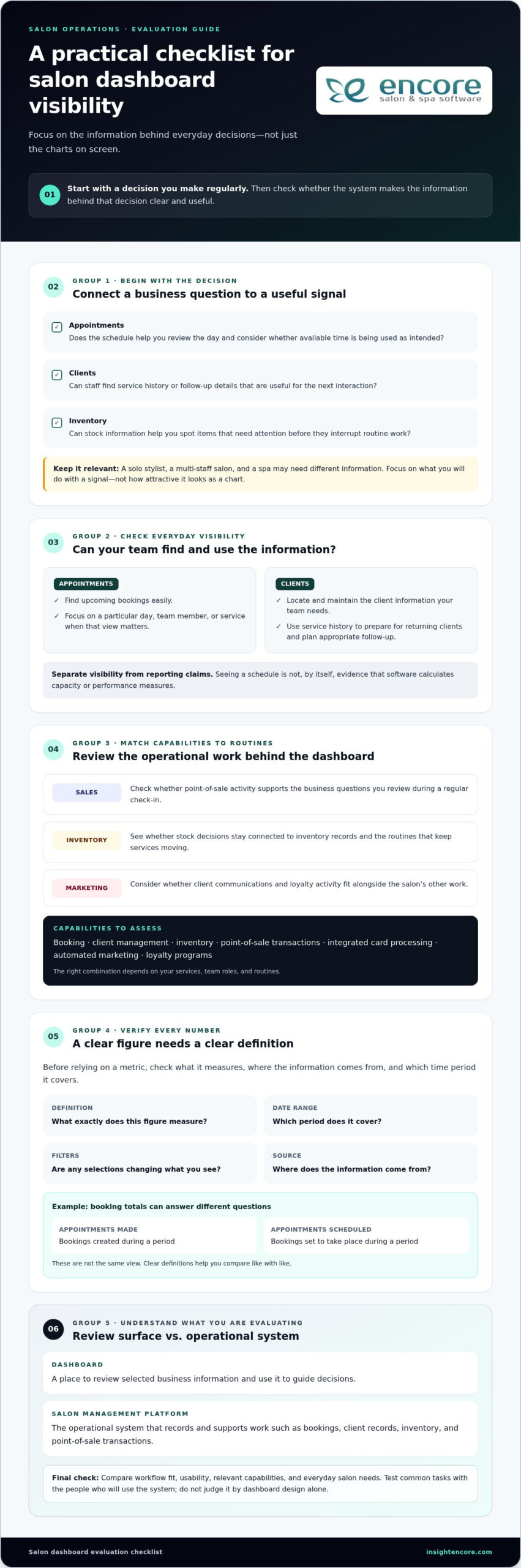
Categories
Uncategorized

Client Profile Template for Hair Stylists: A Practical Guide

What if a client profile did more than remind you of someone’s name and appointment time? A useful client profile template for hair stylists brings preferences, service history, color formulas, and follow-up notes together, so you’re not relying on memory or hunting through scattered records. It should support a personal consultation, not turn one into paperwork.

Small details can make the next appointment feel more consistent and considered: a client’s hair goals, what worked at their last visit, or what they’d like to avoid. But generic forms may ask for too much while missing the hair-specific information you need.

This guide provides an adaptable template for new and returning clients, plus tips for keeping service notes clear and useful. You’ll learn what to record, what to leave out, and how to make the process repeatable without losing the human touch. We’ll also compare paper profiles with digital client management, including how salon software can keep client records alongside broader salon operations.

Key Takeaways

  • Use a client profile template for hair stylists to capture useful preferences and service details without making consultations feel like paperwork.
  • Choose essential, optional, and service-specific fields to keep your template focused on what you’ll actually use.
  • Compare paper and digital records by considering access, updates, storage, and who needs to see the information.
  • Follow a simple prepare, consult, record, and review routine to keep client notes current between appointments.
  • Recognize when a standalone template works well and when connected digital client management may better suit your salon’s workflow.

What Should a Hair Stylist Client Profile Template Help You Remember?

A client’s preferences can be easy to overlook between appointments, especially when service notes live in different places or rely on memory. A profile gives you one concise reference for details that matter across visits: what the client likes, which services they’ve had, and what may need a follow-up. Its purpose isn’t to record everything about a person. It’s to help you prepare and continue the conversation with care.

A hair stylist client profile is a concise, ongoing record of service-relevant client details that supports consultations, continuity between appointments, and thoughtful follow-up.

A useful client profile template for hair stylists makes those details easy to find and update. Focus on information that helps you deliver salon care, such as preferred styles, communication preferences, and notes from previous services. Avoid collecting personal details simply because a form has room for them. The goal is a practical working record, not a longer intake form. This reflects the broader idea of Customer Relationship Management (CRM), where organized customer information helps support ongoing relationships.

Client profile, consultation form, and appointment record: what is the difference?

These records serve related but distinct purposes. A client profile holds useful information across visits, such as how someone prefers to communicate or the general style they’re working toward. A consultation form guides a structured conversation about a planned service, helping you discuss the client’s goals and relevant considerations before you begin. An appointment record documents a specific visit, including the service performed, decisions made, and any follow-up discussed. Together, they provide context without treating every appointment as a first meeting.

When does a stylist benefit from a consistent client record?

A consistent record is especially helpful when details need to carry forward. You might note that a client prefers a quiet appointment, likes to see style options before deciding, or wants to discuss how a previous cut has grown out. For a solo stylist, a repeatable format makes it easier to review those notes before the next service. In a salon team, shared record-keeping can help colleagues maintain continuity when a client sees different stylists.

Use notes as prompts, not assumptions. A preference can change, and a past service doesn’t determine what’s right today. Before starting, check relevant notes with the client and ask what they’d like this time. Their current goals, hair condition, and conversation guide your professional judgment. The record simply gives you a more informed place to begin.

  • Useful across visits: preferred styles, communication preferences, and ongoing goals.
  • Specific to one visit: dated service details and follow-up notes.
  • Unnecessary for the task: personal information that doesn’t help with consultation, service, or follow-up.

Keep the profile concise enough to scan before an appointment, and update it when a detail becomes useful. That balance helps records feel supportive rather than bureaucratic, while leaving space for the most important part of the service: listening to the client in front of you.

Build a Hair Stylist Client Profile Template With These Essential Fields

A useful template isn’t the longest one. It’s a focused record that helps you prepare, provide a considered service, and pick up the conversation next time. Use the outline below as a starting point. Remove fields that don’t fit your services or workflow, and add service-specific details only when they’ll help with future appointments.

A practical stylist profile can include contact and appointment preferences, hair goals, relevant service history, and agreed next steps, with optional or service-specific fields added only when they serve a clear purpose.

Copy-ready client profile outline

  • Identity and communication
    • Essential: Client name; preferred contact method; contact details needed for salon communication.
    • Optional: Preferred stylist; appointment preferences; referral source, if you use it to understand how clients find your salon.
    • Optional: Birthday or demographic details only when they support a clear business purpose. Explain why you’re asking before collecting them.
  • Hair preferences and goals
    • Essential: Preferred cut or style; current goals; maintenance preferences, such as how much at-home styling the client wants to do.
    • Service-specific: Relevant sensitivities or product preferences that may affect a planned service. Keep health-related details limited to what’s relevant.
  • Service history
    • Essential: Dated service notes, relevant observations, and aftercare discussed or agreed with the client.
    • Service-specific: For color services, record the formula details and processing notes that are useful for future appointments, along with the service date.
  • Next steps
    • Essential: Follow-up discussed, the client’s next goal, or a reminder to revisit a question at the next appointment.
    • Optional: Permission for relevant photos or follow-up messages, including what the client agreed to and the intended use.

Keep contact and appointment fields purposeful

Collect only the contact information you need to communicate about salon services and appointments. A preferred stylist or appointment preference can help with scheduling, while a referral source may be useful if you track how clients discover your business. Birthday and demographic fields are not automatically necessary. If you include them, be clear about their purpose and let that purpose guide whether they belong on the form.

Write service notes clearly and handle sensitive details with care

Use factual, neutral language. For example, note the client’s stated style goal or what aftercare you discussed, rather than making assumptions about their habits. Record color details in a format you can understand and use again; don’t rely on vague shorthand. Treat health-related information and other sensitive details thoughtfully, and limit collection to what supports the service. Follow the privacy and retention practices that apply in your location. Requirements vary by jurisdiction, so verify the rules that apply to your salon before using the form.

Document permission for photos or follow-up messages clearly, including what the client agreed to. A well-organized client profile template for hair stylists makes relevant details easy to find while keeping unnecessary personal information out. To organize client records alongside salon operations, explore Encore’s client management tools.

Paper or Digital Client Profile Template: Which Format Fits Your Salon?

Choosing a format comes down to how you work, who needs access, and how often you look back at a client’s history. A printable profile can suit an individual stylist who likes to write during a face-to-face consultation. Digital records may be more practical when you need to find details across a busy schedule or keep information accessible to a salon team. Neither format is right for every business.

Compare how each option fits your day-to-day routine:

Consideration Paper profiles Digital profiles
Access Available where the physical file is kept. Can be retrieved through the system or device where records are maintained.
Updates Write additions by hand; keep notes legible and dated. Update the electronic record as details change.
Storage Requires space for organized physical files. Stored digitally, with access practices suited to your salon.
Team visibility Colleagues need access to the relevant file. May make records easier for authorized team members to find, depending on the system and setup.

Think about the friction you want to reduce. If looking up a note means searching through folders, a consistent filing routine may help. If several people need to refer to client information, consider how your chosen format supports appropriate access and makes it clear which record is current.

When a printable client profile is a practical starting point

Paper can be a straightforward choice for a solo stylist or anyone who prefers handwriting during consultations. Print one consistent profile for each client, date new visit notes, and file updates with the original record so service history stays together. Set a routine for returning files to their place after appointments. Keep records from being casually viewed, misplaced, or accessed by people who don’t need them.

When a digital client profile can reduce recordkeeping friction

Digital records may help when you regularly need to retrieve information for returning clients or keep records organized across a salon team. Clear naming and updating habits still matter; a digital file isn’t useful if notes are hard to locate or out of date. Digital client management can also sit alongside broader salon workflows. Encore combines client management with online booking and point-of-sale tools. See how these operational areas fit together in its salon software features.

Start with the format you can maintain consistently. A printable client profile template for hair stylists can establish a reliable routine, while digital records may suit a growing team or a workflow that benefits from connected client management. Whichever you choose, set clear habits for updates, storage, and access. Revisit the decision if your salon’s needs change.

Client Profile Template for Hair Stylists: A Practical Guide

How to Use and Update a Hair Stylist Client Profile at Every Visit

A profile works best as part of the appointment routine, not as a form you complete once and forget. Use the same four stages each time: prepare, consult, record, and review. This rhythm helps you arrive with useful context, make room for the client’s current preferences, and leave clear notes for the next visit.

Introducing the profile without making consultation feel like paperwork

Keep the explanation simple: “I keep a few notes so we can pick up where we left off and focus on what you want today.” Invite the client to share preferences that matter to the service, then fill in only the relevant fields. The profile supports your conversation; it shouldn’t compete with it.

A four-stage routine for each appointment

  • Prepare: Before the appointment, check the client’s existing profile and most recent service notes. Look for useful context, such as a style goal or a detail to follow up on. Don’t treat old notes as instructions for today.
  • Consult: Welcome the client and confirm what still applies. Instead of asking a returning client to repeat everything, try, “Last time, you mentioned wanting a lower-maintenance style. Is that still your goal?” Ask what has changed, then discuss the planned service in person.
  • Record: After the consultation and service, add concise, dated notes. Capture relevant service details, the client’s stated preferences, your observations, and any maintenance guidance you agreed on. Separate what the client said from what you observed so the next reader can understand the context.
  • Review: Before the next visit, read the latest entry and note anything worth revisiting. This makes it easier to continue the conversation without assuming the client’s needs or preferences have stayed the same.

Updating service history and preparing for the next appointment

Useful notes are specific enough to guide a follow-up, but brief enough to scan. For example, record the service date, relevant formula details when applicable, the result discussed with the client, and agreed maintenance notes. Avoid turning the profile into a transcript of the appointment. If a detail isn’t useful for the service or future continuity, leave it out.

Use neutral, clear wording. “Client prefers to air-dry; discussed styling options” distinguishes a client-stated preference from a stylist’s observation. If you note an observation, keep it factual and connected to the service rather than writing a judgment. That makes the record easier for you or a colleague to interpret later.

This repeatable approach works with paper records or digital client management. As a salon grows, connected records can help keep client management alongside broader salon operations. Encore’s client management tools support an organized digital workflow for salon businesses.

Make the routine easy to maintain. Update the record while the appointment details are fresh, then use the next visit to confirm what remains relevant. A consistent client profile template for hair stylists helps you remember the context without asking clients to start from scratch or letting notes replace a personal consultation.

See Encore’s client management tools

From a Client Profile Template to Organized Salon Client Management

A standalone template can be enough when you’re an independent stylist with a manageable client list and a recordkeeping routine you can maintain. It gives you a consistent place for relevant notes without adding another system to learn. As your salon grows, separate files may become harder to keep current or find quickly. The decision isn’t simply paper versus software. It’s whether your current process helps the right people find and update the right information at the right time.

Signs your salon may have outgrown separate client forms

Look for repeated friction in everyday work. Are there duplicate profiles because staff aren’t sure which record to use? Do you spend appointment time searching for a previous note? Are service updates kept in different places, or does each team member record details in a different way? These are signs that your recordkeeping process may need more structure.

A shared process can help salon teams maintain continuity, but software alone won’t set expectations. Agree on what staff should record, when to update a profile, and who should have access. Keep the form focused, and make sure the workflow respects applicable privacy practices. Clear habits matter as much as the tool.

Choosing a client management workflow staff can maintain

Choose a process that fits naturally around appointments. Ask whether the profile is quick to use, whether staff can keep it updated after a service, and whether it’s easy to review before the next visit. For a solo professional, a simple template or digital record may be sufficient if it stays organized and easy to access. A booth renter can build a consistent individual workflow around the same principles: prepare, confirm, record, and revisit.

For a salon team, digital client management can bring client records alongside other salon operations. Encore includes a client management system as part of its salon software offering, with online booking and point-of-sale tools within the broader platform. These tools support different parts of the client journey, from arranging an appointment to completing a transaction. Set clear team habits for recording and updating client details so the workflow stays consistent.

Start by reviewing where client information lives today and where staff experience friction. Then choose a process that’s easy to follow consistently, whether that means refining your form or moving toward digital client management. A client profile template for hair stylists is a practical foundation; organized salon client management can help keep the recordkeeping approach aligned with the way your business operates.

Read the Encore Salon Software overview to see how client management fits within a broader salon platform.

Make Your Next Client Record Easier to Use

Your next step doesn’t need to be a complete change to the way you run your salon. Start by choosing one part of your recordkeeping that feels harder than it should, then adjust your process to make that moment simpler. A client profile template for hair stylists should fit naturally into the way you welcome, consult with, and care for clients.

As you use your template, pay attention to which notes help you feel prepared and which fields rarely serve a purpose. That everyday feedback gives you a practical way to refine the form over time. Keep what supports thoughtful service, and let go of what creates extra work without adding useful context. The result can be a recordkeeping habit that feels personal to clients and manageable for you.

Encore’s salon and spa software brings client management, online booking, and point-of-sale tools together in one platform.

Explore Encore’s client management tools

Choose a process you can keep up with, then build on it at your own pace. A little more clarity can make each client interaction feel that much more considered.

Frequently Asked Questions

What should a hair stylist include in a client profile?

Include details that help you prepare for the client’s next service, and make it clear which notes apply to a specific visit. For example, a general preference can live in the profile, while a formula belongs with its dated color-service entry. If a field wasn’t discussed, don’t guess or fill it with an assumption. Leaving it blank is more useful than recording something that could mislead you later.

How do I create a client profile template for hair clients?

Build the form around your actual appointment flow, then test it before making it standard. Complete a sample profile for a familiar service and check whether another stylist could understand the entries without asking you to translate shorthand. Rename unclear fields, remove questions that don’t inform a service decision, and keep different service types adaptable. A template should guide note-taking, not force every client into the same consultation.

Should hair stylists use paper or digital client records?

Either format can work; choose the one your salon can keep accurate and appropriately protected. If you use both, decide which record is authoritative and how updates move between them. Otherwise, one version may show a newer preference than the other. Consider a short trial using your regular appointment routine, then notice whether staff can locate the right information and make updates without creating duplicate records.

How often should a hairstylist update a client profile?

Review the profile at every appointment, and update it whenever the client shares a meaningful change or a service adds useful context. You don’t need to rewrite unchanged details. For instance, if a client switches their preferred contact method, update that specific field and leave unrelated notes intact. A dated entry helps distinguish new information from older context, especially when several visits have passed between major changes.

Should a hair stylist record allergies and color formulas?

Record relevant sensitivities and color-service details carefully, but treat notes as context for a fresh consultation, not as a substitute for checking with the client. A formula entry can include the service date and the outcome discussed, so you can understand when and why it was used. Limit sensitive details to what supports the service, and follow the privacy and recordkeeping rules that apply where your salon operates.

How can a stylist keep client profile forms from feeling intrusive?

Tell clients why a question helps, and make it easy to skip information that isn’t needed for the service. You might say, “I ask about styling preferences so I can tailor the appointment. You can leave anything blank.” Ask only relevant questions, and let the client’s answers guide the conversation. A brief, respectful explanation can make the form feel like a helpful part of their visit, not an interrogation.

Disclaimer

This article is general in nature and may contain errors, please verify all claims with your sales rep
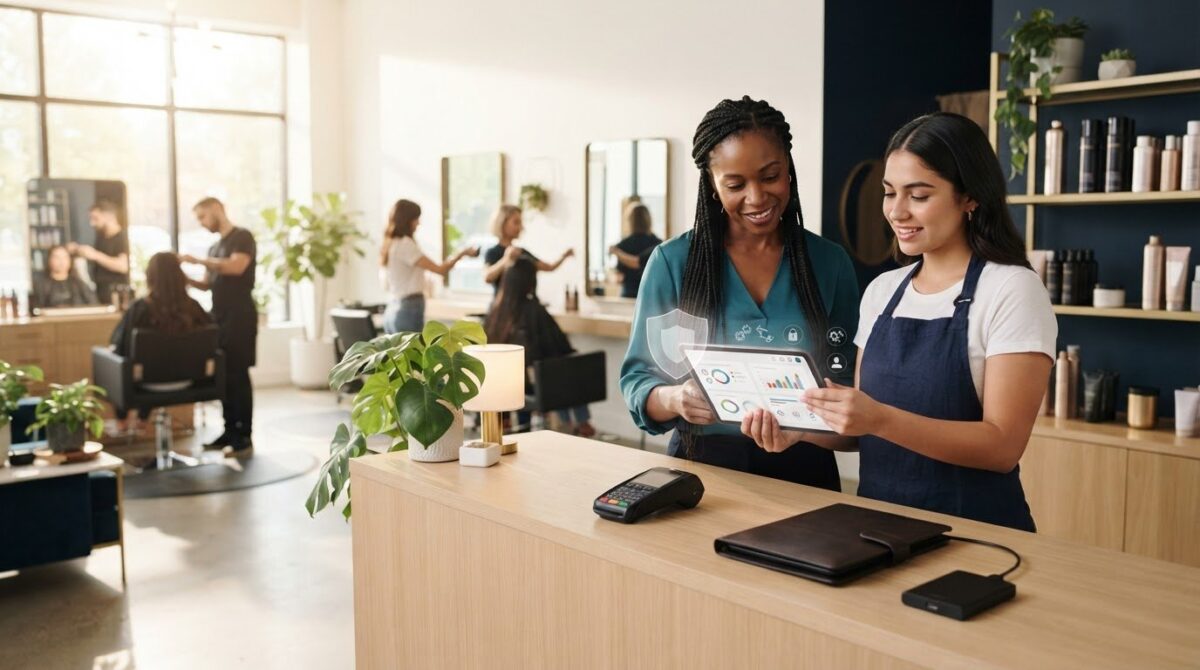
Categories
Uncategorized

Point of Sale for Booth Renters: A 2026 Buying Guide

What if checkout could do more than take a payment? The right point of sale for booth renters can connect each transaction with client records and appointment activity, helping you keep your independent business organized without adopting a salon-wide system you don’t need.

As a booth renter, you manage your own clients and daily workflow. A basic payment terminal may feel too limited, while software built around an entire salon may seem like more than you need. A practical setup should make payments straightforward and keep useful client and transaction details easy to find.

This guide covers the POS features that can support independent day-to-day operations, from integrated payment processing to client management and online booking. You’ll learn how to compare payment-only tools with connected software, what to prioritize, and which extras may add complexity without helping your routine. Encore’s specialized chair and booth renter software brings POS transactions, credit card processing, client management, and online booking together. Use the criteria below to assess what fits the way you work.

Key Takeaways

  • Start with the daily tasks your POS needs to support, including checkout and organized transaction records.
  • Choose a point of sale for booth renters that suits an independent workflow instead of adding tools designed mainly for salon-wide management.
  • Compare a payment-only setup with connected software to decide whether combining checkout, client records, and booking would simplify your routine.
  • Map your booking, checkout, client, and product workflows before comparing features, so you can focus on tools you’ll use.
  • Encore’s chair and booth renter software brings POS transactions, integrated payments, client management, and online booking together.

What Does Point of Sale for Booth Renters Need to Handle?

A point-of-sale (POS) system combines the tools and software used to record and complete purchases. For a booth renter, that can mean processing payment after a service, recording a retail sale, and keeping the transaction organized alongside client and appointment activity. A basic payment terminal records a sale; a more connected POS can help make that sale part of a broader client workflow.

POS systems can include more than checkout. The Point of Sale (POS) Systems overview explains how these systems bring together components and functions used to complete transactions. For an independent beauty professional, the practical question is how well those functions support the work around each sale, from recording the service to organizing the next visit.

How a booth renter’s checkout differs from a salon-wide POS

A salon-wide system may be organized around the owner’s view of staff, services, and the business as a whole. A booth renter needs a clear view of their own transactions and client activity. When comparing systems, look for a workflow that lets you identify what was sold and keep relevant information with your own client records. Salon arrangements differ, so focus on the way you manage your own work rather than assuming every business handles checkout the same way.

A booth renter’s POS is a checkout and recordkeeping tool for managing their own client purchases, services, products, and appointment context. This distinction helps you look beyond whether a system accepts payment. The right fit depends on whether it supports your independent workflow.

Which transactions and client interactions should POS support?

Begin by listing the transactions you handle. Your setup should make it possible to process service payments and record retail purchases clearly enough to review later. If a client buys a product during a service visit, consider whether you can record both parts of the sale together or whether you would need to track one elsewhere.

Client and appointment details can add useful context. Consider whether client information can be kept alongside service and purchase activity, and whether appointment details are easy to access during the visit. When checkout, booking, and client records work together, you may spend less time switching between separate tools.

Gift cards may also matter if they’re part of your business. Treat them as a specific checkout requirement, not a must-have for every renter. The goal is a point of sale for booth renters that keeps essential transactions and client activity organized without introducing unnecessary steps.

Which POS Features Matter Most for Booth Renters?

Start with the tasks that happen at checkout. A useful POS should make it straightforward to process a payment, record what the client purchased, and complete the visit without unnecessary steps. Then consider whether client management and appointment booking should connect with checkout. The best point of sale for booth renters supports daily work first; extra tools matter only when they serve a real need.

Core POS checklist: compare payment processing, clear transaction records, a simple checkout flow, client profiles, and appointment context before weighing optional business tools.

Payments, receipts, and transaction records

Payment processing and accurate records are the foundation. A service payment should be easy to enter and review later, and a retail item should be identifiable if it’s part of the same visit. Consider how receipts are handled and whether the transaction history provides the details you need to keep your business records organized.

Compare payment-processing terms, supported payment methods, and the transaction information available for review. These details vary between systems, so assess each option rather than assuming they’re the same. Also consider how integrated credit card processing fits into the checkout workflow you want.

Client management, booking, and business-building tools

Client profiles can keep contact details and service information close to checkout, while online booking can bring appointment scheduling into the client visit workflow. If you’re considering how client records fit into a solo workflow, read this guide to booth renter client management apps.

Other features depend on how you run your business. Inventory tools may be useful if you regularly sell products; automated marketing or loyalty programs may suit renters who actively encourage repeat visits. Gift cards are another option if you plan to offer them. You don’t need every feature. Prioritize tools that solve a specific workflow problem.

  • Essential: payment processing, clear transaction records, and an easy checkout flow.
  • Workflow support: client profiles and appointment booking that connect with your visit process.
  • Optional: inventory, marketing, loyalty, and gift card tools that match your business needs.

Encore’s chair and booth renter software brings POS transactions together with integrated payments, client management, and online booking. Explore Encore for your booth renter workflow as you compare the features that matter to you.

Standalone Payment Tool or Connected Booth Renter POS?

A payment-only tool can be a sensible fit if your main need is accepting payments and keeping basic transaction records. Connected software may suit you better if you want checkout alongside appointment booking and client management. Neither setup works for every renter. Compare how each handles your actual tasks, not just how many features appear on a list.

Workflow area Standalone payment tool Connected booth renter POS
Checkout Focused on processing and recording payments. Can place payment within a broader service and client workflow.
Client records May require a separate client record system. May connect checkout with client profiles.
Booking Appointments may be managed in another tool or process. May bring online booking into the same workflow as checkout.
Reporting Review the transaction information the payment tool provides. May connect transaction activity with other business information.
Business tools Typically focuses on payment needs. May include optional tools such as inventory, marketing, loyalty, or gift cards.

When a payment-only POS may be enough

If you mainly need to accept payment after each service and record the transaction, a focused tool may cover your essentials. You can keep appointments and client notes in separate systems if that arrangement works for you. The trade-off is managing information across those tools, but that doesn’t automatically make the setup unsuitable. Ask yourself how quickly you can find the details you need during a busy day.

When connected salon software may make daily work easier

Connected software can bring related tasks closer together. Booking establishes the appointment, client management helps organize client information, and POS transactions record purchases. If you regularly move between all three tasks, it may be useful to manage them within one broader workflow. Specialized booth renter software supports a setup designed around independent beauty businesses.

An all-in-one platform can feel like too much if it adds steps or tools you won’t use. Keep the comparison practical: start with payments, records, booking, and client details. Then consider extras only when they address a real need, such as tracking products you sell or offering gift cards. A point of sale for booth renters should fit your work, not require you to adopt every available feature.

Encore offers specialized chair and booth renter software with POS transactions, integrated credit card processing, client management, and online booking. Explore Encore’s booth renter software as you consider which workflow best fits your business.

Point of Sale for Booth Renters: A 2026 Buying Guide

How to Evaluate POS Options for Your Booth Rental Business

A useful comparison starts with your actual work, not a feature list. Before choosing a point of sale for booth renters, trace how a client moves from booking to checkout. Note where you currently record payments, client details, and product sales. This simple workflow map helps you identify what should connect and what can stay separate.

A practical five-step POS evaluation checklist

  1. Start with payments and records. List how clients pay, what you sell, and which transaction details you need for your records. Note any payment methods that are essential to your checkout routine.
  2. Map your current workflow. Write down how you handle booking, appointments, client notes, checkout, and product sales. Mark where information moves between tools and where you intentionally keep tasks separate.
  3. Decide what needs to connect. Identify whether you want appointments linked to client profiles, service details available at checkout, or product sales connected to inventory. Focus on links that would make your daily process clearer.
  4. Compare the must-haves first. Check that each option supports your payment and recordkeeping needs. Then assess ease of use and the transaction or business information you can review. Don’t let optional features distract from essentials.
  5. Consider future needs selectively. If you plan to sell retail products, use online booking, or offer gift cards, include those requirements in your comparison. Choose tools that suit your plans rather than judging an option by feature count alone.

Assess cost, setup, and everyday usability

Compare software charges separately from payment-processing terms. Look at what each charge covers and how processing terms fit the transactions you expect, rather than judging a system by one number. Weigh costs against the capabilities you need and the workflow you mapped.

Ease of use matters, too. Think through a typical appointment: Can you find client details, complete checkout, and keep the transaction record without awkwardly switching between tools? Consider the setup steps and whether the available information helps you manage your business day to day. A system should support your routine, not make it more complicated.

Once you’ve identified your priorities, compare them with Encore’s specialized chair and booth renter software, which includes POS transactions, integrated credit card processing, client management, and online booking.

Explore Encore and see whether it fits your booth renter workflow

How Encore Supports a Booth Renter’s POS Workflow

Once you know which tasks your POS needs to handle, look for software designed for independent booth and chair renters. Encore’s specialized chair and booth renter software brings POS transactions together with integrated credit card processing, client management, and online booking. These capabilities let you consider checkout as part of your client workflow, rather than as a separate payment step.

Bring booth renter tasks into a more connected platform

Consider a client’s visit from start to finish. Online booking supports appointment scheduling, client management helps organize client information, and POS transactions record purchases. Bringing these capabilities into a broader platform can help you think through how those tasks fit together during your day. The right fit depends on the workflow you want, not simply the number of tools available.

Encore also includes inventory tracking, automated marketing, loyalty programs, and gift cards. These capabilities may suit you if you sell retail products, want to encourage repeat visits, or plan to offer gift cards. They’re options to weigh against your needs, not a checklist every booth renter must adopt. For a broader look at the platform, visit Encore Salon & Spa Software.

Explore the next step at your own pace

Use the priorities you established to assess Encore: payment processing and transaction records, client management, and booking. Consider which capabilities you’ll rely on regularly and which optional tools match your business plans. This keeps the decision focused on a practical point of sale for booth renters, not features that add complexity without serving your routine.

Encore is part of Syntec Business Systems, founded in 1991. Compare the software’s capabilities with the workflow you mapped, then visit Encore’s booth renter software page to explore the solution.

Try Encore and explore a POS workflow for booth renters

Choose a POS That Fits the Way You Work

The best point of sale for booth renters should make daily business easier to manage, not add complexity. Begin with straightforward checkout and clear transaction records. Then decide whether connecting payments with client management and appointment booking would make your workflow more organized. Inventory tracking, marketing, loyalty programs, and gift cards matter when they support goals you already have.

Encore offers specialized chair and booth renter software with POS transactions, integrated credit card processing, client management, and online booking. As you compare options, focus on which tasks you want to handle in one place and which features you’ll use in your independent business. A practical fit can help you manage client visits and keep important activity organized.

Try Encore and explore software built for booth renters

Start with a clear picture of your workflow and the tasks you want your POS to support. Explore Encore’s chair and booth renter software to see how its connected tools fit those priorities.

Frequently Asked Questions

What is the best point of sale for booth renters?

The best point of sale for booth renters is one that matches how you handle payments, client information, and appointments. If you only need to accept and record payments, a focused payment tool may be enough. If you want checkout connected with booking and client management, consider specialized booth renter software. Encore offers a chair and booth renter solution with POS transactions, integrated credit card processing, client management, and online booking.

Do booth renters need their own POS system?

Not every booth renter needs a separate POS, but you do need a clear way to process and track the transactions you manage. Your setup could be a payment-only tool or a broader system that supports client and appointment tasks, too. Consider how you handle checkout and records now, and whether your current process gives you a clear view of your own business activity.

Can booth renters use salon software to manage payments and clients?

Yes. Salon software can help booth renters manage payments and client information, especially when it supports independent workflows as well as salon operations. Encore offers specialized chair and booth renter software with POS transactions, integrated credit card processing, and client management. Online booking is also available within the platform, bringing appointment tasks into the software workflow.

What features should a booth renter look for in POS software?

Prioritize payment processing, clear transaction records, and an easy checkout flow. Then consider whether client profiles and appointment booking should connect with checkout, so visit details are easier to manage. If you sell products or offer gift cards, inventory and gift card tools may be useful. Marketing and loyalty features are optional; include them when they serve your business goals, not simply because they’re available.

How much does point-of-sale software for booth renters cost?

Costs vary by software plan and payment-processing terms, so compare those separately rather than relying on a single headline price. Consider whether a system includes the functions you need, such as client management or booking, or whether you’d use separate tools for those tasks. Review each option’s pricing details and weigh them against your workflow. A higher feature count doesn’t automatically mean better value.

Can a booth renter use one system for appointments and payments?

Yes. Some salon software combines online booking and POS transactions, allowing you to manage appointment activity and record payments within one platform. This may suit you if you prefer to keep those tasks connected. Encore’s software includes online booking and POS transactions, alongside client management and integrated credit card processing. Whether one system is right for you depends on how you prefer to organize your daily work.

Is integrated credit card processing useful for independent stylists?

Integrated credit card processing can be useful if you want payment handling as part of a broader business-management workflow. It brings payment processing alongside POS transactions, so you can manage these tasks within the same platform. Compare processing terms and supported payment methods as part of your decision, since they can vary. Encore includes integrated credit card processing in its software for chair and booth renters.

Disclaimer

This article is general in nature and may contain errors, please verify all claims with your sales rep
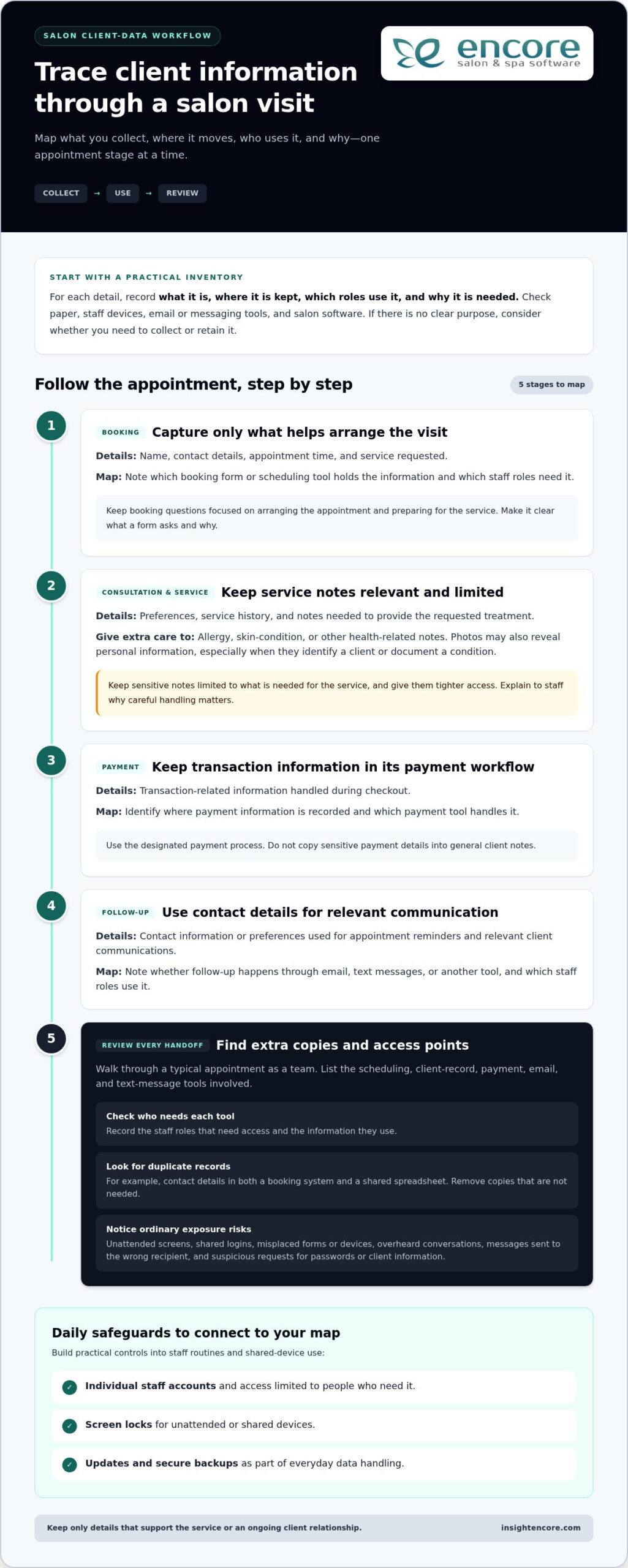
Categories
Uncategorized

Get Positive Salon Reviews: A Practical 2026 Guide

What if getting more salon reviews had less to do with asking more often and more to do with asking at the right moment? Happy clients can leave feeling great about their visit, then forget to share that experience. If you’re wondering how to get positive reviews for my salon without making clients or staff uncomfortable, the answer starts with a simple, respectful routine.

It’s understandable to feel cautious. You want more honest feedback, but you don’t want to pressure clients, break platform rules, or make a critical review feel personal. A clear process helps your team know when to ask, what to say, and how to respond calmly to both praise and concerns.

This practical guide explains how to invite feedback naturally and make it easy for clients to find the right review page. You’ll also learn how to keep requests fair, handle negative comments constructively, and use organized booking and client records to support consistent follow-up. The goal isn’t to chase perfect ratings. It’s to help satisfied clients share genuine experiences and show every reviewer that you’re listening.

Key Takeaways

  • For how to get positive reviews for my salon, invite honest feedback after clients have experienced the service, without pressure or incentives tied to positive ratings.
  • Make requests easy to act on: choose a natural moment, ask politely, share the review destination, and thank the client.
  • Prioritize review platforms your clients already use to discover and evaluate local salons.
  • Respond to praise and criticism with calm, personal replies that acknowledge the client’s experience and address concerns constructively.
  • Build a steady routine for requests and feedback, with clear staff ownership and no pressure to target only certain clients.

Why positive salon reviews start with a memorable client experience

A positive salon review is a client’s voluntary account of what they genuinely experienced. It isn’t a script to steer them toward a five-star rating. The foundation is the visit itself: clear expectations, attentive service, and straightforward checkout. A beautiful result matters, but so does whether the client felt heard, knew what to expect, and left with useful aftercare guidance.

That’s why how to get positive reviews for my salon starts before anyone asks for feedback. Each part of the appointment can shape a client’s impression, and a small mismatch can overshadow excellent technical work. Consistency helps clients feel comfortable sharing specific, honest feedback. Authentic salon reviews grow from experiences clients can describe clearly, from booking through aftercare.

Which parts of a salon visit influence client feedback?

Clients notice different details, so don’t assume one part of the visit matters most to everyone. A first-time guest may value a clear consultation, while a regular may appreciate an on-time appointment or a stylist who remembers their preferences. Consider the full experience:

  • Booking: Make available services, timing, and appointment details clear.
  • Arrival: Greet clients warmly and explain any wait or next step.
  • Consultation: Discuss the desired result, maintenance, and realistic options before beginning.
  • Service: Check in at appropriate points, especially before making a notable change.
  • Payment: Keep checkout clear, including what the client is paying for and how to rebook.
  • Aftercare: Share relevant care advice so clients know how to maintain their style or treatment.

Clear communication can prevent avoidable disappointment. For example, explaining that a color result may take more than one appointment helps align expectations before the service starts. Organized booking and client records can also help your team provide consistent service and thoughtful follow-up.

Why authentic reviews matter more than a perfect-looking score

Specific, balanced feedback gives prospective clients a more useful picture than a string of vague praise. A review that describes the consultation, the stylist’s approach, or the maintenance advice can help someone decide whether the salon suits their needs. Reputation management broadly involves shaping how a business is perceived online; online reputation management also includes paying attention to what people share and responding thoughtfully.

Keep the distinction clear: genuine reviews come from real clients describing their own visits. Fabricated, purchased, or staff-written reviews misrepresent that experience and undermine trust. A particular rating can’t guarantee bookings or search visibility. Aim instead for an honest picture of the service your team provides, and use feedback to recognize what clients value and where the experience could be clearer.

How to ask salon clients for positive reviews without pressure

A good request feels like a natural part of follow-up, not a push for praise. Keep the process simple: choose a suitable moment, ask politely, share the review destination, then thank the client. Invite honest feedback about their experience, whether it was entirely positive or not. Don’t decide who to ask based on who seems most likely to leave a high rating.

When is the right time to invite a salon review?

A friendly checkout request can work when a client is relaxed and has had time to experience the service. If they’re rushing, raising a concern, or focused on payment, don’t force the moment. A brief follow-up message after the appointment gives them space to reflect. Choose timing that fits your salon’s client journey, and keep the invitation optional.

For an in-person ask, try: “Thanks for coming in today. If you’d like to share how your visit went, we’d appreciate an honest review. I can show you where to leave one.” It’s warm, clear, and doesn’t imply that only positive comments are welcome.

What should a salon review request say?

Use a short message that thanks the client, makes clear that feedback is voluntary, and provides a direct route to your chosen review platform where its rules permit. For example: “Thanks for visiting us. If you have a moment, you’re welcome to share honest feedback about your appointment here: [review link]. We appreciate you taking the time.” Review each platform’s current request rules before sending messages or sharing links.

Keep the tone personal rather than scripted. A follow-up might mention the service the client received, but don’t ask them to describe specific praise or change a rating. The Federal Trade Commission’s guidelines for customer reviews offer useful direction for collecting and presenting feedback transparently.

A smooth appointment journey can make follow-up feel more natural. For ideas on organizing booking and client information, explore this guide to salon software and client management. Organized records and follow-up workflows can support a consistent process, while the review invitation itself remains thoughtful and client-led.

That’s a practical foundation for how to get positive reviews for my salon: ask consistently, make it easy to respond, and leave the choice entirely with the client. If they decline or don’t respond, thank them just the same.

Which review channels should your salon focus on?

You don’t need to ask clients to post everywhere. Focus on the places they already use to find or evaluate local salons, and make the choice clear. Consider where potential clients discover your business, what feedback helps them decide, and whether your team can keep up with responses.

Google, Yelp, or Facebook: how do salon review sites differ?

Each platform serves a different role, and its value depends on your local area, services, and clients’ habits. Google Business Profile connects reviews with a business listing clients may encounter while searching locally. Yelp focuses on local business discovery and customer reviews. Facebook can make feedback visible in a social setting where clients may already follow or interact with your salon. None is automatically the right choice for every salon.

Platform Where clients may find the salon Review usefulness Owner response options
Google Business Profile Google Search or Maps business listings Feedback alongside basic local business information Reply to reviews through the business profile, subject to current platform features
Yelp Yelp’s local business directory and review pages Client accounts of their experiences with local businesses Respond through available business tools
Facebook A salon’s Facebook presence and related social activity Feedback in a familiar social environment for clients who use Facebook Reply through the salon’s page, according to current settings

Use the table as a guide, not a ranking. Notice which sites clients mention, where your salon already receives genuine feedback, and which channels your team can monitor consistently. A focused approach to how to get positive reviews for my salon means building visibility where clients naturally look, not scattering requests across every platform.

How can a salon make leaving a review easier?

Offer a direct link or a QR code that takes clients to the intended review page, where the platform permits that method. Keep the instruction simple, such as, “You can share feedback about your visit here.” Don’t make clients search for your listing or follow a long set of steps. They may need to sign in or meet other platform requirements, so don’t promise a process with no extra steps.

Check each platform’s current policies before inviting reviews, including rules for links, QR codes, and incentives. Never offer a reward, discount, or gift in exchange for a positive review. If you offer an incentive for feedback, it must not depend on the rating or sentiment and must comply with the platform’s rules. Invite clients fairly, and let them decide whether and where to share their honest experience.

Get Positive Salon Reviews: A Practical 2026 Guide

Responding to Salon Reviews & Handling Criticism

Your reply is part of the experience people see when they evaluate your salon. A composed response shows that you pay attention to feedback, whether the review is glowing or difficult to read. You don’t need to answer in a hurry. Take a moment to understand the comment and choose words that are respectful, specific, and useful to anyone following the conversation.

How should a salon reply to a positive review?

Thank the client and refer to a detail they chose to share. If they mention feeling comfortable during a consultation or loving the finished style, acknowledge that detail without adding information they didn’t make public. Keep the reply warm and brief. A personal response feels more genuine than pasting the same template under every review, and there’s no need to pressure the reviewer to return or leave more praise.

For example: “Thank you for sharing this. We’re glad the consultation helped you feel comfortable with your new style, and we appreciate you choosing our salon.”

What should you do when a salon review is negative?

Pause before replying, especially if the review feels personal. Then use a simple framework: thank the reviewer for speaking up, acknowledge the concern they described, address it briefly, and offer a private way to discuss details and possible next steps. Avoid arguing point by point or trying to prove the client wrong in public.

A professional response acknowledges a client’s concern while protecting the private details of their visit. Don’t confirm appointment specifics, discuss health information, or bring personal disputes into a public reply. You could say, “We’re sorry to hear the visit didn’t meet your expectations. Please contact the salon directly so we can understand more and discuss this with you.” Keep the invitation calm and open, without promising an outcome before you understand the issue.

After responding, look for lessons in the feedback. If several clients raise a similar concern about wait times, communication, or checkout, review the process with your team and decide whether a practical change is needed. Treat each comment as one person’s account, but don’t dismiss a recurring theme.

A thoughtful routine for how to get positive reviews for my salon includes making space for criticism, not just celebrating praise. Consistent, personal replies can reassure current and prospective clients that feedback is taken seriously. Protecting privacy keeps the conversation respectful.

To see how salon management software can support organized booking and client follow-up, explore Encore’s salon management software.

Build a sustainable salon review routine with better client follow-up

A review process works best when it’s part of your salon’s regular client-care routine, not a scramble to collect praise. Give one team member responsibility for checking feedback, agree on a natural moment to invite clients to share an honest review, and keep a simple record of follow-up. Ask consistently across clients rather than selecting only those you expect to be happy.

Look for themes, not just ratings. Feedback about consultations, appointment flow, or aftercare may point to something the team can improve. Set a regular time to review comments and staff observations, but avoid review targets that could make requests feel pressured or lead to selective invitations.

How can salon software support a consistent client experience?

Online booking and organized client records can help your team manage appointments and keep relevant client information accessible. That supports more consistent service and considered follow-up, such as remembering preferences or noting the best way to communicate. Encore Salon & Spa Software brings salon operations tools together, including online booking and client management. It helps organize the client journey, while review invitations remain personal and client-led.

A simple weekly review routine salon owners can maintain

Set aside a regular time to read new feedback, respond where appropriate, and note recurring service themes. Then check in with staff: does everyone know when and how to invite honest feedback, and does the request feel comfortable for both the team and clients? Adjust the process if it feels rushed or uneven.

  • Assign ownership: Decide who checks review channels and shares useful themes with the team.
  • Keep invitations consistent: Choose a natural point in the client journey and invite feedback without pressure.
  • Learn from patterns: Discuss recurring comments and choose practical service improvements where warranted.

Keep the routine lightweight. The goal is a dependable process that helps clients share real experiences and helps your team listen, not a quota for ratings. Organized booking, client information, and follow-up can make that process easier to maintain as part of daily salon operations.

Encore’s salon management tools bring online booking and client management together to help organize appointments and client information. Explore Encore for your salon.

Build a review routine clients can trust

The best answer to how to get positive reviews for my salon isn’t pressure or a perfect-rating target. It’s a thoughtful client experience, followed by a polite invitation to share honest feedback. Ask consistently, make it easy to find your chosen review platform, and give every client the same freedom to decide whether to respond.

Keep listening after reviews arrive. Thank clients for specific praise, address concerns calmly, protect private details, and look for recurring themes that could help improve service. A steady routine makes review follow-up manageable and shows clients that their feedback matters.

Organized salon operations can support that consistency. Encore provides salon management software with online booking and client management, plus automated marketing and loyalty program tools. These features can help your team organize appointments and follow-up, while review requests and replies remain personal and client-led.

Start with one simple step, then build a process that feels natural for your team and respectful to every client. Genuine feedback grows from genuine care.

Explore Encore for your salon

Frequently Asked Questions

How do I ask salon clients for a review?

Ask politely after the appointment and make clear that honest feedback is welcome, whether it’s positive or negative. For example: “Thanks for visiting us. If you’d like to share your experience, you can leave an honest review here.” Share a direct link to your chosen platform where its rules allow, then thank the client. Invite clients consistently rather than asking only those you expect to give a high rating.

When should a salon ask a client to leave a review?

Ask after the client has had time to experience the service, such as during a relaxed checkout or in a later follow-up message. Avoid interrupting a consultation, service, or sensitive conversation. Adapt the timing to your salon’s flow and the client’s situation. If someone seems rushed or is raising a concern, give them space and don’t press for a review.

Can salons offer discounts in exchange for positive reviews?

No. Don’t offer discounts, gifts, or other rewards in exchange for a positive review. A review invitation should leave clients free to share their honest opinions without pressure or a benefit tied to the rating. Incentives can undermine trust and may conflict with platform policies. Check the current rules for each review site before running any feedback campaign, including one that offers an incentive for reviews generally.

How can a salon get more Google reviews?

Invite clients consistently to share honest feedback on your Google Business Profile, and make the review page easy to find with a direct link where permitted. Don’t filter requests based on whether a client seems happy, offer rewards for positive ratings, or ask clients to change their opinions. A clear, low-pressure request after the appointment gives clients the choice to review without making the invitation feel like a demand.

What should a salon do about a negative review?

Pause, then reply calmly and acknowledge the concern the client described. Thank them for the feedback, address the issue briefly, and invite them to contact the salon privately to discuss details and possible next steps. Don’t argue publicly or disclose appointment, health, or personal information. Review feedback for recurring themes, then consider practical service changes if the same concern appears repeatedly.

How many reviews does a salon need to build trust?

There’s no single review count that guarantees trust. Prospective clients may find recent, specific feedback more useful than a large collection of older or vague comments. Focus on inviting reviews consistently and fairly, then respond thoughtfully to both praise and criticism. Honest accounts that describe different aspects of the client experience can help readers form realistic expectations without suggesting that every visit is identical.

Can salon software automatically ask clients for reviews?

Salon software can help organize appointments and client information, supporting a consistent client experience and follow-up. Encore Salon & Spa Software provides tools such as online booking, client management, automated marketing, and loyalty programs. Keep review invitations personal, voluntary, and consistent with each platform’s current rules.

Disclaimer

This article is general in nature and may contain errors, please verify all claims with your sales rep