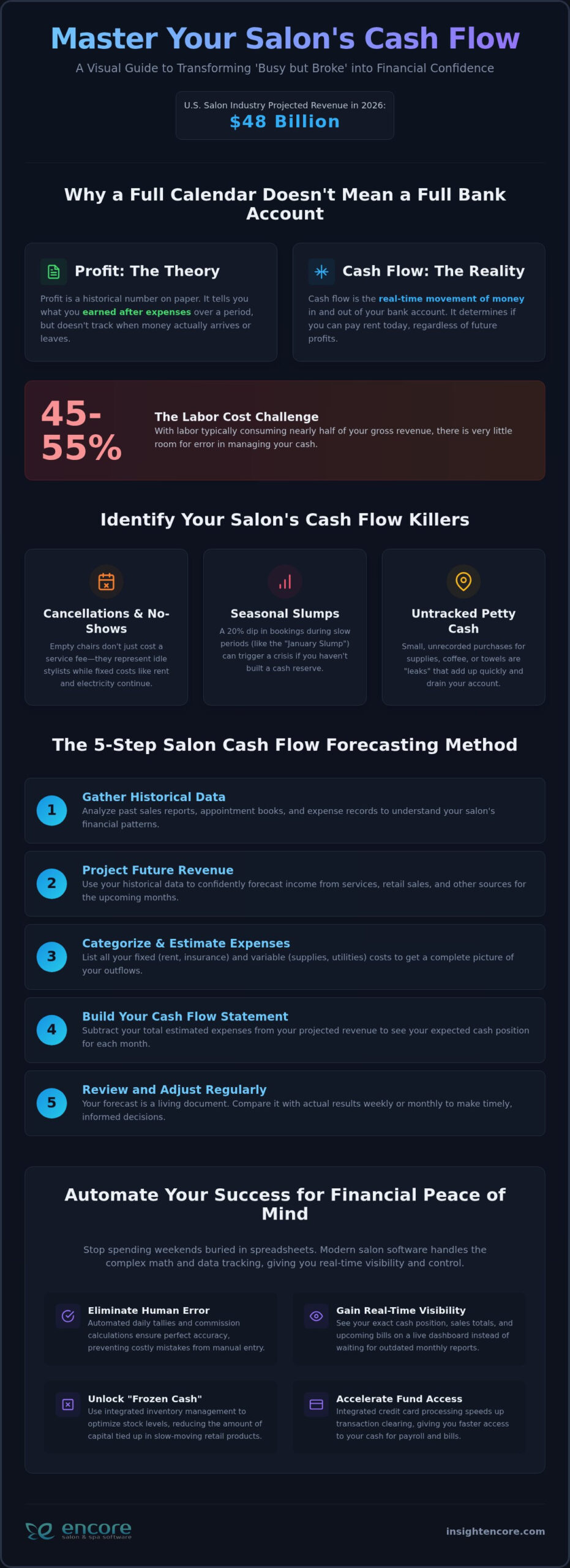
What if your salon business plan did more than fill a folder and actually helped you decide what to do next? Starting with a blank document can make it hard to connect your salon concept, ideal clients, daily operations, and financial assumptions. A practical salon business plan template 2026 gives you a clear structure for working through those decisions, including the services you’ll offer, how clients will book, and what your salon needs to operate.
It’s normal to feel unsure about projections while you’re still shaping the business. The goal isn’t to predict every outcome perfectly. It’s to make your assumptions visible, understand how they fit together, and update them as your salon develops.
This step-by-step guide will help you outline your concept and customer base, assess your market, map services and operations, and organize startup costs, revenue expectations, and ongoing expenses. Use it as a working document, not a one-time exercise. Revisit it when your services, staffing, bookings, or costs change.
Key Takeaways
- Use the salon business plan template 2026 to connect your concept, customers, services, operations, and financial assumptions.
- Build a customer profile worksheet around real needs, service preferences, location, and booking habits. Separate research findings from assumptions.
- Compare service categories, delivery formats, staffing, and booking workflows to keep your service mix aligned with your salon concept.
- Organize your financial plan in sequence, from startup costs and revenue assumptions to recurring expenses and cash flow.
- Turn the plan into a working roadmap by tracking sources, dates, owners, and next actions, then revisiting it when the business changes.
Start Your Salon Business Plan 2026 With a Focused Concept
A salon business plan connects your concept, customers, operations, and financial assumptions. It gives each decision a place in the bigger picture: who you want to serve, what you’ll offer, how the salon will run, and what resources the business needs. If you’re new to planning, this overview of a business plan explains its role and common components.
Start with the salon you intend to build, not a generic description of the beauty industry. Name your format, service focus, location or service area, and the experience you want clients to have. For example, a studio specializing in color services will plan its appointments, staffing, and customer experience differently from a full-service salon offering hair, nails, and other treatments. Those specifics make the rest of the plan more useful.
Write an executive summary that explains the salon at a glance
Your executive summary should give readers a concise understanding of the business. Draft it after completing the other sections so it reflects your research and forecast, rather than untested promises. Describe the concept, intended customers, core services, and business goals. Explain the experience you plan to deliver with practical details, such as your consultation style, appointment format, or planned services.
Copy-ready prompt: “[Salon name] will be a [salon format] in [location or service area], serving [intended customers and their needs]. Its core services will include [services]. Customers can expect [distinctive, practical experience]. The business aims to [goals]. It is planning to [funding need, if applicable], based on a forecast that estimates [brief financial highlights].” Leave the funding and financial highlights blank until you’ve built the forecast. Then check that each statement matches the details elsewhere in your plan.
Define the salon model before filling in the rest
Choose a working model that reflects how clients will access your services and how the salon will operate. A full-service salon may offer several service categories under one roof, while a specialty studio may focus on a narrower set of treatments. An independent stylist may work alone; another business may have a team or use a chair or booth rental arrangement. Treat these as planning choices and describe the one that fits your idea.
- Format: What kind of salon or studio are you planning?
- Service focus: Which core services fit the concept, and what experience will they create?
- Business stage: Is this plan for a new launch, expansion, ownership change, or review of an existing operation?
- Location: Where will you operate, and what local requirements apply to the business and practitioners?
State your location and research the requirements for that jurisdiction, since rules can vary. Keep the salon business plan template 2026 grounded in its planning context: date your estimates and research, identify assumptions, and revisit them when the location, services, staffing, or circumstances change. A dated plan is easier to review than one that treats early estimates as permanent facts.
Build a Salon Market and Marketing Plan Around Real Customers
A useful market plan starts with people, not broad claims about what “everyone” wants from a salon. Identify the customer groups your concept is designed to serve, the needs behind their service choices, and how they may find and book with you. Separate what you’ve learned through research from what you’re still assuming. That distinction helps you make decisions without presenting a guess as a fact.
Describe your target customers and local market
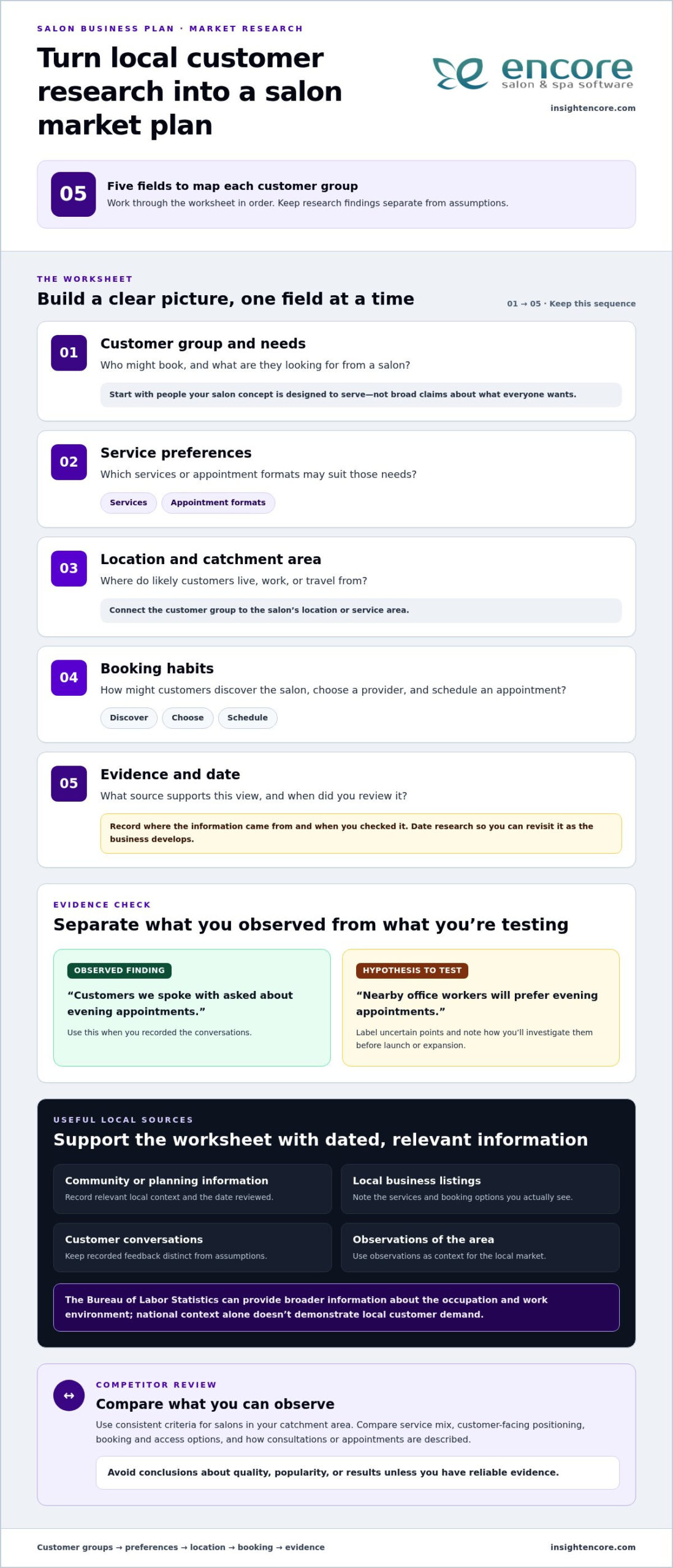
Use this worksheet for each customer group you’re considering. Be specific enough to connect the group to your services and location.
- Customer group and needs: Who might book, and what are they looking for from a salon?
- Service preferences: Which services or appointment formats may suit those needs?
- Location and catchment area: Where do likely customers live, work, or travel from?
- Booking habits: How might they discover the salon, choose a provider, and schedule an appointment?
- Evidence and date: What source supports this view, and when did you review it?
For local context, record relevant sources such as dated community or planning information, local business listings, customer conversations, and your observations of the area. When comparing online listings, note the services and booking options you actually see, and when you reviewed them. The Bureau of Labor Statistics can provide broader information about the occupation and work environment, but national context alone doesn’t demonstrate local customer demand.
Separate findings from hypotheses. For example, “customers we spoke with asked about evening appointments” is an observed finding if you recorded those conversations. “Nearby office workers will prefer evening appointments” is a hypothesis to test. Label each statement and note how you’ll investigate uncertain points before launch or expansion.
Compare competitors and clarify your position
Review salons in your catchment area using consistent criteria and information you can observe. Compare their service mix, customer-facing positioning, booking and access options, and the way they describe consultations or appointments. Avoid conclusions about quality, popularity, or results unless you have reliable evidence. The goal isn’t to copy another salon. It’s to understand what clients can already choose and define how your concept will differ.
Summarize your position in one clear customer-facing sentence: “We help [customer group] get [service or experience] through [specific approach].” Keep it grounded in what your salon plans to deliver, not an unsupported claim that it’s the best or only option.
Turn positioning into a focused marketing plan
Choose activities that fit how your intended clients discover and revisit salons. Include how clients will move from finding your business to choosing a service and booking an appointment. For each activity, record an owner, a review date, and a measure, such as inquiries, first-time appointments, referral bookings, repeat visits, or promotion redemptions.
- Discovery: Keep local listings and service information accurate, and share useful salon content through suitable channels.
- Referrals: Give satisfied clients a simple way to recommend the salon and track referral bookings.
- Repeat visits: Plan follow-up and retention activities that suit your services and appointment cycle.
- Promotions: Set a clear purpose, audience, and review date before offering a promotion.
In your salon business plan template 2026, treat each marketing idea as something to review, not a guaranteed result. Compare activity with the measures you chose, keep what supports your goals, and revise what doesn’t. Encore’s automated marketing, loyalty programs, and gift card management can support the marketing activities you choose to include in your salon’s operations.
Choose Salon Services, Staffing, and Workflows That Fit the Concept
Your service menu shapes more than what clients can book. It affects the people, time, supplies, space, and daily processes your salon needs. Build the menu around your concept and the customer needs you’ve identified, then check that each service fits your staffing and schedule. The Small Business Administration’s business-plan guidance also emphasizes connecting key plan details rather than treating each choice in isolation.
Select a service mix and explain how it supports the salon
Use this comparison worksheet to assess each proposed category. Add a row for each service and note what it requires before including it in your launch menu.
Service category: [Service] | Delivery format: [In-salon, appointment, walk-in, or other] | Staffing approach: [Owner, employee, commission, or renter] | Customer access: [How clients find and book it]
Customer need and concept fit: [Need served and how this service supports the salon’s promise] | Resources and dependencies: [Staff skills, space, equipment, products, or other requirements] | Timing: [Launch priority or possible later addition]
For example, a specialty salon might prioritize a focused set of related services rather than add unrelated options just to make the menu longer. State why each service belongs and what it depends on. If you don’t yet have evidence of demand, label it as an assumption and set a review date. This keeps an early idea from quietly becoming a fixed forecast.
Match staffing and appointment workflows to the business model
Compare staffing approaches based on the experience and operating structure you want, not on a universal “best” model. Employee teams can support shared workflows; commission arrangements connect compensation to service work; booth rental gives independent professionals their own operating arrangement; an owner-operated salon relies heavily on the owner’s available time. Record who handles each task and how the approach fits the planned services. Research jurisdiction-specific requirements separately.
Next, map the customer journey as distinct steps. An appointment-led salon plans capacity around scheduled services; a walk-in model needs a process for arrivals and waiting; a mixed model must account for both. For each service, estimate appointment length and available working hours, and note the assumptions behind each estimate. Review the salon staff utilization rate alongside booking capacity, but don’t treat every open hour as a bookable service hour. Consultations, transitions, and other duties take time too.
- Booking: Capture service, timing, and appointment details.
- Consultation: Confirm the client’s needs and planned service.
- Service delivery: Assign the right staff member and time.
- Checkout: Record the transaction and any relevant product sale.
- Follow-up: Document the next step, such as a rebooking reminder.
In your salon business plan template 2026, identify an owner for each workflow step and the system that supports it. Online booking, client records, inventory tracking, and point-of-sale tools can form part of the operational plan. Encore provides these tools to support salon workflows. Revisit staffing and capacity assumptions when the menu, schedule, or customer demand changes.
Use a Salon Financial Plan Template to Connect Assumptions
A financial plan becomes useful when each estimate traces back to an operating choice. Your service mix informs appointment capacity; capacity and booking assumptions inform revenue; and the costs of delivering those services shape cash needs. Treat figures as planning scenarios, not promises. Build cautious, expected, and stronger cases to see how changes in bookings, costs, or timing may affect the plan.
Estimate startup needs and recurring salon expenses
Separate one-time setup costs from ongoing expenses. Research costs for your location and business model, then record a source and date beside every estimate. A note such as “supplier quote, reviewed [date]” makes it easier to revisit an assumption later.
- One-time setup: premises preparation [estimate, source, date]; equipment [estimate, source, date]; opening supplies and inventory [estimate, source, date]; launch activity [estimate, source, date].
- Recurring expenses: rent and occupancy [estimate, source, date]; staffing [estimate, source, date]; supplies replenishment [estimate, source, date]; systems and payment costs [estimate, source, date]; ongoing marketing and other operating costs [estimate, source, date].
Separate fixed commitments, such as a regular lease payment, from costs that may change with service volume, such as product use. Use categories that reflect your actual plan rather than an invented industry average. A solo operator and a staffed salon, for example, may have different staffing and premises assumptions. Make sure your estimates match the model you’ve chosen.
Connect service capacity to revenue and cash-flow assumptions
Build the forecast in sequence. First, list services, planned prices, and the time each appointment requires. Then estimate available bookable time after allowing for breaks, administration, and other duties. Apply an expected booking assumption to that capacity, and show how many appointments or services you expect to complete. Keep each input visible. An open appointment slot is not a confirmed booking.
Use this five-step worksheet to connect the figures:
- Startup costs: Total one-time setup items and note when payments are expected.
- Revenue assumptions: Connect services and planned prices to available capacity and expected bookings.
- Operating expenses: List recurring fixed costs and costs that vary with activity.
- Cash flow: Map when money is expected to come in and when bills and setup costs are due.
- Review: Compare cautious, expected, and stronger cases, then record the source, date, and owner of each key assumption.
Break-even worksheet: Planned costs for the period [ ]; expected revenue per completed service [ ]; estimated services needed to cover planned costs [ ]; assumptions and review date [ ]. Break-even means revenue covers the costs included in your plan. It isn’t a profit target or a guarantee. A salon profit margin checklist can also help you examine how operating choices relate to profitability.
As your salon operates, compare actual bookings, transactions, and expenses with your assumptions. Online booking, client records, inventory tracking, and point-of-sale tools can help organize the activity you review. Encore Salon & Spa Software brings these capabilities together, along with integrated credit card processing. Keep the salon business plan template 2026 adjustable, and update the forecast when services, staffing, or costs change.
Turn Your Salon Business Plan Into a Working 2026 Roadmap
A finished plan is a starting point, not a document to file away. Use it to guide decisions, then update it when the business changes. Before sharing it or acting on it, check that the executive summary matches your customer, service, operations, and financial sections. If the summary promises a service the operating plan doesn’t support, or the forecast relies on bookings your schedule can’t accommodate, resolve the mismatch first.
Review the plan before sharing or acting on it
Run through this checklist to make the plan clear, grounded, and ready to use:
- Owners: Name who is responsible for each action and assumption.
- Evidence: Record the source behind important market findings and estimates.
- Assumptions: Label what you still need to test instead of presenting it as confirmed.
- Dates: Add when each source was reviewed and when the assumption should be revisited.
- Next actions: Specify the task, owner, and review date so an idea becomes a practical step.
For each key assumption, keep a short note such as “expected appointment demand, based on [source or reasoning], owned by [person], review by [date].” The salon management software features you choose should also match workflows documented in the plan, rather than being selected without a clear operational need.
Use salon software to support planned workflows
Revisit your plan after a meaningful change, such as adding or removing services, changing staffing, seeing a sustained shift in demand, or adjusting operating priorities. You don’t need to rewrite every section each time. Update the affected assumptions, then check how the change affects capacity, costs, customer access, and financial expectations. Date each revision so you can distinguish the current plan from earlier estimates.
Make sure the systems you use support the daily steps you’ve mapped. Online booking supports appointment scheduling; client management organizes client records; inventory tracking helps you account for products; and point-of-sale tools record checkout transactions. These details matter because the plan is only practical if the workflows behind it can be carried out consistently.
Encore Salon & Spa Software brings together online booking, client management, inventory tracking, and point-of-sale transactions, along with integrated credit card processing, automated marketing, loyalty programs, and gift card management. Match these capabilities to the tasks your salon plans to handle, and document how the tools fit into your workflow. Software can support salon operations, while decisions about your services, team, and customer experience remain part of your plan.
Keep the salon business plan template 2026 as a working reference. Set a recurring review date that suits your business, and revisit it sooner when an important change calls for a fresh look. If Encore’s salon management capabilities fit the workflows you’ve planned, explore how they can support your day-to-day operations.
Put Your Salon Plan Into Motion
Your plan doesn’t need to answer every question before you begin. Choose one assumption to test next, such as which services to prioritize or how clients will book, and give that step an owner and review date. Small, tracked decisions help turn the salon business plan template 2026 into a practical guide you can adjust as you learn.
As you put the plan into action, consider whether your daily systems fit the workflows you’ve mapped. Encore Salon & Spa Software includes online appointment booking and client management, along with inventory tracking, point-of-sale transactions, and integrated credit card processing. These tools support the operational tasks in your plan while your salon’s goals and choices remain your own.
Start with the next clear step, review what you learn, and let your plan develop alongside your salon. Explore Encore Salon & Spa Software to see how its booking, client management, inventory, and point-of-sale tools can support your planned workflows.
Frequently Asked Questions
Can I use a salon business plan template for a booth-rental or solo stylist business?
Yes. Adapt the template to the business you actually operate. An independent stylist can describe their services, customer base, workspace arrangement, booking process, and business responsibilities, including which tasks they handle themselves. Keep a shared-space or booth-rental arrangement distinct from an employee model, since responsibilities and expenses may differ. Base financial assumptions on the stylist’s own income and costs, not on figures copied from a full-service salon plan.
Do I need a business plan if my salon is already open?
Yes. A plan can help an operating salon clarify priorities, assess a new service, consider a staffing change, or prepare for growth. Start with current information rather than treating launch estimates as permanent. Before adding a service, for example, compare the idea with your current schedule, customer feedback, and available resources. Note what has changed, then update the sections that will help you make the decision.
How long should a salon business plan be?
There’s no single required length for every use. A working plan should explain your salon concept, customers, operations, and financial assumptions clearly without becoming difficult to review. Focus on useful detail, not page count. If you’re preparing the plan for a lender, landlord, or another audience, tailor its depth and supporting documents to that audience’s stated requirements. A concise plan can still be thorough when its evidence and assumptions are clear.
Can a salon business plan guarantee a loan or business success?
No. A plan can organize your salon concept, show how your assumptions connect, and communicate the preparation behind your decisions, but it can’t guarantee financing or business results. Decisions depend on factors beyond the document, and projections are estimates rather than promises. Use available evidence, be clear about uncertainty, and revise estimates as operating information becomes available. Treat the plan as a decision-making tool, not a certain prediction of what will happen.
How often should I update my salon business plan?
Review it on a regular schedule and whenever a meaningful change affects the business. A new service mix, staffing arrangement, location, or shift in customer demand may change the assumptions behind your plan. You don’t need to rewrite every section each time. Check which details no longer reflect current conditions, record the important changes, and assign someone to complete the next review by a specific date.
What financial information should I gather before completing a salon plan?
Gather the information that supports your estimates, including proposed services and prices, expected appointment capacity, startup needs, recurring expenses, and available cash-flow information. The details you need depend on your salon’s stage and location, so research local costs instead of relying on generic figures. If you don’t yet have exact numbers, label estimates clearly, note how you arrived at them, and revisit them before making commitments.
Is a salon business plan template useful when I am still researching my idea?
Yes. A salon business plan template 2026 can help you identify what you still need to learn before settling on a concept or committing resources. Use it to keep open questions, research sources, and assumptions together, rather than treating early guesses as established facts. For example, record what you need to find out about potential customers or workspace options, then update those sections as your research develops.
Disclaimer
This article is general in nature and may contain errors, please verify all claims with your sales rep