
window.dataLayer = window.dataLayer || []; function gtag(){dataLayer.push(arguments);} gtag('js', new Date()); gtag('config', 'UA-206511945-1');
Search
Categories
Uncategorized

Managing Salon Gift Card Liability Through Redemption and Breakage

A gift card sale brings in cash, not earned revenue. Under U.S. GAAP, managing salon gift card liability means recording the payment as a liability until the promised service or product is provided, then recognizing revenue when the customer redeems the card. Expected breakage follows separate rules, and expiry depends on applicable state law.

It’s easy to mistake gift card sales for income because the money is already in your account. But the salon still owes the cardholder something, so keep the balance visible until it’s redeemed or otherwise accounted for. Customer deposits also represent money received before a service, but they relate to a specific booking rather than an open-ended gift card balance.

Can software automate the tracking? It can help record sales, redemptions, and remaining balances, but the accounting treatment still depends on what the salon owes and when that obligation is fulfilled. This article explains when gift card revenue is recognized, how breakage differs from deposits, and why expiry rules can affect the liability you carry.

Key Takeaways

  • Keep prepaid gift card balances distinct from earned revenue, and recognize service revenue as the card is redeemed.
  • Separate gift card obligations from customer deposits, since each relates to a different promise the salon must fulfill.
  • Use redemption history and evidence-based estimates to assess breakage rather than treating every unused balance as income.
  • Account for state expiry and unclaimed-property rules before deciding how to handle dormant balances.
  • Gift card software can help track sales, redemptions, and outstanding balances, giving you clearer records to support accounting decisions.

Revenue recognition at redemption

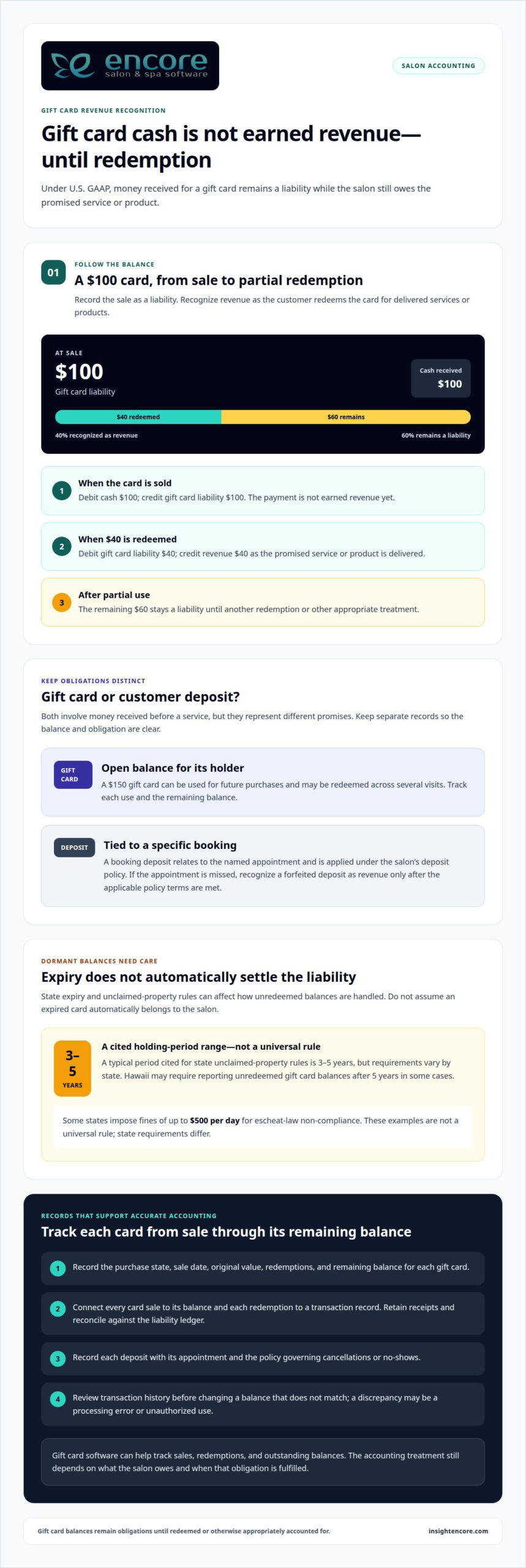
Under U.S. GAAP, cash received for a gift card is a contract liability until the promised service or product is delivered. Track the balance from sale through redemption, including any partial use.

Accounting Entries for Sales and Redemptions

Accounting entries show when gift card cash arrives and when the salon fulfills its obligation. They matter because recording a sale as earned revenue too early can overstate income. For a $100 gift card, debit cash and credit gift card liability by $100. If the customer later redeems $40, debit the liability and credit revenue by $40.

The remaining $60 stays recorded as a liability until another redemption or other appropriate treatment. A digital or physical card changes how the balance is accessed, not the basic accounting sequence: record the sale, then recognize revenue as services or products are delivered.

Effects on Cash Flow, Taxes, and Statements

Gift card sales bring in cash before the salon delivers a service, while the balance sheet carries the unredeemed amount as a liability. That cash can support current operations, but spending it does not remove the obligation to serve cardholders. Tracking outstanding balances alongside cash flow helps the salon plan for future redemptions and read financial statements accurately.

Book revenue and taxable income can follow different timing. According to the Internal Revenue Service, an accrual-method salon generally includes advance payments for future goods or services in gross income in the taxable year received. Keep tax reporting distinct from the U.S. GAAP liability entry, and use the applicable accounting and tax treatment.

To encourage redemption and repeat purchases, make balance inquiries simple and send clear reminders. Digital gift cards can make balances easier to access through mobile wallets, while online and in-salon redemption options give customers more ways to use them. Prompting customers to book a follow-up appointment at checkout can help turn a gift-card visit into an ongoing salon relationship.

Connect each card sale to its balance and every redemption to a transaction record. Limit who can issue cards or adjust balances, retain receipts, and reconcile sales and redemptions against the liability ledger. If a balance doesn’t match, review the transaction history before changing the amount. This helps distinguish a processing error from unauthorized use.

If the salon closes, changes ownership, or changes its services, outstanding cards still represent customer obligations that need a clear plan. Preserve balance and transaction records, identify who will handle remaining redemptions, and communicate service changes to cardholders. The federal CARD Act provides an underlying framework for U.S. gift card regulation, while state rules also apply to unredeemed funds and expiry.

What’s the difference between gift cards and customer deposits?

A gift card creates an obligation to provide services or products to its holder, while a customer deposit is usually tied to a specific booking. For example, a $150 gift card remains available for future purchases, but a deposit for a scheduled appointment relates to that reservation. Keeping separate records helps show what the salon owes and why.

That difference matters when plans change. A customer may redeem a gift card across several visits, leaving a balance after each partial use. A booking deposit, by contrast, is applied to the named appointment under the salon’s deposit policy. If a customer misses that appointment, recognize a forfeited deposit as revenue only after the applicable policy terms are met.

Unredeemed gift card balances can also become unclaimed property, sometimes called escheat. In many U.S. states, businesses may have to report and remit unused value after a state-specified holding period. A typical period cited for state unclaimed-property rules is 3-5 years, but the governing requirements vary by state. This is a separate issue from recognizing revenue under accounting rules.

To understand which requirements apply, identify where the card was purchased and where the issuer is incorporated. The state whose rules may apply is typically the state where the card was purchased or where the issuer is incorporated. Then consult that state’s official unclaimed-property rules for reporting, remittance, and any exemptions. Some states exempt certain single-merchant retail cards from escheat, while others require remittance of qualifying balances.

State differences can affect both timing and treatment. For example, Hawaii may require reporting unredeemed gift card balances after 5 years in some cases. Some states also impose fines of up to $500 per day for escheat-law non-compliance. These examples aren’t a universal rule; a salon operating across state lines may need to track the state connected to each card.

Keep separate records for deposits and gift cards. For each gift card, retain the purchase state, sale date, original value, redemptions, and remaining balance. For each deposit, record the related appointment and the policy that governs cancellations or no-shows. These details help identify dormant balances without treating every unused amount as revenue or as a customer deposit.

A clear ledger also supports ownership changes or business closures. Keep a record of outstanding cards by state and preserve evidence of reporting or remittance. Because state rules determine whether unredeemed balances must be transferred, don’t assume an expired card automatically belongs to the salon.

When can I recognize breakage for unredeemed gift cards?

Breakage is the portion of gift card value customers are expected never to redeem. Recognize it as revenue only under an evidence-based approach, not simply because a card has gone unused.

Estimating Gift Card Breakage

Estimate breakage from historical redemption patterns for comparable gift cards, then apply that evidence consistently. An unsupported estimate can overstate revenue and understate outstanding gift card balances. The estimate should reflect actual customer behavior, including partial redemptions and how long balances typically remain unused.

One example uses $1,000 in cards and estimated breakage of 10%. That leaves a $900 redemption-eligible pool. The estimate is not a universal salon rate. A salon’s own transaction history is the relevant practice for assessing whether its estimate is reliable. Javelin estimated breakage at about 1.5% across the industry, but that figure does not establish an individual salon’s rate. Estimates should be reviewed against subsequent redemptions, so the approach reflects whether the original forecast holds up.

Recognizing Breakage as Revenue

When expected breakage can be estimated reliably, ASC 606 and IFRS 15 call for recognizing it in proportion to actual redemptions. This matters because revenue then follows customer use rather than an arbitrary date or assumption. In the $1,000 example, a $90 redemption from the $900 eligible pool corresponds to $10 of breakage recognition.

Apply the calculation consistently as customers redeem cards, and retain the data supporting both the estimated breakage and the recorded revenue. Breakage recognition under ASC 606 must be proportionate and evidence-based. For salons managing salon gift card liability, that means keeping the estimate tied to documented redemption patterns, not treating every inactive card as earned income.

Breakage and unclaimed property are separate issues. Accounting treatment addresses when revenue may be recognized; state unclaimed-property rules may require certain unredeemed balances to be reported or remitted. An accounting estimate does not erase a legal obligation. Track card balances and state-related records separately, and avoid counting the same amount as both breakage revenue and property owed to a state.

Time alone does not prove successful breakage recognition. Historical data may show when redemption becomes remote; the guide’s example timeframe for estimating patterns is 2-3 years, while breakage is typically considered after 24-36 months when redemption is deemed remote. Those periods are not automatic release dates. A disciplined approach to managing salon gift card liability uses actual redemption evidence and applicable state rules before recording revenue from unclaimed balances.
Managing Salon Gift Card Liability Through Redemption and Breakage

Recognizing revenue when gift cards are redeemed

Recognize revenue as the customer receives the promised service or product, not merely when a card is sold. Under ASC 606, redemption reduces the gift card liability and records the delivered item or service as revenue.

At redemption, apply the amount used to the customer’s transaction and reduce the corresponding liability. If a card covers only part of a salon visit, record the redeemed portion and keep the unused balance as a liability. The customer may use that remaining amount later, subject to applicable rules. This approach keeps the balance sheet aligned with what the salon still owes.

Retail purchases follow the same delivery principle. If a customer uses a gift card for shampoo, recognize revenue when the product is provided and reduce the liability by the amount applied. If the card covers both a haircut and retail items, allocate the redemption across those sales in the transaction record. This helps sales reports show which services and products customers actually received.

For memberships, account for when the salon provides the included benefits. If a gift card pays for a membership that provides services over time, the salon has not necessarily delivered every promised benefit on the purchase date. Track the card amount applied to the membership, then recognize revenue as membership services are provided. Clear records help distinguish a prepaid membership obligation from completed visits.

Promotions can create more than one obligation. A salon may sell a $100 gift card for $90, or offer a $20 bonus voucher configured as a zero-price promotional gift card with its own expiry. Keep the paid card and bonus voucher identifiable in the records. Their terms and redemption history may differ, so combining them can obscure the outstanding value and complicate revenue reporting.

Gift cards given to employees have a different tax treatment from customer cards. They are treated as supplemental wages and are generally taxable to the employee. Record employee gifts separately from customer gift card sales, and account for them through payroll records. This avoids mixing compensation with customer balances awaiting redemption.

Use a consistent checkout process for each redemption: identify the card, apply the amount used, record the service or product delivered, and preserve any remaining balance. Gift card software can connect transaction histories to outstanding balances, but accurate revenue entries still depend on recording what the customer received. Review sales reports against the liability ledger so redeemed retail items, memberships, and salon services are reflected correctly.

Gift card expiry rules

In the United States, a salon gift card generally cannot expire or must remain valid for five years. State rules can provide stronger protections, so an expiry date printed on a card doesn’t automatically settle how long the balance remains usable. Expiry also doesn’t necessarily remove an outstanding accounting liability or resolve a separate unclaimed-property obligation.

The Federal Gift Card Act was enacted in 2009, and state rules also shape expiry requirements. For example, California prohibits expiry on most gift cards, while Minnesota gift cards never expire. Hawaii gift cards cannot have expiration dates, and balances under $5 must be refundable in cash. These examples show why a salon’s policy needs to reflect the rules that apply to each card.

For compliance, connect each card to its terms and relevant state. Record where it was purchased, its issue date, its stated expiry, and its remaining balance. If a salon sells cards in more than one state, tracking applicable rules helps avoid applying one state’s policy to every customer. Keep the wording on receipts and digital cards consistent with the rules that govern those sales.

An expiry date and an unused balance are separate accounting questions. If a card reaches its stated expiry date, don’t automatically treat its full value as earned revenue. The salon still needs to consider applicable state rules, its accounting treatment, and whether unclaimed-property reporting applies. A card may be expired under its terms yet still involve a legal obligation concerning its balance.

Build a recurring review into gift card tracking. Compare outstanding balances with each card’s issue date, redemption activity, and applicable state requirements. Keep evidence of redemptions, refunds, and balance adjustments. A customer who uses only part of a card still has a remaining balance to account for, unless a lawful rule or other valid treatment applies. This review helps prevent expired cards from disappearing silently from records.

Historic practices don’t establish current compliance. Some salons once enforced a one-year expiration on gift certificates, while paper certificates could still be presented more than three years after purchase. Those examples show why old policies should not be reused without assessing current state rules. Clear expiry terms, consistent records, and state-aware handling help salons manage unredeemed value accurately.

Before changing an expiry policy, identify the states connected to card sales and review the applicable requirements for each. Then update the terms consistently across printed cards, digital cards, receipts, and sales materials. Accurate tracking supports both customer service and accounting: staff can explain a card’s status, while the books retain a record of the outstanding obligation.

Encore Salon & Spa Software: Encore Salon Software

Encore Salon & Spa Software offers Encore Salon Software for salons that want gift card sales and point-of-sale transactions within their business management setup. When gift card activity is spread across separate records, managing sales and client information in one platform can make transaction history easier to follow. Use it as an operational tool alongside your accounting process, not as a replacement for deciding when revenue is recognized or how state rules apply.

For a spa, Encore Spa Software is a related option; Chair/Booth Renter Software and Tattoo Studio Software serve those business types. Choose the solution that fits your operation and how you handle customer transactions. If you’d like to discuss whether Encore Salon Software suits your salon, contact Encore Salon & Spa Software.

Make your next gift card decision with confidence

Managing salon gift card liability is an ongoing part of running a salon, not a task to leave until year-end. Build a routine that keeps transaction records, customer balances, and accounting decisions connected. As your gift card program changes, revisit how its records fit your daily checkout and reporting process.

Encore Salon & Spa Software offers Encore Salon Software, Encore Spa Software, and Chair/Booth Renter Software. The right fit depends on your business and how you manage customer transactions. A conversation can help you explore how a salon management system may support clearer day-to-day operations alongside your accounting practices.

Explore Encore software for your business

With a consistent process and traceable records, you can manage gift card activity with greater clarity and keep your attention on the clients who make your business thrive.

Frequently Asked Questions

Can software automate this?

Software can record gift card transactions and connect card activity to salon sales, reducing reliance on separate spreadsheets. It can’t decide whether a balance qualifies as breakage or satisfies state reporting rules; those decisions depend on accounting evidence and legal requirements. For example, use transaction records to identify a balance that needs review, then document the accounting treatment separately. Encore’s Gift Cards and point-of-sale tools support operational tracking.

What happens to unused gift card funds?

Unused funds remain associated with the cardholder’s outstanding balance until redemption or another valid treatment applies. Depending on the circumstances, a salon may recognize estimated breakage under accounting rules or need to report and remit funds under state unclaimed-property rules. These are different outcomes. If a salon closes, preserve card and transaction records so outstanding obligations can be identified and handled rather than lost during the transition.

What is the IRS rule on gift cards for businesses?

For an accrual-method salon, the Internal Revenue Service says advance payments for future goods or services generally belong in gross income for the taxable year received. Financial accounting may treat an unredeemed card as an outstanding obligation until the salon provides the promised goods or services. Keep tax records and the gift card liability ledger distinct, and make sure each reflects its own purpose.

How should a salon account for gift card sales and unredeemed balances?

Record each sale against a gift card liability account, then maintain a subledger showing individual card activity. As a practical control, reconcile the total subledger balance with the general ledger at each reporting close and investigate mismatches before posting adjustments. Keep records of voided sales, refunds, and corrections with the original transaction details. This creates a traceable record for staff and supports review by the salon’s accounting professional.

What are the U.S. federal and state gift card expiration and fee rules?

The federal Gift Card Act was enacted in 2009. U.S. inactivity fees can only be charged after 12 months, and salon gift cards generally cannot expire or must remain valid for five years. State protections can be stricter: California prohibits expiry on most gift cards, Minnesota gift cards never expire, and Hawaii gift cards cannot expire. In Hawaii, balances under $5 must be refundable in cash.

Do salon gift card liabilities qualify as unclaimed property or escheat, and what state rules apply?

Yes, some unredeemed gift card balances may be reportable as unclaimed property under state rules. A typical state holding-period range is 2 to 5 years, but requirements and exemptions differ. The relevant state is typically where the card was purchased or where its issuer is incorporated. Keep purchase-state information with each card’s records, since the balance’s location can affect reporting and remittance responsibilities.

How should a salon track gift card balances, redemptions, refunds, and outstanding liability?

Assign each card a record that connects its sale, every redemption, refunds, adjustments, and current balance. Reconcile that detail to the liability account monthly, then flag exceptions such as a refund without a matching card adjustment. Preserve transaction dates and staff records for corrections. This helps distinguish a legitimate balance change from a duplicate redemption or an entry error that could distort the salon’s outstanding liability.

What salon gift card software features help manage liability and compliance?

Useful capabilities include recording gift card sales and redemptions, applying cards at point of sale, and keeping customer and transaction details available for review. Encore Salon Software includes point-of-sale transactions, client management, and gift card management. These tools can organize operational records, but they don’t replace accounting judgments or state compliance decisions. Confirm that your reporting process captures the details your salon needs for reconciliation and review.

Disclaimer

This article is general in nature and may contain errors, please verify all claims with your sales rep
Categories
Uncategorized

15 Creative Salon Gift Card Promotion Ideas to Skyrocket Revenue in 2026

Did you know that 61% of consumers spend more than their gift card’s value when they finally sit in your chair? It’s a staggering figure that proves your credits are much more than just pre-paid services; they’re powerful engines for growth. If you’ve struggled with inconsistent cash flow, implementing the right salon gift card promotion ideas can be the bridge that carries your business through quiet months. We understand the frustration of manual tracking and the worry of unredeemed balances. It shouldn’t be a chore to offer your clients a way to share their love for your work.

You deserve a system that works as hard as you do. We’ll show you how to design, market, and automate a gift card program that drives immediate revenue and sparks new client referrals. We’ve gathered 15 creative strategies to help you move past paper certificates and into a professional, digital experience. From leveraging 2026’s wellness trends to mastering seasonal outreach, you’re about to learn how to turn every gift card into a long-term relationship. Let’s look at how you can regain control and watch your salon thrive.

Key Takeaways

  • Learn how to turn gift cards into a high-leverage data acquisition tool that creates a self-sustaining marketing loop for your salon.
  • Discover 15 high-converting salon gift card promotion ideas like “BOGO” bonuses and retail bundling to increase your upfront revenue.
  • Master the essential accounting and legal requirements for 2026, including how to track outstanding liability without the stress.
  • Build a seasonal marketing calendar that targets the “Big Five” holidays and “Self-Care January” to ensure consistent cash flow.
  • See how Encore Salon & Spa Software automates your digital gifting experience to create a 24/7 sales engine that works while you sleep.

The Strategic Value of Gift Card Promotions for Modern Salons

Think of your gift card program as more than a simple convenience for last-minute shoppers. It’s a high-leverage marketing tool that requires very little overhead but offers massive returns. When you look at what is a gift card in the modern beauty industry, it’s clear these tools have evolved from paper certificates into sophisticated digital assets. Effective salon gift card promotion ideas don’t just sell services; they secure your future revenue while building a foundation of trust with your community.

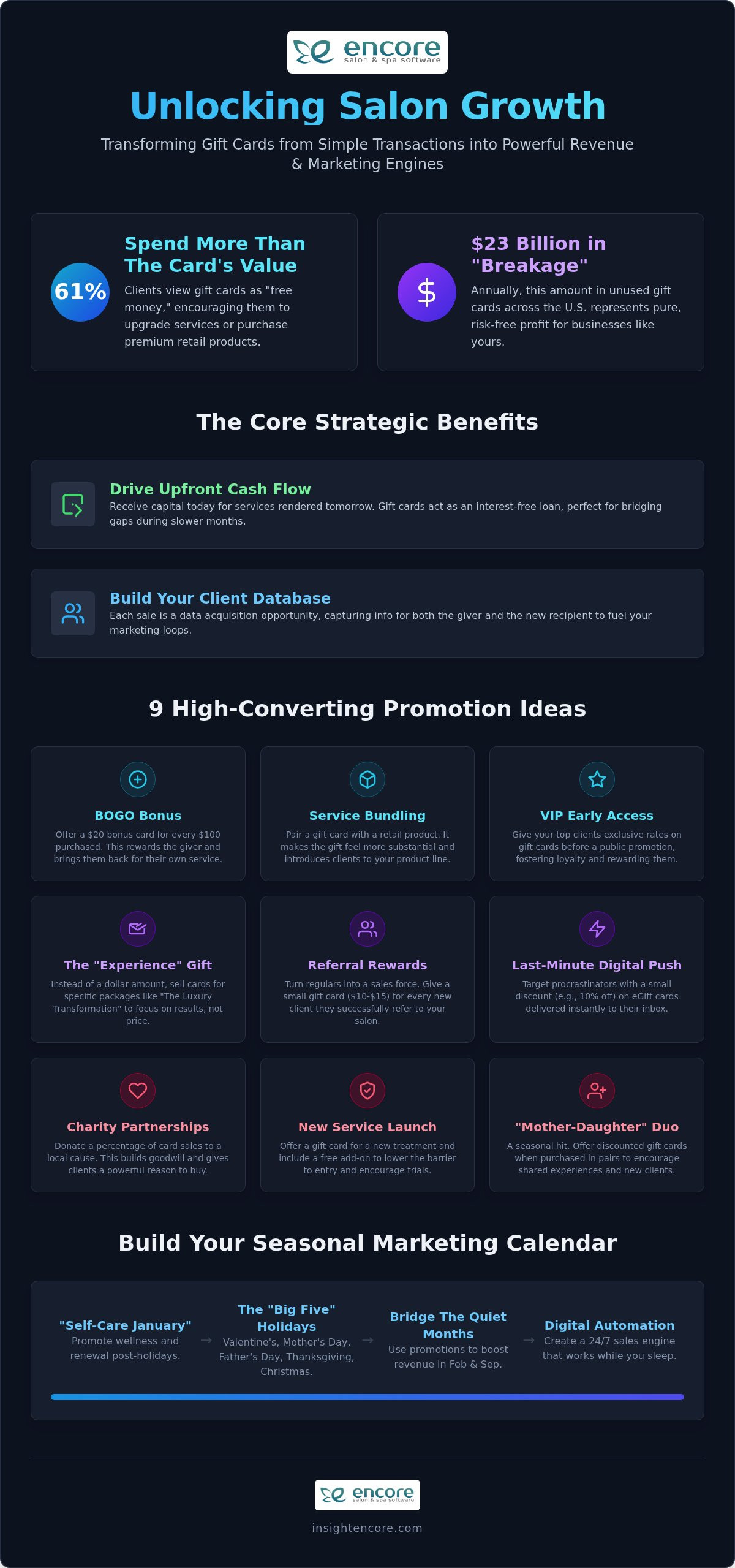
The financial benefits go beyond the initial sale. Research shows a significant "breakage" benefit, with an estimated $23 billion in unused gift cards existing in the U.S. annually. While you always want your clients to visit, these unredeemed balances represent pure profit for your business. Even more exciting is the psychological shift that happens when a client walks in with a card. Statistics from August 2026 indicate that 61% of consumers spend more than the card’s balance during their visit. They view the card as "free money," which encourages them to upgrade their service or try that premium retail product they’ve been eyeing.

Driving Upfront Cash Flow

Cash flow is the lifeblood of any salon, yet it’s often the biggest source of stress. Gift cards act like an interest-free loan from your clients to your business. You receive the capital today, which you can use to upgrade equipment, stock up on inventory, or cover overhead during slower seasons. These promotions are perfect for bridging the gap during quiet months like February or September. By securing revenue before you even pick up a pair of shears, you create a financial safety net that allows you to focus on your craft rather than your bank balance.

Building a High-Quality Client Database

Every gift card sold is an opportunity to gather valuable data. You aren’t just selling to the giver; you’re gaining access to a brand-new recipient who might never have found your salon otherwise. By capturing contact information for both parties, you can fuel your Automated Marketing & Loyalty Programs. This data allows you to follow up with personalized offers that turn a one-time visitor into a regular. Focusing on improving salon client experience from the very first interaction ensures that the "gift" leads to a long-term relationship. It’s about using your salon gift card promotion ideas to build a community, not just a transaction list.

15 High-Converting Salon Gift Card Promotion Ideas

Many articles offer five basic tips and call it a day. We know your business is more diverse than that. To truly move the needle, you need salon gift card promotion ideas that resonate with your specific clientele and business model. Whether you run a high-end hair studio or a busy pet grooming shop, these strategies help you capture attention and drive sales. Start with the "BOGO" Bonus. It’s a classic for a reason. Offer a $20 bonus card for every $100 purchased. This rewards the giver and often brings them back for their own service.

For those looking to increase retail sales, try Service Bundling. Pair a gift card with a professional shampoo set for a "Complete Care" kit. It makes the gift feel substantial and introduces clients to your product line. You can also offer VIP Early Access. Give your top 10% of clients exclusive rates on gift cards before the general public. Finally, consider the "Experience" Gift. Instead of a dollar amount, sell cards for specific high-end packages like "The Luxury Transformation." This shifts the focus from price to the result.

Incentive-Based Promotions

Don’t wait for clients to come to you. Use Referral Rewards to turn your regulars into a sales force. Giving a $10 gift card for every new client referred is a low-cost way to grow your book. If you’re seeing a dip in mid-week sales, a "Last-Minute" Digital Push works wonders. Target procrastinators with 10% off eGift cards delivered instantly to their inbox. You can also build community goodwill through Charity Partnerships. Donating a percentage of card sales to a local cause gives people a powerful reason to choose your salon over a big-box retailer.

Service-Specific and Seasonal Ideas

Launching a new treatment? Offer a gift card specifically for that service and include a free add-on. This lowers the barrier to entry for something new. For holidays, the "Mother-Daughter" Duo is a hit. Offer discounted cards when purchased in pairs to encourage shared experiences. If you want to build momentum, a Holiday Countdown featuring 12 days of different gift card surprises keeps your brand top-of-mind throughout December. These salon gift card promotion ideas create urgency without devaluing your primary services.

Niche Promotions for Spas, Tattoos, and Groomers

Customizing your approach is key to success. Tattoo studios can offer discounts for pre-paying a 4-hour session, which helps secure large projects. Pet groomers might sell "Puppy’s First Year" multi-card packages to ensure repeat business as the dog grows. Spas can thrive by selling "Stress-Relief" cards in bulk to local corporate offices for employee rewards. Managing these diverse offers doesn’t have to be a headache. You can see how Encore automates these promotions to keep your business running smoothly while you focus on your clients.

While brainstorming creative salon gift card promotion ideas is the exciting part of business growth, the backend details are what protect your profit. You shouldn’t treat gift card sales like a typical service transaction. When you sell a card, that cash is "deferred revenue." It’s a liability on your books because you still owe the client a service. You haven’t "earned" that money until they actually sit in your chair. Tracking this outstanding liability is vital for clean accounting. If you don’t have real-time reporting, you’re flying blind and risking a surprise at tax time.

Escheatment laws in 2026 are also a critical factor for modern owners. These regulations determine what happens to "abandoned" property, which includes unredeemed gift card balances. Depending on your region, you might eventually be required to turn these funds over to the state. Digital tracking and unique identification numbers are your best defense against fraud. They stop double-redemption and ensure that once a card is used, it’s instantly updated across your entire system. This level of security gives you peace of mind and protects your bottom line from simple human errors.

Managing Your Books with Ease

Categorizing your gift card sales correctly for tax purposes saves hours of frustration later. You need a system that handles partial redemptions automatically. If a client uses half a card today, your software should calculate the remaining balance without manual math. This is where Integrated Credit Card Processing becomes a game changer. It ensures every transaction is secure and instantly logged in your financial reports. It’s about removing the "accounting nightmare" and replacing it with organized control.

Expiration Dates and Fees

Navigating the legal landscape of expiration dates requires careful attention to current laws. Under the federal CARD Act, gift cards generally cannot expire for at least five years from the date of activation. However, some states have even stricter rules. For example, effective April 1, 2026, California law requires businesses to provide a cash refund for gift card balances under $15 if a client asks. Using "No Expiration" policies for your salon gift card promotion ideas often builds more brand trust. It shows you value the client’s investment and aren’t looking for "gotcha" moments. Transparency in your terms ensures a positive experience for every recipient.

15 Creative Salon Gift Card Promotion Ideas to Skyrocket Revenue in 2026

Designing Your Marketing Calendar: When and How to Promote

A successful year doesn’t happen by accident. It requires a clear roadmap that aligns your salon gift card promotion ideas with the natural rhythm of the beauty industry. You should focus your heaviest efforts on the "Big Five" holidays: Valentine’s, Mother’s Day, Graduations, Weddings, and Christmas. These peaks represent the highest consumer demand for thoughtful, easy-to-buy gifts. By planning your creative themes months in advance, you avoid the stress of last-minute scrambling and ensure your messaging is consistent across all platforms.

Don’t overlook the potential of a "Self-Care January" push. With 2026 trends shifting heavily toward wellness and scalp health, clients are often looking for a fresh start after the holiday rush. Position your gift cards as the perfect investment in a new self-care resolution. Your salon client booking portal is prime digital real estate for these offers. Ensure your active promos are visible the moment a client logs in to book their next appointment. At the physical salon, place attractive displays at the checkout counter to capture impulse buys as clients finish their services.

Digital Outreach Strategies

Your digital presence should act as a 24/7 sales engine. Email marketing remains incredibly effective when you use conversion-focused subject lines. Try something direct like "Give the Gift of Glow" or "Last-Minute Solutions for Mom." On social media, use Instagram Stories to film a short "unboxing" of your gift cards. Show the premium packaging or the sleek, mobile-friendly digital delivery to make the experience feel tangible. For those final hours before a holiday, a punchy SMS reminder can be the helpful nudge a busy client needs to complete their shopping.

Staff Training and Incentives

Your team is your most valuable marketing asset. Teach your stylists and front desk staff to mention gift cards as a genuine solution for "gift-giving" stress. If a client mentions a friend’s upcoming birthday or a sister’s wedding, it’s the perfect time to offer a luxury package. You can keep energy high by running internal contests. Reward the staff member who sells the most cards in a month with a bonus or a professional tool upgrade. Providing simple scripts helps them bring up the topic naturally during a consultation without feeling like a pushy salesperson.

Start planning your marketing calendar today

Automating Your Success with Encore’s Integrated Gift Card Suite

Implementing these salon gift card promotion ideas shouldn’t create more work for your team. If you’re still using paper certificates or disconnected systems, you’re missing out on the full potential of your program. Encore provides a total integration that links your gift cards directly to Encore Salon Software. This means every sale, redemption, and balance adjustment happens in one place. You don’t have to worry about manual entry or errors at the front desk. It’s about giving you the organized control you need to scale your business without the headache.

Your salon can become a 24/7 sales engine. With our eGift card module, your clients can purchase gifts while you sleep. The digital card is delivered instantly to their inbox, making it the perfect solution for last-minute shoppers. When they come in to redeem it, verification is instant at the point of sale. This prevents disputes and ensures a professional experience for every guest. When tax season rolls around, your accountant will thank you. You can generate one-click liability and breakage reports that keep your books crystal clear and compliant.

Setting Up Your Program in Encore

Customizing your program is simple and intuitive. You can design digital cards that match your luxury brand’s aesthetic. This ensures a consistent experience from the first click to the final service. By linking your sales to our Client Management System, you’re building a robust database of both givers and recipients. This data is gold for your future salon gift card promotion ideas. You can also set up automated promo codes for your seasonal campaigns. This allows you to track which offers are driving the most revenue without any manual math or tracking sheets.

Ready to Transform Your Revenue?

We’ve been a trusted partner in the beauty industry since 1991. Thousands of businesses rely on Encore because we combine powerful technology with a human-centric approach. You’re never just a number to us. We understand the daily hurdles you face and are dedicated to your individual success. Our support team is here to help you move from a state of stress to a feeling of total control. You deserve a partner that cares as much about your growth as you do. Let’s build a more profitable future together.

Start your stress-free gift card journey with Encore today!

Secure Your Salon’s Financial Future Today

You’ve seen how the right salon gift card promotion ideas can transform your revenue from unpredictable to unstoppable. By mapping your marketing to the natural rhythms of the industry and embracing 2026’s wellness trends, you create a self-sustaining growth loop. It’s time to leave behind the stress of manual tracking and the anxiety of accounting errors. Your expertise in the chair combined with a professional, automated gifting experience is a winning formula for long-term client loyalty.

As an industry leader in beauty and wellness software since 1991, we provide the integrated POS and real-time liability reporting you need to stay compliant and profitable. Whether you’re managing a busy hair studio or a high-end spa, the right tools make all the difference in your daily peace of mind. We’re committed to your success and ready to support your business as it reaches new heights. Let’s make this your most organized and profitable year yet.

Try Encore Now and Automate Your Gift Card Sales
You have the talent and the vision to succeed. Let us handle the technical heavy lifting so you can focus on what you do best: making your clients look and feel incredible. You’ve got this, and we’re here to help every step of the way.

Frequently Asked Questions

Do salon gift cards expire in 2026?

Under the federal CARD Act, gift cards generally cannot expire for at least five years from activation. However, you must check your specific state laws as some are even stricter. For instance, as of April 1, 2026, California requires businesses to provide cash refunds for balances under $15. Providing a "no expiration" policy is often the best of your salon gift card promotion ideas because it builds lasting trust with your clients.

How do I account for gift card sales for taxes?

Gift card sales are recorded as deferred revenue, which is a liability on your balance sheet until the service is performed. You only recognize it as earned revenue once the client redeems the card. This distinction is vital for accurate tax filing and prevents you from overpaying on income you haven’t technically earned yet. Using integrated software ensures these categories are tracked automatically, removing the risk of manual accounting errors during tax season.

Is it better to offer physical or digital gift cards?

Offering both is the most effective strategy for modern salons. While physical cards are popular for traditional gift-giving, digital eGift cards are projected to grow at a much faster rate through 2026. Digital options provide 24/7 sales potential and instant delivery, making them perfect for last-minute shoppers. Physical cards, on the other hand, serve as a tangible marketing tool in your retail space and can drive impulse buys at the checkout counter.

How can I prevent gift card fraud in my spa?

You can prevent fraud by using unique identification numbers and real-time digital tracking for every card sold. This stops double-redemption and ensures that once a card is used, the balance updates instantly across your system. Avoid using generic paper certificates that are easily duplicated. Integrated systems like Encore provide a secure environment where every transaction is logged, giving you peace of mind and protecting your business from unauthorized or fraudulent redemptions.

What is ‘breakage’ in gift card accounting?

Breakage refers to the portion of gift card balances that are never redeemed by the consumer. This unused value eventually becomes pure profit for your salon, though you must follow state escheatment laws regarding "abandoned" property. In the U.S., billions of dollars in gift cards go unused annually. Tracking breakage through your software helps you understand your true liability and provides a clearer picture of your long-term financial health and overall profitability.

Should I offer discounts on gift card purchases?

While direct discounts can drive quick cash flow, they can sometimes devalue your services. Instead, consider value-added salon gift card promotion ideas, such as a $20 bonus card for every $100 spent. This keeps your service price points intact while providing an incentive for the client to spend more. These "BOGO" style offers are highly effective because 61% of clients typically spend more than the card’s original value during their visit anyway.

How does Encore track gift card liability?

Encore tracks gift card liability through a fully integrated module that records every sale and redemption in real-time. You can generate liability reports that show exactly how much outstanding credit exists on your books. This removes the "accounting nightmare" of manual tracking and ensures your financial data is always accurate for your accountant. The system also handles partial redemptions automatically, updating the client’s remaining balance instantly at the point of sale.

Disclaimer

This article is general in nature and may contain errors, please verify all claims with your sales rep

Categories
gift cards marketing

Cross Promoting Your Salon or Spa for Growth

Cross Promoting Your Salon or Spa

Marketing & Sales

2 minute read

Looking to grow your client base? A great and inexpensive method is partnering with another business and cross promoting with them.


What are the Benefits?

Cross promotions will raise awareness of your business in a positive manner. Every business has built a trusting relationship with their loyal customers. When they refer those customers to your salon or spa, they are connecting their reputation with your business.


Partnering with another business can also reduce promotional costs. Split the cost when you advertise together or mail out promotional postcards.

Who Should I Partner With?

Your partner should either provide a different service/product to the same audience or serve a different target audience.


Think about your client’s needs and desires. Is there something that will complement the services you provide to them? For example if you run a hair salon, it may make sense to partner with a nail technician. Alternatively, you can team up with a business that serves a different target audience. Your clients may be interested in finding a quality barbershop for their husbands, and perhaps the barber has a few clients whose wives are looking for a new salon! Pay attention to your clients because they might give you some clues.


After identifying some potential businesses, you can then consider if the partnership will be balanced. Will their clients be similarly inclined to visit your business and possibly become loyal customers?


One caution is to ensure that your partnering businesses are in line with yours. Do they share a similar values? Do their prices align with your clients’ budgets? Remember that your clients trust that you have their best interest in mind.

How Do We Work Together?

  • Display each other’s business cards or brochures. Leave them in highly visible areas like the front desk.
  • Mention your partner when talking to your clients. You don’t need to make a sales pitch, but if you’re talking about a relevant topic, you can naturally mention the partnership.
  • Extend your reach by mentioning each other through your social media networks. Send an email to your clients on behalf of your partner and get them to do the same (be careful not to share your client’s information unless they have given you permission to do so).
  • Sell each other’s gift cards if your partner is targeted at a different market. For example, men at a barbershop may want to treat their wives to a spa day. By making it convenient for them to purchase gift cards to your spa, you will attract new clients without affecting the barbershop’s sales. If your partner is serving the same people, consider whether selling their gift card will cut into your own business’s gift card sales.
  • Bundle related products and services. If you are a hair salon, connect with a cosmetologist or nail salon. Assemble a range of retail products to bundle and sell. Create a wedding package so brides will easily find someone to do their hair, nails, makeup and everything else!

If you are not already using Encore Salon & Spa Management Software click here to try it now for FREE

Categories
gift cards marketing

4 Practical Ways To Skyrocket Your Gift Card Sales

4 Salon Gift Card Promotions to Boost Sales

Marketing & Sales

3 minute read

Gift cards provide amazing opportunities to build brand awareness, encourage client loyalty, and win back customers. Take a look at a few ways to utilize them in growing your salon and spa business.

Build Brand Awareness

Method: Offer an incentive for gift card purchases


Primary target: Potential clients and their significant others


Communication: Targeted Facebook advertising, cross promotions


Often, the greatest challenge for a new salon is to get people through the door so that you will have an opportunity to wow them and convert them into a loyal client. Especially around the holiday season, gift cards are valuable for attracting new clients. While gift cards are consistently the most-requested item on holiday wish lists, it can be a challenge to push your salon’s gift card to the top of that list.


When targeting potential clients (or their significant others), consider boosting a Facebook post to your ideal clientele based on demographics (gender, age, etc.) and interests. Another option is to partner with another business which serves your intended audience. For example, men frequenting a barber shop would appreciate the convenience of purchasing a gift card to a salon for their spouses.


Whichever channel you choose to use, showcase your salon brand and offer an incentive to entice them to purchase right away. It could be a free hair product or nail polish to be used as a stocking stuffer. Or you can sell $100 gift cards for just $80.

Raise Engagement

Method: Run contests for gift card prizes


Primary target: Everyone


Communication: Social media, email newsletters, text messages, cross promotions


Everyone loves free stuff! Even people who aren’t within your target audience may enter to win for a friend or share your post with their own social networks. Either way, it is a great way to build brand awareness, keep current clients engaged, and win back lost customers!


There are many ways to run the contest: selecting a random client who visited your salon this month, choosing a random person who shared one of your Facebook posts, or having people nominate a friend or family member who deserves a makeover or a spa day.


The gift card gives the winner the flexibility to select how they wish to utilize the prize from selecting specific services or bringing a friend with them. Gift cards of lower values can also be used as secondary prizes as well. More chances to win will likely encourage more people to enter the contest.

Increase Client Spending

Method: Encourage additional spending by offering free gift cards


Primary target: Existing clients


Communication: Signage within the salon, email newsletters, text messages, social media


Gift cards can be a great way to say thank you and an incentive to increase client spending! The key to making the most of this promotion is to set a necessary spend level to be slightly higher than the average client’s invoice amount. Clients will then need to purchase an add-on service or product in order to reach it. This opens the door to get them hooked on to new services or add-ons, thus increasing their spending for future appointments as well.


In addition to the immediate revenue boost, you are also providing an opportunity for clients to spoil themselves when utilizing the gift card at their next visit. When paying with a gift card, many people opt to purchase something that they would not normally spend their own money on. But even if they stick with their regular services or products, you are still building a positive relationship between your salon and the client.

Build Partnerships

Method: Negotiate prices for bulk gift card orders


Primary target: Businesses


Communication: Networking with business owners and managers


Over 80% of businesses use gift cards as an employee incentive, according to GiftCards.com. Talk to people that you already know (start with existing clients, family/friends, and surrounding businesses) and promote your gift cards as an excellent reward or present. If they are interested in purchasing a bulk number of gift cards, you can negotiate a special rate as, realistically, the full value of the gift cards will probably not be used. However the more they are used, you will have more opportunities to win over new clients.