

A salon’s monthly costs depend on its size, but they shouldn’t be a mystery. To learn how to create a salon budget, list recurring expenses, estimate variable costs, and compare the total with expected income.
Rent, payroll, supplies, and quiet periods can all make cash harder to predict. A clear budget shows what the salon needs to earn, helps you plan for bills, and supports more confident spending decisions.
Learn how to track expenses, build monthly and quarterly forecasts, plan for salon space and equipment, and protect cash flow during slower periods. You’ll also see how to review your numbers and adjust the plan as costs or income change.
Key Takeaways
- Sort expenses into fixed and variable costs, then review what share of spending each category takes.
- Build forecasts around your salon model, staffing, rent, supplies, and expected income rather than relying on a one-size-fits-all budget.
- For a suite or booth, account for rent, startup deposits, supplies, and equipment before setting your monthly spending plan.
- Prioritize equipment that supports services clients use regularly, and compare its ongoing costs with the revenue it could bring in.
- Plan for slower periods by setting cash aside and scheduling bill payments around expected income.
1. Should I Track Salon Expenses Using a Spreadsheet?
Yes. A spreadsheet gives you one place to track income, expenses, and performance, then compare actual spending with your plan. Include wages and related staff costs, rent, insurance, supplies, and marketing. Record transactions monthly to see what the salon earns, spends, and where costs are changing.
Create a separate row for each expense, with columns for the date, category, amount, payment method, and a short note. Track income in a separate section, grouped by service, retail sales, or other revenue. For example, record a colour service as service income and the product used as a supply expense. This keeps income and spending distinct while showing how each service contributes to results.
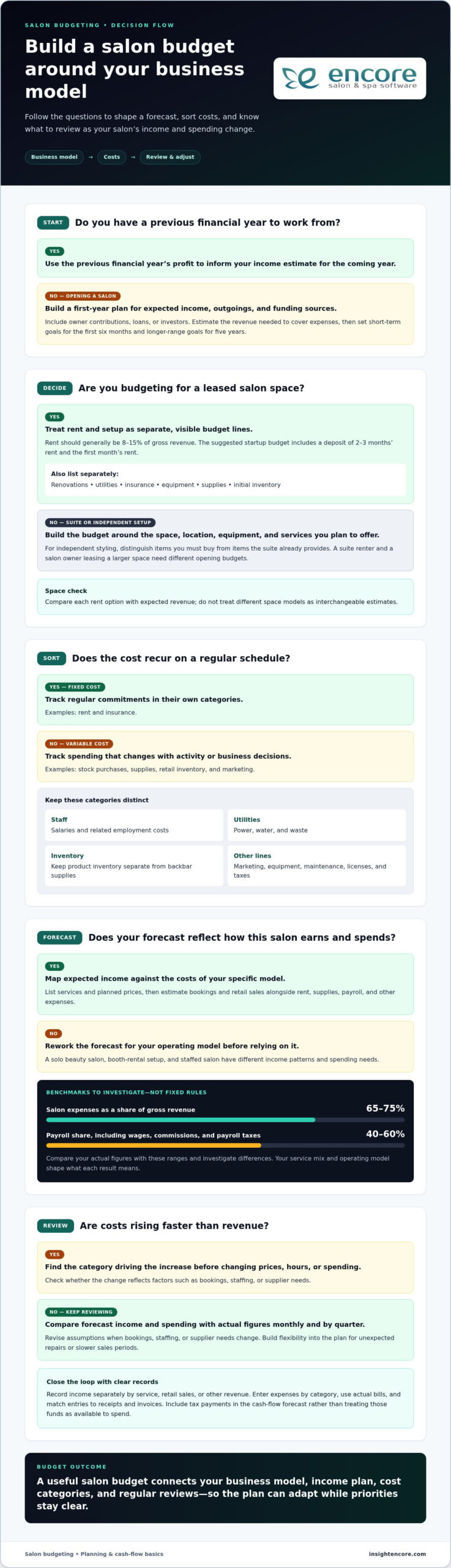
Classify costs as fixed or variable. Fixed expenses generally recur on a regular schedule, such as rent and insurance. Variable expenses change with activity or purchasing decisions, including stock and marketing. Give wages and related staff costs their own category, as they can include different types of compensation. Avoid combining unlike costs: separate product inventory from backbar supplies so you can see which area needs attention.
- Fixed: Rent, insurance, and other regular bills.
- Variable: Stock purchases and marketing spend.
- Staff: Salaries and related employment costs.
- Utilities: Track power, water, and waste separately.
Use actual bills rather than estimates. These are example figures, not standard salon rates; your entries should match your invoices and payment records. Save receipts and invoices by month, then match each spreadsheet entry to its supporting record. This makes duplicate charges and missing bills easier to spot.
At month-end, total each category and calculate its share of total expenses. Compare the results with the previous month and note the reason for any meaningful change, such as a larger stock order or a new staff cost. Review income alongside expenses rather than judging performance by sales alone. This monthly check can reveal whether higher spending supports revenue or simply reduces what remains.
Keep the spreadsheet manageable: use consistent category names, enter transactions regularly, and preserve original records. A simple sheet works well when you keep it up to date. As salon activity grows, the same categories and monthly totals provide a clear structure for refining your budget and tracking performance.
2. How do you create a solid financial plan and budget for your hair or beauty salon?
Build the plan around your business model, expected revenue, and costs. A solo beauty salon, a booth-rental setup, and a staffed salon have different income patterns and spending needs. List your services and planned prices, then map expected bookings and retail sales against rent, supplies, payroll, and other expenses. This makes revenue goals practical rather than guesswork.
For a yearly forecast, use the previous financial year’s profit to inform your income estimate for the coming year. If you’re opening a salon, prepare a first-year plan covering expected income, outgoings, and funding sources such as owner contributions, loans, or investors. Set milestones: estimate the revenue needed to cover expenses, then create short-term goals for the first six months and longer-range goals for five years.
Use percentage benchmarks as prompts for review, not fixed rules for every business. Salon expenses commonly total 65 to 75 percent of gross revenue, while payroll, including wages, commissions, and payroll taxes, may take 40 to 60 percent. Compare your actual figures with these ranges and investigate differences. For example, a rising payroll share could reflect staffing changes, lower bookings, or both. Your own service mix and operating model shape the meaning of each result.
Keep fixed and variable costs visible in the plan. Rent and insurance are recurring commitments; supplies, retail inventory, and marketing can change with activity or business decisions. Give marketing, equipment, and maintenance separate categories, and connect each planned expense to a purpose. For example, record a campaign’s cost alongside the bookings or sales it supports. For equipment, consider purchase or financing costs, upkeep, and the services it enables.
Put licenses, taxes, and local operating requirements in separate budget lines, since costs and timing depend on location and business structure. Keep supporting records with each entry, and include tax payments in the cash-flow forecast rather than treating those funds as available to spend.
Review the budget monthly and organize results by month and quarter. Compare forecast income and spending with actual figures, then revise assumptions when bookings, staffing, or supplier needs change. Build flexibility into the plan so an unexpected repair or slower sales period doesn’t derail a key goal. If costs rise faster than revenue, identify the category driving the increase before adjusting prices, hours, or spending. A useful financial plan can adapt while keeping the salon’s priorities clear.
3. Salon suite and independent renter costs
A suite renter and a salon owner leasing a larger space need different opening budgets. Treat them as separate business models, not interchangeable estimates: your figures depend on the space, location, equipment, and services you plan to offer.
Rent is often the largest commitment. Compare each option with expected revenue; salon rent should generally be 8–15% of gross revenue.
Before opening, list the costs required to occupy and operate the space. For a leased salon, the suggested startup budget includes a deposit of 2–3 months’ rent and the first month’s rent. Add renovations, utilities, insurance, equipment, supplies, and initial inventory as separate lines. For independent styling, distinguish items you must buy from items the suite already provides. This prevents a low weekly rent from disguising additional setup spending.
Base the plan on your operating model. A booth renter may have fewer shared-space obligations than a salon owner, but still needs funds for tools, products, and client-facing operations. Estimate monthly outgoings, then compare them with realistic service capacity and expected bookings. If rent takes too much of projected gross revenue, consider whether a smaller space, fewer services, or a different location would make the plan more workable.
Salon owners can lower upfront costs by prioritizing what clients need for everyday services. Start with core retail inventory displayed neatly on simple shelves, then upgrade fixtures as sales grow. Open shelves, ready-made cabinets, or wall racks can replace custom cabinetry at launch. Choose practical roller shades or basic blinds instead of expensive window treatments, and postpone high-end options until the business is established.
Build a startup worksheet with columns for one-time purchases, recurring costs, and each bill’s due month. Include a separate cash reserve for opening expenses that come before regular bookings begin. Review the numbers whenever a lease, renovation, or equipment decision changes. A smaller initial setup can protect cash, but should still support safe, efficient styling and the services you intend to offer.
4. Adding equipment to expand services and revenue
Equipment can create a new revenue stream, but every purchase needs a clear role in your plan. Before adding a facial steamer, nail table, or styling station, identify which service it supports and who will use it. Estimate how often clients might book that service, whether existing staff can provide it, and what supplies or upkeep it requires. Connect each purchase to a specific business opportunity.
Start with the full cost, not just the purchase price. Include financing payments, delivery, setup, maintenance, supplies, and any change in insurance costs related to the equipment. The actual payment depends on the equipment and financing terms, so add the expected amount to your cash-flow forecast before committing.
Next, set a revenue target for the equipment. Estimate how many additional appointments it could support in a typical month, then calculate how much revenue those bookings need to generate to cover ongoing costs. Use your own service prices and realistic appointment capacity. For example, a salon adding a treatment service can track bookings, supply use, and income separately to see whether the new offering contributes to profit.
Prioritize equipment that clients and stylists will use regularly. A core item supporting several appointments may deserve attention before a specialty purchase with limited use. You can delay upgrades to furnishings or tools that don’t affect current services. This staged approach preserves cash for existing expenses and lets you assess whether demand supports a larger investment.
Keep revenue streams distinct in your records. Separate service income from retail sales, booth or suite income, and gift card sales where applicable. Track the service or revenue stream connected to each equipment purchase. This helps you compare performance over time and identify whether growth comes from the new service, stronger bookings elsewhere, or other sales.
Review performance monthly after the equipment is in use. Compare actual appointments and related revenue with your target, then include supplies, repairs, loan payments, and relevant insurance costs. If usage stays low, consider whether scheduling, staff training, or client awareness is limiting bookings before buying more equipment. A clear review helps you base the next purchase on performance, not excitement alone.
5. Reasons salons and spas need budgets and cash-flow plans
A budget shows whether the salon can cover its costs; a cash-flow forecast shows when money arrives and bills are due. To build one, list expected service, retail, and other income by month, then add payment dates for rent, payroll, suppliers, and loans. Set aside a cash reserve from available funds to cover quiet periods or unexpected costs, rather than relying on sales that haven’t arrived.
Timing matters. A salon may be busy around Christmas, then see quieter bookings in January. If rent, wages, and supplier invoices are still due during that slower month, strong holiday sales can disappear quickly. Forecast income and payments across the calendar, not only as monthly totals. This helps you spot a shortfall before a bill is due and decide whether optional spending can wait.
Opening a salon also creates a gap between startup costs and steady customer income. Include deposits, initial stock, equipment payments, and wages in the forecast alongside anticipated bookings. Record when each expense must be paid and when clients are expected to pay. For retail, account for the cash spent on products before projecting income from their sale. Separating these dates makes your working cash needs easier to see.
Use the forecast to plan bill payments. Pay invoices by their due dates, and don’t treat future bookings as cash already available. If income is lower than expected, review upcoming expenses and identify purchases that can wait without disrupting services. Keep essential costs separate from optional upgrades so decisions reflect the actual cash position, not just a sales target.
A useful cash-flow review compares planned and actual deposits, sales, and payments. Update the forecast when bookings shift, a supplier invoice changes, or an equipment repair comes due. Note the reason for each difference. For example, a slower January might mean postponing a retail order, while stronger-than-expected service sales could support replenishing popular products. This connects your reserve to decisions instead of leaving it as an unexplained balance.
Software can help organize appointments, sales, and expenses as part of a regular operating routine, but the forecast still depends on accurate entries and consistent review. Set a monthly review to compare expected cash with the account balance and invoices due. Then adjust planned purchases or reserve contributions using the updated figures. A profitable month doesn’t automatically mean cash will be available when the next bill arrives.
Encore Salon & Spa Software: Encore Salon Software
Encore Salon & Spa Software offers Encore Salon Software to help manage salon operations. When appointment activity, sales, and stock are spread across separate records, a salon management platform can bring those workflows together and make information easier to use in budget reviews. Online booking helps manage appointments, while point-of-sale transactions and inventory management support tracking sales and product movement.
Use these operating records in your financial reviews: compare service and retail activity with budgeted expenses, then adjust purchasing or forecasts as needed. Encore also offers Encore Spa Software, Chair/Booth Renter Software, and Tattoo Studio Software for other business models.
Contact Encore Salon & Spa Software to learn more about Encore Salon Software.
Make your next budget decision with confidence
A salon budget works best as a living decision tool, not a document you file away after opening. As your services, team, or booking patterns change, use each review to decide what needs attention next. Learning how to create a salon budget helps you make those choices from clear records rather than guesswork.
Choose one manageable next step today: update a category, review an upcoming purchase, or schedule your next financial check-in. If appointment and sales information is difficult to organize alongside those decisions, Encore Salon & Spa Software offers Encore Salon Software, Encore Spa Software, and Chair/Booth Renter Software for different business needs.
With a clear process and regular reviews, you can approach each new business decision with greater clarity.
Frequently Asked Questions
How much does it cost to run a hair salon per month?
A full-service salon’s costs depend on staffing, rent, services, and purchasing needs, so a smaller salon will have a different cost profile. Estimate your own total by adding regular bills, expected payroll, supply orders, and other operating expenses, then compare the result with forecast revenue.
What Does a Monthly Salon Budget Look Like?
A monthly salon budget brings expected income, planned spending, and payment timing together. List service and retail income separately, then group costs under rent, payroll, utilities, supplies, equipment, and marketing. Add bill due dates and notes about changes, such as an unusually large product order. Reviewing categories during the month can help you spot where actual spending is moving away from plan.
How do you create a solid financial plan and budget for your hair or beauty salon?
Start with your business model, services, and expected income sources. Use sales records if the salon is operating, or estimate opening revenue from planned appointments and service prices. To learn how to create a salon budget, match income estimates against costs and payment dates, then set revenue milestones. Review actual results regularly and revise assumptions when bookings, staffing, or purchasing patterns change.
Should I Track Salon Expenses Using a Spreadsheet?
Yes, a spreadsheet can organize salon spending and compare actual costs with planned amounts. Create sections for transactions, monthly totals, and budget-versus-actual results. Use consistent categories and formulas to total expenses, and keep supplier invoices separate from equipment purchases. Filtering by month can reveal recurring charges or unusual entries. To put a salon budget into practice, use these comparisons to identify categories that need closer review.
What Are Fixed Expenses?
Fixed expenses are recurring business costs that generally remain stable over a set period, even when bookings change. Rent and insurance are common examples; regular software subscriptions or scheduled loan payments may also fit. Record each cost with its due date and payment amount. When a contract or payment schedule changes, update the entry so your forecast reflects the salon’s current commitments.
What Are Variable Expenses?
Variable expenses change with business activity, customer demand, or purchasing decisions. A salon may order more colour products during a busy booking period, while retail stock needs can shift with customer purchases. Marketing costs may also vary by campaign. Track each cost separately and note its purpose. This context helps you distinguish demand-related changes from optional spending when reviewing monthly results.
What makes a salon profitable?
A salon is profitable when revenue exceeds total expenses over the period being measured. The remaining amount is profit, which differs from cash currently available because payments and income may arrive at different times. Most salons have a net profit margin of 8 to 15 percent. Compare service and retail performance with related costs, then assess whether additional spending contributes to income or reduces what remains.
What are typical monthly operating costs for a salon?
Common operating costs include rent, payroll, utilities, insurance, supplies, retail inventory, marketing, software, and equipment upkeep. Keep these categories separate in your records. A single expense total won’t show whether rent, labour, or stock is driving a change in monthly spending.
Disclaimer
This article is general in nature and may contain errors, please verify all claims with your sales rep