
window.dataLayer = window.dataLayer || []; function gtag(){dataLayer.push(arguments);} gtag('js', new Date()); gtag('config', 'UA-206511945-1');
Search
Categories
Uncategorized

The Complete Guide to Managing Salon Inventory with a Spreadsheet in 2026

Imagine it’s 8:00 PM on a Sunday. Instead of unwinding, you’re crouched in the backroom, counting half-empty bottles of developer while your coffee goes cold. It’s a familiar scene for owners who feel buried under manual stock takes, yet managing salon inventory with a spreadsheet remains a reliable first step toward reclaiming your time and preventing mid-service shortages.

We understand how draining it is to juggle client expectations while worrying about shrinkage or missing retail numbers. You deserve a system that provides peace of mind and professional confidence. This guide is your roadmap to building a professional tracking system from scratch, setting up automatic low stock alerts, and streamlining your entire ordering process.

We’ll walk you through the essential steps to maintain your data and show you how to get a clear view of your total stock value. Finally, we’ll help you recognize the signs that your growing business is ready to graduate from manual entries to the ease of full salon automation.

Key Takeaways

  • Learn how to set up a logical framework in Google Sheets or Excel that turns a cluttered list into a functional management tool.
  • Discover the specific formulas needed for managing salon inventory with a spreadsheet, including conditional formatting for instant low-stock alerts.
  • Master the “First In, First Out” (FIFO) method and audit routines to ensure your stock levels are always accurate and products never expire.
  • Identify the hidden costs of manual tracking and learn how simple human errors can lead to expensive ordering mistakes.
  • Recognize the clear signals that your salon has outgrown manual sheets and is ready for the efficiency of an integrated inventory management system.

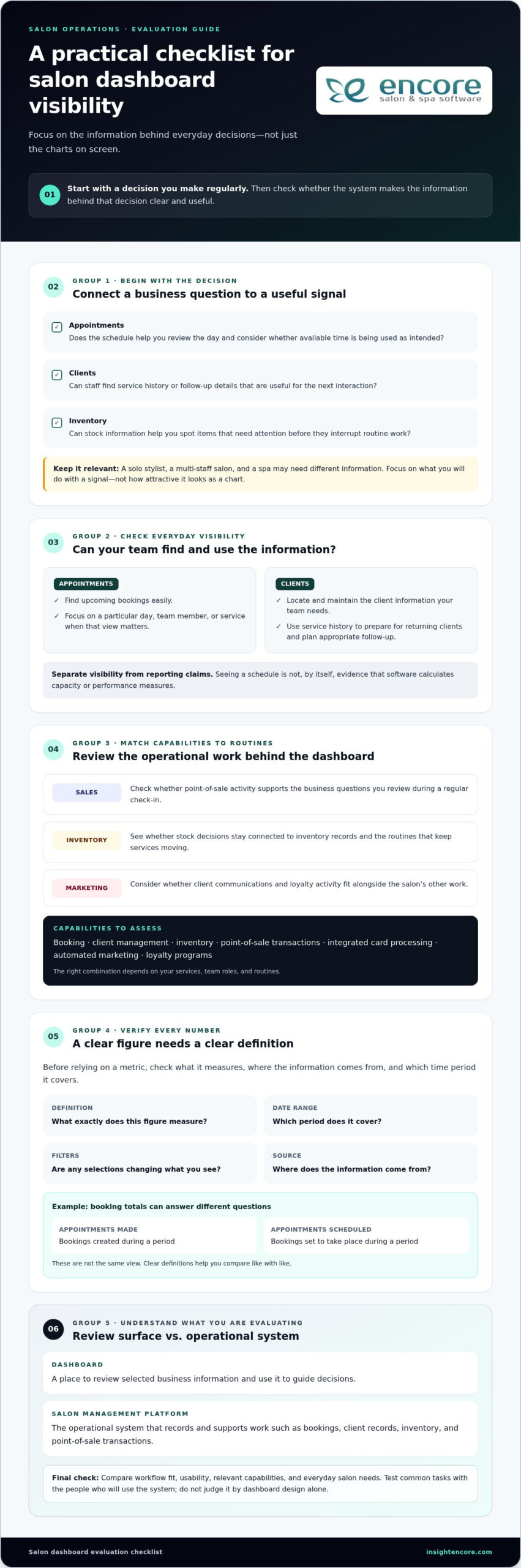
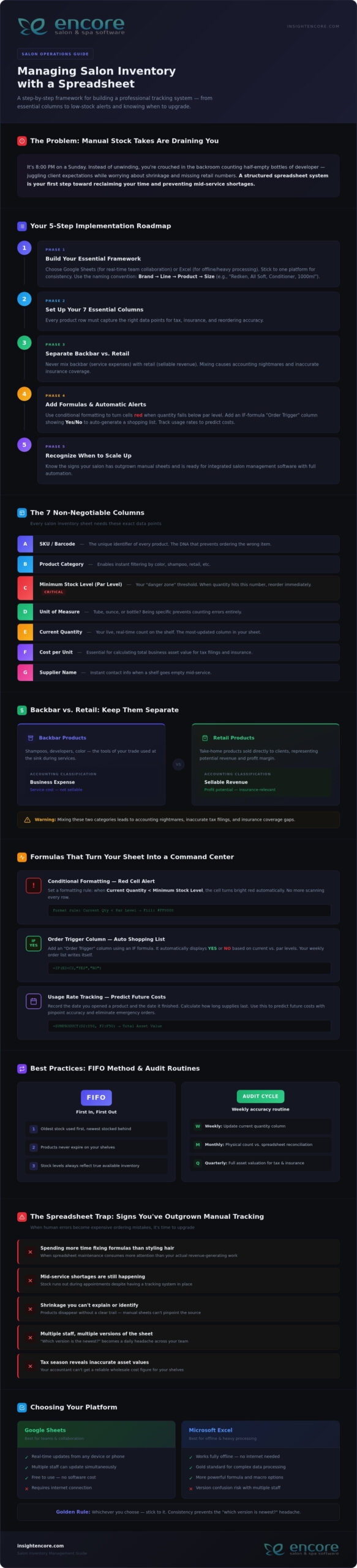
Building Your Salon Inventory Spreadsheet: The Essential Framework

Starting the journey of managing salon inventory with a spreadsheet can feel overwhelming, but it’s the first step toward total control. Without a structured layout, your data is just a digital pile of notes. A professional framework turns that list into a tool that protects your profit margins and prevents mid-service panic. You need a system that grows with your salon, not one that breaks the moment you add a new color line.

Your first decision is where your data will live. Google Sheets is a brilliant choice for collaboration. It allows your team to update stock levels from their phones in real-time. If you prefer working offline or need heavy-duty data processing, Excel remains the gold standard. Whichever you choose, stick to it. Consistency prevents the “which version is the newest?” headache that plagues many small businesses.

Organization relies on a golden rule for naming conventions: Brand, Line, Product, and Size. Instead of writing “Conditioner” or “Blue bottle,” use “Redken, All Soft, Conditioner, 1000ml.” This precision makes it impossible to order the wrong SKU. It also helps when you separate your Master List from your Daily Log. Your Master List acts as your permanent library, while the Daily Log tracks the actual movement of products in and out of the cabinet.

The 7 Non-Negotiable Columns Every Salon Needs

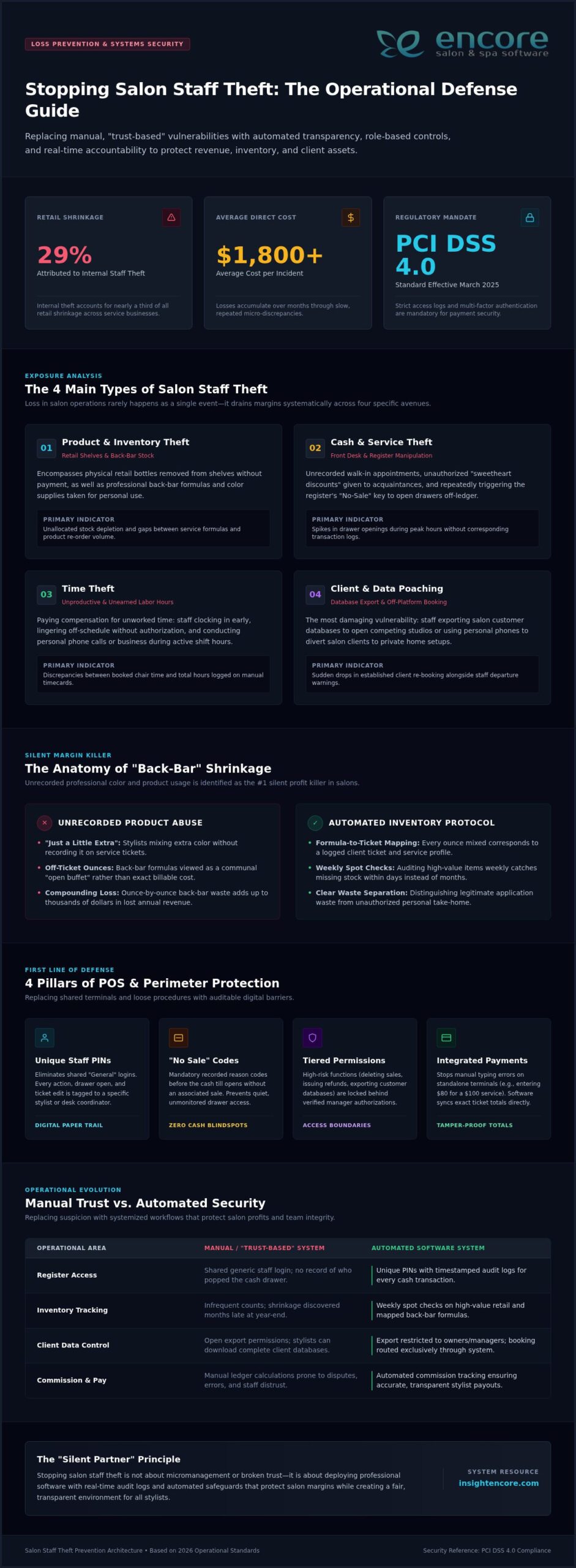
To keep your records accurate, every item needs specific data points. These columns provide the context your business needs for tax time and insurance purposes:

  • SKU/Barcode: This is the unique DNA of the product.
  • Product Category: This helps you filter your view instantly.
  • Minimum Stock Level (Par Level): This is your “danger zone” threshold. When you hit this number, it’s time to reorder.
  • Unit of Measure: Are you tracking by the tube, the ounce, or the bottle? Be specific to avoid counting errors.
  • Current Quantity: Your live count on the shelf.
  • Cost per Unit: Essential for calculating your total business value.
  • Supplier Name: Who do you call when the shelf is empty?

Categorizing for Success: Backbar vs. Retail

One of the biggest mistakes in managing salon inventory with a spreadsheet is mixing backbar and retail items. Backbar products are the tools of your trade, like developers and shampoos used at the sink. These are business expenses. Retail products are inventory meant for sale to clients, representing potential revenue.

Mixing these two categories leads to accounting nightmares. You need to know exactly how much stock is tied up in service costs versus retail profit. Keeping them separate allows you to track which side of your business is more efficient. It also ensures your insurance coverage reflects the true value of your sellable goods.

Advanced Tracking: Formulas and Thresholds for Stock Control

Managing salon inventory with a spreadsheet becomes truly powerful when you stop treating it like a static list and start using it as a diagnostic tool. By adding simple formulas, you transform rows of data into a live command center. This shift allows you to make decisions based on facts rather than gut feelings. It’s the difference between hoping you have enough color and knowing exactly when the next shipment needs to arrive.

Visual cues are your best friend during a busy shift. You can use conditional formatting to make your life easier. Set a rule where a cell turns bright red if the “Current Quantity” falls below your “Minimum Stock Level.” This visual “red alert” means you don’t have to scan every line to know what’s missing. You can also add an “Order Trigger” column. Use a simple IF statement to display “Yes” or “No” based on your stock levels. This creates an automatic shopping list for your weekly supplier run.

Tracking usage rates is the next level of professional management. If you record the date you opened a gallon of shampoo and the date it finished, you’ll learn exactly how long your supplies last. This data helps you predict future costs with pinpoint accuracy. If you find yourself spending more time fixing formulas than styling hair, exploring an integrated inventory management system might be the relief you need.

Calculating Inventory Valuation for Tax Season

Your accountant needs to know the exact wholesale value of your shelves, not the potential retail price. Wholesale cost is what you paid; MSRP is what the customer pays. Keeping these distinct ensures your tax filings are accurate and your insurance coverage is sufficient. You can calculate your total asset value instantly by using a SUMPRODUCT formula to multiply the quantity of every item by its individual wholesale cost. This single number represents the cash currently tied up in your stockroom.

Setting Accurate Par Levels (Minimum Stock)

Finding your “Minimum Stock Level” isn’t a one-time task. You must consider shipping times, your weekly service volume, and seasonal peaks. While managing salon inventory with a spreadsheet offers a clear view of your current situation, setting accurate par levels ensures you never run out of critical supplies. Avoid the “Overstock Trap” by remembering that too much inventory is just cash sitting on a shelf. Adjust your levels before the holiday rush to ensure you have enough color for every guest without cluttering your backroom.

The Spreadsheet Trap: Why Manual Tracking Often Fails Growing Salons

While managing salon inventory with a spreadsheet is a great starting point, it eventually becomes a bottleneck. Many owners fall into the “Spreadsheet Trap” without realizing how much it actually costs them. You might think you’re saving money by avoiding software fees, but the hidden expenses tell a different story. If you’re spending your Sunday nights manually counting bottles, you’re paying for that time with your own energy and business growth.

Consider the hourly rate of the person managing the file. If a manager spends just three hours a week on manual entry, that’s over 150 hours a year. That’s time that could be spent training staff or improving the client experience. Then there’s the risk of human error. A single mistyped digit can turn a small restock into a $500 ordering mistake. These errors are easy to make when you’re tired and staring at a grid of tiny numbers.

The biggest hurdle is the lack of POS integration. Your spreadsheet is a silent observer. It doesn’t know when a stylist uses a tube of color or when a client buys a retail bottle. This disconnect leads to “inventory ghosts” where your sheet says you have stock that isn’t actually on the shelf. Security is another concern. One accidental click or a disgruntled employee can delete months of data in seconds, leaving you with no backup and a lot of frustration.

Spreadsheet vs. Integrated Inventory Software

The difference between manual sheets and professional software comes down to speed and accuracy. Software provides real-time updates. The moment a sale is made, the stock is deducted. You don’t have to wait until the end of the week to see where you stand. Professional systems also handle automated ordering. Instead of typing out a list, the software generates purchase orders based on your par levels. It also builds staff accountability. You can track exactly which products are being used by which stylist, removing the guesswork from your backbar costs.

Signs Your Salon Has Outgrown Excel

It’s okay to move on when a system no longer serves you. You’ll know it’s time to upgrade when you see these red flags:

  • Your team has grown to more than 3 stylists sharing the same supplies.
  • You spend more than 2 hours every week updating stock levels manually.
  • Discrepancies between your sheet and your shelves are becoming a regular occurrence.
  • You feel anxious about the accuracy of your ordering list.

When you reach this stage, transitioning to Encore’s Inventory Management System provides the relief you’ve been looking for. It turns inventory from a stressful chore into a seamless part of your daily routine. You can finally stop counting bottles and start focusing on the creative work you love.

The Complete Guide to Managing Salon Inventory with a Spreadsheet in 2026

Best Practices for Maintaining Inventory Accuracy Every Week

Your spreadsheet is a living document. It needs regular attention to stay relevant. Managing salon inventory with a spreadsheet requires more than just a good template; it demands a consistent routine. Without regular updates, your data becomes a relic of the past, leading to the very stockouts you’re trying to avoid. Establishing a rhythm ensures your numbers reflect the reality of your shelves.

One of the most effective ways to protect your investment is the “First In, First Out” (FIFO) method. When new shipments arrive, place them behind the existing bottles. This simple habit prevents products from expiring at the back of the shelf. You should also create a clear process for handling shrinkage. Whether it’s a spilled bottle of developer or a damaged retail box, every loss must be documented. If it isn’t in the sheet, your stock value will never be accurate.

Success depends on your team. Make inventory management a part of your salon culture. When stylists understand that accurate tracking leads to better supplies and fewer headaches, they’re more likely to help. Encourage them to log every use immediately. This shared responsibility lightens your load and builds a sense of professional pride across the floor. It’s about working together to ensure nobody ever runs out of the tools they need mid-service.

The Sunday Night Audit: A Step-by-Step Checklist

A weekly audit is the heartbeat of a healthy salon. Start by comparing your physical count to what’s listed on your sheet. If there’s a discrepancy, ask why. Did someone forget to log a sale? Was there an unrecorded spill? Use this time to update wholesale prices if your suppliers have made changes. Finally, take five minutes to organize your stockroom. A tidy space makes next week’s count significantly faster and less stressful.

Inventory for Booth Renters and Independent Stylists

If you’re a chair renter or a solo professional, your needs are slightly different. You must keep your personal stock strictly separate from any salon-provided backbar. This clarity is essential for your own tax reporting. Use a simplified version of your spreadsheet to track your specific expenses. It ensures you maximize your deductions and stay organized without the complexity of a multi-chair operation. Managing your own supplies is the first step toward true business independence.

Streamline your inventory tracking today

Scaling Beyond the Grid: Moving to Integrated Salon Software

Growth brings new challenges that require more than just a static list. Managing salon inventory with a spreadsheet is a solid foundation, but as your business gains momentum, the effort required to maintain that sheet pulls you away from your clients. Scaling beyond the grid means choosing a system that works for you, rather than the other way around. Automation turns inventory into a profit center by giving you back your most valuable asset: time. It’s about moving from a state of potential stress to a feeling of organized control.

The real magic happens when your stockroom talks to your front desk. By using Integrated Credit Card Processing, every retail sale automatically updates your inventory levels. There’s no manual tally at the end of the day. This seamless flow reduces human error and ensures your records are always audit-ready. When you move beyond managing salon inventory with a spreadsheet, you unlock the power of “One-Click” reporting for instant business health checks. Your accountant will appreciate the clean data, and your staff will appreciate the fairness and transparency of a professional system.

The Encore Advantage: Inventory That Manages Itself

The Encore system is designed to remove industry frustrations and act as your dedicated mentor. It features automatic deductions from every service and retail sale, so you’re never guessing what’s left on the shelf. You can generate purchase orders with a single click based on your custom par levels, ensuring you never run out of backbar essentials mid-service. Plus, mobile access means you can check your stock from home or the distributor’s aisle. You’ll have the peace of mind that comes with knowing exactly where your business stands at all times.

  • Automatic deductions ensure your stock levels are always live.
  • One-click reports show you which products are actually driving profit.
  • Mobile tools let you manage your stockroom without being tied to a desk.

Transitioning from Sheets to Encore

Moving from a manual system doesn’t have to be a daunting task. We’ve made the process simple and encouraging for users of all technical levels. You can easily import your existing spreadsheet data to get started quickly, preserving all the hard work you’ve already done. We’ll help you set up barcodes for lightning-fast scanning, turning a three-hour Sunday night stock take into a twenty-minute walk-through. It’s time to stop counting bottles and start focusing on the creative work that inspired you to open your salon. Ready to stop counting and start growing? Discover Encore Salon Software today.

Take Control of Your Salon’s Future

Managing salon inventory with a spreadsheet is a commendable first step toward professional organization. You’ve learned how to build a structured framework and use formulas to prevent stockouts. These tools provide the initial clarity needed to protect your margins. However, as your business grows, the hours spent on manual audits can become a heavy burden that pulls you away from your creative passion and your clients.

Since 1991, we’ve helped beauty professionals navigate these transitions with confidence. Whether you run a spa, a tattoo studio, or a busy hair salon, our specialized modules are designed to replace frustration with flow. Our integrated POS and inventory features ensure that every sale is tracked automatically. This removes the “late-night audit” from your schedule and gives you the reliable data you need for your accountant and your own peace of mind.

Ready to ditch the spreadsheet? Explore Encore's automated inventory tracking.

You deserve a system that works as hard as you do. Empower your team and protect your profits by moving beyond manual entries. We’re here to support you every step of the way as you scale your business toward its full potential.

Frequently Asked Questions

Is it better to use Google Sheets or Excel for salon inventory?

Google Sheets is generally better for real-time collaboration among multiple staff members, while Excel offers superior offline capabilities and advanced data processing for larger datasets. Most modern salons prefer Sheets because stylists can update stock levels from their phones as they use products. This accessibility reduces the delay between usage and recording, which is a common failure point when managing salon inventory with a spreadsheet. Choose the platform that fits your team’s daily workflow.

How often should I do a full physical inventory count in my salon?

You should perform a full physical inventory count at least once a month, though high-volume salons often benefit from weekly spot checks on popular items. Regular counts help you identify shrinkage or recording errors before they become expensive problems. Consistency is the key to maintaining a reliable system. By setting a recurring “Stock Take” appointment in your calendar, you ensure that your digital records always reflect the actual bottles sitting on your backroom shelves.

What is a ‘Par Level’ and how do I calculate it for my hair color?

A par level is the minimum amount of a specific product you must have on hand to meet demand until your next shipment arrives. To calculate it for hair color, add your average weekly usage to the number of days it takes for a supplier to deliver your order. If you use four tubes of a specific shade per week and shipping takes seven days, your par level should be at least five tubes to ensure safety.

Can a spreadsheet automatically alert me when I’m low on stock?

A spreadsheet cannot send you an email or push notification like professional software, but you can use conditional formatting to create visual alerts. By setting a rule that turns a cell bright red when the current quantity drops below your par level, you create a clear signal for reordering. While this requires you to manually check the file, it provides a much-needed visual shortcut during the busy rush of your weekly ordering process.

What should I do if my spreadsheet count doesn’t match my physical stock?

When your numbers don’t match, you must first document the discrepancy as “shrinkage” and then investigate the cause to prevent it from happening again. Common reasons include unrecorded spills, forgotten retail sales, or staff members pulling backbar supplies without logging them. Use these moments as a teaching opportunity for your team. Updating the sheet immediately to reflect the physical reality ensures your ordering list remains accurate while you work on improving your salon’s tracking habits.

How do I track professional backbar use vs. retail sales in one sheet?

The most effective method is to use two separate tabs within your workbook or a dedicated “Category” column to filter your view. Since backbar items are business expenses and retail products are sellable assets, mixing them complicates your accounting. Managing salon inventory with a spreadsheet works best when you clearly label each item. This separation allows you to track service costs accurately while monitoring which retail lines are generating the most profit for your business.

Is there a way to scan barcodes into a spreadsheet?

Yes, you can scan barcodes into a spreadsheet using a USB barcode scanner or a mobile app that syncs with your digital files. When you click on a cell and scan a product, the SKU number appears instantly. While this speeds up the initial setup of your master list, remember that a spreadsheet still won’t automatically deduct that item from your total when a stylist uses it. It remains a manual entry process at its core.

At what point should I switch from a spreadsheet to salon management software?

You should consider upgrading to professional salon software when you’re spending more than two hours a week on manual data entry or if you have more than three stylists. If you consistently find that your manual sheet is out of sync with your actual stock, it’s a sign your business has outgrown the grid. Transitioning to an integrated system like Encore provides the automation needed to turn inventory management from a chore into a seamless profit center.

Disclaimer

This article is general in nature and may contain errors, please verify all claims with your sales rep
Categories
Uncategorized

The Ultimate Guide to Salon POS Software with Inventory Management in 2026

Last Saturday, Sarah realized her salon was out of its bestselling shampoo right as a client reached for their wallet. It’s a sinking feeling that every owner knows too well. You shouldn’t have to spend your Sunday nights manually counting bottles or wondering why your backbar supplies are disappearing. It’s exhausting to have your hard-earned cash tied up in slow-moving products while your favorites vanish without warning. This is exactly why implementing modern salon POS software with inventory management is the most important step you can take for your peace of mind.

The good news is that you can turn this daily stress into a streamlined, automated process. We’re going to show you how to unify your checkout and stockroom to eliminate waste, prevent stockouts, and boost your bottom line. We’ll explore how real-time visibility and automated reordering can give you back your evenings and keep your shelves full. This guide covers everything you need to know to gain organized control and see higher profit margins in 2026. Let’s get your business running as smoothly as your best blowout.

Key Takeaways

  • Stop losing money to manual entry errors and high shipping fees by connecting your front desk and backroom data.
  • See how salon POS software with inventory management uses automatic stock level adjustments to keep your shelves full without the guesswork.
  • Learn to manage the “two-headed beast” of retail products and backbar supplies to protect your profit margins.
  • Follow a clear implementation strategy to move from exhausting spreadsheets to a unified platform with confidence.
  • Discover why a human-centric approach to technology makes the transition easy for you and your entire team.

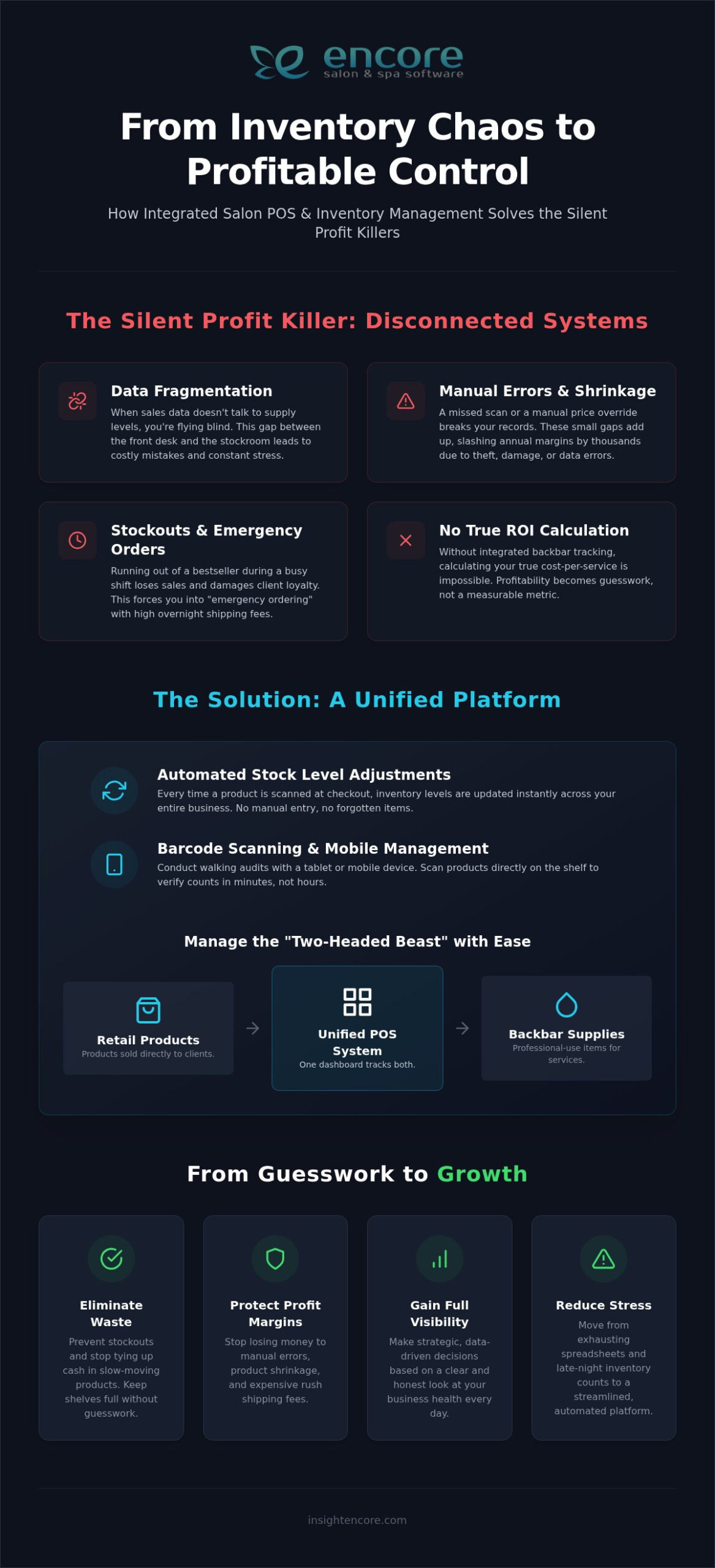
The Silent Profit Killer: Why Disconnected POS and Inventory Systems Fail Salons

Many salon owners treat their front desk and their stockroom as two different worlds. This gap is where profit goes to die. When your sales data doesn’t talk to your supply levels, you’re dealing with "data fragmentation." It’s a technical term for a very practical headache. You end up with "emergency ordering" and paying high overnight shipping fees just to keep your bestsellers on the shelf. This isn’t just about the money; it’s about the stress. Your team feels the weight when they have to apologize to a loyal client because a promised product isn’t there. In 2026, relying on "good enough" spreadsheets is a risk you don’t need to take. Moving toward Inventory management software that integrates directly with your sales is the only way to stay competitive.

The Friday Night Crisis: Stockouts and Manual Overrides

It usually happens during the busiest shift. A barcode won’t scan, so your stylist performs a manual price override just to keep the line moving. While the client is happy in the moment, your records are now broken. The system doesn’t know that specific bottle of volumizing spray is gone. This leads to replenishment failures. Inventory shrinkage is the loss of products between the point of purchase from a supplier and the point of sale, usually caused by theft, damage, or record-keeping errors. Over a year, these small gaps can slash your annual margins by thousands. When a client leaves empty-handed, you don’t just lose a sale. You lose the retail loyalty that keeps your business stable. Implementing a modern salon POS software with inventory management allows you to see these gaps before they become crises.

Data Fragmentation and the Difficulty of True ROI

You can’t grow what you can’t measure. Without integrated backbar tracking, calculating your true cost per service is nearly impossible. Are your stylists using two ounces of color or four? If your backroom isn’t synced, you’re just guessing at your profit. Reconciling the till at the end of the day becomes a nightmare when the physical stock doesn’t match the digital report. This is where Encore Salon Software steps in. By using a unified salon POS software with inventory management, you eliminate the friction between your sales and your supplies. You get a clear, honest look at your business health every single day. This visibility helps you make decisions based on facts rather than feelings.

Core Features of Modern Salon POS Systems with Integrated Inventory

Choosing the right salon POS software with inventory management isn’t just about bells and whistles. It’s about building a foundation that works while you’re busy with clients. You need a system that handles the details so you don’t have to. Without these core features, you risk the dangers of disconnected inventory systems, which often lead to wasted resources and lost sales. Modern platforms act as a silent partner. They can manage stock across different chairs or studio branches from one dashboard, ensuring your multi-location synchronization is seamless and accurate.

Automated Stock Level Adjustments at Point of Sale

A truly integrated system understands the difference between a bottle of retail conditioner and the gallon of shampoo used at the sink. Every time a product is scanned at checkout, the software should trigger an immediate update across your entire business. This real-time syncing is vital for online booking portals where products might be pre-sold or reserved. When your payments are linked through integrated credit card processing, the inventory-to-income cycle speeds up significantly. You get paid, the stock is deducted, and your records stay perfect without a single manual entry. If you’re curious about how this could work for your space, you can explore our comprehensive management features to see the logic in action.

Barcode Scanning and Mobile Management

Gone are the days of being tethered to a desktop computer with a massive binder of spreadsheets. Modern tools allow you to perform walking audits using a mobile device or tablet. You can scan bottles right on the shelf to verify counts in minutes instead of hours. This mobility is especially helpful for variant tracking. If you carry a hairspray in three different sizes or a color line with fifty shades, the software keeps each one distinct. It’s a simple change that makes a massive impact. Industry experts often note that barcode scanning can reduce human error by as much as 90% in busy salon environments compared to manual typing. This accuracy ensures that your par levels, the minimum amount of stock you need to have on hand, are always reliable. Your system will send you a low-stock alert before you ever have to tell a client no.

Managing the Two-Headed Beast: Retail vs. Backbar Inventory Tracking

Managing a salon involves balancing two completely different types of inventory. First, you have your retail products. These are high-margin items meant for client purchase and prominent display. Then, there is the "backbar." These are the professional-use supplies like color, developers, and shampoos that keep your services running. While retail is visible, backbar costs are often hidden. They can quietly drain your profits if they aren’t tracked with precision. Using a unified salon POS software with inventory management allows you to oversee both categories without overwhelming your front-desk team. It keeps the data separate but accessible, ensuring you have a full picture of your studio’s health.

The real challenge often lies in the "Service Cost" problem. If you aren’t tracking your supplies down to the gram or milliliter, you can’t truly know if your color services are profitable. A stylist might use three ounces of color for one client and five for another. Without digital tracking, that variation remains a mystery. Modern software solves this by allowing your team to log usage during the service, which the system then reconciles automatically. This ensures your professional supplies are always accounted for and your margins stay protected. You stop guessing and start growing based on real numbers.

Optimizing Retail Margins with Sell-Through Analytics

Your retail shelves should be a source of income, not a graveyard for "dust collectors." These are slow-moving products that sit on your shelves and tie up your cash flow. By reviewing sell-through analytics, you can identify exactly which brands are performing and which are just taking up space. You can even use this data to trigger automated marketing campaigns for your highest-margin items. This turns your inventory into a proactive sales tool. For more details on how this works in specialized environments, check out The Complete Guide to Choosing a Spa Inventory Management System in 2026.

Reducing Waste in the Backbar

Waste is the enemy of a healthy stockroom. One of the most effective ways to combat this is by implementing "formula notes" within your CRM. This allows you to predict exactly how much product a recurring client needs based on their history. You can also adopt a "parts and labor" pricing model. This ensures the cost of professional supplies is always accounted for in the final bill. This level of detail is especially important for specialized businesses. For example, specialized modules for nail salons are designed to track specific liquids and powders that are easily wasted without strict oversight. A robust salon POS software with inventory management turns these tiny measurements into clear profit data.

The Ultimate Guide to Salon POS Software with Inventory Management in 2026

Implementation Strategy: Moving from Spreadsheets to a Unified Platform

Switching from a binder of papers or a messy spreadsheet to a digital system can feel like a mountain to climb. It doesn’t have to be. By following a logical path, you can transition your business without the stress. The right salon POS software with inventory management is designed to make this move simple, but it starts with a clean slate. You’re not just moving data; you’re setting up a more profitable future for your team. Here is how you can get started:

  • The Master Audit: Physically count every bottle, tube, and foil box in your building. This is your baseline. Without an accurate start, your digital records will never be right.
  • Categorization: Organize your products by brand and type. Clearly separate retail items from backbar supplies to keep your reports clean.
  • Data Import: Use CSV templates to move thousands of SKUs in minutes. Most modern systems allow you to upload your entire list at once, saving you hours of manual typing.
  • Team Training: Build a culture where "scan everything" is the rule. Whether it is at the station or the front desk, every item must be tracked.

Preparing Your Data for a Seamless Transition

Before you hit the import button, take a moment to clean your digital house. Don’t bring "dead stock" into your new system. If a product hasn’t sold in twelve months, it doesn’t need to be in your active inventory. During this setup phase, you should also set your minimum and maximum stock levels for every SKU. These par levels tell the system when to send you an alert. Adding high-quality product photos to the interface also helps your staff identify items at a glance, which reduces errors during a busy shift.

Building Staff Accountability for Inventory Accuracy

Accuracy is a team effort. By using individual staff logins, you can see exactly who is checking out products or performing updates. This isn’t about micromanaging; it’s about transparency and support. When everyone is responsible, accuracy goes up. You can also move away from those exhausting five-hour monthly audits. Instead, create a weekly audit schedule that targets specific brands or sections. It takes fifteen minutes and keeps your data fresh. You can explore the specific Encore features that support this level of staff management and accountability.

Start your stress-free transition today

Why Encore Salon Software is the Strategic Choice for Growth-Minded Studios

Encore isn’t just another software vendor. We’ve been a supportive partner to the beauty industry since 1991. Our roots with Syntec Business Systems mean we understand the daily rhythm of a busy shop. When you choose our salon POS software with inventory management, you aren’t just buying a tool. You’re gaining an ally that values your peace of mind as much as your growth. We’ve spent decades refining our workflows to remove the frustrations that keep you up at night. This long-term expertise allows us to offer a system that feels human-centric and reliable.

Specialized Inventory Logic for Niche Beauty Services

Different studios have different needs. A one-size-fits-all approach doesn’t work for a high-volume barber shop or a custom tattoo studio. Our tattoo studio software is built to manage the unique mix of single-use disposables and expensive ink sets. Meanwhile, barber shops benefit from a rugged interface designed for fast walk-ins. We also provide specialized tools for independent professionals. These tools allow booth renters to manage their own mini-inventory without getting lost in an enterprise-level system. For more on this, read The Independent Stylist’s Guide: Why You Need a Booth Renter Client Management App in 2026.

We know that technology can feel intimidating. That’s why we prioritize the human touch. Our support team doesn’t treat you like a ticket number in a queue. We approach every interaction with a "can-do" attitude and a commitment to your success. Whether you’re upgrading from an old system or starting a new studio, we are here to guide you every step of the way. You deserve a salon POS software with inventory management that is as dedicated to your craft as you are. Let’s build something great together.

Take Control of Your Salon’s Future Today

You’ve poured your heart into building your studio. Don’t let manual inventory counts or unexpected stockouts slow your progress. Moving to a unified system means you can finally stop guessing and start making decisions based on real data. You’ll gain real-time visibility into your stockroom while providing a faster, more professional checkout experience for your clients. It’s about more than just software. It’s about giving yourself the freedom to focus on your artistry while your business runs itself.

By integrating your payments and tracking every ounce of backbar usage, you protect your hard-earned margins and eliminate waste. The right salon POS software with inventory management turns your daily stress into an organized, automated flow. We’ve been a trusted partner to the beauty industry since 1991, offering specialized modules for every niche and integrated payments designed for 2026 efficiency.

Streamline your studio today with Encore Salon Software
You deserve a business that runs as smoothly as your best services. We’re excited to help you take this next step toward a more profitable and peaceful future.

Frequently Asked Questions

How does salon POS software with inventory management save me money?

Salon POS software with inventory management saves you money by stopping profit leaks from over-ordering and high shipping fees. It helps you identify slow-moving products so you don’t tie up cash in items that don’t sell. By tracking every bottle and tube, you also reduce inventory shrinkage from theft or unaccounted usage. This precision ensures your capital stays in your pocket rather than sitting idle on shelves.

Can I track both retail products and professional backbar supplies?

You can easily track both retail products and professional backbar supplies within the same system. The software keeps these categories separate so your sales data doesn’t get cluttered. Retail items are monitored for high-margin sales, while backbar supplies are tracked for service costs like color or developer. This level of detail allows you to calculate your true ROI for every service you provide to your clients.

Does the software work on mobile devices and tablets?

Our software works perfectly on mobile devices and tablets to give you freedom of movement. You can perform audits or check stock levels while walking through your studio instead of being stuck at a desktop. Stylists can even log usage at their stations in real time. This mobility makes inventory management a quick, natural part of your day rather than a long task after closing.

What happens to my current inventory data if I switch to Encore?

Switching to Encore is a smooth process because we help you import your current data using CSV templates. You can move thousands of SKUs into your new account in minutes without tedious manual entry. Our supportive team acts as a guide to ensure your records are clean and organized from the start. It’s a simple way to upgrade your business without the stress or data loss.

Is it possible to set up automatic ordering of low-stock items?

You can set up automatic ordering of low-stock items by choosing "par levels" for every item you carry. When a product hits that minimum level, the system automatically adds that product to your next purchase order so you can reorder before you run out. This prevents the frustration of telling a client that their favorite product is out of stock. It keeps your retail shelves profitable and your backroom fully prepared for every appointment.

How does integrated credit card processing help with inventory accuracy?

Integrated credit card processing links your payments directly to your stock levels. Every time you scan a product and process a payment, the system automatically updates your inventory records. This removes the need for manual overrides or end-of-day reconciliations that often lead to errors. It ensures your digital reports are always 100% accurate, giving you peace of mind even during your busiest shifts.

Can I manage inventory for multiple salon locations from one account?

You can manage inventory for multiple locations from a single, unified dashboard. This feature allows you to see stock levels at every branch and even transfer products between sites if one location is running low. It’s a powerful way to maintain control over your entire brand while managing the specific needs of each studio. You get a clear picture of your total business health at once.

Does Encore offer specialized inventory tracking for tattoo or nail studios?

We offer specialized modules for tattoo studios, nail salons, and barber shops that are tailored to your specific tools. Our tattoo logic tracks single-use disposables and ink sets, while our nail salon tools monitor liquids and powders with precision. These niche-specific features ensure that your salon POS software with inventory management fits your unique workflow. We understand your craft and provide the exact tracking tools you need to succeed.

Disclaimer

This article is general in nature and may contain errors, please verify all claims with your sales rep
Categories
Uncategorized

Salon Retail Inventory Best Practices: The Ultimate 2026 Profit Guide

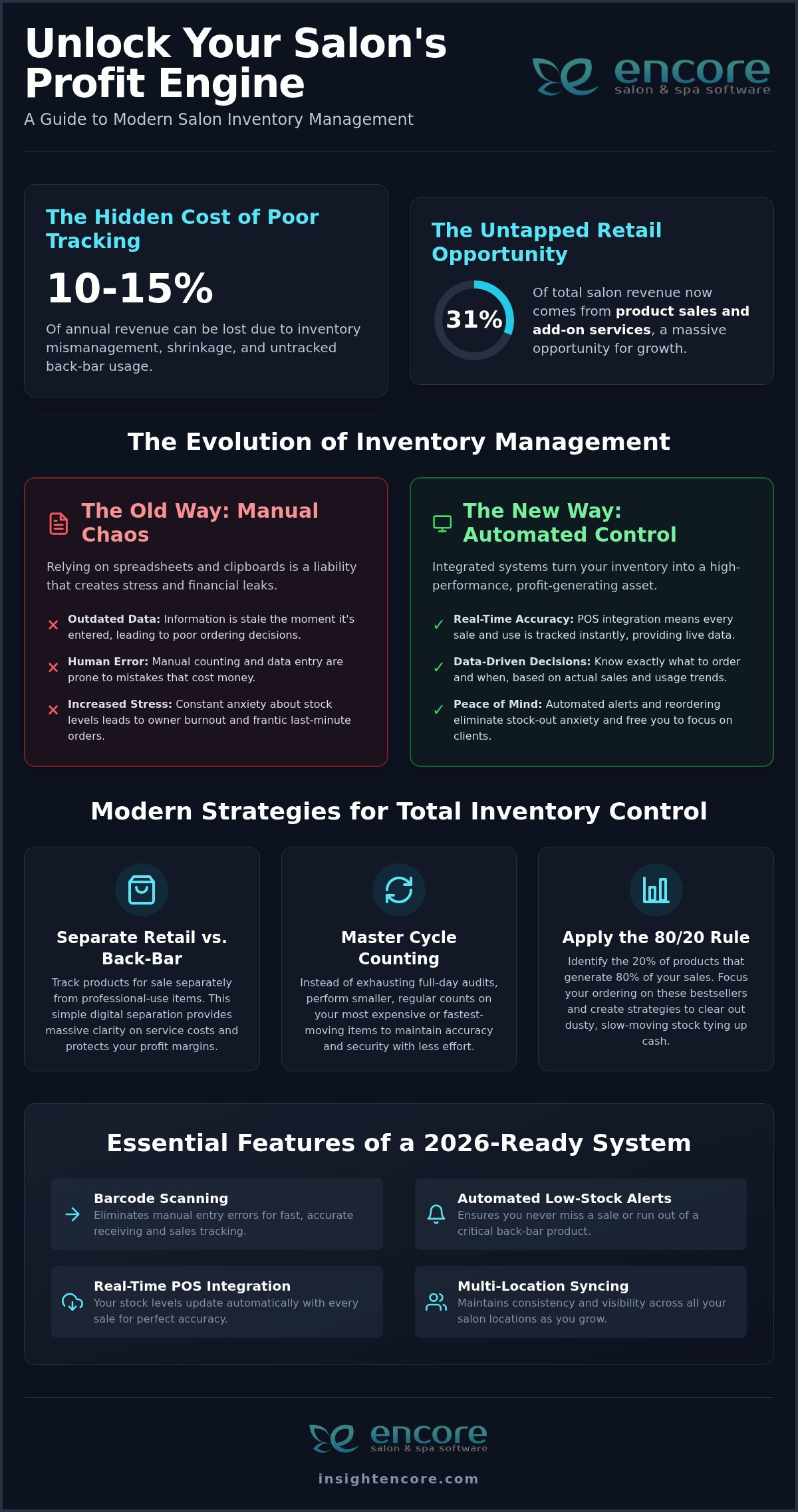
Did you know that 31% of salon revenue now comes from product sales and add-on services, according to Salon Business Strategies? It is a massive opportunity; however, if you haven’t mastered salon retail inventory best practices, that stockroom can quickly become a source of stress. You have likely felt the frustration of seeing your hard-earned cash tied up in dusty bottles that just won’t move. Perhaps you are tired of dealing with unexplained shrinkage or a team that constantly forgets to log back-bar usage.

We understand how heavy that burden feels. You started this business to create beauty and connect with people, not to be buried in spreadsheets. This guide will show you exactly how to flip the script and turn your inventory into a streamlined profit engine. You’ll discover how to move from manual chaos to a system that offers real-time accuracy and automated reordering. We are going to walk through the modern strategies you need to protect your margins, boost your retail-to-service ratio, and finally get your stock under control so you can focus on your clients.

Key Takeaways

  • Learn how to identify the “hidden drains” in your stockroom that could be costing your business up to 15% of its annual revenue.
  • Discover how to implement modern salon retail inventory best practices by moving away from manual spreadsheets and toward real-time POS integration.
  • Master the art of cycle counting to keep your most expensive items secure without the exhaustion of a full-day manual audit.
  • Use the 80/20 rule to pinpoint your true bestsellers and effectively clear out dusty products that are tying up your cash flow.
  • Explore how automated reordering and professional support can transform your inventory management into a stress-free, background process.

Beyond the Stockroom: Why Salon Retail Inventory is Your Secret Profit Engine

Poor tracking often leads to a hidden drain on your business, costing the average salon between 10% and 15% of its annual revenue. This isn’t just about missing a few bottles of conditioner; it’s about lost opportunities and leaked cash. Salon retail inventory is the strategic management of products you sell to clients versus those you use in-service. It’s a delicate balance. To truly succeed, you need to master salon retail inventory best practices so you can stop viewing your stockroom as a chaotic expense and start seeing it as a high-performance asset.

In 2026, consumer demand for professional home-care is at an all-time high. Clients are more educated than ever, and they want the specific products their stylists recommend. When you view your stockroom as a collection of high-value assets rather than just a storage expense, your profit margins begin to shift. Applying standard inventory control principles allows you to stop reacting to shortages and start planning for growth. This is where you move from being a storekeeper to a business strategist who understands exactly what drives your bottom line.

Retail vs. Back Bar: The Critical Distinction

Tracking professional-use products requires a different logic than retail sales. While a retail bottle has a clear price tag, back-bar products are "internally consumed." If you don’t track that liter of shampoo used at the sink, your service margins will suffer. It’s easy to lose track of small amounts, but they add up fast over a month. Modern software, like the Encore Inventory Management System, lets you set up separate digital bins. This keeps your reporting clean and ensures you always know what is for sale and what is for service. It’s a simple change that provides massive clarity for your team.

The Emotional Cost of Inventory Chaos

Inventory chaos isn’t just a financial problem; it’s an emotional one. We know the stress of that Sunday night panic when you realize you’re out of a key color line. Eliminating the "did we order more?" anxiety reduces owner burnout instantly. It gives you back your weekends and your peace of mind. An organized stockroom also boosts staff morale. When stylists feel confident that the tools they need are always available, they perform better and stay longer. Plus, a tidy, well-stocked retail area creates a welcoming environment. It naturally encourages your clients to browse, making retail feel like a helpful service rather than a pushy sales pitch.

The 2026 Inventory Framework: Modern Tech Meets Best Practices

Manual spreadsheets are officially a liability. By 2026, the industry has moved toward automated ecosystems that eliminate human error. If you’re still relying on a clipboard or a static Excel file, you’re likely working with outdated data. Modern salon retail inventory best practices require real-time accuracy that only a fully integrated system can provide. When your POS talks directly to your stockroom, you gain a level of control that manual counting can’t touch. It’s about moving from "guessing" to "knowing."

Mobile accessibility is another game-changer. Stylists don’t have time to run back to the stockroom to see if a specific serum is in stock. With a mobile app, they can check availability right from the chair. This empowers them to make recommendations with confidence. It also ensures that the data-driven demand forecasting in your software is working with live numbers. Your software should tell you when to buy, not the other way around. This shift allows you to keep your focus on the client in the chair rather than the boxes in the back.

Essential Features of a 2026 Inventory System

To stay competitive, your system needs specific tools that simplify your life. Barcode scanning is the absolute minimum requirement for accuracy. It removes the "guesswork" and keeps your team accountable. You should also look for specific capabilities like:

  • Automated low-stock alerts: These ensure you never miss a sale because of an empty shelf.
  • Multi-location syncing: This is vital for maintaining consistency across every site as you grow.
  • Barcode integration: A simple scan updates your entire database instantly.

Adopting these proven inventory management strategies ensures your business stays resilient and profitable. It’s a supportive way to ensure your business grows without the usual growing pains.

Master the Count: Modern Auditing and Cycle Counting Strategies

Counting every single item in your salon at once is a recipe for burnout. It’s often called the "Sunday Stocktake," and it’s something most owners dread. Instead, modern salon retail inventory best practices favor cycle counting. This method involves counting small portions of your stock on a rotating basis. It keeps your data fresh without requiring you to close your doors or stay late. It’s a supportive way to maintain accuracy while protecting your personal time.

We recommend the "High-Value" Rule. Your most expensive items, like luxury serums or professional styling tools, should be counted weekly. These are your biggest assets. If one goes missing, you’ll want to know immediately. Lower-value items, like hair ties or basic combs, can wait for a monthly check. This targeted approach ensures your time is spent where the money is. It also helps you identify shrinkage early. Most shrinkage isn’t actually theft; it’s usually just a stylist forgetting to log a product they used at the back bar. Frequent counts help catch these habits before they ruin your margins.

A Step-by-Step Cycle Counting Schedule

To make this work, divide your stock into "A, B, and C" categories based on their value and how fast they sell. Category A items are your top earners and should be counted every week. Category B items move moderately and need a bi-weekly check. Category C items are low-cost staples that only need a monthly count. This 15-minute weekly habit prevents the dreaded year-end audit. When you find a discrepancy, don’t panic. Simply check your recent sales and back-bar logs to see if a transaction was missed. Resolving these small gaps immediately is much easier than trying to solve a three-month-old mystery.

Empowering Your Team to Track

Inventory management shouldn’t be a solo mission. By building a culture of accountability, you turn inventory into a shared team goal. Designating an "Inventory Lead" is a great way to delegate without creating a bottleneck. This person doesn’t have to do all the work, but they should oversee the schedule and ensure counts are completed. You can also incentivize staff for accuracy. When the team sees that organized stock makes their jobs easier, they’re more likely to participate. Using a tool like Encore Salon & Spa Software allows you to delegate these tasks with clear permissions. It gives your team the responsibility they need while giving you the oversight you want. This collaborative approach turns a chore into a source of professional pride.

Salon Retail Inventory Best Practices: The Ultimate 2026 Profit Guide

Data-Driven Merchandising: Turning Dust-Collectors into Bestsellers

Not every product on your shelf deserves the same amount of space. One of the most effective salon retail inventory best practices is applying the 80/20 rule. This principle suggests that roughly 20% of your products generate 80% of your retail profit. By identifying these "hero" products, you can ensure they never go out of stock while reducing the space given to slow-movers. This is about working smarter to maximize every square inch of your retail area.

Identifying "dead stock" is the next step in cleaning up your profit engine. If a product hasn’t moved in six months, it’s a dust-collector that’s eating your cash. Don’t be afraid to clear it out. You can discount these items, bundle them with a popular service, or even donate them to a local charity for a tax benefit. Once you’ve cleared the clutter, establish par levels. This is the science of knowing the minimum number of bottles you need on hand to meet demand until your next shipment arrives. It keeps your shelves looking full without tying up unnecessary capital in the back room.

Your data also gives you a seat at the table with vendors. When you can show a supplier exactly how much of their line you move, you’re in a much stronger position to negotiate. You might ask for better margins, free back-bar samples, or extended payment terms. Having these numbers at your fingertips turns a vendor relationship into a true partnership that supports your growth. It’s a professional way to ensure your business remains healthy and competitive.

[Unlock Your Salon’s Profit Potential with Encore](https://insightencore.com/try-encore-now/)

Visual Merchandising for Maximum Impact

Your retail display should do the heavy lifting for you. Remember that "eye-level is buy-level." Place your high-margin hero products where clients can’t miss them. Use simple signage or "shelf talkers" to explain the benefits of a product in plain language. Instead of a hard sell, focus on how the product solves a client’s problem. If you have an overstock of a specific item, try a "Gift with Purchase" strategy. Offering a free travel-size bottle with a full-size purchase is a great way to move stock while making the client feel pampered and appreciated.

The Power of Bundling and Loyalty

Bundling is a fantastic way to increase your average ticket price. Create "Service + Product" packages, like a "Color Refresh Bundle" that includes a color-safe shampoo and conditioner. This ensures the client gets the best results at home while boosting your sales. You can also link your inventory to your Loyalty Program. Rewarding clients with points for retail purchases encourages repeat business and builds long-term trust. Use automated marketing to send a quick text or email when a client’s favorite product is back in stock. It shows you’re paying attention to their needs and makes their lives easier.

Automating Excellence with Encore: The Stress-Free Path to Inventory Control

Transitioning from manual tracking to a digital ecosystem is the final step in mastering salon retail inventory best practices. It is the bridge that connects the strategies we have discussed; like cycle counting and par levels; into a single, effortless workflow. Encore Salon & Spa Software provides an integrated Inventory Management System that removes the guesswork from your daily operations. Instead of checking shelves and cross-referencing paper logs, you have a live pulse on your business that updates with every transaction.

This integration starts the moment a client clicks your online booking link. As services are performed and retail items are scanned at the desk, your stock levels adjust automatically. This seamless flow ensures your data-driven merchandising is always based on reality, not a three-week-old count. Whether you are an independent professional using our specialized modules for chair renters or a manager overseeing a multi-location spa, the system scales to meet your needs. You get the same level of professional confidence and real-time accuracy regardless of your shop’s size.

We believe that technology should feel like a partner, not a hurdle. That’s why we prioritize human support for every setup and migration. You don’t have to face the transition alone. Our team understands the daily hurdles of the beauty industry and is genuinely invested in your success. We help you move your data over so you can start seeing the relief of organized control from day one.

Reports That Actually Help You Grow

Data is only useful if it leads to action. Our platform generates reports that simplify the complex decisions you face as an owner. The Sales Statistics Report automates the 80/20 analysis for you, showing exactly which brands are driving your revenue and which are taking up space. Meanwhile, the Professional Product Usage Report helps you catch back-bar waste by comparing what was used in-service against your service sales. We also offer tailored reporting for niche businesses, such as tattoo studios, where tracking specialized supplies is critical for maintaining margins. It’s a professional way to ensure your business stays lean and profitable.

Getting Started: Your 30-Day Inventory Turnaround

You can achieve a total stockroom transformation in as little as 30 days. We’ve designed the migration process to be straightforward and supportive, helping you import your current stock data without the usual headache. Once your data is in, we’ll help you set your first automated reorder points and par levels. This turns the panic of "running out" into a background process that the software handles for you. It’s a steady, logical path toward a business that runs smoothly even when you aren’t standing in the stockroom.

Book a demo with a friendly Encore expert today

Take the Next Step Toward a More Profitable Future

Mastering your stockroom is no longer a matter of manual counts and stressful Sunday audits. By shifting your mindset from "counting bottles" to "managing assets," you unlock a level of financial clarity that most owners only dream of. You’ve seen how modern tools like cycle counting, automated par levels, and data-driven merchandising can turn a dusty stockroom into a high-performance profit engine. It’s about working smarter, not harder, to ensure every product on your shelf is earning its keep.

Implementing salon retail inventory best practices is the most direct path to reclaiming your time and your margins. Since 1991, Syntec Business Systems has been the trusted partner for owners who want to eliminate industry frustrations once and for all. With integrated booking, POS, and stock management backed by real-person support, you have everything you need to succeed.

Start Your Stress-Free Inventory Journey with Encore Salon & Spa Software
You have the roadmap and the professional tools to make it happen. We are genuinely excited to help you take this next step toward a more organized, empowered, and profitable business. Your future starts with one simple choice to put your inventory on autopilot.

Frequently Asked Questions

How often should I do a full inventory count in my salon?

You should perform a full physical inventory count at least once a year for tax and accounting purposes. However, if you follow salon retail inventory best practices like cycle counting, you won’t need to close your shop for a massive audit. By rotating through small sections of your stock weekly, your year-end count becomes a quick verification rather than a multi-day ordeal. This keeps your data accurate and your stress levels low throughout the year.

What is a good retail-to-service sales ratio for a hair salon?

A healthy retail-to-service sales ratio for most hair salons is between 15% and 20%. While service revenue pays the bills, retail profit is what truly grows your business. If your ratio is below 10%, it’s time to look at your team’s consultation habits. High-performing salons often reach 25% by focusing on home-care education. Tracking this number in your reports helps you identify which stylists are natural educators and who might need extra training.

How can I prevent staff from using retail products on the back bar?

The best way to prevent retail products from migrating to the back bar is to use separate tracking bins in your software. When you clearly designate specific bottles for professional use, it’s easier for the team to stay organized. You can also implement barcode scanning for every product pulled from the shelf. If a stylist knows that every item is tracked in real-time, they are much more likely to grab the correct back-bar liter instead of a retail bottle.

What should I do with retail products that aren’t selling?

If a product hasn’t moved in six months, you should bundle it with a popular service or offer it as a gift with purchase. Letting dead stock sit on your shelf ties up cash that could be used for faster-moving items. You can also try a "stylist pick" promotion to give the product more visibility. If it still won’t move, consider donating it to a local charity. This clears your shelf space and can provide a helpful tax deduction.

Is it better to have a few large brands or many small ones in my retail section?

It is generally better to focus on a few core brands rather than many small ones. Managing multiple vendors creates extra administrative work and makes it harder to hit the volume thresholds needed for better margins. By concentrating your orders, you become a more valuable partner to your primary suppliers. This often leads to better support, free samples, and more favorable terms. Aim for a balanced selection that covers all hair types without creating shelf clutter.

How do I calculate the "carrying cost" of my salon inventory?

To calculate the carrying cost of your inventory, you need to add up your storage expenses, insurance premiums, and the opportunity cost of the cash tied up in products. Most industry experts estimate this cost is about 20% to 30% of your total inventory value annually. For example, if you have $10,000 in stock, it might be costing you $2,500 a year just to keep it. This is why following salon retail inventory best practices is so vital for your profitability.

Can I manage inventory if I am just a booth renter?

You can absolutely manage inventory as a booth renter, and it’s actually one of the best ways to boost your take-home pay. Since you are running your own mini-business, tracking your color usage and retail sales is essential for tax time. Specialized software for chair renters allows you to track your small stockroom on your phone. This ensures you never run out of your favorite lightener and helps you maximize every dollar of profit from your retail shelf.

What is the best way to handle product returns from clients?

The best way to handle product returns is to have a clear, written policy that prioritizes exchanges over refunds. If a client isn’t happy with a product, encourage your stylists to find a better fit. This keeps the revenue in your business and ensures the client still gets the home-care results they need. Always log the return in your inventory system immediately. This keeps your stock counts accurate and helps you track if a specific product has a high return rate.

Disclaimer

This article is general in nature and may contain errors, please verify all claims with your sales rep
Disclaimer

This article is general in nature and may contain errors, please verify all claims with your sales rep