

A gift card sale brings in cash, not earned revenue. Under U.S. GAAP, managing salon gift card liability means recording the payment as a liability until the promised service or product is provided, then recognizing revenue when the customer redeems the card. Expected breakage follows separate rules, and expiry depends on applicable state law.
It’s easy to mistake gift card sales for income because the money is already in your account. But the salon still owes the cardholder something, so keep the balance visible until it’s redeemed or otherwise accounted for. Customer deposits also represent money received before a service, but they relate to a specific booking rather than an open-ended gift card balance.
Can software automate the tracking? It can help record sales, redemptions, and remaining balances, but the accounting treatment still depends on what the salon owes and when that obligation is fulfilled. This article explains when gift card revenue is recognized, how breakage differs from deposits, and why expiry rules can affect the liability you carry.
Key Takeaways
- Keep prepaid gift card balances distinct from earned revenue, and recognize service revenue as the card is redeemed.
- Separate gift card obligations from customer deposits, since each relates to a different promise the salon must fulfill.
- Use redemption history and evidence-based estimates to assess breakage rather than treating every unused balance as income.
- Account for state expiry and unclaimed-property rules before deciding how to handle dormant balances.
- Gift card software can help track sales, redemptions, and outstanding balances, giving you clearer records to support accounting decisions.
Revenue recognition at redemption
Under U.S. GAAP, cash received for a gift card is a contract liability until the promised service or product is delivered. Track the balance from sale through redemption, including any partial use.
Accounting Entries for Sales and Redemptions
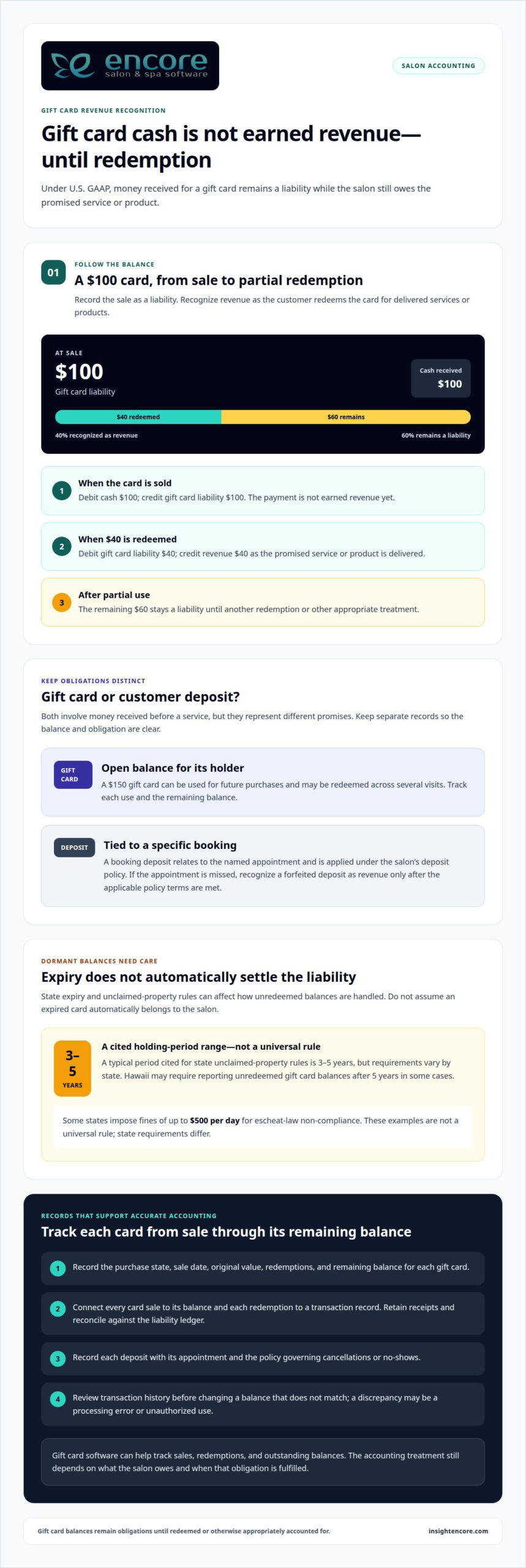
Accounting entries show when gift card cash arrives and when the salon fulfills its obligation. They matter because recording a sale as earned revenue too early can overstate income. For a $100 gift card, debit cash and credit gift card liability by $100. If the customer later redeems $40, debit the liability and credit revenue by $40.
The remaining $60 stays recorded as a liability until another redemption or other appropriate treatment. A digital or physical card changes how the balance is accessed, not the basic accounting sequence: record the sale, then recognize revenue as services or products are delivered.
Effects on Cash Flow, Taxes, and Statements
Gift card sales bring in cash before the salon delivers a service, while the balance sheet carries the unredeemed amount as a liability. That cash can support current operations, but spending it does not remove the obligation to serve cardholders. Tracking outstanding balances alongside cash flow helps the salon plan for future redemptions and read financial statements accurately.
Book revenue and taxable income can follow different timing. According to the Internal Revenue Service, an accrual-method salon generally includes advance payments for future goods or services in gross income in the taxable year received. Keep tax reporting distinct from the U.S. GAAP liability entry, and use the applicable accounting and tax treatment.
To encourage redemption and repeat purchases, make balance inquiries simple and send clear reminders. Digital gift cards can make balances easier to access through mobile wallets, while online and in-salon redemption options give customers more ways to use them. Prompting customers to book a follow-up appointment at checkout can help turn a gift-card visit into an ongoing salon relationship.
Connect each card sale to its balance and every redemption to a transaction record. Limit who can issue cards or adjust balances, retain receipts, and reconcile sales and redemptions against the liability ledger. If a balance doesn’t match, review the transaction history before changing the amount. This helps distinguish a processing error from unauthorized use.
If the salon closes, changes ownership, or changes its services, outstanding cards still represent customer obligations that need a clear plan. Preserve balance and transaction records, identify who will handle remaining redemptions, and communicate service changes to cardholders. The federal CARD Act provides an underlying framework for U.S. gift card regulation, while state rules also apply to unredeemed funds and expiry.
What’s the difference between gift cards and customer deposits?
A gift card creates an obligation to provide services or products to its holder, while a customer deposit is usually tied to a specific booking. For example, a $150 gift card remains available for future purchases, but a deposit for a scheduled appointment relates to that reservation. Keeping separate records helps show what the salon owes and why.
That difference matters when plans change. A customer may redeem a gift card across several visits, leaving a balance after each partial use. A booking deposit, by contrast, is applied to the named appointment under the salon’s deposit policy. If a customer misses that appointment, recognize a forfeited deposit as revenue only after the applicable policy terms are met.
Unredeemed gift card balances can also become unclaimed property, sometimes called escheat. In many U.S. states, businesses may have to report and remit unused value after a state-specified holding period. A typical period cited for state unclaimed-property rules is 3-5 years, but the governing requirements vary by state. This is a separate issue from recognizing revenue under accounting rules.
To understand which requirements apply, identify where the card was purchased and where the issuer is incorporated. The state whose rules may apply is typically the state where the card was purchased or where the issuer is incorporated. Then consult that state’s official unclaimed-property rules for reporting, remittance, and any exemptions. Some states exempt certain single-merchant retail cards from escheat, while others require remittance of qualifying balances.
State differences can affect both timing and treatment. For example, Hawaii may require reporting unredeemed gift card balances after 5 years in some cases. Some states also impose fines of up to $500 per day for escheat-law non-compliance. These examples aren’t a universal rule; a salon operating across state lines may need to track the state connected to each card.
Keep separate records for deposits and gift cards. For each gift card, retain the purchase state, sale date, original value, redemptions, and remaining balance. For each deposit, record the related appointment and the policy that governs cancellations or no-shows. These details help identify dormant balances without treating every unused amount as revenue or as a customer deposit.
A clear ledger also supports ownership changes or business closures. Keep a record of outstanding cards by state and preserve evidence of reporting or remittance. Because state rules determine whether unredeemed balances must be transferred, don’t assume an expired card automatically belongs to the salon.
When can I recognize breakage for unredeemed gift cards?
Breakage is the portion of gift card value customers are expected never to redeem. Recognize it as revenue only under an evidence-based approach, not simply because a card has gone unused.
Estimating Gift Card Breakage
Estimate breakage from historical redemption patterns for comparable gift cards, then apply that evidence consistently. An unsupported estimate can overstate revenue and understate outstanding gift card balances. The estimate should reflect actual customer behavior, including partial redemptions and how long balances typically remain unused.
One example uses $1,000 in cards and estimated breakage of 10%. That leaves a $900 redemption-eligible pool. The estimate is not a universal salon rate. A salon’s own transaction history is the relevant practice for assessing whether its estimate is reliable. Javelin estimated breakage at about 1.5% across the industry, but that figure does not establish an individual salon’s rate. Estimates should be reviewed against subsequent redemptions, so the approach reflects whether the original forecast holds up.
Recognizing Breakage as Revenue
When expected breakage can be estimated reliably, ASC 606 and IFRS 15 call for recognizing it in proportion to actual redemptions. This matters because revenue then follows customer use rather than an arbitrary date or assumption. In the $1,000 example, a $90 redemption from the $900 eligible pool corresponds to $10 of breakage recognition.
Apply the calculation consistently as customers redeem cards, and retain the data supporting both the estimated breakage and the recorded revenue. Breakage recognition under ASC 606 must be proportionate and evidence-based. For salons managing salon gift card liability, that means keeping the estimate tied to documented redemption patterns, not treating every inactive card as earned income.
Breakage and unclaimed property are separate issues. Accounting treatment addresses when revenue may be recognized; state unclaimed-property rules may require certain unredeemed balances to be reported or remitted. An accounting estimate does not erase a legal obligation. Track card balances and state-related records separately, and avoid counting the same amount as both breakage revenue and property owed to a state.
Time alone does not prove successful breakage recognition. Historical data may show when redemption becomes remote; the guide’s example timeframe for estimating patterns is 2-3 years, while breakage is typically considered after 24-36 months when redemption is deemed remote. Those periods are not automatic release dates. A disciplined approach to managing salon gift card liability uses actual redemption evidence and applicable state rules before recording revenue from unclaimed balances.
Recognizing revenue when gift cards are redeemed
Recognize revenue as the customer receives the promised service or product, not merely when a card is sold. Under ASC 606, redemption reduces the gift card liability and records the delivered item or service as revenue.
At redemption, apply the amount used to the customer’s transaction and reduce the corresponding liability. If a card covers only part of a salon visit, record the redeemed portion and keep the unused balance as a liability. The customer may use that remaining amount later, subject to applicable rules. This approach keeps the balance sheet aligned with what the salon still owes.
Retail purchases follow the same delivery principle. If a customer uses a gift card for shampoo, recognize revenue when the product is provided and reduce the liability by the amount applied. If the card covers both a haircut and retail items, allocate the redemption across those sales in the transaction record. This helps sales reports show which services and products customers actually received.
For memberships, account for when the salon provides the included benefits. If a gift card pays for a membership that provides services over time, the salon has not necessarily delivered every promised benefit on the purchase date. Track the card amount applied to the membership, then recognize revenue as membership services are provided. Clear records help distinguish a prepaid membership obligation from completed visits.
Promotions can create more than one obligation. A salon may sell a $100 gift card for $90, or offer a $20 bonus voucher configured as a zero-price promotional gift card with its own expiry. Keep the paid card and bonus voucher identifiable in the records. Their terms and redemption history may differ, so combining them can obscure the outstanding value and complicate revenue reporting.
Gift cards given to employees have a different tax treatment from customer cards. They are treated as supplemental wages and are generally taxable to the employee. Record employee gifts separately from customer gift card sales, and account for them through payroll records. This avoids mixing compensation with customer balances awaiting redemption.
Use a consistent checkout process for each redemption: identify the card, apply the amount used, record the service or product delivered, and preserve any remaining balance. Gift card software can connect transaction histories to outstanding balances, but accurate revenue entries still depend on recording what the customer received. Review sales reports against the liability ledger so redeemed retail items, memberships, and salon services are reflected correctly.
Gift card expiry rules
In the United States, a salon gift card generally cannot expire or must remain valid for five years. State rules can provide stronger protections, so an expiry date printed on a card doesn’t automatically settle how long the balance remains usable. Expiry also doesn’t necessarily remove an outstanding accounting liability or resolve a separate unclaimed-property obligation.
The Federal Gift Card Act was enacted in 2009, and state rules also shape expiry requirements. For example, California prohibits expiry on most gift cards, while Minnesota gift cards never expire. Hawaii gift cards cannot have expiration dates, and balances under $5 must be refundable in cash. These examples show why a salon’s policy needs to reflect the rules that apply to each card.
For compliance, connect each card to its terms and relevant state. Record where it was purchased, its issue date, its stated expiry, and its remaining balance. If a salon sells cards in more than one state, tracking applicable rules helps avoid applying one state’s policy to every customer. Keep the wording on receipts and digital cards consistent with the rules that govern those sales.
An expiry date and an unused balance are separate accounting questions. If a card reaches its stated expiry date, don’t automatically treat its full value as earned revenue. The salon still needs to consider applicable state rules, its accounting treatment, and whether unclaimed-property reporting applies. A card may be expired under its terms yet still involve a legal obligation concerning its balance.
Build a recurring review into gift card tracking. Compare outstanding balances with each card’s issue date, redemption activity, and applicable state requirements. Keep evidence of redemptions, refunds, and balance adjustments. A customer who uses only part of a card still has a remaining balance to account for, unless a lawful rule or other valid treatment applies. This review helps prevent expired cards from disappearing silently from records.
Historic practices don’t establish current compliance. Some salons once enforced a one-year expiration on gift certificates, while paper certificates could still be presented more than three years after purchase. Those examples show why old policies should not be reused without assessing current state rules. Clear expiry terms, consistent records, and state-aware handling help salons manage unredeemed value accurately.
Before changing an expiry policy, identify the states connected to card sales and review the applicable requirements for each. Then update the terms consistently across printed cards, digital cards, receipts, and sales materials. Accurate tracking supports both customer service and accounting: staff can explain a card’s status, while the books retain a record of the outstanding obligation.
Encore Salon & Spa Software: Encore Salon Software
Encore Salon & Spa Software offers Encore Salon Software for salons that want gift card sales and point-of-sale transactions within their business management setup. When gift card activity is spread across separate records, managing sales and client information in one platform can make transaction history easier to follow. Use it as an operational tool alongside your accounting process, not as a replacement for deciding when revenue is recognized or how state rules apply.
For a spa, Encore Spa Software is a related option; Chair/Booth Renter Software and Tattoo Studio Software serve those business types. Choose the solution that fits your operation and how you handle customer transactions. If you’d like to discuss whether Encore Salon Software suits your salon, contact Encore Salon & Spa Software.
Make your next gift card decision with confidence
Managing salon gift card liability is an ongoing part of running a salon, not a task to leave until year-end. Build a routine that keeps transaction records, customer balances, and accounting decisions connected. As your gift card program changes, revisit how its records fit your daily checkout and reporting process.
Encore Salon & Spa Software offers Encore Salon Software, Encore Spa Software, and Chair/Booth Renter Software. The right fit depends on your business and how you manage customer transactions. A conversation can help you explore how a salon management system may support clearer day-to-day operations alongside your accounting practices.
With a consistent process and traceable records, you can manage gift card activity with greater clarity and keep your attention on the clients who make your business thrive.
Frequently Asked Questions
Can software automate this?
Software can record gift card transactions and connect card activity to salon sales, reducing reliance on separate spreadsheets. It can’t decide whether a balance qualifies as breakage or satisfies state reporting rules; those decisions depend on accounting evidence and legal requirements. For example, use transaction records to identify a balance that needs review, then document the accounting treatment separately. Encore’s Gift Cards and point-of-sale tools support operational tracking.
What happens to unused gift card funds?
Unused funds remain associated with the cardholder’s outstanding balance until redemption or another valid treatment applies. Depending on the circumstances, a salon may recognize estimated breakage under accounting rules or need to report and remit funds under state unclaimed-property rules. These are different outcomes. If a salon closes, preserve card and transaction records so outstanding obligations can be identified and handled rather than lost during the transition.
What is the IRS rule on gift cards for businesses?
For an accrual-method salon, the Internal Revenue Service says advance payments for future goods or services generally belong in gross income for the taxable year received. Financial accounting may treat an unredeemed card as an outstanding obligation until the salon provides the promised goods or services. Keep tax records and the gift card liability ledger distinct, and make sure each reflects its own purpose.
How should a salon account for gift card sales and unredeemed balances?
Record each sale against a gift card liability account, then maintain a subledger showing individual card activity. As a practical control, reconcile the total subledger balance with the general ledger at each reporting close and investigate mismatches before posting adjustments. Keep records of voided sales, refunds, and corrections with the original transaction details. This creates a traceable record for staff and supports review by the salon’s accounting professional.
What are the U.S. federal and state gift card expiration and fee rules?
The federal Gift Card Act was enacted in 2009. U.S. inactivity fees can only be charged after 12 months, and salon gift cards generally cannot expire or must remain valid for five years. State protections can be stricter: California prohibits expiry on most gift cards, Minnesota gift cards never expire, and Hawaii gift cards cannot expire. In Hawaii, balances under $5 must be refundable in cash.
Do salon gift card liabilities qualify as unclaimed property or escheat, and what state rules apply?
Yes, some unredeemed gift card balances may be reportable as unclaimed property under state rules. A typical state holding-period range is 2 to 5 years, but requirements and exemptions differ. The relevant state is typically where the card was purchased or where its issuer is incorporated. Keep purchase-state information with each card’s records, since the balance’s location can affect reporting and remittance responsibilities.
How should a salon track gift card balances, redemptions, refunds, and outstanding liability?
Assign each card a record that connects its sale, every redemption, refunds, adjustments, and current balance. Reconcile that detail to the liability account monthly, then flag exceptions such as a refund without a matching card adjustment. Preserve transaction dates and staff records for corrections. This helps distinguish a legitimate balance change from a duplicate redemption or an entry error that could distort the salon’s outstanding liability.
What salon gift card software features help manage liability and compliance?
Useful capabilities include recording gift card sales and redemptions, applying cards at point of sale, and keeping customer and transaction details available for review. Encore Salon Software includes point-of-sale transactions, client management, and gift card management. These tools can organize operational records, but they don’t replace accounting judgments or state compliance decisions. Confirm that your reporting process captures the details your salon needs for reconciliation and review.
Disclaimer
This article is general in nature and may contain errors, please verify all claims with your sales rep