
window.dataLayer = window.dataLayer || []; function gtag(){dataLayer.push(arguments);} gtag('js', new Date()); gtag('config', 'UA-206511945-1');
Search
Categories
Uncategorized

2026 Spa Digital Waiver Guide: Security & Compliance

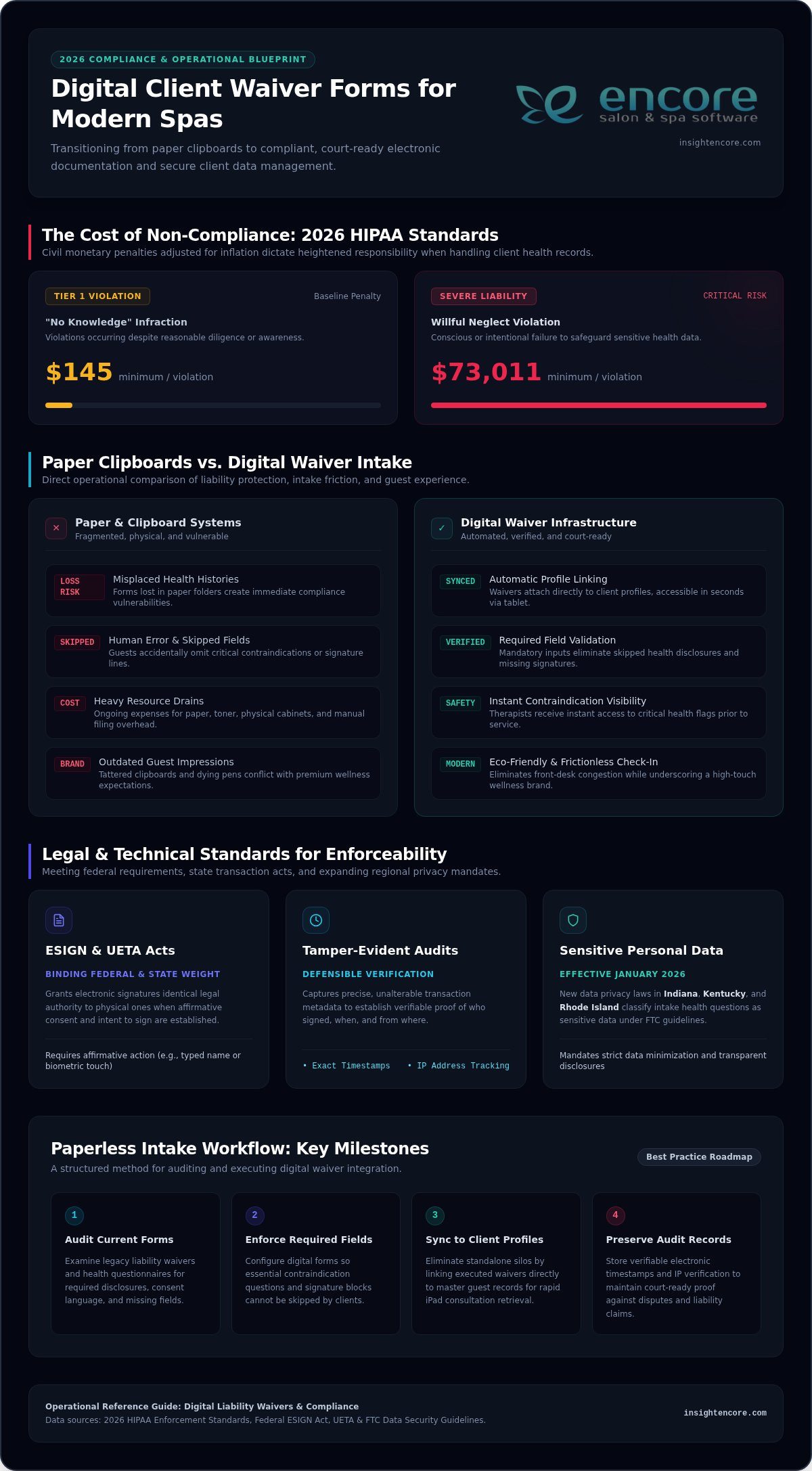
Imagine a client arrives for a luxury treatment, but your front desk is scrambling because their health history form has vanished into a misplaced folder. It’s a stressful way to start a service, and in 2026, it’s also a significant liability risk. With HIPAA civil penalties for willful neglect now reaching a minimum of $73,011 per violation, the stakes for handling sensitive health data have never been higher. Transitioning to client waiver forms for spas digital isn’t just about saving trees. It’s about building a secure, ironclad foundation for your business growth.

We understand that changing your daily workflow can feel daunting, but you deserve a system that works as hard as you do. This guide will walk you through the transition from messy clipboards to a seamless, modern experience that protects your spa legally. You’ll learn how to implement digital waivers that sync automatically to client profiles, ensuring faster check-ins and total peace of mind. We’re diving into the latest 2026 security standards and the simple steps to create a truly paperless, compliant office.

Key Takeaways

  • Understand the critical 2026 legal standards, including HIPAA and ESIGN, to ensure your forms are fully compliant and court-ready.
  • Discover how switching to client waiver forms for spas digital removes the friction of paper filing while keeping sensitive health data secure.
  • Identify the hidden operational costs of standalone apps and why integrated software creates a more seamless experience for your team.
  • Learn a practical, step-by-step approach to auditing your current forms and launching a modern, paperless intake workflow.
  • See how automated syncing to client profiles can eliminate front-desk congestion and provide therapists with instant access to vital contraindications.

Why Digital Client Waiver Forms are Essential for Spas in 2026

Digital waivers are much more than just a PDF on a screen. They are legally binding electronic records that replace traditional paper liability releases. These systems ensure every guest acknowledges the risks and protocols of their treatment before they ever step into a treatment room. By meeting foundational ESIGN Act requirements, these digital documents carry the same legal weight as a physical signature, but with far greater security. Implementing client waiver forms for spas digital protects your business and your clients simultaneously.

Maintaining a wall of filing cabinets isn’t just an eyesore. It’s a drain on your resources. Between paper, toner, and the physical space required for long-term storage, paper systems are expensive. There’s also a significant “first impression” cost. Premium clients in 2026 expect a high-tech, high-touch experience. Handing a guest a tattered clipboard and a dying pen feels out of sync with a modern wellness brand.

The Shift Toward Paperless Operations

Transitioning to client waiver forms for spas digital allows your team to focus on the guest, not the paperwork. You can reduce administrative overhead by eliminating the need to scan and file documents manually. When a client returns for their second or third visit, you won’t have to go digging through folders. Real-time accessibility means your staff can pull up a waiver on an iPad in seconds during a consultation. This efficiency reinforces your brand as a “green,” forward-thinking establishment that values both the environment and the client’s time.

Legal Protection in the Digital Age

A digital signature is often more enforceable than a scrawled paper one. Digital platforms capture an audit trail that paper simply can’t match. This includes exact timestamps and IP tracking for verification. In a dispute, being able to prove exactly when and where a form was signed is vital. Digital forms also prevent human error. You can make specific fields “required,” ensuring no guest accidentally skips a crucial health disclosure or signature line.

The stakes for compliance are higher than ever. As of January 2026, HIPAA civil monetary penalties have been adjusted for inflation. Even a “No Knowledge” violation (Tier 1) can carry a minimum penalty of $145 per violation. Willful neglect can skyrocket to over $73,011. Using a secure digital system ensures you are meeting these standards while keeping your professional liability insurance premiums in check. For businesses offering specialized services, such as those using Tattoo Studio Software, having these digital safeguards in place is often the difference between a minor hiccup and a business-ending legal battle.

Adopting client waiver forms for spas digital transitions your business into a sophisticated legal framework. It’s not just about convenience; it’s about building a defense that holds up under scrutiny. In 2026, legal standards have evolved to demand more than just a digital signature. They require proof of identity, intent, and a clear audit trail. When you handle sensitive health data, you aren’t just a service provider. You’re a data steward.

Understanding ESIGN and UETA Compliance

The legal weight of your digital forms rests on two pillars: the federal ESIGN Act and the state-level Uniform Electronic Transactions Act (UETA). For a signature to be binding, you must prove the client intended to sign and consented to do business electronically. You can’t just assume consent. Your system must clearly present the terms and capture an affirmative action, like a typed name or a biometric touch. In 2026, ESIGN Act compliance for spa owners means maintaining a verifiable, tamper-evident record of a client’s clear intent and affirmative consent to be bound by electronic terms.

Privacy laws are also tightening. As of January 2026, new comprehensive data privacy laws in Indiana, Kentucky, and Rhode Island have gone into effect. These laws classify the health questions on your intake forms as “sensitive personal data.” This mandates strict data minimization and clear privacy disclosures. Following FTC data security guidelines is no longer optional for professional spas. It’s a baseline requirement for avoiding heavy fines and maintaining client trust.

Data Security and Storage Best Practices

Where you store your data matters just as much as how you collect it. Local storage on a front-desk computer is a significant risk. If that hardware fails or is stolen, your legal protection vanishes. Cloud-based storage offers superior security through redundancy and high-level encryption. Look for software that carries SOC 2 Type II certification. This third-party audit proves the platform meets the highest industry standards for security, availability, and confidentiality.

Your digital ecosystem should protect data at every stage. This includes “encryption at rest” for stored files and “encryption in transit” when a client submits a form. To dig deeper into protecting your business, check out our Salon Client Data Security Best Practices. Modern systems now even utilize biometric verification or AI-driven fraud detection to ensure the person signing is who they say they are. These layers of protection turn your intake process into a robust security asset. If you’re ready to move beyond paper, you can modernize your intake process with a platform built for these 2026 standards.

Standalone Waiver Apps vs. Integrated Spa Management Software

Choosing the right tool for client waiver forms for spas digital often comes down to one question: do you want your software systems to talk to each other? Many owners start with standalone apps because they seem quick to set up. However, these tools often create “data silos” where your legal documents live in one world and your appointment book lives in another. This disconnect forces your front desk to manually check if a form was signed before every single service. It’s an unnecessary hurdle that slows down your operations and frustrates your team.

When you use separate systems, you are likely paying for two subscriptions. You’re also paying in lost time. Manual data entry or uploading PDFs from one app to another is a recipe for human error. Integrated systems like Encore Salon & Spa Software remove this friction by making the waiver a natural part of the client’s master record. This ensures that every piece of data, from contact info to liability releases, stays in one secure place. Beyond waivers, securing how you process payments is equally critical — understanding PCI compliance for small business salons ensures your entire client data ecosystem is protected from breach to billing.

The Case for Standalone Waiver Tools

Standalone tools might suffice for a solo provider with a very small client list. They offer a basic way to go paperless without committing to a full management suite. But as you scale, the limitations become obvious. You’ll find yourself wrestling with manual exports or finicky third-party integrations just to keep your records updated. If a client disputes a treatment, you don’t want to be hunting through a separate app to find their specific signature. You need that information available instantly within their profile.

The Power of Integrated Client Records

The real power of modern technology lies in a unified Client Management System. When your waivers are integrated, they become the foundation of a client’s digital history. Professional client intake and consent documentation shouldn’t be an isolated task. It should be a seamless part of the guest journey. With Encore, you can automate this entire process from the start.

Your Online Booking Module can trigger a waiver request the moment an appointment is made. By the time the client walks through your door, their signed form is already attached to their profile. This reduces check-in friction because your staff can see a “missing waiver” alert before the client even arrives. You save money on multiple subscriptions and, more importantly, you save hours of administrative time every week. It’s about moving from a state of potential stress to a feeling of organized, professional control.
2026 Spa Digital Waiver Guide: Security & Compliance

How to Implement a Seamless Digital Intake Workflow

Transitioning from paper to client waiver forms for spas digital requires a clear plan, but the relief of a paperless office is well worth the effort. Start with a thorough audit of your current physical forms. Identify the essential legal clauses and remove any redundant questions that create unnecessary clutter. Once you’ve refined your content, choose a platform that understands your niche. If you offer specialized services, look for Tattoo Studio Software or medspa modules that already include compliant, industry-specific templates.

Map the client journey from the moment of booking to the final signature. Your staff should be empowered to guide clients through this change. Instead of just handing over a tablet, they can explain how digital storage keeps sensitive health data safer than a physical folder. For your existing paper archives, you don’t need to scan every document overnight. Focus on digitizing active clients first and move through the rest of your files as time permits during slower periods.

Designing Your Digital Form for Clarity

A great digital form is short and relevant. Use conditional logic to hide questions that don’t apply to a specific client. If a guest indicates they have no allergies, they shouldn’t have to scroll past five more questions about allergy types. Mobile-friendliness is also non-negotiable. Most clients will complete these forms on their phones, so ensure the layout is clean and the buttons are easy to tap. Use clear, non-technical language. Swapping complex medical jargon for everyday terms makes the process feel more welcoming and less like a legal interrogation.

Optimizing the Check-In Experience

The goal is to remove friction before the client even arrives. Send automated text or email links 24 hours before the appointment to encourage pre-arrival completion. For those who prefer to sign in person, set up a dedicated tablet kiosk in your waiting area. This keeps your front desk clear of congestion. If a client is tech-averse, approach them with empathy. A friendly staff member can walk them through the tablet interface, turning a potential hurdle into a professional, supportive interaction.

Modernize your spa intake process today

Secure Your Future with Encore Spa Software

Choosing a software partner is about more than just a feature list. It’s about reliability and long-term support. At Encore, we’ve been a dedicated ally to the beauty and wellness industry since 1991. We understand the daily hurdles you face because we’ve spent decades helping businesses like yours overcome them. Our platform integrates client waiver forms for spas digital directly into your daily operations. This ensures that legal protection isn’t a separate, manual task. Instead, it becomes a built-in standard that protects your peace of mind.

Security is our priority. We provide the cloud-based reliability you need to store sensitive health data without the risks of physical filing. When your waivers live inside your management system, you eliminate the data silos that lead to errors. You gain a unified view of your business that scales as you grow. Whether you’re managing a single boutique or a large multi-location franchise, our tools for POS, inventory, and staff management work in perfect harmony with your digital intake process.

More Than Just a Signature

A waiver is the start of a client relationship, not just a liability shield. The information you collect during intake is a goldmine for business growth. With Automated Marketing, you can turn client preferences and health notes into personalized experiences that drive revenue. If a guest mentions a specific skin concern on their digital form, your system can trigger a follow-up email with relevant care tips or a curated treatment recommendation.

You can also strengthen your total ecosystem by connecting intake data to our Gift Cards and loyalty programs. When you know your clients better, you can serve them better. This level of personalization is what builds lasting loyalty in a competitive market. You aren’t just checking a compliance box; you’re building a data-driven strategy for success that starts the moment a client signs their first form.

Getting Started with Encore

We know that moving your data can feel like a massive undertaking. That’s why we’ve designed our migration process to be as smooth as possible. Our team acts as your dedicated mentor, helping you move away from paper or outdated systems with professional confidence. We don’t just hand you a login. We provide the hands-on support you need to implement a 2026-ready workflow that simplifies your life and impresses your guests.

Ready to see the difference for yourself? You can explore our Pricing or reach out to us for a personalized demo through our Contact page. Let’s work together to create a secure, seamless, and paperless future for your spa today.

Take the Next Step Toward a Secure, Paperless Spa

Moving your business into 2026 means leaving behind the clutter and risk of physical paperwork. You’ve seen how modern security standards demand more than just a signature. They require a secure, verifiable system. Transitioning to client waiver forms for spas digital isn’t just a technical upgrade. It’s a commitment to protecting your clients and your business from legal and financial vulnerability.

By integrating these forms into your overall management workflow, you remove the friction that slows down your front desk and frustrates your guests. Since 1991, we’ve helped beauty and wellness professionals replace stress with organized control. Our all-in-one management suite provides specialized modules for spas and tattoo studios, ensuring your intake data lives securely within the client record where it belongs. You gain a partner that understands the specific nuances of your craft and the importance of data security.

Ready to go paperless? Request a demo of Encore Spa Software today.

You deserve a system that grows alongside your business while providing total peace of mind. We’re here to help you make this transition with professional confidence and ease. Let’s make your transition to a modern, secure office simple and empowering.

Frequently Asked Questions

Are digital waivers as legally binding as paper ones in 2026?

Yes, digital waivers carry the same legal weight as traditional paper forms under the ESIGN Act and UETA. To be fully enforceable, your system must capture clear intent to sign and affirmative consent to do business electronically. Modern platforms create a tamper-evident audit trail that records timestamps and IP addresses. This level of detail often makes digital records more reliable than paper in a court of law.

Can I use a digital waiver software on an iPad or tablet at the front desk?

Yes, using a tablet or dedicated kiosk is a standard practice for modern spas. You can set up a station in your waiting area where clients can securely complete their forms upon arrival. If you use integrated software, your front desk team will see an automatic alert if a waiver is missing. This prevents service delays and ensures your client waiver forms for spas digital are always signed before a treatment begins.

How does digital waiver software help with HIPAA compliance for medspas?

Digital software provides encryption and access controls that physical filing cabinets simply cannot offer. With HIPAA civil penalties for willful neglect starting at $73,011 in 2026, secure storage is a financial necessity. A compliant system ensures that sensitive health data is only accessible to authorized staff. It also maintains a log of who viewed the record and when, which is a critical requirement for medical-grade wellness facilities.

Do clients need to create an account to sign a digital waiver?

No, most clients don’t need to create a username or password to sign their forms. You can send a secure, personalized link directly to their phone or email 24 to 48 hours before their appointment. This low-friction approach allows them to complete the intake process on their own device at their convenience. It speeds up the check-in process and keeps your lobby clear of congestion.

What happens if a client refuses to sign a digital form?

If a client is hesitant, your staff should explain that digital forms are used to protect their private health information. You can offer to walk them through the process on a spa tablet to show how simple it is. While you can technically provide a paper copy, this creates a data silo that is harder to secure. Most businesses find that a reassuring, empathetic explanation of the security benefits resolves these concerns.

Can I customize the digital waiver to match my spa branding?

Yes, professional software allows you to fully customize your forms to reflect your brand identity. You can add your logo, choose your brand colors, and adjust the fonts to create a cohesive experience. This consistency builds trust with your clients and reinforces your image as a high-quality establishment. Customizing your client waiver forms for spas digital ensures that every touchpoint feels like a natural extension of your spa.

How long should I store digital waivers for my spa business?

Storage requirements vary by state, but most legal experts recommend keeping liability waivers for at least three to seven years. Some states have longer statutes of limitations for personal injury claims. One of the biggest benefits of cloud-based software is that it provides unlimited, secure storage without taking up physical space. You don’t have to worry about documents getting lost or damaged over time, as they are backed up automatically.

Does Encore Salon Software include digital waiver features?

Yes, Encore Salon & Spa Software includes integrated digital intake and waiver features as part of its all-in-one management suite. We’ve been a trusted partner in the industry since 1991, and our system is designed to remove the frustration of disconnected apps. Your waivers live directly within the client’s master profile. This integration ensures that therapists can review contraindications and notes instantly before every service, keeping your clients safe and your business compliant.

Disclaimer

This article is general in nature and may contain errors, please verify all claims with your sales rep
Categories
Uncategorized

Salon Client Data Security Best Practices: The 2026 Owner’s Guide

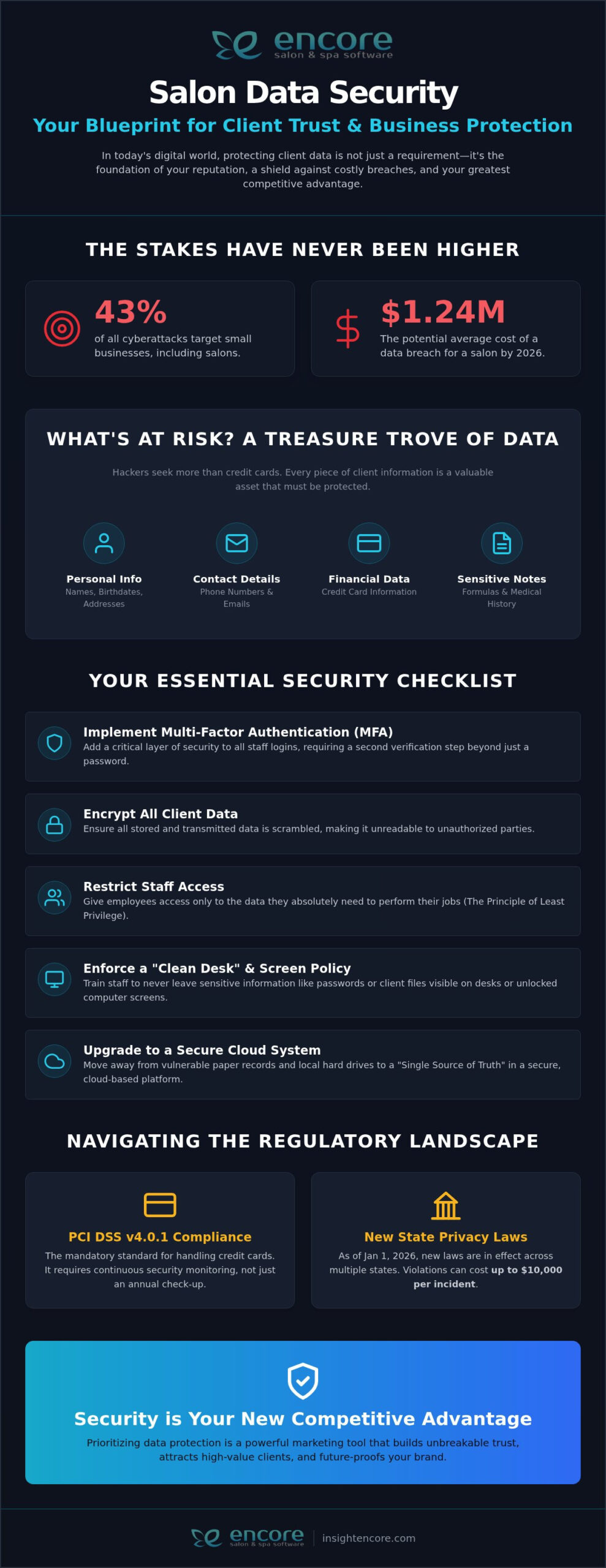
Did you know that 43% of all cyberattacks now target small businesses, with the average cost of a breach for a typical salon reaching up to $1.24 million in 2026? It’s a staggering figure that highlights why salon client data security best practices are no longer optional; they’re as essential as a sanitized toolkit. You’ve spent years building a reputation for excellence and care. Protecting your clients’ phone numbers, addresses, and credit card details is the ultimate way to honor that relationship and keep your business thriving.

We know the technical side of things can feel overwhelming. Dealing with PCI DSS v4.0.1 requirements or new state privacy laws shouldn’t keep you up at night. You deserve to feel confident that your digital doors are locked tight. This guide provides a straightforward checklist to help you master modern security protocols and build unbreakable trust with your high-value clients. We’ll explore everything from encryption basics to managing staff access, giving you the peace of mind to grow your business safely.

Key Takeaways

  • Learn how treating privacy as a premium service builds client loyalty and protects your hard-earned reputation from costly breaches.
  • Stay ahead of the latest legal requirements, including PCI DSS 4.0.1 and new state privacy laws, to avoid heavy financial penalties.
  • Discover the most effective salon client data security best practices, such as implementing Multi-Factor Authentication and restricted staff access.
  • Create a culture of safety by training your team on “Clean Desk” policies and secure record handling to eliminate common human errors.
  • Understand why moving to a cloud-based management system provides a more secure “single source of truth” than keeping records on local hardware.

Why Salon Data Security is Your Biggest Business Asset in 2026

In 2026, privacy isn’t just a back-office chore. It’s a premium service. Clients expect their personal details to be as safe as their hair is in your hands. A data breach does more than trigger a fine; it shatters the trust you’ve spent years building. While the financial impact is heavy, the loss of your reputation is often permanent. Recovering from a public security failure is much harder than preventing one. By prioritizing salon client data security best practices, you’re telling your community that you value them beyond the chair. You’re showing that you are a supportive partner in their overall well-being.

The Anatomy of Salon Data

Hackers aren’t just looking for credit cards. They want Personal Identifiable Information (PII). This includes names, birthdates, and those “harmless” phone numbers. In fact, phishing remains the most common attack vector against small businesses. Even your color formulas and sensitive medical notes are assets. Storing these insecurely puts your clients at risk of identity theft or targeted scams. Understanding basic data security principles helps you see your database as a vault that needs protection. Every piece of info you collect is a responsibility that requires professional care.

Security as a Competitive Advantage

High-value clients prioritize discretion. When you can prove that their data is locked down, you’re offering a level of professionalism that sets you apart. Mentioning your secure booking portal in your marketing isn’t bragging; it’s reassuring. You can highlight how Encore Salon Software features keep every record encrypted and accessible only to those who need it. This transparency builds a “safety brand” that attracts clients who are willing to pay more for peace of mind. It turns a technical necessity into a powerful selling point that makes your salon the obvious choice.

Moving away from paper binders is your first big win for modern protection. Paper records are easily lost, stolen, or seen by the wrong eyes. Digital systems allow for much better control and tracking. Modern salon client data security best practices rely on a “Single Source of Truth.” This means all data lives in one secure, cloud-based home rather than scattered across sticky notes and local hard drives. It’s the foundation of a modern, professional beauty business that respects its clients’ digital lives as much as their physical ones. This shift is the first step toward total peace of mind for you and your guests.

The Regulatory Landscape: PCI Compliance and Privacy Standards

Understanding the rules isn’t just about avoiding fines. It’s about professional integrity. In 2026, the regulatory world is a patchwork of payment security and personal privacy laws. Many owners confuse the two. PCI DSS v4.0.1 governs how you handle credit cards. Meanwhile, state laws like those in Indiana and Kentucky protect who can see a client’s home address. Following salon client data security best practices means respecting both sets of rules. It ensures your business remains a safe space for every guest.

PCI DSS v4.0.1 is now the mandatory standard. It moved the industry from once a year checks to continuous security monitoring. This is a big shift. You can find excellent FTC cybersecurity guidance to help you navigate these basics. The goal is to ensure that cardholder data never lingers where it shouldn’t. It’s about creating a safe environment for every swipe or tap. If you aren’t monitoring your systems regularly, you’re already behind the curve.

PCI Compliance for Small Business Salons

The biggest risk in many salons is the simplest one: writing down credit card numbers on paper. This is a major compliance violation. It’s also an invitation for theft. Using integrated credit card processing simplifies this burden immensely. When your software handles the transaction, the sensitive data never touches your local network. This keeps you safe and keeps your clients’ bank accounts protected. It removes the stress of manual record-keeping and local data storage. For a complete breakdown of what these requirements mean for your business, our PCI compliance for small business salons guide walks you through every step without the technical jargon.

Privacy laws are also getting tougher. As of January 1, 2026, new laws in Indiana, Kentucky, and Rhode Island are in full effect. Violations in these states can cost up to $7,500 or $10,000 per incident. Twelve states now require businesses to recognize Global Privacy Control (GPC) signals for opting out of data sales. If you operate across state lines, this complexity grows quickly. You need a system that adapts to these changes automatically and protects you from accidental non-compliance.

Medical Data and Medspas

For medspas and tattoo studios, the stakes are even higher. You aren’t just handling names; you’re handling health history and allergy records. While not every salon falls under HIPAA, many beauty businesses are moving toward those higher standards to ensure total protection. Client waiver forms for spas digital solutions and secure consultation notes are essential. They provide a legal paper trail that protects you if a client has an adverse reaction. This documentation is your best defense against liability and reputation damage.

Managing these layers of compliance doesn’t have to be a headache. You can explore how automated systems handle the heavy lifting for you. By choosing the right tools, you can focus on your craft while the technical details remain secure in the background. It’s about reclaiming your time and your peace of mind while building a business that stands the test of time.

Essential Technical Safeguards: From Encryption to Access Control

Technical safeguards are the locks and alarms on your digital storefront. While previous sections covered the “why” and the “rules,” these tools are how you actually get the job done. Implementing salon client data security best practices starts with end-to-end encryption. This technology scrambles sensitive info so it’s unreadable to anyone without the key. It’s your first line of defense against prying eyes. Pair this with automated cloud backups. If your salon ever faces a hardware failure or a ransomware attempt, these backups act as a safety net to restore your business in minutes. You don’t have to be a tech expert to use these; you just need the right partners in place.

Multi-Factor Authentication (MFA) is another non-negotiable in 2026. It requires a second form of verification, like a code sent to a phone, before granting access to your system. This simple step stops the vast majority of unauthorized login attempts instantly. It’s about building layers of protection that make it too difficult for hackers to bother with your data. By making MFA a standard part of your login routine, you’re choosing a proactive path to peace of mind.

Securing Your Physical Salon Hardware

Your front-desk terminal and tablets are physical gateways to your data. Start by separating your networks. Always offer a “Guest Wi-Fi” for clients that is completely isolated from your “Business Wi-Fi.” This prevents a guest’s infected device from reaching your salon’s private records. Ensure every tablet is password-protected and never left logged in and unattended on the salon floor. For those managing booth or chair renters, encourage them to use their own secure logins rather than sharing a single “salon” account. This keeps everyone’s information separate and safe from accidental exposure.

Software-Level Security Features

Modern software allows you to implement the Principle of Least Privilege (PoLP). This means your team only sees the information they need to perform their specific roles. A receptionist might need the calendar, but they don’t necessarily need access to your year-end tax documents or full client contact lists. Using audit logs lets you see exactly who accessed client data and when, providing total transparency. This approach aligns with the FTC’s Guide to Protecting Personal Information, which emphasizes limiting access to sensitive data to a “need-to-know” basis. If you are an independent pro, our Management Software for Chair Renters offers these same high-level protections tailored for your unique needs.

Salon Client Data Security Best Practices: The 2026 Owner’s Guide

Creating a Culture of Security: Staff Training and Protocols

Your team is the heart of your salon, but they can also be your biggest vulnerability. Most data leaks aren’t the result of high-tech hackers; they’re the result of simple, avoidable mistakes. Training your staff on salon client data security best practices is the most effective way to close these gaps. It’s about building a shared sense of responsibility. When every stylist understands that protecting a client’s email address is just as important as the quality of their highlight, your salon becomes a fortress of trust. Implementing these salon client data security best practices helps you avoid the $11.5 million average cost of a typical U.S. data breach in 2026.

Start by implementing a “Clean Desk” policy across the salon floor. This means no client phone numbers on sticky notes and no passwords written on the back of tablets. In a busy environment, it’s easy to jot something down and forget it. However, a misplaced note is a major security risk. Encourage your team to enter information directly into your secure management system and keep workstations clear of physical records. This simple habit keeps sensitive information away from prying eyes and maintains a professional atmosphere.

Managing staff turnover is another critical protocol. When a team member leaves, their access to client lists and payment systems must be revoked immediately. This prevents potential data theft and ensures that client records stay within your business. In 2026, phishing scams have also become incredibly sophisticated due to the rise of AI. Your team might receive a text or email that looks exactly like a message from you or a trusted vendor. Teach them to verify any unusual request for data or login credentials. If it feels off, it probably is.

Onboarding Staff with Security in Mind

Include data privacy in your employee handbook from day one. Explain how to use secure client messaging and why sharing login details is strictly prohibited. This sets a clear standard for professional behavior. For more operational advice, you might find our 15 Barbershop Management Tips helpful for streamlining your team’s daily routines and maintaining high standards for safety and service.

Ongoing Security Audits

Regular check-ins keep your systems healthy. Schedule monthly password resets and review who has permission to access specific data. A security audit for a salon owner is a systematic review of all digital and physical touchpoints to ensure client information remains protected and compliant with current laws. Test your backup systems regularly to ensure they’re ready if you ever need them. Consistency is the key to maintaining total control over your business assets.

Secure your salon's future today

Future-Proofing Your Business with Secure Management Software

Choosing the right technology is the single most important decision you’ll make for your business’s safety. In the past, many salons kept records on local servers or personal laptops. This is a massive risk. If that hardware is stolen or damaged, your data is gone forever. Cloud-based systems are inherently more secure because they remove these physical vulnerabilities. By moving to a “Single Source of Truth,” you ensure that every client record, color formula, and payment detail lives in one encrypted, professional-grade vault. This centralized approach reduces the number of entry points for hackers and makes managing salon client data security best practices much easier for you and your team.

Encore Salon Software handles the technical heavy lifting so you don’t have to. Our infrastructure has security baked into every feature, from integrated credit card processing to specialized modules for tattoo and medspa compliance. We’re also looking ahead. The next wave of technology will include AI-driven monitoring to spot suspicious login patterns and biometric access like fingerprint or facial recognition for staff terminals. These tools will add even more layers of protection. By partnering with us, you’re ensuring your salon stays at the forefront of these advancements without needing an IT degree.

Choosing the Right Partner

When you evaluate a software provider, ask about their encryption standards and how often they perform automated backups. It’s also vital to consider the human element. If you have a security concern, you need a responsive partner who offers human-led support rather than a delayed automated response. You want a guide who understands the daily hurdles of the beauty industry. For a deeper look at how the right tools can transform your operations, check out our Encore Salon Software Guide. It’s designed to help you master every aspect of your business with confidence.

Next Steps for Your Salon

You can improve your security profile in just ten minutes today. Start by checking that your “Guest Wi-Fi” is truly separate from your business network. Next, verify that every staff member has their own unique login with the correct permission levels. Finally, ensure your front-desk terminal is set to auto-lock after a few minutes of inactivity. If your current system makes these salon client data security best practices difficult to manage, it might be time for a change. Transitioning from a legacy system to Encore is a straightforward process designed to give you organized control and total peace of mind.

Ready for a more secure salon? Try Encore Now

Securing the Future of Your Beauty Business

Mastering salon client data security best practices is about more than checking boxes; it’s about protecting the heart of your business. You’ve learned that modern privacy is a premium service that high-value clients expect. By moving to a cloud-based system and training your team to spot phishing, you’re building a foundation of trust that can’t be broken. Security shouldn’t be a source of stress. With the right tools, it becomes a natural part of your professional routine.

Since 1991, we’ve been helping salon owners navigate industry complexities with reliability and care. Our integrated PCI-compliant payment processing takes the guesswork out of compliance, while our human-centric support team guides you through implementation. You don’t have to handle the technical heavy lifting alone. We’re here to ensure your data stays locked down so you can focus on your craft.

Secure your business and your clients—Try Encore Now

Take the first step toward total peace of mind today. Your clients will thank you for the extra care. You’ll enjoy the confidence that comes with knowing your legacy is safe.

Frequently Asked Questions

Is it safe to store client credit card information in my salon software?

It is safe and highly recommended if you use a system with integrated credit card processing. Encore Salon & Spa Software uses cloud-based infrastructure that ensures sensitive payment data is encrypted and never stored locally on your devices. This approach follows salon client data security best practices by removing the risk of data loss from stolen hardware. It also simplifies your compliance burden because the software handles the heavy technical lifting of protecting cardholder information.

What should I do if I suspect a salon data breach?

You must act quickly to contain the issue and protect your clients. First, secure your systems by changing all passwords and isolating affected hardware. Contact your software provider immediately to investigate the scope of the incident. You may also need to notify affected clients and local authorities depending on your state’s data privacy laws. Having a clear response plan in place ensures you can handle the situation professionally and maintain long-term trust with your guests.

Do independent booth renters need their own data security protocols?

Yes, independent professionals are responsible for the client information they manage. Even if you work within a larger salon, you handle personal details and payments that require protection. Using specialized Chair/Booth Renter Software ensures your records are encrypted and separate from the main salon’s database. This protects your business from liability and ensures you are following the same high security standards as a full-scale salon or spa. It’s about protecting your personal brand and reputation.

How does PCI compliance affect my salon processing fees?

Maintaining PCI compliance helps you avoid non-compliance fees that many processors charge. While there isn’t a direct discount for being compliant, the cost of a breach or a penalty for failing an audit is significantly higher than the cost of a secure system. Integrated processing often streamlines these requirements into your monthly service. This provides a predictable cost structure while giving you the peace of mind that your transactions are fully protected against modern threats and costly fines.

Can I use a personal tablet for client check-ins and booking?

You can use a personal tablet, but it must be properly secured to meet professional standards. This includes setting a strong, unique password and ensuring the device isn’t used for personal browsing while connected to your business network. Always use a dedicated app rather than a mobile browser to access your management system. Separating your business data from personal files is a key part of salon client data security best practices that prevents accidental exposure of sensitive information.

How often should I update my salon’s digital security settings?

You should review your security settings at least once a month. This includes updating passwords, reviewing staff access permissions, and ensuring your software is running the latest version. Regular audits help you stay ahead of new threats and ensure your team is following established protocols. It’s much easier to perform small, monthly checks than to fix a major security gap later. Consistency is the most effective way to maintain a safe and professional digital environment for your team and clients.

Is paper-based client tracking more secure than digital software?

No, paper records are significantly less secure than modern digital systems. Physical binders can be easily lost, stolen, or viewed by unauthorized people on the salon floor. They also lack the encryption and audit logs that professional software provides. Digital systems offer a “Single Source of Truth” that is backed up in the cloud, protecting you from fire, theft, or simple human error. Switching to a secure digital platform for client waiver forms and spa records is the first step toward professional data protection and business growth. When you’re ready to grow that protected client base further, exploring nail salon client retention ideas can help you turn first-time visitors into loyal, returning guests.

Disclaimer

This article is general in nature and may contain errors, please verify all claims with your sales rep