

window.dataLayer = window.dataLayer || []; function gtag(){dataLayer.push(arguments);} gtag('js', new Date()); gtag('config', 'UA-206511945-1');
Search
Categories
Uncategorized

Track Salon Expenses and Compare Costs with Service Profitability

A full appointment book doesn’t automatically mean your salon keeps more of what it earns. The best way to track salon expenses is to record each business purchase with its date, category, description, and receipt, then regularly compare expenses with income and service costs.

Receipts and small purchases can easily slip through during a busy week. A consistent system makes spending easier to understand and helps you see whether services cover their product and labor costs.

This guide explains how to organize expense records, capture receipts, use accounting software, and keep transaction records in order. You’ll also learn how to compare costs with service profitability, so the numbers can support clearer business decisions.

Key Takeaways

  • Choose accounting software that makes salon spending easier to organize and review alongside income.
  • Keep receipts connected to clear expense records so purchases are easier to understand later.
  • Separate retail inventory from products used during services to see where costs belong.
  • Compare the product and labor costs of each service with its price to understand its contribution to profit.
  • Reconcile cash and card transactions regularly to spot gaps between sales records and deposits.

Accounting software features for expense tracking

Salon accounting software turns individual purchases and deposits into organized records. Its value comes from making expenses easier to classify, review, and compare with income.

Expense Tracking Features

Expense tracking tools can capture purchases, assign categories, and connect transactions to supporting records. This structure helps salon owners distinguish recurring costs from one-off spending. For example, categorize color used for services as a service supply, while retail products for resale belong in inventory records. Clear categories help reports reflect what the business actually spends.

Useful tools may include bank feeds, receipt attachments, searchable transactions, and recurring expense entries. A bank feed can import transactions for review, while an attached receipt shows what a charge covered. Check imported entries carefully: one supplier may sell both backbar products and retail stock, which need different classifications. Consistent labels make comparisons more meaningful.

Software can organize income and spending into bookkeeping reports. For example, review supply purchases alongside service income, then investigate changes without sorting through a pile of receipts. Keep categories specific enough to reveal useful patterns, but simple enough to use consistently. A short list, such as rent, utilities, supplies, payroll, and marketing, is easier to maintain than dozens of overlapping labels.

Reporting Features

Reporting tools summarize recorded transactions into views of income, expenses, and financial activity. Use a defined reporting period to see which expense categories changed and how those changes relate to revenue. A profit-and-loss report, for example, groups income and outgoings for review instead of leaving every purchase as an isolated entry.

Reports are only as useful as the records behind them. If a supply purchase is mistakenly entered as equipment, the category totals can mislead. Review unusual entries and compare reports across consistent periods. The Internal Revenue Service states that the U.S. self-employment tax rate is 15.3%, comprising Social Security and Medicare taxes. The Internal Revenue Service also states that, in the United States, self-employed people file Schedule SE when net earnings are $400 or more. Organized records can make tax preparation more manageable, but software reports do not replace tax advice.

Plan options and pricing differ by the tools included, the number of users, and whether a business needs bookkeeping alone or salon operations features too. Compare what each plan covers, such as transaction records, reports, inventory, or appointment management, rather than choosing by name alone. The salon software pricing page is relevant when assessing plan options. Avoid paying for functions your workflow won’t use, and consider whether a salon-specific system can keep service and retail activity together.

Before choosing software, list the records you need to maintain: purchases, deposits, expense categories, and reports. Then check whether the system keeps those records easy to find and export. Accounting software supports expense tracking; Encore Salon & Spa Software can also connect financial activity with day-to-day operations. The right fit depends on whether your priority is bookkeeping, salon workflows, or a combination of both.

Recording expense categories, dates, descriptions, and receipts

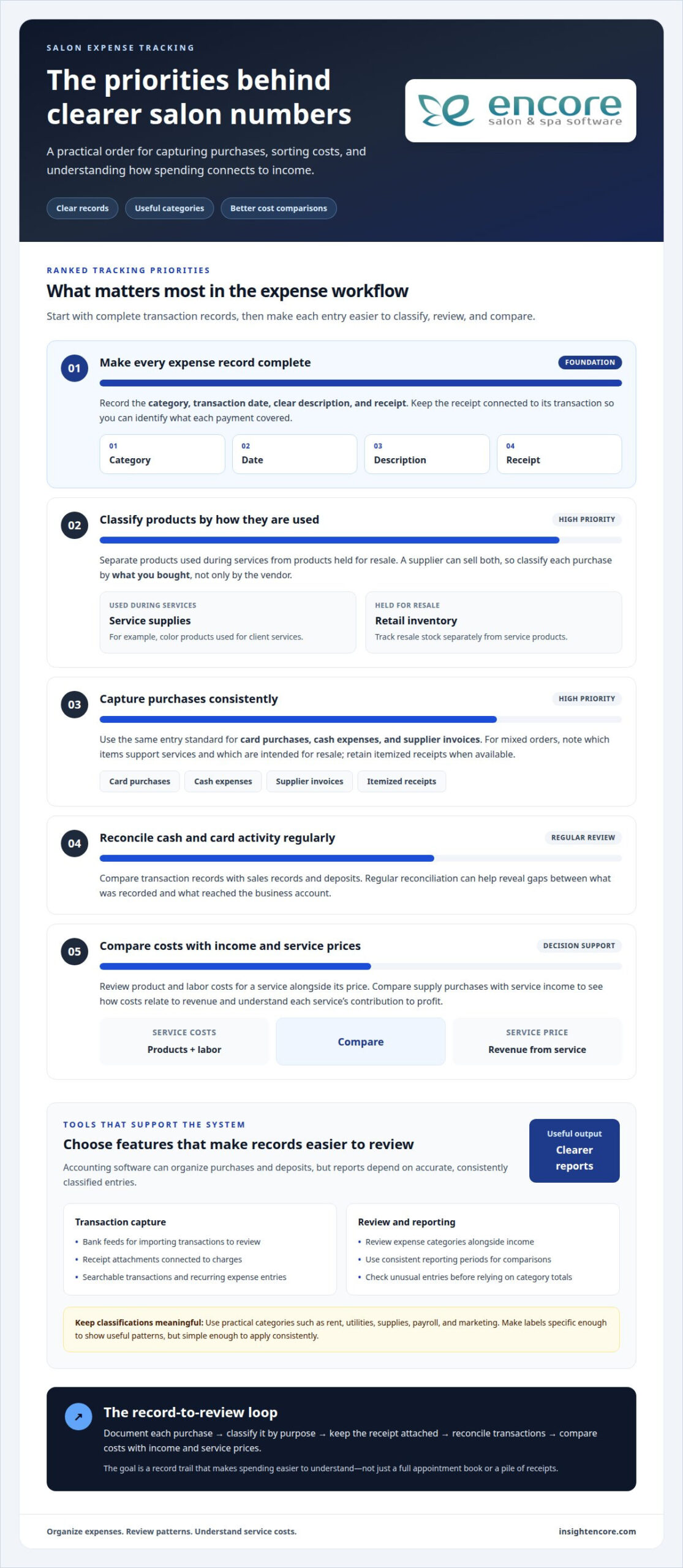
A useful expense record includes a clear category, transaction date, description, and receipt. These details help you understand what each payment covered and find its supporting document later.

Setting Up Expense Categories

Expense categories group similar salon purchases so you can review spending by purpose. Start with labels that match real transactions, such as rent, utilities, beauty supplies, payroll, and marketing. A manageable set keeps records easier to maintain and reports readable. Add a category only when it distinguishes a meaningful type of spending from existing labels.

Keep category names distinct. For example, separate equipment purchases from routine supplies instead of placing both under a broad “salon costs” label. This helps show whether a transaction supports ongoing operations or a specific purchase. Review categories as the business changes, such as when you add retail products or a new service, and remove labels that no longer fit.

Customizing and Categorizing Expenses

Custom categories let you organize expenses around your services and purchasing habits. A beauty salon might separate color products from skincare supplies, while a business with retail sales could track resale stock separately from products used during services. This detail helps reveal where spending goes without creating a separate label for every supplier.

For each transaction, choose the category that reflects what you bought, not just the vendor’s name. A supplier may sell both retail items and backbar products, so the same vendor can appear in more than one category. Apply the same rule consistently. This makes comparisons useful across seasons, even as service demand and purchasing patterns shift.

Recording Expense Details

Each expense record should include its category, date, description, and receipt details. Use the transaction date shown on the receipt, then describe the purchase clearly, such as “hair color for client services” rather than “store purchase.” Attach or file the receipt with the record so the document and transaction stay connected.

Capture enough detail to identify each purchase later. For a mixed order, note which items supported services and which were intended for resale. If a receipt lists several products, keep the itemized document rather than recording only the total. A consistent naming format, such as supplier plus purchase purpose, makes searches faster and reduces confusion during bookkeeping reviews.

Set a simple standard for every entry: category, date, concise description, and receipt. Apply it to card purchases, cash expenses, and supplier invoices. When a record lacks one of those details, resolve it while the purchase is still familiar. A structured expense record helps owners trace a transaction from the bank statement to its business purpose. An organized way to manage salon records can support that routine.

Tracking salon costs and service profitability

Compare service revenue with the product and labor costs tied to each appointment, then account for shared overhead. The best way to track salon expenses also makes those costs useful for understanding which services contribute to profit.

Common Monthly Costs

Monthly costs are recurring expenses that keep a salon operating. Tracking them separately helps you see which commitments take the largest share of revenue and how much remains for other needs. Common categories include rent, utilities, supplies, payroll, marketing, insurance, and payment processing.

Costs vary with salon size and location.

Review each category on its own. Location, space, staffing, and purchasing patterns affect which expenses weigh most heavily on your salon.

Inventory, Product, and Supply Costs

Inventory records distinguish products held for resale from supplies used to perform services. Track retail stock as inventory, and record the cost of items sold as cost of goods sold. Backbar products consumed during appointments are operating costs, not resale stock.

For example, record shampoo sold to a client as retail inventory, but track color used during an appointment as a service supply. Compare purchases and product use with the services performed. If an appointment uses more product than expected, its margin can shrink even when revenue looks strong.

Service profitability compares what a service earns with its direct product and labor costs. Use the same method to compare services and see which contribute more toward shared expenses such as rent and utilities.

Potentially deductible salon costs are ordinary and necessary business expenses under Section 162 of the Internal Revenue Code. Keep records for rent, supplies, utilities, and payroll, and separate personal spending from salon transactions. A profit-and-loss report detailing income and outgoings can help a tax preparer review the business’s records.

Track tips separately from service revenue and payroll entries. Tips are taxable income that self-employed salon operators must report. To assess service profitability, connect labor and product costs to the work that generated them, then review those figures alongside shared overhead. That’s the best way to track salon expenses for this purpose.
Track Salon Expenses and Compare Costs with Service Profitability

Recording receipts and expenses regularly

A regular bookkeeping routine keeps salon income, spending, and receipts connected while details are easy to recall. Reconcile daily sales, then set aside time each week to update expense records and review cash flow.

Daily reconciliation gives you a timely view of money received. Compare the point-of-sale settlement and counted cash with the bank deposit, and investigate differences while the day’s transactions are still familiar. For example, a card sale recorded by the salon but missing from the settlement needs attention before it is mistaken for an expense or overlooked income.

Use your weekly bookkeeping session to collect receipts and enter outstanding purchases. Photograph paper receipts so the records remain accessible if the originals fade or get misplaced. Connect each image to its payment and add a short description, such as “color order for appointments.” This context makes reports clearer than a vendor name alone.

A dependable routine can follow this sequence:

  • Gather paper receipts, emailed invoices, and card notifications from the week.
  • Match each purchase to the bank or card transaction.
  • Record the expense under the appropriate category and attach its receipt.
  • Review income, spending, and available cash for unusual changes.

A weekly review helps you spot a supplier charge entered twice, a missing receipt, or a purchase assigned to the wrong category. It also creates a useful rhythm for tracking bills due and deposits expected. Cash flow is easier to understand when records include both money received and payments made, not just expenses.

Keep a short list of unresolved items during each review. A transaction with no receipt, an unclear card charge, or a deposit that differs from the sales record should stay visible until resolved. Note what needs attention, then update the entry when you find the supporting details. This prevents unexplained items from disappearing into a general expense category.

At the end of the week, review the updated records together, not just the latest receipt. Compare income with spending, scan category totals for unexpected changes, and check whether upcoming payments could affect operating cash. A brief note can explain a noticeable shift, such as a larger supply order or a quiet booking period. That context makes future reports more useful.

Daily reconciliation and weekly bookkeeping serve different purposes: one checks transaction accuracy, while the other keeps records complete. Together, they provide a repeatable view of cash flow and make reporting less dependent on memory at month-end.

Salon expense tracking and transaction records

Transaction records connect salon sales, expenses, and deposits across bank accounts, cards, and payment processors. Consistent reconciliation helps you identify missing deposits, duplicate entries, and unexplained differences.

Receipts and Tax Records

Tax records are documents that support the income and expenses reported by a U.S. salon. Keep receipts, supplier invoices, bank and card statements, sales reports, and payroll records together so each entry has supporting evidence. These documents show where reported figures came from and make a tax preparer’s review more straightforward.

Connect records to specific transactions. For example, match a supply invoice to its payment and expense entry, and retain sales reports showing income received. Organize files by date or accounting period, with clear names such as “supplier invoice” or “daily sales report.” Each record should make the business purpose and amount understandable without relying on memory.

Reconciling Accounts and Payment Records

Reconciliation compares recorded transactions with bank statements, card activity, and processor settlements. A salon’s sales total may differ from the amount deposited because of payment timing, refunds, or processing adjustments. Compare the point-of-sale settlement and counted cash with the bank deposit each day, then investigate differences promptly.

Use a separate bank account for salon transactions and keep personal spending in a personal account. Match each deposit to the sales record, and compare card batches with processor reports instead of assuming every sale appears as a separate bank deposit. Several card payments may be grouped into one settlement, so compare the batch total with its related transaction details.

For a practical reconciliation, review these records together:

  • The salon’s point-of-sale report for the day’s sales, refunds, and payment types.
  • The processor settlement showing card transactions and adjustments.
  • The counted cash and the amount prepared for deposit.
  • The bank activity showing deposits and other account transactions.

Record the reason for each difference, such as a refund, timing delay, or bank fee, and match it to supporting documentation. If a processor settlement doesn’t match recorded card sales, inspect the batch details before changing the bookkeeping entry. This preserves the original sales record and makes any adjustment traceable.

Reconcile card and bank activity regularly, and complete the cash-to-deposit comparison daily. That cadence gives salon owners and stylists a clearer transaction trail, while a shareable profit-and-loss report can summarize income and outgoings for tax preparation.

Explore salon management tools

Encore Salon & Spa Software

Encore Salon & Spa Software brings salon operations together in one management platform, with tools for point-of-sale transactions, inventory tracking, and client management. If expense records feel disconnected from daily sales or product movement, these tools can help organize related business activity in one system.

Encore Salon Software, Encore Spa Software, Chair/Booth Renter Software, and Tattoo Studio Software serve different business settings. Choose the option that fits your operation, then use its management tools to support clearer tracking of sales and inventory alongside your expense-recording routine. Software can organize activity, but accurate categories and regular reconciliation remain essential to reliable bookkeeping.

If you’d like to discuss how Encore can support your salon’s recordkeeping, contact Encore Salon & Spa Software.

Make Your Records Work for What’s Next

Decide what you want your financial records to help you see. A clearer view can guide decisions about service mix, purchasing, staffing, and where to focus. The best way to track salon expenses is to build a routine you can sustain and use when decisions arise. Treat your records as a management tool, not just an end-of-year task.

As your salon evolves, revisit whether your tracking setup still reflects the way you work. New services, changing product use, or a different staffing model can make old categories less useful. Adjust the structure when it no longer supports the decisions you need to make, while keeping the process simple for your team to follow.

Explore how Encore can fit your salon

With a clear system in place, you can make decisions with greater confidence and a stronger understanding of your business.

Frequently Asked Questions

What expenses should a salon track?

Track every business outlay, including recurring bills, one-time purchases, subscriptions, and payment adjustments. For example, record a replacement styling tool separately from a routine supply order, and note refunds or supplier credits against the related transaction. Include costs paid by card, bank transfer, or cash. A complete expense picture helps you understand where money goes and how costs change as your salon’s services and operations evolve.

How do you set up a salon expense tracking system?

Choose one recordkeeping method, define categories that match your salon’s operations, and decide who enters and reviews transactions. For example, a salon manager could record purchases while the owner reviews entries and outstanding items each week. Use a consistent naming approach for digital receipts, such as supplier and purchase purpose. Keep the process simple enough for every team member who handles salon spending to follow.

What is the best bookkeeping software for salons, and how should you compare prices?

The right fit depends on whether you need bookkeeping alone or tools that also support salon operations. Compare what each plan includes, how pricing is structured, and whether it suits your team and location needs. A salon management platform such as Encore can bring point-of-sale activity and inventory tracking into salon workflows. Focus on the functions you’ll use regularly, rather than choosing software by its plan name alone.

How should salon expenses be categorized for bookkeeping and taxes?

Use categories that describe the business purpose of each purchase, and keep personal spending separate. If an order includes products for client services and items for resale, split the transaction across the appropriate records using the receipt’s item details. Apply the same approach to refunds and supplier credits, linking each adjustment to its original purchase. Clear, consistent entries help your bookkeeping reflect salon activity without treating every payment to one vendor alike.

How to track salon payroll, commissions, and tips

Record wages, commissions, and payroll taxes as payroll expenses, and track tips as income because self-employed salon operators must report them as taxable income. Payroll typically consumes 40 to 60 percent of gross revenue.

Disclaimer

This article is general in nature and may contain errors, please verify all claims with your sales rep

Categories
Uncategorized

Managing Salon Gift Card Liability Through Redemption and Breakage

A gift card sale brings in cash, not earned revenue. Under U.S. GAAP, managing salon gift card liability means recording the payment as a liability until the promised service or product is provided, then recognizing revenue when the customer redeems the card. Expected breakage follows separate rules, and expiry depends on applicable state law.

It’s easy to mistake gift card sales for income because the money is already in your account. But the salon still owes the cardholder something, so keep the balance visible until it’s redeemed or otherwise accounted for. Customer deposits also represent money received before a service, but they relate to a specific booking rather than an open-ended gift card balance.

Can software automate the tracking? It can help record sales, redemptions, and remaining balances, but the accounting treatment still depends on what the salon owes and when that obligation is fulfilled. This article explains when gift card revenue is recognized, how breakage differs from deposits, and why expiry rules can affect the liability you carry.

Key Takeaways

  • Keep prepaid gift card balances distinct from earned revenue, and recognize service revenue as the card is redeemed.
  • Separate gift card obligations from customer deposits, since each relates to a different promise the salon must fulfill.
  • Use redemption history and evidence-based estimates to assess breakage rather than treating every unused balance as income.
  • Account for state expiry and unclaimed-property rules before deciding how to handle dormant balances.
  • Gift card software can help track sales, redemptions, and outstanding balances, giving you clearer records to support accounting decisions.

Revenue recognition at redemption

Under U.S. GAAP, cash received for a gift card is a contract liability until the promised service or product is delivered. Track the balance from sale through redemption, including any partial use.

Accounting Entries for Sales and Redemptions

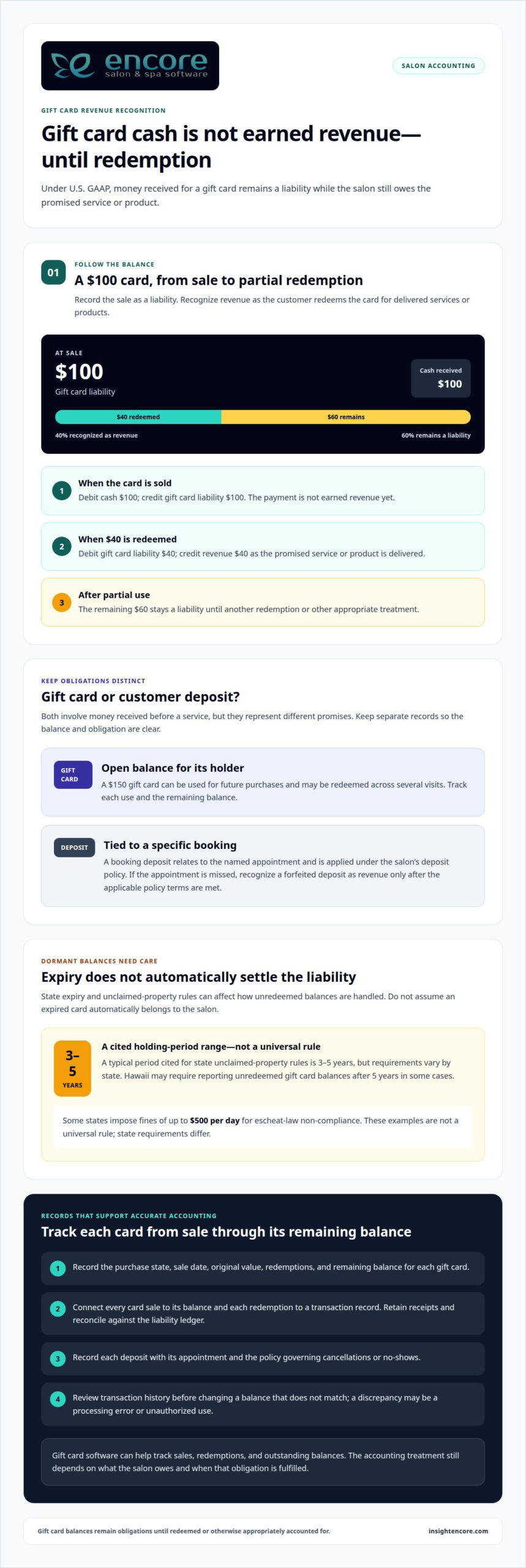
Accounting entries show when gift card cash arrives and when the salon fulfills its obligation. They matter because recording a sale as earned revenue too early can overstate income. For a $100 gift card, debit cash and credit gift card liability by $100. If the customer later redeems $40, debit the liability and credit revenue by $40.

The remaining $60 stays recorded as a liability until another redemption or other appropriate treatment. A digital or physical card changes how the balance is accessed, not the basic accounting sequence: record the sale, then recognize revenue as services or products are delivered.

Effects on Cash Flow, Taxes, and Statements

Gift card sales bring in cash before the salon delivers a service, while the balance sheet carries the unredeemed amount as a liability. That cash can support current operations, but spending it does not remove the obligation to serve cardholders. Tracking outstanding balances alongside cash flow helps the salon plan for future redemptions and read financial statements accurately.

Book revenue and taxable income can follow different timing. According to the Internal Revenue Service, an accrual-method salon generally includes advance payments for future goods or services in gross income in the taxable year received. Keep tax reporting distinct from the U.S. GAAP liability entry, and use the applicable accounting and tax treatment.

To encourage redemption and repeat purchases, make balance inquiries simple and send clear reminders. Digital gift cards can make balances easier to access through mobile wallets, while online and in-salon redemption options give customers more ways to use them. Prompting customers to book a follow-up appointment at checkout can help turn a gift-card visit into an ongoing salon relationship.

Connect each card sale to its balance and every redemption to a transaction record. Limit who can issue cards or adjust balances, retain receipts, and reconcile sales and redemptions against the liability ledger. If a balance doesn’t match, review the transaction history before changing the amount. This helps distinguish a processing error from unauthorized use.

If the salon closes, changes ownership, or changes its services, outstanding cards still represent customer obligations that need a clear plan. Preserve balance and transaction records, identify who will handle remaining redemptions, and communicate service changes to cardholders. The federal CARD Act provides an underlying framework for U.S. gift card regulation, while state rules also apply to unredeemed funds and expiry.

What’s the difference between gift cards and customer deposits?

A gift card creates an obligation to provide services or products to its holder, while a customer deposit is usually tied to a specific booking. For example, a $150 gift card remains available for future purchases, but a deposit for a scheduled appointment relates to that reservation. Keeping separate records helps show what the salon owes and why.

That difference matters when plans change. A customer may redeem a gift card across several visits, leaving a balance after each partial use. A booking deposit, by contrast, is applied to the named appointment under the salon’s deposit policy. If a customer misses that appointment, recognize a forfeited deposit as revenue only after the applicable policy terms are met.

Unredeemed gift card balances can also become unclaimed property, sometimes called escheat. In many U.S. states, businesses may have to report and remit unused value after a state-specified holding period. A typical period cited for state unclaimed-property rules is 3-5 years, but the governing requirements vary by state. This is a separate issue from recognizing revenue under accounting rules.

To understand which requirements apply, identify where the card was purchased and where the issuer is incorporated. The state whose rules may apply is typically the state where the card was purchased or where the issuer is incorporated. Then consult that state’s official unclaimed-property rules for reporting, remittance, and any exemptions. Some states exempt certain single-merchant retail cards from escheat, while others require remittance of qualifying balances.

State differences can affect both timing and treatment. For example, Hawaii may require reporting unredeemed gift card balances after 5 years in some cases. Some states also impose fines of up to $500 per day for escheat-law non-compliance. These examples aren’t a universal rule; a salon operating across state lines may need to track the state connected to each card.

Keep separate records for deposits and gift cards. For each gift card, retain the purchase state, sale date, original value, redemptions, and remaining balance. For each deposit, record the related appointment and the policy that governs cancellations or no-shows. These details help identify dormant balances without treating every unused amount as revenue or as a customer deposit.

A clear ledger also supports ownership changes or business closures. Keep a record of outstanding cards by state and preserve evidence of reporting or remittance. Because state rules determine whether unredeemed balances must be transferred, don’t assume an expired card automatically belongs to the salon.

When can I recognize breakage for unredeemed gift cards?

Breakage is the portion of gift card value customers are expected never to redeem. Recognize it as revenue only under an evidence-based approach, not simply because a card has gone unused.

Estimating Gift Card Breakage

Estimate breakage from historical redemption patterns for comparable gift cards, then apply that evidence consistently. An unsupported estimate can overstate revenue and understate outstanding gift card balances. The estimate should reflect actual customer behavior, including partial redemptions and how long balances typically remain unused.

One example uses $1,000 in cards and estimated breakage of 10%. That leaves a $900 redemption-eligible pool. The estimate is not a universal salon rate. A salon’s own transaction history is the relevant practice for assessing whether its estimate is reliable. Javelin estimated breakage at about 1.5% across the industry, but that figure does not establish an individual salon’s rate. Estimates should be reviewed against subsequent redemptions, so the approach reflects whether the original forecast holds up.

Recognizing Breakage as Revenue

When expected breakage can be estimated reliably, ASC 606 and IFRS 15 call for recognizing it in proportion to actual redemptions. This matters because revenue then follows customer use rather than an arbitrary date or assumption. In the $1,000 example, a $90 redemption from the $900 eligible pool corresponds to $10 of breakage recognition.

Apply the calculation consistently as customers redeem cards, and retain the data supporting both the estimated breakage and the recorded revenue. Breakage recognition under ASC 606 must be proportionate and evidence-based. For salons managing salon gift card liability, that means keeping the estimate tied to documented redemption patterns, not treating every inactive card as earned income.

Breakage and unclaimed property are separate issues. Accounting treatment addresses when revenue may be recognized; state unclaimed-property rules may require certain unredeemed balances to be reported or remitted. An accounting estimate does not erase a legal obligation. Track card balances and state-related records separately, and avoid counting the same amount as both breakage revenue and property owed to a state.

Time alone does not prove successful breakage recognition. Historical data may show when redemption becomes remote; the guide’s example timeframe for estimating patterns is 2-3 years, while breakage is typically considered after 24-36 months when redemption is deemed remote. Those periods are not automatic release dates. A disciplined approach to managing salon gift card liability uses actual redemption evidence and applicable state rules before recording revenue from unclaimed balances.

Managing Salon Gift Card Liability Through Redemption and Breakage

Recognizing revenue when gift cards are redeemed

Recognize revenue as the customer receives the promised service or product, not merely when a card is sold. Under ASC 606, redemption reduces the gift card liability and records the delivered item or service as revenue.

At redemption, apply the amount used to the customer’s transaction and reduce the corresponding liability. If a card covers only part of a salon visit, record the redeemed portion and keep the unused balance as a liability. The customer may use that remaining amount later, subject to applicable rules. This approach keeps the balance sheet aligned with what the salon still owes.

Retail purchases follow the same delivery principle. If a customer uses a gift card for shampoo, recognize revenue when the product is provided and reduce the liability by the amount applied. If the card covers both a haircut and retail items, allocate the redemption across those sales in the transaction record. This helps sales reports show which services and products customers actually received.

For memberships, account for when the salon provides the included benefits. If a gift card pays for a membership that provides services over time, the salon has not necessarily delivered every promised benefit on the purchase date. Track the card amount applied to the membership, then recognize revenue as membership services are provided. Clear records help distinguish a prepaid membership obligation from completed visits.

Promotions can create more than one obligation. A salon may sell a $100 gift card for $90, or offer a $20 bonus voucher configured as a zero-price promotional gift card with its own expiry. Keep the paid card and bonus voucher identifiable in the records. Their terms and redemption history may differ, so combining them can obscure the outstanding value and complicate revenue reporting.

Gift cards given to employees have a different tax treatment from customer cards. They are treated as supplemental wages and are generally taxable to the employee. Record employee gifts separately from customer gift card sales, and account for them through payroll records. This avoids mixing compensation with customer balances awaiting redemption.

Use a consistent checkout process for each redemption: identify the card, apply the amount used, record the service or product delivered, and preserve any remaining balance. Gift card software can connect transaction histories to outstanding balances, but accurate revenue entries still depend on recording what the customer received. Review sales reports against the liability ledger so redeemed retail items, memberships, and salon services are reflected correctly.

Gift card expiry rules

In the United States, a salon gift card generally cannot expire or must remain valid for five years. State rules can provide stronger protections, so an expiry date printed on a card doesn’t automatically settle how long the balance remains usable. Expiry also doesn’t necessarily remove an outstanding accounting liability or resolve a separate unclaimed-property obligation.

The Federal Gift Card Act was enacted in 2009, and state rules also shape expiry requirements. For example, California prohibits expiry on most gift cards, while Minnesota gift cards never expire. Hawaii gift cards cannot have expiration dates, and balances under $5 must be refundable in cash. These examples show why a salon’s policy needs to reflect the rules that apply to each card.

For compliance, connect each card to its terms and relevant state. Record where it was purchased, its issue date, its stated expiry, and its remaining balance. If a salon sells cards in more than one state, tracking applicable rules helps avoid applying one state’s policy to every customer. Keep the wording on receipts and digital cards consistent with the rules that govern those sales.

An expiry date and an unused balance are separate accounting questions. If a card reaches its stated expiry date, don’t automatically treat its full value as earned revenue. The salon still needs to consider applicable state rules, its accounting treatment, and whether unclaimed-property reporting applies. A card may be expired under its terms yet still involve a legal obligation concerning its balance.

Build a recurring review into gift card tracking. Compare outstanding balances with each card’s issue date, redemption activity, and applicable state requirements. Keep evidence of redemptions, refunds, and balance adjustments. A customer who uses only part of a card still has a remaining balance to account for, unless a lawful rule or other valid treatment applies. This review helps prevent expired cards from disappearing silently from records.

Historic practices don’t establish current compliance. Some salons once enforced a one-year expiration on gift certificates, while paper certificates could still be presented more than three years after purchase. Those examples show why old policies should not be reused without assessing current state rules. Clear expiry terms, consistent records, and state-aware handling help salons manage unredeemed value accurately.

Before changing an expiry policy, identify the states connected to card sales and review the applicable requirements for each. Then update the terms consistently across printed cards, digital cards, receipts, and sales materials. Accurate tracking supports both customer service and accounting: staff can explain a card’s status, while the books retain a record of the outstanding obligation.

Encore Salon & Spa Software: Encore Salon Software

Encore Salon & Spa Software offers Encore Salon Software for salons that want gift card sales and point-of-sale transactions within their business management setup. When gift card activity is spread across separate records, managing sales and client information in one platform can make transaction history easier to follow. Use it as an operational tool alongside your accounting process, not as a replacement for deciding when revenue is recognized or how state rules apply.

For a spa, Encore Spa Software is a related option; Chair/Booth Renter Software and Tattoo Studio Software serve those business types. Choose the solution that fits your operation and how you handle customer transactions. If you’d like to discuss whether Encore Salon Software suits your salon, contact Encore Salon & Spa Software.

Make your next gift card decision with confidence

Managing salon gift card liability is an ongoing part of running a salon, not a task to leave until year-end. Build a routine that keeps transaction records, customer balances, and accounting decisions connected. As your gift card program changes, revisit how its records fit your daily checkout and reporting process.

Encore Salon & Spa Software offers Encore Salon Software, Encore Spa Software, and Chair/Booth Renter Software. The right fit depends on your business and how you manage customer transactions. A conversation can help you explore how a salon management system may support clearer day-to-day operations alongside your accounting practices.

Explore Encore software for your business

With a consistent process and traceable records, you can manage gift card activity with greater clarity and keep your attention on the clients who make your business thrive.

Frequently Asked Questions

Can software automate this?

Software can record gift card transactions and connect card activity to salon sales, reducing reliance on separate spreadsheets. It can’t decide whether a balance qualifies as breakage or satisfies state reporting rules; those decisions depend on accounting evidence and legal requirements. For example, use transaction records to identify a balance that needs review, then document the accounting treatment separately. Encore’s Gift Cards and point-of-sale tools support operational tracking.

What happens to unused gift card funds?

Unused funds remain associated with the cardholder’s outstanding balance until redemption or another valid treatment applies. Depending on the circumstances, a salon may recognize estimated breakage under accounting rules or need to report and remit funds under state unclaimed-property rules. These are different outcomes. If a salon closes, preserve card and transaction records so outstanding obligations can be identified and handled rather than lost during the transition.

What is the IRS rule on gift cards for businesses?

For an accrual-method salon, the Internal Revenue Service says advance payments for future goods or services generally belong in gross income for the taxable year received. Financial accounting may treat an unredeemed card as an outstanding obligation until the salon provides the promised goods or services. Keep tax records and the gift card liability ledger distinct, and make sure each reflects its own purpose.

How should a salon account for gift card sales and unredeemed balances?

Record each sale against a gift card liability account, then maintain a subledger showing individual card activity. As a practical control, reconcile the total subledger balance with the general ledger at each reporting close and investigate mismatches before posting adjustments. Keep records of voided sales, refunds, and corrections with the original transaction details. This creates a traceable record for staff and supports review by the salon’s accounting professional.

What are the U.S. federal and state gift card expiration and fee rules?

The federal Gift Card Act was enacted in 2009. U.S. inactivity fees can only be charged after 12 months, and salon gift cards generally cannot expire or must remain valid for five years. State protections can be stricter: California prohibits expiry on most gift cards, Minnesota gift cards never expire, and Hawaii gift cards cannot expire. In Hawaii, balances under $5 must be refundable in cash.

Do salon gift card liabilities qualify as unclaimed property or escheat, and what state rules apply?

Yes, some unredeemed gift card balances may be reportable as unclaimed property under state rules. A typical state holding-period range is 2 to 5 years, but requirements and exemptions differ. The relevant state is typically where the card was purchased or where its issuer is incorporated. Keep purchase-state information with each card’s records, since the balance’s location can affect reporting and remittance responsibilities.

How should a salon track gift card balances, redemptions, refunds, and outstanding liability?

Assign each card a record that connects its sale, every redemption, refunds, adjustments, and current balance. Reconcile that detail to the liability account monthly, then flag exceptions such as a refund without a matching card adjustment. Preserve transaction dates and staff records for corrections. This helps distinguish a legitimate balance change from a duplicate redemption or an entry error that could distort the salon’s outstanding liability.

What salon gift card software features help manage liability and compliance?

Useful capabilities include recording gift card sales and redemptions, applying cards at point of sale, and keeping customer and transaction details available for review. Encore Salon Software includes point-of-sale transactions, client management, and gift card management. These tools can organize operational records, but they don’t replace accounting judgments or state compliance decisions. Confirm that your reporting process captures the details your salon needs for reconciliation and review.

Disclaimer

This article is general in nature and may contain errors, please verify all claims with your sales rep