
window.dataLayer = window.dataLayer || []; function gtag(){dataLayer.push(arguments);} gtag('js', new Date()); gtag('config', 'UA-206511945-1');
Search
Categories
Uncategorized

Tattoo Studio Software: How to Choose the Right System in 2026

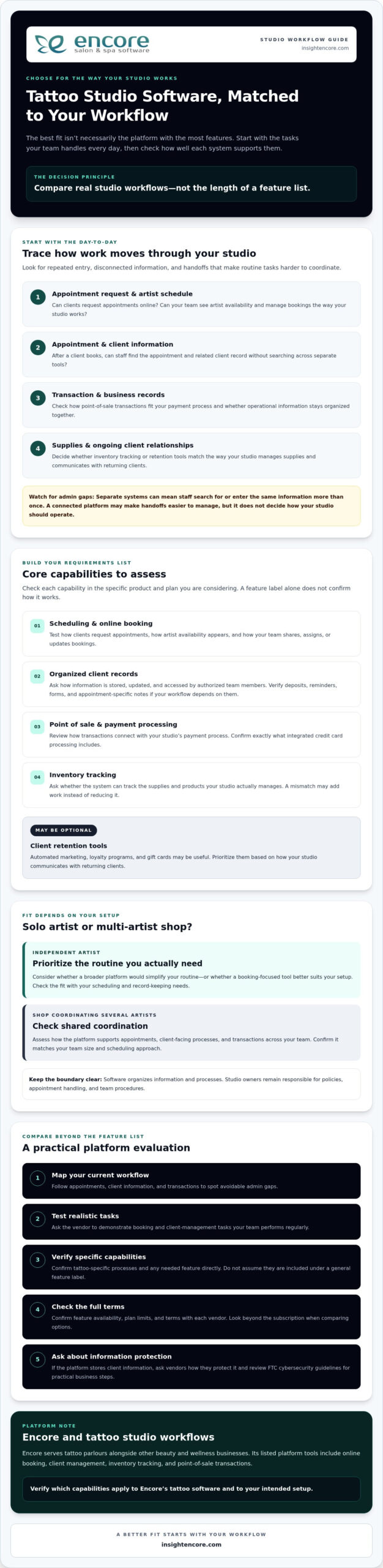
The tattoo studio software with the most features isn’t necessarily the best fit for your shop. If a system doesn’t match how you schedule artists, manage client information, and handle transactions, it can add steps instead of taking work off your plate.

When artist availability is hard to coordinate or client and payment details are spread across separate tools, it can be difficult to know which features matter most. Start with your studio’s day-to-day workflow, not a long list of capabilities.

This guide shows how to compare tattoo studio software against the tasks your team actually handles, from booking and client management to payments and inventory. You’ll learn what to assess for solo artists and multi-artist shops, which tattoo-specific features to verify, and how to look beyond the subscription when comparing options. By the end, you’ll have a practical way to narrow the field and choose a platform that supports your artists and clients without unnecessary complexity.

Key Takeaways

  • Map how appointments, client details, and transactions move through your studio to find avoidable admin gaps.
  • Use scheduling, records, payments, inventory, and client retention to define your essential tattoo studio software requirements.
  • Compare platforms by how well they support real studio workflows, not by the length of their feature lists.
  • Test realistic booking and client-management tasks, then confirm feature availability, plan limits, and terms with each vendor.
  • Encore may suit studios looking to bring several management tools together. Verify which capabilities are included in its tattoo software offering.

What Tattoo Studio Software Does for Your Day-to-Day Operations

Tattoo studio software helps organize appointments, client information, and business transactions in one place. A booking-only tool mainly handles appointment requests and schedules, while studio management software may also bring together other daily tasks. Capabilities vary by platform, so check exactly what’s included before choosing.

This distinction matters when a studio uses separate systems for artist availability, client details, and transactions. Staff may have to search for or enter the same information more than once. A connected platform can make these handoffs easier to manage, but it won’t determine how your studio should operate.

Which everyday studio tasks can software help organize?

Online booking gives clients a way to request appointments and helps the studio coordinate its schedule. Client management tools organize relevant records in one system, much like a Customer Relationship Management (CRM) system supports organized customer information and interactions. Point-of-sale tools can connect service transactions with business records, keeping operational information together.

Assess how these tasks work together, not just whether each feature appears on a list. After a client books, for example, can staff find the appointment and the related client record without switching between separate tools? Ask the provider to demonstrate that workflow and clarify any plan limits.

Who benefits from tattoo studio management software?

Owners coordinating several artists may value a shared way to manage appointments, client-facing processes, and transactions. Independent artists can consider whether a broader platform would simplify their routine or whether a booking-focused tool better suits their setup. In either case, check that the system fits your team size and the way you handle scheduling and records.

Software organizes information and processes. It doesn’t set studio policies or deliver tattoo services. Owners remain responsible for decisions such as how appointments are handled and what procedures the team follows. If a system appears to support a particular policy or tattoo-specific process, verify that capability directly rather than assuming it’s included.

Encore serves tattoo parlours alongside other beauty and wellness businesses. Its listed platform tools include online booking, client management, inventory tracking, and point-of-sale transactions. Check which capabilities apply to its tattoo studio software and your intended setup on the tattoo studio software page.

Tattoo Studio Software Features: Build Your Essential Requirements List

Build your requirements list around your studio’s actual workflow, not the platform with the longest feature list. Core capabilities to assess include scheduling and online booking, organized client records, point-of-sale transactions and payment processing, and inventory tracking. Retention tools such as automated marketing, loyalty programs, and gift cards may also be useful. Confirm which features are available in the specific product and plan you’re considering.

Scheduling and client records for tattoo appointments

Start with the schedule. Can clients request appointments online? Can your team see artist availability and manage bookings in a way that matches current studio processes? A feature name alone won’t show whether a system can handle how your artists share, assign, or update bookings. Ask vendors to demonstrate the scheduling tasks your team performs regularly.

Next, look at client records. Check how information is stored, updated, and accessed by authorized team members. If your workflow depends on deposits, reminders, forms, or appointment-specific notes, verify each capability directly. Don’t assume these are included under a general “client management” or “booking” label.

Payments, inventory, and client retention tools

Review how point-of-sale transactions fit with your studio’s payment process, and confirm what integrated credit card processing includes. For inventory, ask whether the system can track the supplies and products your studio actually manages. A tool that doesn’t match your inventory needs may add work instead of reducing it.

Automated marketing, loyalty programs, and gift cards can support client retention, but may be optional rather than essential. Prioritize them based on how your studio communicates with returning clients. If the platform stores client information, ask vendors how they protect it and review the FTC cybersecurity guidelines for practical steps businesses can take to safeguard information.

  • Scheduling: online booking, artist availability, and appointment visibility.
  • Client management: organized records and appropriate team access.
  • Transactions: point-of-sale tools and integrated payment capabilities.
  • Inventory: tracking that fits the supplies and products you manage.
  • Retention: marketing, loyalty, and gift card tools if they suit your client approach.

Rank each requirement as essential, useful, or optional. A studio coordinating several artists may prioritize shared scheduling, while an independent artist may focus on straightforward booking and accessible client records. Encore lists online booking, client management, inventory tracking, point-of-sale transactions, integrated credit card processing, automated marketing, loyalty programs, and gift card management among its platform capabilities. Check which are included in the tattoo software offering and applicable plan, then explore Encore as a possible fit.

How to Compare Tattoo Studio Software Beyond the Feature List

A broad platform can bring daily tasks together, but only if it fits the way your studio works. Separate tools may suit a team with an established process, while connected tools may reduce repeated data entry and switching between systems. Neither setup is automatically better. Compare each option against your real workflows, and confirm feature availability, limits, and plan applicability with the vendor.

Area What to compare
Workflow fit Can the system support how your studio assigns, updates, and tracks work?
Booking Can clients request appointments, and can staff view and manage schedules as needed?
Records Can authorized team members find and update relevant client information?
Transactions Do point-of-sale and payment capabilities match how the studio handles transactions?
Inventory Can you track the supplies and products your studio actually manages?
Support What help is available, through which channels, and during what hours?

What should a tattoo studio ask during a software demo?

Ask the vendor to demonstrate a typical client journey, from requesting an appointment to finding the client record and handling the transaction. Make the walkthrough practical: ask how staff find information during a working day, who can access or update it, and what happens when an appointment changes. Get clear answers about included features, implementation steps, data handling, and available support. A direct walkthrough can reveal gaps that a feature list won’t.

How can you assess cost and value without guessing?

Compare each provider’s current plan details, included features, limits, and transaction fees where applicable. Don’t assume a feature is included just because it appears on a general product page. Ask which plan supports your needs and whether additional charges apply.

Then consider the operational trade-off: could consolidating tools reduce duplicate work, or would separate systems remain easier for your team? Assess value against the tasks staff perform without assuming a particular financial return. For Encore’s current plan details, review the Encore pricing information, and confirm which capabilities apply to its tattoo studio software offering.
Tattoo Studio Software: How to Choose the Right System in 2026

A Practical Checklist for Choosing Tattoo Studio Software

Use a consistent process to compare platforms before moving appointments or client records. A focused evaluation helps you determine whether tattoo studio software fits your studio’s routines, rather than relying on a feature list or polished demo alone.

  1. Map your current workflow. Write down how clients book, how artists manage their schedules, and where client records are kept. Note repeated admin tasks, handoffs, or moments when staff have to search across tools. Include tattoo-specific needs, such as deposits or forms, as items to verify with vendors rather than assumed features.
  2. Rank what matters. Sort requirements into essential, useful, and optional. Ask artists and staff what slows them down and what information they need to find quickly. Review current records and processes too, so you understand what may need to move or change.
  3. Shortlist platforms. Compare providers against your priorities, team size, and daily tasks. Review Encore platform features alongside other vendors’ information, and confirm that any required capability applies to the specific product and plan you’re considering.
  4. Test realistic tasks. Use the same sample workflow for every shortlisted platform, such as handling an appointment request, finding a client record, updating details, and completing a transaction. Ask staff to try the steps and assess whether they can find the information they need without unnecessary detours.
  5. Confirm the terms. Ask each vendor about data migration, onboarding, available support, feature limits, and contract terms. Clarify what your team needs to prepare and which records or processes may require manual attention during a changeover.

Make the evaluation practical

A feature may sound useful but still be awkward in daily use. During a demo or trial, ask staff to complete the same tasks they handle at the studio, then gather their feedback. Can they follow the workflow and find and update the right information? Does the system support the process your studio wants, or would the team need to change how it works?

Before switching, check that current records are organized and identify what should be transferred, retained, or reviewed. A clear view of existing processes makes it easier to ask specific questions and plan the transition. The right choice should meet your priorities without adding features or complexity your studio won’t use.

Explore Encore for your studio

Is Encore Tattoo Studio Software a Fit for Your Business?

Encore is a management platform for beauty and wellness businesses, including tattoo parlours. It may be worth considering if you want to assess several everyday studio tools together rather than evaluate booking in isolation. The fit depends on whether the available features match your team’s workflow, not simply on how many capabilities the platform lists.

Which Encore capabilities may support a tattoo studio?

Encore lists online booking, client management, inventory tracking, and point-of-sale transactions among its platform capabilities. Other listed tools include integrated credit card processing, automated marketing, loyalty programs, and gift card management. These may be relevant to studios reviewing appointment coordination, client records, transactions, stock, and client retention.

Confirm which capabilities are included in the tattoo studio software offering and the plan you’re considering. If your process depends on a specific tattoo-related feature, such as digital forms, deposits, appointment reminders, artist-level access, or particular reporting, ask Encore directly whether it’s available and how it works. Don’t assume a capability is included based on a general feature description.

For product-specific details, review Encore tattoo studio software. Use your list of essential workflows to assess whether the listed tools address your needs, and ask for clarification wherever the details aren’t clear.

How can you take the next step with confidence?

Before exploring the trial, write down your must-have tasks and questions. These might include how your team handles booking requests, updates client records, tracks inventory, and processes transactions. Compare those workflows with the capabilities available in the tattoo offering. A clear checklist helps you focus your evaluation and identify what still needs confirmation.

Ask about feature availability, plan details, onboarding, data handling, and support arrangements that matter to your studio. If the fit isn’t clear, ask more questions rather than rushing a decision. Evaluate the platform against your real process and involve the people who will use it.

If you’re ready to explore the next step, see how Encore’s trial fits your studio’s requirements.

Try Encore and explore whether it fits your studio

Choose a System That Works for Your Studio

The strongest choice isn’t the platform with the longest feature list. It’s the one that supports your real workflow, helps keep bookings and client records organized, and fits your team’s needs. Before deciding, test routine tasks and confirm which features are included in the product and plan you’re considering.

Encore offers tattoo studio software for tattoo parlours, with listed platform capabilities including online booking, client management, inventory tracking, and point-of-sale transactions. Integrated credit card processing and automated marketing are also listed offerings. Check directly which capabilities are available for your studio and whether they support your tattoo-related requirements.

Use your checklist to explore the option at your own pace. A practical evaluation can help you move forward with confidence.

Try Encore and explore whether it fits your studio

Frequently Asked Questions

What is tattoo studio software?

Tattoo studio software helps organize business tasks such as appointment booking, client management, and transactions. Some platforms also offer inventory tracking, marketing, loyalty programs, or gift card tools. Capabilities vary by provider, so compare them with your studio’s daily workflows. A useful system should support the way you manage appointments and records, rather than require changes to essential studio practices without a clear reason.

What features should tattoo studio software include?

Start with the tools your studio needs most, such as online booking, artist scheduling, client records, and payment handling. Inventory tracking and client-retention features may also be useful. Ask vendors to confirm any tattoo-specific requirements, including forms, deposits, reminders, or session notes. Don’t assume a feature is included just because a platform serves tattoo businesses. Check availability, plan limits, and how each tool works in your actual workflow.

Can tattoo studio software manage multiple artists?

Some platforms may support team scheduling and shared studio workflows, but capabilities vary by product and plan. Ask the vendor to demonstrate how your team can view artist availability, manage appointments, and access client information. If you need artist-level permissions or reporting, confirm those details directly. Before choosing, test a realistic multi-artist scenario, such as updating an appointment and checking that the right team members can find the relevant information.

How does online booking help a tattoo studio?

Online booking gives clients a way to request or schedule appointments without relying entirely on back-and-forth messages. It can also help keep booking information organized for the studio. Check whether the system supports your preferred process, including consultations or other steps before an appointment is confirmed. Ask how booking requests are reviewed, updated, and confirmed, and whether the workflow suits the way your artists manage availability.

Is tattoo studio software suitable for a solo tattoo artist?

It can suit a solo artist if its booking, client-management, and payment tools match the way you work. You may not need every team or inventory feature, so compare the available capabilities and plan details against your actual requirements. Consider whether you can manage the system independently and find the client information you need. A simpler tool may be a better fit if a broader platform adds steps you won’t use.

How much does tattoo studio software cost?

Pricing depends on the provider, included capabilities, and applicable plan terms. Compare current vendor information rather than relying on generic estimates. Ask whether setup, payment processing, or optional features involve additional charges for your situation, and review contract terms before deciding. Look beyond the headline price to consider which tools are included and whether they support your workflow. That gives you a clearer basis for comparing value.

How do I switch to tattoo studio software?

Start by documenting your current booking process, client records, and routine business tasks. Shortlist platforms, ask vendors about data migration and onboarding, then test realistic workflows before committing. Confirm what information can be transferred, what your team needs to do, and what support is available. Review your records before the change and plan staff training. Choose a transition time that gives your team room to adjust and address questions.

Disclaimer

This article is general in nature and may contain errors, please verify all claims with your sales rep
Categories
Uncategorized

Upgrading Salon Cash Registers to POS: 2026 Guide

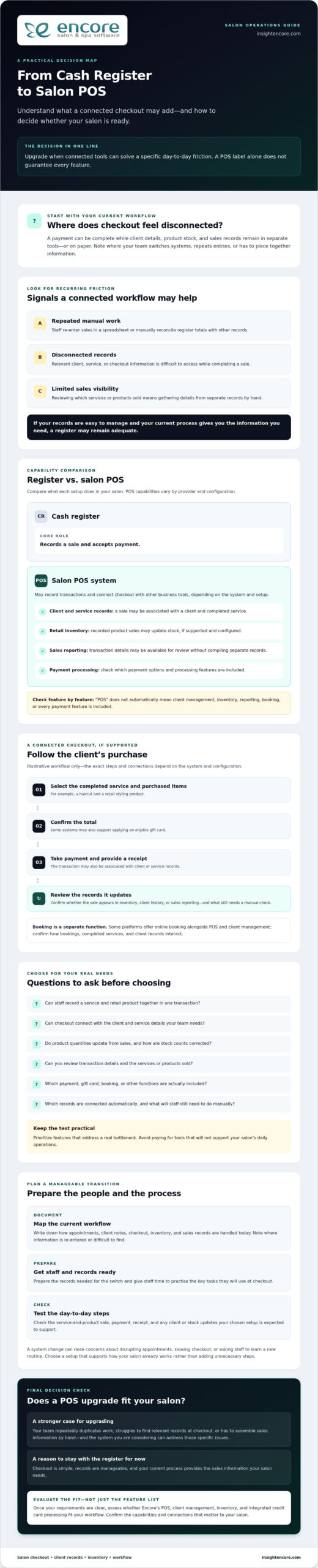
A client finishes a service, buys a styling product, and pays at the front desk. If the sale goes through one tool while the appointment, client notes, and stock records live elsewhere, checkout may be complete, but the picture of your business is not. That is the practical question behind upgrading from a cash register to a POS system: what can it connect that your register cannot?

A cash register can record a payment. A salon POS system may also connect transactions with client records, inventory, and payment processing, depending on its features. But changing systems can raise fair concerns about disrupting appointments, slowing checkout, or asking staff to learn a new routine. Your salon needs a setup that supports the way you already work, not one that adds unnecessary steps.

This guide will help you compare day-to-day capabilities, identify the features your salon actually needs, and plan a manageable transition. You’ll see how checkout can fit into the wider client journey, what to check before choosing a system, and how to prepare staff and records before switching. By the end, you’ll have a clearer basis for deciding whether a POS system suits your salon’s checkout and management needs.

Key Takeaways

  • Identify where checkout, client details, product stock, and sales records feel disconnected before deciding whether to upgrade.
  • Compare register and POS capabilities carefully. Client information, inventory tracking, and reporting depend on the system you choose.
  • Make upgrading from a cash register to a POS system more manageable by documenting your current workflow and giving staff time to practise key tasks.
  • Choose features around your salon’s real needs, rather than paying for tools that won’t support daily operations.
  • Once you’ve set your requirements, assess whether Encore’s POS, client management, inventory, and integrated credit card processing fit your workflow.

When should a salon upgrade from a cash register to a POS system?

Checkout can run smoothly while the information behind it stays scattered. A service payment goes through the register, retail stock is tracked separately, and client details sit in another tool or on paper. That arrangement may be workable, but repeated manual steps can make it harder to reconcile transactions, see what sold, or give staff the information they need at checkout.

A cash register records sales and accepts payment. A POS system may do that and connect checkout with other business tools, but capabilities depend on the provider and setup. As a foundation, Point of Sale (POS) systems combine hardware and software to handle sales transactions.

A salon POS system records transactions and may connect them with services, client details, inventory, or reporting, depending on the system you choose. The term “POS” alone doesn’t guarantee that every feature is included.

What does a POS system add to a cash register?

Consider a client who receives a haircut and buys a retail product before leaving. A basic register can record the payment total. A suitably configured POS may let staff record the service and product together, associate the sale with a client record, and update inventory. These steps may depend on the system and its configuration, so check each capability rather than assuming it comes standard.

Signs your salon may be ready to upgrade

Look for recurring friction, not just attractive feature lists. Do you or your team regularly re-enter sales in a spreadsheet, manually compare register totals with other records, or struggle to review which services and products sold? Do staff have to switch between tools to find client, service, and checkout information? These are practical signs that a connected workflow could help.

  • Repeated manual work: Routine reconciliation or duplicate entry takes attention away from clients.
  • Disconnected records: Staff can’t easily access relevant details while completing a sale.
  • Limited sales visibility: Reviewing transaction history means piecing information together by hand.

Start with the problem you want to solve. A feature that sounds appealing may not matter if it doesn’t address a real bottleneck in your salon. If checkout is simple, records are easy to manage, and your current process gives you the sales information you need, a register may remain adequate. Upgrading from a cash register to a POS system makes most sense when connected tools can reduce specific day-to-day friction, not simply because newer technology is available.

How a POS system can connect salon checkout, clients, and inventory

A salon checkout has several steps: staff select the service or items being purchased, confirm the total, take payment, and provide a receipt. A POS system may bring some of those steps together with client and product records. The exact workflow depends on the provider and configuration. Check how each system handles the information your team needs instead of assuming everything connects automatically.

For example, a system might let staff select a completed service, add retail products, apply an eligible gift card, and record the payment in one transaction. If it also supports sales reporting, owners may be able to review transaction details without compiling them from separate records. The U.S. Chamber of Commerce outlines several benefits of POS systems for small businesses, including payment processing and sales data capture. Connected data can reduce repeated entry when selected tools share information, but confirm exactly what is linked.

Connect checkout with client and service records

If a POS connects with client management, staff may be able to view relevant visit information while preparing or completing checkout. That can help associate the service and transaction with the right client, if the system supports that workflow. Online booking is a separate function. Some platforms offer it alongside POS and client management, but don’t assume appointments automatically appear at checkout. Confirm how bookings, completed services, and client records interact.

Track retail products and gift card activity

Inventory tracking may help staff and owners follow retail products sold through checkout, such as shampoo or styling products. Ask whether quantities update from recorded sales, how stock counts are corrected, and what checks your team must still perform. A system can support inventory oversight, but accurate records depend on setup and consistent processes. If your salon sells gift cards, check whether the POS can record their sale and redemption in a way that fits your checkout routine.

Payment is another connection to assess. Integrated credit card processing may keep payment steps within the selected workflow, but it isn’t a universal POS feature. Confirm supported payment methods, hardware compatibility, and how transaction records are handled before choosing. If this capability matters to your salon, review Encore’s integrated credit card processing as part of your comparison.

As you consider upgrading from a cash register to a POS system, map the journey your staff actually follow, from selecting a service to issuing a receipt. Mark where information is re-entered or looked up in another tool. Then identify which connections would remove that work and which features aren’t essential. This keeps the decision focused on your salon’s workflow, not simply on a longer feature list.

Cash register vs. POS system: compare the right capabilities for your salon

A useful comparison goes beyond the number of features on a plan. Focus on the tasks your team performs, how easily staff can use the system during a busy checkout, and whether you can access the records you need afterward. The U.S. Chamber of Commerce explains what a modern POS system is and how capabilities such as inventory tracking and sales reporting may support small businesses. Actual features vary by provider and setup.

Capability Cash register POS system
Transaction recording Records payment totals and sales, depending on the register. Records sales; itemized transaction details depend on the system.
Client context Usually handles checkout without connected client records. May connect sales to client or service records if supported and configured.
Inventory May require separate stock records and manual updates. May track retail products sold; confirm how stock counts are updated.
Reporting May offer basic totals or require manual review. May provide more detailed sales reports, depending on available tools.

Which POS features matter most in a salon?

Start with reliable checkout, payment processing that fits your business, and transaction records you can understand and review. Then weigh client management, inventory tracking, and booking integration against your actual workflow. A salon with a small retail range may need simpler stock oversight than one that regularly sells products. Encore’s salon software features can help you assess how management tools may fit alongside POS.

For a nail salon, consider whether tracking products is a recurring challenge before prioritizing inventory tools. The same principle applies across service models: choose capabilities that address real work, not features that simply look impressive in a comparison.

Questions to ask before choosing a POS

Test common tasks with the people who’ll use the system. Ask staff to ring through a service and retail item, take payment, find a past transaction, and correct an error. Can they complete each task clearly and confidently? Check that the workflow suits your team, not just the owner’s reporting needs.

  • Which payment methods and hardware are supported? Verify current compatibility directly with the provider.
  • Can you access or export the records you need, and in what format?
  • What security responsibilities apply to your salon and any providers handling payment data?
  • Which tools are essential now, and which can wait until your needs change?

Upgrading from a cash register to a POS system is a better fit when its everyday workflow solves a specific problem without adding unnecessary steps. Compare practical usability and data access alongside the feature list.

Upgrading Salon Cash Registers to POS: 2026 Guide

Planning a Low-Disruption Move from Cash Register to POS

A smoother transition starts with your current routine, not with a software demo. Before upgrading from a cash register to a POS system, map how your salon handles services, retail items, discounts, gift cards, payments, receipts, and end-of-day checks. This gives you a practical checklist for comparing systems and preparing staff without changing everything at once.

Prepare staff, records, and checkout routines

Use a short, step-by-step plan to keep the change organized:

  1. Document your needs. Note the checkout tasks you perform, payment arrangements, products you sell, and records your team relies on.
  2. Choose a point person. Have one staff member collect questions, coordinate checks, and gather feedback from the people who use checkout every day.
  3. Review records and data options. Ask the provider what information can be imported, what can be exported later, and what may need manual review. Confirm whether migration assistance is available and what it includes. Don’t assume records will transfer automatically.
  4. Compare the full workflow. Check that the system supports the features you need, and confirm device, payment, and receipt requirements before committing. Ask for the provider’s implementation guidance and write down a changeover plan.

Keep the scope realistic. Prioritize the records and tasks that matter at checkout, such as service and product lists, gift card handling, and transaction history. Reviewing your current practices can help you ask better questions and spot gaps before they affect the client experience.

Test the new system before full changeover

Give staff time to practise before relying on the new workflow during a busy period. Run representative transactions, including a service sale, a service plus retail item, a discount, and a gift card transaction if applicable. Practise correcting an entry, processing a refund, and reviewing end-of-day totals where the system supports those tasks.

Also confirm that the required devices, network connection, payment setup, and receipt process work as expected. Choose a changeover window that gives the team room to focus, and keep access to essential records from the old register during the transition. Ask the provider what support, training, and data-transfer steps are included rather than treating them as automatic.

A written salon software implementation plan can help you track decisions, responsibilities, and test results. Adjust it around your salon’s staffing and appointment schedule, then share the final steps with everyone who handles checkout.

Explore Encore salon software

Is a salon POS upgrade right for you? Evaluate Encore as a next step

A standalone register may be enough if your salon has straightforward checkout, keeps reliable records elsewhere, and can review sales without repeated manual work. Connected management tools may be more useful if staff move between client information, transactions, and product records to complete everyday tasks. The right choice depends on your workflow, not on how many features a system offers.

Encore combines POS transactions with salon and spa management features, including client management, inventory tracking, and integrated credit card processing. Compare Encore salon management software with the needs you’ve already identified, then confirm that the specific functions you require are available for your business and setup.

Match the software to your business model

Consider how your team works. A salon, spa, barber shop, nail salon, tattoo studio, or chair or booth rental business may have different checkout and recordkeeping needs. Decide which functions matter most: processing transactions, accessing client records, tracking products, or offering online booking. Encore offers specialized solutions for several business types, but confirm the fit for your own service model.

If card payments are part of your decision, review Encore’s credit card processing options. Verify current supported payment methods, hardware compatibility, and any related terms directly before making a choice.

Take the next step without rushing the decision

Before committing, prepare specific questions for the provider. Ask what setup involves, whether your existing records can be transferred or exported, what staff training is available, and what support is provided. Confirm which capabilities are included and how they work with your current checkout routine. These details can vary, so get clear answers rather than assuming migration, training, or particular equipment is covered.

Then compare the answers with your priorities. If connected checkout, client management, inventory, or booking addresses a real operational need, a POS upgrade may be worth exploring. If your register and existing processes already serve you well, there’s no need to rush. Decide when the expected workflow fits your team and the practical details are clear.

Explore Encore and take the next step

Choose a POS upgrade that fits your salon’s next step

Upgrading from a cash register to a POS system makes sense when it addresses a clear need, such as connecting checkout with client records, inventory, or sales reporting. Compare the day-to-day workflow, confirm which features are included, and plan staff practice and record handling before making the switch. A standalone register may still suit a salon with simple, stable checkout needs.

Encore combines POS transactions with salon and spa management capabilities. The company was founded in 1991 and is part of Syntec Business Systems. If those connected tools align with your priorities, explore how Encore may fit your workflow. Confirm current capabilities, payment options, and transition details directly before deciding.

Explore Encore and take the next step

Explore Encore’s software and discuss whether its POS and management tools fit your salon’s checkout workflow.

Frequently Asked Questions

What is the difference between a cash register and a POS system?

A cash register records sales and handles checkout, while a POS system may connect transactions with other business tools. Depending on the provider and setup, those tools can include client management, inventory tracking, booking, payment processing, or reporting. Not every POS includes every feature. Compare the specific functions offered and how they fit your salon’s daily workflow before choosing.

Can a POS system track salon inventory and sales?

Some POS systems offer inventory tracking and sales reports, but features and workflows vary. A system may record retail items sold and provide transaction summaries, while stock counts may still need staff review and correction. Before choosing, ask how product quantities are updated, what reports are available, and whether you can access the information in a format that helps with regular reviews.

Will switching to a POS system disrupt my salon operations?

A switch can affect routines if staff haven’t practised or important records aren’t ready, but planning can help limit disruption. Document common transactions, check what data can be transferred, and ask the provider what setup and training involve. Practise service and retail sales, corrections, and end-of-day tasks before relying on the new process during a busy period. Keep access to essential old records while your team adjusts.

Can a POS system manage client records and payments together?

Some platforms combine POS transactions with client management and payment processing, but confirm how those functions connect in the system you’re considering. A connected workflow may let staff access relevant client information while completing checkout and record payment alongside a transaction. Check which payment methods are supported and whether staff can access the records they need. Don’t assume all POS providers link appointments, client details, and payments automatically.

Do I need to replace my cash register hardware to use a POS system?

Not necessarily, but whether existing equipment can be used depends on the POS provider’s hardware requirements and compatibility. Ask which devices, payment terminals, and receipt printers are supported before purchasing or reusing equipment. Also confirm what your salon needs for its chosen payment setup. Hardware compatibility can’t be assumed across systems, so get current details directly from the provider before planning the changeover.

How do I choose the right POS system for my salon?

Choose based on the work you need the system to support, not the length of its feature list. Prioritize reliable checkout, suitable payment processing, and usable transaction records, then assess whether client management, inventory, or booking tools solve real needs. Have staff test common tasks, ask about data access and transfer, and verify current hardware and payment compatibility. Clarify setup, training, and support terms before making a decision.

Disclaimer

This article is general in nature and may contain errors, please verify all claims with your sales rep
Categories
Uncategorized

Measuring Salon Marketing ROI: A Practical Guide for 2026

A full appointment book can make a promotion look successful, even when many clients would have booked anyway. That’s why measuring salon marketing roi starts with a more useful question: which bookings and revenue can you reasonably connect to the campaign?

It’s frustrating to see likes, clicks, and appointments without knowing what your marketing contributed. Discounts can muddy the picture, too. A campaign may bring in bookings while leaving little profit behind. You don’t need perfect tracking to make a more confident decision, but you do need to separate campaign-driven visits from business that was already likely to happen.

This guide explains how to calculate a useful ROI measure, account for campaign costs and discounts, and compare channels using consistent data. It also covers how to treat repeat bookings carefully, so one promotion doesn’t get credit for a client’s ongoing loyalty. Use your salon’s own results to decide what to keep, change, or stop, rather than relying on a generic industry benchmark.

Key Takeaways

  • Choose one clear outcome for each campaign, such as first-time bookings or redeemed offers, to make results easier to interpret.
  • Measuring salon marketing roi means looking beyond clicks and bookings to compare attributable revenue with the full campaign cost.
  • Track campaign spend, attributed bookings, and revenue consistently so you can compare channels without relying on generic benchmarks.
  • Check seasonality, appointment capacity, cancellations, and repeat-client behavior before deciding whether a campaign contributed to a change.
  • Bring booking, client, and transaction records together where possible, then use the results to choose what to keep, adjust, or stop.

What Measuring Salon Marketing ROI Really Tells You

A campaign can fill appointments and still fall short financially. To judge its contribution, measuring salon marketing roi means comparing the revenue you can reasonably attribute to the campaign with the cost of running it. The result is a decision-making measure, not proof that every new booking came from marketing.

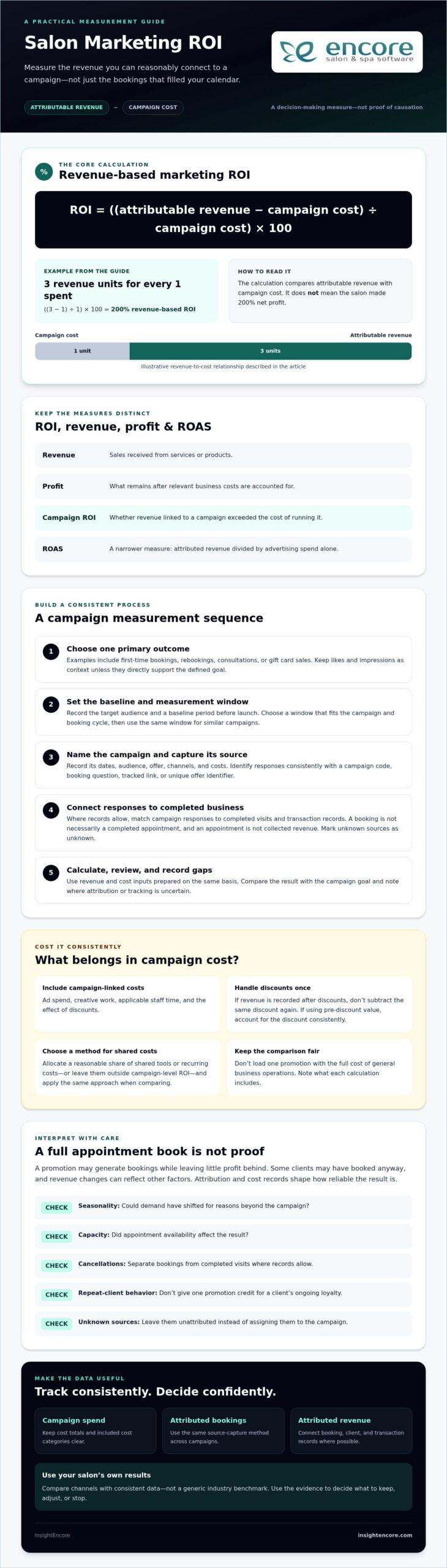
Salon marketing ROI is the percentage return from campaign-attributed revenue after campaign costs are deducted. Use this formula:

Marketing ROI = ((attributable revenue − campaign cost) ÷ campaign cost) × 100

For example, if a campaign generates three units of attributable revenue for every one unit spent, its revenue-based ROI is 200%. That does not mean the salon made 200% net profit. The calculation compares revenue with campaign costs, not with every cost of delivering the services sold.

Marketing ROI versus salon revenue and profit

Revenue is the sales received; profit is what remains after relevant business costs are accounted for. Campaign ROI sits between those ideas: it asks whether the revenue linked to a campaign exceeded the cost of that campaign. Return on ad spend (ROAS) is narrower, dividing attributed revenue by advertising spend alone. For background on the broader metric, see Return on Marketing Investment (ROMI).

A revenue increase after a promotion doesn’t prove the promotion caused it. Clients may have already planned to visit, or demand may have shifted for other reasons. Your calculation is only as reliable as the attribution and cost information behind it.

Which marketing costs belong in the calculation?

Include costs tied to the campaign, such as ad spend, creative work, applicable staff time, and the effect of discounts. If you record revenue after discounts, don’t subtract the same discount again as a separate cost. If you use the pre-discount value instead, account for the discount consistently.

Shared tools or recurring costs also need a consistent approach. You might allocate a reasonable share to each campaign or leave them outside campaign-level ROI, as long as you use the same method when comparing results. Don’t load one promotion with the full cost of general business operations. Keep campaign costs distinct, and note what your calculation includes so you can compare like with like.

How to Measure Salon Marketing ROI Step by Step

A repeatable process makes campaign results easier to compare and less dependent on guesswork. Before launching, decide what success means, how you’ll identify campaign-driven activity, and when you’ll review the results.

Set one goal and a measurement window

Choose one primary outcome for each campaign, such as first-time bookings, rebookings, consultations, or gift card sales. Record the target audience and a baseline period before launch, then set a measurement window that fits the campaign and booking cycle. Use the same window when comparing similar campaigns. Impressions and likes can help explain reach, but they aren’t sales unless they directly support a defined goal.

Aligning a metric with a business objective helps you measure marketing effectiveness, rather than just activity. Keep secondary measures for context, but don’t change the main success measure after the campaign has started.

Define the campaign and capture its source

Give each promotion a clear name and record its dates, audience, offer, channels, and costs. Then choose a practical way to identify responses: a campaign code, a booking question, a tracked link, or a unique offer identifier. Apply the method consistently so you can identify bookings or sales associated with the campaign.

Connect the source to the outcome as far as your records allow. A booking is not necessarily a completed appointment, and an appointment is not the same as collected revenue. Match campaign responses to completed visits and transaction records where possible. If a client’s source is unknown, mark it as unknown instead of assigning it to the promotion.

Calculate and review the result

Campaign ROI is ((attributable revenue minus campaign cost) divided by campaign cost) multiplied by 100. It requires a consistent cost total and revenue linked to campaign responses within your pre-set measurement window.

Use revenue and cost inputs prepared on the same basis, including discounts and applicable campaign labor. Then compare the result with the campaign’s goal and note any gaps in tracking. The calculation won’t resolve uncertain attribution, but a consistent process can show where the evidence is strong and where it needs improvement.

Booking, client, and transaction records can provide useful inputs when they’re connected appropriately. Salon management tools such as Encore Salon & Spa Software bring online booking, client management, and POS transactions together, but you’ll still need to confirm how campaign sources can be captured and matched to outcomes. Use what the records support, then refine your tracking for the next campaign.

Which Salon Marketing Metrics Help Explain ROI?

ROI is the result you’re trying to understand, while supporting metrics help explain what happened along the way. Separate outcome metrics, such as completed appointments and sales, from activity metrics, such as impressions, clicks, and likes. Activity can show that people noticed a campaign. On its own, it can’t show that the campaign was profitable.

For a useful comparison, keep a simple record for each campaign. Measuring salon marketing roi becomes more meaningful when you use the same fields and definitions from one campaign to the next.

Campaign Spend Attributed bookings Attributed revenue Estimated ROI
Campaign name and dates Costs included Bookings linked to campaign Revenue linked to those bookings Calculated using your stated method

Bookings, new clients, repeat visits, and average transaction value

Bookings show a response, but they don’t confirm that appointments were completed or paid for. Separate first-time clients from returning clients: a promotion that attracts new guests has a different purpose from one that encourages existing clients to return. Repeat visits can signal ongoing engagement, but they don’t prove which campaign caused the visit.

Average transaction value shows the typical revenue per completed transaction. It can help explain whether campaign-linked visits generated higher or lower sales, but it doesn’t reveal campaign costs or profit on its own. Read these measures together, and define each one consistently.

Attribution challenges in salon marketing

A client might see a social post, receive an email, and later book after a reminder. Three common approaches assign credit differently: first-touch credits the earliest recorded interaction, last-touch credits the final one before booking, and self-reported attribution asks clients how they heard about the salon. Each offers a useful view, but none captures every influence.

Write your attribution method beside the results. Compare campaigns only when their goals, measurement windows, and tracking methods are reasonably alike. A campaign focused on new-client bookings shouldn’t be ranked directly against one designed to encourage repeat visits. Channel performance depends on your objective and the quality of your tracking, not a universal winner.

Measuring Salon Marketing ROI: A Practical Guide for 2026

How to Interpret Salon Marketing ROI Without Misleading Yourself

A strong month is encouraging, but it doesn’t prove a campaign caused growth. Clients may already have planned their visits, demand may have shifted with the season, or your team may have had more availability than usual. When measuring salon marketing roi, treat the calculation as evidence to assess, not a verdict on its own.

Put campaign results in context. Check whether appointment capacity changed, whether cancellations affected completed visits, and whether revenue came from first-time clients or repeat guests. A campaign may prompt an existing client to book earlier without creating a new visit. That distinction matters when you assess whether the promotion achieved its intended goal.

Discounts need a closer look, too. An offer can increase bookings while lowering the amount collected per appointment. Compare campaign-linked revenue after discounts with campaign costs, and consider whether the service mix or margin changed. More appointments don’t automatically mean a better financial result.

Common salon ROI calculation mistakes

Before acting on a result, check for omitted campaign costs, revenue counted more than once, and offers redeemed without a trackable identifier. Don’t credit every sale during a campaign period to that campaign. Small booking counts can swing sharply from one appointment, while inconsistent comparison periods can make a routine seasonal change look like campaign impact. Note these limitations beside the result.

Use a practical review cycle to improve campaigns

Review results after the measurement window you chose before launch. Record what the data supports, what remains uncertain, and whether the campaign met its primary goal. When the evidence is limited, test again rather than treating one result as conclusive. When practical, change one meaningful element at a time, such as the offer or audience. That makes it easier to see what may have influenced the next result.

  • Continue when tracking is credible and the campaign supports its goal.
  • Adjust when results are mixed and you can identify a clear issue to address.
  • Test again when results look promising but sample size or attribution is weak.
  • Stop when reliable evidence shows the campaign repeatedly misses its goal.

Keep the decision proportional to the evidence. Organized booking, client, and transaction records can help you review outcomes, but they don’t establish campaign attribution by themselves. Use them alongside your source-tracking method, and note any gaps before deciding what to change.

To see how Encore’s tools bring booking, client, and transaction information together, explore Encore Salon Software.

Build a Salon Marketing ROI Tracking Routine with the Right Tools

A simple routine is easier to maintain than a complicated dashboard. For each campaign, record its goal, dates, audience, tracking method, and costs. After the measurement window closes, capture the relevant outcomes, calculate the result using the same definitions, and decide what to do next. This steady process makes measuring salon marketing roi more useful over time because it lets you compare campaigns on consistent terms.

  • Record: Note the campaign details and which costs are included.
  • Capture: Connect campaign sources with bookings and completed sales where possible.
  • Calculate: Apply your chosen ROI formula consistently.
  • Decide: Keep, adjust, test, or stop based on the strength of the evidence.

What to look for in salon marketing and management software

Online booking, client records, POS transactions, and marketing tools can each contribute useful information. Together, they may help you organize campaign activity alongside bookings and sales, but they don’t automatically establish which campaign caused a transaction. Before choosing a system, ask how campaign sources can be recorded and whether booking and completed-sale information can be reviewed or exported together. If your salon is still relying on a basic cash register for transactions, it may also be worth reviewing what’s involved in upgrading from a cash register to a POS system to better connect sales data with client and booking records.

Encore Salon Software combines online booking, client management, POS transactions, and automated marketing tools. Explore Encore salon software features, and confirm which records or exports support the tracking process you plan to use.

Turn campaign results into a confident next step

Start with one campaign and a small tracking sheet. Include the campaign name, goal, dates, spend, source, attributed bookings, completed sales, revenue, and any limitations in the data. A spreadsheet can be enough to establish a consistent method before you add more tools or campaigns.

Software can help keep operational information organized, but it can’t replace clear goals, consistent attribution, or careful interpretation. Build the method first, then decide whether a platform’s records and reporting options fit your needs.

To explore whether Encore fits your salon’s tracking routine, learn more about Encore.

Make Your Next Marketing Decision with Confidence

Strong campaign decisions don’t depend on perfect data or a universal benchmark. They come from a consistent way to connect marketing activity with bookings, completed sales, and campaign costs. Measuring salon marketing roi becomes more useful when you set a clear goal, track where responses came from, and interpret results alongside repeat visits, cancellations, and discounts.

Start with one campaign and a simple tracking routine. Record what you can verify, note where attribution is uncertain, and use the findings to decide whether to continue, adjust, test again, or stop. Over time, organized records can help you identify which activities are worth another look.

Encore brings together online booking, client management, and POS tools, alongside automated marketing, loyalty programs, and gift card management. These tools can help organize salon activity, while your chosen tracking method remains essential to measuring campaign results.

Take it one campaign at a time. A clearer view of your results can help you make your next marketing decision with greater confidence.

Frequently Asked Questions

What is a good marketing ROI for a salon?

There’s no single marketing ROI benchmark that applies to every salon or campaign. A useful result depends on the goal, which costs you include, and how confidently you can connect bookings or sales to the campaign. Compare similar campaigns over comparable periods, and treat early results as directional if the sample is small. Consider profit and available appointment capacity alongside attributed revenue before deciding whether a result is strong.

How do you calculate salon marketing ROI?

Subtract campaign costs from the revenue reasonably attributed to the campaign, divide by those costs, then multiply by 100. For example: ((attributed revenue − campaign cost) ÷ campaign cost) × 100. Include relevant expenses, such as advertising, discounts, and campaign labor, consistently. Measuring salon marketing roi also requires you to state how you attributed revenue. The formula organizes the calculation, but it can’t make uncertain source data reliable.

How can a salon track which marketing campaign generated a booking?

Use a trackable link, campaign-specific code, booking question, or unique offer identifier, then connect the recorded source to completed appointments and transactions where possible. Choose a method staff can use consistently. A client may see several promotions before booking, so tracking won’t always identify a single cause. Record the attribution approach you use, and mark the source as unknown when the available information doesn’t support a confident match.

Should salons measure revenue or profit when calculating marketing ROI?

Revenue is often easier to connect to campaign-linked bookings, but it doesn’t account for the costs of delivering services or running the promotion. Profit gives a fuller financial picture when those costs can be estimated reliably. Choose the measure that fits the decision you’re making, clearly state what it includes, and apply it consistently. Don’t compare a revenue-based calculation with a profit-based one as if they measure the same result.

Can a salon measure social media marketing ROI?

Yes, if you define a business outcome and have a way to connect social activity to bookings or sales. Use tracked links, campaign codes, or a booking-source question where practical, then compare the attributed outcome with campaign costs. Likes, views, and comments can help show engagement, but they don’t establish revenue or profit on their own. Be transparent about any sales or bookings whose source you can’t confirm.

How often should a salon review marketing ROI?

Set a review period before each campaign and allow enough time for its intended outcome, such as a booking followed by a completed appointment. A weekly check can help catch tracking gaps while the campaign is running; make the final assessment using the window and method chosen at launch. Compare campaigns with similar goals and timing, and account for changes in seasonality, appointment capacity, or cancellations.

What if a salon cannot identify which campaign caused a sale?

Report the sale as unattributed or uncertain rather than assigning it to a campaign without evidence. You can still review overall booking and sales trends, but keep those observations separate from campaign-attributed results. For the next promotion, try a unique link, offer code, or booking-source question, and make the tracking step clear for staff and clients. Better source records can strengthen future comparisons without guaranteeing perfect attribution.

Explore Encore for your salon

Disclaimer

This article is general in nature and may contain errors, please verify all claims with your sales rep
Categories
Uncategorized

Spa Marketing Automation Examples: 10 Ideas to Build Client Loyalty in 2026

What if the best way to bring spa clients back isn’t another generic promotion, but a timely message that fits their client journey? When manual follow-ups compete with appointments and daily operations, messages can go out too late, too often, or without a clear reason. The most useful spa marketing automation examples start with a client’s needs, not a calendar of blasts.

It makes sense to be careful: outreach that feels impersonal can weaken the relationships your spa works hard to build. Automation should make follow-up more thoughtful, not make clients feel like names on a list. This guide shares practical campaign ideas and explains when each may work best, so you can choose messages that feel relevant and useful.

Explore 10 examples across the client journey, from welcome and post-visit messages to rebooking reminders, win-back campaigns, and loyalty outreach. For each, you’ll see what client information can guide the timing and what to measure. You’ll also learn how to start with a manageable plan and review it over time, using connected booking, client management, marketing, and loyalty tools to keep campaigns organized.

Key Takeaways

  • Build campaigns around client actions and stages, so messages feel timely and relevant rather than like generic promotions.
  • Use spa marketing automation examples as adaptable starting points, then tailor each message to its audience, purpose, and timing.
  • Choose one campaign goal and track a fitting measure, such as rebooking or response, to see whether clients find it useful.
  • Compare software by how clearly it connects client records, booking context, campaign controls, and reporting.
  • Connected booking, client management, marketing, and loyalty tools can help organize spa workflows. Confirm which triggers and channels a platform supports.

Why spa marketing automation works best across the client journey

A client’s relationship with your spa doesn’t begin and end in the treatment room. It may start when they discover your services, continue as they book and visit, and grow through useful follow-up and future appointments. Marketing automation can help you communicate at those moments without relying on someone to remember every task manually.

Spa marketing automation is software-supported messaging or tasks that begin when a client takes an action or a chosen time condition is met. A one-off campaign goes to a selected group at a particular time; an automated workflow responds to a defined client moment. This reflects the broader idea of marketing automation, where software helps coordinate marketing tasks and communication.

The distinction matters. Automation isn’t a reason to send more promotions. It’s a way to make communication more useful: booking information when someone schedules, a thoughtful check-in after a visit, or a relevant reminder after a client-defined interval. The best spa marketing automation examples fit the service and the client’s expectations rather than treating every client alike.

Which spa moments are useful automation triggers?

Start with moments that give a message a clear purpose. A booking can prompt practical appointment information. An appointment completion may prompt a follow-up. A client-defined interval can cue a relevant return-visit reminder, while an inactive-client period may prompt a gentle check-in. These are possible workflow ideas, not a universal schedule. Choose triggers that make sense for your services and how clients prefer to hear from you.

Keep operational messages distinct from promotional ones. Operational communication helps a client manage an existing appointment or understand what happens next. Promotional communication invites them to consider another service or offer. The purpose affects the content, timing, and permissions you need to check before sending.

How can automation still feel personal?

Personal doesn’t have to mean overly familiar. Use preferences or service history only when they’ve been appropriately recorded and are relevant to the message. A simple reference to the service a client booked can feel more considered than a generic offer. Adding unnecessary personal details, however, may feel intrusive.

Keep every message warm, specific, and easy to understand. Make the next step clear, and respect the client’s communication permissions and stated preferences. For promotional outreach, ensure your process reflects applicable consent requirements and makes preferences or opt-outs clear.

Connected booking and client-management records may help a spa organize context for follow-up, while marketing and loyalty tools can support related workflows. Before choosing software, confirm which triggers and communication channels it actually supports. The goal is a client journey that feels thoughtfully supported, not a larger volume of automated messages.

Spa marketing automation examples for booking, follow-up, and rebooking

Use these workflows as starting points, not guaranteed revenue drivers or a universal message schedule. The right trigger and timing depend on your spa’s services, policies, and client expectations. For more help assessing booking workflows, consult a spa booking software buyer’s guide.

What can a spa automate before and after an appointment?

Begin with practical messages that support an appointment already on the books. Keep each one clear and focused on what the client needs next.

  • Booking confirmation: Trigger it when an appointment is booked. Send the appointment details and explain how to request a change. Review delivery and how often clients use the stated process to handle changes.
  • Appointment reminder: Trigger it as the appointment approaches, with timing chosen to fit your policies and client preferences. Its purpose is to help clients remember and prepare. Review responses, changes, or missed appointments to assess whether the timing and wording are useful.
  • Post-visit check-in: Trigger it after a completed appointment when follow-up makes sense for the service. Invite the client to share feedback or ask a question. Measure replies or feedback received rather than assuming every treatment needs the same message.

These are operational communications: they help clients manage an existing appointment. Keep them distinct from promotional messages, which invite a client to consider another visit or service.

How can spas encourage the next visit?

A rebooking prompt should relate to the service and arrive at an interval the spa considers appropriate. Avoid treating one schedule as right for every client. A message can invite the client to book again without implying they need a service or assuming a particular result.

  • Service-relevant rebooking: Trigger it after a spa-selected interval has passed since a completed visit. Send it to clients who received that service, with a warm, optional invitation to view booking availability. Measure return bookings among the clients who received the prompt.
  • Relevant next-step suggestion: Trigger it after a visit when a suitable recommendation is supported by the service and the client’s recorded preferences. Keep the message informative, and measure replies or bookings linked to the recommendation.

Gift-related follow-up has a different audience and purpose. After a gift card purchase, for example, a spa might send useful information about how the recipient can use it. Explore gift card management tools when planning that workflow.

Review each campaign’s responses and client feedback. Adjust or pause messages that feel mistimed, irrelevant, or repetitive. The aim is thoughtful follow-up, not more contact for its own sake.

Spa automation examples for retention, win-back, and client loyalty

Retention messages work best when they recognize why a client might value hearing from your spa. A service follow-up can invite feedback, a win-back note can reopen a conversation, and a loyalty update can acknowledge participation. Seasonal education can offer helpful context without turning every change in season into a sales pitch. These spa marketing automation examples are options to adapt, not fixed schedules or promises of results.

Automation should support a human experience, not replace thoughtful service. Use a message to make the next interaction easier or more relevant, then leave room for a personal response when a client has a question or concern.

Trigger Appropriate message Intended client value Measurement option
Visit completed A brief service follow-up or invitation to share feedback, when appropriate A simple way to give input or ask a question Replies or feedback received
Spa-defined inactive period A warm check-in or relevant service reminder A useful, low-pressure prompt to reconnect Responses or return bookings
Loyalty participation changes A clear update about the client’s loyalty activity Recognition and a better understanding of the program Client engagement or questions about the program
Seasonal point chosen by the spa Practical education related to services or client interests Helpful information without an unnecessary sales push Engagement with the message or related inquiries

These measures are options, not industry benchmarks. Choose a spa-defined target for each campaign, then review results alongside client feedback. If a message gets little response or draws complaints, reconsider its timing, relevance, or audience.

What does a respectful win-back message look like?

Define “inactive” using a timeframe that fits the service cycle at your spa. A client who hasn’t returned within that period could receive a friendly check-in or useful reminder, without an assumed discount or pressure to book. If clients don’t engage, stop or adjust the outreach according to your communication policy. Respecting silence helps keep future contact welcome.

How can loyalty campaigns add value without over-messaging?

Send loyalty updates when there’s something useful to share, rather than repeating sales prompts. A clear note can recognize participation or explain relevant program information without inventing rewards or mechanics. Beyond loyalty updates, date-based triggers such as automated birthday greetings for salon clients offer another way to acknowledge clients personally without adding manual work. Encore offers loyalty programs alongside automated marketing capabilities. If you’re comparing software, review its automated marketing and loyalty features, and confirm which triggers and channels are supported.

Keep the experience personal by using only appropriately recorded client information and honoring communication preferences. A smaller number of relevant messages can serve clients better than frequent outreach that asks for their attention without offering something useful.

Spa Marketing Automation Examples: 10 Ideas to Build Client Loyalty in 2026

How to choose spa marketing automation examples and measure them

The most useful spa marketing automation examples solve a clear communication problem and give you a way to assess whether the workflow is helping. Start small. A campaign that’s easy to understand, check, and adjust is more manageable than several automations launched at once.

Use this sequence to shape one workflow:

  • Choose one goal: For example, reduce missed appointments or encourage clients to return.
  • Define the audience: Select clients for whom the message is relevant.
  • Set a trigger: Choose a recorded action or spa-defined timing condition.
  • Write the message: Make its purpose and next step clear.
  • Select a channel: Use a method that suits the message and client permissions.
  • Pick a measure: Decide what response or outcome you’ll review.

Booking information can provide useful context for appointment-related workflows. A salon client booking portal guide may help you consider how booking details fit into the client experience. If you’re evaluating software, look for usable client records, relevant booking context, control over campaign audiences and timing, and reports your team can interpret. Confirm which specific triggers and channels are available before relying on them.

Which metrics can a spa track for each campaign?

Match the measure to the message. For booking reminders, review attendance or rescheduling when those records are reliable. For retention outreach, consider rebooking, repeat visits, replies, and opt-outs. Campaign activity, such as messages sent or opened, isn’t the same as a business outcome. A change in bookings may have other causes, so avoid crediting automation alone. To go further, measuring salon marketing ROI can help you separate campaign-driven visits from business that was already likely to happen and assess what each promotion actually contributed.

Set any performance target yourself, based on your spa’s goals and starting point. Then compare results over a useful review period and note client feedback, not just counts.

How should a spa start without overwhelming the team?

Pick one recurring communication problem staff can describe clearly. Draft the message and review it manually before automating delivery. Check that the audience, wording, timing, and next step make sense. Assign an owner to monitor accuracy, client responses, and the effort required to keep the workflow working. Once the process is dependable, decide whether to refine it or test another campaign.

This measured approach helps you improve without adding unnecessary work. Encore brings online booking, client management, automated marketing, and loyalty programs into one platform. Review whether its capabilities fit your workflow and verify the triggers and channels you need.

Explore Encore for spa marketing workflows

How Encore can support a more organized spa marketing workflow

It’s easier to plan relevant client communication when booking details, client records, and marketing activities are organized together. Encore serves spa and beauty businesses with online booking, client management, automated marketing, and loyalty programs. These capabilities can help a spa coordinate its workflow, such as keeping booking context accessible while planning communications for clients.

That organization is a starting point, not a strategy by itself. Your team still decides who should receive a message, what it should say, and whether the timing suits the service and client. Software can support the process, but it doesn’t replace consent, good judgment, or personal care.

What should spa owners confirm in a software evaluation?

Ask the provider to show how client records, online booking, marketing tools, and loyalty programs work together in practice. A system’s feature list matters less than whether staff can use the information to manage the workflow you have in mind. When evaluating how transactions, client notes, and inventory connect at checkout, it may also be worth reviewing what’s involved in upgrading from a cash register to a POS system to understand what a more connected setup can support.

  • Campaign control: Can your team choose or adjust the audience and timing?
  • Channels and triggers: Which communication channels and campaign triggers are available? Confirm the specific options directly with the provider.
  • Reporting: Can you understand what was sent and review the responses or outcomes that matter to your spa?
  • Team fit: Does the workflow suit your services, staff responsibilities, and clients’ communication preferences?

Bring a real example to the evaluation. For instance, map the information your team would need to send a relevant follow-up after a visit. Check where that information is recorded, who reviews the message, and how you’d know whether the process is working. This helps reveal gaps before you commit to a workflow.

When is it time to explore Encore?

If coordinating bookings and repeat-client communication across separate processes is creating extra work, it may be worth seeing how Encore’s capabilities fit together. Encore offers spa and beauty business software, not a full-service marketing agency. Before relying on a particular automation, confirm the triggers, communication channels, and reporting available for your needs.

The spa marketing automation examples in this article can help you identify a first workflow to evaluate. Choose one that addresses a clear client or team need, then assess whether the tools support it without adding unnecessary complexity. Keep client preferences and thoughtful service at the center. You can explore Encore and its spa workflow tools as part of that evaluation.

Build a more thoughtful client journey, one step at a time

The strongest spa marketing automation examples aren’t about sending more messages. They help your team communicate at useful moments, with content that fits the client and a clear way to review how it’s received. Start with one workflow, define what you want it to do, and adjust based on client responses and your team’s experience.

Good tools can make that work easier to organize. Encore includes online booking, client management, automated marketing, and loyalty programs, bringing key parts of the spa workflow into one platform. As you evaluate the fit, confirm that its available campaign controls and channels support the approach you have in mind. Automation can support your relationships, while your team’s thoughtful care keeps them personal.

You don’t need to automate everything at once. Choose a useful place to begin, learn from the response, and build a client journey that feels considered at every step.

Frequently Asked Questions

What are examples of marketing automation for a spa?

Examples include booking confirmations, appointment reminders, post-visit feedback requests, service-relevant rebooking prompts, loyalty updates, and check-ins for clients who haven’t visited within a spa-defined period. These spa marketing automation examples work best when each has a clear audience and purpose. Before launching one, decide what client need it serves, what information it relies on, and how you’ll tell whether it’s useful.

How can a spa automate client follow-up after an appointment?

A spa can use appointment records to organize a follow-up for clients who’ve completed a visit, if the software supports that workflow. First decide whether follow-up is appropriate for the service, then write a brief message that offers a useful next step, such as a way to share feedback. Review the wording and recipient criteria, and make sure the message respects client permissions and preferences.

Can spa marketing automation help bring clients back?

It can support return visits by helping a spa follow up with relevant clients at a time that fits its service cycle. For example, a spa might identify clients who haven’t booked again within a timeframe it defines, then send a considerate check-in rather than assuming they want a promotion. Review resulting bookings and replies, but remember that automation supports outreach; it can’t guarantee a client will return.

How often should a spa send automated marketing messages?

There’s no single schedule that suits every spa or client. Set timing according to the purpose of each message, your services, client preferences, and communication permissions. Avoid sending multiple messages that repeat the same request or arrive too close together. Review client responses, opt-outs, and complaints for signs that the pace or content needs to change, and pause messages that no longer feel relevant.

What should a spa measure in an automated marketing campaign?

Choose measures that match the campaign’s purpose. For appointment communications, review reliable attendance or rescheduling records. For retention outreach, consider replies, repeat visits, rebookings, and opt-outs. Opens or clicks can show interaction, but they don’t prove a campaign caused a business outcome. A practical approach to measuring salon marketing ROI can help you account for discounts, compare channels consistently, and avoid giving one promotion credit for a client’s ongoing loyalty. Compare results with your spa’s own goals and context, and treat targets as internal benchmarks rather than universal standards.

Does spa marketing automation replace personal client service?

No. Automation can help organize routine communication, but it can’t replace a staff member’s judgment, attentive treatment, or personal response to a client’s question. Use it to handle appropriate, predictable tasks, and give clients a clear way to get help from your team when they need it. Keep messages accurate and considerate, and review feedback so your communication continues to reflect the experience your spa wants to provide.

Explore Encore for your spa marketing workflow

Disclaimer

This article is general in nature and may contain errors, please verify all claims with your sales rep
Categories
Uncategorized

How to Set Up Automated Birthday Greetings for Salon Clients in 2026

What if your salon could remember every client’s birthday without adding another task to your already full day? Automated birthday greetings for salon clients can make that possible, but the message should still feel like it came from your team, not a bulk mailing list.

Tracking birthdays manually can be tiring, and it’s reasonable to worry that automation might feel cold or spammy. Done thoughtfully, a birthday message gives you a simple way to celebrate clients, invite them back during quieter periods, and keep your salon in mind between appointments.

This guide explains how to build a birthday marketing system that feels personal and is straightforward to manage. You’ll learn what information to collect, how to choose a message and offer, when to send it, and how to make booking easy. We’ll also cover how salon software with client management and automated marketing tools can help, plus basic considerations for promotional messages. With a few practical choices, you can create a repeatable process while keeping the client relationship at the centre.

Key Takeaways

  • Set up automated birthday greetings for salon clients by keeping client details accurate and choosing a system that can reduce manual work.
  • Match the channel to the message: SMS suits a concise greeting and offer, while email allows more room for imagery and service ideas.
  • Make each greeting personal with a warm tone, a relevant treat, and wording that sounds like your salon.
  • Consider a birthday-month offer to give clients more flexibility to book and redeem it.
  • Track redemptions and bookings to learn which messages encourage clients to return.

The Psychology of the Personal Touch: Why Birthday Marketing Works

A birthday message can do more than fill a quiet appointment slot. It shows clients you remember them as people, not just as services on the books. That gesture can build goodwill and give them a natural reason to consider booking. It won’t guarantee a visit, but it can put your salon top of mind.

This is the idea behind relationship marketing: building lasting client relationships through relevant, thoughtful communication rather than focusing only on the next sale. Automated birthday greetings for salon clients can support that approach when the message sounds sincere and any offer feels optional, not pressuring.

The Emotional Connection in Beauty and Wellness

Salon visits are personal. Clients trust you with their appearance, preferences, and time, which gives your team an opportunity to make milestones feel meaningful. A message that says, “We hope your day feels special,” has a different tone from a generic discount blast. Keep the greeting warm, use the client’s name when you have it recorded accurately, and make the offer secondary to the celebration. Consistent, thoughtful messages can build familiarity over time.

Combating the “Slow Month” with Birthday Peaks

Birthdays fall throughout the year, so a birthday-month offer can create booking opportunities beyond major holidays. Compare client birthday dates with your appointment calendar to identify quieter periods and plan messages in advance. Rather than rely on broad claims about how birthday marketing affects retention, measure your own results. Track offer redemptions, return visits, and bookings during the periods you want to improve.

Encore Salon & Spa Software combines client management with automated marketing and loyalty programs, giving salons tools to organize client outreach. You can explore how to record client details and plan milestone messages, then confirm which birthday-date and campaign options are available in your setup. The value of a greeting may extend beyond one appointment: it can encourage a client to return and remind them of the care they receive from your team. Review the response over time to see whether the campaign supports repeat visits.

How to Set Up Your Automated Birthday System in 4 Steps

A reliable birthday campaign starts with accurate records and a clear plan, not complicated technology. Use these four steps to create automated birthday greetings for salon clients that feel thoughtful and are manageable for your team.

Collecting Quality Data at the Front Desk

When a new client books, ask whether they’d like to share their birthday and explain that you may use it to send a greeting or offer. Include a birthday field in your intake process, but let clients skip it. A salon booking and management system can help organize client details, and a booking portal may give clients a convenient way to review or update their information. Collect only what you need, limit staff access to client records, and follow the privacy and messaging rules that apply to your salon. The Australian Government’s Manage customer relationships guide also explains how customer records can support more relevant communication.

  • Step 1: Clean your database. Check for missing or incomplete birthday dates, duplicate records, and outdated contact details. Ask permission before using birthday information for marketing, and establish a simple process for correcting records.
  • Step 2: Choose your channel. SMS is suited to a brief greeting and direct booking prompt. Email gives you more room for salon imagery, service ideas, and a fuller message. Use a channel the client has agreed to receive, and check that your software supports the delivery method you choose.
  • Step 3: Set the trigger. Decide when the message should be sent. A week before the birthday is one practical starting point: it gives clients time to plan without making the reminder feel last minute. It won’t suit every salon, so compare it with a birthday-month message or a greeting on the day itself.
  • Step 4: Choose the offer and expiry. Select a clear, simple birthday treat and set an expiry date that gives clients a reasonable booking window. Spell out the terms so clients and staff know how redemption works.

Configure, Check, Then Switch It On

Before launching, preview the message on a phone and in an email inbox. Check that the client’s name, timing, offer details, and booking instructions appear correctly. Send a test to your own contact details first. To prevent duplicate messages, use one primary birthday trigger, look for overlapping campaigns, and review who will receive the message. If your system allows it, begin with a small test group and check delivery and bookings before expanding. Encore’s Automated Marketing & Loyalty Programs can support more organized outreach; confirm the available trigger and channel settings for your setup.

Crafting the Perfect Birthday Message: Templates and Offers

A good birthday message starts with the client, not the promotion. Keep the greeting warm, make the offer easy to understand, and give the client one clear next step. These examples are starting points for automated birthday greetings for salon clients. Adjust the wording to suit your team, and test personalization fields before sending.

Two Ready-to-Adapt Templates

Short and sweet SMS: “Happy birthday, [First Name]! Treat yourself to a little extra care this month. Enjoy [birthday offer] when you book by [expiry date]: [booking link]. Hope you have a wonderful day, [Salon Name].” Keep the text brief, include one clear offer, and check that the booking link works on a phone.

Visual storyteller email: Use your salon’s current branding, a welcoming subject line such as “A birthday treat from [Salon Name],” and a layout that’s easy to read on mobile. Start with a personal greeting, explain the offer and its terms, then add a clear booking button. For example: “Happy birthday, [First Name]! We’d love to help you celebrate with [birthday offer]. Book by [expiry date] and choose a time that works for you.”

Before launching, send test messages to check how names, dates, stylist details, and links appear. If you don’t have a reliable stylist name, sign off from the salon instead of leaving a blank or broken placeholder.

Choose Offers That Fit Your Clients

Possible birthday treats include a discount on a service, a complimentary deep-conditioning add-on, or extra loyalty points. A service add-on can feel like a thoughtful upgrade while keeping the focus on the salon experience. The right choice depends on your services, margins, and what clients value. If you offer special rewards to a segment of clients, define eligibility clearly and apply it consistently.

  • Birthday-month pass: Gives clients flexibility to book around work, family, and existing appointments.
  • Birthday-week offer: Creates a shorter booking window and a timely reason to act, but may not suit clients who plan ahead.
  • No-strings-attached greeting: Send a simple birthday wish without a discount or booking request. This can feel especially sincere when your goal is to recognize the client, not prompt a purchase.

Professional and friendly means being clear about the offer while writing with the warmth you’d use in a genuine conversation. For a tattoo studio, tailor the language to its clients and services rather than reusing salon-specific copy. Explore tattoo studio software as a starting point for understanding that specialized setting.

How to Set Up Automated Birthday Greetings for Salon Clients in 2026

Timing and Personalization: 2026 Best Practices

A birthday greeting works best when it arrives early enough to help a client plan, but not so early that it feels disconnected from the occasion. A birthday-month offer gives clients flexibility to choose a date that suits them, including a date before or after the birthday if their schedule is busy.

Give Clients Time to Book

Try sending the first greeting about a week before the birthday. This gives clients a chance to book ahead, whether they want a fresh style for a celebration or simply a moment of self-care. If you offer a birthday-month promotion, state the final redemption date clearly rather than implying that clients must visit on their birthday.

Make the next step simple. Link directly to your online booking module if it supports the booking path you want clients to use. Test the link on a phone before sending, and check that it takes clients to a clear appointment option.

Personalize with Purpose

Useful personalization reflects what you know about a client without making the message feel overly familiar. Review service history and preferences to shape a relevant suggestion. For example, a client who regularly books blowouts might appreciate, “Ready for your birthday blowout?” A client who visits for nail services could receive a greeting tailored to that experience. Mention a preferred stylist only if the information is reliable; otherwise, keep the greeting salon-wide.

Use purchase history to shape product recommendations only when the record gives you a sensible reason. Don’t assume every client wants the same service or product, and don’t imply that software provides specific recommendations unless your system supports that feature. For more relevant messages, group clients by service or visit pattern and adjust the wording for each group. Even small changes can make a birthday email feel more thoughtful than a generic broadcast.

Coordinate Channels and Respect Preferences

SMS can deliver a concise birthday greeting and booking prompt, while email allows more room for service ideas and salon imagery. If you use both, give each message a distinct purpose. For instance, send an email with ideas for a birthday visit, then use a brief text to share the offer or a booking reminder. Avoid repeating the same copy across channels, and don’t message clients who have opted out of that channel.

Handle opt-outs promptly and without pressure. Keep contact preferences current, remove unsubscribed recipients from future marketing messages, and make any available unsubscribe option easy to find. Respecting a client’s choice protects trust, even when it means sending fewer birthday offers. A well-timed, relevant message is more useful than a crowded inbox.

Explore Encore for automated salon marketing

Measuring Success: Turning Greetings into Revenue

A birthday campaign should do more than send a pleasant message. Track whether it leads to bookings, offer redemptions, and ongoing engagement. Clear measurement helps you improve automated birthday greetings for salon clients without losing the personal touch.

Track Bookings and Offer Redemptions

Give each birthday offer a distinct code or checkout label so your team can record redemptions. To calculate the redemption rate, divide the number of redeemed offers by the number delivered, then multiply by 100. Compare results across different message timings or offers, but remember that redemptions alone don’t tell the whole story. Also track how many recipients booked, whether they were returning clients, and how many appointments took place during your target period.

To estimate the effect on average ticket size, compare the average spend per birthday visit with a relevant baseline, such as those clients’ typical visit spend or similar appointments during the same period. Keep the comparison consistent and account for discounts or complimentary add-ons. This gives you a more useful picture than counting gross sales alone. For a broader framework on evaluating what your promotions actually contribute, see this practical guide to measuring salon marketing ROI, which covers how to separate campaign-driven visits from bookings that would have happened anyway.

Connect Greetings to Loyalty and Gift Cards

Birthday recognition can complement your salon’s broader loyalty efforts. If your loyalty program supports birthday points, decide how clients qualify, what they can use the points for, and how you’ll record them. Confirm that your software can apply the reward as intended before promising automatic credit. If it can’t, your team can use a consistent manual process. You can also mention salon gift card options as a way for clients to treat themselves or invite someone else to celebrate with them.

Encore Salon Software includes point of sale, booking, and marketing, along with Automated Marketing & Loyalty Programs. Use the records and reports available in your setup to review birthday-related transactions and compare results over time. Check which reporting views can isolate campaign revenue, redemptions, and average ticket size rather than assuming a specific report is available. Consider the overall value of the visit and any subsequent return appointments, not just the initial offer.

Refine the Campaign as You Learn

Test one change at a time, such as a different subject line or a service add-on instead of a discount. Ask clients a simple follow-up question: “Did you enjoy your birthday treat?” Use their responses alongside booking and redemption data to decide what to keep. As your salon grows, review whether client groups, offer rules, and reporting are applied consistently across locations. Regular, small adjustments can keep the campaign useful for clients and staff.

Make Every Birthday a Reason to Reconnect

Thoughtful birthday marketing doesn’t need to be complicated. Keep client details accurate, send a warm message at a useful time, and choose an offer that suits your salon and clients. Then review bookings and redemptions to learn what’s working and refine your approach.

Automated birthday greetings for salon clients help you recognize milestones consistently while reducing the need for manual reminders. The relationship still comes first. Automation simply helps your team show up at the right moment.

Encore offers beauty-industry software with automated marketing tools and an integrated platform that brings point of sale and loyalty programs together. The right system can help you organize a birthday process that feels personal and manageable.

Explore Encore Salon Software

Start with one thoughtful greeting, then build from there. Your next client celebration can be the beginning of a stronger salon relationship.

Frequently Asked Questions

Is automated birthday marketing really effective for small salons?

It can be a practical way for a small salon to recognize clients and encourage return visits, but results depend on the message, offer, and client preferences. Automated birthday greetings for salon clients reduce manual reminders and help you communicate consistently. Start with a simple greeting, then track bookings and offer redemptions to see whether the campaign supports your salon’s goals.

How far in advance should I send an automated birthday greeting?

Try sending the first greeting about a week before the client’s birthday, then compare results with a birthday-month message. An early note gives clients time to plan an appointment, while a month-long offer gives them more flexibility. There isn’t one timing that suits every salon, so test one approach at a time and review booking and redemption activity before changing your schedule.

What is the best offer to give clients for their birthday?

The best offer is one clients value and your salon can provide sustainably. Consider a relevant service add-on, a discount, or loyalty points, and make the terms easy to understand. A complimentary add-on may feel like a personal treat, while a discount is straightforward to explain. Choose one offer, state its expiry date clearly, and review redemptions alongside the value of the visits.

Can I send automated birthday greetings via text (SMS) and email?

You can use SMS, email, or both if your messaging platform supports those channels and clients have agreed to receive marketing messages through them. SMS works well for a brief greeting and booking prompt; email gives you room for images and service ideas. If you use both, make each message useful on its own and avoid sending duplicate copy close together.

What if I don’t have all of my clients’ birth dates?

You can start with the clients whose birthday information you have. Invite others to share their birthday when booking or at the front desk, explain how you’ll use the date, and let them decide whether to provide it. Don’t guess or fill in missing dates. Keep client details current so greetings reach the right person at the right time, and respect a client’s choice not to share.

How do I make sure the automated messages don’t sound like spam?

Write as you would to a valued client: use their name when the information is reliable, keep the greeting warm, and make any offer secondary to the celebration. Avoid generic, sales-heavy copy and repeated reminders. Send messages only through channels clients have agreed to use, make the booking step clear, and provide an easy way to opt out of future marketing messages.

Is there a way to track how many people actually use their birthday discount?

Yes. Use a distinct offer code or checkout label so staff can record each redemption in your point-of-sale system. Calculate the redemption rate by dividing redeemed offers by delivered offers, then multiplying by 100. Also compare birthday bookings and average visit spend with a suitable baseline. These measures help you assess whether an offer is bringing clients in and supporting revenue, not just generating clicks.

Do I need special software to automate birthday greetings?

You don’t necessarily need dedicated birthday software, but a salon management platform can make client records and marketing easier to organize. Encore Salon & Spa Software is an all-in-one platform with online booking, client management, point of sale, automated marketing, and loyalty programs. Check that any system you consider supports the birthday triggers and message channels you need, and confirm how it handles client preferences.

Disclaimer

This article is general in nature and may contain errors, please verify all claims with your sales rep
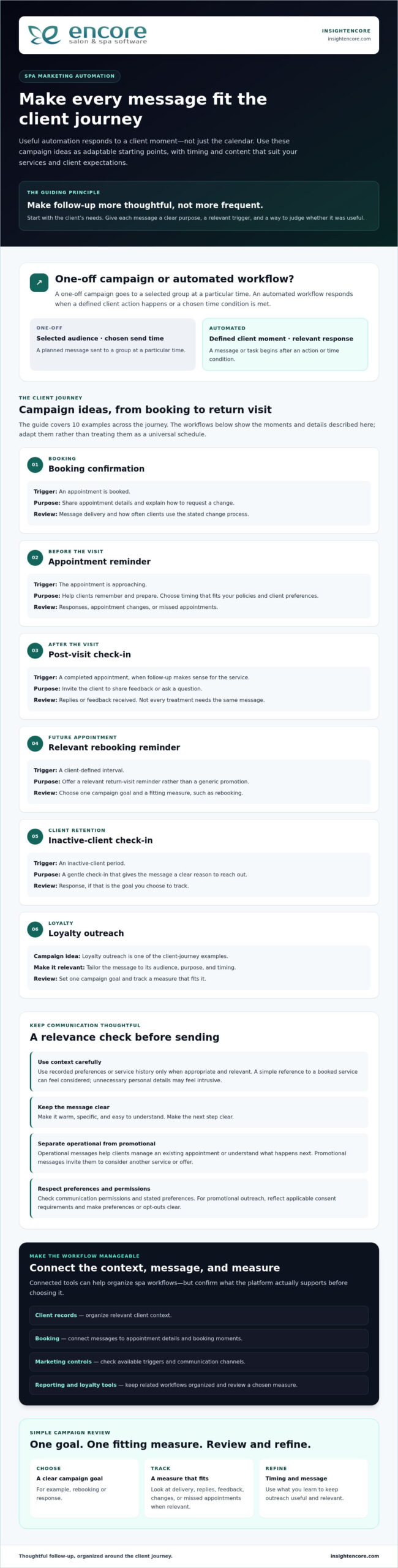
Categories
Uncategorized

Nail Salon Inventory App: The Complete 2026 Guide to Tracking Supplies and Retail

Most nail studios don’t lose their hard-earned profit on empty chairs; they lose it in unmeasured splashes of monomer, missing chrome powders, and clipboard counts that steal Sunday nights. You already know the headache of a technician running out of a trending gel shade mid-appointment, or trying to guess your actual margins on an intricate set. Generic spreadsheets treat a retail lotion the same way as a microscopic dab of foil glue, and that disconnect quietly drains your revenue. That’s why finding the right nail salon inventory app is an essential step toward running a calmer, more profitable studio.

You shouldn’t have to spend your weekends counting identical bottles just to stay organized. In this guide, you’ll discover how a dedicated nail salon inventory app eliminates backbar waste, tracks micro-usage art products, and protects your retail margins. We’ll explore practical ways to automate stock deductions right at checkout, pinpoint your exact service costs per manicure, and establish automated low-stock reorder alerts so you never face an unexpected shortage again.

Key Takeaways

  • Understand why standard retail tools stumble over micro-usage supplies, and how a dedicated nail salon inventory app solves the challenge of fractional liquid tracking.
  • Discover the practical differences between backbar consumption and retail inventory, including how to set unique targets for each revenue engine.
  • Learn a simple, step-by-step setup process to purge dead stock and standardize bottle naming across every brand, finish, and shade in your salon.
  • See how connecting stock tracking directly to your checkout process eliminates manual entry for technicians while keeping bottle counts fully accurate.
  • Uncover how real-time cost visibility per service protects your bottom line and triggers timely reorders before top-selling items run out.

Why Generic Inventory Systems Fail Modern Nail Salons

A standard retail store sells items by the unit; a customer buys a bottle of lotion, and the register deducts one box from the shelf. Nail studios don’t work that way. A modern nail salon inventory app must bridge the gap between whole-unit retail and the complex world of fractional backbar consumption. In our industry, a single bottle of monomer, basecoat, or acetone services dozens of clients across several days. While understanding inventory fundamentals helps any business buffer against shortages, general retail tools cannot calculate micro-usage. Liquids evaporate, opened polishes thicken over time, and fine art pigments spill during busy rushes. When your tracking system treats bulk salon supplies like standard boxed retail goods, your numbers drift away from reality.

The Unique Complexity of Nail Studio Supplies

Nail studios balance two completely different inventory models at the same time. Retail shelves feature sealed cuticle oils and files sold directly to clients for a set margin. Backbar supplies, however, are fluid, shared, and consumed in tiny amounts per service. Managing seasonal collections makes this balance even tougher. Trendy pastel collections peak in spring and drop off by summer, leaving behind half-empty bottles that tie up valuable working capital. Meanwhile, unrecorded product usage slowly eats into your service profits. When technicians apply generous scoops of builder gel or cut foil wraps without logging them, your treatment costs silently surge.

The Hidden Costs of Clipboard and Spreadsheet Audits

Manual stocktaking drains both your energy and your schedule. Studio owners frequently spend several hours every Sunday night squinting at hundreds of near-identical lacquer caps on a clipboard audit. Fatigued eyes make mistakes. A hurried count might misidentify a sheer nude as fully stocked, leading to a frantic, embarrassing stockout in the middle of a packed Saturday rush. Spreadsheets also trap numbers in static rows. They fail to connect supply levels with appointment schedules, making accurate cost forecasting and seasonal budgeting nearly impossible.

Essential Features to Look for in a Nail Salon Inventory App

General warehouse systems track pallets and cartons, but a high-performing nail salon inventory app needs to solve much smaller, daily bottlenecks. Nail technicians work at a fast pace, moving through appointments while pulling from shared shelves. You need intuitive digital tools that simplify station audits, catch missing stock early, and protect your margins. Industry reports frequently highlight the billions lost to retail shrink each year, and nail studios face that same vulnerability when unmonitored backbar jars and retail products walk out unaccounted for. Looking for dedicated inventory management features tailored to salon workflows ensures your tracking supports your team instead of slowing them down.

Micro-Tracking for Nail Art, Gems, and Powders

Tiny embellishments cause major tracking headaches. Individual crystals, striping tapes, and foils lack standard barcodes, making unit tracking impossible. An effective salon tool lets you bundle these micro-items into service-level recipes or flat-fee art tiers. For jars of dip powder and builder gel, photo-tagged supply indexing allows technicians to confirm color swatches instantly without opening jars or guessing pigment codes.

Mobile Barcode Scanning and Rapid Audit Modes

Nobody wants to be tethered to a front-desk computer. With mobile scanning, your phone or tablet camera turns into an agile counting tool. Technicians can complete rolling audits of a single drawer between client appointments. When wholesale shipments arrive, quick camera scans verify received items against purchase orders in seconds, preventing shelf delays.

Automated Purchase Orders and Supplier Profiles

Running out of essential supplies stalls appointments. Modern platforms monitor your usage patterns and flag low balances automatically. Key ordering capabilities should include:

  • Dynamic threshold alerts: Notifications trigger based on real-time consumption rather than fixed guesses.
  • Centralized distributor records: Store multiple supplier terms, contact details, and item numbers in one place.
  • Digital invoice matching: Cross-check incoming shipments against original POs to stop vendor overcharges before paying.

Backbar vs. Retail Inventory: Managing Two Distinct Revenue Engines

Every bottle in your studio serves one of two financial masters. Lumping professional supplies together with take-home products clouds your financial health, leaving you unsure whether service fees cover supply costs or if retail sales are masking backbar waste. A dedicated nail salon inventory app separates these streams into distinct ledgers so you can track treatment expenses independently from sales revenue. Applying essential inventory management techniques like First-In, First-Out (FIFO) ensures you rotate aging lacquers on backbar racks while preserving the fresh presentation of client retail shelves.

Inventory Dimension Professional Backbar Supplies Front-Desk Client Retail
Primary Purpose Internal operational use during treatments Direct merchandise resale to clients
Core Metrics Cost per service, waste rate, station usage Inventory turnover, gross margin, attach rate
Depletion Event Service completion or internal supply transfer Point-of-sale barcode checkout
Packaging Status Opened, shared across stations, fluid levels Factory sealed, pristine display packaging

Tracking Professional Backbar Usage and Service Costing

Accurate treatment pricing begins with knowing your true cost per service. When you divide the wholesale price of a builder gel bottle by its average application count, you reveal your baseline material expense for every full set. Tracking backbar transfers also highlights technician consumption habits early. If Station 3 goes through twice as much monomer as Station 1 for identical service numbers, you can offer gentle coaching on brush control and liquid management before lost volume hurts your margins.

Maximizing Front-Desk Retail Turnover and Cuticle Care Sales

Retail sales should serve as a high-margin booster rather than an afterthought. Trending cuticle oils, specialty hand creams, and nail strengtheners carry strong retail margins, yet studios frequently forfeit these sales due to empty shelves. Modern inventory tracking links client service histories with retail recommendations, prompting reception staff to offer the exact aftercare serum discussed during a manicure. Automated reorder triggers ensure your display racks remain fully stocked ahead of busy gift-buying rushes and holiday weekends. Pairing strong stock management with thoughtful spa marketing automation examples can further boost retail attach rates by reaching clients with timely product recommendations between visits. Combining these outreach strategies with automated birthday greetings for salon clients gives your team another touchpoint to celebrate loyal guests and encourage repeat bookings without adding manual work to your day.

Nail Salon Inventory App: The Complete 2026 Guide to Tracking Supplies and Retail

Step-by-Step: Setting Up Inventory Tracking Across All Nail Categories

Transitioning from cluttered shelves to an orderly digital system feels intimidating, but a systematic setup removes the stress. By following a clear operational roadmap, your salon can establish reliable stock controls in just a few focused stages. Here is how to configure your nail salon inventory app from the ground up:

  • Step 1: Conduct a physical purge. Clear every drawer and station shelf. Toss dried-out polishes, separated lacquers, and jars contaminated with dust or stray glitter.
  • Step 2: Standardize your naming system. Build a uniform structure across your entire catalog, such as [Brand] – [Line] – [Color Name/Code] – [Bottle Size]. Consistency prevents duplicate entries.
  • Step 3: Separate stock physical locations. Divide items into three physical and digital zones: client retail displays, active station backbar, and bulk backup storage.
  • Step 4: Establish safety stock baselines. Input your starting bottle counts into your nail salon inventory app, assigning minimum reorder thresholds based on average weekly appointment volumes.
  • Step 5: Train your team on daily checkouts. Educate technicians on how their appointment notes translate directly into inventory deductions at the front desk.

Organizing Lacquers, Gel Systems, and Acrylic Chemistry

Chemicals require strict categorization to ensure smooth service flow and workplace safety. Group items by curing method, separating standard air-dry lacquers from LED soft gels and hard builder formulas. Mark opening dates directly on bottle labels with a paint pen so you can monitor active shelf life. Match physical storage bins to your software naming system, keeping base liquids, powders, and top finishes organized in dedicated sections.

Establishing Station Restocking Schedules and Checkpoints

Prevent technicians from hoarding popular sheer nudes or premium brushes by setting strict replenishment schedules. Schedule a weekly internal transfer where technicians draw supplies from central storage using a digital restock request. Have staff audit their own station drawers every Friday afternoon. Daily sanitation items like disposable buffers, wooden pushers, and barbicides should be tracked as service overhead rather than counted by the piece.

Explore modern salon management tools

Integrated Salon Software vs. Standalone Inventory Apps: Making the Right Choice

Deciding how to track your stock usually leads to an important crossroads: should you run an isolated tracking tool alongside your calendar, or manage everything within a single platform? While a standalone nail salon inventory app can count bottles, operating it separately from your front desk creates invisible friction. Every service completed, color selected, and retail item rung up requires duplicate work. When your software tools don’t speak to each other, accurate numbers quickly slip away.

The Problem with Disconnected Tools and Manual Entry

Juggling disconnected systems burns precious staff hours and breeds costly bookkeeping mistakes. Technicians rushing between back-to-back clients rarely have time to log used materials into a separate app, leaving your stock levels perpetually outdated. Front-desk staff remain unaware of real-time backbar shortages, risking client bookings for intricate nail art sets when essential supplies are gone. Paying for multiple monthly subscriptions to solve one operational problem simply drains your profit margin.

The Advantage of an All-in-One Platform with Encore

True control happens when your appointment book, point of sale, and supply closets share a single brain. Encore unifies your salon operations into an effortless, all-in-one view. When a client checks out, the system automatically logs the service, runs the card, and deducts the appropriate backbar materials and retail bottles right at the register. Technicians never have to log product usage manually after a busy appointment.

Backed by more than three decades of beauty industry experience through parent company Syntec Business Systems, Encore provides specialized tools tailored to the unique workflow of nail studios. Clear, unified reporting shows the exact profit margins of every manicure, acrylic full set, and custom nail art upgrade on your service menu. You get reliable data, human-centered onboarding, and dependable support that keeps your business running smoothly. Explore Encore Salon Software to simplify your nail salon operations today.

Take Full Control of Your Studio’s Supplies and Profits

Stopping inventory leaks shouldn’t mean sacrificing your weekends to manual bottle counts. By separating fluid backbar usage from front-desk retail and automating deductions at checkout, you protect treatment margins while keeping popular polishes on the shelf. Choosing an integrated nail salon inventory app turns chaotic stockrooms into predictable, profitable operations.

Backed by Syntec Business Systems with over 30 years of salon software expertise, Encore delivers a dedicated Nail Salon Software module that seamlessly connects appointments, point of sale, and inventory tracking. With personalized, human-centered training and onboarding, your team receives hands-on guidance to ensure a smooth transition from day one.

Discover how Encore Salon Software simplifies your inventory and daily operations

Give your technicians the freedom to focus on their artistry while your supply management runs smoothly in the background.

Frequently Asked Questions

How does a nail salon inventory app handle fractional use of monomer and acetone?

Dedicated salon platforms track bulk liquids through service-based product recipes. Instead of forcing technicians to measure ounces after each client, the software links standard consumption amounts, such as a fraction of an ounce of monomer per full set, directly to the appointment. When the service checks out, the system deducts that portion automatically, keeping your overall liquid volume accurate over time.

Can an inventory app track small nail art supplies like crystals, foils, and stickers?

Yes, but counting individual charms or foil sheets by hand is impractical. The most efficient approach bundles nail art supplies into flat-rate service tiers or custom add-ons within your system. When a client books or adds a specific art tier, the software accounts for the bundled material cost, protecting your profit margins without forcing artists to count tiny stones.

What is the difference between backbar inventory and retail inventory in a nail salon?

Backbar inventory covers professional supplies consumed during services, including builder gels, acrylic chemistry, and sanitizing solutions. These items represent internal operational expenses. Retail inventory includes sealed items displayed for customer purchase, such as cuticle oils and home hand care. Separating these two streams ensures backbar supply costs never distort your retail sales numbers or skew treatment profitability.

How often should a nail salon conduct physical inventory counts?

Most salons find success using weekly rolling cycle counts combined with a broader monthly audit. Rather than spending hours counting every shade at once, technicians audit fast-moving gel lines and front-desk retail products weekly. Bulk backups and slower-moving seasonal shades can be checked monthly, catching discrepancies early without disrupting daily salon operations.

Will our nail technicians need to enter product usage manually after every manicure?

No, an integrated nail salon inventory app removes that manual burden entirely. Backbar usage connects directly to your appointment schedule and checkout system. When a technician marks an appointment complete and rings up the client, the software deducts the required polishes, prep liquids, and disposables behind the scenes, leaving your staff free to focus on their clients.

Can I use my smartphone or tablet to scan barcodes during inventory checks?

Yes, mobile-friendly salon platforms let you turn any standard tablet or smartphone camera into an agile barcode scanner. Staff can walk directly to manicure tables, storage bins, and retail shelves to scan items during routine audits. This mobile workflow also accelerates receiving new distributor shipments, letting you verify incoming orders right out of the shipping box.

Why is an all-in-one salon management platform better than a standalone inventory app?

Standalone inventory tools operate in isolation, forcing staff to enter data twice between your appointment book and stock sheets. An all-in-one solution like Encore unites appointments, point of sale, and supply management in one place. Product counts deduct automatically as tickets close, giving you real-time visibility into service margins while eliminating the headaches of juggling multiple software subscriptions.

Disclaimer

This article is general in nature and may contain errors, please verify all claims with your sales rep

Categories
Uncategorized

Nail Salon Client Retention Ideas: Proven Strategies for 2026

Every nail salon owner knows the sinking feeling of an empty station during what should be peak afternoon hours. You invest hard-earned capital into social media ads, introductory discounts, and street-level marketing to attract new guests. They arrive, enjoy a fresh set of gel extensions or a quick pedicure, and walk out the door—never to be seen again.

Constantly chasing new patrons while ignoring existing ones is like trying to fill a bucket riddled with holes. The salon industry has shifted. Running a thriving, predictable nail business in 2026 is no longer about winning the local price war or riding the wave of short-lived viral trends. It comes down to mastering the art and science of recurring visits. By implementing intentional nail salon client retention ideas, you can transform one-time visitors into devoted regulars who fill your books weeks in advance, protect your profit margins, and advocate for your brand.

Why Nail Salon Client Retention Drives Sustainable Profitability

Client retention measures the percentage of guests who return to your salon within an established timeframe—typically within four to six weeks for nail services. While acquisition captures attention, retention creates your bottom line. Securing a steady stream of recurring appointments is the single most effective way to insulate your business from economic fluctuations and escalating advertising costs.

The math behind retention is undeniable. Acquiring a brand-new customer costs five to seven times more than keeping an existing one. New clients require marketing spend, front-desk onboarding, and extra consultation time. A returning guest already knows your pricing, trusts your sanitation protocols, and respects your schedule. More importantly, loyal clients spend roughly 67% more per visit than first-timers, actively seeking out premium nail art, seasonal upgrades, and home care retail products.

The Real Cost of Client Churn in Nail Salons

Client churn—the rate at which regular patrons stop booking appointments—is a silent profit killer. Many salon owners shrug off a dropped client as an inevitable part of doing business. However, when you look at the cumulative numbers, the loss is staggering.

Consider a client who visits your studio every three weeks for a structured gel manicure and occasional nail art, spending an average of $75 per appointment plus tip. Over the course of twelve months, that single client represents roughly $1,300 in direct service revenue. If your salon loses just three regular clients a month due to poor communication, inconsistent service, or lack of rebooking incentives, you are surrendering nearly $47,000 in annualized revenue.

Beyond the raw financial loss, client churn creates operational friction:

  • Unpredictable technician pay: Inconsistent chair occupancy frustrates your top nail technicians, leading to high staff turnover and burnout.
  • Inefficient inventory turnover: Irregular booking numbers make it difficult to forecast product purchases, resulting in either wasted supplies or costly rush orders.
  • Reliance on margin-eroding discounts: Desperate to fill sudden gaps, salons frequently turn to flash sales and promotional deals. These tactics attract bargain hunters who vanish the moment services return to full price.

Understanding the Natural Nail Maintenance Cycle

Unlike hair salons, where a guest might wait eight to twelve weeks between appointments, nail studios operate within a rapid, biologically enforced schedule. Natural human fingernails grow approximately 3 to 3.5 millimeters per month. As a result, gel manicures, builder gel overlays, and acrylic enhancements experience physical structural imbalances after two to three weeks.

When an enhancement grows out past its apex, the stress point moves toward the free edge. This imbalance leads to premature lifting, painful breakage, and potential damage to the natural nail plate. Educating your guests on this physical reality transforms your marketing message. You are not simply asking them to buy another appointment; you are prescribing necessary maintenance to preserve the health, safety, and beauty of their natural nails.

When you align your operational rebooking workflows with the two-to-three-week biological growth cycle, rebooking ceases to feel like a high-pressure sales pitch. Instead, it becomes a seamless extension of your professional client care.

Elevating the In-Salon Experience: Service Standards That Retain Clients

Marketing and automated reminders can prompt a client to return, but they cannot compensate for a lackluster in-person experience. True client loyalty is earned at the station. Retaining modern nail clients requires setting an elevated, consistent standard from the moment someone steps past your threshold until they finalize their payment.

Hospitality and Station Comfort Standards

Clients do not just pay for polished nails; they pay for how your space makes them feel. In a fast-paced world, an hour spent getting a manicure or pedicure is often one of the few moments of genuine personal downtime a person experiences all week. Every sensory detail shapes their perception of your value.

Consider the physical touchpoints that set an exceptional studio apart from an average one:

  • Ergonomic comfort: High-density memory foam wrist rests and supportive technician seating eliminate physical strain for both the guest and the nail artist during meticulous detail work.
  • Clean air and dust management: The modern nail consumer is increasingly health-conscious. Investing in hospital-grade, source-capture dust extraction systems and quiet air purification reassures guests that your salon prioritizes clean, odor-free air.
  • Station cleanliness: Visible, medical-grade sanitization creates instant professional credibility. Clean tools removed from sealed, sterile pouches directly in front of the guest establish an undeniable sense of trust.
  • Thoughtful hospitality: Offering a curated beverage menu—sparkling water, herbal teas, or seasonal refreshments—along with functional charging cords at every station transforms a standard service into a restorative retreat.

The Chairside Consultation and Detailed Client Notes

A rushed service with zero dialogue creates an interchangeable, transactional experience. If a client feels that any technician down the road could provide the exact same service with identical results, they have no reason to stay loyal when a cheaper alternative opens up nearby.

Instituting a mandatory two-minute chairside consultation at the beginning of every appointment completely alters this dynamic. Encourage technicians to ask targeted lifestyle and aesthetic questions:

  • “How did your last set hold up to your daily routine?”
  • “Are you spending extended time typing, gardening, or working out this week?”
  • “Have you noticed any lifting around the sidewalls or cuticle areas?”
  • “Are we looking to maintain your current length, or are you hoping to grow your natural nails longer?”

Once the service concludes, capturing these details is critical. Professional nail technicians should immediately log client preferences, allergies, cuticle sensitivities, preferred nail shapes, and the exact gel shades or nail art techniques used. When a guest returns three weeks later and their technician says, “I noticed your pointer finger had minor lifting last time, so I adjusted our bonding agent today,” the client realizes they are receiving truly customized, irreplaceable care.

8 Practical Nail Salon Client Retention Ideas for 2026

Building long-term customer loyalty requires a delicate balance of human warmth and structured business incentives. Here are eight actionable, nail-specific retention strategies designed to turn first-time guests into permanent fixtures in your appointment book.

Idea 1: Structured Front-Desk Rebooking Scripts with Immediate Incentives

The single most vulnerable moment in client retention occurs during checkout. If a client leaves your salon without their next date on the calendar, the probability of them booking within their ideal maintenance window drops precipitously. Life gets busy, nails grow out, and clients eventually book wherever they can find a last-minute opening.

Empower your front desk team and technicians with confident, non-pushy rebooking scripts. Instead of asking a vague question like, “Do you want to book your next appointment?”—which invites a polite decline—train your team to guide the process consultatively:

“To keep this builder gel balanced and prevent any lifting, we should schedule your infill between the 14th and the 18th. I have a Thursday at 4:00 PM or a Friday at 10:00 AM with Sarah. Which of those fits your schedule better?”

Sweeten the interaction by offering a modest “Same-Day Rebooking Perk,” such as a complimentary paraffin hand treatment, a free nail art accent on two accent nails, or a small credit toward their next visit if scheduled before walking out the door.

Idea 2: Tiered Frequency-Based Loyalty Programs

Traditional punch cards and generic “spend $100, get $5” programs do very little to drive consistent behavioral changes. In the nail industry, consistency of visits matters far more than an occasional large spend.

Design a tiered loyalty structure that rewards clients for maintaining their recommended booking intervals:

  • Bronze Tier (Occasional Guests): Earns baseline points on service spending and retail purchases.
  • Silver Tier (Every 3-4 Weeks): Earns 1.5x points on all services, complimentary hydration treatments, and access to last-minute waitlist openings.
  • Gold Tier (Every 2-3 Weeks): Earns 2x points, priority booking during peak holiday seasons, complimentary seasonal cuticle oil refills, and an annual birthday pampering voucher.

By rewarding visit frequency rather than just total basket size, you incentivize clients to keep their nails looking immaculate on an uninterrupted schedule.

Idea 3: Curated At-Home Maintenance Kits

Service longevity does not end when the topcoat cures; it depends heavily on how the client treats their hands at home. When a client experiences peeling or chipped polish five days after an appointment, they frequently blame the salon—even if the issue stemmed from unhydrated cuticles or cleaning with harsh household chemicals.

Equip your guests with custom at-home aftercare kits designed to extend the lifespan of their manicure. These kits can include:

  • A travel-sized, high-penetration jojoba-based cuticle oil pen.
  • An ergonomic, high-grit natural nail file for smoothing snagged edges between visits without compromising the enhancement seal.
  • A pair of durable, stylish household gloves for cleaning and dishwashing.
  • A clear instruction card outlining simple habits to preserve gel and acrylic wear.

When you provide clients with the tools and education to keep their nails looking fresh, their sets last longer, their satisfaction skyrockets, and they associate your studio with lasting quality.

Idea 4: Exclusive VIP Holiday Early-Booking Windows

The weeks leading up to Thanksgiving, Christmas, New Year’s Eve, and peak wedding season are notoriously chaotic for nail salons. During these periods, appointment slots are at a premium. Leverage this supply-and-demand dynamic to reward your most dependable regulars.

Two to three weeks before opening your holiday calendar to the general public, send an exclusive private booking link to your regular clients. Frame this as a meaningful expression of gratitude:

“You’ve supported us all year, and we want to make sure your hands look stunning for the holidays without the stress. We are opening our December calendar exclusively to our loyal regulars before general public booking begins on Monday.”

This simple perk costs your salon nothing, yet it makes your core clients feel valued, eliminates holiday scheduling friction, and fills your busiest weeks with your best-paying guests well in advance.

Idea 5: Prepaid Maintenance Bundles and Branded Digital Gift Cards

Cash flow stability improves dramatically when you transition your salon from transactional visits to recurring commitments. Prepaid service packages allow guests to purchase a bundle of three to six maintenance visits at a slight structural value—such as paying for five deluxe pedicures and receiving an included nail strengthener add-on for each visit.

Complement these packages by integrating branded digital gift cards into your checkout experience. Digital gift cards make it effortless for existing fans to treat friends, family, and colleagues to your salon for birthdays and holidays. Because the recipient arrives with prepaid credit in hand, they are far more relaxed, open to trying premium nail art or restorative treatments, and primed to transition into your permanent clientele.

Idea 6: Automated Post-Service Health and Maintenance Reminders

Clients are busy. Even when they intend to return every two weeks, work deadlines, family commitments, and personal errands push salon appointments down their priority list. Before they know it, five weeks have passed, their gel is lifted, and their natural nails are snapping.

Implement automated, intelligent follow-up communications timed perfectly to the biological nail cycle:

  • 48 Hours Post-Service: Send a quick, caring text message: “Hi Maya! Just checking in to make sure you are loving your new Russian manicure set. Remember to apply your cuticle oil daily to keep your beds hydrated!”
  • 14 Days Post-Service: If no future appointment is on the books, dispatch a timely prompt: “Hi Maya, it’s time to balance your overlay! Sarah has a few openings this Thursday and Friday to keep your natural nails strong and healthy. Click here to grab your spot: [Booking Link]”

These gentle, value-focused prompts demonstrate that you care about their nail health, taking the mental burden of remembering off the client’s shoulders.

Idea 7: Personalized Milestone Celebrations and Birthday Pampering

Generic marketing blasts feel cold and transactional. Personalized milestone communications, on the other hand, build authentic emotional connections that keep clients anchored to your salon.

Track client birth dates and visit milestones within your central software. Automatically dispatch a celebratory message during their birthday month offering a complimentary luxury upgrade—such as an aromatic sugar scrub, deep hand massage, or specialized nail stamping accent—with their booked service.

Similarly, celebrate longevity milestones: “Happy 1-Year Salon Anniversary! Thank you for trusting us with your nails over the past twelve months. Your next paraffin treatment is on us!” Celebrating these moments demonstrates that you see the person sitting at the station, not just the revenue they generate.

Idea 8: Exclusive Seasonal Polish Launches and Client Appreciation Events

Transform your nail studio into a vibrant social community by hosting intimate, after-hours trend preview events. When a brand introduces a highly anticipated autumn lacquer palette or a revolutionary chrome technique, invite your top fifty clients for an exclusive evening event.

Serve mocktails and light bites, provide complimentary express swatches or nail art demonstrations, and partner with local neighborhood businesses—such as nearby boutiques, bakeries, or florists—for door prizes and goodie bags. Encouraging guests to snap photos of their swatches and tag your studio creates authentic social buzz while solidifying a deep sense of belonging.

Nail Salon Client Retention Ideas: Proven Strategies for 2026

Automating the Retention Engine with Specialized Salon Software

Executing these eight retention ideas manually using paper appointment books and personal cell phones is an exhausting, unsustainable task. Salon owners and nail technicians are already stretched thin balancing client services, station sanitization, inventory management, and front-desk inquiries. Attempting to manually track which client needs a reminder text or who is celebrating a birthday invariably leads to dropped balls and administrative burnout.

This is where specialized management technology becomes indispensable. By centralizing operations inside modern salon management software, you can automate your communication workflows, protect technician schedules, and deliver an elevated client experience without spending hours behind a desk.

Frictionless Online Scheduling and Automated Messaging

Modern consumers expect convenience. More than 45% of beauty and wellness appointments are booked outside of regular salon operating hours—typically late at night when clients are relaxing on their phones. If your salon requires guests to call during business hours to secure an appointment, you are quietly losing business to competitors with self-service digital booking.

A sophisticated digital booking platform operates 24/7, providing real-time visibility into open chairs while respecting the specific timing, buffer zones, and technician preferences you establish. Once booked, automated confirmation texts and email alerts eliminate miscommunications.

Crucially, automated software safeguards your schedule against revenue loss. Enforcing a transparent salon client no-show policy by capturing credit card details at the time of booking reduces last-minute cancellations to near zero. If a client must reschedule, automated reminder sequences prompt them to do so well within your required cancellation window, giving your team ample time to fill the empty station.

Furthermore, automated win-back triggers rescue slipping clients before they are gone for good. If the software notices that an established regular has gone 45 or 60 days without an appointment, it can automatically deploy a gentle, friendly re-engagement message: “We miss seeing you at the studio! Come in this week and enjoy a complimentary hydrating mask with your manicure.”

Digital Client Profiles and Service History Tracking

The foundation of personalized customer service is accurate, accessible data. Relying on technician memory alone is risky, especially when a busy artist sees 30 to 40 clients every week.

Centralized client database software enables your staff to build exhaustive digital profiles that document every client preference:

  • High-Resolution Photo Archives: Technicians can snap and upload portfolio photos of custom nail art, chrome finishes, and length progression directly to the client’s file. When a client says, “I want the same nude ombre we did last September,” your team can pull up the exact image in seconds.
  • Formulations and Technique Notes: Record specific gel bases, acrylic powder blends, primer preferences, and curing requirements to ensure predictable results regardless of which artist assists them.
  • Health and Safety Logs: Track allergies to methyl methacrylate, sensitivities to acetone, or thin nail beds resulting from prior improper mechanical removal.
  • Personal Touchpoints: Note key personal details—such as children’s names, upcoming vacation plans, or beverage preferences—allowing technicians to pick up conversations seamlessly from appointment to appointment.

These organized records elevate your salon from a basic service stop into an indispensable personal retreat where guests feel completely understood and protected.

Measuring Retention Metrics to Continuously Improve Your Studio

You cannot improve what you do not measure. Many salon owners assume their retention is healthy simply because the salon feels busy on Friday afternoons. However, a full waiting room can easily mask a severe underlying churn problem if those chairs are being filled solely by expensive first-time promotions rather than returning regulars.

To secure lasting profitability and understand how to increase salon profit margins, you must regularly inspect your core operational metrics.

Key Performance Indicators for Nail Salons

Establish a monthly routine to review three vital retention benchmarks across your entire business and for each individual nail technician:

1. Client Retention Rate (CRR)

This metric reveals the percentage of unique clients who return for another paid service within a designated window (typically 30 to 45 days for nail services).

The Formula:
CRR = ((End-of-Period Clients – Newly Acquired Clients During Period) / Start-of-Period Clients) × 100

A healthy benchmark for an established nail salon is an overall retention rate between 65% and 75%. Top-performing nail artists who specialize in custom nail art, natural nail restoration, or complex extensions regularly achieve retention rates exceeding 80%.

2. Front-Desk Pre-Booking Percentage

Measure the proportion of clients who schedule their subsequent visit before completing their checkout transaction. Your salon should target a minimum pre-booking rate of 60% across all stations, with senior technicians aiming for 75% or higher. When this number dips, it immediately signals that your team requires retraining on checkout consultations and rebooking scripts.

3. Client Lifetime Value (CLV)

Client Lifetime Value represents the total net profit attributed to the entire ongoing relationship with a guest. Monitoring this metric helps you determine how much money you can safely afford to spend acquiring a new customer while maintaining robust business margins.

Turning Retention Data into Actionable Business Growth

Once you begin tracking these numbers, the insights reveal clear operational adjustments:

  • Identify Mentorship Opportunities: If a newly hired technician possesses brilliant nail art skills but struggles with a 35% retention rate, review their chairside manner and consultation style. Pairing them with a senior artist whose retention consistently exceeds 80% helps them master client communication and rebooking pacing.
  • Refine Service Offerings: If data shows that clients who book a specific express pedicure service rarely return, inspect the treatment protocol. Is the service rushed? Are the polish results chipping prematurely? Adjusting or replacing an underperforming service protects your salon’s reputation.
  • Incentivize Staff Retention Excellence: Align your team’s compensation and recognition with loyalty metrics. Consider rewarding technicians who achieve the highest rebooking rates with premium schedule choices, retail commission bumps, or advanced continuing education stipends.

When you build a salon culture centered on client retention, staff members stop viewing their work as isolated, one-off appointments. Instead, they begin treating every interaction as an investment in a rewarding, long-term professional relationship.

To eliminate manual administration and build a predictable, fully booked schedule, explore how Encore Salon Software can streamline your bookings, automate client follow-ups, and effortlessly power your retention engine.

Frequently Asked Questions About Nail Salon Client Retention

How much does customer retention impact a nail salon’s overall profitability?

Customer retention has an outsized impact on salon profitability. Extensive business research demonstrates that increasing customer retention rates by just 5% can increase overall profits by 25% to 95%. Returning clients require zero advertising acquisition spend, purchase higher-margin retail products, and are significantly more receptive to booking premium nail art and upgrade services.

What is a good client retention rate for a nail salon?

For independent nail salons and boutique studios, a healthy overall client retention rate falls between 65% and 75%. For brand-new first-time visitors, returning for a second appointment within six weeks typically hovers between 40% and 50%. Senior technicians with established clientele should consistently retain between 75% and 85% of their regular client base.

Can automated text reminders really prevent lost nail clients?

Yes. Automated text messages boast open rates near 98%, far exceeding traditional email marketing. Sending automated, personalized reminders timed to the physical nail maintenance cycle (around 14 to 18 days after an appointment) provides an effortless, frictionless prompt for busy clients to secure their slot before natural nail growth causes structural lifting and damage.

How often should a nail salon contact clients between service appointments?

Communication should always be helpful, relevant, and respectful of the client’s time. A good rule of thumb is two to three touchpoints between visits: an automated appointment confirmation upon booking, a polite reminder 24 to 48 hours prior to service, and a single check-in message two weeks later reminding them to rebook their maintenance if they haven’t already done so. Over-messaging with non-stop promotional blasts often leads to opt-outs.

What happens if a technician leaves with their regular nail clients?

While clients naturally bond with individual nail artists, strong salon operational systems help retain those patrons within your business. When your studio maintains detailed digital client profiles containing specific formula notes, photos, and personal preferences, any skilled technician on your team can step in and deliver an identical, high-caliber experience. Exceptional facility comfort, pristine sanitation, frictionless online scheduling, and salon-wide loyalty perks anchor guests to your brand, not merely to a single technician.

Is offering discounts the best way to bring back inactive salon clients?

No. Deep discounts tend to attract price-sensitive clients who leave the moment prices normalize, while conditioning your regulars to wait for a sale before booking. Instead of eroding your service margins with price cuts, incentivize inactive clients with added value. Offer a complimentary paraffin treatment, a free nail strengthener upgrade, or bonus loyalty points to encourage them to return while preserving your service’s perceived worth.

Disclaimer

This article is general in nature and may contain errors, please verify all claims with your sales rep
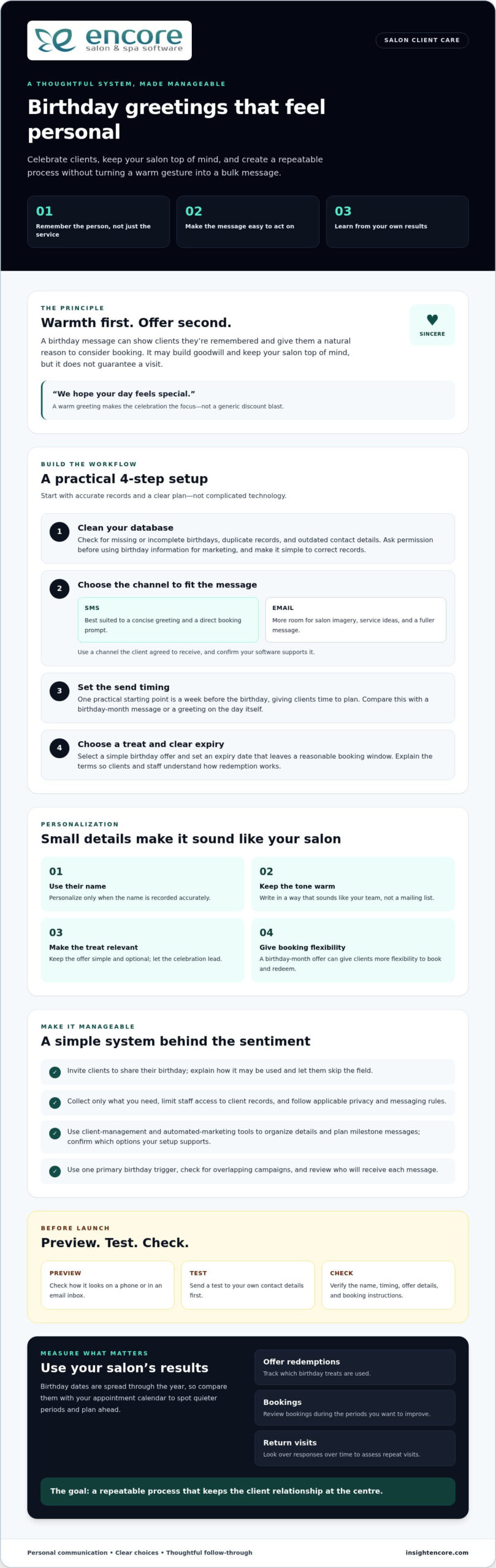
Categories
Uncategorized

Why People Leave Mindbody: Common Frustrations and Smarter Alternatives for 2026

More software features don’t always mean a smoother business; modern studios thrive on specialized operational focus, not bloated enterprise complexity. If you’ve been asking why people leave Mindbody in growing numbers, you aren’t imagining the shift. Managing a busy salon or spa is challenging enough without escalating subscription tiers, unexpected add-on fees, and a cluttered interface that turns routine staff onboarding into a chore. When critical checkout bugs stall your front desk and customer support leaves you waiting in a ticket queue, that frustration hits your bottom line directly.

You got into this industry to serve clients, not to troubleshoot software or lose control over your client records. In this guide, you’ll discover the real reasons beauty and wellness owners switch away from Mindbody and how to choose a platform that truly fits your daily workflow. We’ll examine the standard operational bottlenecks that prompt studios to cancel, evaluate modern salon management alternatives offering transparent tools and dedicated human support, and share a low-risk, step-by-step strategy for migrating your client history seamlessly.

Key Takeaways

  • Understand why people leave Mindbody for dedicated platforms, from unpredictable subscription increases to complex tools built for gyms rather than salons.
  • Discover how purpose-built salon software streamlines split-scheduling, processing intervals, and detailed color formulas without fitness-focused clutter.
  • Learn the essential criteria for evaluating a 2026 software provider, including transparent pricing structures and complete ownership of your client data.
  • Follow a proven migration checklist to export your formulas, retail inventory, and booking records safely without disrupting daily appointments.
  • Explore how an experienced provider like Encore delivers an all-in-one suite designed to give beauty and wellness owners true peace of mind.

The Top Reasons Beauty and Wellness Businesses Leave Mindbody

Running a sustainable salon requires lean operations and dependable tools. Yet, as corporate priorities shift at Mindbody, many independent salon, spa, and studio owners find themselves wrestling with rising expenses and bloated systems. Understanding why people leave Mindbody starts with examining how a platform built for large gym networks often clashes with the daily rhythm of appointment-based personal care.

Escalating Overhead and Add-On Subscription Fatigue

Software costs should scale predictably with your business. Instead, multi-tiered subscription models frequently push essential features, such as automated two-way messaging or customizable forms, into premium brackets. Independent salon operators routinely find themselves bumped into plans costing hundreds of dollars more each month just to retain basic operational tools. To make matters worse, fees extend to marketplace bookings where commissions can reach up to 20%. Owners end up paying steep monthly bills for fitness-centric tools they never touch, squeezing margins at a time when operational discipline matters most.

The Burden of Over-Engineered Navigation and Staff Training

Every extra click at the front desk slows down service. Because the software caters heavily to group fitness rosters and class check-ins, beauty professionals must navigate layers of irrelevant menus just to book an appointment or review a client’s history. Training a new stylist or receptionist becomes an uphill battle that drags on for weeks. When a simple point-of-sale checkout requires multiple tabs and workarounds, counter bottlenecks form, leaving arriving guests waiting and pulling staff away from high-value client care.

Impersonal Support and Prolonged Ticket Resolution Times

When your booking engine stalls or a payment terminal drops offline on a Saturday morning, you need immediate answers. Waiting days for an automated email reply directly damages your client relationships and your daily revenue. A major reason why people leave Mindbody is the shift from accessible, human-led assistance to delayed corporate ticketing queues. Studio owners want a dependable partner who answers the phone and understands salon urgency, not a generic helpdesk ticket that leaves critical checkout bugs unresolved.

Compounding subscription fees, fitness-first workflow bloat, and distant customer service make escalating overhead the primary churn catalyst driving beauty and wellness owners toward streamlined, specialized platforms.

Comparing Mindbody Workflows with Purpose-Built Salon Management Software

At its core, Mindbody was engineered around group fitness classes, gym turnstiles, and shared studio capacity. In contrast, hair salons, day spas, and barbershops operate on intimate, one-on-one guest appointments that require personalized attention. This architectural mismatch is another central reason why people leave Mindbody for software crafted specifically for the personal care industry.

Class Schedules vs. Individual Stylist Appointment Books

Fitness platforms view time as static group blocks, but a colorist’s day rarely moves in a straight line. Hair services rely on processing times and multi-step bookings. A stylist needs to apply a foil, let the color set for 45 minutes, and take a quick haircut client during that intermediate gap. Purpose-built salon software accounts for these split intervals directly on the booking grid, keeping your chairs full without double-booking equipment or overlapping shampoo bowls.

Commission Tracking and Multi-Tiered Stylist Payroll

Calculating salon earnings by hand creates an administrative headache at the end of every week. Stylists often operate under tiered commission scales where product retail margins differ sharply from chemical services or basic cuts. Rather than wrestling with manual spreadsheets, salon teams need automated commission structures that track product sales and tip allocations in real time. Exploring the Encore features page reveals how automated payroll calculations cut hours of administrative overhead every single pay cycle.

Client Retention, Marketing, and Relationship Building

Independent personal care businesses rely on long-term relationships rather than aggregate consumer traffic. You need direct ways to engage guests without paying commission cuts or sending them to a third-party marketplace that highlights your competitors. Dedicated salon tools handle this seamlessly by keeping your brand front and center:

  • Automated Appointment Confirmations: Two-way SMS alerts verify appointments automatically, helping reduce costly no-shows.
  • Integrated Client Profiles: Color formulations, patch test records, and past styling notes remain attached to the client file.
  • Built-In Loyalty and Gifting: Offering integrated balance tracking through the Encore gift cards module helps you build recurring revenue without third-party fees.

When software providers introduce hidden contract renewals or complicate account changes, salon owners feel trapped. With updated FTC rules on recurring subscriptions and cancellations holding vendors to higher standards of transparency, more wellness professionals are seeking business partners that earn their loyalty through straightforward service rather than restrictive lock-ins. If you want a platform built around your daily workflow, take a moment to explore how a salon-first system simplifies your day.

What to Look for in a Mindbody Alternative in 2026

Choosing a new operating system requires looking beyond polished sales demos. You need a setup that simplifies daily tasks rather than burying your staff under unnecessary administrative steps. Unrestricted control over your records is equally critical; policy analysts highlighting the value of reducing switching costs through data portability stress that true business agility relies on open, frictionless access to your operational history. Knowing why people leave Mindbody helps you establish a clear evaluation rubric so your salon lands on a sustainable, supportive foundation.

Transparent Billing Without Hidden Upgrade Traps

Avoid platforms that lock fundamental communication tools behind costly tier jumps. Before signing any contract, ask directly whether two-way SMS confirmations, digital consultation intake forms, or multi-staff calendars incur automatic price bumps. A reliable partner keeps terms simple and visible upfront. You can inspect the Encore pricing page to see how straightforward software tiers eliminate billing surprises and keep overhead predictable.

Integrated Payments and Low-Friction Checkout

A congested checkout desk ruins an otherwise relaxing client visit. Your payment hardware must communicate instantly with your front-desk appointment book to ring up services, split gratuities, and scan retail barcoding in seconds. Choosing a system with integrated credit card processing keeps card-on-file records compliant and reduces errors, ensuring your receipts match your merchant batch reports at the end of every shift.

Specialized Tools for Unique Business Structures

Modern personal care spaces rarely fit into a one-size-fits-all box. Your chosen software needs to match the actual layout of your team:

  • Chair and Booth Rental Independence: Hybrid salons mixing W-2 employees with 1099 independent stylists require separate merchant accounts so renters manage their own revenue smoothly.
  • Custom Treatment Records: Day spas and medical aesthetics practices need clear charting areas for allergy notes and customized consent forms.
  • Walk-In Queue Handling: Barbershops and nail lounges demand dynamic walk-in boards that coordinate with pre-booked appointments.

Selecting software built specifically around these service nuances removes unnecessary hurdles. That flexibility is a primary reason why people leave Mindbody in search of purpose-built systems that respect the way beauty and wellness professionals actually work.

Why People Leave Mindbody: Common Frustrations and Smarter Alternatives for 2026

How to Seamlessly Migrate Away from Mindbody Without Losing Data

The fear of losing years of client formulas, retail records, and booking history keeps many business owners tied to software they’ve outgrown. That lingering hesitation is often why people leave Mindbody only after months of mounting frustration. In reality, switching platforms is an orderly, manageable process when handled with a clear plan. Back up your primary database files into standard CSV format directly from your reports dashboard before initiating any contract cancellations.

Step 1: Auditing and Exporting Your Client Records

Start by extracting complete client contact lists from your administrative reports, ensuring phone numbers, email addresses, and opt-in preferences are preserved. Next, pull detailed chemical formulas, allergy alerts, past visit notes, and historical sales logs. Review the resulting spreadsheets to make sure column headers align cleanly. Clean data allows your replacement software to import profiles without creating duplicate accounts or misplacing essential notes.

Step 2: Transferring Retail Inventory and Outstanding Balances

Perform a hands-on physical inventory count before exporting your digital catalog. Reconciling product counts ensures that recorded quantities match what actually sits on your retail shelves and backbar dispensary. Organize your SKUs, barcodes, and supplier details for a clean import. At the same time, generate reports for unredeemed gift certificates, prepaid series packages, and active client credits so you can honor existing balances without disruption.

Step 3: Training Your Staff and Launching Your New Booking Portal

Give your front desk and service providers dedicated practice time before your official opening day. Running simulated appointments, appointment edits, and checkouts builds confidence and eliminates front-desk anxiety. Once your team feels comfortable, announce the transition to your clients through targeted email and text notifications. For practical operational setup tips and calendar configuration, check out our guide on Encore salon software.

Taking control of your migration timeline removes fear from the equation. That newfound confidence is ultimately why people leave Mindbody for flexible platforms that put studio owners back in charge of their business data.

Explore how simple salon data migration can be with Encore

Why Salon and Spa Owners Choose Encore as Their Long-Term Home

Software should feel like an empowering asset rather than an everyday obstacle. When evaluating why people leave Mindbody, the search usually leads business owners to a desire for stability, clear pricing, and tools tailored to their exact craft. Encore Salon & Spa Software provides that long-term home by combining modern management tools with deep industry experience.

Decades of Dedicated Beauty and Wellness Heritage

Technology trends come and go, but personal care operations require proven stability. Encore is backed by Syntec Business Systems, an established technology partner serving salon and spa professionals since 1991. Over three decades of feedback from studio owners, barbers, nail artists, and aesthetic practitioners have directly shaped our system. We focus entirely on appointment-driven businesses. You don’t have to worry about our attention shifting toward corporate gym franchises or fitness class check-ins. Independent wellness success sits right at the heart of our mission.

A Fully Integrated Suite That Simplifies Daily Operations

Juggling multiple disconnected applications for booking, checkout, inventory, and marketing drains valuable energy. Encore brings these essential operations into a single interface. Your front desk can schedule multi-step appointments, reconcile retail and backbar inventory, process transactions, and maintain rich client records without switching screens. Onboarding new team members takes hours instead of weeks. Explore our tailored tools on the Encore salon software page to see how a streamlined system restores calm to your reception area.

Get Started with a Personalized Transition Plan

Switching your management platform doesn’t need to be stressful. That anxiety is often why people leave Mindbody only after months of mounting friction, but you don’t have to tackle the process alone. Our dedicated team understands salon floor dynamics and helps you organize your transition from day one. We assist in structuring your service menu, setting up your staff books, and ensuring your client records transfer accurately. When you’re ready to leave platform bloat behind, connect with our team through the Encore contact page to schedule a personalized walkthrough.

Reclaim Your Time with Software Built for Beauty

Managing your appointments and guest care shouldn’t feel like wrestling with your software. The reality behind why people leave Mindbody comes down to reclaiming control: ditching hidden add-on costs, leaving behind clunky gym-first interfaces, and protecting your hard-earned client records. Your daily work deserves an all-in-one platform that simplifies booking, inventory, and point of sale without forcing you to manage multiple disconnected apps.

Backed by Syntec Business Systems and over 30 years of software expertise since 1991, Encore pairs specialized salon tools with dedicated human support. You don’t have to navigate changes alone when you have an experienced partner committed to your daily peace of mind.

Switch to stress-free salon management with Encore

Your salon was built on personal connection. Give your team the breathing room and dependable tools to focus on what truly matters: caring for your guests.

Frequently Asked Questions

Why are salon and spa owners actively leaving Mindbody in 2026?

The primary reason why people leave Mindbody centers on rising operational costs and platform design. Many salon and spa owners find the software increasingly weighted toward fitness chains, leaving personal care teams with cluttered menus and irrelevant features. When you combine unexpected tier bumps with slow response times from automated helpdesks, studio owners naturally seek specialized platforms built specifically around appointment-based salon workflows.

Will I lose my historical client formulas and notes when leaving Mindbody?

No, you do not have to lose your valuable client records or technical formulas. Mindbody allows administrators to export client profiles, contact information, and appointment histories into standard CSV files directly from the reports menu. Once extracted, clean spreadsheet files can be mapped and uploaded into your replacement system, preserving past formula notes and service records so your stylists never miss a beat.

How does Encore handle booth renters versus commission salon employees?

Encore provides dedicated workflows designed specifically for both business models. For commission teams, the software automatically tracks retail and service tiers alongside tips for payroll. For hybrid or rental setups, Encore Chair/Booth Renter Software offers separate financial partitioning. Independent stylists can process their own transactions and view their personal calendars securely without exposing confidential salon data or complicating owner tax reporting.

Is migrating salon client records and retail inventory difficult?

Switching systems is straightforward when you follow a structured step-by-step checklist. The migration involves downloading your client spreadsheets, reconciling physical retail stock, and mapping those records into the new platform. With dedicated onboarding guidance from an experienced software partner, you can complete the data transfer smoothly without disrupting your daily appointment calendar or confusing your guests.

Can I keep my existing merchant processing when switching to Encore?

Encore integrates directly with specialized salon merchant processing to deliver seamless counter checkouts and protect cardholder security. Using integrated credit card processing connects your front-desk appointment book with modern payment terminals, eliminating manual key-in errors and saving time during peak departure hours. Our team walks you through setting up merchant accounts tailored to single-owner salons or individual chair renters.

Does Encore charge extra for essential features like automated client reminders?

Encore believes essential daily tools should not come with surprise price hikes. Online booking, client records, inventory control, and automated marketing communications are built into the platform suite to prevent multi-app subscription fatigue. This transparent structure is another key reason why people leave Mindbody, as business owners prefer knowing their software overhead won’t expand unexpectedly as their client list grows.

How long does it take for salon staff to become comfortable using Encore?

Most salon teams feel confident using Encore within just a few days of guided practice. Because the interface is designed specifically for appointment scheduling and retail checkout rather than complex corporate rosters, the learning curve is minimal. Stylists, front-desk coordinators, and managers can quickly run test bookings and ring up sample sales during initial setup, ensuring switchover day feels smooth and stress-free.

Disclaimer

This article is general in nature and may contain errors, please verify all claims with your sales rep
Categories
Uncategorized

How to Stop Salon Staff Theft: A Comprehensive 2026 Prevention Guide

Did you know that internal employee theft accounts for nearly 29% of all retail shrinkage, with the average incident costing a business over $1,800? It’s a heavy weight to carry when you suspect that "missing" retail bottles or end-of-day cash discrepancies aren’t just simple accidents. You’ve worked hard to build your salon. It’s heartbreaking to feel like your trust is being tested by the very people you’ve hired. We understand that you want to maintain high staff morale without feeling like a micromanager. Learning how to stop salon staff theft is really about replacing manual, "trust-based" systems with automated transparency that protects both your profits and your team’s integrity.

You deserve a secure business where every dollar and product is accounted for. This comprehensive 2026 guide will show you how to identify hidden leaks and implement professional systems that protect your revenue, inventory, and client list. We’ll walk through everything from role-based software permissions to the latest PCI DSS 4.0 compliance standards and tip-theft regulations. By the end, you’ll have a clear roadmap to turn Encore software into a silent partner that keeps your books clean and your mind at ease.

Key Takeaways

  • Learn to spot the difference between honest back-bar waste and intentional retail shrinkage to protect your hard-earned margins.
  • Discover how to stop salon staff theft by using tiered POS permissions that keep your cash drawer and client database secure.
  • Implement weekly spot checks on high-value inventory items to catch missing products within days rather than months.
  • Strengthen team morale with automated commission tracking that ensures your stylists are paid accurately and transparently every time.
  • Use real-time audit logs and automated reporting to act as a silent partner, flagging discrepancies so you don’t have to micromanage.

Identifying the 4 Main Types of Salon Staff Theft

Theft in a salon environment is rarely a one-time heist. It’s usually a slow leak that drains your bank account over months. To understand how to stop salon staff theft, you first need to recognize that it comes in many forms, some of which might even look like "business as usual" at first glance. Identifying these leaks is the first step toward reclaiming your peace of mind and protecting your bottom line.

Most internal loss falls into one of four categories:

  • Product and Inventory Theft: This covers retail bottles on your shelves and professional supplies in the back.
  • Cash and Service Theft: This includes unrecorded walk-ins, "sweetheart" discounts for friends, or using the "no-sale" key to open the drawer without a transaction.
  • Time Theft: Paying for hours not worked, such as when staff clock in early, stay late without cause, or spend shift hours on personal calls.
  • Client and Data Poaching: The most dangerous form, where staff export your database to start a competing business or direct clients to their home studios.

The Hidden Cost of "Back-Bar" Shrinkage

Unrecorded color usage is often the number one silent profit killer in salons. It’s easy for a stylist to justify "just a little extra" for a client without adding it to the ticket, but those ounces add up to thousands of dollars in lost revenue annually. Back-bar shrinkage is the unallocated cost of professional supplies used during services. There is a clear, expensive difference between professional use and a staff member "taking a bottle home" for personal use. Without real-time tracking, your back-bar becomes an open buffet that eats your margins.

Client Data: Your Most Valuable (and Vulnerable) Asset

Your client list is the heartbeat of your business. When stylists use personal phones to bypass your booking system, they’re creating a private bridge that bypasses your brand. Learning how to stop salon staff theft requires securing this digital perimeter. If a stylist leaves and takes your database with them, the financial hit can be devastating to your long-term growth. The legal and financial implications of a stolen client database are severe; you’re not just losing future bookings, you’re losing the marketing investment you spent to acquire those leads. Protecting this requires following client data security best practices, such as restricting export permissions and using individual staff logins.

Strengthening Your Point of Sale (POS) Security

When thinking about how to stop salon staff theft, your POS system is your first line of defense. Your front desk is the heart of your business, but it’s also where most revenue leaks happen. If everyone uses the same "General" login, you’ve lost accountability before the day even starts. Assigning unique PINs or login codes to every team member creates a digital paper trail for every action. When you know exactly who opened the drawer at 2:15 PM, the temptation to "borrow" from the till vanishes. This isn’t just about suspicion; it’s about meeting modern security standards. As of March 2025, PCI DSS 4.0 requires strict access logs and multi-factor authentication for payment environments.

Eliminating the abuse of the "No Sale" button is another vital step. In many legacy systems, this button is an open invitation to open the drawer without recording a transaction. By requiring a mandatory reason code for every "No Sale" event, you force transparency. If a drawer opens, there should be a recorded reason why. This simple change is a foundational part of how to stop salon staff theft without creating a hostile work environment.

The Power of Tiered Employee Permissions

Trust is important, but professional boundaries are better. Your junior stylists or front desk staff rarely need the ability to delete a transaction or issue a full refund without oversight. By setting tiered permission levels, you ensure that high-risk actions require a manager’s approval. You can also restrict access to sensitive financial reports and client export tools, ensuring your data stays where it belongs. These Encore features allow you to build a system of checks and balances that supports your team while protecting your assets.

Integrated Payments vs. Manual Entry

Manual payment entry is a major security loophole. When a stylist has to manually type a service total into a standalone terminal, it’s easy for a "fat finger" error to occur. Or worse, a $100 service is intentionally typed in as $80, with the difference disappearing into a pocket. Integrated credit card processing removes this risk entirely. The POS total communicates directly with the terminal, ensuring the bank deposit matches your sales report down to the penny every single day.

Automating your daily reconciliation gives you peace of mind that can’t be found in a manual ledger. It turns your checkout process into a secure, closed loop. If you want to see how these automated systems can simplify your life, you might want to explore our management tools today.

Mastering Inventory Control to Prevent Shrinkage

Inventory management is often the most overlooked strategy when owners consider how to stop salon staff theft. It’s easy to focus solely on the cash drawer, but with internal theft accounting for nearly 29% of all retail shrinkage, your shelves are a primary target. The average internal theft incident costs a business $1,890, which is over four times the cost of an external shoplifting event. You need a system that flags missing items before the loss becomes a crisis.

Implementing a "check-out" system for back-bar supplies and setting up automated "low stock" alerts are simple ways to build accountability. These alerts act as an early warning system. If you suddenly have an unexplained drop in a high-velocity item like a popular lightener, you’ll know within hours. When a stylist knows that the system expects a specific number of color tubes to be used based on the day’s bookings, the temptation to divert products for personal side-work disappears. It turns your software into a silent partner that watches your margins while you focus on your clients.

Retail vs. Professional Inventory Tracking

Tracking retail bottles is straightforward because they’re sold as individual units. You can see the empty spot on the shelf. However, tracking color bowls and chemical treatments is where the real money is saved. These professional supplies are often treated as "free" by staff, but they represent a massive overhead cost. By using Encore Salon Software, you can link specific product consumption to every appointment on your calendar. This creates a clear map of where your supplies are going. If you manage a larger facility, you can find similar tools in our spa inventory management system guide to keep every department in check.

The "Spot Check" Method for Accountability

You don’t need to shut down the salon for a full audit to keep things secure. The "spot check" method involves picking just five high-value items and counting them against your digital records. It’s quick, non-confrontational, and highly effective. When you discuss "missing" items immediately, it prevents small discrepancies from becoming long-term habits. Consistency in counting is more effective than the frequency of the count. This approach builds a culture of transparency where everyone knows the inventory is valued and monitored. It’s a proactive way to manage how to stop salon staff theft without creating an atmosphere of suspicion.

How to Stop Salon Staff Theft: A Comprehensive 2026 Prevention Guide

Building a Culture of Transparency and Fairness

Culture is your strongest defense against internal loss. When your team feels respected and fairly compensated, the psychological barrier to theft becomes much higher. Many owners wonder how to stop salon staff theft, but the answer often starts with looking at your own payroll processes. In 2026, compliance with laws like California SB 648 is essential. This bill, which took effect on January 1, 2026, bars owners from skimming tips or deducting credit card fees from employee gratuities. When you show your team that you respect their earnings, they’re far more likely to respect your inventory and your brand.

Update your employment contracts to include clear non-solicitation and theft clauses. These documents define exactly what happens if a breach occurs, which removes ambiguity for everyone. Hold regular team meetings to review salon performance metrics without finger-pointing. Celebrate high utilization rates and reward honesty when discrepancies are reported voluntarily. When you treat these metrics as a collective win, staff are more likely to protect the resources that help the entire business succeed.

Transparency in Commission and Pay

Removing the mystery from paychecks is a powerful deterrent. If a stylist feels they’re being "short-changed" on a complex commission structure, they might rationalize taking a retail bottle to "even things out." By calculating salon staff commission automatically, you remove the human error that leads to these disputes. Providing staff with their own performance dashboards allows them to track their earnings in real-time. This visibility builds a psychological link between their hard work and their bank account, making them feel like a valued partner in the success of the salon.

Setting Clear Expectations from Day One

Include a "Salon Code of Conduct" in your onboarding packet to set the tone from day one. Explain the "why" behind your tracking systems clearly. It’s not about watching their every move; it’s about protecting their paycheck and the salon’s future growth. When the first discrepancy occurs, take a supportive but firm approach. Ask questions to understand if it was a training issue before assuming it was malicious. Setting these standards is a proactive way to manage how to stop salon staff theft while keeping your team’s morale high.

Start your free Encore trial today

Leveraging Encore Salon Software as Your Security Partner

While building a great culture and setting clear expectations are vital, your management software is the engine that keeps your security systems running. It’s the difference between guessing what happened and having a factual record you can rely on. Software shouldn’t feel like a digital prison for your team. Instead, it acts as a safety net that protects the salon’s assets and ensures everyone is treated fairly. By centralizing your operations, you move from reactive "firefighting" to proactive management.

Modern systems do more than just book appointments. They act as a silent partner that watches your margins 24/7. From tracking every "no-sale" drawer opening to flagging unusual retail discounts, the right tools help you understand how to stop salon staff theft without spending your entire day hovering over the front desk. This automation allows you to focus on growing your brand while the software handles the heavy lifting of oversight.

The Audit Trail: Your Digital Paper Trail

The team behind Encore has been a supportive partner to salon owners since 1991, and our real-time audit trails are a testament to that experience. Every time a staff member logs in, opens a drawer, or completes a sale, a digital footprint is created. You can use the "Transaction History" feature to reconstruct a suspicious day minute by minute. This transparency is incredibly powerful. The mere presence of a robust, visible tracking system deters approximately 90% of opportunistic theft. When staff know that every voided transaction is logged and reviewed, the temptation to "bend the rules" effectively disappears.

Remote Management for Peace of Mind

In 2026, you shouldn’t have to be physically present in the salon to know your business is secure. Mobile access allows you to monitor daily sales, check inventory levels, and review staff activity from your phone, whether you’re at home or on vacation. This high-level visibility helps you spot red flags before they become expensive problems. For example, you can use salon business analytics to identify long-term patterns of loss that might go unnoticed during a busy shift. These reports can flag if a specific stylist has a high rate of "product waste" or if the cash drawer is consistently short on certain days.

Ready to secure your salon and get back to doing what you love? Explore Encore Features to see how our secure client management and automated reporting can protect your business today.

Reclaim Your Peace of Mind and Profits

Protecting your business doesn’t mean sacrificing the positive culture you’ve built. It’s about empowering your team with systems that reward honesty and clear away the fog of manual tracking. By implementing tiered POS permissions and automated inventory counts, you turn your operations into a secure, transparent environment where every product and dollar is accounted for. You’ve discovered how to stop salon staff theft by focusing on visibility rather than suspicion.

Syntec Business Systems has been a dedicated mentor to beauty professionals since 1991. We provide the tools you need to succeed, including comprehensive audit trails and specialized inventory tracking. Our easy-to-use POS systems allow you to customize employee permissions, ensuring your most sensitive data stays protected while your stylists focus on their craft.

Secure your salon’s future with Encore Salon Software
You don’t have to carry the stress of "missing" revenue anymore. With a reliable partner by your side, you can lead with confidence and watch your profit margins thrive.

Frequently Asked Questions

What should I do if I catch a salon employee stealing?

Confront the employee privately with documented evidence immediately. It’s vital to follow your state or provincial labor laws to avoid wrongful termination claims. Keep the conversation professional and focused on the facts you’ve gathered from your audit logs. Depending on the severity, you may need to involve local authorities. Having a clear "Salon Code of Conduct" in place from day one makes these difficult conversations much easier to manage.

Is it legal to install security cameras in my salon?

You can legally install security cameras in public areas of your salon, like the reception desk or retail floor. However, you must never place cameras in private areas such as bathrooms or changing rooms. It’s often required to post a sign informing staff and clients that the premises are under surveillance. Always consult with a local legal professional to ensure you’re complying with specific privacy regulations in your region.

How do I know if a stylist is "stealing" clients for home appointments?

Sudden drops in a stylist’s rebooking rate or a high number of "no-show" clients who were previously regulars are major red flags. You might also notice stylists sharing their personal phone numbers or social media handles during services. A robust client management system helps you track these patterns by flagging unusual appointment gaps. Keeping your database secure with restricted export permissions is the best way to prevent this type of loss.

Can salon software really prevent cash drawer discrepancies?

Integrated systems significantly reduce errors by ensuring that the amount charged on the terminal matches the POS ticket exactly. When you use individual staff PINs, every transaction is tied to a specific person, which eliminates the "it wasn’t me" excuse. This transparency is a key part of how to stop salon staff theft because it removes the opportunity for skimming. Automated reconciliation at the end of each shift catches small errors before they grow.

What are the most common red flags of salon staff theft?

Common red flags include a high frequency of "voided" transactions, excessive "no-sale" drawer openings, and retail inventory that doesn’t match your sales reports. You might also notice a stylist whose retail sales are significantly lower than their peers despite having a full schedule. Defensive behavior when you mention inventory counts is another warning sign. Monitoring these patterns allows you to address potential issues before they impact your overall profit margins.

How do I track professional back-bar product usage accurately?

The most accurate way to track back-bar usage is to link specific product amounts to the services performed in your inventory management system. For example, if a color service typically uses two ounces of developer, the system should automatically deduct that amount from your stock. Performing weekly cycle counts on your top 20% highest-value items helps you catch discrepancies quickly. This level of detail turns your professional supplies from a "free" resource into a tracked asset.

Should I fire an employee for a first-time minor theft?

Deciding whether to fire an employee for a minor first-time offense often depends on the specific language in your employment contract. Many owners choose a zero-tolerance policy because even small thefts can signal a lack of respect for the business. If you decide on a warning, ensure the incident is documented and the expectations are clearly restated. Understanding how to stop salon staff theft involves setting firm boundaries that protect your salon’s long-term financial health.

How can I prevent "time theft" in a busy salon environment?

You can prevent time theft by using a digital clock-in system that requires unique staff credentials. This eliminates "buddy punching" where one employee clocks in for another who is running late. Encore Salon Software allows you to compare scheduled hours against actual hours worked, making it easy to spot discrepancies. Clear policies regarding personal phone use and breaks also help maintain a professional environment where everyone is focused on client care during their shift.

Disclaimer

This article is general in nature and may contain errors, please verify all claims with your sales rep
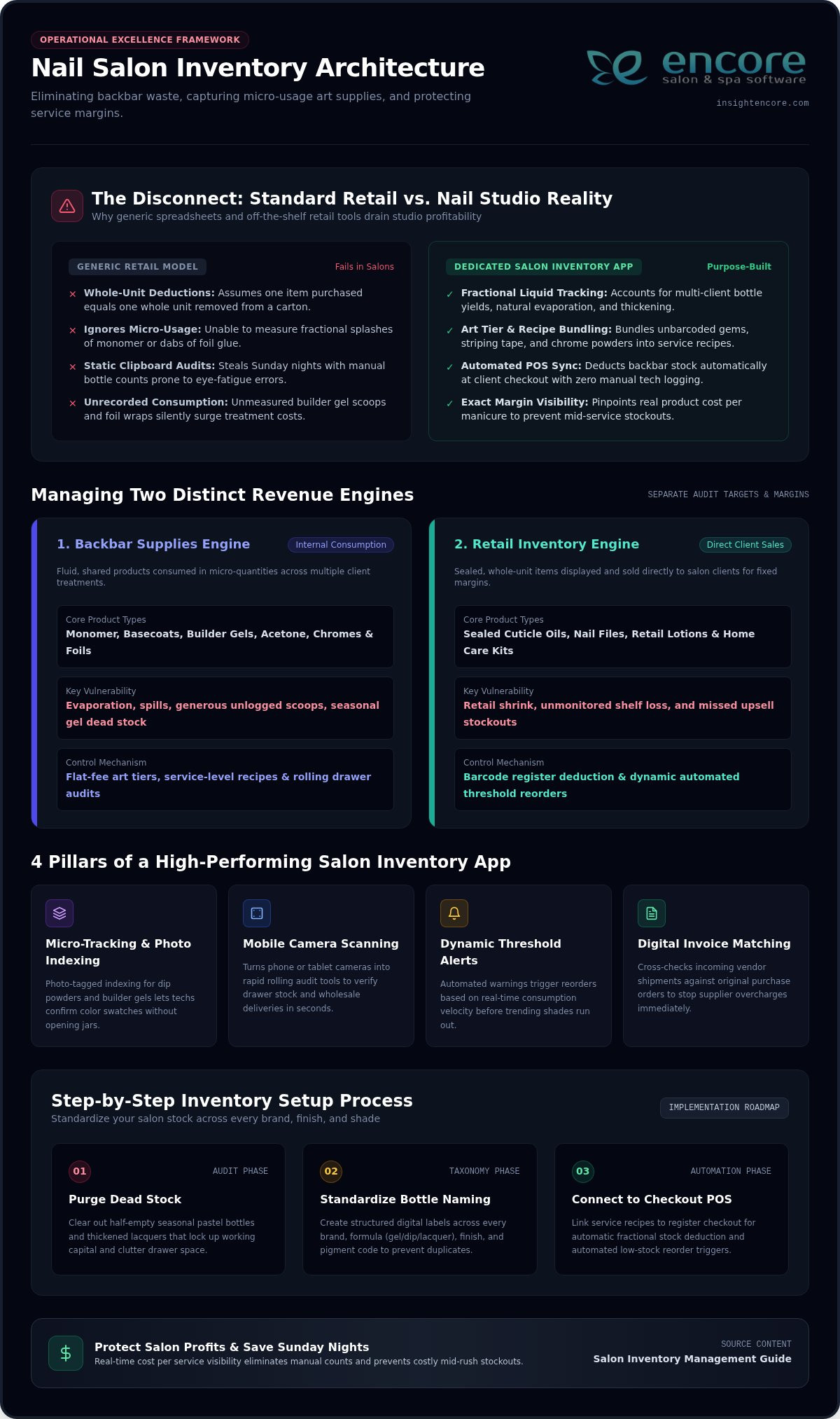
Categories
Uncategorized

Freeing Up Time From Salon Admin Work: The 2026 Automation Guide

Did you know the average salon owner spends between 10 and 16 hours every week on tasks that don’t earn a single cent? That’s nearly two full workdays lost to messy spreadsheets, endless phone tag, and manual math. If you feel like you’re drowning in paperwork, you aren’t alone. Most owners are currently paying a “time tax” that keeps them away from the chair and their families. This guide focuses on freeing up time from salon admin work by using modern automation to handle the heavy lifting for you.

We understand that you didn’t open your doors to become a full-time administrator. You’re an artist and a leader. Yet, your Sunday nights are likely spent calculating multi-tier commissions or worrying about inventory shortages. It’s exhausting to see your creative passion buried under a mountain of manual entries. We’re here to help you move past that stress. You can reclaim 10 or more hours every week while providing a better experience for your clients and a more organized environment for your staff.

This 2026 guide reveals how to eliminate manual double-bookings and slash no-shows by up to 38 percent. We’ll show you how to automate your payroll to capture the expanded FICA tip credits and keep your inventory synced in real time. It’s time to trade your admin burden for a streamlined workflow that finally gives you your life back.

Key Takeaways

  • Identify the hidden “Admin Tax” that drains your energy and pinpoint the three biggest time-wasters in your daily routine.
  • Stop chasing clients and eliminate phone tag by implementing a 24/7 self-service booking portal with automated reminders.
  • Master the art of freeing up time from salon admin work by automating your POS and staff commission calculations for instant, accurate reporting.
  • Ensure your shelves stay stocked and your chairs stay full using automated inventory alerts and “set it and forget it” marketing campaigns.
  • Discover how specialized software modules can streamline your specific business model, from nail salons and barber shops to tattoo studios.

The Salon Admin Tax: Identifying Your Biggest Time Wasters

You didn’t start your salon to be a bookkeeper. You’re a creator. Yet, right now, you’re likely paying a “salon admin tax.” This tax consists of every unbilled hour spent wrestling with spreadsheets or chasing appointments. It’s the time you can’t bill for, but it drains your energy just the same. Identifying these leaks is the first step toward freeing up time from salon admin work. When you know where the minutes are vanishing, you can finally take them back.

Most owners face three primary time sinks. We call these the “Big Three.” First, there’s the relentless phone tag with clients. Second, the Sunday night payroll and commission math. Third, the manual inventory counts that never seem to match what’s actually on your shelves. When you rely on manual systems, errors are inevitable. A single double-booking doesn’t just ruin one hour; it creates a ripple effect of stress for your staff and disappointment for your clients. Salon admin work is the operational friction that limits creative growth.

The Hidden Cost of Manual Scheduling

Every phone call takes an average of three to five minutes. Multiply that by twenty bookings a day, and you’ve lost over an hour just talking about dates and times. Modern appointment scheduling software removes this burden entirely. It allows your clients to book while you sleep. Beyond the time saved, consider the emotional toll. Manually managing cancellations and no-shows is exhausting. Automating this process is a vital part of learning how to increase salon profit margin by focusing on billable services instead of logistics.

The Payroll and Commission Headache

Manual commission calculations are notoriously difficult. Industry data shows that manual systems are often prone to 5-10% error rates. These mistakes aren’t just expensive; they erode the trust you’ve built with your team. Your stylists work hard. When their pay is delayed or incorrect due to paperwork hurdles, morale drops. Freeing up time from salon admin work means moving toward real-time financial tracking. Instead of facing a mountain of receipts at the end of the month, you get instant clarity. You deserve a system that supports your team’s growth without the headache of manual math.

Phase 1: Eliminating Phone Tag with Self-Service Booking

If you’re still relying on a paper book and a landline, you’re essentially tethered to your front desk. Breaking free requires a shift toward self-service. The first phase of freeing up time from salon admin work involves moving your schedule to a cloud-based system that works while you’re busy with a client or sleeping. Research shows that roughly 46 to 50 percent of salon appointments are booked outside regular business hours. If you don’t have a system to catch those requests, you’re leaving money on the table and creating a backlog of voicemails to return the next morning.

The Bureau of Labor Statistics occupational outlook notes that salon owners often juggle heavy administrative duties alongside their craft. By setting up salon client booking portals, you offload the most repetitive part of your day. It isn’t just about convenience; it’s about reclaiming your mental energy.

Setting Up Your 24/7 Virtual Front Desk

To make this transition smooth, don’t just open your calendar. Set intelligent booking rules. For example, you can prevent awkward 15-minute gaps by forcing appointments to sit back-to-back. This ensures your day remains compact and profitable. When configuring your portal, make sure to collect essential data upfront to save time later. A quick checklist for your booking form should include:

  • Updated contact information and preferred communication methods.
  • Chemical history or allergy alerts for new clients.
  • Specific service requirements to ensure the correct time block is reserved.

Digital consultation forms take this a step further. Send these out automatically the moment a booking is confirmed. When the client arrives, you already have their history and goals ready. It’s a professional touch that saves five minutes of “getting to know you” time per appointment.

Automating the “Are You Coming?” Conversation

Automated SMS reminders are a game-changer for any busy owner. They reduce no-show rates by 35 to 38 percent. It isn’t just a nudge; it’s about the psychology of commitment. When a client receives a professional text, they’re more likely to respect your time. Two-way messaging allows them to confirm or reschedule without you ever picking up the phone. You can even see how these automated workflows feel in practice to understand the relief they provide.

Finally, empower your team by giving them mobile access to their own schedules. This eliminates the “when is my first client?” texts that clutter your personal time. When your staff can manage their own day, you’re one step closer to truly freeing up time from salon admin work and focusing on your growth as a mentor and artist.

Phase 2: Automating the Numbers (Payroll, POS, and Commissions)

Numbers don’t lie, but they sure can be exhausting to track by hand. If you’re still using a calculator and a notepad to figure out what you owe your team, you’re losing hours of your life every single pay period. In fact, research shows that salons running manual payroll spend over 11 hours every two weeks just on math. Transitioning to a system where your Point of Sale (POS) talks directly to your calendar is the most effective way of freeing up time from salon admin work. It turns a day-long chore into a few simple clicks.

According to the U.S. Chamber of Commerce guide to business automation, streamlining these repetitive financial workflows prevents burnout and saves hundreds of hours annually. When your sales data flows instantly into your reporting, you get a real-time view of your business health. You don’t have to wait until the end of the month to see your profit and loss; you can see it in seconds.

One-Click Commission and Payroll

The secret to a happy team is accuracy and transparency. You can set up specific rules in your software to calculate salon staff commission automatically based on their experience level. Whether you have senior stylists on a higher tier or junior assistants earning a flat rate, the system handles the logic for you. This is where the Encore advantage really shines, especially for hybrid salons. It manages specialized booth renter financials with ease, keeping your accounts separate and compliant. Giving your staff mobile access to view their own performance metrics builds trust and keeps everyone motivated without you having to print out reports every Friday.

Streamlined Checkout for Clients and Staff

The checkout process should be a celebration of the service, not a math test. By moving to integrated credit card processing, you eliminate the reconciliation errors that happen when you manually type totals into a separate terminal. It’s faster, safer, and much more professional. Storing cards on file allows for a “silent” checkout, which is perfect for busy clients who need to get back to their day. You can also boost your immediate cash flow by offering integrated gift cards that track themselves. Tips and product add-ons are added with a tap, ensuring your stylists get paid exactly what they earned without any manual entry. This level of automation is the ultimate tool for freeing up time from salon admin work while keeping your focus on the guest experience.

Freeing Up Time From Salon Admin Work: The 2026 Automation Guide

Phase 3: Streamlining Inventory and Client Retention Marketing

The final hurdle in freeing up time from salon admin work often involves the tasks you can’t see but definitely feel: inventory and marketing. Counting bottles of shampoo at 9:00 PM or manually emailing clients who haven’t visited in six weeks is a drain on your creative energy. By automating these “back-of-house” processes, you ensure your business remains profitable and your chairs stay full without you ever lifting a pen. It’s about creating a system that cares for your clients and your supplies as much as you do.

Automated Stock Control

Manual inventory counts are notoriously inaccurate and time-consuming. Instead of guessing what you need to order, implement barcode scanning for instant updates. When a stylist checks out a client or logs a formula, your stock levels should update in real time. Using a spa inventory management system allows you to distinguish between back-bar professional usage and retail sales instantly. You can set low-stock alerts that notify you the moment a popular color tube or serum hits a critical level.

This data-driven approach is essential for reducing salon operating costs, as it prevents money from sitting on shelves in the form of overstock. For specialized businesses like tattoo studios, tracking specific supplies like needles and ink is just as critical to maintaining safety and professional standards. When your software handles the ordering logic, you spend less time on clipboards and more time on your craft.

Hands-Free Marketing and Loyalty

Client retention accounts for roughly 87 percent of total salon revenue, yet manual marketing is often the first thing to slide when things get busy. “Set it and forget it” campaigns solve this by triggering “we miss you” emails automatically based on a client’s last visit date. If someone hasn’t re-booked within their usual six-week window, the system sends a friendly nudge for you. This persistent connection is a core part of freeing up time from salon admin work while maintaining a high-end, personal feel.

Automated birthday greetings and holiday promotions build lasting bonds without requiring a single minute of your day. You can also ditch the manual punch cards that clients always lose. An automated loyalty program tracks points internally and applies them at checkout with a simple tap. It rewards your frequent guests and encourages higher spending, all while the software handles the record-keeping in the background.

Automate your marketing and inventory today

Reclaiming Your Freedom: Implementing the Encore Management Suite

Choosing the right system shouldn’t add to your workload. It should be the end of it. Encore Salon & Spa Software acts as a supportive mentor that handles the boring, repetitive tasks so you can focus on being creative. We understand that migrating your data or switching from a complex competitor can feel intimidating. That’s why we use a human-centric approach to get you up and running without the technical headaches. Our team is here to ensure your transition is smooth, reliable, and accessible. Our goal is to guide you from a state of constant operational stress to a feeling of total, organized control. Freeing up time from salon admin work is finally within reach when you have a partner that prioritizes your peace of mind alongside your business growth.

A Solution for Every Business Model

Not every beauty business is the same. A high-end spa has different needs than a bustling barbershop. If you’re an independent pro, you might need a dedicated booth renter client management app that keeps your finances separate from the salon owner’s. Encore provides specialized modules for tattoo artists, nail techs, and barbers, ensuring the tools fit your specific workflow rather than forcing you into a one-size-fits-all box. The Encore features are designed to be an all-in-one suite. This means you don’t have to juggle five different apps to run one business. Whether you’re managing a team of twenty or working solo, the system scales with you, providing the exact level of support you need to thrive.

The Next Step Toward More Free Time

It’s time to stop paying the “admin tax.” You’ve worked hard to build your brand, and you shouldn’t have to sacrifice your personal life or your Sunday nights to keep the lights on. Freeing up time from salon admin work is about more than just convenience; it’s about reclaiming your freedom to lead and inspire. With the reliability of Syntec Business Systems, a company that’s been supporting the industry since 1991, you’re partnering with experts who’ve seen every industry shift. We’re deeply invested in your individual success. We reject delayed interactions and cold, automated support. Instead, we offer a hands-on alliance that empowers you to grow. Take the first step toward a more balanced life today and see how much your business can achieve when you’re finally back behind the chair.

Try Encore Now to Reclaim Your Time

Take Control of Your Salon’s Future

You’ve seen how much your business changes when you stop fighting with spreadsheets and start using smart systems. By automating your booking, payroll, and inventory, you aren’t just making things easier. You’re actively freeing up time from salon admin work so you can focus on the artistry that made you open your doors in the first place. Whether it’s cutting out the stress of manual commission math or ensuring your shelves are always stocked, the right tools make every day feel lighter.

Since 1991, we’ve helped salon professionals transition from chaos to organized control. Our all-in-one platform comes with no hidden fees and dedicated human support to guide you through every step of your migration. You don’t have to navigate these changes alone. We’re here to be the partner that helps your business grow while giving you back your personal life and your Sunday nights.

Start freeing up your time today, try Encore for yourself!

Your journey to a more balanced and profitable salon starts with a single step. We’re excited to help you see what’s possible when the paperwork is finally off your plate and you’re back to doing what you love.

Frequently Asked Questions

How much time can salon software really save me each week?

Most salon owners save between 10 and 16 hours every week by automating their manual workflows. This reclaimed time comes from eliminating the need for manual scheduling, phone tag, and complex payroll calculations. By freeing up time from salon admin work, you can focus on creative services or spend more time with family. It’s a significant shift that turns two full workdays of paperwork into a few simple clicks each morning.

Is it difficult to move my client data from paper or spreadsheets to Encore?

Transitioning your business is much easier than you might think. We provide a human-centric migration process designed to lower the barrier for those moving from manual systems or complex competitors. Our team handles the heavy lifting of importing your client records, formula histories, and service lists. You won’t have to worry about losing important data during the switch. We act as your supportive partner to ensure you’re ready to go without the setup anxiety.

Can I manage multiple staff commission structures automatically?

Yes, you can easily set up automated rules for various staff tiers. Whether you have senior stylists on a high percentage or junior assistants on a flat rate, the software handles the math instantly at checkout. This transparency builds trust with your team because they can view their own performance metrics in real time. It eliminates the 5 to 10 percent error rate often found in manual systems and ensures everyone gets paid accurately and on time.

What happens if I’m not tech-savvy? Is there support available?

We specialize in making technology accessible for everyone. Our platform is designed with simplicity in mind, using clear language instead of dense technical jargon. If you ever feel stuck, you have access to toll-free human phone support from our team of experts. We avoid the cold, impersonal feel of traditional software companies. You’ll always have a responsive ally ready to help you navigate the system and grow your business with confidence.

Does Encore Salon Software work for independent chair renters?

Absolutely. We offer specialized Chair/Booth Renter Software specifically for independent pros. This version includes partitioned logins and separate financial tracking to keep your business records distinct from the salon owner’s. It’s the perfect solution for independent stylists who need professional tools for scheduling and CRM without the complexity of a full enterprise suite. You’ll have total control over your own client list, pricing, and service history in one convenient app.

How do automated reminders help reduce my salon admin work?

Automated reminders act as your virtual front desk, handling the “Are you coming?” conversation while you work. By sending two-way SMS confirmations, you can reduce your no-show rate by up to 38 percent. This is a vital part of freeing up time from salon admin work because it eliminates the need for morning confirmation calls. Clients can confirm or reschedule via text, ensuring your chair stays full and your schedule remains organized without manual effort.

Can I track my inventory and retail sales in the same platform?

Yes, our all-in-one platform includes an integrated Inventory Management System. You can track professional back-bar usage and retail sales in real time using barcode scanning. When a stylist uses a product or sells a bottle of shampoo, the stock levels update automatically. The system even sends low-stock alerts to prevent shortages. This keeps your operating costs low and ensures you never have to spend another Sunday night manually counting bottles in the stockroom.

Is integrated credit card processing more expensive than my current bank terminal?

Integrated processing is often more cost-effective because it eliminates expensive reconciliation errors and manual entry mistakes. While rates vary based on transaction types, having your payments connected directly to your POS saves hours of bookkeeping. It allows for card-on-file bookings and silent checkouts, which improve the client experience. You’ll gain instant financial reporting and a clear view of your profit margins without the headache of managing separate bank terminals and software reports.

Disclaimer

This article is general in nature and may contain errors, please verify all claims with your sales rep