
What if the best way to bring spa clients back isn’t another generic promotion, but a timely message that fits their client journey? When manual follow-ups compete with appointments and daily operations, messages can go out too late, too often, or without a clear reason. The most useful spa marketing automation examples start with a client’s needs, not a calendar of blasts.
It makes sense to be careful: outreach that feels impersonal can weaken the relationships your spa works hard to build. Automation should make follow-up more thoughtful, not make clients feel like names on a list. This guide shares practical campaign ideas and explains when each may work best, so you can choose messages that feel relevant and useful.
Explore 10 examples across the client journey, from welcome and post-visit messages to rebooking reminders, win-back campaigns, and loyalty outreach. For each, you’ll see what client information can guide the timing and what to measure. You’ll also learn how to start with a manageable plan and review it over time, using connected booking, client management, marketing, and loyalty tools to keep campaigns organized.
Key Takeaways
- Build campaigns around client actions and stages, so messages feel timely and relevant rather than like generic promotions.
- Use spa marketing automation examples as adaptable starting points, then tailor each message to its audience, purpose, and timing.
- Choose one campaign goal and track a fitting measure, such as rebooking or response, to see whether clients find it useful.
- Compare software by how clearly it connects client records, booking context, campaign controls, and reporting.
- Connected booking, client management, marketing, and loyalty tools can help organize spa workflows. Confirm which triggers and channels a platform supports.
Why spa marketing automation works best across the client journey
A client’s relationship with your spa doesn’t begin and end in the treatment room. It may start when they discover your services, continue as they book and visit, and grow through useful follow-up and future appointments. Marketing automation can help you communicate at those moments without relying on someone to remember every task manually.
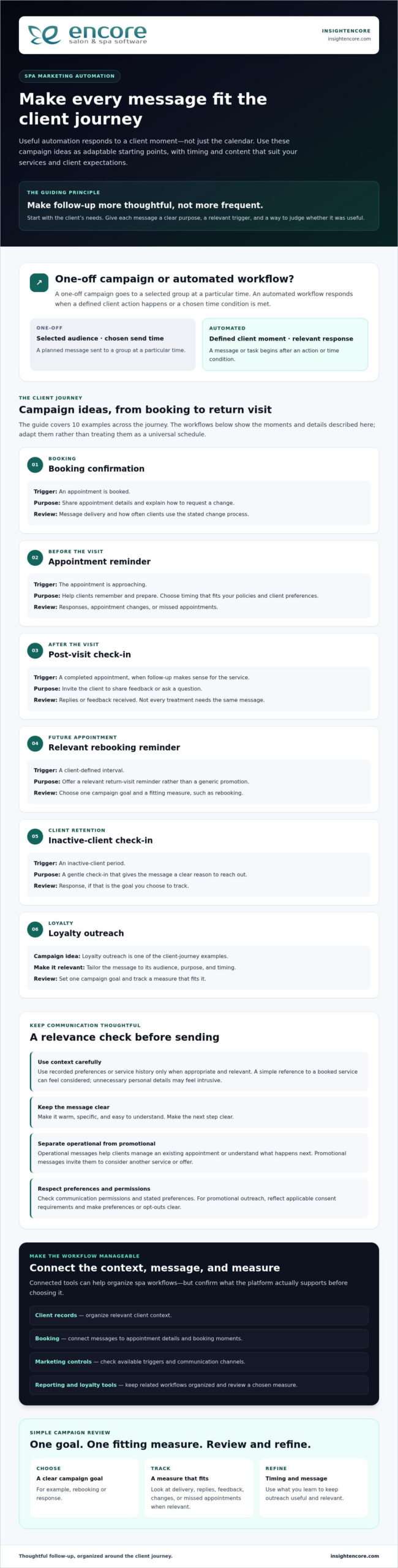
Spa marketing automation is software-supported messaging or tasks that begin when a client takes an action or a chosen time condition is met. A one-off campaign goes to a selected group at a particular time; an automated workflow responds to a defined client moment. This reflects the broader idea of marketing automation, where software helps coordinate marketing tasks and communication.
The distinction matters. Automation isn’t a reason to send more promotions. It’s a way to make communication more useful: booking information when someone schedules, a thoughtful check-in after a visit, or a relevant reminder after a client-defined interval. The best spa marketing automation examples fit the service and the client’s expectations rather than treating every client alike.
Which spa moments are useful automation triggers?
Start with moments that give a message a clear purpose. A booking can prompt practical appointment information. An appointment completion may prompt a follow-up. A client-defined interval can cue a relevant return-visit reminder, while an inactive-client period may prompt a gentle check-in. These are possible workflow ideas, not a universal schedule. Choose triggers that make sense for your services and how clients prefer to hear from you.
Keep operational messages distinct from promotional ones. Operational communication helps a client manage an existing appointment or understand what happens next. Promotional communication invites them to consider another service or offer. The purpose affects the content, timing, and permissions you need to check before sending.
How can automation still feel personal?
Personal doesn’t have to mean overly familiar. Use preferences or service history only when they’ve been appropriately recorded and are relevant to the message. A simple reference to the service a client booked can feel more considered than a generic offer. Adding unnecessary personal details, however, may feel intrusive.
Keep every message warm, specific, and easy to understand. Make the next step clear, and respect the client’s communication permissions and stated preferences. For promotional outreach, ensure your process reflects applicable consent requirements and makes preferences or opt-outs clear.
Connected booking and client-management records may help a spa organize context for follow-up, while marketing and loyalty tools can support related workflows. Before choosing software, confirm which triggers and communication channels it actually supports. The goal is a client journey that feels thoughtfully supported, not a larger volume of automated messages.
Spa marketing automation examples for booking, follow-up, and rebooking
Use these workflows as starting points, not guaranteed revenue drivers or a universal message schedule. The right trigger and timing depend on your spa’s services, policies, and client expectations. For more help assessing booking workflows, consult a spa booking software buyer’s guide.
What can a spa automate before and after an appointment?
Begin with practical messages that support an appointment already on the books. Keep each one clear and focused on what the client needs next.
- Booking confirmation: Trigger it when an appointment is booked. Send the appointment details and explain how to request a change. Review delivery and how often clients use the stated process to handle changes.
- Appointment reminder: Trigger it as the appointment approaches, with timing chosen to fit your policies and client preferences. Its purpose is to help clients remember and prepare. Review responses, changes, or missed appointments to assess whether the timing and wording are useful.
- Post-visit check-in: Trigger it after a completed appointment when follow-up makes sense for the service. Invite the client to share feedback or ask a question. Measure replies or feedback received rather than assuming every treatment needs the same message.
These are operational communications: they help clients manage an existing appointment. Keep them distinct from promotional messages, which invite a client to consider another visit or service.
How can spas encourage the next visit?
A rebooking prompt should relate to the service and arrive at an interval the spa considers appropriate. Avoid treating one schedule as right for every client. A message can invite the client to book again without implying they need a service or assuming a particular result.
- Service-relevant rebooking: Trigger it after a spa-selected interval has passed since a completed visit. Send it to clients who received that service, with a warm, optional invitation to view booking availability. Measure return bookings among the clients who received the prompt.
- Relevant next-step suggestion: Trigger it after a visit when a suitable recommendation is supported by the service and the client’s recorded preferences. Keep the message informative, and measure replies or bookings linked to the recommendation.
Gift-related follow-up has a different audience and purpose. After a gift card purchase, for example, a spa might send useful information about how the recipient can use it. Explore gift card management tools when planning that workflow.
Review each campaign’s responses and client feedback. Adjust or pause messages that feel mistimed, irrelevant, or repetitive. The aim is thoughtful follow-up, not more contact for its own sake.
Spa automation examples for retention, win-back, and client loyalty
Retention messages work best when they recognize why a client might value hearing from your spa. A service follow-up can invite feedback, a win-back note can reopen a conversation, and a loyalty update can acknowledge participation. Seasonal education can offer helpful context without turning every change in season into a sales pitch. These spa marketing automation examples are options to adapt, not fixed schedules or promises of results.
Automation should support a human experience, not replace thoughtful service. Use a message to make the next interaction easier or more relevant, then leave room for a personal response when a client has a question or concern.
| Trigger | Appropriate message | Intended client value | Measurement option |
|---|---|---|---|
| Visit completed | A brief service follow-up or invitation to share feedback, when appropriate | A simple way to give input or ask a question | Replies or feedback received |
| Spa-defined inactive period | A warm check-in or relevant service reminder | A useful, low-pressure prompt to reconnect | Responses or return bookings |
| Loyalty participation changes | A clear update about the client’s loyalty activity | Recognition and a better understanding of the program | Client engagement or questions about the program |
| Seasonal point chosen by the spa | Practical education related to services or client interests | Helpful information without an unnecessary sales push | Engagement with the message or related inquiries |
These measures are options, not industry benchmarks. Choose a spa-defined target for each campaign, then review results alongside client feedback. If a message gets little response or draws complaints, reconsider its timing, relevance, or audience.
What does a respectful win-back message look like?
Define “inactive” using a timeframe that fits the service cycle at your spa. A client who hasn’t returned within that period could receive a friendly check-in or useful reminder, without an assumed discount or pressure to book. If clients don’t engage, stop or adjust the outreach according to your communication policy. Respecting silence helps keep future contact welcome.
How can loyalty campaigns add value without over-messaging?
Send loyalty updates when there’s something useful to share, rather than repeating sales prompts. A clear note can recognize participation or explain relevant program information without inventing rewards or mechanics. Beyond loyalty updates, date-based triggers such as automated birthday greetings for salon clients offer another way to acknowledge clients personally without adding manual work. Encore offers loyalty programs alongside automated marketing capabilities. If you’re comparing software, review its automated marketing and loyalty features, and confirm which triggers and channels are supported.
Keep the experience personal by using only appropriately recorded client information and honoring communication preferences. A smaller number of relevant messages can serve clients better than frequent outreach that asks for their attention without offering something useful.
How to choose spa marketing automation examples and measure them
The most useful spa marketing automation examples solve a clear communication problem and give you a way to assess whether the workflow is helping. Start small. A campaign that’s easy to understand, check, and adjust is more manageable than several automations launched at once.
Use this sequence to shape one workflow:
- Choose one goal: For example, reduce missed appointments or encourage clients to return.
- Define the audience: Select clients for whom the message is relevant.
- Set a trigger: Choose a recorded action or spa-defined timing condition.
- Write the message: Make its purpose and next step clear.
- Select a channel: Use a method that suits the message and client permissions.
- Pick a measure: Decide what response or outcome you’ll review.
Booking information can provide useful context for appointment-related workflows. A salon client booking portal guide may help you consider how booking details fit into the client experience. If you’re evaluating software, look for usable client records, relevant booking context, control over campaign audiences and timing, and reports your team can interpret. Confirm which specific triggers and channels are available before relying on them.
Which metrics can a spa track for each campaign?
Match the measure to the message. For booking reminders, review attendance or rescheduling when those records are reliable. For retention outreach, consider rebooking, repeat visits, replies, and opt-outs. Campaign activity, such as messages sent or opened, isn’t the same as a business outcome. A change in bookings may have other causes, so avoid crediting automation alone. To go further, measuring salon marketing ROI can help you separate campaign-driven visits from business that was already likely to happen and assess what each promotion actually contributed.
Set any performance target yourself, based on your spa’s goals and starting point. Then compare results over a useful review period and note client feedback, not just counts.
How should a spa start without overwhelming the team?
Pick one recurring communication problem staff can describe clearly. Draft the message and review it manually before automating delivery. Check that the audience, wording, timing, and next step make sense. Assign an owner to monitor accuracy, client responses, and the effort required to keep the workflow working. Once the process is dependable, decide whether to refine it or test another campaign.
This measured approach helps you improve without adding unnecessary work. Encore brings online booking, client management, automated marketing, and loyalty programs into one platform. Review whether its capabilities fit your workflow and verify the triggers and channels you need.
How Encore can support a more organized spa marketing workflow
It’s easier to plan relevant client communication when booking details, client records, and marketing activities are organized together. Encore serves spa and beauty businesses with online booking, client management, automated marketing, and loyalty programs. These capabilities can help a spa coordinate its workflow, such as keeping booking context accessible while planning communications for clients.
That organization is a starting point, not a strategy by itself. Your team still decides who should receive a message, what it should say, and whether the timing suits the service and client. Software can support the process, but it doesn’t replace consent, good judgment, or personal care.
What should spa owners confirm in a software evaluation?
Ask the provider to show how client records, online booking, marketing tools, and loyalty programs work together in practice. A system’s feature list matters less than whether staff can use the information to manage the workflow you have in mind. When evaluating how transactions, client notes, and inventory connect at checkout, it may also be worth reviewing what’s involved in upgrading from a cash register to a POS system to understand what a more connected setup can support.
- Campaign control: Can your team choose or adjust the audience and timing?
- Channels and triggers: Which communication channels and campaign triggers are available? Confirm the specific options directly with the provider.
- Reporting: Can you understand what was sent and review the responses or outcomes that matter to your spa?
- Team fit: Does the workflow suit your services, staff responsibilities, and clients’ communication preferences?
Bring a real example to the evaluation. For instance, map the information your team would need to send a relevant follow-up after a visit. Check where that information is recorded, who reviews the message, and how you’d know whether the process is working. This helps reveal gaps before you commit to a workflow.
When is it time to explore Encore?
If coordinating bookings and repeat-client communication across separate processes is creating extra work, it may be worth seeing how Encore’s capabilities fit together. Encore offers spa and beauty business software, not a full-service marketing agency. Before relying on a particular automation, confirm the triggers, communication channels, and reporting available for your needs.
The spa marketing automation examples in this article can help you identify a first workflow to evaluate. Choose one that addresses a clear client or team need, then assess whether the tools support it without adding unnecessary complexity. Keep client preferences and thoughtful service at the center. You can explore Encore and its spa workflow tools as part of that evaluation.
Build a more thoughtful client journey, one step at a time
The strongest spa marketing automation examples aren’t about sending more messages. They help your team communicate at useful moments, with content that fits the client and a clear way to review how it’s received. Start with one workflow, define what you want it to do, and adjust based on client responses and your team’s experience.
Good tools can make that work easier to organize. Encore includes online booking, client management, automated marketing, and loyalty programs, bringing key parts of the spa workflow into one platform. As you evaluate the fit, confirm that its available campaign controls and channels support the approach you have in mind. Automation can support your relationships, while your team’s thoughtful care keeps them personal.
You don’t need to automate everything at once. Choose a useful place to begin, learn from the response, and build a client journey that feels considered at every step.
Frequently Asked Questions
What are examples of marketing automation for a spa?
Examples include booking confirmations, appointment reminders, post-visit feedback requests, service-relevant rebooking prompts, loyalty updates, and check-ins for clients who haven’t visited within a spa-defined period. These spa marketing automation examples work best when each has a clear audience and purpose. Before launching one, decide what client need it serves, what information it relies on, and how you’ll tell whether it’s useful.
How can a spa automate client follow-up after an appointment?
A spa can use appointment records to organize a follow-up for clients who’ve completed a visit, if the software supports that workflow. First decide whether follow-up is appropriate for the service, then write a brief message that offers a useful next step, such as a way to share feedback. Review the wording and recipient criteria, and make sure the message respects client permissions and preferences.
Can spa marketing automation help bring clients back?
It can support return visits by helping a spa follow up with relevant clients at a time that fits its service cycle. For example, a spa might identify clients who haven’t booked again within a timeframe it defines, then send a considerate check-in rather than assuming they want a promotion. Review resulting bookings and replies, but remember that automation supports outreach; it can’t guarantee a client will return.
How often should a spa send automated marketing messages?
There’s no single schedule that suits every spa or client. Set timing according to the purpose of each message, your services, client preferences, and communication permissions. Avoid sending multiple messages that repeat the same request or arrive too close together. Review client responses, opt-outs, and complaints for signs that the pace or content needs to change, and pause messages that no longer feel relevant.
What should a spa measure in an automated marketing campaign?
Choose measures that match the campaign’s purpose. For appointment communications, review reliable attendance or rescheduling records. For retention outreach, consider replies, repeat visits, rebookings, and opt-outs. Opens or clicks can show interaction, but they don’t prove a campaign caused a business outcome. A practical approach to measuring salon marketing ROI can help you account for discounts, compare channels consistently, and avoid giving one promotion credit for a client’s ongoing loyalty. Compare results with your spa’s own goals and context, and treat targets as internal benchmarks rather than universal standards.
Does spa marketing automation replace personal client service?
No. Automation can help organize routine communication, but it can’t replace a staff member’s judgment, attentive treatment, or personal response to a client’s question. Use it to handle appropriate, predictable tasks, and give clients a clear way to get help from your team when they need it. Keep messages accurate and considerate, and review feedback so your communication continues to reflect the experience your spa wants to provide.
Disclaimer
This article is general in nature and may contain errors, please verify all claims with your sales rep