What if your next repeat visit began with one well-timed message and a reward that felt genuinely worthwhile? Automated Marketing & Loyalty Programs can help connect those moments when they match client needs and fit your salon or spa’s daily workflow.
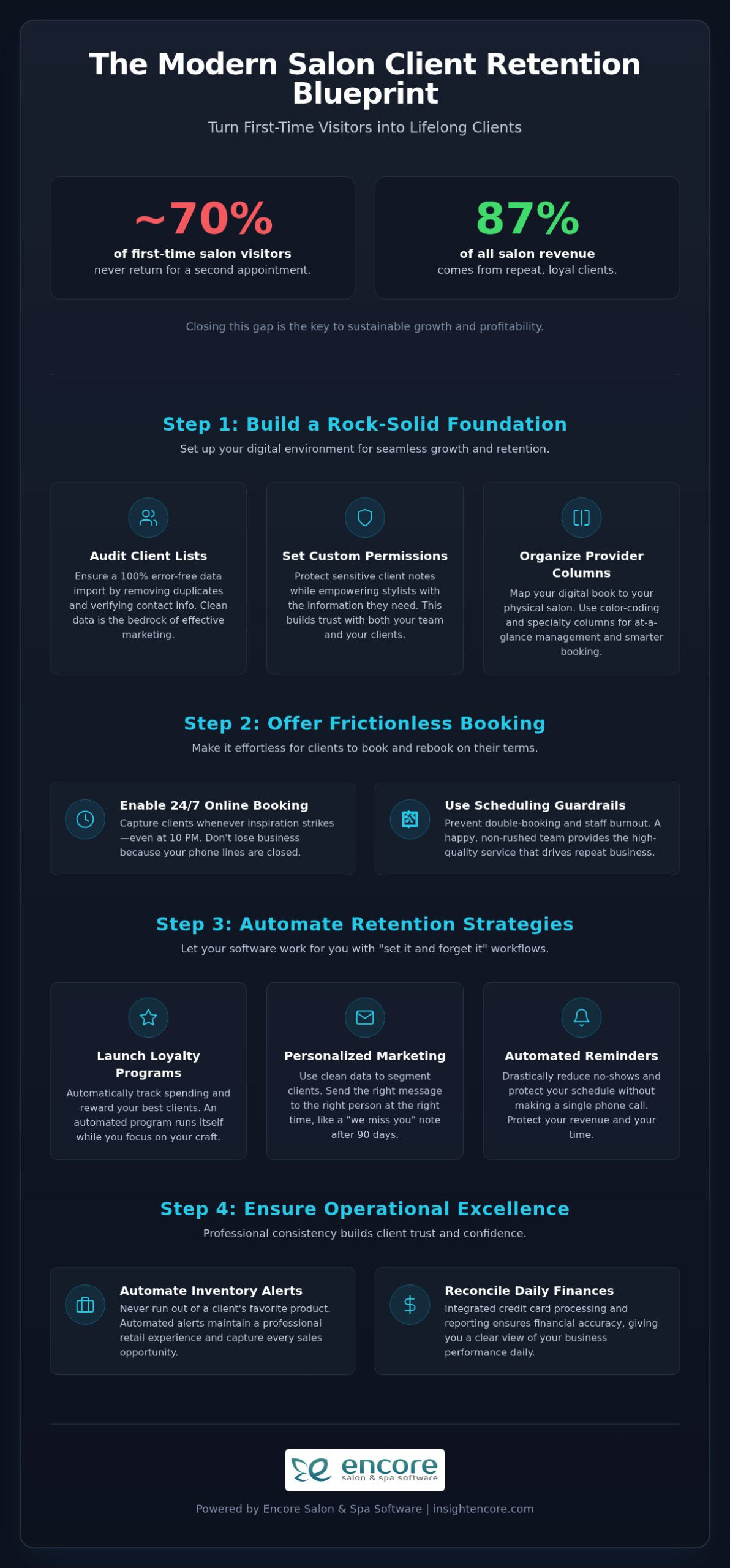
Follow-up matters, but sending messages between appointments, managing operations, and serving clients leaves little time for manual marketing. A generic offer may not give someone a compelling reason to return. Industry research reports that 73% of clients are more likely to choose a salon or spa with a loyalty or membership program. The opportunity is there, but the approach needs to feel relevant and be measured.
This guide explains how to pair timely communication with meaningful rewards, assess whether your efforts support repeat business, and choose a practical setup. You’ll also see how client management, online booking, marketing, and loyalty can work together through Encore Salon & Spa Software, helping you create a more consistent client journey with less manual effort.
Key Takeaways
- Connect communication and rewards across the client journey, from the first interaction to a future return.
- Compare points, visit-based rewards, and non-discount recognition to find an approach clients can understand and your team can manage.
- Use Automated Marketing & Loyalty Programs to make client communication more consistent while keeping rewards relevant.
- Start with one business goal and one client group, then explain program terms clearly to clients and staff.
- See how Encore brings marketing and loyalty capabilities into a broader platform that includes client management and online booking.
What Automated Marketing & Loyalty Programs Mean for Salons
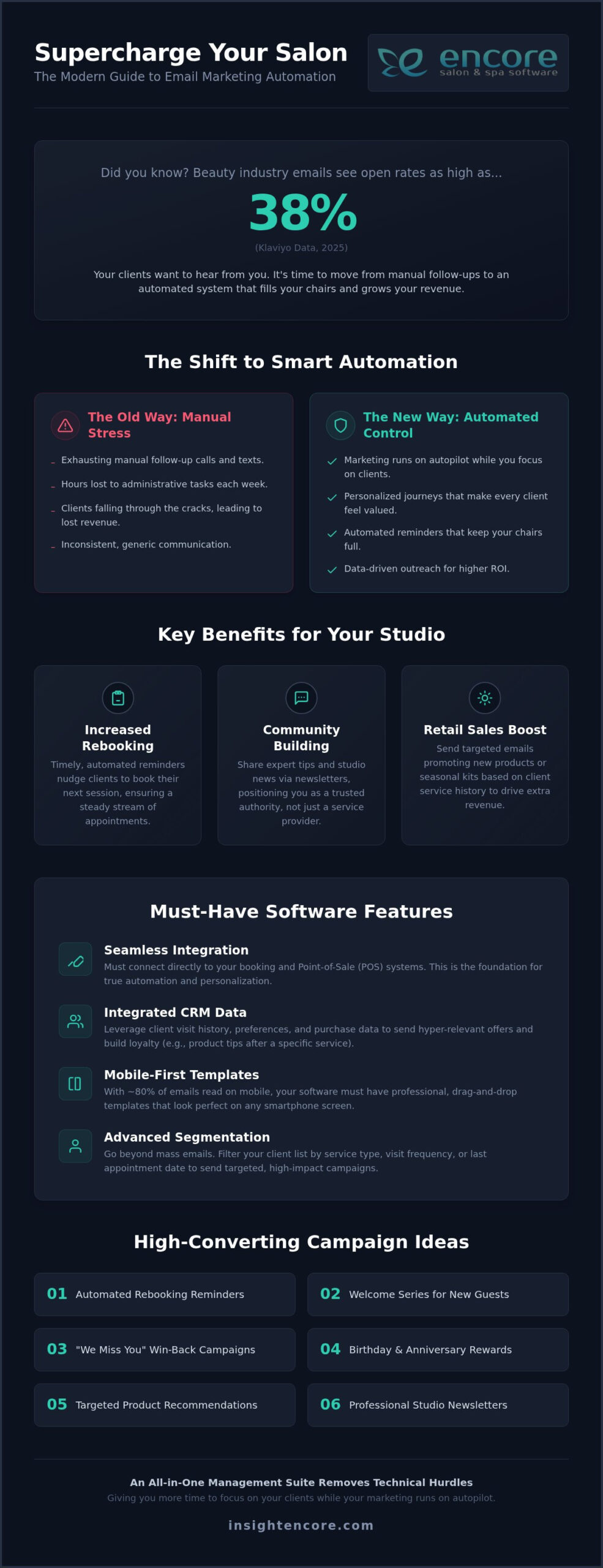
Salon relationships are built in person, but they continue between appointments. A useful update, a timely follow-up, or recognition of a client’s continued visits can keep that relationship active without relying on staff to remember every task. Automated Marketing & Loyalty Programs bring together two distinct activities: planned communication and meaningful recognition.
Marketing automation uses software to support repeatable communication workflows. It can help organize messages and client information, but it doesn’t replace professional judgment or the personal attention clients value. The overview What is Marketing Automation? explains the broader concept and its applications. For a salon or spa, the practical question is how to make each communication useful and appropriate, not simply how to send more messages.
How do automated marketing and loyalty programs differ?
Think of marketing automation as the communication process and a loyalty program as the value or recognition offered to clients. For example, a salon might plan a message with relevant service information for a color client, while separately recognizing clients who continue to book over time. The business decides what to say, when it makes sense to say it, and how clients receive the recognition.
Client information can make both activities more relevant. Service history and booking preferences can help a team avoid sending a broad promotion that doesn’t fit a client’s needs. That context can also help staff recognize ongoing relationships in a way that feels sincere. Record only useful details, keep them current, and put the client experience first.
Why does the combination matter in a salon or spa?
Appointment-based businesses have natural points of connection: a client discovers the business, books, receives a service, and decides whether to return. Consistent communication can make those transitions clearer. A helpful follow-up can keep a client engaged after a visit, while a relevant reward can offer an added reason to continue the relationship.
Neither element works well if it feels impersonal. Frequent messages can become noise, and a reward with complicated rules may not feel valuable. Keep communications purposeful, explain recognition clearly, and let staff bring their knowledge of clients into the relationship. Software can organize the process, but the human welcome, consultation, and service remain essential.
Marketing keeps the conversation timely; loyalty gives clients a meaningful reason to continue it. Together, they can support a connected client journey without treating every person as if they have the same needs. Encore brings automated marketing and loyalty capabilities into salon and spa management software alongside client management and online booking. Explore salon software features to see how these capabilities fit into business management.
How Marketing Automation and Loyalty Connect Across the Client Journey
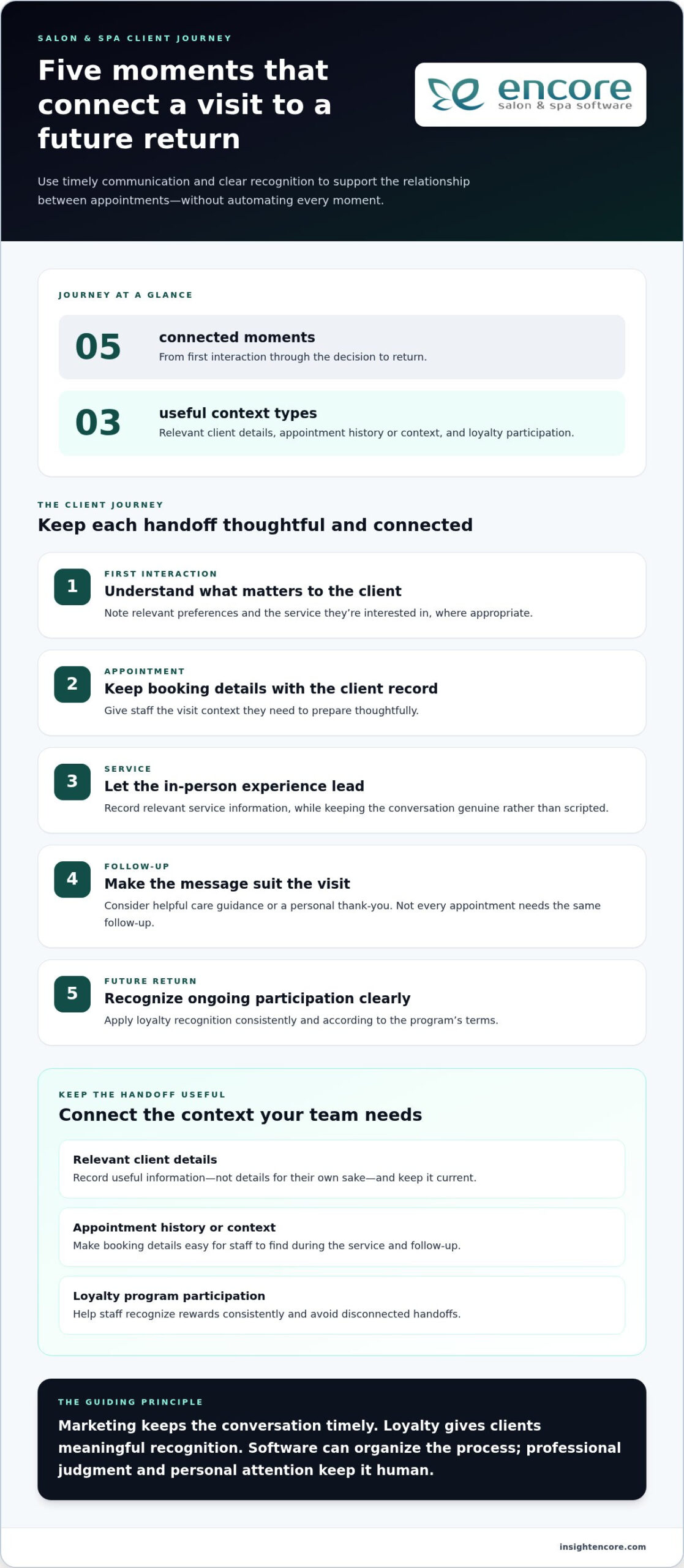
A client’s experience doesn’t begin and end in the salon chair. It moves through discovery, booking, service, follow-up, and the decision to return. When client records, appointment context, communication, and loyalty participation are organized around that journey, each interaction can feel more connected. The aim isn’t to automate every moment. It’s to help your team keep useful details accessible and communicate with care.
Where can marketing and loyalty meet in a client journey?
Picture a first-time client who finds your salon, books a consultation, receives a service, and considers their next visit. A simple journey map helps your team identify what information and support matter at each step:
- First interaction: Note the client’s preferences and the service they’re interested in, where appropriate.
- Appointment: Keep booking details connected to the client’s record so staff can prepare with the visit’s context in mind.
- Service: Record relevant service information, then let the in-person experience lead. A genuine conversation is more valuable than a scripted exchange.
- Follow-up: Decide whether a helpful message, such as care guidance or a personal thank-you, suits the visit. Don’t assume every appointment needs the same follow-up.
- Future return: Recognize ongoing participation in a loyalty program clearly and consistently, according to its terms.
The handoff matters. When booking details are easy for the team to find during the service, staff can carry that context into follow-up. A salon client booking portal guide can help you consider how online booking fits into the wider experience, from choosing an appointment to arriving prepared.
What should salon owners keep connected?
Start with the information your team needs to serve clients thoughtfully: relevant client details, appointment history or context, and loyalty program participation. The point isn’t to collect information for its own sake. Make useful context available when it can improve a conversation or help staff provide a more consistent experience.
Disconnected records can lead to generic communication. A client might receive an offer that doesn’t reflect their services, or staff may not know whether a reward has already been recognized. Agree on what information the team records, where it belongs, and how staff keep it current. A shared process makes handoffs easier without requiring a complicated journey design.
Encore brings client management, online booking, automated marketing, and loyalty capabilities into a broader business-management platform. Explore the client management features as you consider how organized records can support daily operations. Explore Encore to see how these tools could fit your business.
How to Judge Whether a Salon Loyalty Program Is Worthwhile
A loyalty program should feel worthwhile to clients and manageable for your team. Before choosing a reward, ask whether clients will understand its value, staff can explain the rules, and you can track participation. The best fit depends on your services, client habits, and capacity to run the program consistently, not on how elaborate it looks.
Which loyalty approach fits your clients and business?
Each approach balances clarity, perceived value, and administration differently. Use this comparison to narrow your options:
- Points: Clients accumulate points through defined activity and redeem them for a stated reward. This can offer flexibility, but earning and redemption rules need to be easy to follow and maintain.
- Visit-based rewards: Clients receive recognition after a set number of visits or services. The idea is simple to explain, but the program needs a clear way to record progress and define which visits count.
- Non-discount recognition: A business can acknowledge continued participation without making a price reduction the focus. This may feel personal, but the recognition still needs to matter to clients and be delivered consistently.
Consider your service mix and booking patterns. If clients tend to return for similar services, a straightforward visit-based structure may be easier to explain. If they use a wider range of services, a flexible points model may suit them, provided the team can administer it accurately. Non-discount recognition can complement either approach, but it needs a clear purpose too. Keep the terms brief: explain how clients participate, what counts, and how they receive recognition. If staff need a lengthy explanation, simplify the rules.
How can a business tell whether the program is helping?
Set a baseline before launch so you have a fair point of comparison. Choose a period that reflects your normal appointment patterns, then track a small set of measures consistently:
- Repeat visits: Track whether participating clients return and compare the pattern with your baseline.
- Redemptions: Note how often clients use rewards and which types they choose.
- Client response: Record questions, feedback, and signs that clients understand or value the offer.
- Team workload: Notice whether tracking and explaining the program fits comfortably into daily operations.
Redemption shows that a reward was used. It doesn’t, by itself, show that the program prompted a meaningful return visit. Compare behavior over time and consider whether clients might have booked again without the reward. Avoid treating correlation as proof that the program caused a change.
Program activity shows participation; repeat behavior helps show whether the program is supporting the relationship. Salesforce has cited a broad estimate that customer acquisition can cost at least six times more than retention. Treat that as general research, not a salon-specific benchmark or a prediction of what your own program will achieve. Judge Automated Marketing & Loyalty Programs using your own records, client feedback, and the effort required to keep the program clear and consistent.
How to Launch Automated Marketing and Loyalty Without Overwhelming Clients
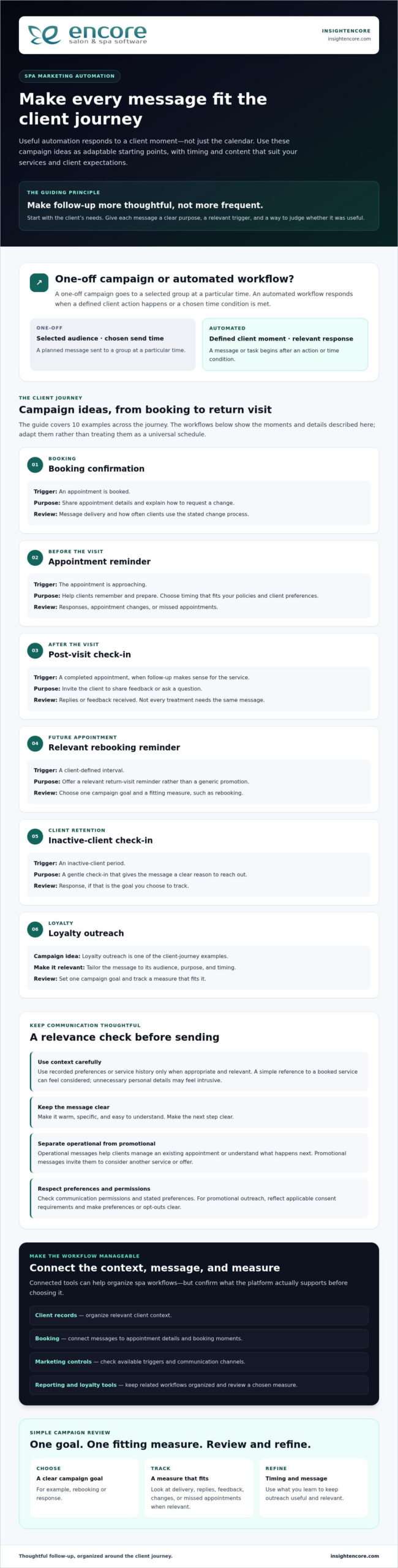
A manageable launch starts with focus, not a long list of campaigns. Choose one business goal and one client group, then build a process your staff can explain and maintain. For example, you might focus on keeping clients who book a particular service connected between visits. Keep the first version small enough to review and adjust.
What should a practical launch sequence include?
Before setting anything up, write down how your team currently handles client follow-up and rewards. This gives you a starting point and helps reveal manual steps or confusing handoffs. Then follow a straightforward sequence:
- Choose a measurable objective. Decide what you want to learn or improve, such as whether a specific client group returns after a service. Record the current process or baseline so you can compare later.
- Set simple program rules. Define how clients participate, what recognition they can receive, and which terms they need to understand. Keep the explanation brief enough for staff to share consistently.
- Prepare the client-facing language. Draft a clear message that sounds like your business. Make sure staff know how to answer common questions and where to find program details.
- Review responses and refine. Look at participation, client feedback, and any confusion your team encounters. Adjust the message or rules based on what you observe before adding another client group or idea.
This sequence lets you test the experience as well as the offer. A program that looks simple on paper still needs to work at the front desk, during a busy appointment day, and in the way clients understand it.
How can automation stay personal and respectful?
Automation should make useful communication easier to manage, not become a reason to contact clients more often. Before sending a message, ask whether it’s relevant to the recipient, clear about its purpose, and consistent with the service they receive in person. If it adds no useful information or value, leave it out.
Keep the language warm and direct. Use familiar wording, explain why you’re contacting the client, and describe any reward in plain terms. Review messages regularly so details stay accurate as services or program rules change. Let staff use their judgment too. A planned workflow can support consistency, while a personal conversation is still the right choice for questions or individual client needs.
Start with the smallest version that lets you learn. A measured rollout gives your team room to build confidence and gives clients a clear, comfortable experience. Encore brings automated marketing and loyalty capabilities into a broader salon and spa management platform, alongside client management and online booking.
How Encore Brings Salon Marketing and Loyalty Into Business Management
Marketing and rewards are easier to manage when considered alongside the daily work of running a salon or spa. Encore Salon & Spa Software is an all-in-one management platform with automated marketing and loyalty capabilities, as well as client management, online booking, gift card management, and point-of-sale transactions. This broader context helps owners consider how client communications and recognition fit into daily operations instead of treating them as separate tasks.
How does Encore fit into salon and spa operations?
Appointment-based businesses rely on clear client and booking information to organize the client experience. Encore Salon & Spa Software brings client management and online booking into the same broader software offering as marketing and loyalty. These capabilities support planning client communications and rewards, while the business chooses messages and program terms that suit its clients.
Encore Salon & Spa Software also serves barber shops, tattoo studios, massage businesses, and pet grooming businesses, alongside salons and spas. Each business has different needs, so consider how the management tools relate to the way your team books appointments and maintains client relationships. The Encore Salon & Spa Software overview provides salon-specific platform context.
Keep gift cards distinct from loyalty rewards. A gift card represents stored value that can be purchased or given to someone, while a loyalty program recognizes ongoing client participation according to its terms. Both can be part of a client-focused business, but they serve different purposes. Encore Salon & Spa Software includes gift card management alongside its marketing and loyalty capabilities.
What is a sensible next step for your business?
Before adopting new tools, take stock of your current process. Where does your team record client information? How do you handle follow-up? Can staff explain existing rewards consistently? These questions help identify what’s working and where manual steps or disconnected records create extra effort.
Next, consider how marketing and rewards fit with your client-management needs. A useful solution should support the way your business organizes client details and appointments while keeping communication clear and manageable. Start with the needs you’ve identified, such as more organized records or a more consistent approach to client recognition. Then consider how the platform’s relevant capabilities could support those priorities without assuming every feature or workflow is necessary for your business.
Encore Salon & Spa Software’s Automated Marketing & Loyalty Programs are part of a broader management platform for appointment-based businesses. Salon and spa owners can consider marketing, loyalty, booking, and client management together while keeping decisions about the client experience in their hands.
Build a Client Experience You Can Keep Improving
Your next step doesn’t need to be a full campaign calendar or a complex rewards structure. Choose one moment in the client relationship where a clearer, more thoughtful touchpoint could help. Decide what you want clients to understand or do, then make the experience easy for your team to deliver consistently.
As you put Automated Marketing & Loyalty Programs into practice, leave room to learn. Pay attention to client questions, staff feedback, and whether the process fits naturally into daily work. Use those observations to make small adjustments before expanding your approach. Progress comes from building a system that feels useful to clients and manageable for your business, not from adding more messages or rules.
Build a more organized, personal client experience at a pace that works for your team. Explore Encore for your business.
Frequently Asked Questions
Is automated marketing useful for a small salon?
Yes, Automated Marketing & Loyalty Programs can help a small team keep routine client communication from slipping during busy days. Start with one purpose, such as sharing useful service information with a defined client group. Review the wording before using it, then note whether clients respond or ask questions. The goal is to make repeatable tasks easier, not to replace staff conversations or personal service.
Can a salon loyalty program work without discounts?
Yes, a salon can recognize client engagement without making price cuts the main reward. For example, a business might acknowledge a client milestone or offer an experience-based benefit that suits its services and capacity. Consider what clients would find meaningful and what staff can deliver consistently. Keep participation terms straightforward, and explain what recognition clients can expect.
How often should a salon send automated marketing messages?
There isn’t one schedule that works for every salon or client group. Separate practical appointment information from promotional communication, then consider whether each planned message has a clear purpose. A service update may be useful, while another general offer soon afterward may feel unnecessary. Review replies, unsubscribes, and client feedback where available, and adjust the schedule if people seem confused or overwhelmed.
Do clients need an app to participate in a salon loyalty program?
No, a separate app isn’t automatically required. The participation method depends on how the salon designs its program and what its software supports. Some businesses may explain progress in person or use another straightforward way to record participation. Tell clients how to join, track their status, and receive rewards. A simple process is easier to understand.
How much should a salon offer as a loyalty reward?
There’s no universal reward amount that fits every salon. Consider the cost of delivering the benefit, the value clients may place on it, and whether it fits comfortably within your service business. Compare a lower-cost recognition idea with a more substantial benefit before setting the program terms. Track participation and redemptions over time, but don’t assume reward use alone means clients are returning more often.
What happens if clients do not use their loyalty rewards?
Low redemption doesn’t automatically mean the program has failed. Check whether clients know they’re enrolled, understand how to use a reward, and can recall the terms when they’re ready to book. Staff can note common questions during checkout or service conversations. If clients aren’t clear on the benefit, improve how it’s explained before changing the reward itself. Make one adjustment at a time so you can see what helps.
Disclaimer
This article is general in nature and may contain errors, please verify all claims with your sales rep