window.dataLayer = window.dataLayer || []; function gtag(){dataLayer.push(arguments);} gtag('js', new Date()); gtag('config', 'UA-206511945-1');
Search
Categories
Uncategorized

Barbershop Performance Dashboard: Metrics That Drive Better Decisions in 2026

What if a full appointment book is masking your barbershop’s biggest opportunity? A packed Saturday can look like success, but it won’t tell you whether clients are returning, chairs are being used consistently, or each visit is supporting healthy revenue. A barbershop performance dashboard brings those signals into view when you focus on the right measures and interpret them together.

If booking, client, sales, and inventory information lives in separate places, it’s easy to miss patterns or react to a single number without context. You don’t need to track everything. You need a focused set of indicators that answers practical questions about your shop. Connected tools for booking, client management, transactions, and inventory can give you a broader view of daily operations.

This guide covers which revenue, client, and operational metrics deserve attention, how to interpret changes against your shop’s schedule and goals, and how to turn what you learn into practical next steps. You’ll also find a repeatable review routine to make performance data useful in everyday decisions, not just another report to glance at.

Key Takeaways

  • Build a barbershop performance dashboard around decisions you need to make, not numbers that look impressive but offer no clear next step.
  • Organize measures across revenue, appointments, client relationships, and inventory to spot where closer attention may help.
  • Read results against comparable periods and changes in your schedule or service mix before deciding what they mean.
  • Use a steady review routine to turn patterns into a small number of practical actions and follow up on what changes.
  • Connect booking, client records, sales, and inventory tools to create a clearer view of daily operations.

What a Barbershop Performance Dashboard Should Help You See

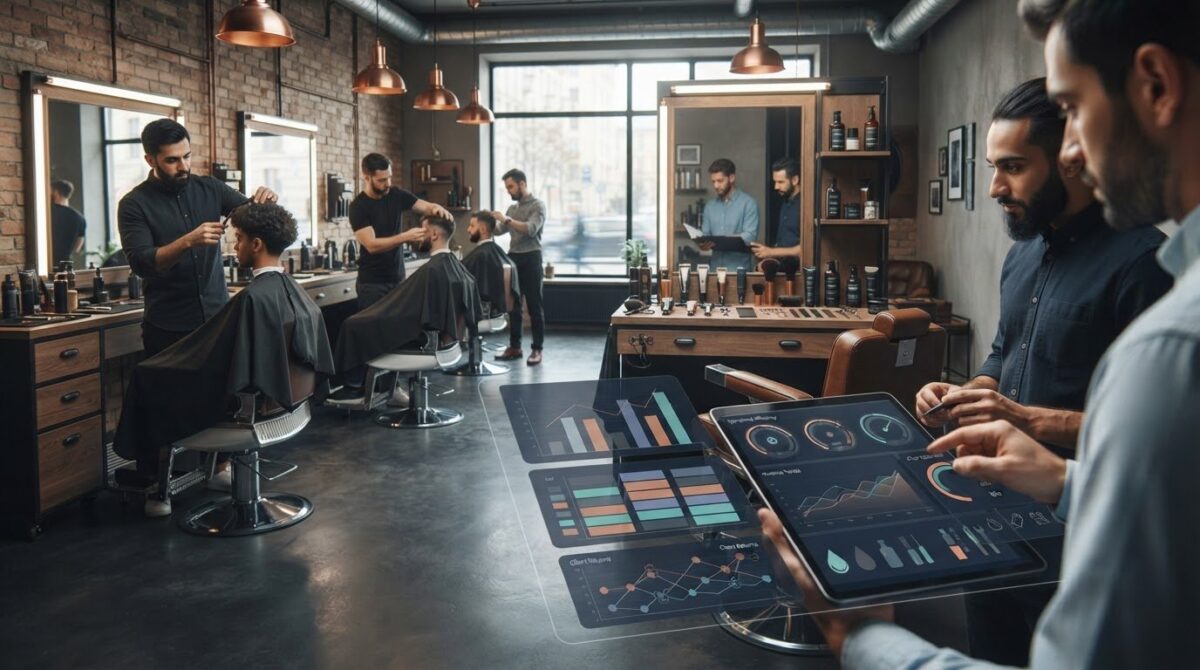
Bookings may sit in one place, sales in another, and client or inventory details somewhere else. When you’re piecing together the shop’s performance between appointments, scattered figures can be frustrating. A barbershop performance dashboard is a focused view of selected business measures that helps you understand what’s happening and decide what to do next. It’s not a wall of numbers. It’s a way to connect daily activity to decisions you can influence.

Think of a dashboard as the shop’s operating picture. Booking records can show demand and gaps in the schedule. Completed services and sales transactions show what actually happened, while client records can reveal whether guests are returning. Inventory records add context by showing which products are moving and which may need attention. Together, these sources can help explain a change that a single figure can’t.

The goal is to track useful signals, not every available count. A large social following or a high number of appointments booked might look impressive, but neither tells you whether those bookings are completed or clients come back. Give a measure space on your dashboard when it answers a real business question and points toward an action.

Which daily questions should the dashboard answer?

Start with questions that connect shop activity to choices you can make. For demand, ask whether upcoming bookings are filling the hours and days you want to staff. If certain periods are consistently quiet, you might adjust scheduling or consider a targeted promotion. For completed services, compare appointments on the book with visits completed. A gap may prompt you to review cancellations, reminders, or the time set aside between services.

For sales activity, look at what guests purchased alongside their services. If service sales are steady but retail activity changes, explore product visibility or staff recommendations before changing your inventory. For returning clients, review whether guests book their next visit or come back over time. That pattern can help you decide where follow-up or rebooking conversations deserve more attention.

Keep the time frame in mind. One unusually busy day may reflect a holiday, a local event, or a schedule change. One quiet day may be just that, one day. Treat it as context to investigate, not proof of a lasting trend. Look for a pattern across comparable periods before making a bigger change.

Dashboard, report, and KPI: what is the difference?

A report gives you detailed records to examine, such as individual transactions or appointment histories. A dashboard presents a concise overview of selected measures, making it easier to notice what deserves a closer look. A business dashboard can be organized in different ways, but its purpose is to make important information easier to monitor and use.

A KPI, or key performance indicator, is a measure tied to an important business objective, such as improving repeat visits. A raw operational count records activity; a KPI shows whether that activity is helping meet a goal. A count tells you what happened; a KPI helps you judge whether it moved the business toward an objective. That distinction keeps your dashboard focused on decisions, not just data.

Which Barbershop Performance Metrics Belong on Your Dashboard?

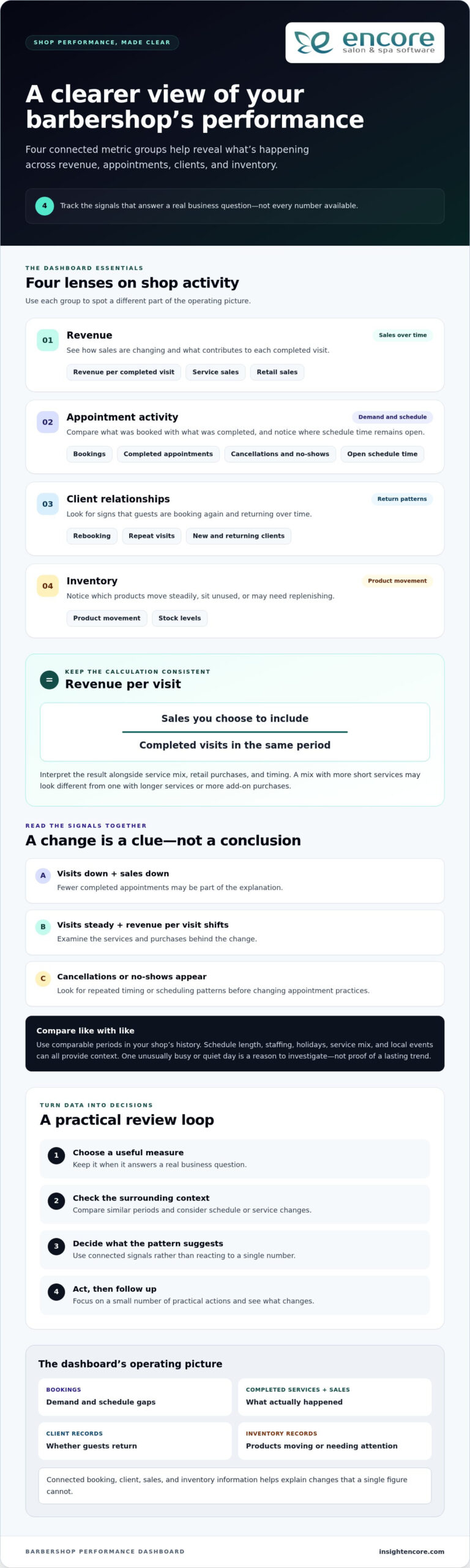
A useful barbershop performance dashboard gives you a balanced view, not a crowded collection of numbers. Choose a small group of measures across revenue, appointment activity, client relationships, and inventory. For each one, know what question it answers and what decision it might inform. A metric without a clear purpose adds noise instead of helping you manage the shop.

  • Revenue: Track sales over time, revenue per completed visit, and the mix of service and retail sales.
  • Appointment activity: Review bookings, completed appointments, cancellations, no-shows, and open time in the schedule.
  • Client relationships: Watch rebooking and repeat-visit patterns, including how new and returning clients contribute to activity.
  • Inventory: Look at product movement and stock levels to notice items that sell steadily, sit unused, or may need replenishing.

Revenue and appointment indicators to interpret together

Revenue per visit can show whether the value generated by each completed appointment is changing. Calculate it consistently by dividing the sales you choose to include by completed visits for the same period. Then interpret the result alongside service mix, retail purchases, and timing. A period with more short services may produce a different average than one with longer services or more add-on purchases. Keep the calculation consistent so comparisons remain meaningful.

Pair the revenue figure with appointment activity. If completed visits fall and sales fall with them, fewer appointments may be part of the explanation. If visits stay steady but revenue per visit shifts, examine the services and purchases behind the change. Compare similar days or periods in your own shop’s history rather than applying a universal target. Schedule length, staffing, holidays, and changes in the services offered can all affect the result.

Cancellation patterns need the same care. Review cancellations and no-shows in relation to bookings, and look for repeated timing or scheduling patterns before changing policies or appointment practices. One cancellation is an event; a recurring pattern is a reason to investigate.

Client and inventory signals that reveal patterns

Rebooking and repeat visits help you understand whether clients are returning and how consistently they do so. A change may relate to service timing, availability, or the way the next appointment is offered. Use client records to explore the pattern, then choose a practical response, such as making rebooking part of checkout conversations. Keep staff utilization distinct from shop-wide appointment measures: the former focuses on an individual barber’s working time, while the latter looks across the shop’s schedule and capacity. For a closer look at the staff measure, see this barbershop staff utilization guide.

Inventory movement adds context to sales. If a product’s sales change, consider whether client demand shifted, purchasing changed, or the item was unavailable when guests wanted it. Compare sales activity with inventory records before adjusting orders. No single measure explains the whole story. Together, these signals help you decide what deserves a closer look and what action is worth testing.

How to Read Dashboard Results Without Misleading Yourself

A dashboard shows what changed, but it can’t explain the cause on its own. Read each measure in context before adjusting prices, staffing, or promotions. Upcoming bookings are a leading indicator: they offer a view of demand that may turn into future work. Completed appointments and sales are lagging results: they show what has already happened. Comparing the two can help you see whether a shift in bookings is showing up in completed business, but allow enough time for the results to develop.

Compare like with like before drawing conclusions

Choose comparable periods, such as the same weekdays across two time windows, rather than comparing a full week with a partial one. Check whether opening hours, staffing, available services, or local events changed. A holiday week may follow a different pattern from a regular week, and a new service mix can shift average sales without indicating a problem. Be cautious with small samples. A single comparison can point to a question, but it rarely proves what caused the change.

Turn a metric change into a useful question

Suppose completed sales are lower than in the prior comparison period. The cause could be fewer appointments, more cancellations, shorter hours, a different mix of services, or a change in retail purchases. Each explanation suggests a different follow-up. Check booking records, completed appointments, and transaction details before deciding whether to change a schedule, price, or promotion.

A metric is a clue to investigate, not a diagnosis of what’s wrong. Use a change to guide your next question, then look for supporting evidence. Connected booking, client, point-of-sale, and inventory records make that review more grounded. Encore’s software features include tools across these operational areas, helping shops keep relevant information connected to daily work.

Signal Possible explanations Follow-up question
Upcoming bookings are down Fewer repeat bookings, reduced availability, seasonal demand, or a shorter booking window Are comparable days and booking lead times also lower?
Completed visits are steady, but sales have shifted Different service mix, changes in add-on purchases, or altered transaction patterns Which services or items account for the change?
Cancellations have increased A particular day, time, service, or booking pattern may be contributing Do appointment records show a recurring pattern or just a brief fluctuation?
Product sales have changed Shifting guest demand, purchase timing, or product availability Do inventory records support the same pattern?

For a barbershop performance dashboard to support sound decisions, keep the comparison method consistent and note important changes alongside the figures. If the signal persists and related records point in the same direction, you have a stronger basis for action. If they don’t, keep observing rather than making a costly change based on one reading.
Barbershop Performance Dashboard: Metrics That Drive Better Decisions in 2026

Build a Simple Barbershop Dashboard Review Routine

A barbershop performance dashboard becomes useful when you review it consistently and connect what you see to a next step. Keep the process light enough to fit around the work of running the shop. You don’t need a long meeting or a complicated scorecard. A focused check-in, consistent definitions, and a clear record of follow-up can turn scattered figures into a routine you can maintain.

Start with a small, decision-focused scorecard

Choose measures that match your current priorities, such as filling appointment gaps, understanding repeat visits, or reviewing retail movement. For every measure, write down its definition, where its information comes from, and the period you’ll review. This prevents the same label from being calculated differently each time. Add one sentence about the decision it supports, such as, “This measure helps us decide whether to adjust coverage during quiet appointment periods.”

Then follow a repeatable sequence:

  1. Choose the question. Name the operating issue you want to understand before opening the figures.
  2. Select the measures. Use only the indicators that help answer that question, and keep their definitions consistent.
  3. Review the pattern. Compare the chosen period with a relevant prior period, noting changes in hours, staffing, or services.
  4. Record an action. Decide whether to investigate further, try a practical adjustment, or keep watching the trend.

Move from review to action and follow-up

Close each review with a brief note: what you observed, what you’ll do next, who owns the action, and when you’ll revisit it. For example, if appointment gaps appear repeatedly during a particular time, review staffing coverage or booking availability. Assign one person to follow through, even if that person is the owner. Clear responsibility helps turn a useful observation into a completed task.

Pick a cadence that fits your operating rhythm. A short weekly check can help you notice near-term changes in bookings or cancellations, while a monthly review gives you more room to assess repeat visits, sales patterns, and inventory movement. These are starting points, not fixed rules. If a measure changes slowly, review it over a longer period; if it affects daily scheduling, a more frequent glance may make sense.

At the next check-in, ask whether the action changed the pattern you were watching. If it did, decide whether to continue or make the adjustment part of normal operations. If it didn’t, revisit your assumption before repeating the same step. Avoid adding another metric simply because it’s available. Add one only when it answers a real operating question or helps you make a decision with more confidence.

Explore Encore Barber Software

Use Barbershop Management Software to Connect the Operating Picture

A useful review depends on having relevant operating information available when you need it. If appointments, client details, sales, and inventory are recorded in separate places, it can take extra effort to understand how one part of the shop relates to another. Barbershop management software can bring these everyday activities into one platform, giving you a more organized foundation for reviewing how the business is operating.

Connect everyday records to better-informed decisions

Booking records help you examine appointment activity, such as how the schedule fills and which periods have open time. Client management records add context about guest history and return visits. Consider them together: booking activity shows what’s planned, while client records can help you understand who is coming back and how often.

Point-of-sale transactions provide a record of completed sales. Inventory records add information about product movement. Looking at both can help you ask useful questions: Did product sales change along with inventory movement? Are there items that appear to be moving differently than expected? The records don’t make the decision for you, but they give you relevant details to investigate before changing purchasing or sales practices.

These connections matter when you’re reviewing a barbershop performance dashboard. Encore’s barber shop software brings together tools for online booking, client management, point-of-sale transactions, and inventory tracking. Having these management activities in one platform helps organize information you can use to review daily operations and investigate performance changes.

Choose tools that fit the way your barbershop operates

Start with the work your shop needs to manage. Consider how you handle booking, client information, transactions, and inventory today. Then assess whether a software platform supports those workflows and makes the information easier to keep organized and review. Bringing relevant management activities together can reduce the need to piece together the operating picture from unrelated records.

The right setup should support your real routine, not add complexity for its own sake. A shop focused on appointment flow may start by keeping booking activity organized; another may prioritize client records or product tracking. Define what information you need to review and how it will support a decision. Then use the same definitions and review periods over time so comparisons remain useful.

Software is one part of effective operations. Staff communication, service standards, and clear day-to-day processes matter too. For practical ideas beyond the numbers, explore this barbershop management tips guide. Together, consistent operating practices and organized records can make it easier to spot questions worth investigating.

If you’re ready to bring booking, client management, sales, and inventory activities into a more organized workflow, take a look at Encore’s barber shop software.

Explore Encore Barber Software

Make Your Next Review a Step Toward Better Decisions

Your next step doesn’t need to be a major overhaul. Choose one operating question you want to answer, decide which figures can help, and note one action to test. A barbershop performance dashboard becomes more useful as that simple habit helps you learn what deserves attention and what can wait. Keep the process grounded in your shop’s goals, and let the evidence guide the next adjustment.

Encore has supported salon and barber shop businesses since 1991, with specialized software for barber shops. If you’re ready to explore management tools that can support your shop’s day-to-day work, take a look at Encore as a practical next step.

Try Encore for your barbershop

Keep asking clear questions, reviewing what changes, and building on what you learn. Your next decision can start with one useful signal.

Frequently Asked Questions

What is a barbershop performance dashboard?

A barbershop performance dashboard is a compact way to keep important business measures visible so you can decide what deserves attention. For example, an owner preparing for a staffing discussion might look at upcoming appointment demand alongside recent completed visits. The dashboard doesn’t explain every change by itself. Its value is helping you identify a useful question, then find the records or context needed to investigate it.

Which KPIs should a barbershop track?

Track the measures that help you manage a current priority. If you’re trying to understand quiet appointment periods, you might review bookings and completed visits for those time slots. If you’re focused on repeat business, consider rebooking or return-visit measures. Define each measure the same way every time, and compare it with your shop’s own history. A figure is more useful when you know what decision it can inform.

How often should a barbershop owner review performance metrics?

Choose a review rhythm you can maintain and match it to the decision at hand. A quick weekly look may help you notice upcoming schedule gaps, while a longer comparison can be more helpful for assessing a gradual change in client visits. Avoid changing the review window from one check-in to the next. Keep a short note of what you observed and what you plan to revisit, so each review builds on the last.

Can barbershop software help track business performance?

Yes. Barbershop software can organize records that support performance reviews, including online bookings, client information, point-of-sale transactions, and inventory activity. Encore offers specialized software for barber shops with these management tools. Use the records to examine specific questions, such as whether a scheduling change coincides with a shift in completed appointments. Software can help organize business information, but you still need context to interpret what a change means.

What should I do if my barbershop metrics suddenly change?

First check that you’re comparing the same type of period and using the same calculation. Then look for a practical explanation in the records. If sales shift, for example, check whether the number of completed appointments or the mix of services also changed. Note what you find and choose a proportionate next step, such as watching the pattern for another review period. One unexpected result is a reason to investigate, not automatically to overhaul your process.

How much does a barbershop performance dashboard cost?

There isn’t one cost that applies to every dashboard or software setup. The amount depends on the solution and the tools your barbershop chooses. Consider which activities you need to manage, what’s included in the option you’re evaluating, and whether it suits your shop’s workflow. Compare pricing information for the options you’re considering with the needs you’ve identified.

Is a performance dashboard useful for a one-chair barbershop?

Yes, if it helps you make a practical decision without creating unnecessary admin. A solo barber might use a small scorecard to understand which appointment periods are hardest to fill or whether clients are booking their next visit. Start with information you already record during daily work. If a measure doesn’t lead to a useful question or action, leave it off. A simple review habit can be more manageable than a complicated tracking system.

Disclaimer

This article is general in nature and may contain errors, please verify all claims with your sales rep

Categories
Uncategorized

Barbershop Inventory Control: A Practical Guide to Stock That Stays in Sync

A busy Saturday can make a stock problem hard to spot: a popular styling product sells out at the front desk while supplies used for services run low in the back. If counts are easy to forget and product use isn’t recorded consistently, barbershop inventory control can feel like one more task competing for your attention.

You don’t need a complicated system to get a clearer picture. A repeatable process helps you track what’s on hand, distinguish retail sales from service use, and make reorders with more confidence. The key is connecting product movement to a routine your team can maintain.

This guide covers how to organize retail products and service supplies, set a manageable counting and replenishment schedule, and use stock records to spot patterns. You’ll also learn when inventory-tracking software can bring stock records closer to the rest of your shop workflow, including point-of-sale transactions. The goal is practical control, not perfect paperwork.

Key Takeaways

  • Separate retail products from supplies used during services to see where stock is going.
  • Build a repeatable barbershop inventory control workflow, from recording incoming stock to reviewing counts.
  • Choose paper, spreadsheets, or software based on who needs access and how your stock activity is changing.
  • Set replenishment points using your own usage records, delivery timing, and each product’s importance.
  • Consider inventory alongside point-of-sale activity to bring stock records closer to your shop’s daily workflow.

What barbershop inventory control means, and why informal stock checks fall short

Barbershop inventory control is the routine of recording, checking, and replenishing the retail products and service supplies a shop keeps on hand. It means keeping records aligned with physical stock and deciding what needs attention. For a foundational explanation of the term, see Inventory control.

A glance at a shelf can help, but informal checks leave room for errors. Staff may count a partly used package differently, or a retail sale may never make it into the stock record. That can lead to unexplained count differences, urgent restocking, and uncertainty about whether a product was sold, used during a service, or recorded incorrectly.

The aim isn’t to count every item constantly. It’s to create enough visibility to make sensible replenishment decisions without turning stock checks into a daily burden. Start by deciding what belongs in your inventory system and how your team will record it.

Which products belong in a barbershop inventory system?

Track retail items sold to clients separately from supplies consumed while providing services. Retail stock might include shampoo, conditioner, styling products, or beard-care products. Service-use supplies can include shaving products, disinfectant, gloves, and other grooming or sanitation essentials. Separating the categories shows what generates retail sales and what supports the services you provide.

Prioritize items according to client demand, their role in delivering services, and how difficult they are to replace. Use the same product name and unit every time. For example, track individual bottles consistently rather than switching between bottles and cases. Uniform records make counts easier to compare.

What does good inventory control help an owner see?

Good records distinguish the physical count from recent stock activity. A shelf count shows what’s on hand now; sales and usage records help explain what has moved since the last count. Together, they give you a clearer picture than either view alone.

If the recorded quantity and physical count don’t match, review the process rather than treating the difference as proof of theft or assigning blame. Check whether a delivery, sale, service use, damaged item, or unit conversion was recorded inconsistently. Over time, these reviews can show which products need closer attention, which are moving steadily, and where replenishment or product-range decisions may need adjusting.

Barbershop Inventory Control: Receiving to Replenishment

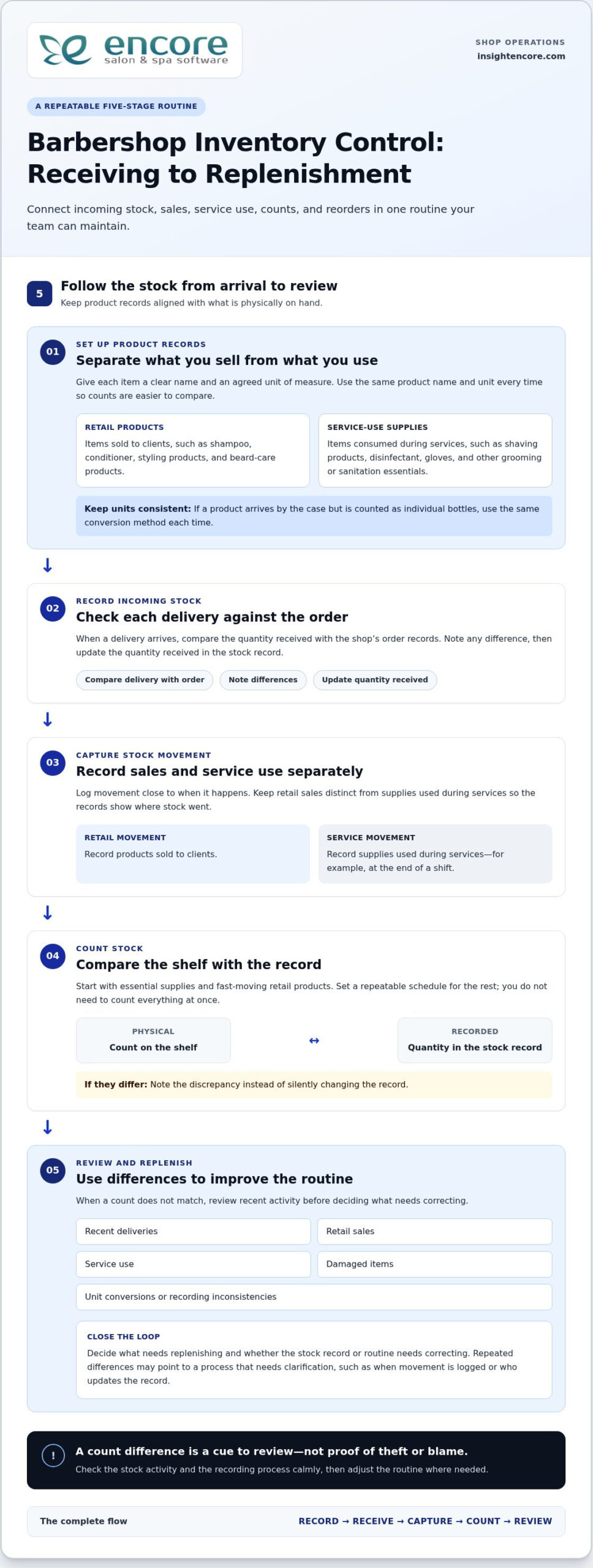
A reliable stock routine connects what comes into the shop with what gets sold, used, counted, and reordered. Keep the process simple enough to follow during a busy week. The five steps are: set up product records, record incoming stock, capture movement, count, and review.

Set up consistent product records and receiving habits

Give each item a clear name and an agreed unit of measure. If a product arrives in a case but is sold as individual bottles, decide how to record that conversion and use the same method every time. Otherwise, one person may enter a case while another counts bottles, making the record hard to compare with the shelf.

When a delivery arrives, compare the quantity with the shop’s order records, note any difference, and update the quantity received. Record stock movement close to when it happens. Keep retail sales separate from supplies used during services, using a routine your team can follow, such as noting service-use supplies at the end of a shift. The Retail inventory management guide also explores how sales patterns can inform retail stock decisions.

Count stock and turn discrepancies into useful information

You don’t need to count everything at once. Start with essential supplies and fast-moving retail products, then set a repeatable schedule for the rest. During each count, compare the physical quantity on the shelf with the recorded quantity. Note differences instead of silently changing the record, so you can review what may have caused them.

If quantities don’t match, check recent deliveries, sales, service use, damaged items, and unit conversions. A single discrepancy may be a recording slip. Repeated differences can point to a process that needs clarification, such as when movement is logged or who updates the record. Review the issue calmly and adjust the routine rather than jumping to conclusions about the cause.

Finish each review by deciding what needs replenishing and whether the record or routine needs correcting. Over time, this gives you a more dependable basis for reorders. Encore’s management software features include inventory tracking and point-of-sale transactions, bringing these tools into a broader shop-management workflow.

Spreadsheet, manual counts, or software: which barbershop inventory method fits?

The right method is the one your team can maintain accurately. A paper list may suit a small, stable assortment, while a spreadsheet makes records easier to sort and share. Software can suit a shop that wants inventory records alongside point-of-sale activity and other operations. Whatever the tool, staff still need to record stock movement consistently.

Method Setup effort Shared visibility Record consistency As activity grows
Paper list Low Limited to whoever can access the list Depends on one person keeping it current Can become harder to maintain as products or users increase
Spreadsheet Moderate Can be shared, depending on how it’s stored Requires clear entry rules and version control Useful for organizing more detail, but updates can become scattered
Inventory-tracking software Requires setup of product records and routines Can support a shared shop workflow Provides a consistent place to record stock, when staff use it May be a better fit as product movement and operational needs increase

When can a manual list or spreadsheet be enough?

A paper list can work when the assortment is small, stock movement is straightforward, and one accountable person updates counts and notes changes. A spreadsheet gives you more room to sort items and review entries, but multiple editors need to use a shared file and follow clear version rules. The right level of detail depends on your products and routines, not on a universal item-count threshold.

Either approach can become difficult to manage when entries are missed, staff keep separate copies, or no one knows which record is current. Before changing tools, clarify who records sales, service use, deliveries, and corrections. Reliable barbershop inventory control depends on that routine, whatever method you choose.

When does inventory-tracking software become more useful?

Software is worth considering when staff need a shared record or when you want to view stock information alongside other shop activity. Encore’s management platform includes inventory tracking and point-of-sale transactions, so shops can manage these tasks as part of a broader workflow. Explore the software features to see how the inventory tools fit into shop operations.

Software still depends on accurate entries. If a retail sale or service-use item isn’t recorded, the system can’t show that movement reliably. For more on approaches such as prioritizing items by importance, Forbes covers several inventory management techniques that can help inform your process.

Barbershop Inventory Control: A Practical Guide to Stock That Stays in Sync

How to set stock levels, count consistently, and prevent avoidable gaps

A useful stock level reflects how your shop uses a product, not a universal quantity. Set a replenishment point by considering recorded retail sales or service use, how long replenishment usually takes based on your supplier experience, and how important the item is to daily operations. A core sanitation supply may deserve closer attention than a slow-moving retail item.

Choose practical reorder points for products your shop depends on

Use stock records to understand how quickly each product moves. When the remaining quantity may not cover expected use during the usual replenishment time, plan to reorder. Set levels based on your shop’s experience, then revisit them when demand changes, a service routine shifts, or supply timing changes. Keep the reasoning with the record so the next review is easier.

Not every product needs the same attention. Prioritize items that support essential services or sell regularly, then assess less critical products according to their movement and role in your assortment. This makes barbershop inventory control more practical: protect availability where it matters without tying up attention in arbitrary stock targets.

Make cycle counts and stock reviews manageable

Instead of waiting to count everything at once, assign a small, defined group of products to each count session. Give someone clear responsibility for checking physical quantities and recording adjustments. Compare the count with the record, note unresolved differences, and look for likely process causes before changing the number. Use a regular management check-in to review those notes.

Use the same review to look at slow-moving products. Check whether they still meet a client need, fit the shop’s services, or merit shelf space before automatically reordering. A product that moves slowly may call for a smaller order, a change to the assortment, or another review period. Let your shop’s records guide the decision.

Inventory decisions are part of the wider work of running a shop. For a broader view of how management tools can support barber-shop operations, explore barbershop management software.

Explore Encore for your barbershop

Bring barbershop inventory control into a connected management workflow

A dependable process doesn’t need to be complicated. Categorize retail products and service supplies, record stock movement, count on a repeatable schedule, review differences and product activity, then adjust records and replenishment decisions. These steps create a useful foundation, whether you track stock on paper or use software.

As you assess your process, consider how inventory records relate to point-of-sale activity. Reviewing stock information alongside sales can help you interpret what’s moving, but the records still depend on accurate entries. A connected platform brings these parts of shop operations into a broader workflow while keeping the need for consistent staff record-keeping clear.

What to look for in software for barbershop inventory control

Start with the everyday tasks your system needs to support. Can your team keep clear records for retail items and supplies used during services? Can staff follow a process for recording sales, use, deliveries, counts, and adjustments? Consider how inventory fits with point-of-sale operations and whether the workflow makes sense to the people who will use it. A long feature list matters less if the routine is difficult to follow.

Evaluate software against your actual stock-control process. Decide who updates records, how often you count, and what information you need before replenishing. Then consider whether a shared management platform could reduce reliance on disconnected records while keeping responsibilities clear.

Take the next step with Encore

Encore Salon & Spa Software is designed for barbershops and includes inventory tracking and point-of-sale transactions within its management platform. It gives shop owners an option for bringing stock records into a wider operational workflow. Explore Encore software for barbershops as you plan how to organize inventory alongside other shop needs.

Keep the process practical: define your categories, assign record-keeping responsibilities, and review stock regularly. Then choose tools that fit the routine you’ve built. For broader operational planning, explore Encore’s barber-shop software information as part of your next steps.

Explore Encore and see how it can support your barbershop

Build a Stock Routine You Can Rely On

Steady barbershop inventory control starts with a clear routine: separate retail products from service supplies, record stock movement consistently, and count and review products on a manageable schedule. Use your own sales, service-use, and delivery records to guide replenishment decisions instead of relying on guesswork or one-size-fits-all stock levels.

The right tracking method should fit how your shop operates. A paper list or spreadsheet may be enough for a simple setup, while software can bring inventory records closer to point-of-sale activity. Whichever approach you choose, consistent staff habits keep the information useful.

Encore offers specialized software for barbershops, including inventory tracking and point-of-sale transactions within its management platform. Encore has focused on vertical-market software for beauty and wellness businesses since 1991, giving barbershops an option for connecting stock tracking with broader shop operations.

Explore Encore and see how it can support your barbershop

Start with a routine your team can maintain, then build on it as your needs change. Clearer records can help you make stock decisions with greater confidence.

Frequently Asked Questions

What is barbershop inventory control?

Barbershop inventory control is the routine of recording what stock the shop has, tracking products sold or used, checking physical quantities, and deciding when to replenish. It helps you distinguish retail products from supplies consumed during services, so you can see what’s available and what’s moving. Start with clear product names, consistent units, and a process your team can follow. Consistency matters more than complexity.

How often should a barbershop count inventory?

There’s no single counting schedule that suits every barbershop. Count essential supplies and fast-moving products more regularly, then set a manageable routine for the rest. Consider how quickly items move, how many people handle stock, and whether your records match physical counts. If sales patterns or shop routines change, review the schedule and adjust it. A consistent cadence is more useful than an ambitious plan that’s often missed.

What inventory should a barbershop track?

Track products sold directly to clients separately from supplies used during services. Retail items might include styling or beard-care products, while service supplies can include grooming and sanitation products. Begin with items that are essential, frequently used, or commonly requested, then add others as your routine becomes manageable. Use consistent names and units, such as individual bottles rather than switching between bottles and cases.

Can a spreadsheet work for barbershop inventory control?

Yes. A spreadsheet can work well if your assortment is limited, stock movement is straightforward, and one person is responsible for keeping records current. If several staff members update it, use one shared version and agree on how to record sales, service use, deliveries, and corrections. Conflicting copies or missed entries can make the record unreliable. If you want inventory considered alongside point-of-sale activity, software can offer a more connected workflow.

How do you calculate when to reorder barbershop products?

Use your own records to understand how quickly a product sells or gets used, then consider how long replenishment usually takes for your shop. Choose a practical point at which you’ll review stock and place an order if needed. Give essential items closer attention than products that are easy to replace or move slowly. Compare reorder decisions with later counts and adjust them as demand or supply timing changes.

Does barbershop software help with inventory control?

Inventory software can provide a structured place to record products and review stock information. Encore’s management platform includes inventory tracking and point-of-sale transactions, which helps owners consider stock alongside sales activity. Software supports the process, but it doesn’t replace clear product records or consistent staff habits. Decide who records movement and how counts are reviewed so the information remains useful in day-to-day decisions.

What is the difference between retail inventory and back-bar inventory?

Retail inventory is made up of products the shop sells directly to clients. Back-bar inventory refers to products used while providing services, such as grooming or sanitation supplies. Keeping the categories separate helps you understand which items contribute to retail sales and which support service delivery. Record each category consistently, including clear product names and counting units, so you can review movement and replenishment needs for each group.

Disclaimer

This article is general in nature and may contain errors, please verify all claims with your sales rep
Categories
Uncategorized

Barbershop Appointment Scheduling Software: The 2026 Management Guide

You are halfway through a precision skin fade when the shop phone rings for the third time this hour. You can’t step away to answer it, so the call goes to voicemail, and another potential client likely moves on to the shop down the street. It’s a frustrating cycle that costs you money and breaks your creative flow. Most shop owners agree they would rather spend their time behind the chair than acting as a full-time receptionist or chasing down last-minute no-shows. You didn’t open your doors to spend all day on the phone.

The good news is that your technology should be doing the heavy lifting for you. This 2026 guide will show you how the right barbershop appointment scheduling software can act as a silent business partner, handling your logistics while you focus on your craft. We’ll explore how to eliminate scheduling gaps, automate your payments and tips, and manage complex commission structures for your team. You will discover how to build a professional online presence that works 24/7, ensuring your calendar stays full even while you sleep.

Key Takeaways

  • Shift from simple digital calendars to a comprehensive business engine to eliminate manual booking errors and recover lost revenue.
  • Understand the critical role of specialized booth and chair renter management in maintaining fair and transparent accounting across your entire team.
  • Evaluate the true value of professional barbershop appointment scheduling software compared to basic apps that often hide high transaction fees and lack human support.
  • Master the transition to new technology with a clear strategy for auditing client data and optimizing your service menu with precise buffer times.
  • Build your shop’s future on a foundation of trust by partnering with a human-centric management provider that offers decades of industry expertise.

Beyond the Paper Book: Why Barbershops Need Specialized Scheduling in 2026

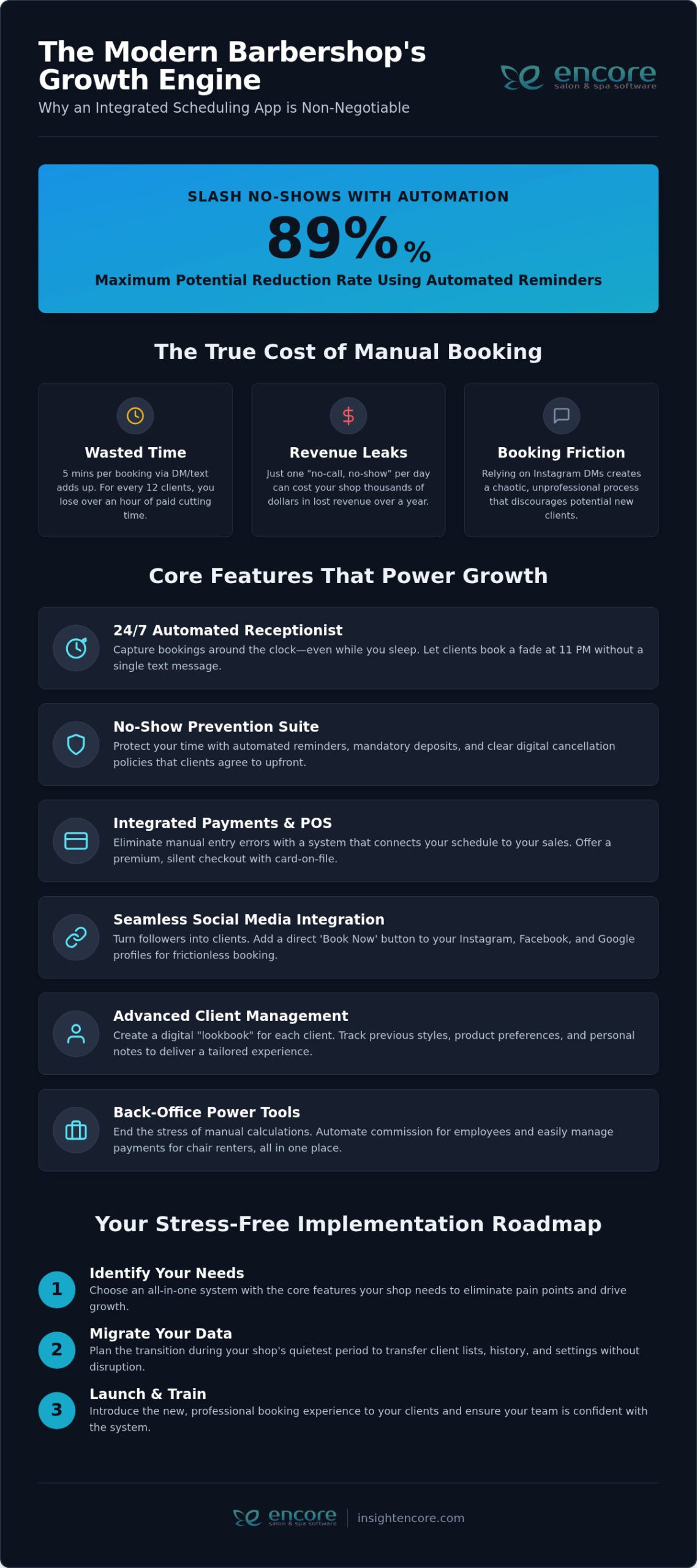
The traditional paper book was once the heart of the shop. It sat on the counter, filled with crossed-out names and scribbled phone numbers. But in 2026, that book is a liability. Modern barbershop appointment scheduling software has evolved into a comprehensive business engine that powers your entire operation. It’s no longer just a digital calendar; it’s the central hub where your marketing, payments, and client relationships live.

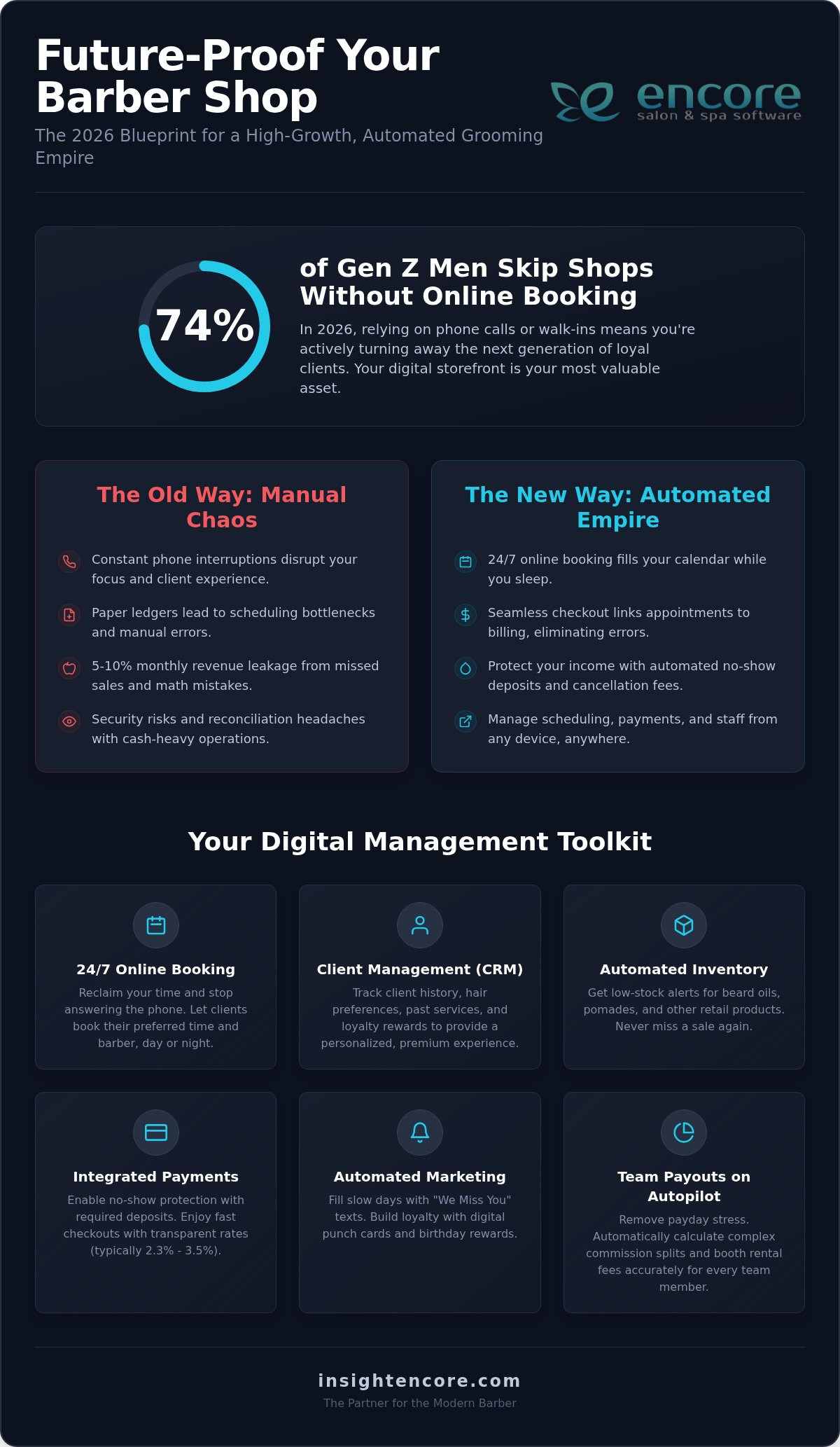
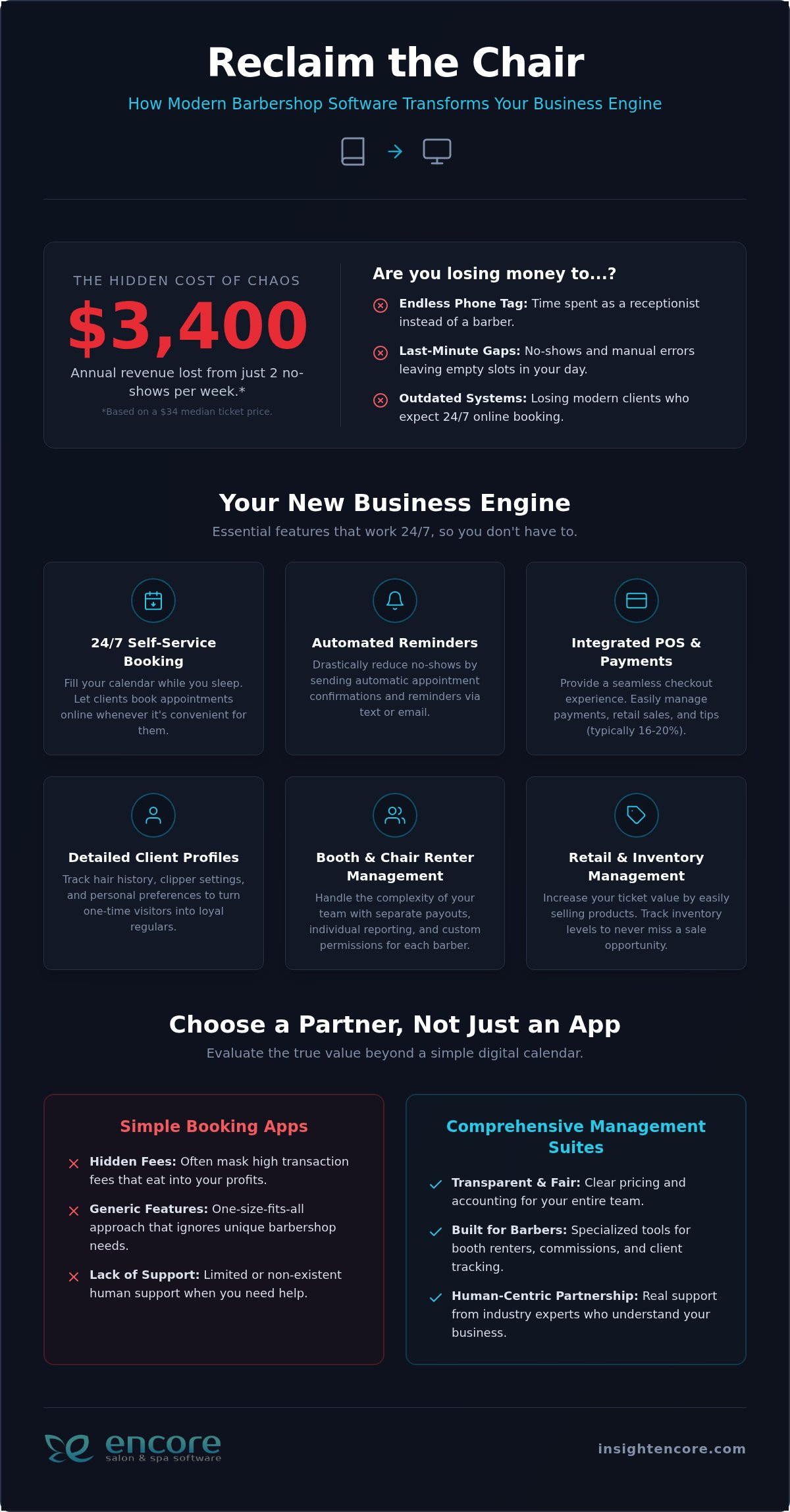
Broadly speaking, appointment scheduling software allows businesses to manage their time more effectively, but for a barber, it does much more. It eliminates the “cost of chaos” by preventing double-bookings and ensuring your revenue remains predictable. By automating administrative tasks, you can finally focus on “reclaiming the chair” and doing the work you actually love. Today’s clients don’t want to wait for business hours to book. They expect 24/7 self-service. If they think about a haircut at 11 PM on a Sunday, they want to book it right then. If you aren’t available digitally, you’re invisible to a massive segment of the market.

The Evolution of the Modern Barbering Business

The industry has shifted away from the “walk-in and wait” culture. Clients value their time, and they want the certainty of an appointment. Modern barbershop management is the intersection of craft and digital efficiency. This digital approach also builds your brand identity. A sleek booking interface tells clients you are a professional who respects their time and invests in a high-quality experience. It moves you from being just another shop on the corner to a premium destination.

The Real Cost of No-Shows and Last-Minute Gaps

Let’s look at the numbers. Based on a median ticket price of $34, losing just two clients a week to no-shows means you’re leaving over $3,400 on the table every year. That’s a significant hit to your bottom line that you can’t afford to ignore. Automated reminders act as a professional barrier against forgetfulness, prompting clients to confirm or reschedule before it’s too late. Beyond the money, there is a psychological benefit. Walking into a shop with a full, organized calendar boosts barber morale and creates an atmosphere of success that clients can feel the moment they walk through the door. Using barbershop appointment scheduling software ensures that your most valuable asset, your time, is never wasted.

Essential Features for Modern Barbers: From Booth Renting to Retail Management

Choosing the right barbershop appointment scheduling software involves more than just picking a pretty interface. It requires a tool that understands the specific financial flow of a busy shop. For many owners, the biggest headache isn’t the haircut itself. It’s the administrative tangle of managing different revenue streams while keeping the atmosphere professional. When introducing new technology to your team, focusing on features that solve daily friction points is the fastest way to get everyone on board.

A truly modern system bridges the gap between the chair and the front desk. Integrated POS systems allow you to transition a client from a finished fade to a completed transaction in seconds. This isn’t just about speed; it’s about accuracy. By using detailed client profiles, you can track hair history, specific clipper settings, and even personal preferences. These small details turn a one-time visitor into a loyal regular who feels seen. Plus, with integrated processing, you can easily manage tips, which in this industry typically range between 16% and 20% of the ticket value.

Managing Independent Barbers and Chair Renters

Most generic booking apps fail because they assume every barber is a standard employee. We know the reality of the industry is often different. Your software needs to handle the complexity of booth and chair renters with ease. This means generating separate payouts and individual reporting so each barber can see their own progress without compromising shop-wide data. With Encore Salon Software, you can set specific permissions. This allows individual barbers to manage their own calendars on their phones while you maintain total oversight of the shop’s performance. It creates a culture of autonomy and trust.

Barbershop Inventory Control for Retail and Professional Use

Profits aren’t just made through services. They are often found on your retail shelves. Effective barbershop appointment scheduling software must include robust inventory tracking. You need to know exactly how many neck strips, blades, and shave creams you have in your back-bar at all times. Running out of professional supplies mid-day is a disaster you can easily avoid with automated low-stock alerts.

Similarly, managing your retail stock for pomades and beard oils is crucial for boosting your margins. Automated alerts ensure you never miss a sale because a product wasn’t on the shelf. If you’re ready to see how these features can transform your daily grind, you can see our specialized features in action to find the perfect fit for your shop. Finally, don’t overlook automated marketing. You shouldn’t have to spend your Monday nights texting clients to fill a slow Tuesday. Smart systems identify gaps in your schedule and reach out to regulars who are due for a trim, keeping your chairs full without the manual effort.

Evaluating the Options: Simple Booking Apps vs. Comprehensive Management Suites

Choosing the right barbershop appointment scheduling software often feels like a choice between a quick fix and a long-term investment. Many shops start with “free” or low-cost booking apps, thinking they’re saving money. However, these basic tools often hide their true costs in high transaction fees or a total lack of human support when things go wrong. You shouldn’t have to wait three days for an email response when your calendar is frozen on a busy Friday. Professional tools provide the reliability you need to keep your doors open and your chairs full.

Professional management suites provide a unified experience that basic apps can’t match. One major advantage is Integrated Credit Card Processing. Instead of juggling third-party hardware that may or may not sync with your bookings, an all-in-one system ensures your finances and your schedule are always in the same place. In 2026, data ownership is also a top priority. You need to know that your client list belongs to you, not the software provider, and that your shop’s data is secure and accessible from any device. Basic apps often create data silos, making it nearly impossible to get a clear picture of your shop’s health.

When a Basic App Is No Longer Enough

You know it’s time to upgrade when you feel the weight of “app fatigue.” This happens when you use one tool for booking, another for your marketing emails, and a third for your taxes. It’s exhausting. A modern shop requires cloud-based reliability that allows you to check your numbers from home or on the go. If you’re spending more time syncing data between apps than you are talking to your clients, your current system is failing you. Moving to a comprehensive suite eliminates these gaps and brings your entire business into a single, easy-to-use platform.

Calculating the True ROI of Professional Software

Don’t just look at the monthly subscription price. The real ROI comes from the hours you save and the extra revenue you generate. Features like automated loyalty programs and digital gift cards create immediate cash flow and keep regulars coming back. When you view your software as a profit center rather than an expense, the choice becomes clear. You can explore our Pricing and Value page to see how a professional suite pays for itself through increased efficiency and reduced administrative stress. Investing in the right barbershop appointment scheduling software isn’t just about a digital calendar. It’s about giving your business the foundation it needs to scale without the headache of disconnected tools.

Barbershop Appointment Scheduling Software: The 2026 Management Guide

How to Implement New Scheduling Software Without Disrupting Your Shop Flow

Changing your business systems shouldn’t feel like a gamble. You’ve built your shop on solid relationships, and you don’t want technology to get in the way of that. A smooth transition to new barbershop appointment scheduling software is all about preparation. By following a steady, logical path, you can switch tools without losing a single booking or frustrating your team. It’s about moving from a state of potential stress to a feeling of organized control.

The first step is auditing your current client list. This is the perfect time to clean up your data by removing inactive profiles and ensuring phone numbers are accurate. Once your data is ready for migration, focus on your service menu. Set clear durations for every cut and shave, but don’t forget to include buffer times. If a skin fade takes 30 minutes, add a 10-minute buffer for sanitizing your station and resetting your tools. This prevents a “domino effect” where one late client ruins the entire afternoon.

Before going live, ensure 100% adoption through team training. Spend a morning walking everyone through the interface. Finally, launch your online portal to your clients. Offering a small introductory incentive, like a discount on their first online booking, is a great way to shift behavior quickly and get your calendar filled without you picking up the phone.

Staff Buy-In: Making the Transition Smooth

Some barbers may worry that new software feels like micromanagement. You can overcome this by framing the change as a tool for empowerment. Show the team how the system automatically tracks their commissions and tips, saving them from doing manual math at the end of a long shift. When they see that the software actually helps them earn more through repeat bookings and automated reminders, they’ll become your biggest advocates. For more leadership advice, explore these Barbershop management tips for new owners.

Client Communication: Introducing the New Booking Portal

Use your new automated marketing tools to announce the upgrade. Send a blast text or email to your regulars explaining how much easier their lives are about to become. You can also use social media to drive excitement. A simple script like, “Skip the phone tag! Book your next fresh cut in 30 seconds through our new portal. Link in bio!” works wonders. For long-time clients who still prefer to call, don’t worry. Your staff can easily enter their details manually into the barbershop appointment scheduling software, keeping your digital records perfect while maintaining that personal touch.

Start your stress-free transition today

Scaling Your Shop with Encore’s Barbershop Management Solution

Growing a business is about more than just adding chairs. It’s about building a foundation that can support your ambition without crumbling under administrative pressure. While many software giants offer cold, one-size-fits-all platforms, Encore provides a human-centric alternative designed specifically for the unique culture of the barbershop. Built on the 30-plus-year history of Syntec Business Systems, our barbershop appointment scheduling software offers the reliability of an industry veteran with the innovation required for 2026.

Scaling effectively requires tools that turn a single visit into a lifelong habit. Features like integrated gift cards and automated loyalty programs are essential for retention. These aren’t just “add-ons”; they’re revenue drivers that help you maintain a steady cash flow even during slower seasons. When your technology works as hard as you do, you can finally move from a state of constant hustle to one of organized control. It’s time to stop fighting with your tools and start using them to build your legacy.

A Partner, Not Just a Provider

In a world increasingly dominated by AI chatbots and delayed email tickets, we believe in the power of human connection. You deserve talk-to-real-people support when you have a question about your shop’s data. Our team acts as a dedicated mentor, helping you navigate the system so it fits your specific shop layout and workflow. We offer deep customization options because we know no two shops are identical. If you’re ready for a system that adapts to you, contact our team for a personalized walkthrough that addresses your specific goals.

Future-Proofing Your Business for 2026 and Beyond

The industry is moving fast. To stay competitive, your shop must adopt modern trends like mobile-first payments and high-security standards. Encore evolves alongside these changes, ensuring your business never falls behind. A critical part of this is having integrated Credit Card Processing that meets 2026 security protocols while keeping fees transparent. By unifying your payments and bookings, you protect your data and provide a seamless experience for your clients. You’ve done the hard work of mastering your craft. Let us handle the technical heavy lifting so you can focus on the next level of your success.

Try Encore Now

Take the Next Step Toward a Stress-Free Shop

You have seen how the right technology can transform your daily grind from a series of interruptions into a steady flow of creative work. By moving beyond the paper book and embracing a system that handles everything from chair rentals to retail inventory, you are not just buying a tool; you are investing in your peace of mind. The transition does not have to be overwhelming when you have a partner that understands the specific culture of your business.

Choosing barbershop appointment scheduling software shouldn’t feel like a risk. With Encore, you are backed by decades of expertise dating back to 1991. Our platform brings your marketing, loyalty programs, and POS together in one place, ensuring you have the specialized support needed for both employees and independent booth renters. You have done the hard work of building your brand. Now it’s time to let your software do the heavy lifting.

Ready to streamline your shop? Try Encore Now

We are here to help you build the future of your shop with confidence and clarity. Your success is our priority, and we look forward to helping you grow.

Frequently Asked Questions

Is barbershop scheduling software worth the monthly cost for a solo barber?

Yes, it is absolutely worth the investment for a solo barber because it acts as a virtual assistant that never sleeps. Instead of pausing a cut to answer the phone or returning voicemails late at night, you can let your clients book themselves 24/7. This ensures you never miss a lead while you are behind the chair. It also helps you maintain a professional image that builds trust with new guests.

How does barbershop software handle booth renters who pay a flat weekly fee?

Our specialized module for chair and booth renters is designed for this exact scenario. The software can track flat weekly rent payments while allowing each barber to manage their own individual schedule and client records. This creates a clear boundary between the shop owner’s oversight and the barber’s independent business. It simplifies your accounting by keeping rent records and service data in one secure, organized place.

Can I migrate my client data from a different app or a paper book?

You can certainly migrate your data to ensure a smooth transition. If you are moving from another digital app, we can often help you import your existing client lists and contact information. For those moving from a paper book, it requires a bit of manual entry to get started, but it’s a one-time task that sets the foundation for years of organized growth. This cleanup process helps you remove inactive profiles.

Does the software work on both iPads and Android devices?

Yes, the system is designed to be flexible and works seamlessly across various hardware. Whether your shop uses iPads at the front desk or your barbers prefer to check their schedules on Android phones, the cloud-based nature of the platform keeps everyone synced in real-time. This cross-platform accessibility ensures that you can manage your business from the shop, your home, or even while you are on the go.

How do automated reminders actually reduce no-shows?

Automated reminders reduce no-shows by providing a gentle, professional nudge to clients before their appointment. These messages often include a confirmation link, which requires the client to actively commit to the time slot. By giving them an easy way to reschedule or cancel ahead of time, you can fill those gaps with other waiting clients. It removes the “I forgot” excuse and sets clear expectations for the value of your time.

What happens if my internet goes down? Can I still access my schedule?

If your shop’s internet goes down, you can still access your data using mobile data on a smartphone or tablet. Since the information is stored securely in the cloud, it is not tied to a single physical location or local network. You can quickly switch to a hotspot to view your upcoming appointments or check out a client. This level of reliability ensures that your shop stays operational regardless of local connection issues.

Can I sell gift cards and retail products through the scheduling app?

Yes, selling gift cards and retail products is a core feature of high-quality barbershop appointment scheduling software. The system includes an integrated inventory management tool that tracks your stock levels for pomades, oils, and back-bar supplies. You can process these sales at the same time as the service checkout, making it easy to boost your average ticket price. Digital gift cards can also be sold 24/7 through your online booking portal.

Is it possible to set different prices for different barbers in the same shop?

You can easily set different price points for different barbers based on their experience or seniority. This tiered pricing structure allows you to charge more for a master barber while keeping standard rates for junior staff. The barbershop appointment scheduling software handles these variations automatically during the booking and checkout process. It ensures that every transaction is accurate and that your team is compensated fairly for their specific skill level.

Disclaimer

This article is general in nature and may contain errors, please verify all claims with your sales rep
Categories
Uncategorized

15 Barbershop Management Tips: The 2026 Success Guide

The hardest part of opening a barbershop isn’t the first cut. It’s the first hour you spend staring at a complex spreadsheet instead of a client. You’ve spent years mastering your craft, but suddenly you’re expected to be an accountant, a marketing expert, and a manager all at once. It’s exhausting to feel like your shop is running you. We understand that frustration. That’s why we’ve compiled these essential barbershop management tips for new owners to help you reclaim your time.

This 2026 success guide is designed to help you master the transition from master barber to confident business owner with total ease. We’ll show you how to implement "invisible infrastructure" that handles the boring admin while you focus on your art and your community. It’s about moving from a state of stress to a feeling of organized control. We’re here to be your partner in this growth, providing the clarity you need to succeed.

In the following sections, we’ll walk through 15 actionable strategies for operations, finance, and team growth. You’ll learn how to slash no-show rates, track inventory without the headache, and gain clear visibility into your shop’s profitability. It’s time to build a streamlined workflow that supports your passion rather than draining it. Let’s get started on building your legacy.

Key Takeaways

  • Learn to balance your time behind the chair with the 80/20 rule for sustainable business growth.
  • Discover essential barbershop management tips for new owners to implement 24/7 online booking and eliminate missed calls.
  • Gain visibility into your shop’s health by moving from a cash drawer to an integrated POS with inventory tracking.
  • Create a winning environment by hiring for culture and using clear performance data to mentor your team.
  • Reach your 2026 goals with automated marketing that secures client loyalty and streamlines every transaction.

The Transition: From Master Barber to Business Manager

You’ve spent years perfecting the fade and mastering the straight-razor shave. The history of the barber profession is rooted in craftsmanship and community, but becoming an owner requires a different set of tools. You’re moving from a focus on billable hours to broad operational oversight. This mental shift is the foundation of long-term success. Instead of just thinking about the next cut, you’re now responsible for the entire environment. It’s a big change, but it’s where your legacy truly begins.

Most successful owners follow an 80/20 rule to stay balanced. While you likely still want to cut hair, you must dedicate at least 20% of your week to growth and management tasks. If you stay behind the chair 100% of the time, you’ll miss the small operational leaks that drain your profit. Setting clear KPIs (Key Performance Indicators) from day one keeps you grounded. Don’t just guess how you’re doing. Track your client retention rates and average ticket prices to see the real health of your business. Using specialized Encore barber software can help you see these numbers without the manual headache.

Setting Your Business Goals

It’s vital to differentiate between your personal income and shop profit. Your individual chair brings in money, but the shop’s profit is what allows for future expansion, equipment repairs, and marketing. Create a one-year growth roadmap for your new shop. This plan should identify your target demographic and your local market niche. Are you a high-end grooming lounge or a fast-paced community hub? Knowing your identity helps you apply the right barbershop management tips for new owners to your specific neighborhood.

Developing Standard Operating Procedures (SOPs)

Consistency is what builds a brand. You want every client to receive the same high-quality experience, regardless of which chair they sit in. This starts with documentation. During your first six months, write down every process. Draft opening and closing checklists for your staff so nothing is left to chance. Set firm expectations for chair cleanliness and tool maintenance. When your team has a clear manual to follow, the shop runs like clockwork even when you aren’t there. This structure provides the peace of mind you need to lead with confidence.

Streamlining Operations with Modern Scheduling

Gone are the days when a ringing landline was the heartbeat of a shop. In 2026, the call-in is effectively dead. Modern clients expect to book a trim at 11 PM while scrolling through their phones. If you aren’t offering 24/7 online booking, you’re essentially closing your doors the moment you lock up for the night. This is one of the most vital barbershop management tips for new owners because it removes the friction between a client’s impulse and a confirmed appointment. It keeps your chair full without you ever having to pick up the phone.

Managing a hybrid flow is equally important for a new business. You need a system that balances scheduled appointments with the local walk-in culture that keeps shops vibrant. Automated SMS and email confirmations act as your first line of defense against empty chairs. When a cancellation does happen, waitlist automation can instantly notify your next eager client. This fills the gap before you even notice it. It’s about creating a seamless experience that respects both your time and the client’s schedule.

The Power of Online Booking

Implementing a salon client booking portal can increase your total bookings by 20% simply by making the process effortless. You should integrate your booking link directly into Instagram and Google My Business. This allows clients to find you, see your work, and secure a spot in seconds. Your software should also allow them to select their preferred barber during checkout. This builds individual staff loyalty and ensures your team stays busy with the clients they serve best.

Reducing Revenue Leakage

No-shows are more than an annoyance. They’re lost revenue that you can’t recover. A fair but firm cancellation policy is essential for protecting your bottom line. For high-value services like a premium beard sculpt or a hot towel shave, requiring a small deposit ensures the client is committed. These barbershop management tips for new owners help you establish professional boundaries early. You can find more advice on professional standards in the SBA’s guide to business management, which helps you stay compliant while growing.

Analyzing your peak hours is the final piece of the puzzle. Look at your data to see when the shop is consistently packed. This allows you to optimize staff scheduling so you never have too many barbers standing around or too many clients waiting on the bench. If you want to see how these tools work in real-time, you can explore our booking features today to see the difference automation makes.

Financial Management and Inventory Control

Managing the till shouldn’t feel like a chore at the end of a long shift. Moving beyond the traditional cash drawer is one of the most effective barbershop management tips for new owners who want to scale. An integrated POS system does more than just process payments. It simplifies end-of-day reconciliation for multiple barbers, ensuring every penny is accounted for without the manual math. It provides a clear audit trail that builds trust with your team and gives you peace of mind. If you’re still evaluating your options, our guide to the best pos system for a small barber shop breaks down the top 2026 solutions, from processing rates to booth rental management, so you can choose with confidence.

Retail sales shouldn’t be an afterthought. You should track them as a percentage of your total revenue to see where you might be leaving money on the table. Automating your inventory counts prevents those awkward "out of stock" moments when a client wants to buy their favorite pomade. When your system alerts you to low stock, you can restock before the shelf goes bare. This level of organization transforms your shop from a hobby into a professional enterprise.

Mastering Barbershop Inventory

Setting par levels for both your back-bar and retail shelves is a game changer. This means you always know the minimum amount of product you need to have on hand to keep operations running smoothly. Using Encore Salon Software allows you to track exact product usage per service. This data helps you identify your highest-margin retail items. When you know which products bring in the most profit, you can train your team to focus their sales efforts where they’ll have the biggest impact.

Optimizing Cash Flow

Understanding the gap between your total revenue and your actual profit margin is vital for survival. You might bring in thousands of dollars each week, but your actual take-home depends entirely on your overhead and expenses. Monitoring how to increase salon profit margin through diligent expense tracking ensures you stay in the black. For more foundational advice on financial planning and legal compliance, check out the resources provided by the Small Business Administration (SBA).

Your staffing model also dictates your cash flow. Whether you choose a chair rental model with fixed fees or commission-based payouts, your software must handle these calculations automatically. This transparency prevents disputes and keeps your books clean. By mastering these financial basics, you create a stable foundation that allows you to focus on the creative side of your business. It’s about working smarter, not harder, to secure your shop’s future.

15 Barbershop Management Tips: The 2026 Success Guide

Building and Retaining a High-Performance Team

The people in your shop are your greatest asset. A great haircut brings a client in, but the relationship with the barber keeps them coming back for years. One of the most critical barbershop management tips for new owners is to hire for culture first and skill second. You can always mentor a barber on their technique. It’s much harder to change a personality that clashes with your shop’s vibe. Your team should reflect the welcoming brand you’ve worked hard to build. High staff retention leads directly to high client retention.

Data makes management conversations easier and much more objective. Instead of giving vague feedback, use real numbers to drive performance reviews. Show your team exactly where they excel and where they have room to grow. This transparency builds a culture of trust and progress. It also helps you manage the different legal and operational expectations for employees versus chair renters. While renters have more autonomy, they still need to meet your shop’s baseline standards for professionalism and cleanliness to protect your reputation.

Tracking Staff Productivity

Understanding how your team spends their time is essential for a healthy bottom line. You should learn how to calculate salon staff utilization rate to see if your scheduling matches your actual demand. Set individual goals for client retention and retail upselling that feel achievable. When staff can see their progress on a real-time dashboard, they stay motivated and engaged. It turns management into a collaborative effort rather than a top-down command. This clarity removes the guesswork from your daily operations.

Fostering Shop Culture

A strong culture doesn’t happen by accident. It’s built through regular team meetings and intentional skill-sharing sessions. These moments allow your team to learn from each other and feel truly invested in the shop’s success. Reward your top performers with public recognition or small bonuses to show your appreciation. This encourages high performance without alienating the rest of the team. When you build a brand that values growth and respect, talented barbers stay for the long haul. They become partners in your shop’s growth.

Don’t forget to involve your team in your loyalty programs. When staff are excited about the perks they can offer, they’re much more likely to promote them to every client in their chair. This creates a win-win for everyone involved. Your team feels empowered to provide extra value, and your clients feel like part of an exclusive club. It’s a simple way to boost morale and revenue at the same time. For a deeper dive into keeping your regulars coming back, explore these proven barbershop client retention ideas that turn one-time walk-ins into lifelong regulars. If you operate or partner with a nail salon, you’ll also find value in these nail salon client retention ideas that use automated systems and personalized client profiles to keep stations fully booked with loyal, returning clients.

Start managing your team with confidence today

Scaling Your Barbershop with 2026 Tech

Scaling your business doesn’t mean you have to work more hours behind the chair. It means letting technology take the weight of daily admin off your shoulders. One of the best barbershop management tips for new owners is to embrace automation early, before you feel overwhelmed. This starts with integrated credit card processing. It cuts down checkout time and removes the risk of manual entry errors. Your clients get a faster, more professional experience, and you get accurate financial records instantly.

Off-peak hours can be a challenge for any new shop. Using gift cards helps you smooth out those revenue dips by bringing in cash flow ahead of time. They’re perfect for seasonal gifts and encourage new clients to visit during quieter periods. When you pair this with a mobile-first management app, you can check your shop’s performance from anywhere. You’re no longer tethered to a back-office desk. You have the freedom to lead your team while the tech handles the routine tasks.

Automated Marketing Strategies

Automation acts like a silent marketing team that never sleeps. You can set up "We Miss You" emails to trigger automatically for any client who hasn’t visited in six weeks. It’s a gentle, personal nudge that keeps your chair full without you sending a single manual message. SMS marketing also works perfectly for seasonal promotions or filling last-minute openings. These tools help you collect and showcase client reviews automatically. Positive social proof builds trust with new neighbors and keeps your local reputation strong.

Choosing the Right Software Partner

The right software partner should feel like an extension of your team rather than just another bill. When you evaluate Encore features, you’ll see tools designed specifically for the unique flow of a modern barbershop. We believe human support matters more than AI chatbots. If you have a question, you deserve a real conversation with someone who understands your daily hurdles. These barbershop management tips for new owners are most effective when supported by a reliable, human-centric system. As you build that system, make sure you’re also following salon client data security best practices to protect your clients’ personal and payment information from the growing threat of cyberattacks. Ready to streamline? View Encore Pricing and start your journey today.

Take Control of Your Shop’s Future

Stepping into your role as a business owner is a bold move. It’s about more than just great haircuts; it’s about building a community and a sustainable legacy. By implementing these barbershop management tips for new owners, you’re setting a foundation for a business that thrives even when you’re not behind the chair. You’ve learned how to automate your scheduling, master your finances, and mentor a high-performance team using real data. These strategies turn daily chaos into organized control.

Syntec Business Systems, the developer of Encore, has been a supportive partner for beauty and wellness pros since 1991. We provide an all-in-one POS, booking, and inventory system that handles the paperwork so you don’t have to. Our team offers real human support to every owner, ensuring you never feel alone in your business journey. You have the vision and the craft. Now, you have the strategy to scale with confidence and ease.

Streamline your shop with Encore Barber Software
We’re excited to see your shop grow and become a neighborhood staple. Your success is our priority, and we’re ready to help you every step of the way. It’s time to work on your business, not just in it.

Frequently Asked Questions

How do I choose the best management software for my new barbershop?

Focus on all-in-one solutions that handle booking, POS, and inventory in a single platform. Look for a partner with decades of experience, like the people behind Encore, who have been supporting beauty and wellness pros since 1991. You need a system that offers real human support rather than just automated bots. This ensures you have help when you’re in the middle of a busy shift. Choose a platform that scales with your growth.

What is the most effective way to reduce no-shows in a barbershop?

Automated SMS and email reminders are the most effective way to keep your chairs full. When you implement barbershop management tips for new owners, prioritize systems that send these notifications 24 to 48 hours before the appointment. Requiring a deposit for high-value services also secures client commitment. These small steps protect your revenue and respect your barbers’ time, creating a more professional environment for everyone involved.

Should I use a commission-based or chair-rental model for my barbers?

The choice depends on your long-term business goals and desired level of control. A commission model often fosters a stronger team culture and gives you more influence over the client experience. Chair rental offers lower overhead and more autonomy for the barbers, which can attract seasoned pros. Whichever you choose, ensure your software can handle the specific financial calculations automatically. This transparency prevents disputes and keeps your team focused on their craft.

How much should I spend on marketing my new barbershop?

Start by focusing on low-cost, high-impact digital strategies like Google My Business and local social media. While many experts suggest allocating 5% to 10% of your gross revenue to marketing, your focus should be on automated loyalty programs and client referrals. These internal tools often yield a higher return on investment than expensive external ads. Building a solid reputation in your local neighborhood is the most sustainable way to grow.

Can I manage my barbershop operations from my phone?

Yes, modern cloud-based systems allow you to oversee your shop from anywhere with an internet connection. You can check your daily schedule, track retail sales, and monitor staff performance right from your mobile device. This flexibility is essential for the modern owner who needs to balance shop management with their personal life. You aren’t tethered to a desk, which gives you the freedom to lead your team effectively while on the move.

How do I track inventory for both back-bar and retail products?

Use an integrated inventory management system that automatically deducts products as they’re sold or used in services. Setting "par levels" ensures you receive alerts when stock is low, so you never run out of essential supplies. This level of automation is one of the top barbershop management tips for new owners because it eliminates manual counting errors. It keeps your shelves stocked and your back-bar ready for every client without any guesswork.

What are the most important KPIs for a new barbershop owner to track?

Focus on client retention rate, average ticket value, and staff utilization rate. These three metrics provide a clear picture of your shop’s health and profitability. Retention shows if your clients are happy, while ticket value reveals how well you’re upselling retail or premium services. Monitoring these numbers through a real-time dashboard helps you make informed decisions. It transforms your management style from guessing to leading with pure confidence and clarity.

How do I handle walk-ins when my barbers are fully booked?

Implement a digital waitlist that sends a text message to the client when their barber is ready. This allows walk-ins to grab a coffee or run an errand nearby instead of crowding your waiting area. Your online booking module should also show real-time availability so clients can see if a spot opens up later in the day. This seamless flow keeps the shop atmosphere calm and professional, even during your busiest peak hours. To keep those walk-ins returning long after their first visit, review these barbershop client retention ideas designed to build lasting loyalty in 2026. As you grow your client base, be sure to also review salon client data security best practices to ensure the personal and payment information of every new client is properly protected.

Disclaimer

This article is general in nature and may contain errors, please verify all claims with your sales rep

Categories
Uncategorized

Barbershop Scheduling App: The 2026 Guide to Streamlining Your Shop

Did you know that automated reminders can slash your no-show rate by up to 89%? In 2026, a reliable barbershop scheduling app is more than just a digital calendar; it’s the engine that powers your growth while you’re busy with a clipper in hand. You shouldn’t have to spend your evenings chasing Instagram DMs or stressing over manual commission math just to keep the lights on. Your shop deserves a professional edge that works as hard as you do.

We understand that your time is your most valuable asset, and it’s frustrating when a chaotic schedule keeps you from actually growing your business. You deserve a system that handles the heavy lifting, turning every empty slot into a revenue opportunity without the manual effort. This guide will help you find the right software to automate your bookings, eliminate no-shows, and provide clear reports on your best clients and barbers. We’re going to break down the essential features you need to move from daily stress to organized control, ensuring your chairs stay full and your peace of mind stays intact.

Key Takeaways

  • Reclaim your time by transforming your digital calendar into a 24/7 automated receptionist that captures appointments while you focus on your clients.
  • Identify the core integrations needed to sync your social media pages directly with your shop’s point-of-sale system for a frictionless booking experience.
  • Navigate the financial nuances of managing chair renters and commission-based employees using specialized back-office tools.
  • Learn how to choose the perfect barbershop scheduling app to eliminate no-shows and automate your shop’s daily growth.
  • Get a clear, stress-free roadmap for migrating your client data and launching new software during your shop’s quietest periods.

Beyond the Digital Calendar: Why Barbershops Need an Integrated Scheduling App in 2026

Moving from a paper ledger to a modern appointment scheduling software isn’t just about going paperless. It’s about evolving. In 2026, clients don’t want to wait for a return call or a text confirmation. They want to book a fade at 11 PM while scrolling through their phone. A dedicated barbershop scheduling app acts as your 24/7 receptionist, capturing revenue while you’re focused on the chair or even while the shop is closed. This shift creates a professional image that builds immediate trust. When a client sees a sleek, automated booking page, their perception of your shop’s value increases before they even walk through the door.

The True Cost of Manual Booking

Managing a shop through Instagram DMs or texts is a recipe for burnout. It’s not just the time spent typing. It’s the mental load of tracking dozens of separate conversations. If you spend just five minutes per client on back-and-forth booking, you’re losing over an hour of cutting time for every 12 clients. That is time you aren’t being paid for. Relying on DMs also creates a massive revenue leak. One no-show a day might seem small, but over a year, that’s thousands of dollars in empty chair time you can never recover. Your primary income stream shouldn’t depend on a social media inbox.

Winning the ‘No-Show’ War

Ghosting is the silent killer of shop profitability. You can fight back. Research from sources like Market.us shows that automated reminders can reduce no-shows by up to 89%. By using a robust barbershop scheduling app, you can send automated SMS and email alerts that keep your shop top-of-mind. Beyond reminders, modern systems allow you to protect your barbers’ time through deposits and clear cancellation policies.

Setting these expectations from the first click changes the client relationship. Digital waivers and transparent policies ensure everyone respects the schedule. If you use integrated credit card processing, you can even require a card on file. This simple step virtually eliminates “no-call, no-shows.” Clients are far more likely to honor a commitment when there is a clear financial policy in place. It isn’t about being harsh. It’s about valuing your craft and your team’s livelihood.

Core Features Every Barbershop Scheduling App Needs to Drive Growth

A great tool should do more than just record a time slot. It needs to work as a growth engine. To scale your shop, your barbershop scheduling app must integrate directly with the places your clients already spend their time. This means having an online booking module that connects seamlessly with Facebook, Instagram, and Google. When a potential client sees your work on their feed, they should be able to book immediately without leaving the app. This reduces the friction that often leads to abandoned bookings.

Beyond simple scheduling, a high-performing system acts as a central hub for your business. It tracks client history, creating a digital “lookbook” that records previous styles, preferred products, and even personal notes. This data allows you to provide a tailored experience that keeps regulars coming back. You can explore our full list of management features to see how these tools connect your front desk to your back office.

The Power of Integrated Payments

Your scheduler and your cash register shouldn’t live in two different worlds. When you use integrated credit card processing, you eliminate the need for manual entry at checkout. This reduces human error and ensures your daily payout reports match your schedule perfectly. Understanding how technology can benefit your small business is key here; automation doesn’t just save time, it protects your profits.

Features like card-on-file allow for a “silent” checkout experience. Clients can simply stand up, confirm their tip, and walk out. This premium feel encourages higher tips and better client retention. It also simplifies your end-of-day math, especially when tracking inventory levels alongside service sales. If you want to see how this looks in action, you can reach out to our team for a closer look at our all-in-one system.

Marketing That Works While You Work

Consistency is the secret to a full chair. Automated marketing tools allow you to send the right message at the perfect moment. For example, you can set up “We Miss You” campaigns that trigger automatically if a client hasn’t booked in four weeks. This keeps your shop top-of-mind without you having to send a single manual text. You can also use gift cards to boost your cash flow during slower months or holidays. By rewarding your most frequent regulars through a loyalty program, you turn casual visitors into lifelong advocates for your brand.

Managing Chair Renters vs. Employees: The Back-Office Nuance

Managing a barbershop is rarely a one-size-fits-all situation. You might have a lead barber on a high commission, a junior on a base salary, and three independent contractors renting chairs in the back. Each of these relationships requires different financial and legal handling. It’s critical to correctly determine worker classification to ensure your shop stays compliant with tax laws while protecting your profits. A specialized barbershop scheduling app must be flexible enough to manage these distinct models simultaneously. Without this nuance, you’ll end up spending your weekends buried in spreadsheets trying to figure out who owes what.

The most efficient shops use “split-payments” to handle revenue at the point of sale. This means when a client pays for a service, the software automatically routes the booth rental fee or the house’s commission to your shop account while the barber receives their share. It removes the awkward friction of chasing down rent checks or manually cutting payroll at the end of every week. If you’re looking for a system designed to handle this level of complexity, you can explore our Chair/Booth Renter Software solutions.

Automating Commission and Rental Fees

Friday afternoon shouldn’t be a source of stress. Instead of manually tallying up individual tickets and receipts, you should be calculating salon staff commission automatically through your software. For your independent contractors, the system can track flat-rate rental fees and send automated reminders when a payment is due. Giving each barber their own “mini-dashboard” is a massive efficiency win. It allows them to track their personal earnings and upcoming schedule in real-time on their own devices. This transparency builds trust and saves you from answering “How much have I made this week?” five times a day.

Staff Performance Metrics

Running a successful shop requires looking beyond the daily cash total. You need to know how efficiently your chairs are actually being used. By monitoring the salon staff utilization rate, you can identify which hours are your most productive and where you might need to adjust your staffing levels. It’s not just about who brings in the most cash today; it’s about who is building a sustainable business for the future. Tracking rebooking rates tells you which barbers are genuinely connecting with clients and keeping them coming back. These metrics provide the objective data you need for fair and productive performance reviews that help your entire team reach their full potential.

Barbershop Scheduling App: The 2026 Guide to Streamlining Your Shop

The Roadmap to Implementing New Barbershop Software Without the Headache

Switching to a new barbershop scheduling app shouldn’t feel like a chore. It’s an investment in your shop’s future. The key to a smooth transition is timing. You don’t want to launch right before a massive holiday rush when every chair is full and the shop is loud. Instead, pick a traditionally slower period to give your team the mental space to learn the new system. This approach turns a potential headache into a structured, manageable upgrade for your entire business.

Step 1: Data Migration and Setup

Your first move is to audit your current client list. Take the time to clean up duplicate entries and outdated phone numbers before you export contacts from your phone or old system into the CRM. This ensures your automated marketing actually hits the right targets. Once your data is clean, focus on your service menu. Be realistic about durations. If a detailed skin fade takes 45 minutes, don’t list it as 30 just to squeeze in more bookings. Include buffer times for cleaning and tool prep to keep your barbers from burning out. Finally, configure your “Shop Rules” for cancellations and late arrivals. Having these set in stone within the software removes the emotional weight of enforcing policies manually.

Step 2: The Training Phase

Getting your team on board with a new barbershop scheduling app is the most critical step, especially for “old-school” barbers who might be skeptical of new tech. The best way to build confidence is through a “Mock Day.” Spend a few hours running through practice check-outs, applying tips, and rebooking clients for their next visit. Show every barber how to use the mobile app to manage their own chairs directly from their phones. This autonomy is a huge selling point for staff. To keep things moving, identify a “Software Champion” in the shop. This is usually the team member who picks up tech quickly and can help others with quick questions. It takes the pressure off you and fosters a collaborative environment.

When you’re ready to flip the switch, announce the new system to your clients as a “Premium Upgrade.” Frame it as an improvement to their experience that offers faster booking, better reminders, and more personalized service. This positioning makes the change feel like a benefit to them rather than a technical hurdle for you.

Start your stress-free transition today

Why Encore is the All-in-One Partner for the Modern Barbershop

Choosing a barbershop scheduling app is about more than just picking a tool; it’s about choosing a partner. At Encore, we bring 35 years of specialized beauty and wellness industry knowledge to your shop. Since our founding in 1991, we’ve helped professionals move from chaotic calendars to streamlined, automated engines. We don’t just provide software. We provide the stability that comes from decades of understanding the daily hurdles you face behind the chair.

Many shop owners feel like just another number when using massive marketplace platforms. You’ve likely heard the stories of impersonal, bot-only customer service that leaves you hanging when things go wrong. We take a different path. Our support is human-centric. When you have a question about your payroll or a technical hiccup during a busy Saturday, you talk to a real person. We’re a seasoned professional and a dedicated ally invested in your individual success.

Encore is built to scale alongside your ambition. Whether you’re a solo barber in a private studio or a growing franchise with multiple locations, our platform adapts to your needs. We offer transparent pricing that grows as you do. You won’t find hidden marketplace fees here that eat into your hard-earned revenue. It’s a reliable system designed to give you organized control over your business.

Built for Barbers, by Industry Experts

Our Encore Barber Software is designed around the unique rhythm of a busy shop. We know you don’t have time to flip between five different browser tabs to check your numbers. That’s why we keep your inventory management, point-of-sale, and scheduling in one place. This integration ensures your data is always accurate and your checkout process is fast. It’s about removing the friction that slows you down.

Unlike marketplace apps that prioritize their own brand and directory, we focus entirely on yours. We believe your booking page should match your shop’s vibe, not ours. Our goal is to help you build your own client list and loyalty. We prioritize your brand’s growth over our own marketplace visibility because your success is our primary mission. You’ve worked hard to build your reputation; your barbershop scheduling app should help you protect it.

Ready to Take Control of Your Chair?

Organizing your operations provides a level of peace of mind that’s hard to describe until you feel it. Imagine ending your week without a single manual calculation or a missed appointment. You can finally focus on the craft you love while the software handles the rest. We’d love to show you exactly how this looks in action with a personalized walkthrough of our system. It’s time to turn your chaotic calendar into a high-growth engine.

View our pricing and start your journey with Encore today

Take the First Step Toward a Stress-Free Shop

You’ve seen how the right technology can turn a messy calendar into a high-growth business engine. By automating your bookings and utilizing specialized modules for independent booth renters, you can finally focus on your craft instead of back-office math. Choosing a reliable barbershop scheduling app is the most effective way to eliminate no-shows and reclaim your evenings.

We’ve been a supportive partner to thousands of shops since 1991, offering the reliability of 35 years of industry experience. You’ll never have to deal with impersonal bots because we provide direct human support based in North America. It’s about having a seasoned professional in your corner who understands your daily hurdles and is ready to help you overcome them.

Streamline your shop today with Encore Barber Software

Your shop’s growth is within reach. We’re here to help you build the automated, professional business you’ve always envisioned. You deserve the peace of mind that comes with a perfectly managed chair and a thriving team.

Frequently Asked Questions

Is a barbershop scheduling app worth the monthly cost?

Yes, the investment pays for itself through increased efficiency and reduced no-shows. Industry data suggests shops using management software see a revenue uplift of up to 34%. By automating the booking process, you stop losing money on empty chairs and hours spent on manual admin. A professional barbershop scheduling app ensures your business runs like a well-oiled machine even when you’re busy cutting hair or away from the front desk.

How do I move my clients from my old app to a new one?

Moving your data is a straightforward process that starts with exporting your client list into a CSV or Excel file. Most modern systems allow for a clean import of contact details, notes, and service histories. At Encore, we provide direct human support to guide you through this migration, ensuring no client record is lost. It’s a great time to audit your list and remove outdated information for a fresh start.

Can I manage both employees and independent renters in one app?

Absolutely. Our platform includes specialized modules specifically designed for the unique needs of chair and booth renters alongside traditional employees. You can manage separate schedules, track individual commissions, and even set up split payments so funds are routed correctly at the point of sale. This flexibility allows you to maintain a diverse labor model within a single, organized system without the usual back-office headaches or manual math.

Will my older clients struggle with online booking?

Most clients, regardless of age, appreciate the convenience of booking on their own terms without making a phone call. Modern interfaces are designed to be intuitive and mobile-friendly, requiring just a few simple taps to secure a spot. For those who still prefer a traditional approach, you can always enter their appointments manually into the system. This hybrid model ensures every client feels comfortable while you still benefit from an organized digital calendar.

Does the scheduling app handle my credit card processing too?

Yes, integrated credit card processing is a core feature that connects your schedule directly to your revenue. This allows you to collect deposits, enforce cancellation fees, and store cards on file for faster, touchless checkouts. By removing the need for a separate third-party terminal, you reduce manual entry errors and simplify your daily reporting. It’s an essential tool for protecting your shop’s bottom line and ensuring you get paid for your time.

Can I set different prices for different barbers in the shop?

You can easily configure different pricing tiers based on the experience level or seniority of your barbers. This is a vital feature for shops that employ master barbers alongside juniors or apprentices. The software automatically applies the correct rate when a client selects their preferred professional. It ensures your billing is accurate every time and allows you to reward your top talent for their skills without needing to perform manual price overrides.

What happens if my internet goes down in the shop?

Because modern software is cloud-based, you can still access your entire schedule and client list from a smartphone or tablet using mobile data. Your business doesn’t stop just because the local Wi-Fi fails. You can continue checking clients in and rebooking them directly from your mobile device or personal phone. This level of reliability gives you peace of mind that your shop’s operations are protected against local technical issues or temporary power outages.

Can I sell products and track inventory through the scheduling app?

Selling retail is a major revenue stream, and our inventory management system makes it easy to track every bottle on your shelves. You can add products to any service ticket during the checkout process with a single click. The software automatically adjusts your stock levels in real-time and alerts you when it’s time to reorder. This ensures you never miss a sale because of an empty shelf or a forgotten manual inventory count.

Disclaimer

This article is general in nature and may contain errors, please verify all claims with your sales rep
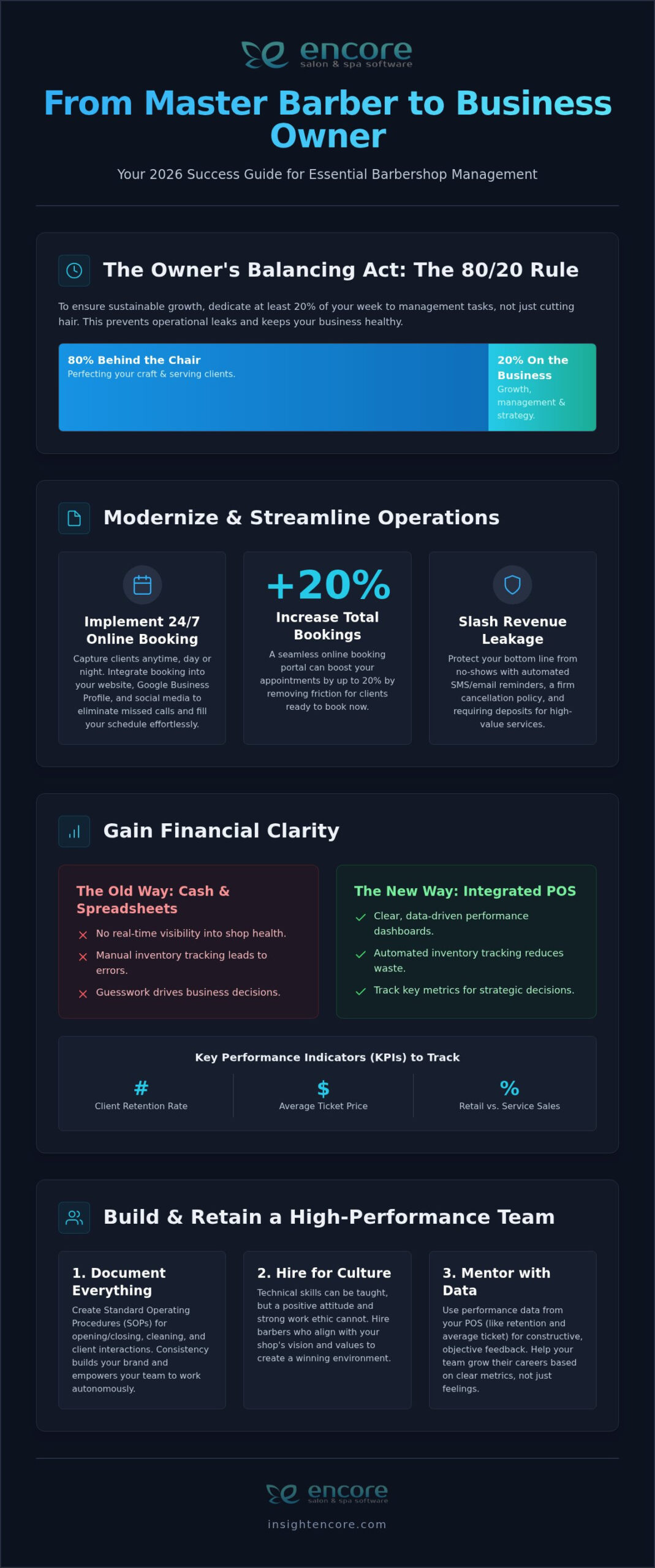
Categories
Uncategorized

Barber Shop POS System: The Ultimate 2026 Guide to Modern Management

Did you know that 74% of Gen Z men will skip your shop entirely if they can’t book their fade online? It’s a staggering reality in 2026. If you’re still relying on a paper ledger or a basic cash drawer, you aren’t just losing time; you’re losing the next generation of loyal clients. Finding the right barber shop POS system is no longer about just swiping cards. It’s about building a digital foundation that works while you’re behind the chair.

We understand the frustration of balancing a straight razor in one hand and a ringing phone in the other. It’s exhausting to manage a busy floor while worrying about manual commission errors or hardware that freezes during the Saturday rush. You deserve a system that acts as a supportive partner rather than a source of stress. This guide will show you how to turn your shop into a high-growth, automated grooming empire where the chairs stay full and the payouts happen on autopilot.

We will explore the essential management features for 2026, from handling booth renters to seamless inventory tracking, so you can finally trade your spreadsheets for peace of mind.

Key Takeaways

  • Reclaim your time and stop answering the phone with 24/7 online booking that meets the high expectations of today’s clients.
  • See how a modern barber shop POS system acts as your digital manager by tracking client history, loyalty rewards, and retail inventory automatically.
  • Remove the stress of payday with automated tools that calculate complex commission splits and booth rental fees accurately for every team member.
  • Learn the simple steps to audit your current hardware and transition to a system that supports both walk-ins and scheduled appointments.
  • Discover how to transform your shop from a manual business into a scalable empire that grows even when you aren’t behind the chair.

Why Your Barber Shop POS System is the Heart of Your Business

Your shop is more than just a place for a fresh fade. It’s a sanctuary for style and community. However, behind the scenes, the daily logistics can quickly become a headache if you don’t have the right tools. A modern barber shop POS system is no longer just a digital cash drawer; it is the central nervous system of your entire operation. By 2026, the most successful shops have moved toward cloud-based management. This technology allows you to oversee scheduling, payments, and staff performance from any device, whether you’re at the shop or taking a well-deserved day off.

Moving away from the traditional pen and paper model is about more than just looking high-tech. It’s about data and efficiency. When you digitize your workflow, you eliminate the scheduling bottlenecks that leave chairs empty and clients frustrated. Integrated payments also have a massive impact on your daily cash flow. Instead of manual reconciliations that take hours at the end of a long shift, your system handles the math instantly. It’s a supportive partner that lets you focus on your craft while it manages the numbers.

The Death of the Manual Cash Register

Manual entry is a silent profit killer. Many shop owners discover that manual processes lead to roughly 5% to 10% in revenue leakage every single month. These small errors in math, missed product sales, or forgotten add-ons like beard trims add up quickly. Beyond the math, traditional cash-heavy operations carry significant security risks. A digital system provides a transparent paper trail for every transaction. Plus, every time you send a digital receipt, you’re building a client email list automatically. This makes it easier to reach out with loyalty rewards or automated marketing programs that keep your chairs full.

Bridging the Gap Between Booking and Billing

Think about the Saturday morning rush. The shop is buzzing, the music is up, and your lobby is full. The last thing you want is a bottleneck at the front desk while a client tries to pay. A specialized barber shop POS system links your online appointments directly to the final checkout screen. This means your staff doesn’t have to re-enter service details or prices manually. We define a seamless checkout as the perfect union of scheduling and payment data; it ensures that what was booked is exactly what is billed. This reduces friction for your clients and keeps the energy in your shop positive and professional. It’s about creating a smooth experience from the moment they book until they walk out the door looking their best.

Essential Features Every Barber Shop Needs in 2026

Running a shop in 2026 means being available even when you’re asleep. With 74% of Gen Z males refusing to visit shops without online booking, your digital presence is your new storefront. A robust barber shop POS system handles these bookings 24/7, ensuring your calendar stays full without you ever picking up the phone. It’s about giving your clients the convenience they crave while protecting your personal time. You can focus on the fade while your software manages the queue.

Beyond the calendar, your software should act as a detailed memory for your business. Client Management (CRM) tools allow you to track specific hair preferences, past services, and even birthday rewards. When a client walks in, you already know exactly how they like their taper. Pair this with automated inventory tracking that alerts you when beard oils or pomades run low. You’ll never have to tell a customer you’re out of their favorite product again. This level of organization transforms a simple visit into a premium experience. The same principle applies across the grooming industry — for example, pet grooming appointment software uses identical logic to track animal health notes and client preferences so groomers can stay focused on their craft rather than their calendar.

Integrated Credit Card Processing

One of the biggest drains on a barber’s income is the dreaded no-show. By using Integrated Credit Card Processing, you can implement no-show protection that requires deposits or cancellation fees. This ensures your time is respected and your income is protected. Look for transparent processing rates rather than just chasing “free” hardware. While typical fees range from 2.3% to 3.5%, knowing exactly what you pay per transaction provides the peace of mind you need to manage your margins effectively. Reliable systems keep the checkout fast so the next client can get in the chair on time.

Automated Marketing and Loyalty

Slow Tuesday mornings don’t have to be the norm. Your POS data is a goldmine for filling those gaps. You can set up automated “We Miss You” texts for clients who haven’t visited in four weeks, offering a small incentive to get them back in the chair. Digital punch cards are another great way to build loyalty without the hassle of physical cards that clients always lose. These tools work in the background to ensure your retention rates stay high without extra effort on your part.

Surprisingly, these features also boost your local visibility. When your system consistently captures client data and encourages reviews, it signals to search engines that your business is active and trusted. This helps you rank higher when locals search for a “barber near me.” If you want to see how these tools can work for your specific shop layout, feel free to reach out to our team for a chat about your goals.

Managing the Team: Commission vs. Booth Renters

Managing a talented team of barbers is often more about people than hair. Whether you run a commission-based shop or lease out chairs to independent contractors, your barber shop POS system must act as a neutral third party. It isn’t just about collecting money; it’s about maintaining trust. Hybrid shops that combine both models under one roof are becoming more common in 2026, but they require software that can keep these distinct financial worlds separate. Automated math for splits, product deductions, and tips ensures that every Saturday night doesn’t end with a stack of receipts and a headache.

Giving your barbers individual logins is a game changer for retention. When staff can track their own performance, they feel empowered and motivated. They can see their service totals and retail sales in real-time, which encourages them to upsell that extra beard oil or pomade. From a legal standpoint, keeping shop finances and renter income distinct is vital for tax compliance. For booth renters, who often face a 15.3% self-employment tax on net earnings, this separation is the difference between being a true business owner and a misclassified employee.

Specialized Tools for Booth Renters

Independent contractors are essentially running a small business within your four walls. They need their own mini-management system to handle their specific clients and track their expenses. By providing them with professional tools, you help them manage their own “barber shop near me” presence more effectively. For a deeper look at how this works, check out our Independent Stylist’s Guide. It explains why a dedicated app is essential for staying organized and professional in 2026.

Commission Tracking Without the Headache

If you’re still using spreadsheets or paper to calculate weekly payouts, you’re likely spending hours on tasks that should take seconds. Manual entry often leads to disputes and staff distrust. Modern barber shop POS system software provides real-time reporting on service versus retail commissions, including automated deductions for backbar products. Shop owners report that automating these payouts can reduce back-office hours by as much as 75%. This transparency doesn’t just save you time; it keeps your best barbers from looking for a chair elsewhere. They know their pay is accurate, and they can see exactly how they earned it.

Barber Shop POS System: The Ultimate 2026 Guide to Modern Management

How to Choose the Best POS System for Your Shop

Selecting your next management tool is a big step for your business. It isn’t just about picking software; it’s about finding a partner that understands the unique rhythm of a busy shop. Start by evaluating your primary model. While 57% of visits are still walk-ins according to 2026 industry data, the shift toward pre-booking is growing fast. Your barber shop POS system must handle both hybrid models and pure appointment schedules without missing a beat. It should feel like a natural extension of your front desk, not a technical hurdle.

Next, audit what you already own. There is no need to throw away perfectly good iPads or tablets if you don’t have to. Many modern systems are flexible enough to work with your current setup. Once you’ve checked the gear, do the real math on costs. A mid-tier software plan often costs between $50 and $100 per month. Don’t just look at the subscription fee; look at the transaction rates too. Typical processing fees range from 2.3% to 3.5%. You want a transparent structure that doesn’t eat into your margins with hidden costs.

Test the mobile experience before you commit. You shouldn’t be chained to the front desk all day. You need the ability to check your shop’s performance or adjust the schedule from your phone while you’re grabbing lunch or at home. Finally, check the human support factor. If your system goes down during the Saturday rush, will a real person answer the phone? You deserve an ally who is as invested in your success as you are, not an automated ticket system that leaves you hanging.

Avoiding the “Free” Hardware Trap

“Free” hardware is often a bait-and-switch. These deals usually come with much higher transaction fees or long, restrictive contracts that are difficult to break. Your data is your property. Make sure you can export your client lists and sales history whenever you need. In 2026, your hardware must meet modern standards, including NFC tap-to-pay, EMV chips, and a reliable offline mode. This ensures you can keep taking payments even if the shop’s Wi-Fi blinks out during a peak hour.

Scalability: Planning for Shop Number Two

If you’re planning for shop number two, you need a system that thinks big. Multi-location reporting is vital for seeing the whole picture across different neighborhoods. Encore Barber Software is built to grow with you. It provides the high-level oversight you need without the technical headaches. Your POS should be the engine that drives your expansion, not the anchor that holds you back. It’s about building a foundation that stays strong as your empire grows.

Ready to see a system that actually fits your workflow? Schedule a personalized demo today and let’s talk about how to future-proof your business.

The Encore Advantage: Professional Management for Modern Barbers

Choosing a barber shop POS system is a decision that impacts every chair in your shop. At Encore, we bring 35 years of industry experience to the table. We’ve seen this industry evolve from basic paper ledgers to the high-tech, automated environment of 2026. Our goal is to act as your friendly guide. We help you navigate the complexities of modern management with software that feels like a supportive partner. We don’t just provide code; we provide a foundation for your professional growth.

Our system streamlines your entire backend so you can focus on your craft. It handles everything from tracking pomade inventory to launching automated marketing campaigns that fill slow mornings. Thousands of independent professionals trust our specialized modules because they’re built for the reality of a busy shop floor. We focus on the small details that keep your business running smoothly. This ensures you have the peace of mind to focus on the craftsmanship that keeps your clients coming back for every fresh fade.

A Partner in Your Success

We’re deeply committed to removing the common industry frustrations that keep shop owners up at night. Whether it’s preventing last-minute cancellations with our Online Booking Module or ensuring your booth renters have clear financial records, we’re here to help. Transparency is at the core of what we do. You won’t find hidden fees or confusing contracts here. We want to empower you to level up your operation. You can explore our features to see how we help you master your business and scale effectively.

Next Steps for Your Shop

Making the switch to a new system might feel intimidating, but it doesn’t have to be. We’ve helped countless shops transition their data without losing a single client record. The process is straightforward and designed to minimize downtime. You don’t have to figure it out alone. Our team is ready to walk you through every step of the setup.

The first step is simple. Book a personalized demo to see our features in action and ask questions specific to your shop’s layout. You can also explore our Pricing page to see our transparent options. Let’s work together to turn your shop into the automated grooming empire you’ve always envisioned. We’re excited to help you build a more organized, profitable, and stress-free business.

Build Your Modern Barbering Empire

The transition from a traditional walk-in shop to a high-growth, automated business doesn’t happen by accident. It requires a foundation that handles the heavy lifting of scheduling, staff payouts, and client retention while you focus on the chair. By choosing a barber shop POS system that prioritizes both human connection and technical reliability, you’re investing in your own peace of mind. You’ve seen how the right tools can eliminate no-shows and turn manual commission math into a few simple clicks.

At Encore, we bring over 35 years of beauty and wellness expertise to your front desk. Our dedicated booth renter and commission modules are designed to handle the unique hurdles of the barbering industry without the headache of hidden fees. We’re here to be your friendly guide as you scale your business and reclaim your time. It’s time to stop managing spreadsheets and start mastering your craft with a partner that understands your vision. Upgrade your shop with Encore Barber Software today and take the first step toward a more organized, profitable future. You’ve built the brand; now let’s build the system that helps it thrive.

Frequently Asked Questions

What is the best POS system for a small barber shop with only two chairs?

The best system for a two-chair shop is one that balances powerful features with simplicity. You need online booking and basic client tracking to keep those chairs full without spending all day on the phone. Look for a solution that lets you start with the essentials and add more advanced tools as you expand your business.

Can I use a barber shop POS system on an iPad or tablet?

You can absolutely use your barber shop POS system on an iPad or most standard tablets. Cloud-based software is designed for flexibility, so you aren’t tied to a bulky counter setup. This allows you to check clients in or process payments right from your station, which keeps the flow of the shop moving smoothly.

How do POS systems handle booth rental payments and taxes?

Specialized software handles booth rentals by automating the math for weekly fees and keeping those payments distinct from shop revenue. This is crucial for tax compliance, especially since independent contractors face specific self-employment tax obligations. Integrated modules ensure that both the shop owner and the renter have clear, accurate records of every transaction.

Is it possible to switch POS systems without losing my client history?

Switching systems is a straightforward process that shouldn’t result in lost client data. Most professional software providers offer data migration services to help you move your history, notes, and contact lists over safely. We recommend looking for a partner that offers human support to guide you through the transition so you don’t miss a single appointment.

Do I need a separate merchant account for my barber shop POS?

You don’t usually need a separate merchant account when you choose a system with integrated credit card processing. This setup is often more efficient because it links your sales data directly to your billing reports. It simplifies your daily reconciliation and ensures that your processing rates are transparent and easy to track.

How much does a typical barber shop POS system cost in 2026?

In 2026, a mid-tier barber shop POS system typically costs between $50 and $100 per month for the software subscription. You should also budget for one-time hardware costs, which can range from $300 for a basic setup to $1,500 for a full counter system. Processing fees are an ongoing cost, generally falling between 2.3% and 3.5% per transaction.

Can a POS system help me rank higher for “barber shop near me” on Google?

Your POS system helps you rank for “barber shop near me” by capturing client data that fuels your local SEO. When your software encourages automated reviews and keeps your business information consistent across the web, search engines see you as a trusted local authority. It’s a smart way to turn your daily operations into a marketing engine.

Disclaimer

This article is general in nature and may contain errors, please verify all claims with your sales rep