
In 2026, the choice between salon commission vs booth rental has shifted from a simple math problem to a strategic decision about your professional sanity. You’ve likely felt the pressure of rising overhead costs cutting into your take-home pay. Maybe you’re even losing sleep over the threat of an IRS misclassification audit or struggling to keep your culture alive. It’s frustrating to feel like you’re working for your business instead of the other way around.
We believe you should feel confident and in control of your profit margins. This guide will help you discover the financial, legal, and operational differences between these two models so you can choose the most profitable path for your specific goals. We’ll provide a clear financial comparison and a step-by-step implementation plan to help you scale with ease. From understanding the true cost of a W-2 employee to mastering the "landlord" model of booth rentals, you’re about to get the clarity you need to lead your salon with total peace of mind.
Key Takeaways
- Understand the fundamental operational differences between W-2 commission employees and 1099 independent contractors to ensure your salon remains compliant.
- Analyze a side-by-side financial breakdown of salon commission vs booth rental to see which model actually leaves more profit in your pocket at the end of the month.
- Master the IRS “Control Test” to protect your business from misclassification audits and understand the legal boundaries of managing independent renters.
- Follow a clear two-step implementation plan to audit your financial health and evaluate local market demand before committing to a new business structure.
- Learn how to reclaim your time by automating complex payroll calculations and booth management tasks with specialized software solutions.
Understanding the Core Models: Salon Commission vs. Booth Rental in 2026
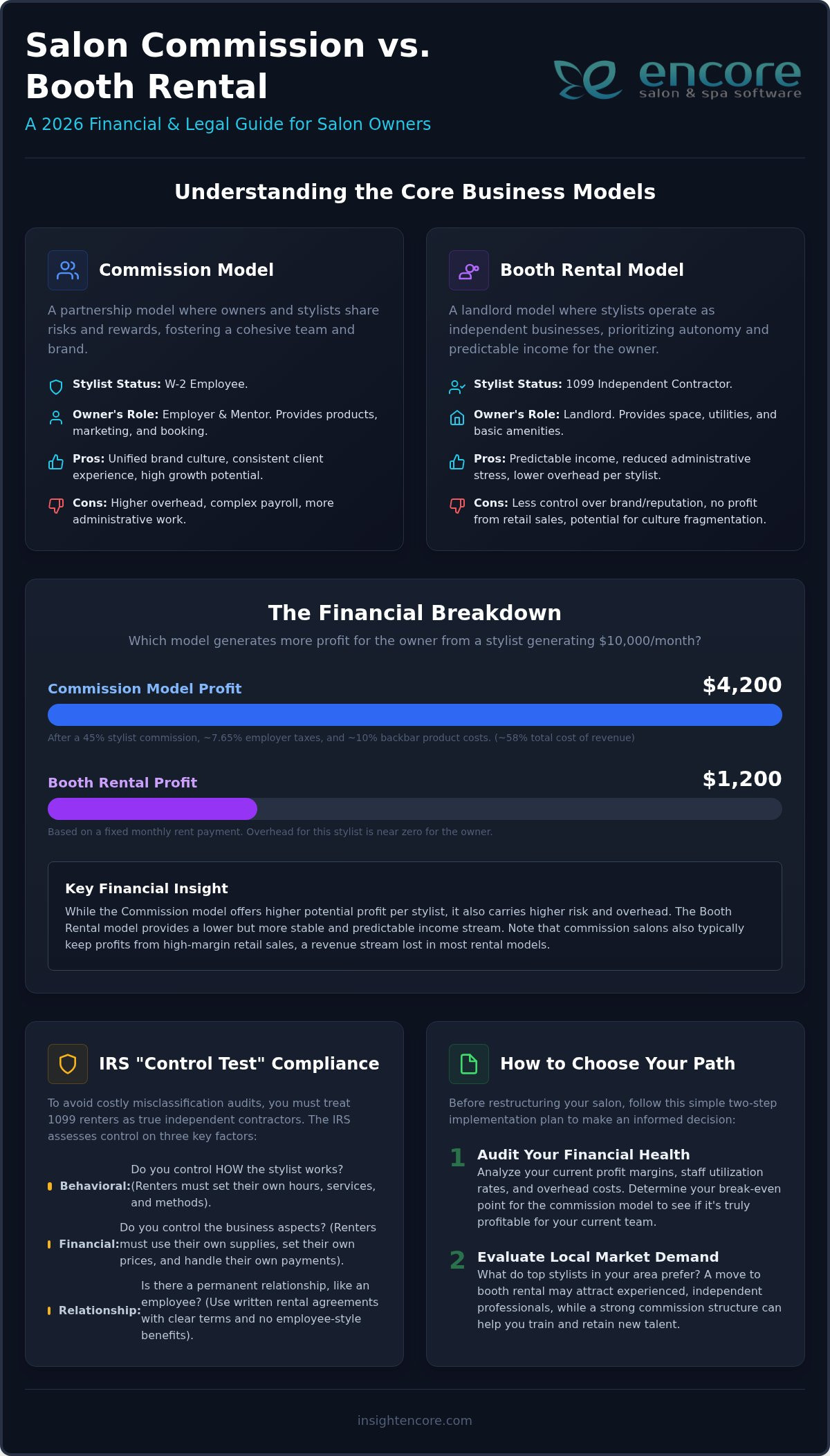
Salon Commission is a collaborative growth model where owners and stylists share risk and reward. In the competitive 2026 market, choosing between salon commission vs booth rental is about more than just numbers. It’s about the culture you want to build. The commission model treats stylists as W-2 employees who earn a percentage of their total service revenue. On the other hand, the booth rental model views stylists as independent 1099 contractors who pay a fixed fee for their space. Both have merits, but they require very different management styles.
Many high-end urban salons are moving toward hybrid approaches. This flexibility helps owners adapt to shifting salon industry trends where professionals value both the support of a team and the freedom of independence. It’s a way to keep your best talent from walking out the door to start their own studio. By offering different paths, you can meet your stylists exactly where they are in their careers.
The Commission Model: A Partnership for Growth
This model is a true partnership. In 2026, commission splits typically range from 40/60 to 60/40, depending on the stylist’s experience level and your salon’s location. As the owner, your role is to provide the infrastructure for success. You supply the backbar products, lead the marketing efforts, and manage the booking portal to ensure a steady stream of clients. It takes the pressure off the stylist so they can focus on their craft. They don’t have to worry about the logistics of running a business; they just have to do great hair.
One of the biggest perks here is brand cohesion. Since you’re the employer, you can establish a unified culture and service standard. It creates a reliable guest experience that keeps people coming back. While it involves more administrative work and higher overhead, the potential for long-term growth is significant. You’re building an asset that is bigger than any one individual.
The Booth Rental Model: The Landlord Approach
Booth rental is the preferred choice for stylists who prioritize maximum autonomy. In this scenario, your role shifts from a mentor or boss to a landlord. You provide the physical chair, utilities, and basic amenities. The stylists handle everything else. They buy their own products, set their own prices, and manage their own schedules. It’s a hands-off relationship that significantly reduces your daily stress. You aren’t responsible for their performance, only for the space they occupy.
This model offers a predictable income stream. You don’t have to worry about a slow week affecting your ability to pay the bills. However, it also means you have less control over the salon’s reputation. You aren’t managing a team; you’re managing a facility. It works best for owners who want to scale their real estate footprint without the complexities of traditional staff management.
The Financial Comparison: Which Model Generates More Profit?
Let’s look at the hard numbers. If a stylist generates $10,000 in monthly service revenue, the outcome of salon commission vs booth rental looks very different on your balance sheet. In a 45% commission split, you’d seemingly keep $5,500. However, the true cost of a W-2 employee is often 53% to 58% of their revenue once you factor in the 7.65% employer FICA tax and backbar supplies. This leaves you with a gross profit closer to $4,200. In a rental model, you might collect an average monthly rent of $1,200. While the rental check is smaller, your overhead for that specific stylist is nearly zero.
Retail sales also tip the scales. In a commission salon, you typically keep the majority of retail profit after paying a 10% to 15% incentive to the stylist. In a rental setup, the stylist usually carries their own inventory. This means you miss out on a high-margin revenue stream. Understanding these nuances is vital for following IRS guidelines on worker classification, as financial control is a major factor in legal audits.
Calculating the Break-Even Point for Commission
To succeed with commission, you must monitor your salon staff utilization rates. If a stylist’s chair is empty half the day, you’re losing money on fixed costs like rent and electricity. You also need to account for "backbar" costs like shampoos, dyes, and foils, which typically range from 8% to 13% of service revenue. Automated tracking prevents profit leaks by ensuring every ounce of color is accounted for in your margins. You can see how automation simplifies these calculations to protect your bottom line.
Stability vs. Scalability in Booth Rental
Many owners choose rental for the "guaranteed income," but this can be a myth. You still face vacancy risks and the headache of late rent payments. An empty chair earns $0, but you still pay the full lease for the square footage. Rental income is strictly capped by the number of chairs you have. While a rental model offers a predictable baseline, it lacks the explosive growth potential of a high-performing commission team. A 5-stylist commission salon often has a much higher long-term ROI because you profit from every extra service and treatment sold. If you’re weighing salon commission vs booth rental for a new location, consider if you want a stable floor or a high ceiling.
Navigating the Legal Landscape: W-2 Employees vs. 1099 Contractors
The legal distinction in the salon commission vs booth rental debate often comes down to one thing: control. The IRS uses a "Control Test" to decide if a worker is an employee or an independent contractor. If you set their working hours, dictate which products they use, or enforce a specific dress code, they are legally W-2 employees. Misclassifying these workers as 1099 contractors is the number one legal risk for salons in 2026. Penalties can be steep, often starting at 1.5% of wages plus back taxes and interest. It’s a heavy burden that can easily be avoided with the right structure.
Maintaining legal separation is especially important for booth renters. One way to prove independence is through credit card processing. Each renter should have their own merchant account so client payments go directly to them, not through your salon’s primary bank account. You also need to verify insurance. W-2 staff are covered by your general business policy and workers’ compensation, but 1099 renters must carry their own professional liability coverage. Seeing these certificates annually protects your business from third-party claims.
W-2 Compliance: Managing the Administrative Burden
Running a commission salon means you’re responsible for the heavy lifting of payroll. You have to handle federal and state tax withholding, unemployment insurance, and Social Security contributions. It’s a lot to track manually. Many owners find that calculating salon staff commission automatically is the only way to stay compliant without losing hours to spreadsheets. Since these stylists are your employees, you also have the right to manage their growth. Using a structured employee performance review template helps you document their progress and maintain high service standards while keeping your records audit-ready.
1099 Compliance: The "Hands-Off" Rule
To keep your booth rental model safe from audits, you have to follow the "Hands-Off" rule. You cannot require renters to use your specific salon software unless you provide it as a free amenity included in their rent. They are independent business owners. This means they must have their own business licenses and individual tax IDs. Your rental agreement should be clear: you are providing the space, not managing their business. Establishing these boundaries early protects you if the IRS ever comes knocking. It’s about creating a professional environment where they can thrive as independent partners rather than subordinates.
How to Choose and Implement the Right Structure for Your Salon
Deciding on salon commission vs booth rental isn’t a one-time choice. It’s a strategic evolution. To make the right move in 2026, follow a logical path that protects your peace of mind and your profits. Start by evaluating local market demand. If your city is flooded with solo suites, stylists might be craving the community of a commission house. Conversely, if high-end talent is looking for more freedom, a rental model might be your fastest path to growth.
- Audit your finances: Review your overhead capacity. Can you handle the 7.65% employer FICA tax and the administrative weight of W-2 staff?
- Define your vision: Decide if you want a curated, high-touch luxury brand or a collective of independent entrepreneurs.
- Draft your contracts: Ensure your agreements reflect the 2026 legal standards for worker classification we discussed earlier.
- Select your platform: Choose a management system that automates the specific burdens of your chosen model.
Transitioning from Commission to Rental (or Vice Versa)
Changing your business structure is a big shift, but it doesn’t have to be a crisis. Communication is everything. When you announce a change, focus on the benefits for the stylists. If you’re moving to commission, highlight the marketing support and lack of business overhead. If you’re moving to rental, celebrate their new independence. This is also the time to audit your salon pricing. A commission model often requires a price increase to maintain healthy margins after accounting for backbar and payroll costs.
Some owners find success with a hybrid model. This allows you to offer commission to new talent while providing rental chairs to your seasoned veterans. It’s a great way to retain top performers who might otherwise leave to open their own studio. Just remember that a hybrid salon requires strict legal boundaries to avoid "control" issues with your renters. You must treat them as separate businesses sharing one roof.
Setting Up Your Tech Stack for Success
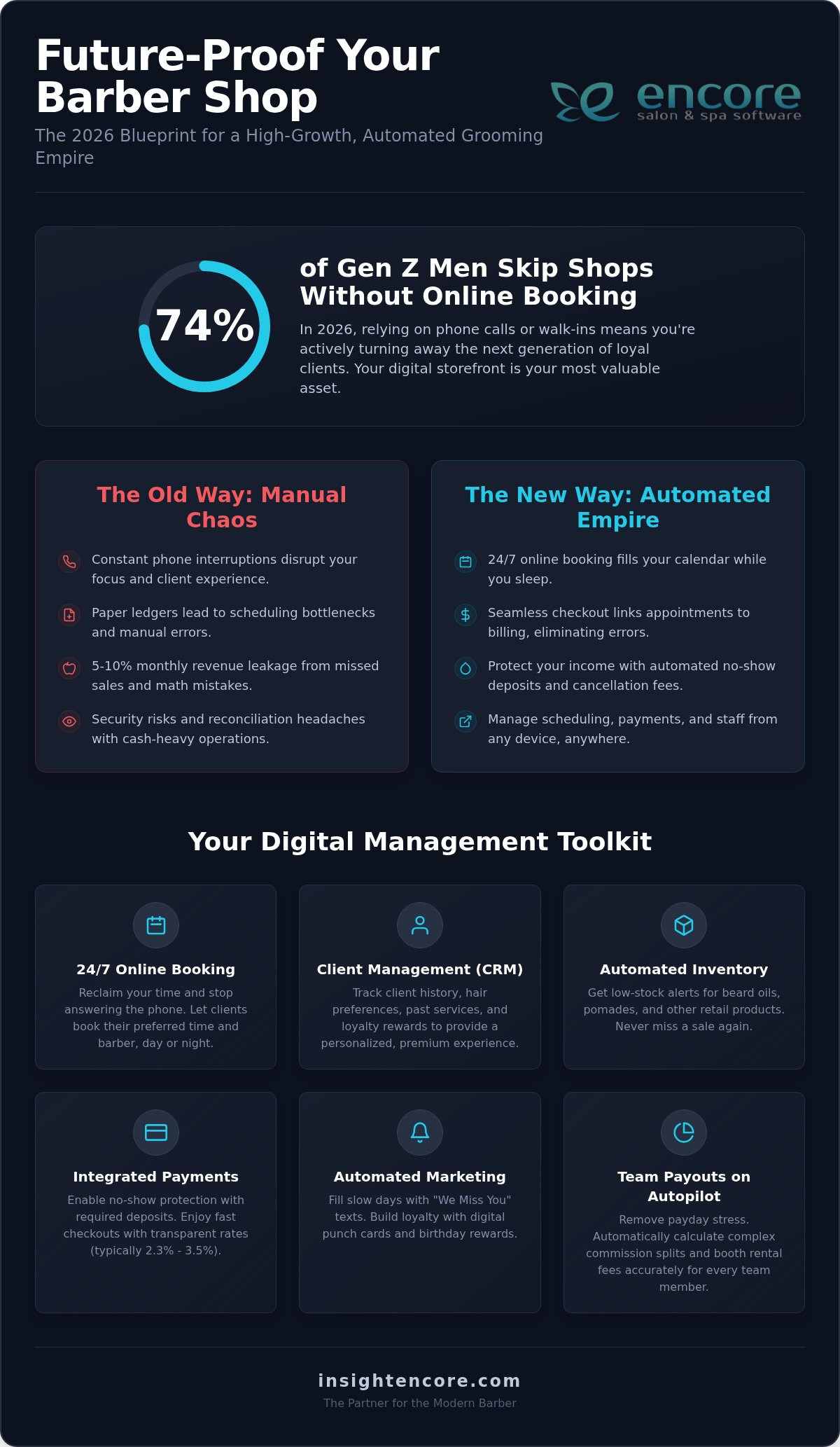
Your software should be your biggest ally, not a source of frustration. In a rental or hybrid setup, each stylist needs a dedicated client management app. This ensures they can manage their own books and financial data independently. As the owner, you can still centralize the overall facility booking while keeping individual revenue streams separate. For barbershop owners navigating similar booth rental decisions, a dedicated barbershop scheduling app can automate bookings and eliminate no-shows while keeping each barber’s revenue stream clearly separated. For inventory, automation is key. Use a system that tracks usage by stylist so you can accurately charge for backbar supplies or manage shared inventory without the guesswork.
Streamlining Salon Payroll: Managing Every Model with Encore
Managing the administrative side of your business shouldn’t feel like a second job. Whether you’ve landed on the side of salon commission vs booth rental, the right tools turn a mountain of paperwork into a few clicks. Encore Salon & Spa Software has become the industry standard for 2026 payroll management because it removes the guesswork. It’s designed to handle the messy reality of salon life, from sliding scale commissions to independent rent tracking, all in one place.
We know that as a salon owner, your time is your most valuable asset. Spending hours every Sunday night on spreadsheets isn’t sustainable. Our system bridges the gap between your brand vision and the technical reality of local labor laws. It’s about giving you the peace of mind that your team is paid accurately and your renters are managed professionally. You can focus on the creative side of your business while we handle the data.
Automating Commission to Save 10+ Hours a Week
Manual spreadsheets are a recipe for errors and frustration. With Encore, you can automate even the most complex commission structures. Whether you use tiered splits, product bonuses, or sliding scales that increase as sales grow, the software does the math for you. Real-time performance dashboards give your stylists a clear view of their progress. This motivates them to hit their goals without you needing to play the role of a taskmaster. It’s a win-win for everyone involved.
Speed is essential in 2026. Direct integration with credit card processing allows for seamless payouts and transparent reporting. You’ll eliminate "back-of-the-napkin" calculations that lead to profit leaks. By automating these tasks, most owners reclaim at least 10 hours every week. That’s time you can spend behind the chair or growing your brand. It’s about working smarter, not harder.
The Landlord Toolbox: Managing Booth Renters
If you’ve chosen the rental path, you need a different set of tools. Our specialized Chair/Booth Renter module empowers independent stylists while protecting your facility’s organization. You can automate rent collection and send professional invoices automatically. This ensures you never have to have an awkward conversation about a late payment. It turns you into a professional landlord with minimal effort.
Renters get their own secure login to manage their clients and schedules independently. This keeps your financial data separate, which is a key requirement for IRS compliance. Plus, our integrated gift card management works across all staff types. Whether a client buys a card for a commission stylist or a booth renter, the system tracks the balance and ensures the right person gets paid when it’s redeemed. You get advanced analytics to monitor the overall health of your salon, giving you total control without the micromanagement.
Build a Profitable Future for Your Salon
You now have the roadmap to navigate the 2026 landscape with total confidence. Whether you lean toward the collaborative growth of a team or the streamlined efficiency of a rental space, your success depends on clear data and legal compliance. Choosing between salon commission vs booth rental is no longer a guessing game when you have the right financial and legal boundaries in place.
We’ve been supporting top salons and spas globally since 1991. Our specialized modules for both commission and rental models take the administrative burden off your shoulders. With integrated credit card processing for faster payouts and automated tracking, you can finally focus on what you love. You don’t have to handle the transition alone. We’re here to help you automate the hard parts so you can enjoy the rewards of a healthy, scaling business.
Try Encore Now – The All-in-One Solution for Any Salon Model
Take the first step toward a more organized and profitable business today. We’re excited to see your salon thrive and grow.
Frequently Asked Questions
Is salon commission or booth rental better for a new salon owner?
When weighing salon commission vs booth rental as a new owner, commission is often the better choice for building a strong brand. It allows you to set service standards and mentor your team to ensure a consistent guest experience. Booth rental is a lower-risk option if you prefer a landlord role with predictable income. Your decision should align with whether you want to manage a team or simply provide a professional space.
What is the average commission split for a hair stylist in 2026?
In 2026, the industry standard for W-2 stylists typically ranges between 40% and 60% of service revenue. Most modern salons land in the 45% to 55% range. Many owners are moving toward tiered or sliding scale models that reward higher productivity. This structure ensures the salon covers its overhead while giving stylists a clear path to increase their earnings as they grow their book of business.
Can I legally tell a booth renter what products to use in my salon?
No, you cannot legally dictate which products a booth renter uses. Under IRS guidelines, an independent contractor must have control over the tools and supplies they use to perform their work. If you require them to use specific brands, you risk misclassifying them as employees. You can offer products as an optional amenity, but the choice must ultimately remain with the renter to maintain a true 1099 relationship.
How do I calculate the break-even point for a rental chair?
To find your break-even point, add up the total fixed costs for the space, including rent, utilities, insurance, and maintenance. Divide this total by the number of chairs available for rent. This number represents the minimum weekly or monthly fee you must charge per renter to cover your expenses. Don’t forget to factor in a margin for vacancy periods to ensure your business remains profitable even when a chair is empty.
What are the biggest tax advantages of the booth rental model?
The primary tax advantage for owners is the elimination of employer-paid payroll taxes. You aren’t responsible for the 7.65% FICA tax, unemployment insurance, or workers’ compensation for independent renters. This significantly reduces your administrative overhead and tax liability. For the stylists, being a 1099 contractor allows them to deduct business expenses like tools and education, though they must pay the full 15.3% self-employment tax on their net earnings.
Can a salon have both commission stylists and booth renters?
Yes, many salons successfully operate using a hybrid model. This setup allows you to offer commission to new talent while providing rental chairs to your seasoned veterans. It’s a great retention strategy for top performers who want more independence. However, you must be extremely careful to maintain distinct legal boundaries. You cannot treat your renters like employees or use the same control measures for both groups without risking an audit.
How does salon software help with IRS compliance for 1099 contractors?
Specialized software like Encore provides clear financial separation between the salon owner and independent renters. It allows each professional to manage their own booking and payments through a secure login. This separation is a key factor in proving to the IRS that you don’t exert financial control over the contractor. Using a dedicated module helps document the independent nature of the relationship, which is vital for maintaining compliance in the salon commission vs booth rental debate.
Disclaimer
This article is general in nature and may contain errors, please verify all claims with your sales rep