
window.dataLayer = window.dataLayer || []; function gtag(){dataLayer.push(arguments);} gtag('js', new Date()); gtag('config', 'UA-206511945-1');
Search
Categories
Uncategorized

PCI Compliance for Salons: 2026 Security Guide

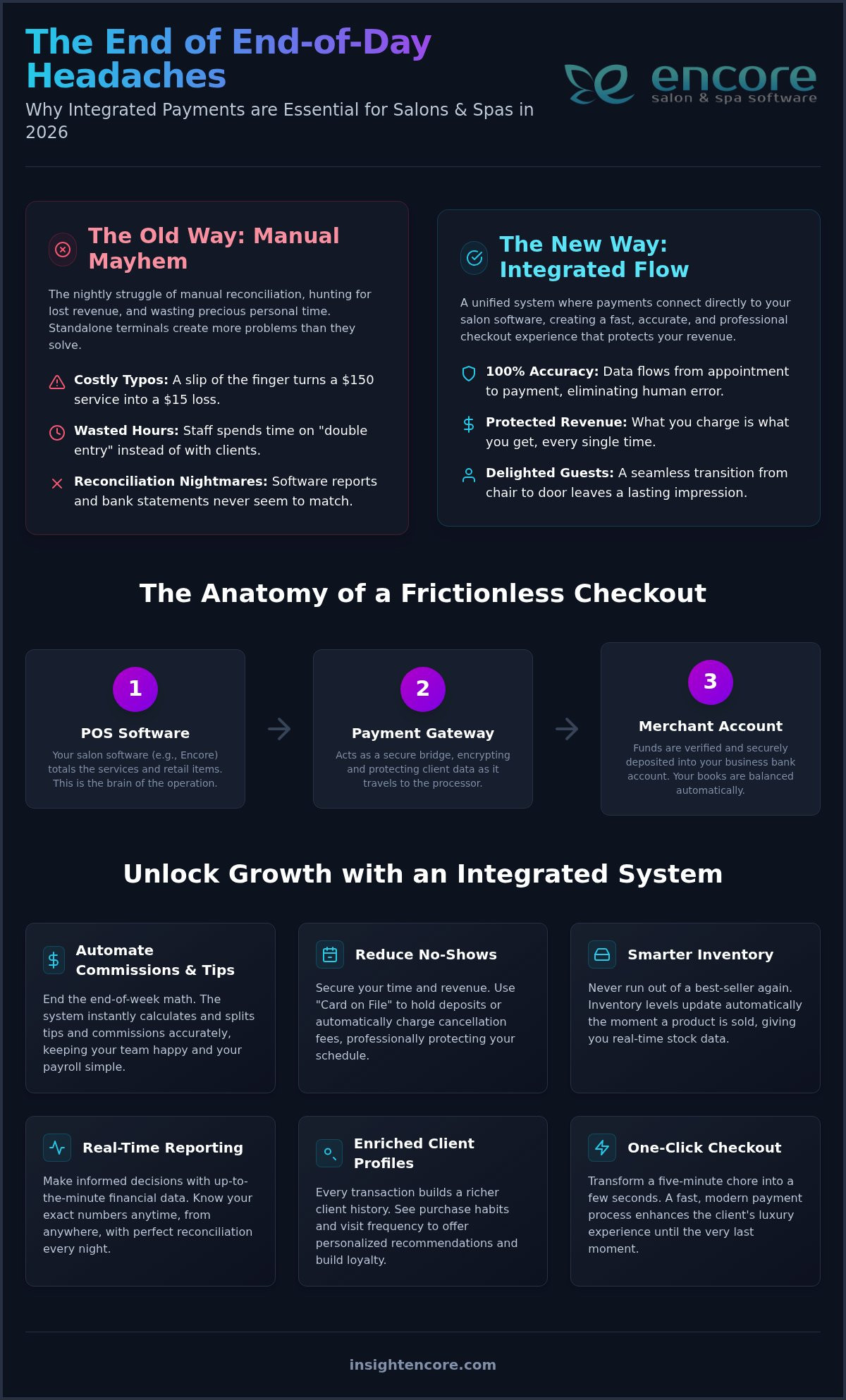
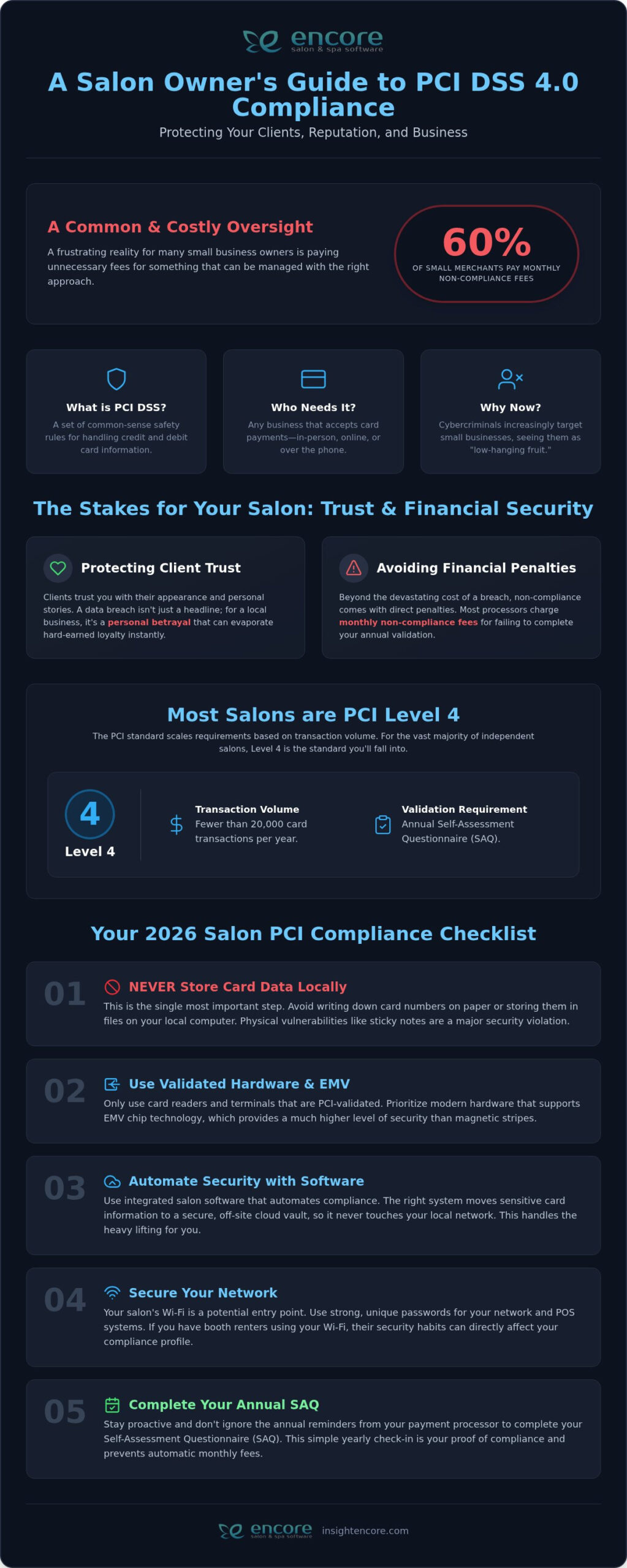
Did you know that roughly 60% of small merchants pay monthly non-compliance fees simply because they haven’t checked the right boxes? It’s a frustrating reality for many owners who would rather focus on their clients than on technical manuals. Managing pci compliance for small business salons often feels like a full-time job involving endless paperwork and the constant fear of a surprise fine. You’ve worked hard to build a reputation of trust. A single data breach shouldn’t be allowed to put that relationship at risk.

We understand that keeping up with the transition to PCI DSS 4.0 can feel overwhelming, especially when you’re trying to decipher complex security requirements. This guide is here to remove that stress. You’ll learn exactly how to protect your salon from data breaches and meet modern security standards without the usual technical headache. We’ll provide a clear checklist of actions and show you how the right software can automate the most difficult parts of the process. You deserve the confidence that comes with knowing your client data is safe and your business is fully protected.

Key Takeaways

  • Identify why Level 4 is the standard tier for pci compliance for small business salons and how to meet these requirements with minimal paperwork.
  • Learn how to avoid monthly non-compliance fees and protect your salon from the devastating “hidden” costs of a data breach.
  • Discover why never storing sensitive card data on your local devices is the most important step in protecting your clients’ trust.
  • Follow a practical 2026 checklist that focuses on using PCI-validated hardware and modern EMV chip technology.
  • See how integrated software can automate your security by moving sensitive information to a secure, off-site cloud vault.

What is PCI Compliance and Why Does Your Salon Need It?

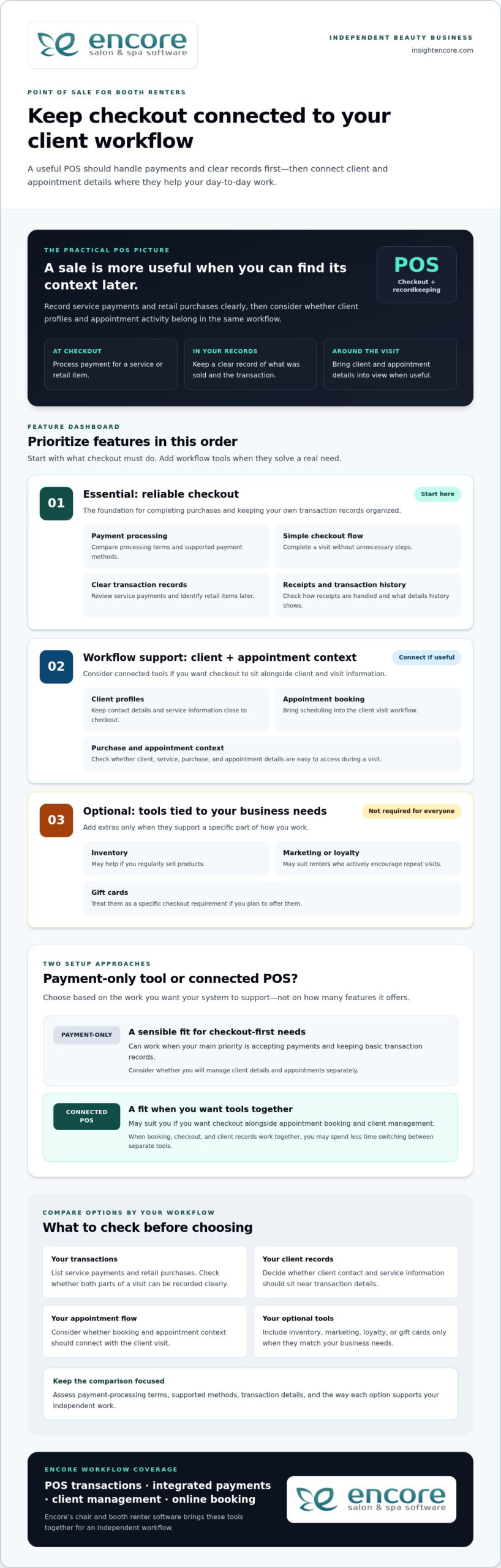
PCI DSS might sound like a mouthful of technical jargon, but it’s actually quite simple. At its core, the Payment Card Industry Data Security Standard (PCI DSS) is a set of common-sense safety rules for digital money. If your salon accepts credit or debit cards, whether through a physical terminal or an online booking system, you’re required to follow these rules. It doesn’t matter if you’re a single-chair studio or a multi-location spa; the standards apply to everyone who touches cardholder data.

In 2026, the digital landscape has shifted significantly. While big-box retailers used to be the main targets for hackers, cybercriminals have turned their attention toward smaller targets. They’ve found that pci compliance for small business salons is often overlooked, making local businesses the “low-hanging fruit” for small-scale breaches. Protecting your business isn’t just a legal hoop to jump through. It’s a fundamental part of your daily operations that keeps your doors open and your reputation intact.

The Link Between Security and Client Trust

Think about the relationship you have with your guests. They trust you with their hair, their skin, and their personal stories. When they hand over a credit card, they’re also trusting you with their financial livelihood. A data breach at a massive corporation is just a headline. A data breach at a local salon is a personal betrayal that can end a stylist’s career.

The emotional impact of identity theft lingers far longer than a bad haircut. If a client’s information is compromised through your system, that hard-earned trust evaporates instantly. By prioritizing security, you’re positioning yourself as a professional who cares about the “behind-the-scenes” details just as much as the final look. Treating data protection as an extension of your high-quality customer service is a smart way to build long-term loyalty.

Common Salon Payment Scenarios

Many owners don’t realize how many touchpoints their data actually has. Whether you’re swiping a card in person or taking a deposit through an online booking module, sensitive data is moving through your network. Each of these scenarios requires specific protections to stay compliant.

Things get even more complex if you have booth renters or independent contractors. If they’re using your Wi-Fi or your software, their security habits directly affect your salon’s compliance profile. One of the biggest risks remains “old school” habits. Writing down a client’s card number on a piece of paper or a sticky note is a major security violation. Digital security starts with moving away from these physical vulnerabilities and using integrated tools like Encore Salon Software to handle the heavy lifting for you.

Understanding the 4 PCI Compliance Levels for Small Businesses

Not every business faces the same level of security scrutiny. The payment card industry divides merchants into four distinct levels based on their annual transaction volume. While it’s tempting to think that being a local shop makes you exempt from these rules, that isn’t the case. Every business that accepts credit cards must validate their compliance. The industry simply scales the proof required so you aren’t stuck with the same audit burden as a global retailer. Understanding pci compliance for small business salons starts with knowing where you fit on this scale.

Level 4: The Small Salon Standard

Level 4 is the standard home for any business processing fewer than 20,000 card transactions per year. For the vast majority of independent salon owners, this is the category where you’ll stay. To maintain your status, you’ll need to complete a yearly self-certification process. This isn’t a physical inspection of your styling stations. Instead, it’s a digital questionnaire where you confirm your security habits and hardware. Your payment processor plays a central role here. They track your volume and send out the annual reminders to stay compliant. Ignoring these requests often leads to automatic monthly non-compliance fees, so it’s best to stay proactive.

The SAQ: Which Version Do You Need?

The Self-Assessment Questionnaire, or SAQ, is the specific document you’ll use to certify your compliance. There are different versions tailored to how you handle client data. SAQ-A is often used when you fully outsource your payments, such as through an online booking portal that handles the transaction entirely off-site. SAQ-B is typically for those using standalone terminals that connect via a phone line or the internet. Choosing the right version is vital because it determines exactly which security questions you have to answer.

Using an integrated system like Encore credit card processing makes this choice much easier. When your point-of-sale software and hardware are designed to work together from the start, they often reduce the scope of your compliance. This means you have fewer technical hurdles to clear and fewer boxes to check on your annual form. It turns a confusing chore into a simple, manageable task. If you’re tired of guessing which forms apply to your business, you can contact our team for a friendly chat about simplifying your setup.

The High Cost of Non-Compliance in the Beauty Industry

Ignoring pci compliance for small business salons isn’t just a security risk; it’s a direct leak in your business bucket. Most payment processors don’t wait for a breach to penalize you. They charge monthly non-compliance fees that typically range from $10 to $100. Over a single year, that is up to $1,200 of your hard-earned money vanishing for no reason other than a missing certificate. This is money that could be spent on better backbar supplies or team education.

If a breach does occur, the situation escalates rapidly. You might be on the hook for forensic audits, which are mandatory investigations that can cost thousands of dollars. You’ll also face card replacement fees for every client affected and potential legal expenses. Many stylists believe they’re too small to be a target, but this is a dangerous misconception. Modern hackers use automated bots that scan the internet for weak spots. These bots don’t care if you have two chairs or twenty; they only care about finding an open door. If you’re found to be at fault during a breach, you could even lose your ability to accept credit cards entirely. That is a death sentence for a modern beauty business.

Fines vs. Fees: What You’ll Actually Pay

It’s vital to distinguish between bank-imposed fees and industry fines. Fees are the monthly charges you pay for simply not being certified. Fines, however, are the massive penalties handed down after a security failure. These can range from $5,000 to $100,000 per month for prolonged periods of non-compliance. This recurring drain on your resources makes it much harder to maintain a healthy business. Learning how to increase salon profit margin starts with plugging these unnecessary financial leaks and protecting what you’ve already built.

The ‘Ghosting’ Effect: Reputation Damage

In 2026, consumers are more sensitive to data privacy than ever before. We live in an “instant cancel” culture where a single security notice can cause your books to empty overnight. If a client receives a letter saying their financial info was compromised at your salon, they won’t just be angry; they’ll feel unsafe. Rebuilding a local brand after a security scandal is incredibly difficult and often more expensive than the fines themselves. Prevention is significantly cheaper than a cure. Taking small steps now to secure pci compliance for small business salons ensures that your reputation for excellence remains untarnished.

PCI Compliance for Salons: 2026 Security Guide

Your 2026 Salon PCI Compliance Checklist: 5 Essential Steps

Securing pci compliance for small business salons isn’t about becoming a tech expert. It’s about building a protective bubble around your daily routine. When you follow these five essential steps, you’re doing more than just following rules; you’re protecting your livelihood and the trust of every guest who walks through your door.

  • Step 1: Use only PCI-validated hardware and software. Ensure your terminals support EMV chip technology and modern contactless payments.
  • Step 2: Never store sensitive card data. This includes CVV codes or full track data on any device, including your salon’s computer or a stylist’s phone. If you don’t have the data, hackers have nothing to steal.
  • Step 3: Secure your salon’s Wi-Fi. Modern salons often run on tablets and mobile devices. You must set up a private network for your business operations and a completely separate guest network for your clients.
  • Step 4: Train your staff on basic hygiene. Ensure everyone has their own unique login and understands that sharing passwords or texting card details is a major risk.
  • Step 5: Complete your annual Self-Assessment Questionnaire (SAQ). This yearly check-in with your payment processor confirms you’re still following best practices and helps you avoid non-compliance fees.

Modern Hardware and the 2026 Standard

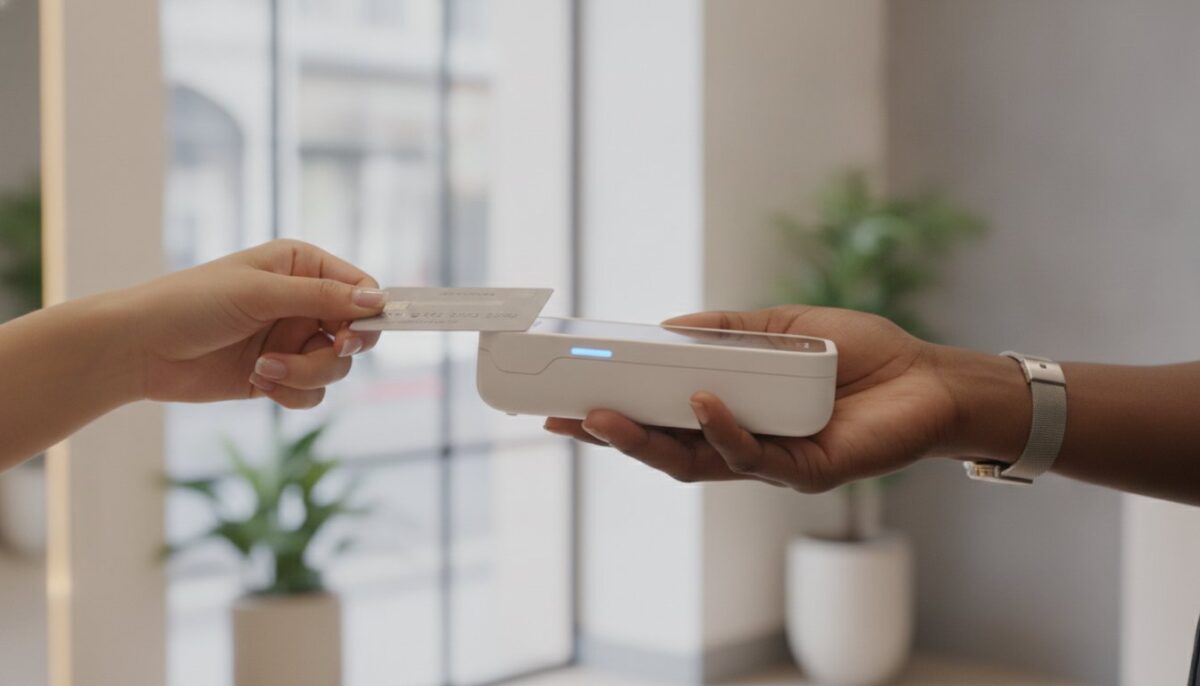
In 2026, the old swipe-only machines are more than just slow; they’re a massive liability. Modern terminals now use Point-to-Point Encryption (P2PE) to protect data from the second a card touches the machine. This ensures that sensitive info is unreadable to anyone trying to intercept it. As we move toward more mobile-first and biometric payments, having hardware that supports these secure, modern methods is vital. You can find more details in our guide on Salon client data security best practices.

Staff Training and Human Error

The most common security leak isn’t a high-tech hack. It’s often a busy stylist texting a client’s card info to the front desk to speed up a checkout. This creates a permanent, unencrypted record of sensitive data on multiple devices. Use your next team meeting to establish simple “dos and don’ts”. For example, never write down card numbers and always use your integrated POS for transactions. Training your team doesn’t have to be a lecture. It’s an opportunity to empower them as protectors of the salon’s reputation. If you have booth renters, make sure your software allows for specific access levels to keep their data separate and secure.

See how Encore can help you stay compliant

Simplifying Compliance with Encore Salon & Spa Software

Managing pci compliance for small business salons doesn’t have to be a solo mission. While the technical requirements of 2026 might seem daunting, the right tools can handle the heavy lifting for you. Encore Salon & Spa Software is designed to act as your reassuring partner, ensuring you meet every security standard without needing a degree in computer science. By using an all-in-one platform, you significantly reduce the scope of your compliance. This means there are fewer areas of your business that require rigorous auditing because the software manages the most sensitive tasks behind the scenes.

One of the most effective ways we protect your business is through our “Vault” approach. When a client pays, their sensitive card information never actually touches your local computer or salon network. Instead, it’s sent directly to a secure, off-site cloud vault using advanced tokenization and encrypted hardware. This ensures that even if your local hardware is compromised, there is no sensitive data for anyone to find. Additionally, our system features automatic updates. You won’t have to worry about manual downloads or checking for patches; we ensure your software always meets the current 2026 standards so you can stay focused on your guests.

Integrated Processing vs. Third-Party Add-ons

When your point-of-sale and your credit card processor speak the same language, security naturally improves. Using third-party add-ons often creates “seams” or gaps in your data flow where information can be vulnerable. By consolidating your tools through Encore features, you reduce the number of vendors you have to manage. This not only closes potential security holes but also simplifies your annual paperwork. One integrated system means one clear path to safety and a much lighter administrative load for you.

Peace of Mind for Every Niche

Every beauty and wellness business has unique needs. For tattoo studios and high-end spas, where client privacy is paramount, our software provides specialized modules that keep records secure and organized. We also offer dedicated support for independent booth renters, helping them maintain their own pci compliance for small business salons without complicating the salon’s overall network. Our goal is simple: you focus on the art of your craft, and we’ll focus on the security of your business. You’ve built a brand your clients love; let’s work together to keep it protected.

Secure Your Salon’s Future and Client Trust

Protecting your business from data breaches isn’t just a legal requirement; it’s a promise to your clients that their financial safety is as important as their style. By following the 2026 checklist and moving away from outdated hardware, you’re building a foundation of trust that keeps guests coming back. You don’t have to face these technical hurdles alone. Modern pci compliance for small business salons is much simpler when you have a partner that handles the encryption and updates for you.

Since 1991, we’ve focused on providing reliable tools for the beauty industry. Our integrated POS and credit card processing are built to meet the highest security standards, ensuring sensitive data stays off your local network. You’ll also have access to dedicated human support to guide you through every step of the setup process.

Secure your salon's future with Encore’s integrated payment processing today.

You’ve worked hard to build your brand. Let’s make sure it’s protected so you can get back to what you love doing most.

Frequently Asked Questions

Is PCI compliance a law or just a guideline?

PCI compliance is a mandatory contractual requirement rather than a federal law. Major credit card brands like Visa and Mastercard require every merchant who accepts their cards to follow these security rules. If you don’t comply, you aren’t just ignoring a suggestion; you are breaching your merchant agreement. This can lead to heavy monthly penalties or the total loss of your ability to process card payments in 2026.

How much does it cost for a small salon to become PCI compliant?

The cost of pci compliance for small business salons depends on your processor and specific hardware. Many banks charge a monthly non-compliance fee if you haven’t certified, which typically ranges from $19.95 to $39.95. You might also pay for annual certification or updated EMV hardware. Choosing an integrated software partner often removes these extra costs by including security features as part of your standard monthly service.

Do I still need to be compliant if I only use a mobile card reader?

Yes, you must remain compliant even if you only use a mobile reader or a tablet based system. Any device that accepts, transmits, or stores cardholder data falls under these security rules. Using a mobile reader doesn’t exempt you from the annual Self-Assessment Questionnaire. It’s vital to ensure your mobile hardware is PCI-validated to protect your business and your clients from potential data theft or unencrypted leaks.

What happens if my salon has a data breach but I am PCI compliant?

If a breach occurs while you are fully compliant, your liability and potential fines are significantly lower. Being compliant proves that you took the necessary steps to protect your data according to industry standards. While you might still face a forensic audit, you won’t be penalized for negligence. Think of it as a solid insurance policy; it provides your best defense against the devastating financial costs of a security incident.

Does PCI compliance cover client contact info like phone numbers and emails?

PCI compliance specifically focuses on protecting cardholder data, such as card numbers and CVV codes. It doesn’t cover personal information like phone numbers or email addresses. However, protecting client contact info is still essential for maintaining trust and professional reputation. While PCI doesn’t mandate its protection, other privacy standards require that you handle all client data with the same level of care you give to their credit cards.

How often do I need to renew my PCI certification?

You are required to renew your PCI certification every year. For most small salons, this involves completing the Self-Assessment Questionnaire to confirm your security practices are up to date. It isn’t a “one and done” task because security threats evolve constantly. Staying on top of this annual requirement is the best way to avoid surprise non-compliance fees from your payment processor throughout the year and keep your business safe.

Can my salon be fined even if we haven’t had a data breach?

Yes, your salon can be fined even if you have never experienced a security breach. Most payment processors charge automatic monthly fees to any merchant who hasn’t validated their pci compliance for small business salons. These are essentially penalties for the risk you represent to the network. By completing your annual certification, you stop these unnecessary financial leaks and prove to your bank that your business follows the current security standards.

Is there a difference between PCI compliance and HIPAA for spas?

There is a major difference between these two standards. PCI compliance focuses entirely on the security of credit card payments and financial data. HIPAA deals with the protection of sensitive health information. If your spa offers medical treatments or keeps detailed health records, you may need to follow both sets of rules. Using a secure management system helps you keep all types of sensitive client data organized and protected without the technical headache. For spas managing health intake forms alongside payment data, transitioning to client waiver forms for spas digital is an important step toward meeting both PCI and HIPAA requirements in a single streamlined workflow.

Disclaimer

This article is general in nature and may contain errors, please verify all claims with your sales rep
Categories
Uncategorized

Best POS for Small Barber Shops: 2026 Buyer’s Guide

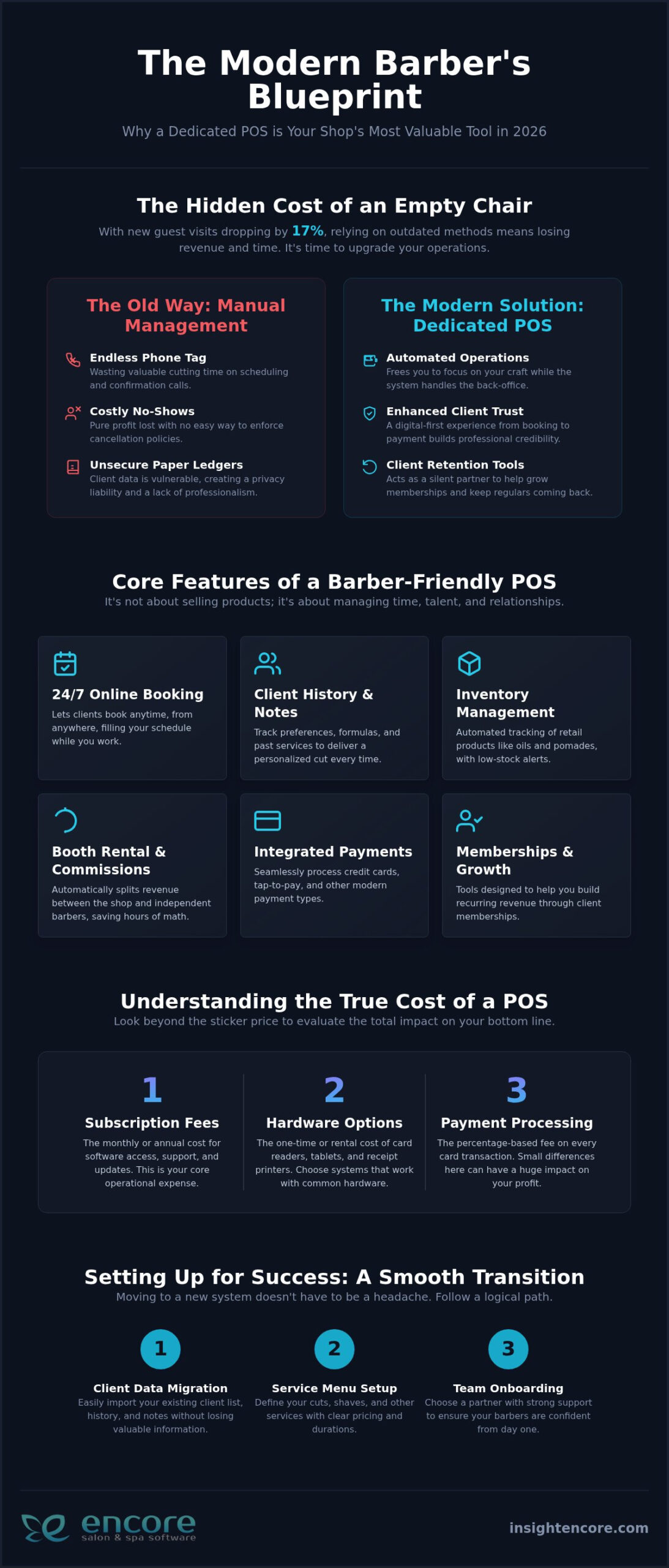
What if the most expensive chair in your shop isn’t the one with a client in it, but the one sitting empty because of a last-minute no-show? With new guest visits in the industry dropping by 17 percent recently, finding the best pos system for a small barber shop is no longer just about taking payments. It’s about survival and growth. It is frustrating to watch your revenue slip away while you’re stuck juggling complex booth rentals and high credit card fees. You started barbering to master the craft, not to become a full-time software troubleshooter or a manual bookkeeper.

We know you need a partner, not just a product. This guide promises to help you discover a system that streamlines your chair rentals, automates your booking, and grows your business without the technical stress. We’ll walk you through the top 2026 options, comparing everything from processing rates to specialized features like automated commission tracking. You’ll learn how to turn your shop into a well-oiled machine that handles the back-office work silently. By the end, you’ll have the clarity to choose a system that keeps your chairs full and gives you the peace of mind you deserve.

Key Takeaways

  • Modern systems do more than swipe cards; they act as a silent mentor to help you retain clients and grow memberships in a competitive market.
  • Finding the best pos system for a small barber shop requires prioritizing specialized tools like automated chair rental management and 24/7 online booking.
  • We break down the true cost of ownership by comparing subscription fees, hardware options, and the impact of payment processing on your bottom line.
  • Moving your business to a new platform doesn’t have to be a nightmare if you follow a logical path for client data migration and service menu setup.
  • Learn why choosing a partner with decades of industry experience ensures your software is built to handle the unique rhythm of a busy shop.

Beyond the Cash Register: Why Small Barber Shops Need a Dedicated POS in 2026

Your barber shop is a place of craft, conversation, and community. However, beneath the hum of clippers, it’s also a business that requires precise management to thrive. While many people think of a point-of-sale terminal as a simple tool for swiping cards, the definition of what a POS system is has evolved significantly. In 2026, it serves as the central nervous system for your shop. It’s no longer just about the transaction at the end of a cut. It’s about everything that happens before a client sits in your chair and long after they walk out the door.

A generic retail POS often fails because it’s built for selling hardware or clothing, not for the unique rhythm of a barber shop. Retail systems don’t understand that you don’t just sell products; you sell time, expertise, and relationships. They lack the built-in logic for booth rentals, commission splits, and the specific scheduling needs of a 1-5 chair shop. The best pos system for a small barber shop acts as a silent partner. It handles the “back-office” noise so you can focus on the fade. This shift from simple payment processing to total business management is what separates growing shops from those that struggle to keep up.

The Hidden Cost of Manual Management

Relying on a paper book or a basic digital calendar might feel “simple,” but it carries a heavy price tag. Every minute you spend on the phone confirming an appointment is a minute you aren’t cutting hair. Manual systems also leave you vulnerable to the financial sting of no-shows. When a client misses a slot and you have no way to enforce a cancellation policy, that’s pure profit out the window. Beyond the money, paper ledgers are a significant security risk. Keeping client phone numbers and notes in an unsecured book isn’t just old-school; it’s a liability in a world where data privacy matters more than ever.

Modernizing My Barbershop Operations

Stepping away from a “cash-only” mindset is about more than just convenience. It’s about professional trust. Modern clients expect a digital-first experience, from the moment they book on their phone to the moment they receive a digital receipt. A dedicated system shows your regulars and new guests alike that you run a serious, organized business. If you are looking for more ways to level up, modernizing my barbershop operations is the first step toward long-term stability. By adopting the best pos system for a small barber shop, you create a seamless flow that makes life easier for both you and your clients. It’s an investment in your peace of mind.

Core Features That Make a POS System ‘Barber-Friendly’

The best pos system for a small barber shop should feel like an extra set of hands in the shop. It isn’t just about the hardware on your counter. It’s about the software’s ability to handle the specific, often messy, details of a service-based business. While a retail store tracks barcodes, you track people, time, and preferences. You need a system that offers 24/7 online booking so clients can grab a slot while you’re focused on a fade. It should also act as a digital memory, storing client history so you know exactly which blade size or pomade a regular prefers without having to ask.

Inventory management is another essential piece of the puzzle. If you sell beard oils or high-end styling creams, your system should alert you before your shelves are empty. When you’re learning how to choose a POS system, look for a platform that integrates these retail sales directly with your service menu. This creates a single, clear picture of your shop’s health. It’s about making the business side as sharp as the cuts you provide. If you’re ready to see how these features work together, you can explore our specialized barber tools today.

Managing Chair and Booth Renters Efficiently

In many small shops, managing independent contractors is the biggest administrative headache. Generic systems often lump all revenue together, leaving you to untangle commissions and rental fees in a spreadsheet at the end of the week. A barber-specific system solves this by automatically separating business revenue from independent barber earnings. This transparency builds trust and saves hours of manual math. Using a dedicated booth renter client management app ensures everyone gets paid accurately and on time.

Client Retention Tools That Drive Loyalty

Keeping your chairs full is a constant priority. Automated reminders are a simple but powerful way to protect your time. Some industry professionals report that automated SMS and email reminders can reduce no-shows by up to 40 percent. This is a massive win for a 1-5 chair shop where every missed appointment hurts. Beyond reminders, look for loyalty programs that reward frequent visits. These barbershop client retention ideas turn one-time walk-ins into lifelong regulars. To take your retention strategy even further, exploring creative barbershop loyalty program ideas can help you build a structured rewards system that keeps clients coming back consistently. When the best pos system for a small barber shop handles the follow-up, you can stay focused on the craft.

The True Cost of a POS: Evaluating Fees, Hardware, and Hidden Contracts

Cost is often the biggest hurdle when you’re looking for the best pos system for a small barber shop. It’s easy to get distracted by a low monthly price while ignoring the “hidden” numbers that eat into your profit. To understand the real price, you have to look at the combination of software subscriptions, hardware investments, and transaction fees. A low sticker price on software doesn’t mean much if the processing rates are sky-high.

Many “free” software options appear attractive at first glance. However, these providers often recover their costs by charging significantly higher processing rates on every transaction. Over a year, those extra fractions of a percentage can cost you thousands. It’s usually better to pay a fair, transparent subscription fee for quality software than to be nickeled and dimed on every haircut. Transparency is key to maintaining your peace of mind.

Integrated Credit Card Processing Explained

One of the smartest moves you can make is choosing integrated credit card processing. When your payments and software talk to each other, you eliminate manual entry errors. You won’t have to worry about accidentally typing $5.00 instead of $50.00 during a busy rush. Plus, if there’s ever a technical glitch, you have one point of contact to call. You don’t want to get stuck in a loop between a software company and a bank, each blaming the other while your shop sits at a standstill.

Long-term contracts are another red flag to watch out for. In a fast-moving industry, you need the freedom to adapt. Avoid being locked into three-year agreements that make it impossible to switch if your needs change or if the service quality drops. You deserve a partner that earns your business every single month.

Hardware vs. Software: Finding the Right Balance

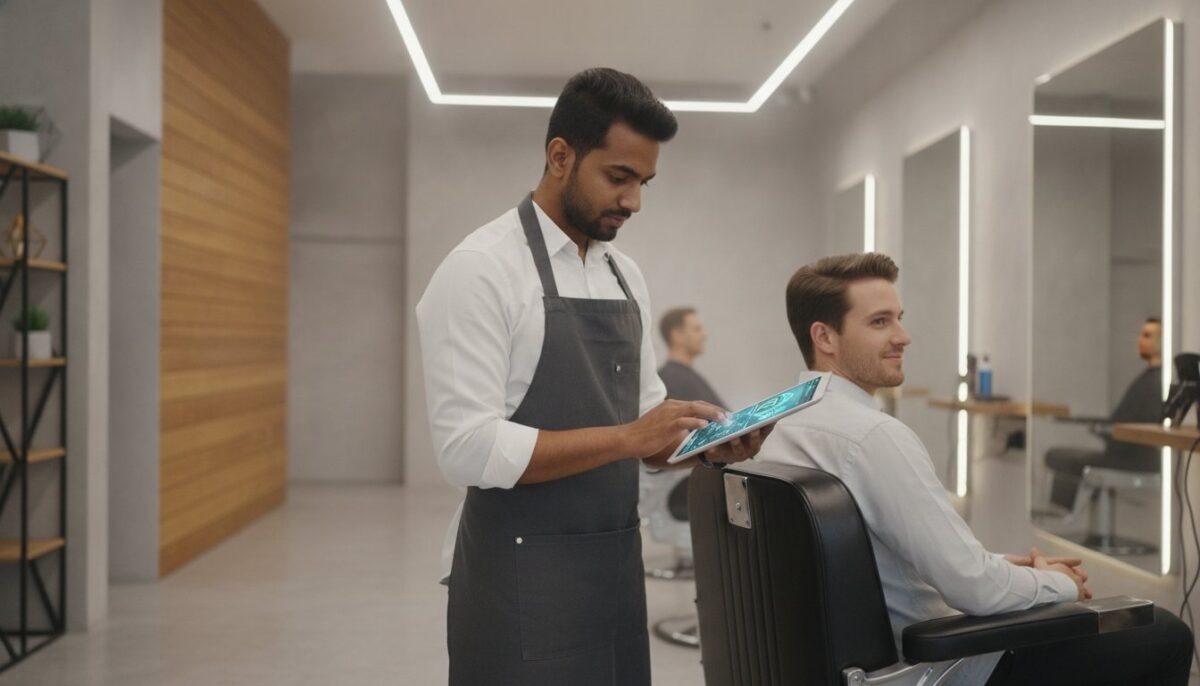
You don’t necessarily need a $1,000 all-in-one terminal for a 2-chair shop. In 2026, cloud-based systems are the industry standard. They allow you to use existing hardware, like an iPad or a tablet, which keeps your initial costs manageable. This flexibility is perfect for small shops that want to grow without a massive upfront investment.

Proprietary hardware can look sleek, but it often locks you into a specific ecosystem. If that proprietary terminal breaks, you’re forced to buy another expensive unit from the same vendor. Tablets offer more flexibility and are much easier to replace. The best pos system for a small barber shop should be accessible on any device. This gives you the power to check your schedule or run reports from home or on the go. Focus on finding a balance that gives you a professional look without the unnecessary technical headache.

Best POS for Small Barber Shops: 2026 Buyer’s Guide

Setting Up for Success: Transitioning to Your New Barbershop POS

Switching your management software can feel like trying to change a tire while the car is moving. We understand the hesitation. You’ve spent years building a loyal client list, and the thought of losing even one contact or service history note is stressful. However, the transition to a professional system shouldn’t be a technical nightmare. The best pos system for a small barber shop is designed to make this move feel like a natural extension of your daily workflow. It’s about moving from “organized chaos” to a state of complete control without the typical software headache.

Data migration is the first priority. Most modern systems allow you to import your existing client list from a spreadsheet or even directly from another app. Once your names and numbers are in, you can begin setting up your service menu. This is where you define exactly how your shop runs. You can set specific time blocks for fades, beard trims, or luxury shaves, ensuring your online booking portal reflects the reality of your chair time. By the time you launch the portal to your clients, every detail will be polished and professional.

The 3-Day Implementation Plan

A structured approach removes the guesswork from your launch and keeps your stress levels low. On Day 1, focus on the foundation. Set up your hardware and enter your basic business information. Day 2 is for the heart of your business: importing clients and setting up those automated reminders that protect your revenue. Finally, Day 3 is for practice. Run a few test transactions to get comfortable with the interface. By the afternoon, you’ll be ready to go live with total confidence and a clear mind.

Overcoming the ‘Tech Anxiety’ Hurdle

Many barbers worry that new software will be too complex for their team to master. The truth is that the best pos system for a small barber shop is built with the same logic as the smartphone apps you already use every day. If you can navigate a social media feed, you can manage your shop’s schedule. The learning curve is intentionally short, often taking less than an hour for you or your team to master the basics. Having a human support line to call during your first week ensures you never feel stuck. Exploring the Encore Salon Software features will show you just how intuitive a professional system can be.

Start your stress-free transition today

Encore: The Professional Choice for Streamlined Barbershop Management

Choosing the best pos system for a small barber shop is about more than just picking software. It’s about choosing who you want in your corner when your shop gets busy. At Encore, we’ve been helping shops thrive since 1991. That is over three decades of industry expertise built directly into our platform. We didn’t just build a generic tool; we developed the Encore Barber Software module to handle the specific needs of barbers. From the perfect fade to the final checkout, our system is designed to mirror the way you actually work.

Our approach is different from the big, impersonal tech giants. We see ourselves as your friendly guide. We know that when you have a question, you don’t want to talk to an AI bot or wait 48 hours for an email response. You want a human being who understands your business. Our human-centric support means you get experts who are ready to help you overcome hurdles in real-time. Whether you’re running a single chair or managing a multi-location franchise, our solution scales with you. We grow as you grow. Pairing your POS with the right barbershop appointment scheduling software gives you a complete performance dashboard so you can track revenue trends and make data-driven decisions with confidence.

A Supportive Partner for Your Growth

We focus on removing the friction that slows you down. Frustrations like manual payroll calculations and messy inventory tracking should be a thing of the past. Our specialized modules for chair and booth renters ensure that everyone in your shop stays organized and motivated. This level of detail gives you the peace of mind to stay behind the chair while the business side runs smoothly. It is about creating a professional environment where you can focus on your craft. If you’re ready to see how a dedicated partner can change your daily workflow, you can contact Encore for a demo and experience the difference yourself.

Transparent Pricing for Small Businesses

We believe in transparency. Many providers lure you in with “free” plans only to trap you with predatory contracts or hidden processing fees. We reject that model entirely. Our goal is to provide value-based pricing that fits the budget of a small shop without any “gotcha” moments. You get professional-grade tools like integrated credit card processing and automated marketing without the fear of a surprise bill. You can view our straightforward Encore pricing to see exactly how we support your bottom line. We are here to help you grow, not to hold you back with red tape. Finding the best pos system for a small barber shop shouldn’t be a gamble; it should be the smartest investment you make this year.

Level Up Your Shop with Confidence

Choosing the best pos system for a small barber shop is a decision that impacts every cut and every client interaction. You’ve seen how the right technology acts as a silent mentor, handling the heavy lifting of booth rentals and automated reminders while you stay focused on your craft. It is about moving away from manual stress and toward a future where your business runs as smoothly as a fresh shave. Since 1991, we’ve dedicated ourselves to helping professionals grow through reliable software and specialized modules for chair renters.

You don’t have to navigate this transition alone. With dedicated human support and a system built by industry experts, the technical headaches of the past are over. You deserve the peace of mind that comes with knowing the business side is handled by a partner who truly cares about your individual success.

Ready to streamline your shop? Explore Encore Barber Software today.

Your shop is more than just a business; it’s a staple of your community. We’re here to help you keep those chairs full and your operations sharp for years to come.

Frequently Asked Questions

What is the best POS system for a small barber shop with only two chairs?

The best pos system for a small barber shop with two chairs is one that offers professional features without overwhelming a small team. Encore Barber Software is specifically designed for this scale. It provides all-in-one management that handles booking and payments seamlessly. Because it’s scalable, you don’t have to pay for enterprise-level features you won’t use, yet it grows with you if you decide to add more chairs later.

How much does a barbershop POS system usually cost in 2026?

In 2026, subscription costs for barbershop software generally range from $20 to over $150 per month depending on your staff size. You should also account for payment processing fees, which often hover around 2.4 percent to 2.7 percent per transaction. While some providers offer “free” plans, these often come with higher processing rates. It is usually more cost-effective to choose a value-based subscription that offers transparent pricing and integrated features.

Can a POS system help me manage independent booth renters?

Yes, a dedicated system is essential for managing independent contractors. Encore offers specialized Chair/Booth Renter Software that tracks individual sales and calculates commissions automatically. This eliminates the need for manual spreadsheets or messy end-of-week math. By separating business revenue from independent barber earnings, you create a transparent environment that builds trust. Each renter can manage their own schedule while you maintain oversight of the shop’s total performance.

Do I need to buy expensive hardware to use a modern POS?

You don’t need to invest in proprietary $1,000 terminals to run a modern shop. Most 2026 systems are cloud-based and compatible with standard tablets or iPads. This allows you to use hardware you might already own, keeping your initial setup costs low. Using a tablet also gives you the flexibility to check your schedule or run reports from home. You only need a reliable internet connection and a compatible card reader to get started.

Will a POS system really help reduce my no-shows?

Automated reminders can significantly protect your bottom line. Industry data shows that sending SMS and email confirmations can reduce no-shows by up to 40 percent. By using the best pos system for a small barber shop, you can set these reminders to go out automatically 24 or 48 hours before an appointment. This gives clients a chance to reschedule and allows you to fill the empty slot before it’s too late.

How hard is it to move my client list from a paper book to a POS?

Moving from a paper book to a digital system is a straightforward process that usually takes less than a day. You can manually enter your core client list or import a spreadsheet if you have one. Modern interfaces are designed to be as intuitive as smartphone apps, so the learning curve is very short. Once your data is in, you’ll never have to worry about losing a phone number or a client’s formula notes again.

Is credit card processing integrated into the software?

Integrated credit card processing is a core feature of the Encore platform. This means your payment terminal talks directly to your software, eliminating the risk of manual entry errors at checkout. When a service is finished, the total is automatically sent to the reader. This creates a faster experience for your clients and ensures your daily sales reports are always 100 percent accurate. You won’t have to spend hours reconciling bank statements.

What kind of support should I expect if my system goes down?

You should expect responsive, human-centric support from experts who understand the beauty industry. At Encore, we reject the use of automated bots or delayed email tickets. Our team provides accessible help to ensure your shop stays up and running. Having a dedicated partner who has been serving the industry since 1991 means you get reliable advice and quick solutions. Your peace of mind is prioritized alongside your business growth.

Disclaimer

This article is general in nature and may contain errors, please verify all claims with your sales rep
Categories
Uncategorized

Reduce Small Business Credit Card Fees: 2026 Guide

That "simple" flat-rate pricing you chose to avoid headaches is likely the very thing quietly draining your bank account. You’ve probably stared at your monthly merchant statement, squinting at line items like PCI non-compliance or statement fees; it’s frustrating to feel like you need a finance degree to learn how to reduce credit card processing fees for small business. We know the feeling of seeing your hard-earned profit margins shrink under the weight of unpredictable costs. It shouldn’t be this complicated to get paid for the great work you do.

This 2026 guide pulls back the curtain on the industry’s hidden junk fees and shows you exactly how to reclaim your profits through smarter processing strategies. We’ll explore the impact of the latest Visa and Mastercard interchange rate reductions, the transparency of interchange-plus models, and how to find a processing partner that values your peace of mind as much as your growth. By the end, you’ll have a clear roadmap to a lower effective rate and a system that integrates perfectly with your existing booking software.

Key Takeaways

  • Learn why the “simplicity” of flat-rate pricing often hides higher margins and how to calculate your true effective rate.
  • Understand the transparency of Interchange-Plus pricing to avoid the expensive “non-qualified” transaction traps found in tiered models.
  • Discover actionable steps on how to reduce credit card processing fees for small business by optimizing your data accuracy and risk profile.
  • Stop losing money to “junk” fees by mastering 2026 security compliance standards and debunking common merchant myths.
  • Streamline your operations by moving to integrated payments, which eliminates manual reconciliation and simplifies your support.

The Hidden Cost of ‘Simple’ Credit Card Processing

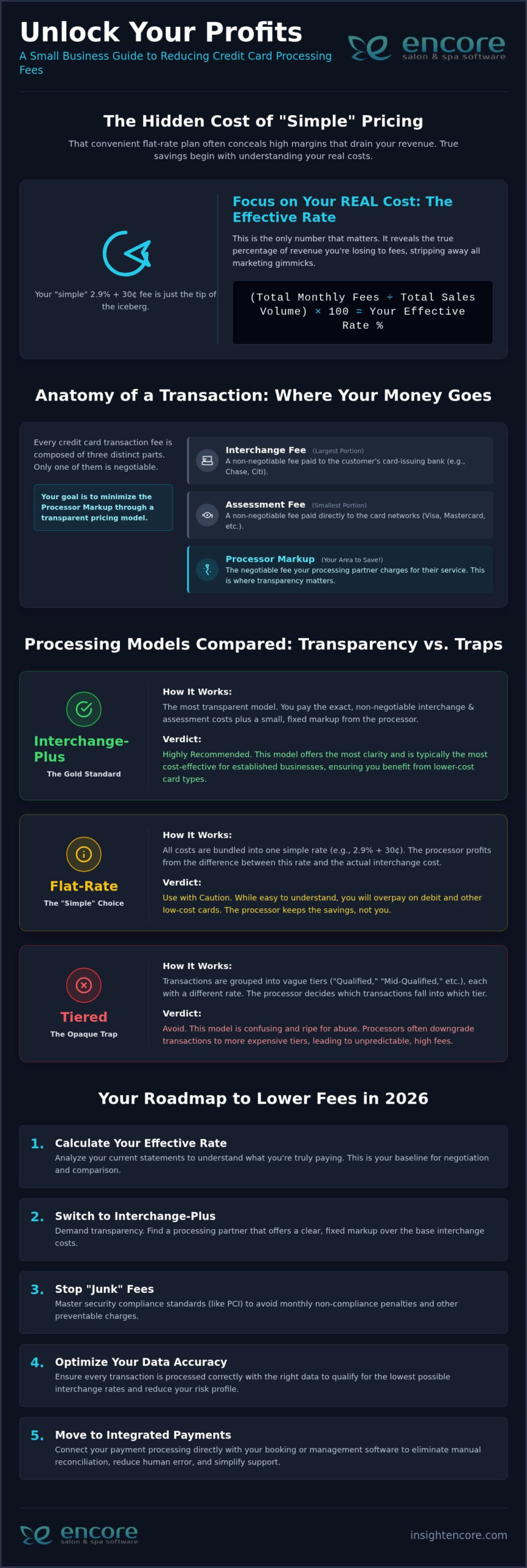
Many salon and spa owners feel a sense of relief when they sign up for a flat-rate processing plan. It sounds easy. It looks predictable. But that simplicity often comes with a steep price tag that stays hidden beneath the surface of your monthly statements. If you want to know how to reduce credit card processing fees for small business, you first have to look past the marketing slogans and focus on your "effective rate." This is the only number that truly matters; it’s calculated by dividing your total monthly fees by your total sales volume. It reveals exactly what percentage of your revenue is vanishing into the processing ether.

Credit card processing fees are the aggregate of interchange, assessment, and processor markup. When a provider offers you a single flat rate, like the common 2.9% + 30c marketing hook, they aren’t actually charging you one fee. They’re bundling all those costs together and adding a significant buffer to ensure they profit on every single swipe, regardless of the card type used. This "convenience" allows brands to hide high margins behind a single, easy-to-digest number.

Myth: Flat-Rate Pricing is Always the Cheapest Option

Flat-rate models are a psychological trap designed for convenience. While they’re great for a brand-new business with very low volume, high-growth salons often find themselves overpaying. The processor essentially "averages out" the costs in their own favor. If a client pays for a $200 hair color service with a basic debit card, the actual cost to process that transaction is quite low. However, with a flat rate, you’re still paying that high percentage. The processor simply pockets the difference. This is a major hurdle when you’re looking for ways how to reduce credit card processing fees for small business. Small-ticket items like a $15 lip wax also get hit hard by the fixed "per transaction" fee, which can eat up a massive portion of your margin on low-cost services.

The True Anatomy of a Transaction Fee

To reclaim your margins, you need to know exactly where your money is going. Every fee you pay is split into three distinct buckets:

  • Interchange fee: This is the non-negotiable cost set by card brands like Visa and Mastercard. It’s paid to the bank that issued the customer’s card. It varies based on the card type and how it’s processed.
  • Assessment fees: These are small, fixed percentages paid directly to the card networks for using their systems. Like interchange, these are non-negotiable for everyone.
  • Processor markup: This is the only area where you actually have leverage. This is the fee your processing partner charges for their service.

Understanding these layers is the first step toward a healthier bottom line. When you use integrated credit card processing, you gain the transparency needed to see these costs clearly rather than having them buried in a single, expensive bundle. It’s about moving from a state of confusion to a position of organized control over your business finances.

Decoding Processing Models: Interchange-Plus vs. Tiered

Understanding the difference between pricing models is a critical step in learning how to reduce credit card processing fees. Most processors use one of two main structures: Interchange-Plus or Tiered. While both might look similar on a sales sheet, their impact on your monthly profit is vastly different. One offers a clear window into your costs, while the other often feels like a locked door. Choosing the right model is about more than just numbers; it’s about gaining the transparency you need to run a healthy, predictable business.

Why Interchange-Plus is the Gold Standard for Salons

Interchange-Plus is often called "wholesale" pricing because it’s the most transparent model available. You pay the exact cost set by the card brands plus a small, fixed markup from the processor. This clarity allows you to see exactly where every penny goes. For high-volume businesses like salons and spas, this model is incredibly cost-effective. You benefit directly from lower interchange rates on debit cards or standard consumer cards. As your business scales, the savings grow with you. Choosing integrated credit card processing using this model ensures your software and payments work together without hidden surprises. It’s a professional approach that treats you like a partner, not just another account number.

Avoiding the Trap of Tiered Pricing

Tiered pricing is the opposite of transparency. It bundles different transaction types into categories like "qualified," "mid-qualified," and "non-qualified." While the low "qualified" rate looks attractive in a marketing brochure, very few modern cards actually qualify for it. Most rewards cards, business cards, and online transactions get pushed into the expensive non-qualified tier. This allows processors to hide high margins behind a confusing wall of categories. You might think you’re paying a low rate, but your effective rate often tells a much more expensive story. It’s a common industry frustration that leaves many owners feeling stuck and confused.

Savvy owners are moving away from these bundled traps. Tiered statements are notoriously difficult to audit because they lack the line-item detail needed to see the actual cost of each transaction. This lack of transparency is why Tiered models are becoming obsolete for businesses that prioritize financial health. When you understand how to reduce credit card processing fees for small business, you realize that the cheapest "looking" rate is rarely the cheapest "actual" rate. If you’re tired of the guesswork and want a partner that values your peace of mind, it’s time to see how integrated software can simplify your payments.

5 Proven Strategies to Reduce Fees in 2026

Implementing a few operational shifts can significantly lower your risk profile and, by extension, your costs. A foundational step in understanding credit card processing fees is recognizing that processors charge more for transactions they perceive as high risk. By improving data accuracy and ensuring your Merchant Category Code (MCC) accurately reflects your service-based business, you set a lower baseline for your rates. These small adjustments are key parts of how to increase salon profit margin in a competitive market.

Strategy 1: Optimize for Card-Present Transactions

Transactions where a card is physically "dipped" or "tapped" carry the lowest risk of fraud. Because the security chip is verified in person, banks reward you with lower interchange rates. On the other hand, keying in card numbers manually is one of the most expensive ways to get paid. It signals a higher risk of chargebacks to the processor. Encourage your clients to use their physical cards or mobile wallets at the counter. While "card on file" features are convenient for no-show protection, using them for every routine checkout can quietly inflate your monthly costs. Learning how to reduce credit card processing fees for small business often starts with this simple hardware habit.

Strategy 2: Leverage Industry-Specific Integrated Software

Standalone terminals often lead to manual entry errors and reconciliation headaches. When you use salon software that features integrated payments, the transaction data flows directly from your booking calendar to the card reader. This precision reduces the chance of human error and provides the "enhanced data" that card brands look for when qualifying you for better rates. It also makes defending against unfair chargebacks much easier. You get a clear audit trail that links the payment to the specific service and client, giving you a level of organized control that third-party terminals simply can’t match.

Strategy 3: Negotiate and Eliminate ‘Junk’ Fees

Many business owners don’t realize that several items on their statements are actually optional markups. Fees for "IRS reporting," "online portals," or "monthly statements" are often just extra profit for the processor. Take the time for an annual fee review with your provider. If you have a consistent processing history and high volume, you have leverage. Don’t be afraid to ask for a "Meet or Beat" offer. A supportive partner will be transparent about these costs and willing to work with you to keep your business healthy. It’s not just about finding the lowest rate; it’s about finding a partner that doesn’t nickel-and-dime your growth.

Reduce Small Business Credit Card Fees: 2026 Guide

Common Processing Myths That Hurt Small Business Margins

Misinformation is often the biggest hurdle to financial freedom. Many salon and spa owners operate under the assumption that their current setup is the only way to do business. This feeling of being "stuck" can lead to thousands of dollars in lost revenue over time. Learning how to reduce credit card processing fees for small business requires clearing away these common myths. This process is a vital part of your overall salon cash flow management strategy.

Myth: I’m Locked Into My Current Bank’s Rates

It’s a common misconception that you must use the processing service offered by your business bank. Banks often bundle these services together to create a sense of "all-in-one" convenience. However, these bundled services are frequently the most expensive way to process payments. Your business bank account and your merchant processor are two separate entities. You have the total freedom to choose a processor that integrates seamlessly with your salon software. Understanding how to reduce credit card processing fees for small business starts with realizing you aren’t tied to your bank’s high-margin bundles. Breaking this cycle allows you to find rates that actually reflect your business volume.

Myth: Security Compliance (PCI) is a Profit Center for Processors

In the 2026 payment landscape, security is more important than ever. Yet, many processors use PCI non-compliance fees as a way to pad their own pockets. These monthly charges aren’t a mandatory tax; they’re a penalty for not completing a Self-Assessment Questionnaire (SAQ). You can avoid these "junk" fees entirely by working with a partner that helps you stay compliant. Modern technology like tokenization also reduces your compliance burden by ensuring sensitive card data never actually touches your local system. A supportive partner won’t just charge you a fee; they’ll provide the tools and guidance to ensure your clients’ data stays safe.

Take control of your processing fees today

Streamlining Your Bottom Line with Integrated Payments

Moving from a standalone terminal to a fully integrated system is often the final step for owners who have mastered how to reduce credit card processing fees for small business. Standalone machines act like islands; they don’t talk to your booking software, which leads to manual errors and hours of wasted reconciliation time. By bringing your payments and your salon management into one ecosystem, you eliminate the friction that quietly drains your profits. It’s about having "one throat to choke." If a transaction doesn’t go through, you have one dedicated partner to call, not a software vendor and a separate bank pointing fingers at each other.

This streamlined approach also transforms the client experience. Checkout becomes a professional, seamless moment rather than a clunky hand-off between two different systems. Your clients notice the speed and efficiency, which builds trust and encourages repeat visits. You have more control over your fees than you might think. By choosing a partner that understands the specific needs of the beauty and wellness industry, you move from a state of financial stress to a feeling of organized control.

The Efficiency Gain of Encore’s Built-in Processing

Our integrated credit card processing removes the need for double-entry. When you close a ticket in your Encore Salon Software, the total amount is automatically sent to the terminal. This prevents the costly manual errors that often happen during a busy shift. Beyond simple swipes, our system allows you to manage gift cards and loyalty programs in the same flow, boosting your revenue without adding extra steps. You also gain access to real-time reporting. You can see your true net profit after fees instantly, rather than waiting for a confusing monthly statement to arrive in the mail.

Transitioning Without Disrupting Your Client Experience

Switching to a new system doesn’t have to be a headache. We guide you through a step-by-step process to ensure your transition to our integrated system is smooth and stress-free. Training your staff on the new, faster checkout procedures usually takes minutes, not hours. Our team is invested in your individual success, providing the human support you need to feel confident from day one. You deserve a processing partner that acts as a supportive ally in your business growth. If you’re ready to stop overpaying and start growing, contact us for a transparent fee review.

Take Control of Your Financial Future

You now have the tools to look past the marketing fluff and see your merchant statements for what they really are. By focusing on your effective rate and choosing transparent interchange-plus models, you move from a state of confusion to one of organized control. Reclaiming your profit margins is a journey that begins with understanding exactly where every penny of your revenue is going.

Learning how to reduce credit card processing fees for small business is one of the most impactful things you can do for your long-term growth. At Syntec Business Systems, we’ve been dedicated to the success of salons and spas since 1991. We believe in a human-centric approach with a strict policy against hidden "junk" fees. Our seamless integration with Encore Salon & Spa Software ensures that your payments and booking work together perfectly.

Ready to stop overpaying? Explore Encore’s transparent credit card processing solutions today.
You’ve worked hard to build your business, and you deserve a partner that respects your bottom line. Take this knowledge and start making the shifts that will protect your profits for years to come. We are here to help you every step of the way.

Frequently Asked Questions

What is a good credit card processing rate for a small salon?

A competitive effective rate for a small salon typically ranges between 1.5% and 3.5%. This percentage includes the interchange fee, network assessments, and your processor’s markup. Rather than chasing a single "low" number, you should calculate your total monthly fees divided by your total sales volume. High-volume businesses often find that interchange-plus models provide a much lower effective rate than simple flat-rate options. It’s about finding the right balance for your specific service mix.

Can I pass credit card processing fees to my customers?

You can apply surcharges for credit card use or offer discounts for cash payments to help offset costs. As of 2026, cash discount programs remain legal in all 50 states. However, you must follow specific card network rules regarding clear signage and disclosure at the point of sale. Many owners prefer cash discounts because they provide a positive incentive for clients while protecting the business’s bottom line from rising processing costs. It is an effective way to manage your margins.

How often should I negotiate my merchant processing rates?

You should conduct a formal review of your merchant processing rates at least once a year. This annual check-up allows you to leverage your consistent processing history to ask for a "Meet or Beat" offer from your provider. If your business volume has grown significantly, you have more leverage to negotiate a lower markup. Staying proactive ensures your processing partner’s fees remain competitive as your salon scales. It is a simple step that protects your long-term financial health and peace of mind.

What are the most common hidden fees in credit card processing?

The most common hidden costs include PCI non-compliance fees, statement fees, and "IRS reporting" fees. These are often optional markups that processors use to increase their own profit margins. Learning how to reduce credit card processing fees for small business involves identifying these line items on your monthly statement. A transparent partner will help you eliminate these unnecessary charges by assisting with compliance and providing digital reporting. It saves you money every month without any hidden surprises.

Is it cheaper to use a third-party flat-rate processor or an integrated system?

Integrated systems are often more cost-effective for growing businesses than third-party flat-rate processors. While flat-rate brands offer simplicity, they often charge a high premium to cover their own risks. An integrated system like Encore provides transparency and eliminates manual data entry errors. This reduces labor costs and prevents reconciliation headaches. For a busy salon, the efficiency gains and lower effective rates of an integrated model usually outweigh the perceived convenience of a simple, third-party flat-rate app.

What happens if I don’t complete my PCI compliance questionnaire?

If you don’t complete your annual Self-Assessment Questionnaire, your processor will likely charge you a monthly non-compliance fee. This is a penalty designed to encourage security, not a mandatory tax. These fees can range significantly and add up quickly over a year. Completing the questionnaire not only removes the fee but also ensures you are using modern security tools like tokenization to protect your clients’ sensitive data. It is a vital part of professional and secure management.

Do debit cards cost the same to process as credit cards?

Debit cards are significantly cheaper to process than credit cards because their interchange rates are regulated. For example, regulated debit rates in 2026 are often as low as 0.05% plus a small fixed fee per transaction. Flat-rate processors typically charge you the same high percentage for both, pocketing the massive difference. Using an interchange-plus model ensures these savings are passed directly to your business rather than staying with the processor. It is a simple way to reclaim your hard-earned profit.

How do integrated payments help reduce my overall business costs?

Integrated payments reduce costs by automating the reconciliation process and eliminating manual entry errors at the front desk. When your checkout software talks directly to your terminal, you spend less time on bookkeeping and more time with clients. This precision is a key part of how to reduce credit card processing fees for small business because it qualifies you for better rates. It also provides a stronger audit trail to help you successfully win unfair chargeback disputes.

Disclaimer

This article is general in nature and may contain errors, please verify all claims with your sales rep
Categories
Uncategorized

The Ultimate Guide to Salon Credit Card Processing in 2026

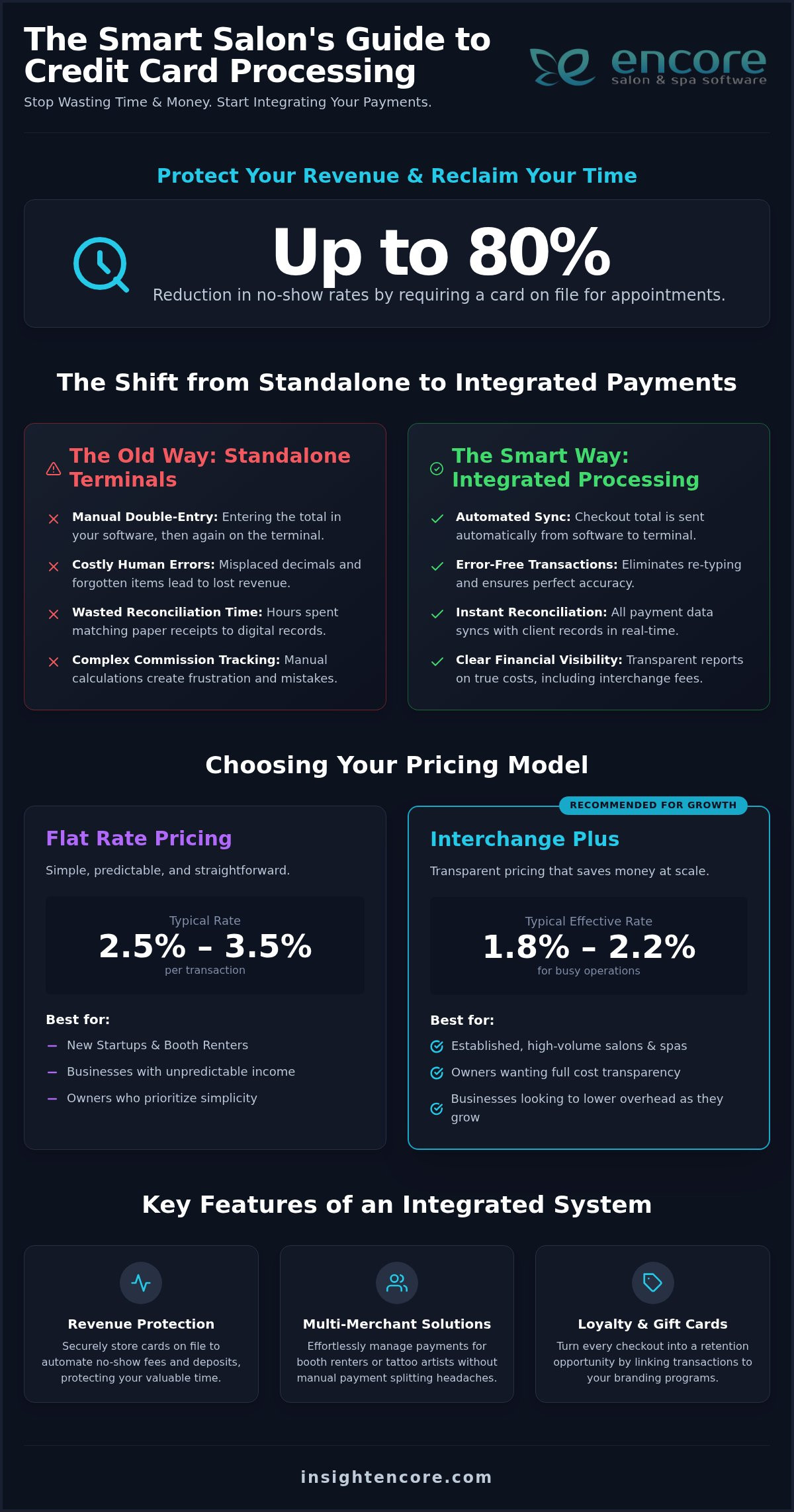
Did you know that requiring a card on file for appointments can reduce your no-show rates by as much as 80%? If you’ve ever spent your evening squinting at a complex merchant statement or realized a manual entry error just cost you a morning’s profit, you aren’t alone. Most owners feel the weight of these recurring frustrations. It’s exhausting when your salon credit card processing feels like a hurdle instead of a help.

We believe your technology should work as hard as you do. This guide is designed to help you reclaim your time and protect your revenue. You’ll discover how the right integration can eliminate manual reconciliation, slash those high no-show costs, and simplify your daily operations. We’ll walk you through how to achieve lower effective rates and ensure every payment syncs perfectly with your client records. It’s time to trade the stress of hidden fees for a system that gives you total control and the peace of mind you deserve.

Key Takeaways

  • Moving beyond standalone terminals saves you hours of manual reconciliation and prevents costly data entry errors.
  • We’ll help you decode the difference between flat-rate and interchange-plus pricing so you stop overpaying as your salon grows.
  • Implementing salon credit card processing with card-on-file technology protects your time by automating no-show fees and deposits.
  • Specialized multi-merchant solutions allow you to manage booth renters or tattoo artists without the headache of manual payment splitting.
  • Linking your transactions to loyalty programs and gift cards transforms every checkout into a retention opportunity for your brand.

Beyond the Terminal: Why Your Salon Needs Integrated Credit Card Processing

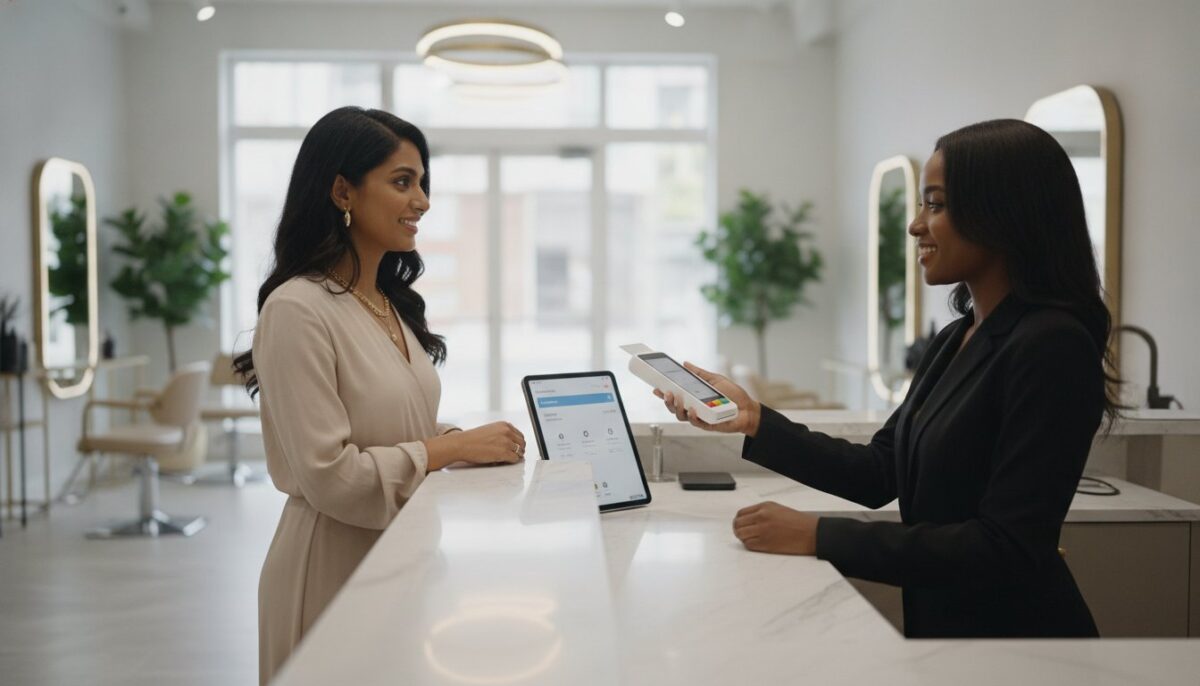
The checkout should be the “golden hour” of your client’s visit. It’s the final moment to solidify that relationship and ensure they leave feeling pampered and valued. However, if your front desk team is frantically typing numbers into a separate terminal while your client waits, that magic disappears. Traditional standalone terminals create a wall between your appointment book and your bank account. This disconnect is more than just a minor annoyance; it’s a silent drain on your focus and your finances.

The Problem with Traditional Standalone Terminals

When your payment terminal doesn’t talk to your software, you’re forced into a “double-entry” workflow. You type the price into your management system, then type it again into the terminal. It sounds simple, but it’s a recipe for human error. A misplaced decimal point or a forgotten retail item can lead to mismatched totals that haunt you during end-of-day balancing. These errors often lead to lost revenue that you might not even notice until it’s too late to correct.

Manual reconciliation is the hidden thief of a salon owner’s time. You likely spend hours every week cross-referencing paper receipts against digital records to find out why your numbers don’t match. Standalone systems also make tracking stylist commissions a nightmare. Without a direct link, you’re stuck manually calculating who earned what for every service and product sold. This process is slow, frustrating, and prone to mistakes that can hurt your team’s morale and your bottom line. It’s a common industry hurdle that modern salon credit card processing is designed to solve.

What is Integrated Salon Credit Card Processing?

Integrated processing is the bridge between your client’s service and your financial data. Instead of two separate systems that ignore each other, your POS and your merchant account live in one unified ecosystem. When you click “checkout” in your management software, the total is automatically sent to the terminal. There’s no re-typing and no room for error. This setup ensures that service totals, retail purchases, and tips sync instantly with your client records.

By using Integrated Credit Card Processing, you eliminate the friction that leads to revenue leaks. You’ll gain better visibility into your actual costs, including the interchange fees that card networks charge for every swipe. This transparency allows you to see the true health of your business without digging through complex, hidden statements. Ultimately, integrated processing is the essential link that connects your daily appointments to your long-term financial growth and stability.

Interchange Plus vs. Flat Rate: Choosing the Right Model for 2026

Fees shouldn’t be a mystery. When you look at your monthly statement, you’re likely seeing a jumble of terms like interchange, assessment fees, and processor markups. Understanding these is the first step toward lower costs. Interchange is the base cost set by the card networks, while assessment fees go to brands like Visa or Mastercard. The markup is what the processor adds on top. Staying informed about FTC rules on electronic payments helps you stay ahead of these shifting costs. Choosing the right salon credit card processing model depends entirely on your current volume and future goals.

When Flat Rate Pricing Makes Sense

Predictability has a price. Flat-rate pricing is popular because it’s simple. You pay one consistent percentage, typically between 2.5% and 3.5%, regardless of the card type used. This model is often ideal for booth renters or new startups with unpredictable monthly income. You won’t have to worry about fluctuating costs when a client pays with a high-end rewards card. It makes your accounting straightforward and stress-free. As your business begins to scale, Encore Salon & Spa Software provides the flexibility to adapt your systems as your needs evolve.

The Advantages of Interchange Plus for High-Volume Spas

For established businesses, transparency leads to savings. High-volume salons often find that flat-rate models become expensive as they grow. Interchange Plus pricing passes the actual card costs directly to you with a small, fixed markup. This can result in lower effective rates, often between 1.8% and 2.2% for busy operations. You get a detailed breakdown of every transaction. This reporting helps you identify which cards cost you more and where you’re saving money. It’s about having total visibility into your overhead. You can check our pricing page to see how our software-led approach prioritizes your bottom line.

We believe you deserve a partner who values transparency as much as you do. Don’t let hidden fees in “low-cost” introductory offers eat into your hard-earned profits. Instead, look for a system that grows with you and offers clear, honest reporting. If you’re ready to see how the right model can transform your finances, you can see how it works for yourself and take the first step toward a more profitable future.

Revenue Protection: Card-on-File and No-Show Fees

An empty chair at 2:00 PM isn’t just a quiet moment. It’s a direct hit to your stylist’s paycheck and your salon’s daily goals. No-shows happen, but they don’t have to be a total loss. By implementing card-on-file as part of your salon credit card processing strategy, you create a layer of professional accountability. This setup allows for an “Uber-style” checkout experience where clients can simply wave goodbye while their payment is handled securely in the background. It feels high-end, seamless, and deeply respectful of everyone’s time.

Transparency is your best friend here. Before you charge a dime, you must ensure your clients understand and agree to your terms. Legally, you need to be clear about appointment deposits and cancellation fees. Most salons in 2026 find that a simple digital consent form during the booking process is enough to stay compliant and protect their revenue. It’s about setting expectations early so there are no surprises later. This approach protects your stylists from the emotional and financial sting of a missed appointment.

Eliminating No-Show Losses with Integrated Policies

Securing your schedule starts long before the client walks through the door. You can use automated appointment reminders to reinforce your cancellation policy 24 or 48 hours in advance. This “set it and forget it” approach ensures your team stays busy and your income stays predictable. Think of card-on-file as a digital handshake between your salon and your client; it signifies a mutual commitment to the appointment time. For high-value services like bridal packages or extensions, collecting an automated deposit ensures you aren’t left holding the bag if plans change.

The Rise of Surcharging: Offsetting Fees Legally in 2026

Processing costs are a reality, but in 2026, more salons are exploring surcharging to offset these expenses. As of August 2026, Visa and Mastercard cap these surcharges at 3% or your actual cost of acceptance. Keep in mind that regulations vary by location. For example, Colorado limits you to 2%, while Illinois caps it at 1%. Surcharging is still prohibited in states like Connecticut, Massachusetts, and Maine. Your salon credit card processing software must handle these complex calculations automatically to keep you compliant. When done with clear signage and open communication, it’s a practical way to protect your margins without losing your luxury appeal.

The Ultimate Guide to Salon Credit Card Processing in 2026

Specialized Solutions: Processing for Booth Renters and Tattoo Studios

Running a salon with independent contractors or booth renters adds a layer of complexity to your daily finances. You aren’t just managing one business; you’re often hosting several micro-businesses under your roof. The “Multi-Merchant” challenge is a common frustration for owners who want to provide a professional front-desk experience without the liability of handling another person’s money. If all payments go into a single account, you’re stuck manually calculating payouts and dealing with messy tax records. This is why booth renters need their own specialized management app. It ensures that every dollar earned by a stylist goes exactly where it belongs. It bypasses the salon owner’s bank account entirely, which is the cleanest way to operate.

Independent Contractor Payouts and Financial Independence

Maintaining clear financial boundaries is crucial for a healthy, long-term salon culture. Encore supports individual merchant accounts within a single, unified software system. This means funds from a haircut or color service go directly to the service provider’s account. It protects the landlord from unnecessary tax liability and gives the contractor total control over their cash flow. You won’t be digging through a year of mixed bank statements when tax season arrives. Integrated transaction histories make 1099 reporting a simple, automated process. It’s a professional way to manage salon credit card processing for a diverse team of independent professionals.

Tattoo Studios: Managing Deposits and Large Transactions

Tattoo studios face unique hurdles that standard retail shops rarely encounter. High-ticket transactions for full-day sessions or complex sleeves require a higher level of security to prevent chargebacks and fraud. This is where tattoo studio software becomes essential for your workflow. These systems allow you to handle large deposits securely and track them against the final bill. You can use digital intake forms to capture payment consent and liability waivers simultaneously. This creates a solid digital paper trail that protects your artists and your studio. For mobile artists or those working guest spots, salon credit card processing offers security on the go. You get the same level of encryption and reporting as a fixed terminal. This ensures your business stays protected and organized, no matter where you’re working.

See how Encore simplifies your specific business needs

The Encore Advantage: Seamless Payments Built for Growth

Choosing a salon credit card processing partner is about more than just a terminal. It’s about finding a guide who understands that your focus should be on your clients, not your software. With over 35 years of industry experience since our founding in 1991, we’ve designed our systems to act as the central hub for your entire operation. Our Integrated Credit Card Processing doesn’t just take payments; it closes the loop on your business management. It connects your front desk to your back office, ensuring every swipe or tap feeds directly into your growth strategy.

From Booking to Checkout: A Frictionless Journey

Imagine a journey where every step is effortless for both you and your client. It starts with a simple online booking where a deposit is collected to secure the spot. Automated reminders go out, and when the service is done, the checkout is a simple one-tap process. Because your payments are synced, your system automatically updates loyalty points and tracks gift cards without any extra steps. This integrated data fuels your marketing, letting you know exactly when to reach out to a client for their next visit. You get the peace of mind that comes from having a single point of contact for both your software and your payments.

PCI Compliance and Data Security in 2026

Security shouldn’t be something you lose sleep over. In 2026, “integrated” is synonymous with “more secure.” We use advanced tokenization and encrypted hardware to ensure that sensitive client data never actually touches your salon’s local network. This removes the heavy burden of technical data security from your shoulders. Our commitment to transparency means you’ll always know your records are safe and your business is compliant with the latest standards. It’s about creating a reliable environment where your financial technology works quietly and effectively in the background.

We know that switching systems can feel daunting. You might worry about disrupting your current bookings or losing client data. We’ve refined our transition process to be as smooth as possible. Our team acts as a dedicated mentor, helping you move your records and set up your new workflow without missing a beat. You aren’t just getting a software provider; you’re gaining a partner who is genuinely invested in your individual success. When you’re ready to simplify your life, we’re here to help you make the move with confidence.

Take Control of Your Salon’s Financial Future

Managing your business shouldn’t feel like a constant battle with your bank statement. By moving toward a fully integrated system, you’re doing more than just updating your hardware. You’re reclaiming hours of your week and protecting your team from the frustration of lost revenue. Whether you’re navigating the complexities of booth renter payouts or looking to slash your no-show rates with secure card-on-file policies, the right technology makes all the difference. Modern salon credit card processing should be a tool for your success, not a source of stress.

We’ve spent 35 years perfecting our approach to the wellness industry. From specialized modules for tattoo studios to seamless support for independent contractors, we understand the daily hurdles you face. Our goal is to provide the reliable, human-centric support you need to grow with confidence. You deserve a partner who is as invested in your success as you are.

Ready to simplify your checkout? Explore Encore’s Integrated Credit Card Processing today.

We’re here to help you every step of the way as you build a more organized and profitable business. It’s time to focus on what you love and let your software handle the rest.

Frequently Asked Questions

How do I choose the best credit card processor for my salon?

Look for a provider that offers Integrated Credit Card Processing to avoid manual entry errors. You should prioritize transparency in pricing, such as interchange-plus models for higher volume, and ensure the system supports card-on-file for no-show protection. A partner with industry-specific experience, like Encore’s 35 years of expertise, ensures they understand your unique daily hurdles. Choosing a partner who values human-centric support will make your transition much smoother.

What is the difference between integrated and non-integrated salon payments?

Integrated payments connect your software directly to your terminal, while non-integrated payments require you to type totals into a separate machine. With an integrated system, checkout totals and tips sync automatically with your client records. This eliminates the “double-entry” process that often leads to revenue-killing errors and hours of manual reconciliation. It’s the most efficient way to maintain organized control over your daily financial data.

Can I charge a no-show fee if I don’t have a card on file?

It is nearly impossible to collect a no-show fee without a card on file unless the client voluntarily pays it later. Requiring a card during the booking process acts as a digital handshake between you and your client. It allows you to automate the collection of fees according to your specific policy. Research shows that simply having a card on file can reduce no-show rates by 60% to 80%.

Is it legal for my salon to add a credit card surcharge to the bill?

Surcharging is legal in most states as of 2026, but specific rules apply depending on your location. Visa and Mastercard generally cap these fees at 3% or your actual cost of acceptance. You must provide clear signage at your entrance and the point of sale to stay compliant. Note that surcharging is currently prohibited in Connecticut, Massachusetts, and Maine, so check your local regulations before implementing this for your salon credit card processing.

Do independent booth renters need their own merchant account?

Yes, having a separate merchant account is the cleanest way for booth renters to manage their own finances and tax liabilities. This setup ensures funds go directly to the stylist instead of the salon owner’s bank account. It simplifies 1099 reporting and gives the renter total control over their cash flow. Integrated systems allow multiple merchant accounts to operate under one roof while maintaining a professional front-desk experience for every client.

How long does it take for salon credit card deposits to hit my bank account?

Most salon credit card processing deposits typically arrive in your bank account within one to two business days. Some modern processors offer “next-day” or even “same-day” funding for an additional fee or as part of a premium service tier. The exact timing often depends on your specific “batch-out” time and your bank’s schedule for electronic transfers. Having a reliable processor ensures your cash flow remains steady and predictable.

What hardware do I need for salon credit card processing in 2026?

You need a PCI-compliant terminal that supports contactless payments like Apple Pay and Google Pay. Modern hardware should be fully compatible with your salon management software to enable Integrated Credit Card Processing. Many salons now opt for sleek, handheld devices that allow for “chairside” checkout. This hardware uses encryption and tokenization to keep your client’s sensitive data safe from the moment they tap, swipe, or dip their card for payment.

How does integrated processing help with salon commission calculations?

Integrated processing automatically links every transaction to the specific stylist who performed the service. This removes the need for manual tallying or messy spreadsheet calculations at the end of the week. Because the software tracks the service total, retail sales, and tips in one place, it can instantly calculate accurate commissions for your team. This transparency builds trust with your staff and ensures everyone is paid correctly for their hard work.

Disclaimer

This article is general in nature and may contain errors, please verify all claims with your sales rep

Categories
Uncategorized

Integrated Card Processing: 2026 Guide for Salons & Spas

Imagine it’s 8:00 PM on a Friday. Your last client just left with a glowing smile, but your workday is far from over. You’re stuck at the front desk, cross-referencing paper receipts with your appointment book to find a missing twenty dollars. It’s a common frustration that eats into your personal time and drains your energy. Switching to Integrated Credit Card Processing changes this narrative entirely. By connecting your payments directly to your Encore Salon Software, you remove the manual entry that leads to costly typos and lost revenue.

You deserve a business system that works as hard as you do. Reconciling bank statements shouldn’t be a nightly chore, and managing booth renter commissions shouldn’t require a calculator and a prayer. This 2026 guide shows you how to transform your checkout into a fast, error-free process that delights your guests and empowers your team. We’ll explore how automatic syncing provides the real-time financial reporting you need to stay in control, allowing you to focus on your craft while your software handles the heavy lifting.

Key Takeaways

  • Learn how a fully unified system allows data to flow directly from your booking software to the payment terminal, ending the need for manual price entry.
  • Discover why Integrated Credit Card Processing is the key to eliminating checkout errors and protecting your hard-earned revenue in 2026.
  • See how automating tip distribution and commission calculations can turn your end-of-day reconciliation from a headache into a few simple clicks.
  • Understand the critical differences between slow standalone terminals and the instant, accurate results of a modern integrated setup.
  • Find out how connecting your payments to tools like automated marketing and inventory management creates a seamless, profit-driving machine.

What is Integrated Credit Card Processing for Salons and Spas?

Integrated Credit Card Processing isn’t just a technical upgrade; it’s the heartbeat of a modern salon. In 2026, the beauty industry has moved firmly into the era of unified commerce. This means every part of your business, from your inventory to your payroll, needs to speak the same language. When your payments are integrated, the data flows directly from your appointment book to the terminal. There’s no manual typing and no room for error. It creates what we call a "Frictionless Checkout." Your guests enjoy a smooth transition from the chair to the door, feeling pampered until the very last second instead of waiting for a clunky machine to reset.

The Core Components of an Integrated System

To understand how this works, think of it as a team of three specialists working in harmony. When these components are part of a single ecosystem, the transaction happens in one fluid motion, keeping your data safe and your records clean:

  • The POS Software: This is the brain of the operation. Systems like Encore Salon & Spa Software track exactly which services were performed and which retail items were added to the checkout.
  • The Payment Gateway: This acts as a secure digital bridge. It encrypts and protects sensitive client data while it moves between your salon and the financial networks.
  • The Merchant Account: This is where your funds are held after being verified by the Payment Processor before they’re deposited into your business bank account.

Why Standalone Terminals are Costing You More Than You Think

Many owners stick with standalone terminals because they seem simple, but they often carry hidden costs that drain your profits. The biggest culprit is the "Double Entry" tax. If your team spends even two minutes per client re-typing totals into a separate credit card machine, you’re losing hours of productive time every single week. This manual process is where human error thrives. A simple typo can turn a $150 color service into a $15 loss, and those small mistakes add up to significant revenue gaps over a year.

Then there are the reconciliation headaches. When your software reports don’t match your bank statements, you’re forced to spend your evenings hunting for missing dollars. Switching to Integrated Credit Card Processing removes this stress, ensuring your books balance perfectly every single night. You gain peace of mind knowing that what happened in the treatment room is exactly what’s reflected in your bank account.

Key Benefits of Connecting Payments to Your Management Software

Connecting your booking software to your payment terminal does more than just move money. It builds a foundation of trust between you, your staff, and your clients. In 2026, client expectations are higher than ever, and they want a checkout experience that’s as professional as the service they just received. By adopting Integrated Credit Card Processing, you’re not just buying a tool; you’re gaining a partner that handles the tedious math so you don’t have to.

One of the biggest headaches in a busy salon is the end-of-week math. Manually calculating commissions or splitting tips across multiple stylists is a recipe for exhaustion. An integrated system does this instantly. Every time a payment is processed, the software knows exactly who performed the service and how much they earned. It’s accurate, transparent, and keeps your team happy. This level of automation is one of the primary Benefits of Integrated Payments, as it transforms your financial data from a static list into a dynamic business asset.

No-shows are a profit killer that no owner should have to tolerate. With "Card on File" features, you can secure deposits or charge cancellation fees automatically. It’s a professional way to protect your time and ensure your revenue remains predictable. Every transaction also enriches your client profiles. You’ll see exactly what they bought and when they last visited without digging through old files. This data allows you to offer personalized recommendations that feel like a concierge service rather than a sales pitch. An integrated system also makes it effortless to redeem and track gift cards at checkout — and if you’re looking to boost revenue during slow seasons, exploring salon gift card promotion ideas can be a powerful complement to your payment strategy.

Streamlining the Client Checkout Journey

The final minutes of a client’s visit should be spent discussing their next appointment, not waiting for a terminal to wake up. One-click checkout turns a five-minute process into a few seconds. If they bought a shampoo, your inventory levels update the moment the card is swiped. You don’t have to remember to count bottles later. Digital receipts add another layer of convenience, sending a professional summary straight to their inbox while capturing valuable data for their client profile. If you’re ready to see how these features can simplify your daily routine, you can see the platform in action.

Booth Renter and Multi-Merchant Support

Managing a salon with independent contractors used to mean having a desk cluttered with multiple terminals. That’s no longer the case. Modern systems allow for multi-merchant support within a single software interface. Whether you need to manage separate accounts or handle complex split payments between the house and the stylist, the technology handles the routing. Your independent contractors get paid faster, and you avoid the liability of mixing funds. It’s a cleaner, more professional way to run a shared space.

Integrated vs. Non-Integrated: A 2026 Comparison

Choosing between a standalone terminal and Integrated Credit Card Processing is about more than just hardware. It’s a choice between a fragmented business and a unified one. In 2026, the gap between these two methods has become a chasm. Standalone systems require you to act as a human bridge between your terminal and your software. Integrated systems, however, create a seamless loop where every transaction is a building block for your success. It’s the difference between guessing your numbers and knowing them with absolute certainty.

  • Speed of Transaction: Standalone terminals are notoriously slow. You have to wake the machine, type the amount, and wait for a response. Integrated systems are instant. The moment you hit "checkout" in your software, the terminal is ready.
  • Data Accuracy: Manual entry is risky. One slip of a finger can turn a $200 service into a $20 loss. With auto-sync, the data is perfect every time because it’s pulled directly from the client’s service record.
  • End-of-Day Reporting: Manual reconciliation can take hours of stressful hunting for missing receipts. Integrated systems generate auto-reports in minutes, giving you back your evenings.

The ROI of Integration

The return on investment for moving to a unified system is immediate. Think about the labor hours your front desk saves. If you save just three minutes per checkout across twenty clients a day, that’s an hour of productivity regained. Over a month, that’s thirty hours you can reinvest into client care or staff training. Faster checkouts also improve the atmosphere at your front desk. When the payment process is quick and easy, your team has more mental space to focus on re-booking the guest, which is the most effective way to grow your revenue. By unifying your provider model, you often reduce the complexity of merchant service fees, making your overhead more predictable.

Security and PCI Compliance in 2026

Protecting your clients’ sensitive data is a heavy responsibility. In 2026, tokenization is the gold standard for security. Integrated systems use this technology to replace card numbers with unique digital "tokens." This means your salon never actually stores the card data, which significantly reduces your business’s PCI liability. These systems also provide valuable insights into the financial health of the business by creating a robust paper trail for every swipe. This level of detail is your best defense against chargebacks. If a dispute arises, you have a complete record of the transaction, the service performed, and the client’s signature all in one place. Using Encore Salon & Spa Software ensures that these security protocols are built into your daily workflow, giving you and your guests total peace of mind.

Integrated Card Processing: 2026 Guide for Salons & Spas

How to Switch to an Integrated Payment Provider

Making the switch to Integrated Credit Card Processing shouldn’t feel like a high-stress technical overhaul. It’s a straightforward journey toward better organization. Unlike generic providers that leave you to figure out the migration on your own, a supportive partner ensures the transition is smooth and predictable. By following a clear roadmap, you can move from a fragmented system to a unified one without missing a single appointment.

  • Step 1: Audit your volume. Review your peak hours and decide if you need a fixed countertop station or mobile devices for chair-side checkout.
  • Step 2: Verify compatibility. Confirm that your chosen hardware works natively with your salon management software to ensure data flows correctly.
  • Step 3: Apply through your partner. Working with your software provider to set up your merchant account often speeds up approval and simplifies support.
  • Step 4: Configure and train. Set up your 2026-ready terminals and walk your team through the new, faster checkout steps.
  • Step 5: Test and go live. Run a small transaction to confirm the payment syncs perfectly with your client records before your first guest of the day arrives.

Choosing the Right Hardware for Your Space

In 2026, flexibility is king. You might prefer a robust countertop terminal for a traditional front desk setup; however, many modern spas are moving toward mobile handheld devices. These allow for a luxury, chair-side experience where the guest never has to stand in a line. Ensure your hardware supports the latest contactless standards, including tap-to-pay and mobile wallets. Future-proofing your desk with devices like the latest Clover or Dejavoo models ensures you stay ahead of consumer trends and security requirements.

Minimizing Downtime During the Transition

Timing is everything when updating your core systems. We recommend making the switch on your slowest day of the week, typically a Monday or Tuesday. This gives your team a quiet environment to get comfortable with the new flow. If you’re worried about existing contracts, ask your new provider about "white-glove" setup services. They can often help you navigate the paperwork and ensure you aren’t hit with unnecessary penalties. This hands-on assistance transforms a potentially stressful day into a moment of business empowerment.

Start your seamless transition today

Unlocking Growth with Encore’s Integrated Processing

Encore Salon & Spa Software creates a unified business ecosystem where every piece of information works together to support your success. In 2026, successful owners know that a payment is never just a transaction; it’s a data point that can fuel your entire operation. When you choose Integrated Credit Card Processing, you’re choosing a system that talks to every other part of your business. For instance, connecting your payments directly to your Inventory Management System ensures that retail stock levels stay accurate in real time. If a client buys a luxury serum during checkout, the system deducts it from your stock immediately, preventing the frustration of accidental overselling.

This connectivity extends to how you keep your chairs full. Your transaction data is the primary engine for your Automated Marketing & Loyalty Programs. Because the software tracks exactly what a client spends and when they last visited, it can trigger personalized rewards or "we miss you" emails at the precise moment they’re most effective. This isn’t just about taking payments; it’s about building a cycle of loyalty that drives consistent profit without extra effort from your team.

What truly makes Encore the preferred partner for 2026 is our human-centric support. We understand that moving to a new system can feel like a big leap. We don’t just give you a login and leave you to figure it out. Instead, we act as a dedicated mentor, offering professional confidence and reassuring empathy at every step. We’re committed to transparency and accessibility, ensuring you always have a human ally to help you overcome daily hurdles.

Beyond the Transaction: Data-Driven Decisions

Your payment history is a roadmap for future growth. By turning transaction data into actionable insights, you can quickly identify your most profitable services and your highest-spending clients. This clarity allows you to focus your energy where it matters most. You can also automate re-booking reminders based on the last transaction date, ensuring your schedule stays packed. This level of organized control gives you the freedom to focus on your artistry while the software manages the logistics.

Ready to Streamline Your Business?

The transition to a more efficient salon or spa starts with a conversation. We invite you to get started with a personalized demo of Encore to see how our unified approach can work for you. You can explore our features to see the full potential of integration in your specific environment. If you’re ready for a solution that’s as unique as your brand, contact our team for a custom quote. We’re here to help you transform your business into a seamless, profit-driving machine.

Step Into the Future of Salon Management

You’ve seen how the right technology can turn a chaotic front desk into a calm, profit-driving hub. By adopting Integrated Credit Card Processing, you aren’t just upgrading a terminal; you’re reclaiming your time and protecting your hard-earned revenue. The days of manual data entry and nightly reconciliation headaches are over. Instead, you gain a unified ecosystem where payments, inventory, and marketing work in perfect harmony.

At Syntec Business Systems, we’ve been serving the beauty industry since 1991. We provide all-in-one management for salons, spas, and pet groomers who want to work smarter, not harder. You’ll never have to navigate these changes alone because our dedicated human support team is always a phone call away. We’re here to ensure your peace of mind is as prioritized as your business growth.

Ready to eliminate checkout stress? See how Encore’s Integrated Credit Card Processing works for you.
It’s time to stop chasing missing receipts and start focusing on the artistry that makes your business special. We’re excited to help you build the seamless, professional experience your guests deserve in 2026 and beyond.

Frequently Asked Questions

What exactly is integrated credit card processing?

It’s a system where your payment terminal and your salon management software communicate directly. This means when you check out a client in your software, the total is automatically sent to the card reader. You don’t have to type the price in manually. Switching to Integrated Credit Card Processing is a unified way to handle transactions that keeps your data accurate and your checkout lines moving quickly in 2026.

Do I need to change my bank account to use integrated processing?

No, you usually don’t need to switch your business bank account to start using an integrated system. The technology works with your existing banking setup by depositing your daily totals directly into your current account. While you’ll need a compatible merchant account, our team helps you set this up so the transition is seamless. Your funds continue to flow exactly where they always have without any banking disruptions.

How much does it cost to switch to an integrated system?

The cost of switching depends on your salon’s specific hardware needs and transaction volume. While we don’t quote specific rates, you’ll want to consider the investment in 2026-ready terminals like Clover or Dejavoo models. Many owners find that the time saved on manual reconciliation and the reduction in human error more than offsets the setup costs. We provide custom quotes to ensure you get exactly what your business needs.

Is integrated processing more secure than a standard terminal?

Yes, integrated systems offer superior security through advanced features like tokenization and end-to-end encryption. Instead of storing sensitive card numbers on your local computer, the system replaces them with secure digital tokens. This significantly lowers your PCI liability and protects your clients’ data from potential breaches. It is a professional standard that gives both you and your guests total peace of mind during every single transaction you process.

Can I use integrated payments if I have booth renters?

Absolutely, modern systems are designed specifically to handle the complexities of booth renters and independent contractors. You can manage multiple merchant accounts within a single software interface. This allows payments to be routed correctly to either the house or the individual stylist. It simplifies split payments and ensures everyone gets paid accurately without the need for multiple, cluttered terminals sitting at your front desk or in your styling stations.

How does integrated processing help with my salon’s accounting?

It transforms your accounting by providing a perfect sync between your sales and your bank deposits. Every transaction is automatically recorded in your software, which eliminates the need for manual data entry at the end of the night. You’ll have access to real-time financial reporting that shows your most profitable services and retail items. This level of organization makes tax season much less stressful for you and your accountant.

What happens if my internet goes down during a transaction?

Most modern 2026-ready hardware includes an offline mode or cellular backup to keep your business running during an outage. This allows you to continue accepting payments securely, which are then processed once your connection is restored. You won’t have to turn clients away or resort to old-fashioned paper receipts. It is a reliable safeguard that ensures your profit-driving machine never stops, even when the local internet connection has a hiccup.

Will I still be able to accept Apple Pay and Google Pay?

Yes, our Integrated Credit Card Processing hardware is fully equipped to handle all modern contactless payment methods. This includes Apple Pay, Google Pay, and tap-to-pay credit cards. Providing these options is essential for meeting client expectations in 2026. It makes the checkout experience faster and more convenient for your guests, reinforcing your image as a modern business that prioritizes client comfort and the latest secure payment technology.

Disclaimer

This article is general in nature and may contain errors, please verify all claims with your sales rep