

window.dataLayer = window.dataLayer || []; function gtag(){dataLayer.push(arguments);} gtag('js', new Date()); gtag('config', 'UA-206511945-1');
Search
Categories
Uncategorized

The Ultimate Guide to Salon Credit Card Processing in 2026

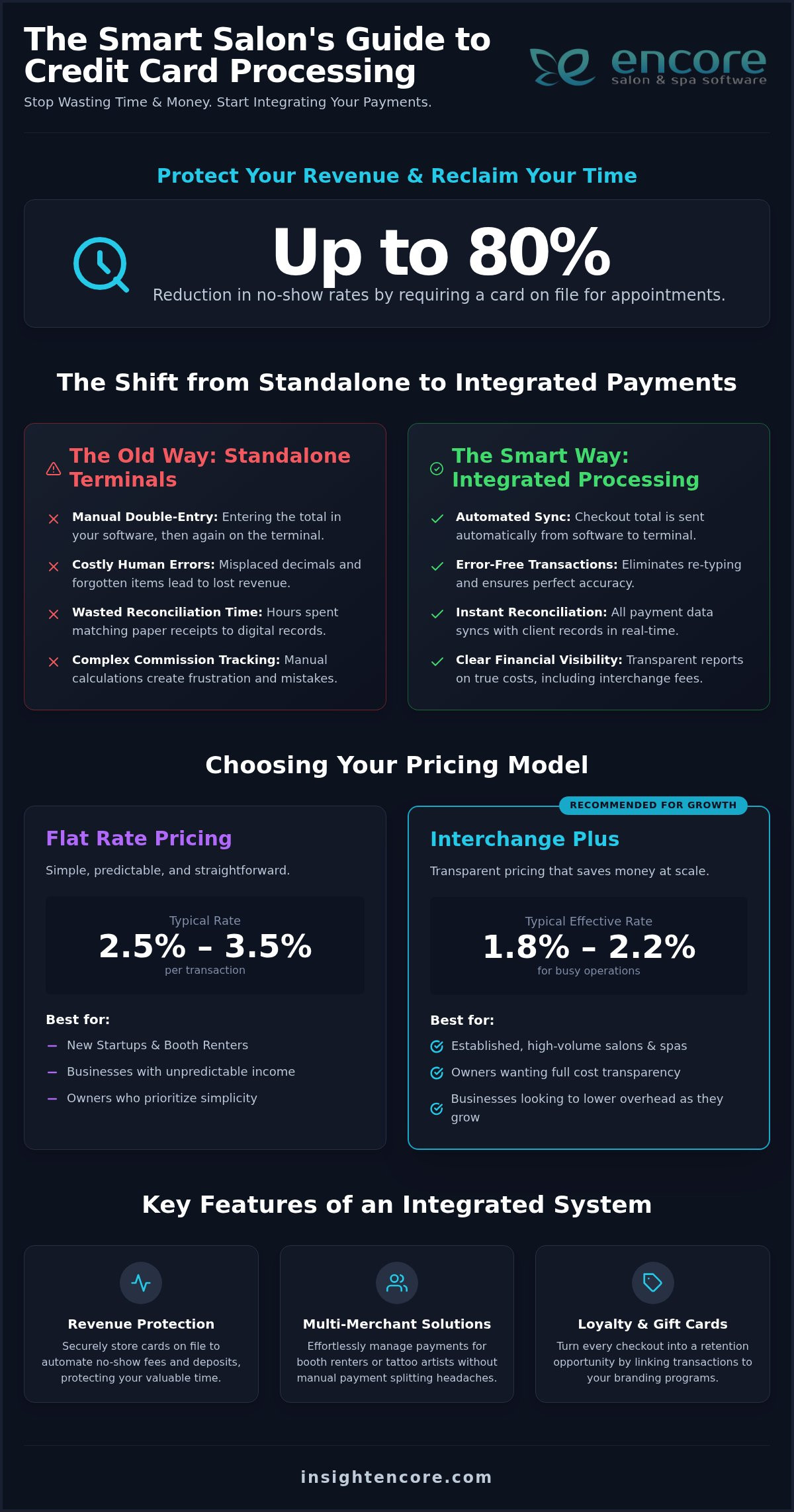
Did you know that requiring a card on file for appointments can reduce your no-show rates by as much as 80%? If you’ve ever spent your evening squinting at a complex merchant statement or realized a manual entry error just cost you a morning’s profit, you aren’t alone. Most owners feel the weight of these recurring frustrations. It’s exhausting when your salon credit card processing feels like a hurdle instead of a help.

We believe your technology should work as hard as you do. This guide is designed to help you reclaim your time and protect your revenue. You’ll discover how the right integration can eliminate manual reconciliation, slash those high no-show costs, and simplify your daily operations. We’ll walk you through how to achieve lower effective rates and ensure every payment syncs perfectly with your client records. It’s time to trade the stress of hidden fees for a system that gives you total control and the peace of mind you deserve.

Key Takeaways

  • Moving beyond standalone terminals saves you hours of manual reconciliation and prevents costly data entry errors.
  • We’ll help you decode the difference between flat-rate and interchange-plus pricing so you stop overpaying as your salon grows.
  • Implementing salon credit card processing with card-on-file technology protects your time by automating no-show fees and deposits.
  • Specialized multi-merchant solutions allow you to manage booth renters or tattoo artists without the headache of manual payment splitting.
  • Linking your transactions to loyalty programs and gift cards transforms every checkout into a retention opportunity for your brand.

Beyond the Terminal: Why Your Salon Needs Integrated Credit Card Processing

The checkout should be the “golden hour” of your client’s visit. It’s the final moment to solidify that relationship and ensure they leave feeling pampered and valued. However, if your front desk team is frantically typing numbers into a separate terminal while your client waits, that magic disappears. Traditional standalone terminals create a wall between your appointment book and your bank account. This disconnect is more than just a minor annoyance; it’s a silent drain on your focus and your finances.

The Problem with Traditional Standalone Terminals

When your payment terminal doesn’t talk to your software, you’re forced into a “double-entry” workflow. You type the price into your management system, then type it again into the terminal. It sounds simple, but it’s a recipe for human error. A misplaced decimal point or a forgotten retail item can lead to mismatched totals that haunt you during end-of-day balancing. These errors often lead to lost revenue that you might not even notice until it’s too late to correct.

Manual reconciliation is the hidden thief of a salon owner’s time. You likely spend hours every week cross-referencing paper receipts against digital records to find out why your numbers don’t match. Standalone systems also make tracking stylist commissions a nightmare. Without a direct link, you’re stuck manually calculating who earned what for every service and product sold. This process is slow, frustrating, and prone to mistakes that can hurt your team’s morale and your bottom line. It’s a common industry hurdle that modern salon credit card processing is designed to solve.

What is Integrated Salon Credit Card Processing?

Integrated processing is the bridge between your client’s service and your financial data. Instead of two separate systems that ignore each other, your POS and your merchant account live in one unified ecosystem. When you click “checkout” in your management software, the total is automatically sent to the terminal. There’s no re-typing and no room for error. This setup ensures that service totals, retail purchases, and tips sync instantly with your client records.

By using Integrated Credit Card Processing, you eliminate the friction that leads to revenue leaks. You’ll gain better visibility into your actual costs, including the interchange fees that card networks charge for every swipe. This transparency allows you to see the true health of your business without digging through complex, hidden statements. Ultimately, integrated processing is the essential link that connects your daily appointments to your long-term financial growth and stability.

Interchange Plus vs. Flat Rate: Choosing the Right Model for 2026

Fees shouldn’t be a mystery. When you look at your monthly statement, you’re likely seeing a jumble of terms like interchange, assessment fees, and processor markups. Understanding these is the first step toward lower costs. Interchange is the base cost set by the card networks, while assessment fees go to brands like Visa or Mastercard. The markup is what the processor adds on top. Staying informed about FTC rules on electronic payments helps you stay ahead of these shifting costs. Choosing the right salon credit card processing model depends entirely on your current volume and future goals.

When Flat Rate Pricing Makes Sense

Predictability has a price. Flat-rate pricing is popular because it’s simple. You pay one consistent percentage, typically between 2.5% and 3.5%, regardless of the card type used. This model is often ideal for booth renters or new startups with unpredictable monthly income. You won’t have to worry about fluctuating costs when a client pays with a high-end rewards card. It makes your accounting straightforward and stress-free. As your business begins to scale, Encore Salon & Spa Software provides the flexibility to adapt your systems as your needs evolve.

The Advantages of Interchange Plus for High-Volume Spas

For established businesses, transparency leads to savings. High-volume salons often find that flat-rate models become expensive as they grow. Interchange Plus pricing passes the actual card costs directly to you with a small, fixed markup. This can result in lower effective rates, often between 1.8% and 2.2% for busy operations. You get a detailed breakdown of every transaction. This reporting helps you identify which cards cost you more and where you’re saving money. It’s about having total visibility into your overhead. You can check our pricing page to see how our software-led approach prioritizes your bottom line.

We believe you deserve a partner who values transparency as much as you do. Don’t let hidden fees in “low-cost” introductory offers eat into your hard-earned profits. Instead, look for a system that grows with you and offers clear, honest reporting. If you’re ready to see how the right model can transform your finances, you can see how it works for yourself and take the first step toward a more profitable future.

Revenue Protection: Card-on-File and No-Show Fees

An empty chair at 2:00 PM isn’t just a quiet moment. It’s a direct hit to your stylist’s paycheck and your salon’s daily goals. No-shows happen, but they don’t have to be a total loss. By implementing card-on-file as part of your salon credit card processing strategy, you create a layer of professional accountability. This setup allows for an “Uber-style” checkout experience where clients can simply wave goodbye while their payment is handled securely in the background. It feels high-end, seamless, and deeply respectful of everyone’s time.

Transparency is your best friend here. Before you charge a dime, you must ensure your clients understand and agree to your terms. Legally, you need to be clear about appointment deposits and cancellation fees. Most salons in 2026 find that a simple digital consent form during the booking process is enough to stay compliant and protect their revenue. It’s about setting expectations early so there are no surprises later. This approach protects your stylists from the emotional and financial sting of a missed appointment.

Eliminating No-Show Losses with Integrated Policies

Securing your schedule starts long before the client walks through the door. You can use automated appointment reminders to reinforce your cancellation policy 24 or 48 hours in advance. This “set it and forget it” approach ensures your team stays busy and your income stays predictable. Think of card-on-file as a digital handshake between your salon and your client; it signifies a mutual commitment to the appointment time. For high-value services like bridal packages or extensions, collecting an automated deposit ensures you aren’t left holding the bag if plans change.

The Rise of Surcharging: Offsetting Fees Legally in 2026

Processing costs are a reality, but in 2026, more salons are exploring surcharging to offset these expenses. As of August 2026, Visa and Mastercard cap these surcharges at 3% or your actual cost of acceptance. Keep in mind that regulations vary by location. For example, Colorado limits you to 2%, while Illinois caps it at 1%. Surcharging is still prohibited in states like Connecticut, Massachusetts, and Maine. Your salon credit card processing software must handle these complex calculations automatically to keep you compliant. When done with clear signage and open communication, it’s a practical way to protect your margins without losing your luxury appeal.
The Ultimate Guide to Salon Credit Card Processing in 2026

Specialized Solutions: Processing for Booth Renters and Tattoo Studios

Running a salon with independent contractors or booth renters adds a layer of complexity to your daily finances. You aren’t just managing one business; you’re often hosting several micro-businesses under your roof. The “Multi-Merchant” challenge is a common frustration for owners who want to provide a professional front-desk experience without the liability of handling another person’s money. If all payments go into a single account, you’re stuck manually calculating payouts and dealing with messy tax records. This is why booth renters need their own specialized management app. It ensures that every dollar earned by a stylist goes exactly where it belongs. It bypasses the salon owner’s bank account entirely, which is the cleanest way to operate.

Independent Contractor Payouts and Financial Independence

Maintaining clear financial boundaries is crucial for a healthy, long-term salon culture. Encore supports individual merchant accounts within a single, unified software system. This means funds from a haircut or color service go directly to the service provider’s account. It protects the landlord from unnecessary tax liability and gives the contractor total control over their cash flow. You won’t be digging through a year of mixed bank statements when tax season arrives. Integrated transaction histories make 1099 reporting a simple, automated process. It’s a professional way to manage salon credit card processing for a diverse team of independent professionals.

Tattoo Studios: Managing Deposits and Large Transactions

Tattoo studios face unique hurdles that standard retail shops rarely encounter. High-ticket transactions for full-day sessions or complex sleeves require a higher level of security to prevent chargebacks and fraud. This is where tattoo studio software becomes essential for your workflow. These systems allow you to handle large deposits securely and track them against the final bill. You can use digital intake forms to capture payment consent and liability waivers simultaneously. This creates a solid digital paper trail that protects your artists and your studio. For mobile artists or those working guest spots, salon credit card processing offers security on the go. You get the same level of encryption and reporting as a fixed terminal. This ensures your business stays protected and organized, no matter where you’re working.

See how Encore simplifies your specific business needs

The Encore Advantage: Seamless Payments Built for Growth

Choosing a salon credit card processing partner is about more than just a terminal. It’s about finding a guide who understands that your focus should be on your clients, not your software. With over 35 years of industry experience since our founding in 1991, we’ve designed our systems to act as the central hub for your entire operation. Our Integrated Credit Card Processing doesn’t just take payments; it closes the loop on your business management. It connects your front desk to your back office, ensuring every swipe or tap feeds directly into your growth strategy.

From Booking to Checkout: A Frictionless Journey

Imagine a journey where every step is effortless for both you and your client. It starts with a simple online booking where a deposit is collected to secure the spot. Automated reminders go out, and when the service is done, the checkout is a simple one-tap process. Because your payments are synced, your system automatically updates loyalty points and tracks gift cards without any extra steps. This integrated data fuels your marketing, letting you know exactly when to reach out to a client for their next visit. You get the peace of mind that comes from having a single point of contact for both your software and your payments.

PCI Compliance and Data Security in 2026

Security shouldn’t be something you lose sleep over. In 2026, “integrated” is synonymous with “more secure.” We use advanced tokenization and encrypted hardware to ensure that sensitive client data never actually touches your salon’s local network. This removes the heavy burden of technical data security from your shoulders. Our commitment to transparency means you’ll always know your records are safe and your business is compliant with the latest standards. It’s about creating a reliable environment where your financial technology works quietly and effectively in the background.

We know that switching systems can feel daunting. You might worry about disrupting your current bookings or losing client data. We’ve refined our transition process to be as smooth as possible. Our team acts as a dedicated mentor, helping you move your records and set up your new workflow without missing a beat. You aren’t just getting a software provider; you’re gaining a partner who is genuinely invested in your individual success. When you’re ready to simplify your life, we’re here to help you make the move with confidence.

Take Control of Your Salon’s Financial Future

Managing your business shouldn’t feel like a constant battle with your bank statement. By moving toward a fully integrated system, you’re doing more than just updating your hardware. You’re reclaiming hours of your week and protecting your team from the frustration of lost revenue. Whether you’re navigating the complexities of booth renter payouts or looking to slash your no-show rates with secure card-on-file policies, the right technology makes all the difference. Modern salon credit card processing should be a tool for your success, not a source of stress.

We’ve spent 35 years perfecting our approach to the wellness industry. From specialized modules for tattoo studios to seamless support for independent contractors, we understand the daily hurdles you face. Our goal is to provide the reliable, human-centric support you need to grow with confidence. You deserve a partner who is as invested in your success as you are.

Ready to simplify your checkout? Explore Encore’s Integrated Credit Card Processing today.

We’re here to help you every step of the way as you build a more organized and profitable business. It’s time to focus on what you love and let your software handle the rest.

Frequently Asked Questions

How do I choose the best credit card processor for my salon?

Look for a provider that offers Integrated Credit Card Processing to avoid manual entry errors. You should prioritize transparency in pricing, such as interchange-plus models for higher volume, and ensure the system supports card-on-file for no-show protection. A partner with industry-specific experience, like Encore’s 35 years of expertise, ensures they understand your unique daily hurdles. Choosing a partner who values human-centric support will make your transition much smoother.

What is the difference between integrated and non-integrated salon payments?

Integrated payments connect your software directly to your terminal, while non-integrated payments require you to type totals into a separate machine. With an integrated system, checkout totals and tips sync automatically with your client records. This eliminates the “double-entry” process that often leads to revenue-killing errors and hours of manual reconciliation. It’s the most efficient way to maintain organized control over your daily financial data.

Can I charge a no-show fee if I don’t have a card on file?

It is nearly impossible to collect a no-show fee without a card on file unless the client voluntarily pays it later. Requiring a card during the booking process acts as a digital handshake between you and your client. It allows you to automate the collection of fees according to your specific policy. Research shows that simply having a card on file can reduce no-show rates by 60% to 80%.

Is it legal for my salon to add a credit card surcharge to the bill?

Surcharging is legal in most states as of 2026, but specific rules apply depending on your location. Visa and Mastercard generally cap these fees at 3% or your actual cost of acceptance. You must provide clear signage at your entrance and the point of sale to stay compliant. Note that surcharging is currently prohibited in Connecticut, Massachusetts, and Maine, so check your local regulations before implementing this for your salon credit card processing.

Do independent booth renters need their own merchant account?

Yes, having a separate merchant account is the cleanest way for booth renters to manage their own finances and tax liabilities. This setup ensures funds go directly to the stylist instead of the salon owner’s bank account. It simplifies 1099 reporting and gives the renter total control over their cash flow. Integrated systems allow multiple merchant accounts to operate under one roof while maintaining a professional front-desk experience for every client.

How long does it take for salon credit card deposits to hit my bank account?

Most salon credit card processing deposits typically arrive in your bank account within one to two business days. Some modern processors offer “next-day” or even “same-day” funding for an additional fee or as part of a premium service tier. The exact timing often depends on your specific “batch-out” time and your bank’s schedule for electronic transfers. Having a reliable processor ensures your cash flow remains steady and predictable.

What hardware do I need for salon credit card processing in 2026?

You need a PCI-compliant terminal that supports contactless payments like Apple Pay and Google Pay. Modern hardware should be fully compatible with your salon management software to enable Integrated Credit Card Processing. Many salons now opt for sleek, handheld devices that allow for “chairside” checkout. This hardware uses encryption and tokenization to keep your client’s sensitive data safe from the moment they tap, swipe, or dip their card for payment.

How does integrated processing help with salon commission calculations?

Integrated processing automatically links every transaction to the specific stylist who performed the service. This removes the need for manual tallying or messy spreadsheet calculations at the end of the week. Because the software tracks the service total, retail sales, and tips in one place, it can instantly calculate accurate commissions for your team. This transparency builds trust with your staff and ensures everyone is paid correctly for their hard work.

Disclaimer

This article is general in nature and may contain errors, please verify all claims with your sales rep
Categories
Uncategorized

Salon Client No-Show Policy Template 2026: Protect Your Revenue & Time

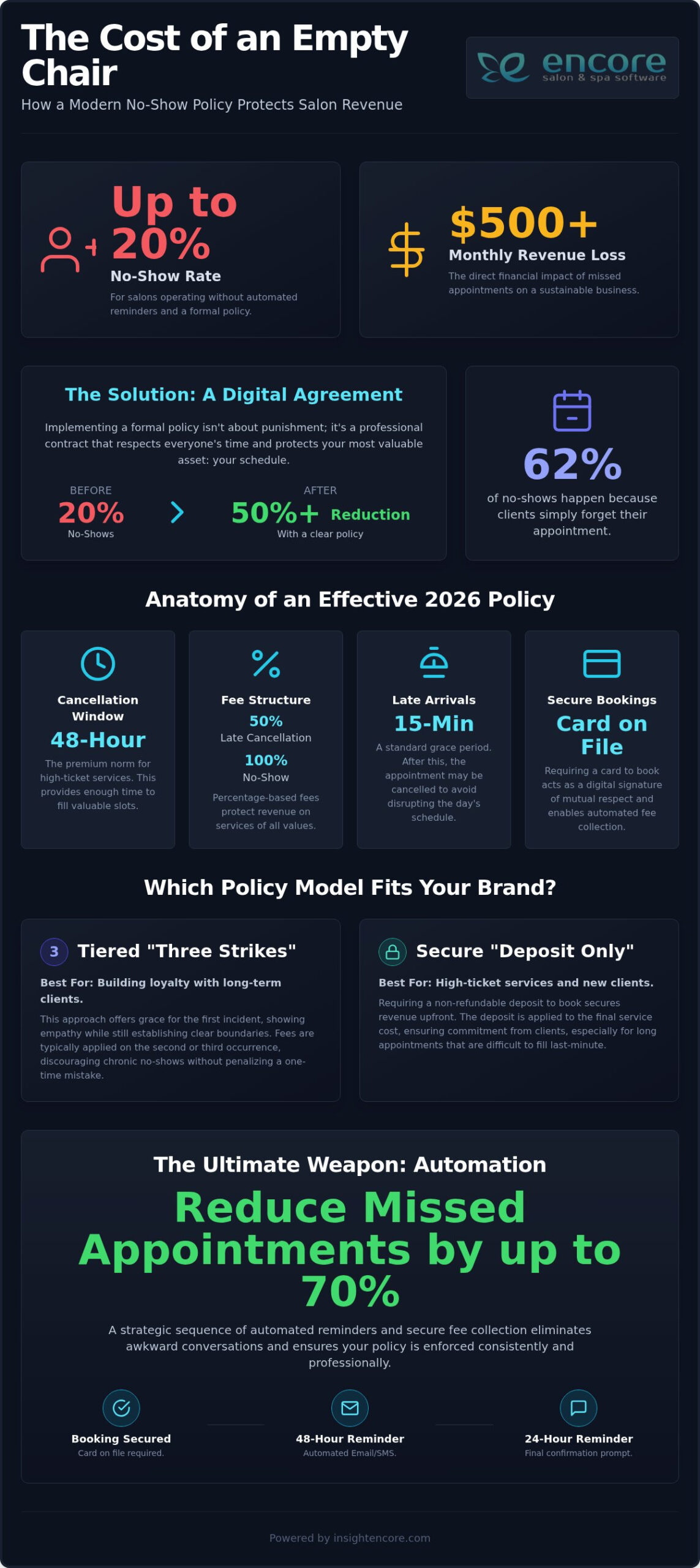
Did you know that salons without automated reminders often face no-show rates as high as 20%? It’s heartbreaking to watch your hard-earned revenue vanish because of an empty chair and a silent phone. You want to be the supportive, welcoming professional your clients love, but losing $500 or more every month to missed appointments simply isn’t sustainable. Finding the right salon client no-show policy template 2026 is the first step toward ending the awkwardness of asking for fees and ensuring your time is finally respected.

We understand that your time is your most valuable asset. We’re here to help you reclaim your schedule and your peace of mind with professional, enforceable strategies that work. By implementing these proven templates and automation tools, you can stop the profit leak and lower your no-show rates by at least 50%. We’ll walk you through creating a clear policy for your booking portal and show you how to collect fees automatically; this allows you to focus on your craft instead of chasing down payments.

Key Takeaways

  • Protect your revenue from rising operational costs by establishing a formal agreement that values both your time and your clients’ access to premium slots.
  • Download a versatile salon client no-show policy template 2026 designed to handle everything from standard hair services to high-ticket specialty treatments.
  • Identify the best policy model for your brand, whether you prefer a tiered “three strikes” approach for loyalty or a secure “deposit only” system for new clients.
  • Eliminate uncomfortable conversations by automating fee collection through integrated credit card processing and secure card-on-file features.
  • Reduce missed appointments by up to 70% using a strategic sequence of automated 48-hour and 24-hour reminders tailored to modern client habits.

Why Your Salon Needs a Formal No-Show Policy in 2026

Think of your salon chair as prime real estate. Every hour is a finite resource. In the modern beauty industry, a no-show policy is a mutual agreement that protects your time while ensuring your most loyal guests have access to the best time slots. Understanding what a no-show policy is helps reframe the conversation from one of punishment to one of professional respect. It sets the stage for a relationship built on transparency.

The 2026 "Price of an Empty Chair" has never been higher. Rising booth rents and inflation mean your margins are thinner than ever. You can’t afford to let a prime afternoon slot stay empty just because a client changed their mind at the last minute. Moving from verbal promises to digital contracts is no longer optional; it’s a standard business practice that protects your livelihood. Clients actually respect clear boundaries. It signals that your services are in high demand and your expertise is valuable. Using a salon client no-show policy template 2026 ensures these expectations are set before the client even sits in your chair.

The Real Cost of a Cancelled Appointment

Calculating your Hourly Loss Rate is a sobering exercise. It isn’t just the lost service fee. You must account for several hidden drains on your business:

  • Wasted product and preparation time
  • Fixed overhead like rent, software, and utilities
  • The opportunity cost of the client you turned away

A single no-show creates a ripple effect. It disrupts your creative flow and can even delay your next guest if you’re scrambling to fill the gap. Research indicates that 62% of no-shows happen because clients simply forget. Without an automated system, filling that gap at the last minute is nearly impossible. Every minute you spend manually texting clients to find a replacement is a minute you aren’t behind the chair earning money.

Setting Professional Boundaries with Empathy

We believe in framing your policy around fair access for all guests. It’s about being a supportive partner to your clients. You aren’t "charging a fine." You are ensuring that someone else doesn’t miss out on a transformation they’ve been waiting for. This approach lowers the barrier to entry for new clients who might feel intimidated by strict rules.

A solid policy helps you differentiate between true emergencies and chronic no-shows. It removes the "awkward" factor from your daily interactions. When you use integrated credit card processing to hold a card on file, fee collection becomes a neutral, automated process. This builds trust because there’s no ambiguity. Your clients know exactly what to expect, and you can focus on providing a stellar experience instead of worrying about your bottom line.

Essential Components of a Professional Salon Cancellation Policy

Crafting a policy that sticks requires more than just a few sentences on a flyer. It needs a structural framework that balances firm boundaries with the empathy your brand is known for. A professional policy serves as a digital contract, ensuring both you and your guest are on the same page before the first bottle of color is even opened. Your salon client no-show policy template 2026 should clearly state that a valid credit card is required to secure any booking, acting as a digital signature of mutual respect.

The fee structure is the heartbeat of your policy. Many pros choose between a flat fee or a percentage of the total service. While a flat fee is simple to explain, a percentage based fee (typically 50% for late cancellations and 100% for no-shows) better protects your revenue for high-ticket services. You should also define a late arrival grace period. Typically, 15 minutes is the industry standard. Beyond that, the appointment may need to be rescheduled and treated as a late cancellation to keep your day on track.

Defining the Cancellation Window

While a 24 hour notice period is the traditional floor, 48 hours is becoming the 2026 premium norm. High volume, low complexity services like a quick trim can often function with a 24 hour window. However, chemical services, extensions, or balayage require more preparation and are harder to fill at the last minute. These "premium" slots deserve a 48 hour window. If your salon is closed on Sundays and Mondays, make sure your policy explains how to handle those appointments. A client with a Tuesday morning slot should know they need to reach out by Saturday to avoid fees.

Deposit and Pre-payment Terms

There is a subtle but important difference between a booking fee and a down payment. In 2026, "no-questions-asked" booking fees are standard for new clients. This isn’t a penalty; it’s a commitment. When setting these terms, it’s wise to stay informed about consumer cancellation rights to ensure your policy remains fair and legally sound. Most salons find success by making deposits non-refundable but transferable if the client reschedules within a specific timeframe.

Handling these transactions manually can feel awkward and intrusive. Using Encore’s integrated credit card processing allows you to securely store cards on file. This removes the friction of asking for money during a sensitive moment. By automating this step, the system handles the "business" side of things, leaving you free to focus on your client’s transformation. If you’re ready to modernize your booking flow, you can explore how automated tools protect your schedule.

Choosing the Right Policy Model for Your Business

Selecting the right framework for your business is about more than just numbers. It’s about aligning your rules with your brand’s unique personality. When you choose a salon client no-show policy template 2026, you are making a statement about how you value your craft and your time. The economic effects of no-shows can be devastating for a growing business, so your model must be both practical and sustainable. Finding a balance between firm protection and client empathy is the secret to long-term success.

The Three Strikes Model is excellent for building trust. It offers a tiered approach: a friendly warning for the first instance, a 50% charge for the second, and a 100% charge for the third. This gives your loyal guests a chance to adjust to your boundaries. Conversely, the Deposit Only Model works best for high-ticket services like extensions or balayage. It ensures your product costs are covered before the client even walks through the door. For elite salons with months-long waitlists, the Strict 100% Model is often the only way to manage intense demand. Finally, the Flexible Model relies on a "pay what you can" or "waived fee" approach for low-competition, community-focused shops where personal relationships are the primary business driver.

Policy Comparison for Different Business Types

Independent professionals often prefer a direct, personal policy. Since you are both the owner and the stylist, your clients feel a closer connection to your personal time. Luxury spas should focus on the "Experience Reservation." This frames the time block as a curated event rather than just a slot on a calendar. For nail salons, a simple late fee structure is often more effective than a complex cancellation policy due to the high frequency of visits and shorter service times.

When to Waive the Fee

Empathy is your greatest retention tool. A "One-Time Forgiveness" rule maintains goodwill when a reliable client has a true emergency. You don’t want to lose a lifelong guest over a single flat tire or a sudden illness. Using Encore’s Client Management System allows you to see a client’s history at a glance. You can identify patterns of chronic no-shows versus isolated incidents. This data-driven approach removes the guesswork. It helps you make fair decisions that protect your business without sacrificing your brand’s heart.

Salon Client No-Show Policy Template 2026: Protect Your Revenue & Time

5 Salon Cancellation and No-Show Policy Templates for 2026

Having a clear, written agreement is the bridge between a casual request and a professional commitment. This salon client no-show policy template 2026 collection provides the exact wording you need to protect your business while maintaining a welcoming atmosphere. Whether you’re an independent stylist or a high-volume studio, these templates help set expectations from the very first click.

The Standard 24-Hour Notice Template

This is the most versatile option for traditional hair salons. It balances firmness with a welcoming tone. Copy and paste this into your booking portal or website:

"Your appointments are very important to the [Salon Name] team. We reserve this time specifically for you. We understand that schedule changes are sometimes necessary; therefore, we respectfully request at least 24 hours’ notice for cancellations. Please understand that when you forget or cancel your appointment without giving enough notice, we miss the opportunity to fill that appointment time, and clients on our waiting list miss the opportunity to receive services. Less than 24 hours’ notice will result in a charge equal to 50% of the reserved service amount. ‘No shows’ will be charged 100% of the reserved service amount. You may cancel via our online booking portal, our mobile app, or by calling us directly at [Phone Number]."

The Deposit-Based Policy for Specialty Services

For Tattoo Studios, med-spas, or balayage specialists, a non-refundable booking fee is the gold standard. This model ensures your preparation time is covered even if the client doesn’t arrive. Focus your wording on the "Booking Fee" rather than a "penalty." Explain that this fee covers the artist’s dedicated setup time and the lost opportunity of a multi-hour block. Remind guests that this amount applies directly toward their final service total, making it a "down payment" on their transformation.

SMS and Email Notification Templates

Automation is your best ally in reducing no-shows. Short, friendly appointment confirmation texts keep your schedule top-of-mind without feeling aggressive. For SMS, try: "Hi [Name]! Reminder of your visit to [Salon] on [Date] at [Time]. Reply ‘C’ to confirm. Note our 24hr cancellation policy. See you soon!" For emails, use a soft reminder that mentions the policy as a way to ensure "fair access for all guests." During the online booking process, include a mandatory checkbox with the following Acknowledgement Clause: "I have read and agree to the cancellation and no-show policy terms for this reservation."

Start your free trial to automate your policy enforcement today

For independent professionals, a direct approach works best: "As a small business owner, missed spots impact my ability to serve everyone fairly. I appreciate your respect for my time." If you run a busy urban hybrid shop, combine your cancellation rules with a 15-minute grace period. This ensures your walk-in flow remains steady while protecting your scheduled slots. Finally, for new clients, consider a "New Guest Only" policy where a card on file is mandatory to secure their introductory experience, significantly mitigating the risk with unknown guests.

Automating Policy Enforcement with Encore Salon Software

A great salon client no-show policy template 2026 is only effective if you have the tools to back it up. We know that manually tracking missed appointments and chasing fees is the least favorite part of your job. It feels confrontational and drains your creative energy. That’s why we’ve built the infrastructure to handle these logistics for you, turning your policy from a static document into a living, breathing part of your workflow. By integrating your agreement directly into the online booking process, you ensure that every guest acknowledges your terms before the "Book Now" button even becomes active.

Automated reminders are your first line of defense. By sending strategic alerts at 48 and 24 hours before an appointment, you can reduce no-shows by up to 70%. These aren’t just notifications; they are gentle nudges that respect your client’s busy life while prioritizing your schedule. If a client still misses their slot, our secure, PCI-compliant Encore Credit Card Processing allows you to hold fees safely using a card-on-file system. Our reporting and analytics tools also help you identify "Red Flag" clients who have a history of late arrivals. By seeing these patterns early, you can make informed decisions before they cost you another hour of revenue.

The "Silent Enforcer": How Encore Removes the Awkwardness

One of the biggest hurdles in salon management is the discomfort of asking for a cancellation fee. Our system acts as a "silent enforcer" by automating the entire collection process. When a no-show occurs, the system can process the charge based on your pre-set rules without you having to say a word. It then sends an automated receipt that clearly states the reason for the charge, referencing the digital signature the client provided during booking. This transparency significantly reduces the risk of credit card chargebacks and keeps your professional relationship intact. You don’t have to be the "bad guy" when the software handles the business side for you.

Rewarding Reliability with Loyalty Programs

While it’s important to protect your time, it’s equally vital to celebrate your most dependable guests. Using Encore’s Loyalty Programs, you can reward clients who consistently show up on time and respect your boundaries. You might even choose to use "VIP status" to automatically waive a cancellation fee for your top 10% of clients if a rare emergency arises. This approach reinforces that your salon client no-show policy template 2026 is about mutual respect, not punishment. It builds a culture of reliability that benefits your entire salon community and ensures your peace of mind.

Ready to reclaim your time and stop the profit leak? See how Encore automates your business.

Reclaim Your Schedule and Your Peace of Mind

Your time is your most valuable asset. Protecting it doesn’t mean being rigid or cold; it means setting a standard of mutual respect that allows your business to thrive. By choosing the right salon client no-show policy template 2026 and supporting it with the right technology, you can stop the revenue drain and focus on what you love most. We’ve shown you how clear boundaries combined with automated reminders can transform a salon’s culture and bottom line. You no longer have to choose between being a supportive stylist and a savvy business owner.

Since 1991, Syntec has been a trusted partner for thousands of beauty professionals looking to grow their brands with confidence. Our Encore system provides 24/7 online booking with built-in policy enforcement and integrated PCI-compliant card processing to keep your transactions secure. You can finally let the software handle the "silent enforcement" while you concentrate on delivering stellar transformations. You deserve a schedule that works for you and a business that respects your expertise.

Automate your salon’s no-show protection with Encore Salon Software today.
Take the first step toward a more organized and profitable future. Your empty chairs are waiting to be filled by clients who value your craft as much as you do.

Frequently Asked Questions

Is a salon cancellation policy legally enforceable in 2026?

Your policy is enforceable as long as you clearly communicate the terms and obtain the client’s agreement at the time of booking. Modern standards rely on digital agreements within your online booking portal. When a client checks a box to acknowledge your rules, they are entering a valid contract. Ensure your salon client no-show policy template 2026 is easily accessible on your website and booking page to avoid any legal disputes.

How much should a salon charge for a no-show fee?

The industry standard for a true no-show is 100% of the scheduled service price. If a client cancels late but provides some notice, a 50% fee is the common benchmark. Some businesses prefer a flat rate, typically ranging from $25 to $50, depending on the service type. These fees should be reasonable and clearly disclosed upfront to ensure they are viewed as a recovery of lost costs rather than a penalty.

Can I charge a cancellation fee if the client didn’t sign a physical paper?

You absolutely can charge a fee without a physical signature. Digital "click-wrap" agreements, where a client clicks a box during the booking process, are legally binding in 2026. This digital contract proves the guest was aware of the terms before finalizing their reservation. By using a salon client no-show policy template 2026 integrated into your booking flow, you create a secure audit trail that protects your business from chargebacks and disagreements.

What is the best way to tell a client they are being charged a no-show fee?

Automation is the most professional way to handle this sensitive conversation. An automated email or text receipt that cites the policy and the specific appointment time removes the personal friction between you and the guest. If you must speak with them directly, lead with empathy. Explain that the fee helps cover the overhead and lost time for that specific slot, which ensures the salon can continue providing high-quality services to everyone.

Should I require a deposit for every single appointment?

While not mandatory for every guest, deposits are highly effective for new clients and high-ticket services like extensions or chemical treatments. Many salons find a hybrid approach works best. You might require a non-refundable booking fee for anyone you haven’t seen before, while letting long-term, reliable regulars book with just a card on file. This strategy mitigates risk with unknown guests without adding hurdles for your most loyal community members.

How do I handle a regular client who suddenly starts no-showing?

Start with a personal check-in rather than an immediate charge. If a reliable guest misses an appointment, there might be a genuine emergency or a health issue involved. Use your client management system to review their history. If it’s their first offense in years, a "one-time forgiveness" gesture builds immense loyalty. However, if the behavior becomes a pattern, it’s time to have a gentle but firm conversation about your time.

How does salon software help with no-show protection?

Software acts as your dedicated administrative assistant by automating the entire enforcement process. It sends out a sequence of reminders at 48 and 24 hours, which research shows can reduce no-shows by 60% to 80%. Beyond reminders, it securely stores credit card information and processes fees automatically. This ensures you aren’t stuck chasing payments manually and allows you to focus entirely on the creative work happening behind the chair.

What happens if a client’s card on file is declined for a no-show fee?

If a card is declined, your software will typically alert you immediately. You can then reach out to the client to update their payment information or let them know the balance will be added to their next visit. For future bookings, it’s wise to require a full pre-payment or a larger deposit from that specific guest. This protects your revenue and ensures that your time is fully secured before they return to your salon.

Disclaimer

This article is general in nature and may contain errors, please verify all claims with your sales rep