

That "simple" flat-rate pricing you chose to avoid headaches is likely the very thing quietly draining your bank account. You’ve probably stared at your monthly merchant statement, squinting at line items like PCI non-compliance or statement fees; it’s frustrating to feel like you need a finance degree to learn how to reduce credit card processing fees for small business. We know the feeling of seeing your hard-earned profit margins shrink under the weight of unpredictable costs. It shouldn’t be this complicated to get paid for the great work you do.
This 2026 guide pulls back the curtain on the industry’s hidden junk fees and shows you exactly how to reclaim your profits through smarter processing strategies. We’ll explore the impact of the latest Visa and Mastercard interchange rate reductions, the transparency of interchange-plus models, and how to find a processing partner that values your peace of mind as much as your growth. By the end, you’ll have a clear roadmap to a lower effective rate and a system that integrates perfectly with your existing booking software.
Key Takeaways
- Learn why the “simplicity” of flat-rate pricing often hides higher margins and how to calculate your true effective rate.
- Understand the transparency of Interchange-Plus pricing to avoid the expensive “non-qualified” transaction traps found in tiered models.
- Discover actionable steps on how to reduce credit card processing fees for small business by optimizing your data accuracy and risk profile.
- Stop losing money to “junk” fees by mastering 2026 security compliance standards and debunking common merchant myths.
- Streamline your operations by moving to integrated payments, which eliminates manual reconciliation and simplifies your support.
The Hidden Cost of ‘Simple’ Credit Card Processing
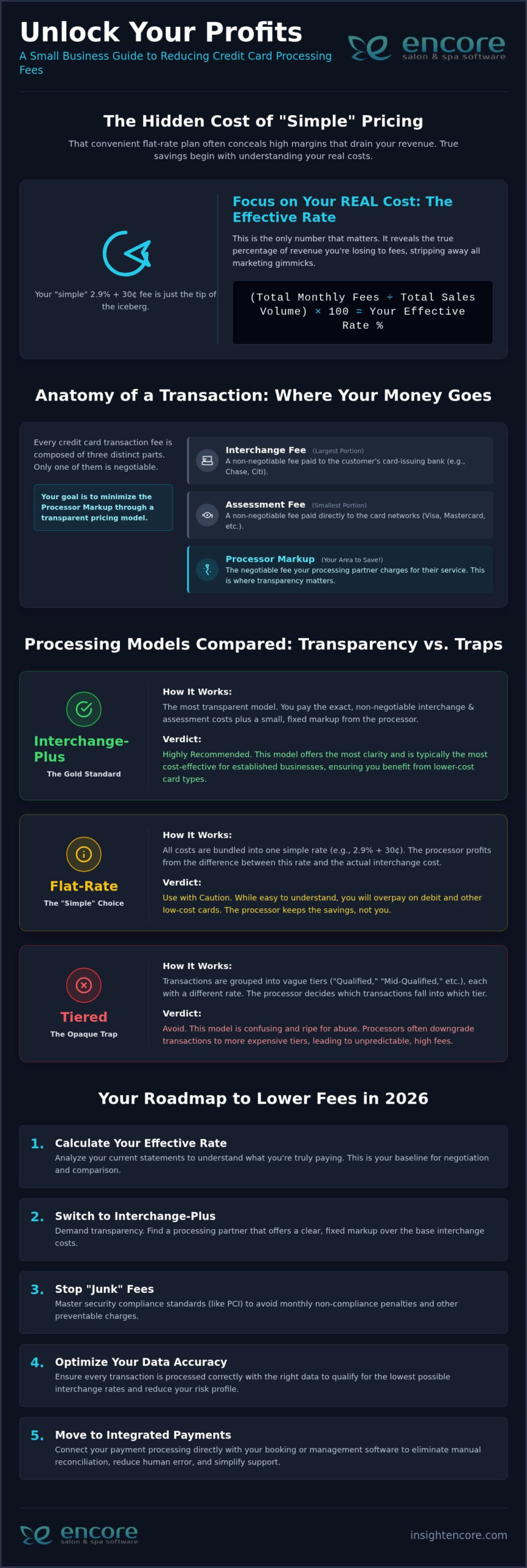
Many salon and spa owners feel a sense of relief when they sign up for a flat-rate processing plan. It sounds easy. It looks predictable. But that simplicity often comes with a steep price tag that stays hidden beneath the surface of your monthly statements. If you want to know how to reduce credit card processing fees for small business, you first have to look past the marketing slogans and focus on your "effective rate." This is the only number that truly matters; it’s calculated by dividing your total monthly fees by your total sales volume. It reveals exactly what percentage of your revenue is vanishing into the processing ether.
Credit card processing fees are the aggregate of interchange, assessment, and processor markup. When a provider offers you a single flat rate, like the common 2.9% + 30c marketing hook, they aren’t actually charging you one fee. They’re bundling all those costs together and adding a significant buffer to ensure they profit on every single swipe, regardless of the card type used. This "convenience" allows brands to hide high margins behind a single, easy-to-digest number.
Myth: Flat-Rate Pricing is Always the Cheapest Option
Flat-rate models are a psychological trap designed for convenience. While they’re great for a brand-new business with very low volume, high-growth salons often find themselves overpaying. The processor essentially "averages out" the costs in their own favor. If a client pays for a $200 hair color service with a basic debit card, the actual cost to process that transaction is quite low. However, with a flat rate, you’re still paying that high percentage. The processor simply pockets the difference. This is a major hurdle when you’re looking for ways how to reduce credit card processing fees for small business. Small-ticket items like a $15 lip wax also get hit hard by the fixed "per transaction" fee, which can eat up a massive portion of your margin on low-cost services.
The True Anatomy of a Transaction Fee
To reclaim your margins, you need to know exactly where your money is going. Every fee you pay is split into three distinct buckets:
- Interchange fee: This is the non-negotiable cost set by card brands like Visa and Mastercard. It’s paid to the bank that issued the customer’s card. It varies based on the card type and how it’s processed.
- Assessment fees: These are small, fixed percentages paid directly to the card networks for using their systems. Like interchange, these are non-negotiable for everyone.
- Processor markup: This is the only area where you actually have leverage. This is the fee your processing partner charges for their service.
Understanding these layers is the first step toward a healthier bottom line. When you use integrated credit card processing, you gain the transparency needed to see these costs clearly rather than having them buried in a single, expensive bundle. It’s about moving from a state of confusion to a position of organized control over your business finances.
Decoding Processing Models: Interchange-Plus vs. Tiered
Understanding the difference between pricing models is a critical step in learning how to reduce credit card processing fees. Most processors use one of two main structures: Interchange-Plus or Tiered. While both might look similar on a sales sheet, their impact on your monthly profit is vastly different. One offers a clear window into your costs, while the other often feels like a locked door. Choosing the right model is about more than just numbers; it’s about gaining the transparency you need to run a healthy, predictable business.
Why Interchange-Plus is the Gold Standard for Salons
Interchange-Plus is often called "wholesale" pricing because it’s the most transparent model available. You pay the exact cost set by the card brands plus a small, fixed markup from the processor. This clarity allows you to see exactly where every penny goes. For high-volume businesses like salons and spas, this model is incredibly cost-effective. You benefit directly from lower interchange rates on debit cards or standard consumer cards. As your business scales, the savings grow with you. Choosing integrated credit card processing using this model ensures your software and payments work together without hidden surprises. It’s a professional approach that treats you like a partner, not just another account number.
Avoiding the Trap of Tiered Pricing
Tiered pricing is the opposite of transparency. It bundles different transaction types into categories like "qualified," "mid-qualified," and "non-qualified." While the low "qualified" rate looks attractive in a marketing brochure, very few modern cards actually qualify for it. Most rewards cards, business cards, and online transactions get pushed into the expensive non-qualified tier. This allows processors to hide high margins behind a confusing wall of categories. You might think you’re paying a low rate, but your effective rate often tells a much more expensive story. It’s a common industry frustration that leaves many owners feeling stuck and confused.
Savvy owners are moving away from these bundled traps. Tiered statements are notoriously difficult to audit because they lack the line-item detail needed to see the actual cost of each transaction. This lack of transparency is why Tiered models are becoming obsolete for businesses that prioritize financial health. When you understand how to reduce credit card processing fees for small business, you realize that the cheapest "looking" rate is rarely the cheapest "actual" rate. If you’re tired of the guesswork and want a partner that values your peace of mind, it’s time to see how integrated software can simplify your payments.
5 Proven Strategies to Reduce Fees in 2026
Implementing a few operational shifts can significantly lower your risk profile and, by extension, your costs. A foundational step in understanding credit card processing fees is recognizing that processors charge more for transactions they perceive as high risk. By improving data accuracy and ensuring your Merchant Category Code (MCC) accurately reflects your service-based business, you set a lower baseline for your rates. These small adjustments are key parts of how to increase salon profit margin in a competitive market.
Strategy 1: Optimize for Card-Present Transactions
Transactions where a card is physically "dipped" or "tapped" carry the lowest risk of fraud. Because the security chip is verified in person, banks reward you with lower interchange rates. On the other hand, keying in card numbers manually is one of the most expensive ways to get paid. It signals a higher risk of chargebacks to the processor. Encourage your clients to use their physical cards or mobile wallets at the counter. While "card on file" features are convenient for no-show protection, using them for every routine checkout can quietly inflate your monthly costs. Learning how to reduce credit card processing fees for small business often starts with this simple hardware habit.
Strategy 2: Leverage Industry-Specific Integrated Software
Standalone terminals often lead to manual entry errors and reconciliation headaches. When you use salon software that features integrated payments, the transaction data flows directly from your booking calendar to the card reader. This precision reduces the chance of human error and provides the "enhanced data" that card brands look for when qualifying you for better rates. It also makes defending against unfair chargebacks much easier. You get a clear audit trail that links the payment to the specific service and client, giving you a level of organized control that third-party terminals simply can’t match.
Strategy 3: Negotiate and Eliminate ‘Junk’ Fees
Many business owners don’t realize that several items on their statements are actually optional markups. Fees for "IRS reporting," "online portals," or "monthly statements" are often just extra profit for the processor. Take the time for an annual fee review with your provider. If you have a consistent processing history and high volume, you have leverage. Don’t be afraid to ask for a "Meet or Beat" offer. A supportive partner will be transparent about these costs and willing to work with you to keep your business healthy. It’s not just about finding the lowest rate; it’s about finding a partner that doesn’t nickel-and-dime your growth.
Common Processing Myths That Hurt Small Business Margins
Misinformation is often the biggest hurdle to financial freedom. Many salon and spa owners operate under the assumption that their current setup is the only way to do business. This feeling of being "stuck" can lead to thousands of dollars in lost revenue over time. Learning how to reduce credit card processing fees for small business requires clearing away these common myths. This process is a vital part of your overall salon cash flow management strategy.
Myth: I’m Locked Into My Current Bank’s Rates
It’s a common misconception that you must use the processing service offered by your business bank. Banks often bundle these services together to create a sense of "all-in-one" convenience. However, these bundled services are frequently the most expensive way to process payments. Your business bank account and your merchant processor are two separate entities. You have the total freedom to choose a processor that integrates seamlessly with your salon software. Understanding how to reduce credit card processing fees for small business starts with realizing you aren’t tied to your bank’s high-margin bundles. Breaking this cycle allows you to find rates that actually reflect your business volume.
Myth: Security Compliance (PCI) is a Profit Center for Processors
In the 2026 payment landscape, security is more important than ever. Yet, many processors use PCI non-compliance fees as a way to pad their own pockets. These monthly charges aren’t a mandatory tax; they’re a penalty for not completing a Self-Assessment Questionnaire (SAQ). You can avoid these "junk" fees entirely by working with a partner that helps you stay compliant. Modern technology like tokenization also reduces your compliance burden by ensuring sensitive card data never actually touches your local system. A supportive partner won’t just charge you a fee; they’ll provide the tools and guidance to ensure your clients’ data stays safe.
Streamlining Your Bottom Line with Integrated Payments
Moving from a standalone terminal to a fully integrated system is often the final step for owners who have mastered how to reduce credit card processing fees for small business. Standalone machines act like islands; they don’t talk to your booking software, which leads to manual errors and hours of wasted reconciliation time. By bringing your payments and your salon management into one ecosystem, you eliminate the friction that quietly drains your profits. It’s about having "one throat to choke." If a transaction doesn’t go through, you have one dedicated partner to call, not a software vendor and a separate bank pointing fingers at each other.
This streamlined approach also transforms the client experience. Checkout becomes a professional, seamless moment rather than a clunky hand-off between two different systems. Your clients notice the speed and efficiency, which builds trust and encourages repeat visits. You have more control over your fees than you might think. By choosing a partner that understands the specific needs of the beauty and wellness industry, you move from a state of financial stress to a feeling of organized control.
The Efficiency Gain of Encore’s Built-in Processing
Our integrated credit card processing removes the need for double-entry. When you close a ticket in your Encore Salon Software, the total amount is automatically sent to the terminal. This prevents the costly manual errors that often happen during a busy shift. Beyond simple swipes, our system allows you to manage gift cards and loyalty programs in the same flow, boosting your revenue without adding extra steps. You also gain access to real-time reporting. You can see your true net profit after fees instantly, rather than waiting for a confusing monthly statement to arrive in the mail.
Transitioning Without Disrupting Your Client Experience
Switching to a new system doesn’t have to be a headache. We guide you through a step-by-step process to ensure your transition to our integrated system is smooth and stress-free. Training your staff on the new, faster checkout procedures usually takes minutes, not hours. Our team is invested in your individual success, providing the human support you need to feel confident from day one. You deserve a processing partner that acts as a supportive ally in your business growth. If you’re ready to stop overpaying and start growing, contact us for a transparent fee review.
Take Control of Your Financial Future
You now have the tools to look past the marketing fluff and see your merchant statements for what they really are. By focusing on your effective rate and choosing transparent interchange-plus models, you move from a state of confusion to one of organized control. Reclaiming your profit margins is a journey that begins with understanding exactly where every penny of your revenue is going.
Learning how to reduce credit card processing fees for small business is one of the most impactful things you can do for your long-term growth. At Syntec Business Systems, we’ve been dedicated to the success of salons and spas since 1991. We believe in a human-centric approach with a strict policy against hidden "junk" fees. Our seamless integration with Encore Salon & Spa Software ensures that your payments and booking work together perfectly.
Ready to stop overpaying? Explore Encore’s transparent credit card processing solutions today.
You’ve worked hard to build your business, and you deserve a partner that respects your bottom line. Take this knowledge and start making the shifts that will protect your profits for years to come. We are here to help you every step of the way.
Frequently Asked Questions
What is a good credit card processing rate for a small salon?
A competitive effective rate for a small salon typically ranges between 1.5% and 3.5%. This percentage includes the interchange fee, network assessments, and your processor’s markup. Rather than chasing a single "low" number, you should calculate your total monthly fees divided by your total sales volume. High-volume businesses often find that interchange-plus models provide a much lower effective rate than simple flat-rate options. It’s about finding the right balance for your specific service mix.
Can I pass credit card processing fees to my customers?
You can apply surcharges for credit card use or offer discounts for cash payments to help offset costs. As of 2026, cash discount programs remain legal in all 50 states. However, you must follow specific card network rules regarding clear signage and disclosure at the point of sale. Many owners prefer cash discounts because they provide a positive incentive for clients while protecting the business’s bottom line from rising processing costs. It is an effective way to manage your margins.
How often should I negotiate my merchant processing rates?
You should conduct a formal review of your merchant processing rates at least once a year. This annual check-up allows you to leverage your consistent processing history to ask for a "Meet or Beat" offer from your provider. If your business volume has grown significantly, you have more leverage to negotiate a lower markup. Staying proactive ensures your processing partner’s fees remain competitive as your salon scales. It is a simple step that protects your long-term financial health and peace of mind.
What are the most common hidden fees in credit card processing?
The most common hidden costs include PCI non-compliance fees, statement fees, and "IRS reporting" fees. These are often optional markups that processors use to increase their own profit margins. Learning how to reduce credit card processing fees for small business involves identifying these line items on your monthly statement. A transparent partner will help you eliminate these unnecessary charges by assisting with compliance and providing digital reporting. It saves you money every month without any hidden surprises.
Is it cheaper to use a third-party flat-rate processor or an integrated system?
Integrated systems are often more cost-effective for growing businesses than third-party flat-rate processors. While flat-rate brands offer simplicity, they often charge a high premium to cover their own risks. An integrated system like Encore provides transparency and eliminates manual data entry errors. This reduces labor costs and prevents reconciliation headaches. For a busy salon, the efficiency gains and lower effective rates of an integrated model usually outweigh the perceived convenience of a simple, third-party flat-rate app.
What happens if I don’t complete my PCI compliance questionnaire?
If you don’t complete your annual Self-Assessment Questionnaire, your processor will likely charge you a monthly non-compliance fee. This is a penalty designed to encourage security, not a mandatory tax. These fees can range significantly and add up quickly over a year. Completing the questionnaire not only removes the fee but also ensures you are using modern security tools like tokenization to protect your clients’ sensitive data. It is a vital part of professional and secure management.
Do debit cards cost the same to process as credit cards?
Debit cards are significantly cheaper to process than credit cards because their interchange rates are regulated. For example, regulated debit rates in 2026 are often as low as 0.05% plus a small fixed fee per transaction. Flat-rate processors typically charge you the same high percentage for both, pocketing the massive difference. Using an interchange-plus model ensures these savings are passed directly to your business rather than staying with the processor. It is a simple way to reclaim your hard-earned profit.
How do integrated payments help reduce my overall business costs?
Integrated payments reduce costs by automating the reconciliation process and eliminating manual entry errors at the front desk. When your checkout software talks directly to your terminal, you spend less time on bookkeeping and more time with clients. This precision is a key part of how to reduce credit card processing fees for small business because it qualifies you for better rates. It also provides a stronger audit trail to help you successfully win unfair chargeback disputes.
Disclaimer
This article is general in nature and may contain errors, please verify all claims with your sales rep