
window.dataLayer = window.dataLayer || []; function gtag(){dataLayer.push(arguments);} gtag('js', new Date()); gtag('config', 'UA-206511945-1');
Search
Categories
Uncategorized

Salon Employee Performance Review Template: The 2026 Management Guide

What if your next performance review was the exact reason your top stylist decided to stay for another five years instead of opening their own suite? Most salon owners dread review season. It feels like a mountain of manual math, awkward conversations about retail sales, and the constant fear that a critique might trigger a resignation. Using a structured salon employee performance review template ensures you aren’t just guessing about who’s performing. You want to mentor your team, but without clear data, it’s hard to be truly objective. It’s exhausting to manage by gut feeling when you’re trying to build a professional brand.

We’re here to help you turn those stressful meetings into a data-driven roadmap for stylist prosperity. This guide provides a professional framework that balances hard metrics with the soft skills that keep your chairs full. You’ll learn how to create clear growth paths that slash turnover and boost your bottom line through better retail and rebooking habits. We’ll show you how to use integrated reporting to remove the guesswork; making every conversation feel like a partnership rather than a test. It’s time to lead with confidence and give your team the organized, professional structure they need to thrive.

Key Takeaways

  • Stop the “salon drama” by turning annual reviews into a structured growth dialogue that keeps your team focused and happy.
  • Use our salon employee performance review template to objectively measure both revenue metrics and the soft skills that drive client loyalty.
  • Abandon the old “feedback sandwich” for a modern “growth loop” approach that motivates stylists without the typical performance review anxiety.
  • Discover how automated software removes the manual math from tracking retail commissions and rebooking percentages for total peace of mind.
  • Create clear, professional growth paths that help you retain top talent and increase your salon’s overall revenue.

Why Performance Reviews are the Heart of Salon Growth

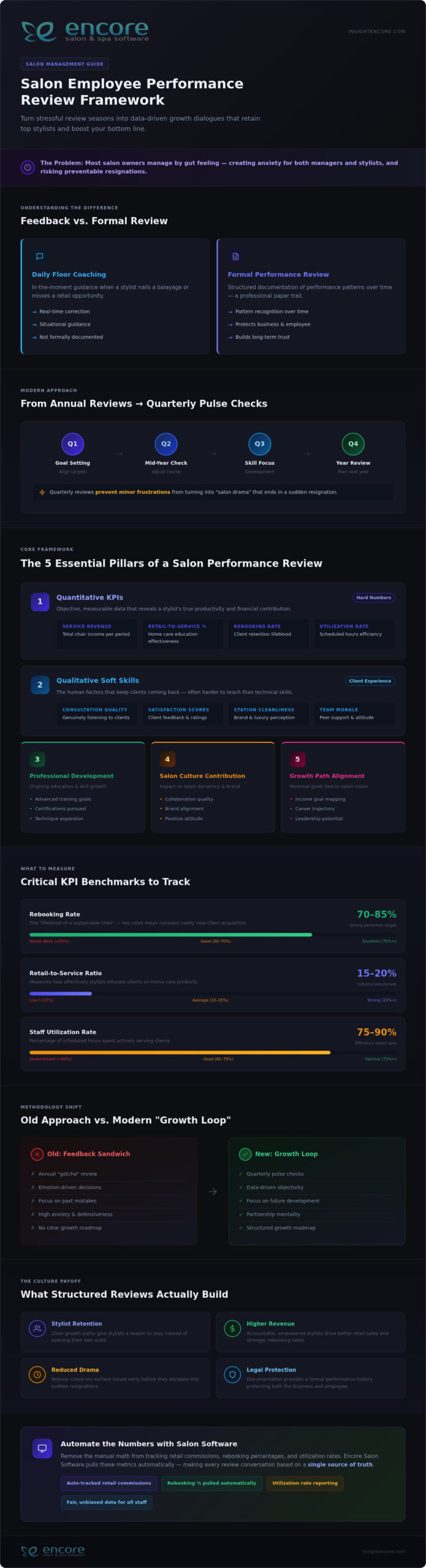
A performance review isn’t a “gotcha” moment or a stressful report card. Think of it as a structured growth dialogue between you and your stylists. It’s a dedicated space to pause, look at the numbers, and plan the next chapter of a stylist’s career. In 2026, the industry is shifting away from the high-pressure annual sit-down. Instead, successful owners are using quarterly “pulse checks” to keep everyone aligned. This regular rhythm prevents minor frustrations from turning into “salon drama” that ends in a sudden resignation. By using a consistent salon employee performance review template, you remove the emotion from the equation and replace it with a supportive roadmap. This isn’t just about feelings; it’s about the bottom line. Clear reviews directly lead to higher rebooking rates and better retail sales because stylists feel empowered and accountable.

The Difference Between Feedback and a Review

Daily floor coaching is essential, but it isn’t a substitute for a formal review. Feedback is what you say when a stylist nails a balayage or misses a retail opportunity in the moment. A review is the formal documentation of those patterns over time. This paper trail is vital for both parties. It protects your business by documenting performance history and protects the employee by ensuring their hard work is officially recognized. When you use a salon employee performance review template, you create a non-punitive environment where the focus remains on professional development rather than past mistakes. Documentation builds trust because it proves you are paying attention to more than just the busy Saturdays.

Salon Culture and Employee Engagement

Stylists aren’t just looking for a chair; they’re looking for a professional home. Reviews foster this sense of belonging by showing that you are invested in their individual success. When you align a stylist’s personal income goals with your salon’s brand vision, magic happens. Transparency is the secret ingredient here. By being open about metrics like utilization rates and average ticket prices, you build long-term loyalty. Stylists who understand the “why” behind the numbers are far more likely to stay engaged and help the business grow. Using Encore Salon Software to provide these metrics ensures the conversation is based on a single source of truth, making the process fair for everyone on the team.

The 5 Essential Pillars of a Salon Performance Review

A high-performing team isn’t built on gut feelings or “vibes” alone. It requires a balanced look at five specific areas that define a stylist’s success. Using a comprehensive salon employee performance review template ensures you don’t miss the subtle details that drive long-term growth. When you evaluate a team member, you’re looking for a harmony between their technical skill, their financial impact, and their contribution to your salon’s culture. This holistic approach turns a standard meeting into a powerful mentorship session. It gives your stylists a clear picture of where they shine and where they can reach the next level of their career.

Quantitative KPIs: Tracking the Numbers

Numbers provide an objective window into a stylist’s productivity. You can’t improve what you don’t measure. Focus on service revenue versus retail-to-service percentages to see how well they are educating clients on home care. Rebooking rates are equally vital; they are the lifeblood of a sustainable chair. If a stylist isn’t rebooking at a high rate, you’re constantly spending money to acquire new clients just to keep them busy. You should also learn How to Calculate Salon Staff Utilization Rate to determine if they are using their scheduled hours efficiently. To make tracking these metrics effortless, you can explore our reporting features which pull this data automatically.

Qualitative Soft Skills: The Client Experience

The client experience is what keeps people coming back. It starts with the consultation quality. Is the stylist truly listening, or are they just going through the motions? You should also track client satisfaction scores and station cleanliness. A messy station reflects poorly on your entire brand and can dampen the “luxury” feel of a service. Beyond the chair, consider their contribution to team morale. A stylist who supports their peers and maintains a positive attitude is worth their weight in gold. These soft skills are often harder to teach than a new cutting technique, so acknowledging them in your salon employee performance review template is essential for a healthy culture.

Technical Excellence and Future Growth

2026 demands constant skill updates. Your reviews should document technical progression, such as new certifications or education credits earned during the quarter. This keeps your team at the forefront of industry trends. Finally, every review must end with future growth and goal setting. Where does the stylist want to be in six months? Whether it’s increasing their average ticket price or becoming a lead educator, setting clear, documented goals gives them a reason to stay and grow within your business. This forward-looking approach transforms the review from a look at the past into a roadmap for the future.

Your Salon Employee Performance Review Template [2026 Version]

Building a high-performing team starts with organization. A well-designed salon employee performance review template acts as the skeleton for your conversation. It ensures you cover everything from basic attendance to complex retail goals without missing a beat. Start your template with a clear header including the stylist’s name, the review period, and the date. Use a simple 1 to 5 scoring system to keep things objective; 1 being “needs immediate improvement” and 5 being “consistently exceeds expectations.” This scale removes the ambiguity of “doing okay” and gives you a concrete way to track professional growth over time. It makes the “why” behind your feedback much easier for the stylist to digest.

Section 1: Performance Metrics Table

The core of your review should be a clear, easy-to-read grid. This is where you list KPIs like rebooking percentages, retail-to-service ratios, and total service revenue. For 2026, setting a “Target” versus “Actual” figure for each metric is essential. It shows the stylist exactly where they hit the mark and where they fell short of the salon’s benchmarks. Visualizing progress over the last three review periods helps identify long-term trends. Are they steadily growing, or have they hit a plateau? Using Encore’s integrated reporting allows you to pull these numbers instantly. It saves you hours of manual math and ensures your “Actual” figures are 100% accurate every single time.

Section 2: The Stylist Self-Evaluation

A review shouldn’t be a monologue. Letting the stylist lead a portion of the meeting fosters ownership and professional maturity. Include a section for self-evaluation with questions like, “What was your biggest win this quarter?” This forces them to acknowledge and celebrate their own successes. Equally important is identifying roadblocks. Ask them, “What tool or training would help you grow?” This shifts the focus from what they did wrong to what they need to succeed. It transforms you from a boss into a mentor who is actively clearing the path for their career progression. When stylists feel they have a voice in their growth, they stay more engaged with your brand.

Close your salon employee performance review template with a space for manager’s comments. This is your opportunity to provide constructive, actionable feedback. Avoid vague praise like “good job.” Instead, use specific examples. If they hit their retail target, mention the specific product line they excelled with. If they need to work on rebooking, suggest a specific script for the chair. When your template combines hard data with empathetic coaching, you create a culture of excellence that stylists won’t want to leave. It turns a standard HR requirement into a powerful tool for retention and revenue.

Salon Employee Performance Review Template: The 2026 Management Guide

Turning Reviews into Results: Best Practices for Managers

A salon employee performance review template is only as effective as the person leading the conversation. If you treat this process like a chore, your stylists will treat it like a punishment. Successful managers use these meetings to transform raw data into a shared vision for the future. It’s about moving away from the old ways of critiquing and moving toward a partnership of progress. When you lead with empathy and professional confidence, you turn a standard HR requirement into a powerful tool for team retention. If you’re also evaluating whether your current staffing model is the right fit, understanding the key differences in salon commission vs booth rental can help you structure your team and your reviews more strategically.

The Pre-Review Data Pull

Never walk into a review without your reports. Relying on memory or “gut feelings” is a fast track to defensive reactions and hurt feelings. Objective data is your best ally. Use Encore Salon Software to generate performance dashboards that show exactly where a stylist stands. Compare their performance to salon averages fairly. If the entire salon saw a dip in retail during a slow month, it isn’t fair to penalize one person for that trend. Data removes the bias and ensures the conversation remains focused on facts rather than personalities.

See how automated reporting simplifies your review prep

The “feedback sandwich” of praise, critique, and more praise is officially dead. Stylists often find it insincere or walk away confused about what they actually need to improve. Try the “Growth Loop” instead. Focus on the observation, the impact on the salon, and the collaborative solution. This method keeps the focus on continuous improvement. It feels like coaching rather than a lecture, which is essential for maintaining a high-performing culture where everyone feels supported.

Conducting the Meeting

Environment matters more than you might think. Choosing a neutral, quiet space outside of busy salon hours ensures you have the stylist’s full attention. Practice active listening techniques; let them speak more than you do. Ask open-ended questions about their challenges on the floor. If a stylist gets defensive, stay calm and empathetic. Acknowledge their perspective, but use the data you’ve gathered to bring the conversation back to professional standards. This balance of kindness and authority builds long-term respect.

Close every meeting with a clear, signed action plan for the next 90 days. Set SMART goals that are specific and measurable. Instead of saying “sell more retail,” set a goal to “increase retail-to-service percentage by 5% by the next review.” When goals are clear, stylists know exactly how to win. This transparency creates a sense of organized control that lowers stress for everyone involved. It turns the review from a look at the past into a roadmap for a successful future.

Streamlining Reviews with Encore Salon & Spa Software

While a salon employee performance review template provides the necessary structure, manual data entry is a relic of the past. If you’re still spending Sunday nights with a calculator and a stack of service receipts, you’re losing valuable time that should be spent on salon strategy. Moving from paper templates to a digital management ecosystem isn’t just about saving trees; it’s about accuracy and peace of mind. Automated performance dashboards turn hours of “number crunching” into seconds of “one-click reporting.” This transition allows you to lead with facts rather than feelings. It ensures that every conversation you have with your team is grounded in reality.

Data transparency is the foundation of a healthy salon culture. When you track retail and commissions in real-time, you remove the “black box” of payroll. Stylists can even access their own performance portal to track their progress toward goals every single day. This autonomy encourages them to take ownership of their chair. They no longer have to wait for a quarterly meeting to see if they’ve hit their rebooking targets. Instead, they can adjust their approach in the moment, leading to a more proactive and engaged team. It’s a supportive way to foster professional maturity across your entire floor. For salon owners managing complex tiered structures, calculating salon staff commission automatically eliminates the manual errors that can damage staff trust and consume your weekends.

Automated Reporting Features

One-click reports for rebooking, retention, and utilization rates provide a “source of truth” that both management and staff can trust. Whether you are managing a team of employees or looking for Specialized Solutions for chair renters, having integrated reporting is essential. It ensures that every review is based on objective metrics. When stylists see that their hard work is being tracked accurately and fairly, their trust in management grows. This clarity is what transforms a simple job into a long-term professional home. It removes the friction that often leads to staff turnover and “salon drama.”

Next Steps for Your Salon

Now is the time to audit your current tracking system. Ask yourself: is it truly objective? If your performance data is scattered across spreadsheets and paper notes, it’s time for a change. Start by downloading a professional salon employee performance review template and scheduling your first “Pulse Review” with your team. This small step signals to your staff that you are invested in their growth and the salon’s future success. Organized leadership is the most effective tool you have for reducing turnover and increasing your bottom line. You don’t have to do it alone; the right tools make all the difference.

Book a demo with Encore to see how we automate your staff tracking and give you back your peace of mind.

Empowering Your Team for Long-Term Success

Your salon’s growth depends on the growth of your individual stylists. By moving from annual “report cards” to quarterly growth dialogues, you build a culture of transparency and trust. A professional salon employee performance review template serves as your roadmap; ensuring you never miss a chance to celebrate a retail win or coach a rebooking opportunity. It’s about turning daily frustrations into documented progress. When you balance hard metrics with genuine empathy, you create a professional home where stylists feel supported and inspired to stay.

Since 1991, we’ve helped owners move from manual chaos to organized control. You don’t have to spend your weekends calculating commissions or guessing at utilization rates. With all-in-one management from POS to performance tracking, you can lead with confidence while knowing our dedicated human support team is always here to help. It’s time to reclaim your peace of mind and focus on the artistry that makes your salon unique. You’ve built something incredible; now give your team the structure they need to help it thrive.

Ready to automate your staff performance tracking? Explore Encore Salon Software today.

Frequently Asked Questions

How often should I conduct salon employee performance reviews?

You should aim for quarterly “pulse checks” rather than waiting for a stressful annual meeting. Frequent check-ins allow you to address small issues before they become “salon drama.” This rhythm keeps stylists engaged and ensures their career goals stay on track. By reviewing your salon employee performance review template every 90 days, you provide a consistent roadmap that adapts to the fast-paced nature of the beauty industry.

What are the most important KPIs for a hair stylist?

The most vital KPIs include rebooking rates, retail-to-service percentages, and utilization rates. Rebooking measures client loyalty, while retail-to-service ratios reflect how well a stylist educates their clients on home care. You should also monitor average ticket prices and new client retention. Tracking these specific numbers helps you identify whether a stylist is maximizing their scheduled hours or if there is room to increase their efficiency and income.

How do I handle a stylist who is underperforming in retail sales?

Focus on education rather than criticism when a stylist misses their retail targets. Often, underperformance stems from a lack of confidence in recommending products. Provide them with specific scripts or host a product knowledge session to build their skills. Use your salon employee performance review template to set a small, achievable goal for the next 30 days. This supportive approach turns a stressful requirement into a collaborative path toward higher commissions.

Should I include client feedback in the performance review?

Yes, client feedback is a valuable qualitative metric that adds depth to your data. Look at online reviews, satisfaction scores, and direct feedback to gauge the “vibe” of the service. While hard numbers show revenue, client comments reveal the quality of the consultation and the overall experience. Just ensure you present this feedback constructively. It helps stylists understand how their soft skills directly impact their rebooking rates and long-term professional success.

What is the best way to track rebooking rates for my team?

The most accurate way to track rebooking is through automated salon management software. Manual tracking is prone to human error and takes up too much of your limited time. Encore Salon Software calculates these percentages instantly at the point of sale, giving you a “source of truth” for every review. Having this data ready at a click ensures your meetings are based on facts, which builds trust and accountability across your entire team.

How do I conduct a review for a booth or chair renter?

Reviews for chair or booth renters should feel like a professional partnership check-in rather than a traditional boss-employee meeting. Focus on shared goals like salon cleanliness, professional standards, and how their business contributes to the salon’s brand. Since they are independent, you aren’t managing their hours, but you can discuss how your specialized Chair/Booth Renter Software tools can help them track their own success and stay organized within your space. If you’re still deciding which model works best for your business, our guide on salon commission vs booth rental profitability breaks down the financial and operational differences in detail.

What should I do if a stylist disagrees with their performance score?

Stay calm and rely on objective documentation if a stylist disagrees with a score. Walk them through the specific reports from your software to show how the numbers were calculated. Listen to their perspective with empathy, as there might be roadblocks you aren’t aware of on the floor. Use the disagreement as a starting point for a collaborative action plan. This professional confidence helps resolve tension while keeping the focus on growth.

Can salon software replace the need for formal performance reviews?

Software provides the essential data, but it cannot replace the human connection of a formal review. While Encore Salon Software removes the manual math and tracks retail in real-time, the review is your chance to act as a mentor. It’s the time to discuss career dreams, offer emotional support, and align personal goals with the salon’s vision. Think of software as the evidence and the review as the inspiration for future growth.

Disclaimer

This article is general in nature and may contain errors, please verify all claims with your sales rep

Categories
Uncategorized

How to Calculate Salon Staff Utilization Rate: The 2026 Management Guide

What if those quiet gaps in your appointment book weren’t just a natural part of the day, but actually a hidden leak in your salon’s profitability? It’s a common frustration for owners who see high overhead costs but feel like their revenue isn’t quite reaching its potential. You shouldn’t have to wonder which stylists are carrying their weight or why your margins feel so thin despite a busy-looking floor. Learning exactly how to calculate salon staff utilization rate is the first step toward reclaiming control over your schedule and your bank account.

We know that managing a team is as much about people as it is about numbers. That’s why this guide focuses on mastering the math behind your productivity without losing the human touch your brand is known for. You’ll learn the exact formula for measuring efficiency, see where you stand against 2026 industry benchmarks, and discover actionable ways to fill empty chairs. We will also look at how automated tools can replace spreadsheet fatigue with clear, reliable insights that empower both you and your staff to succeed. It’s time to turn that idle time into a revenue-generating opportunity.

Key Takeaways

  • Master the fundamental math of your business by learning exactly how to calculate salon staff utilization rate to identify where your revenue is leaking.
  • Discover why a 100% booking rate is actually a sign of potential burnout and learn how to aim for the sustainable “sweet spot” of 75% to 85%.
  • Learn how to eliminate “Swiss cheese” gaps in your daily schedule using automated marketing tools that fill last-minute cancellations.
  • Stop wasting hours on manual performance tracking and see how real-time reporting can replace your spreadsheets with accurate data.
  • Understand the direct link between stylist productivity and rising overhead costs to ensure your salon stays profitable in the 2026 market.

Understanding Salon Staff Utilization: Why This Metric Matters in 2026

In the fast-paced world of hair and beauty, it’s easy to mistake a bustling floor for a profitable one. However, the true health of your business lies in a specific number. A utilization rate is the percentage of time your stylists spend performing services compared to the total hours they are available to work. As we move into 2026, understanding this metric is no longer optional. With rising overhead costs like rent and energy prices, every minute an employee is on the clock must be intentional. This is why learning how to calculate salon staff utilization rate is the first step in protecting your bottom line.

Many owners assume that if their team looks busy, the salon is doing well. This is a common misconception. A stylist might spend half their shift cleaning or folding towels. While these tasks are helpful, they don’t generate direct revenue. Knowing how to calculate salon staff utilization rate allows you to see past the activity on the floor and focus on the actual bookings that pay the bills. It’s the direct link to your break-even point. If your utilization is too low, you aren’t just losing potential profit. You’re actively paying for time that isn’t being sold.

Utilization vs. Productivity: What is the Difference?

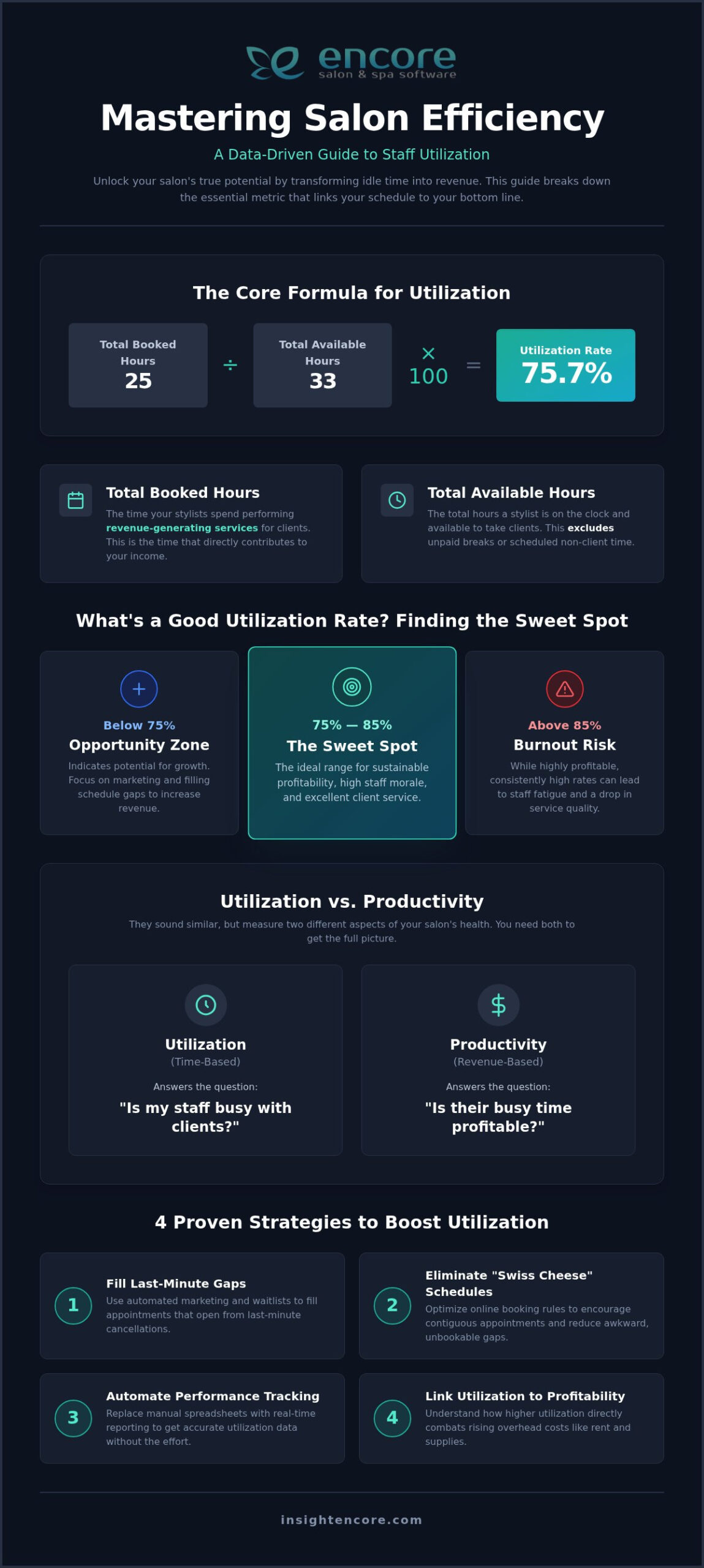
While these terms are often used interchangeably, they measure different things. Utilization is a time-based metric. It tells you if your staff is being kept busy with clients. Productivity, on the other hand, is revenue-based. It tracks how much money a stylist generates during those booked hours. You might have a stylist with 90% utilization who only performs low-cost trims. Conversely, a senior stylist might have 60% utilization but generates massive revenue through high-end color services. You need both metrics to get a full picture of your salon’s health and to make informed management decisions.

The Financial Impact of Idle Time

Idle time is a silent profit killer. Think about the “cost of an empty chair.” Every hour a stylist sits without a client, you’re still paying for rent, utilities, and potentially their base wage. Low utilization rates eat into your margins. This makes it difficult to offer competitive commissions or invest in new equipment. By tracking this data, you can make smarter staffing choices. If utilization is consistently high, it’s time to hire. If it’s low, you might need to adjust your scheduling features or focus on marketing to fill those gaps. Using these insights helps you move from “guesstimating” to running a data-driven business. Of course, utilization is just one piece of the puzzle — pairing this data with a broader strategy to increase your salon profit margin ensures that every filled chair is also contributing meaningfully to your bottom line.

The Step-by-Step Formula for Calculating Stylist Utilization Rates

Ready to get into the numbers? Don’t worry. This isn’t complex calculus. The core formula for how to calculate salon staff utilization rate is straightforward: (Total Booked Hours / Total Available Hours) x 100. This simple equation gives you a percentage that represents how much of your staff’s time is actually being sold to clients. It’s the most reliable way to see if your team is truly productive or just staying busy with side tasks.

To get an accurate result, you must define your terms clearly. “Available Hours” are the hours a stylist is on the clock and ready to work. This should exclude unpaid lunch breaks or scheduled administrative time where they aren’t expected to take clients. “Booked Hours” refers to the time spent performing services. While some owners include cleanup time in this, it’s often better to keep cleanup as a separate operational buffer to avoid inflating your numbers. This ensures you’re measuring the actual revenue-generating capacity of your chairs.

Let’s look at a concrete example. Stylist Sarah works a 40-hour week. After deducting 5 hours for lunch and 2 hours for a weekly staff meeting, her “Available Hours” total 33. If Sarah has 25 hours of services booked on her calendar, her calculation looks like this: (25 / 33) x 100 = 75.7%. This tells you Sarah is performing services for roughly three-quarters of her available time. Knowing how to calculate salon staff utilization rate this way helps you spot performance trends across your entire team.

Accounting for Double Bookings and Overlaps

In busy salons, stylists often work on one client while another’s color processes. This can result in utilization rates exceeding 100%, which might look great on paper but can be confusing for reporting. While high utilization is positive, “weighted” utilization helps you understand if a stylist is multi-tasking effectively or simply overbooked. To keep your data clean, normalize double-booking by counting the total duration of the shift rather than stacking overlapping appointment times. This prevents your reports from suggesting a stylist worked 12 hours in an 8-hour shift, giving you a more realistic view of capacity.

Standardizing Your Data Collection

Consistency is the secret to reliable data. If one stylist clocks in early and another forgets until their first client arrives, your percentages will be skewed. Establish a firm rule for clock-in and clock-out times. You should also distinguish between “walk-in” time and “pre-booked” time. This helps you identify if your utilization is driven by loyal repeat clients or foot traffic. Setting a weekly reporting cadence is usually best for catching trends before they become problems. If you find manual tracking too tedious, you can explore integrated reporting features that handle these calculations for you automatically.

Analyzing Your Results: What Is a “Good” Utilization Rate for a Salon?

Now that you’ve mastered how to calculate salon staff utilization rate, it’s time to interpret what those percentages mean for your business. A common mistake is aiming for 100%. While it sounds efficient, a fully booked team is often a team on the brink of burnout. In the salon industry, the “sweet spot” for sustainable growth usually falls between 75% and 85%. This range allows for maximum revenue while leaving enough room for staff to breathe, clean their stations, and engage with clients about retail products.

If you see rates dipping below 60%, you’ve entered the danger zone. This level of idle time suggests that your marketing isn’t reaching the right people or your scheduling needs a serious overhaul. However, don’t panic if your junior stylists are in this bracket. It’s natural for newer team members to have lower utilization as they build their books. For your master colorists, you should expect to see them consistently hitting that 80% mark. Understanding the numbers is just as important as knowing how to calculate salon staff utilization rate in the first place. If persistent low utilization is squeezing your margins, reviewing your full operational costs through the lens of how to increase salon profit margin can reveal additional leaks that go beyond scheduling alone.

Utilization Benchmarks by Service Type

Expectations should shift based on your business model. High-volume environments like barber shops often thrive with utilization rates closer to 90% because services are quick and transitions are fast. Luxury spas or salons specializing in long-form services like extensions might target a slightly lower rate to ensure the client experience feels unhurried. Specialized businesses have their own rhythms too. For example, artists using Encore Tattoo Software often balance long sessions with significant prep time, which changes how you view a productive day.

Red Flags: When High Utilization Becomes a Liability

Consistency is key, but pushing for 95% or higher is a recipe for staff turnover. When stylists have zero “buffer time,” their stress levels skyrocket and the quality of their work can slip. It also kills your retail sales. A stylist who is rushing to clean up for the next client won’t have the time to explain which shampoo will preserve that fresh color. If your team is over-utilized, you’ll see it in their energy levels and your Google reviews. Sustainable success requires a balance between a full book and a supported team.

How to Calculate Salon Staff Utilization Rate: The 2026 Management Guide

4 Proven Strategies to Improve Low Utilization Without Increasing Burnout

Knowing how to calculate salon staff utilization rate is only half the battle; the real magic happens when you use that data to drive positive change. It’s common to feel a bit stuck when you see low percentages, but you don’t have to push your team to the point of exhaustion to see results. Improving utilization is about working smarter and refining your operations. Start by looking at your daily schedule for “Swiss cheese” gaps. These are those awkward 15 or 30 minute breaks between appointments that are too short for a new service but long enough to waste time. By nudging appointments together, you can reclaim hours of billable time every week.

Automated marketing is another powerful tool for your management toolkit. Instead of waiting for the phone to ring, you can send last-minute booking incentives to your most loyal clients as soon as a gap appears. Cross-training also plays a vital role in a modern salon. When a stylist is trained in multiple service types, they can step in to help with a busy nail tech’s overflow or handle a quick brow wax during a color processing break. Implementing online booking further supports this by allowing clients to fill those gaps themselves, often during the late night hours when your salon is closed.

Incentivizing Staff for Self-Filled Gaps

Your stylists are your best brand ambassadors and they’re often eager to help the business grow. Why not reward them for taking initiative? Offering a small bonus or a slightly higher commission for clients they bring in during their own idle hours can transform a slow afternoon into a productive one. You can encourage them to post “flash sales” on their professional social media pages to fill immediate openings. When you integrate these clear utilization goals into your salon employee performance review template, you turn a math problem into a shared win for the whole team.

Managing Client No-Shows and Cancellations

A single no-show can tank your daily utilization rate and leave a stylist feeling undervalued. Protecting your team’s time is a non-negotiable part of modern management. Implementing small deposits or firm cancellation fees ensures that clients value your schedule as much as you do. You can also use automated waitlists to instantly notify waiting clients the moment a slot opens up. This keeps your chairs full and your revenue steady without adding any extra stress or manual work to your staff’s busy day.

Try Encore for free and fill your empty chairs today

Beyond the Spreadsheet: Automating Performance Tracking with Encore

Many owners spend their Sunday nights hunched over a laptop, trying to figure out why their bank balance doesn’t match the activity they saw all week. While knowing how to calculate salon staff utilization rate manually is a foundational skill, relying on pen and paper or clunky spreadsheets often leads to “guesstimates” rather than solid facts. Spreadsheet fatigue is real, and human error is inevitable when you’re busy managing a team and serving clients. A missed clock-in or a forgotten walk-in can skew your data, leaving you with an inaccurate picture of your business health. Encore Salon Software removes this frustration by automating the entire process. It captures every booking and every minute on the clock to generate real-time reports that you can trust.

Automation doesn’t just save time; it connects your data in ways a manual system never could. When your utilization rates are integrated with your payroll and commission structures, you eliminate the need for stressful double-entry. For a deeper look at how to eliminate manual payroll errors entirely, explore how calculating salon staff commission automatically can build lasting trust with your team and protect your peace of mind. Your stylists can see exactly how their performance impacts their paycheck, which builds a culture of transparency and trust. You can also use these performance dashboards to make confident hiring decisions. If your team is consistently hitting that 85% mark, the data is telling you it’s safe to bring on a new team member. Learning how to calculate salon staff utilization rate through an automated system ensures every growth decision is backed by reliable evidence.

Real-Time Insights for Proactive Management

Stop waiting until the end of the month to realize you had too many empty chairs. With live data, you move from “looking back” at missed opportunities to “fixing today.” You can check staff utilization from anywhere using mobile access, whether you’re at the salon or grabbing a coffee down the street. Set up automated alerts to notify you when specific time slots are consistently under-utilized. This allows you to launch a quick marketing campaign or adjust your staffing levels before the week is even over. It’s about having total control over your schedule without being tied to a desk.

Scaling Your Business with Data

Scaling your business requires more than just a gut feeling. When you track utilization trends over months or years, you gain the clarity needed to plan for a second location or a major expansion. These data-backed reviews also improve staff morale. Instead of a vague conversation about “being busy,” you can show a stylist their growth through clear, visual charts. This professional approach fosters loyalty and keeps your best talent from looking elsewhere. If you’re ready to ditch the calculator and see what automation can do for your peace of mind, contact our team for a demo today. We’re here to help you turn those spreadsheets into a strategy for long-term success.

Take Control of Your Salon’s Future

Mastering how to calculate salon staff utilization rate is the key to identifying hidden profit leaks and protecting your team from burnout. You now have the clarity to target that 75% to 85% sweet spot where productivity meets sustainability. By replacing manual spreadsheets with automated insights, you can stop guessing and start making data-driven decisions that actually move the needle for your business.

Since 1991, we’ve provided salon owners with the specialized tools needed to manage everything from utilization to inventory in one place. Whether you’re an independent stylist or running a large spa, our all-in-one reporting is designed to give you back your Sunday nights. You’ve mastered the math. Now it’s time to let a reliable partner handle the tracking so you can focus on your craft.

Stop doing the math and start growing your salon with Encore Software.

Your journey toward a more efficient and profitable salon starts today. We’re here to help you turn your idle time into revenue and your stress into a feeling of organized control. Let’s get started.

Frequently Asked Questions

How do I calculate salon staff utilization rate manually?

To find this number, divide the total hours a stylist spent with clients by the total hours they were available to work, then multiply by 100. For example, if a stylist was available for 30 hours and performed services for 21 hours, their rate is 70%. Understanding how to calculate salon staff utilization rate manually is a great way to double-check your numbers before you transition to an automated reporting system.

What is a good staff utilization rate for a hair salon?

A healthy target for most salons is between 75% and 85%. While 100% might sound like the goal, it often leads to staff burnout and leaves no room for retail sales or cleaning. If your rates fall below 60%, it’s usually a sign that you need to ramp up your marketing or adjust your scheduling. Aiming for the sweet spot ensures your business stays profitable while your team remains happy.

Does double booking affect my utilization rate calculation?

Yes, double booking can skew your data and even push your utilization rate above 100%. If a stylist works on two clients at once, their booked hours might technically exceed their shift length. To keep your reports accurate, it’s best to normalize this data by counting the total duration of the shift as the maximum capacity. This prevents confusing spikes in your reports and gives you a more realistic view of your salon’s actual floor capacity.

How can I improve my stylists utilization without making them feel pressured?

Focus on filling the “Swiss cheese” gaps in your schedule through automated marketing rather than demanding more speed. Use incentives like small bonuses for stylists who fill their own idle time or offer flash sales to your loyal clients. When you frame utilization as a way for them to grow their own commissions, it feels like a partnership. It’s about optimizing the day to work smarter, not just pushing everyone to work harder.

Should I include unpaid lunch breaks in the available hours calculation?

No, you should always exclude unpaid lunch breaks and scheduled meetings from your “available hours” total. Your utilization rate should only reflect the time a stylist is actually on the clock and ready to accept clients. Including non-working time would artificially lower your percentages and give you an inaccurate picture of your team’s efficiency. Removing these hours ensures you’re only measuring the time that has the potential to generate revenue for your salon.

How often should I review my staff utilization reports?

Reviewing your reports once a week is the best way to catch scheduling trends before they turn into major profit leaks. A weekly check-in allows you to be proactive and adjust your marketing if you see a slow period coming up. You should also do a deeper dive once a month to look at long-term performance and seasonal patterns. Consistent reviews keep you in control and help your team stay aligned with your growth goals.

Can salon software calculate utilization for booth renters?

Yes, specialized tools like our Chair/Booth Renter Software are built specifically for independent professionals. Even if you don’t manage a full team, knowing how to calculate salon staff utilization rate for yourself is vital for managing your own time and income. The software tracks your specific bookings against your personal availability. This gives you the same level of professional insight that a large salon uses to stay profitable and organized every single day.

What is the difference between utilization and productivity in a spa?

Utilization measures the time a therapist spends with clients, while productivity measures the revenue they generate during those sessions. In a spa setting, a therapist might be 90% utilized with low-cost treatments but generate less revenue than someone who is 60% utilized with high-end facials. You need both numbers to see the full picture. High utilization is a great start, but it must be paired with strong productivity to ensure your spa remains truly profitable.

Disclaimer

This article is general in nature and may contain errors, please verify all claims with your sales rep