

window.dataLayer = window.dataLayer || []; function gtag(){dataLayer.push(arguments);} gtag('js', new Date()); gtag('config', 'UA-206511945-1');
Search
Categories
Uncategorized

Salon Client Acquisition Cost: What Each New Client Costs

That makes salon client acquisition cost more than a marketing metric: it helps you judge whether your spending and effort attract clients who return.

It’s easy to focus on how many new appointments a campaign generates. But a first visit doesn’t tell the whole story, especially when some clients rebook and others don’t. Compare marketing channels by considering what each new client may contribute over time, too.

This guide explains how to calculate acquisition cost, compare common ways salons attract new clients, and weigh that spending against client lifetime value. You’ll learn which measures make the numbers meaningful and help you assess whether your marketing supports lasting salon growth.

Key Takeaways

  • Calculate what you spend to bring in each new client, then compare results across marketing channels.
  • Look beyond first-visit revenue by tracking rebooking, visit frequency, and the value clients bring over time.
  • Assess referral incentives, digital ads, and directory listings by both their acquisition cost and the clients they attract.
  • Use new-client and retention trends to see whether marketing is supporting steady salon growth.
  • Consider client management software when you need a clearer way to organize client details and follow-up.

Client lifetime value

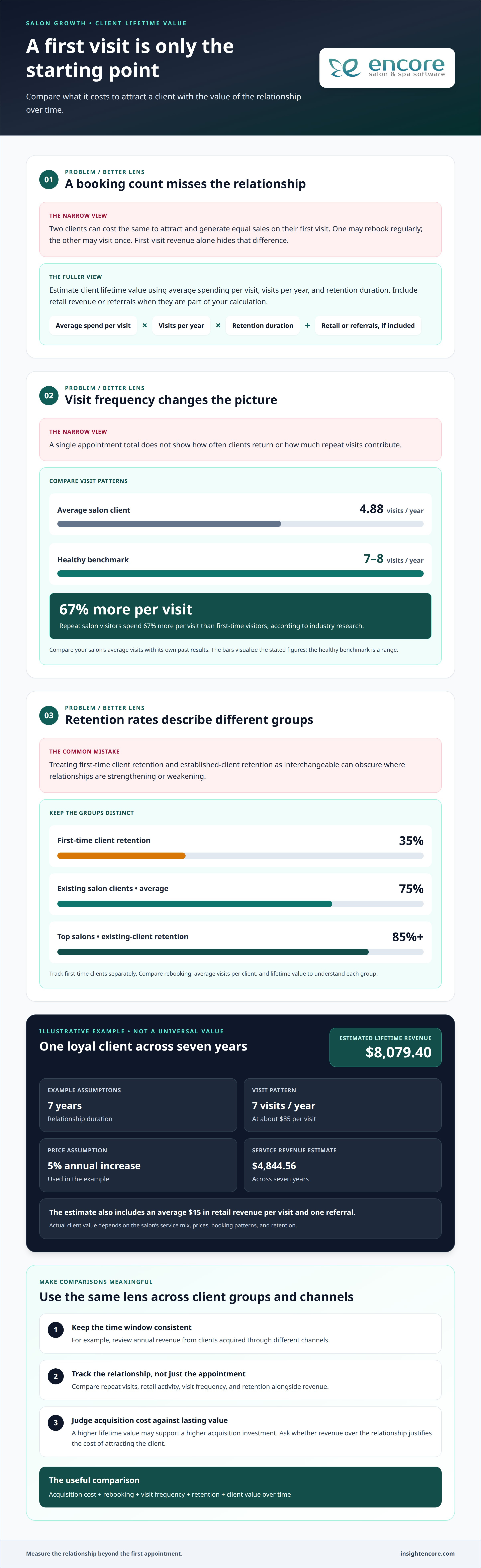
Client lifetime value estimates the revenue a salon earns from one client over the course of the relationship. It shifts attention from the first appointment to repeat visits, retail purchases, and referrals. For example, two clients may cost the same to attract, but one may rebook regularly while the other visits once. Their long-term value differs, even if their first appointments generate equal sales.

Start with three measures: average spending per visit, visits per year, and retention duration. Multiply average spending by visit frequency, then account for how long clients continue booking. Include retail revenue or referrals if they’re part of your calculation. Apply the same method across channels to keep comparisons useful. Tracking these measures annually also shows whether visit frequency or retention changes over time.

One illustrative seven-year example estimates a loyal client’s lifetime revenue at $8,079.40. Its assumptions include seven visits per year, about $85 per visit, and 5% annual price increases. The example estimates $4,844.56 in service revenue across seven years. It also includes an average $15 in retail revenue per visit and one referral. Treat this as an example, not a universal client value. Your salon’s actual result depends on its service mix, prices, booking patterns, and retention.

Frequency can change the calculation substantially. The average salon client visits 4.88 times per year, while a healthy benchmark is 7 to 8 visits annually. Compare your salon’s average visits with its own past results. A client who books one additional appointment contributes another service opportunity. Industry research reports that repeat salon visitors spend 67% more per visit than first-time visitors. This makes return behavior relevant to both visit count and average transaction value.

Retention figures add context, but they need careful interpretation. Existing salon clients have an average retention rate of 75%, while top salons reach 85% or higher. The average first-time client retention rate is 35%. These figures describe different groups, so don’t treat them as interchangeable. Track first-time clients separately from established clients. Then compare rebooking rates, average visits per client, and lifetime value to see where relationships are strengthening or weakening.

Use the same time window when comparing client groups. For example, review annual revenue from clients acquired through different channels, then compare their repeat visits and retail activity. A higher lifetime value may support a higher acquisition investment, while a one-time visit may not. The key question is whether the revenue generated over the relationship justifies the cost of attracting that client.

Consistent records make these comparisons clearer. Encore Salon & Spa Software can organize client history, visit frequency, and spending patterns. Review those measures together rather than relying on appointment totals alone. When clients visit more often and keep returning, lifetime value may rise without needing a new client for every appointment.

Digital ads, referral incentives, and directory listings

Salons can lower acquisition costs by comparing channel spending with completed new bookings and repeat visits. Clear follow-up can also give first-time clients a reason to return.

Using Digital Ads and Directory Listings

Digital ads promote salon services to prospective clients online, while directory listings help people discover local services. Both can bring a salon to someone’s attention when they’re deciding where to book. Track campaign spending alongside inquiries, completed bookings, and service revenue to see which results follow.

SEO and targeted Google Ads can help prospective clients find a salon online. Listings can also make the salon visible to people comparing options. Keep service descriptions and booking details clear wherever clients discover you. Then track which source new clients mention and whether they complete an appointment. This distinguishes clicks or profile views from bookings that generate revenue.

Offering Referral Incentives

A referral incentive rewards an existing client for introducing someone new. Referred clients are estimated to have 18% lower churn than clients acquired through advertising. For a stylist, referrals can connect a trusted recommendation directly to an available service and booking.

Nearly half of salon clients choose where to book based on someone they know. Make the referral process easy to explain, and record which new bookings came through it. Compare incentive spending with the new clients who actually visit. A referral that results in a booking offers a more useful measure than counting recommendations alone.

Compare each channel over the same monthly period. Divide its spending by the number of new clients who completed appointments, not by clicks, messages, or inquiries. For example, if an ad campaign gets many profile visits but few bookings, its cost per actual client may be less favorable. Track referrals, directories, and ads separately to see the difference.

Then connect acquisition results with return behavior. Record each new client’s source, first booking, and subsequent visits. If one channel brings in clients who return, its longer-term value may outweigh a higher initial cost. If clients from another source rarely rebook, review the service match, booking process, and follow-up experience.

Consistent records make those comparisons easier to act on. A clear booking and client follow-up workflow can help keep source and return-visit details organized. Review the numbers monthly, then adjust the channel mix or referral approach based on completed appointments and repeat bookings, not visibility alone.

New-client acquisition and salon growth

New-client acquisition supports growth when it fills available appointment capacity and builds lasting relationships. Track new clients per month, spending per client, and referrals. Together, these measures show whether marketing generates bookings and whether those clients return. They also distinguish a busy campaign from one that contributes to stable salon revenue.

Calculate acquisition cost by dividing the marketing spend for a period by the number of new clients gained in that period. The same example estimates $375 in first-week revenue, based on five appointments at $75 each. That early revenue is useful context, but it doesn’t show whether clients rebook.

The figure can vary by channel, campaign, and the number of clients who complete bookings. Compare like with like: use the same measurement period and count new clients, not clicks or inquiries. Tracking salon client acquisition cost this way grounds marketing decisions in completed appointments.

Growth also depends on how new clients fit into the salon’s schedule. Acquiring clients can help fill chairs for newer stylists. Review appointment availability alongside new-client numbers. If a stylist has open slots, new bookings can put that capacity to use. If appointments are already full, the same campaign may create demand the salon can’t accommodate promptly.

Retention changes the economics. Acquiring a new salon client costs 5-7 times as much as retaining an existing client. That makes repeat visits a key part of sustainable growth, not a separate concern. Compare new-client totals with rebooking and retention patterns. A campaign may bring in more first-time appointments, while follow-up and a positive service experience influence whether those clients return.

Consider the cost of losing a loyal client, too. That potential loss shows why growth plans should include retention, not just new-client targets. If existing clients stop booking, increased acquisition activity may only replace lost revenue rather than expand it.

Retail purchases and referrals can add value beyond the first service. Record them alongside appointment history, then include them when assessing lifetime value. A new client who returns, buys products, or recommends the salon contributes differently from a one-time booking. Reviewing these outcomes by acquisition source helps show which marketing activities support broader growth.

Google search visibility can help prospective clients discover a salon. SEO and targeted Google Ads are two ways to support that discovery. Track completed bookings by source, then compare them with monthly marketing spend and client return patterns. A simple monthly review of acquisition, retention, and retail can show whether growth comes from new traffic alone or stronger client relationships.
Salon Client Acquisition Cost: What Each New Client Costs

How does salon client acquisition cost compare with customer lifetime value?

Acquisition cost measures the investment required to gain a new client. Customer lifetime value estimates the revenue generated over that client’s relationship with your salon. Compare the two to judge whether revenue over time can justify the initial marketing expense. Use the same client group and measurement period for both figures. Otherwise, you may unfairly compare a short-term campaign cost with years of revenue.

A useful comparison starts with revenue, but revenue isn’t profit. Service and retail sales must cover the costs of delivering those services and products, and acquisition spending is another expense. Treat lifetime revenue as a guide, not as an amount available to spend freely. The client’s visit pattern, spending, retention, and referrals all shape the longer-term picture.

One 90-day example compares five newly acquired clients with five existing clients who rebook. The new clients generate $600 in total revenue, while the returning clients generate $975. That difference illustrates why a first appointment alone can understate a client’s value. Rebooking creates additional revenue within the same period, even though those clients weren’t newly acquired.

Use that comparison to guide channel decisions. First, group new clients by how they found your salon. Next, compare the acquisition spending for each group with its revenue over a consistent period. Then review which clients returned and how often. A channel with a higher initial cost may still contribute value if its clients rebook. Base the comparison on actual bookings, not inquiries or potential interest.

Retail can add another layer to the calculation. One example estimates $854.84 in retail revenue from a client over seven years, assuming retail prices increase by 5% annually. That figure is illustrative, not a forecast for every salon. A client’s retail purchases depend on what they buy and how consistently they visit. Include retail only when your records capture it clearly.

Referrals can also extend value beyond the original client. If a client recommends your salon, that introduction may lead to another booking and a separate client relationship. Keep referral revenue distinct from the original client’s service and retail revenue. This avoids attributing another client’s sales to the person who made the referral.

Review the comparison regularly, using a consistent period such as 90 days or an annual view. Track acquisition cost, returning visits, service revenue, and retail revenue by client group. If repeat revenue grows, the original acquisition spending may look more worthwhile. If clients rarely return, examine the booking experience and follow-up before increasing marketing spend. This keeps decisions tied to observed client behavior rather than assumptions.

What factors increase or decrease a salon’s client acquisition cost?

Acquisition costs vary with how a salon reaches prospective clients and turns interest into appointments. A campaign that attracts broad attention may generate many inquiries but few completed bookings. Clear service descriptions and a straightforward booking path can help close that gap. Compare campaign inquiries with the clients who actually attend to see whether visibility is turning into new business.

Audience fit matters, too. Ads aimed at people outside a salon’s service area can spend money without generating useful bookings. Promote services to clients the salon can serve, then compare results by channel and audience. A campaign that reaches fewer people may still use its budget more effectively if those people become clients.

Available appointment capacity also affects the value of acquisition spending. If a salon has open chair time, new bookings can put that capacity to work. If the schedule is already full, additional promotion may not lead to more completed appointments. Review each stylist’s availability before increasing campaign activity. Matching demand with open appointments makes marketing results easier to evaluate.

A salon’s starting position can shape its need for paid marketing. A salon suite with an established clientele may need to spend little on marketing. A newer business without that client base may rely more on outreach to build awareness. In either case, align acquisition activity with the number of appointments the salon wants to fill. The right approach depends on its existing clientele and schedule.

Referrals can also affect acquisition spending. Existing clients may introduce friends and family, creating a source of new bookings alongside paid promotion. Record referrals separately from advertising and directory listings, then compare how each source contributes to appointments and repeat visits. If referrals bring in suitable clients, a salon may choose to strengthen that approach rather than simply increasing paid reach.

Measurement choices can make costs appear higher or lower. Including brand-awareness work in one campaign’s spending but excluding it from another makes the comparison uneven. Apply consistent rules to what counts as acquisition spending and which clients count as new. Review the same time period across channels. Separate first-time appointments from returning clients so retention activity doesn’t distort acquisition results.

Finally, revisit the factors behind changes in results. If acquisition cost rises, look at audience fit, completed bookings, appointment availability, and the mix of paid and referral sources. If it falls, check whether new clients are still a good fit and return for services. This helps distinguish lower spending from genuinely efficient client growth.

Explore tools for managing salon clients

A salon suite with an established clientele may need little marketing spend, while a newer business without that client base may rely more on outreach. The section provides no basis for comparing acquisition costs by location.

Encore Salon and Spa Software: Client Management System

Encore Salon & Spa Software’s Client Management System helps organize client relationships alongside salon operations. When comparing acquisition spending with repeat bookings, keeping client information and appointment activity together can make patterns easier to review. Encore Salon Software and Encore Spa Software support salon and spa businesses, while Chair/Booth Renter Software is designed for renter-based operations.

Consider a client management system when scattered records make it hard to understand booking history or follow client relationships over time. Organized information supports consistent client management and clearer reviews of acquisition and retention. It also puts the calculations in this article into a practical operating context.

To discuss how Encore Salon & Spa Software can fit your business, contact Encore Salon & Spa Software.

Make your next growth decision with confidence

Let salon client acquisition cost guide decisions, not define success on its own. Use it as an operating signal: consider whether your marketing fits available appointments and supports the client relationships you want to build. A regular review can help you spot changing patterns and make thoughtful adjustments before small inefficiencies become habits.

Encore Salon and Spa Software offers Encore Salon Software, Encore Spa Software, and Chair/Booth Renter Software. These options support different salon and spa business models, while the Client Management System helps organize client information. Choose the option that fits how your business manages clients and appointments.

Explore Encore Salon and Spa Software

Keep learning from each booking and returning client. Clearer information can help you make your next growth decision with greater confidence.

Frequently Asked Questions

What is the average client acquisition cost for a salon in the United States?

Treat this as a benchmark, not a fixed average for every U.S. salon. Your result depends on which marketing expenses you include and how many new clients actually book and attend. For a more relevant comparison, calculate your own figure by channel and compare it across consistent reporting periods.

How do salons calculate client acquisition cost?

Divide the marketing expenses tied to gaining new clients by the number of new clients acquired during the same period. Include the spending you attribute to those efforts, such as advertising or referral rewards. Count clients who completed appointments, not clicks or inquiries. Before calculating, separate first-time visitors from returning clients in your booking records so retention activity doesn’t distort the result.

What is a good customer acquisition cost for a hair salon?

A good acquisition cost is one that a client’s revenue over time can support after accounting for the cost of delivering services. There isn’t one target that suits every hair salon. A client who rebooks and purchases retail may contribute more than someone who visits once. Compare acquisition spending with client revenue and repeat behavior, then set a target that fits your salon’s service mix and margins.

How much do salon marketing channels cost per new client, such as Google Ads, social media, and referrals?

These figures don’t provide separate prices for Google Ads or social media. To compare those channels, calculate each one’s spending against completed first-time bookings, and track referral clients separately from paid campaigns.

Disclaimer

This article is general in nature and may contain errors, please verify all claims with your sales rep

Categories
Uncategorized

Salon Employee Performance Review Template: The 2026 Management Guide

What if your next performance review was the exact reason your top stylist decided to stay for another five years instead of opening their own suite? Most salon owners dread review season. It feels like a mountain of manual math, awkward conversations about retail sales, and the constant fear that a critique might trigger a resignation. Using a structured salon employee performance review template ensures you aren’t just guessing about who’s performing. You want to mentor your team, but without clear data, it’s hard to be truly objective. It’s exhausting to manage by gut feeling when you’re trying to build a professional brand.

We’re here to help you turn those stressful meetings into a data-driven roadmap for stylist prosperity. This guide provides a professional framework that balances hard metrics with the soft skills that keep your chairs full. You’ll learn how to create clear growth paths that slash turnover and boost your bottom line through better retail and rebooking habits. We’ll show you how to use integrated reporting to remove the guesswork; making every conversation feel like a partnership rather than a test. It’s time to lead with confidence and give your team the organized, professional structure they need to thrive.

Key Takeaways

  • Stop the “salon drama” by turning annual reviews into a structured growth dialogue that keeps your team focused and happy.
  • Use our salon employee performance review template to objectively measure both revenue metrics and the soft skills that drive client loyalty.
  • Abandon the old “feedback sandwich” for a modern “growth loop” approach that motivates stylists without the typical performance review anxiety.
  • Discover how automated software removes the manual math from tracking retail commissions and rebooking percentages for total peace of mind.
  • Create clear, professional growth paths that help you retain top talent and increase your salon’s overall revenue.

Why Performance Reviews are the Heart of Salon Growth

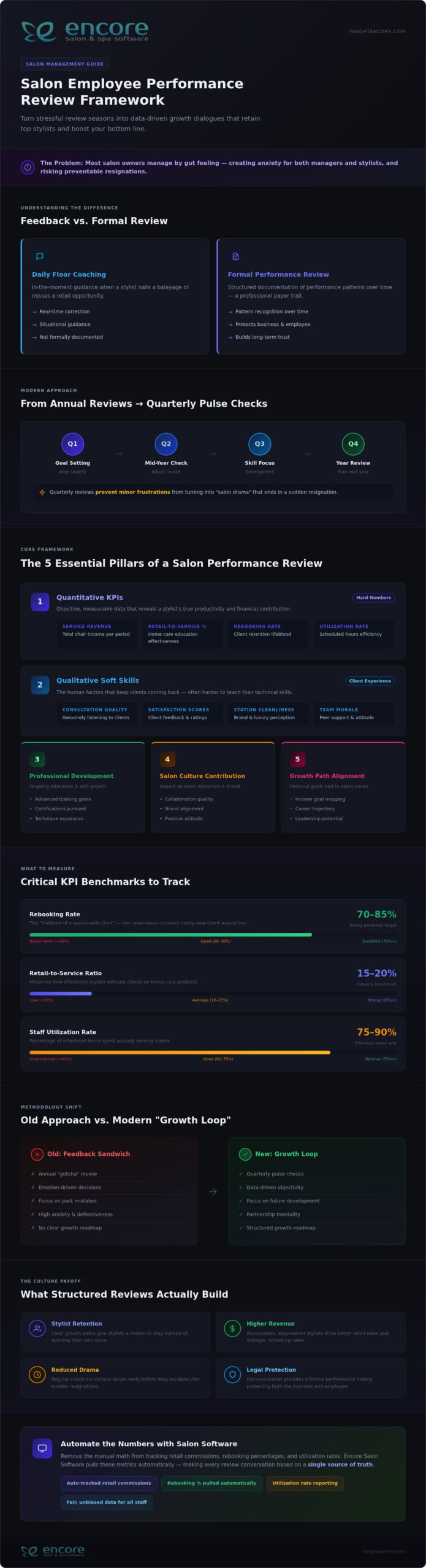
A performance review isn’t a “gotcha” moment or a stressful report card. Think of it as a structured growth dialogue between you and your stylists. It’s a dedicated space to pause, look at the numbers, and plan the next chapter of a stylist’s career. In 2026, the industry is shifting away from the high-pressure annual sit-down. Instead, successful owners are using quarterly “pulse checks” to keep everyone aligned. This regular rhythm prevents minor frustrations from turning into “salon drama” that ends in a sudden resignation. By using a consistent salon employee performance review template, you remove the emotion from the equation and replace it with a supportive roadmap. This isn’t just about feelings; it’s about the bottom line. Clear reviews directly lead to higher rebooking rates and better retail sales because stylists feel empowered and accountable.

The Difference Between Feedback and a Review

Daily floor coaching is essential, but it isn’t a substitute for a formal review. Feedback is what you say when a stylist nails a balayage or misses a retail opportunity in the moment. A review is the formal documentation of those patterns over time. This paper trail is vital for both parties. It protects your business by documenting performance history and protects the employee by ensuring their hard work is officially recognized. When you use a salon employee performance review template, you create a non-punitive environment where the focus remains on professional development rather than past mistakes. Documentation builds trust because it proves you are paying attention to more than just the busy Saturdays.

Salon Culture and Employee Engagement

Stylists aren’t just looking for a chair; they’re looking for a professional home. Reviews foster this sense of belonging by showing that you are invested in their individual success. When you align a stylist’s personal income goals with your salon’s brand vision, magic happens. Transparency is the secret ingredient here. By being open about metrics like utilization rates and average ticket prices, you build long-term loyalty. Stylists who understand the “why” behind the numbers are far more likely to stay engaged and help the business grow. Using Encore Salon Software to provide these metrics ensures the conversation is based on a single source of truth, making the process fair for everyone on the team.

The 5 Essential Pillars of a Salon Performance Review

A high-performing team isn’t built on gut feelings or “vibes” alone. It requires a balanced look at five specific areas that define a stylist’s success. Using a comprehensive salon employee performance review template ensures you don’t miss the subtle details that drive long-term growth. When you evaluate a team member, you’re looking for a harmony between their technical skill, their financial impact, and their contribution to your salon’s culture. This holistic approach turns a standard meeting into a powerful mentorship session. It gives your stylists a clear picture of where they shine and where they can reach the next level of their career.

Quantitative KPIs: Tracking the Numbers

Numbers provide an objective window into a stylist’s productivity. You can’t improve what you don’t measure. Focus on service revenue versus retail-to-service percentages to see how well they are educating clients on home care. Rebooking rates are equally vital; they are the lifeblood of a sustainable chair. If a stylist isn’t rebooking at a high rate, you’re constantly spending money to acquire new clients just to keep them busy. You should also learn How to Calculate Salon Staff Utilization Rate to determine if they are using their scheduled hours efficiently. To make tracking these metrics effortless, you can explore our reporting features which pull this data automatically.

Qualitative Soft Skills: The Client Experience

The client experience is what keeps people coming back. It starts with the consultation quality. Is the stylist truly listening, or are they just going through the motions? You should also track client satisfaction scores and station cleanliness. A messy station reflects poorly on your entire brand and can dampen the “luxury” feel of a service. Beyond the chair, consider their contribution to team morale. A stylist who supports their peers and maintains a positive attitude is worth their weight in gold. These soft skills are often harder to teach than a new cutting technique, so acknowledging them in your salon employee performance review template is essential for a healthy culture.

Technical Excellence and Future Growth

2026 demands constant skill updates. Your reviews should document technical progression, such as new certifications or education credits earned during the quarter. This keeps your team at the forefront of industry trends. Finally, every review must end with future growth and goal setting. Where does the stylist want to be in six months? Whether it’s increasing their average ticket price or becoming a lead educator, setting clear, documented goals gives them a reason to stay and grow within your business. This forward-looking approach transforms the review from a look at the past into a roadmap for the future.

Your Salon Employee Performance Review Template [2026 Version]

Building a high-performing team starts with organization. A well-designed salon employee performance review template acts as the skeleton for your conversation. It ensures you cover everything from basic attendance to complex retail goals without missing a beat. Start your template with a clear header including the stylist’s name, the review period, and the date. Use a simple 1 to 5 scoring system to keep things objective; 1 being “needs immediate improvement” and 5 being “consistently exceeds expectations.” This scale removes the ambiguity of “doing okay” and gives you a concrete way to track professional growth over time. It makes the “why” behind your feedback much easier for the stylist to digest.

Section 1: Performance Metrics Table

The core of your review should be a clear, easy-to-read grid. This is where you list KPIs like rebooking percentages, retail-to-service ratios, and total service revenue. For 2026, setting a “Target” versus “Actual” figure for each metric is essential. It shows the stylist exactly where they hit the mark and where they fell short of the salon’s benchmarks. Visualizing progress over the last three review periods helps identify long-term trends. Are they steadily growing, or have they hit a plateau? Using Encore’s integrated reporting allows you to pull these numbers instantly. It saves you hours of manual math and ensures your “Actual” figures are 100% accurate every single time.

Section 2: The Stylist Self-Evaluation

A review shouldn’t be a monologue. Letting the stylist lead a portion of the meeting fosters ownership and professional maturity. Include a section for self-evaluation with questions like, “What was your biggest win this quarter?” This forces them to acknowledge and celebrate their own successes. Equally important is identifying roadblocks. Ask them, “What tool or training would help you grow?” This shifts the focus from what they did wrong to what they need to succeed. It transforms you from a boss into a mentor who is actively clearing the path for their career progression. When stylists feel they have a voice in their growth, they stay more engaged with your brand.

Close your salon employee performance review template with a space for manager’s comments. This is your opportunity to provide constructive, actionable feedback. Avoid vague praise like “good job.” Instead, use specific examples. If they hit their retail target, mention the specific product line they excelled with. If they need to work on rebooking, suggest a specific script for the chair. When your template combines hard data with empathetic coaching, you create a culture of excellence that stylists won’t want to leave. It turns a standard HR requirement into a powerful tool for retention and revenue.

Salon Employee Performance Review Template: The 2026 Management Guide

Turning Reviews into Results: Best Practices for Managers

A salon employee performance review template is only as effective as the person leading the conversation. If you treat this process like a chore, your stylists will treat it like a punishment. Successful managers use these meetings to transform raw data into a shared vision for the future. It’s about moving away from the old ways of critiquing and moving toward a partnership of progress. When you lead with empathy and professional confidence, you turn a standard HR requirement into a powerful tool for team retention. If you’re also evaluating whether your current staffing model is the right fit, understanding the key differences in salon commission vs booth rental can help you structure your team and your reviews more strategically.

The Pre-Review Data Pull

Never walk into a review without your reports. Relying on memory or “gut feelings” is a fast track to defensive reactions and hurt feelings. Objective data is your best ally. Use Encore Salon Software to generate performance dashboards that show exactly where a stylist stands. Compare their performance to salon averages fairly. If the entire salon saw a dip in retail during a slow month, it isn’t fair to penalize one person for that trend. Data removes the bias and ensures the conversation remains focused on facts rather than personalities.

See how automated reporting simplifies your review prep

The “feedback sandwich” of praise, critique, and more praise is officially dead. Stylists often find it insincere or walk away confused about what they actually need to improve. Try the “Growth Loop” instead. Focus on the observation, the impact on the salon, and the collaborative solution. This method keeps the focus on continuous improvement. It feels like coaching rather than a lecture, which is essential for maintaining a high-performing culture where everyone feels supported.

Conducting the Meeting

Environment matters more than you might think. Choosing a neutral, quiet space outside of busy salon hours ensures you have the stylist’s full attention. Practice active listening techniques; let them speak more than you do. Ask open-ended questions about their challenges on the floor. If a stylist gets defensive, stay calm and empathetic. Acknowledge their perspective, but use the data you’ve gathered to bring the conversation back to professional standards. This balance of kindness and authority builds long-term respect.

Close every meeting with a clear, signed action plan for the next 90 days. Set SMART goals that are specific and measurable. Instead of saying “sell more retail,” set a goal to “increase retail-to-service percentage by 5% by the next review.” When goals are clear, stylists know exactly how to win. This transparency creates a sense of organized control that lowers stress for everyone involved. It turns the review from a look at the past into a roadmap for a successful future.

Streamlining Reviews with Encore Salon & Spa Software

While a salon employee performance review template provides the necessary structure, manual data entry is a relic of the past. If you’re still spending Sunday nights with a calculator and a stack of service receipts, you’re losing valuable time that should be spent on salon strategy. Moving from paper templates to a digital management ecosystem isn’t just about saving trees; it’s about accuracy and peace of mind. Automated performance dashboards turn hours of “number crunching” into seconds of “one-click reporting.” This transition allows you to lead with facts rather than feelings. It ensures that every conversation you have with your team is grounded in reality.

Data transparency is the foundation of a healthy salon culture. When you track retail and commissions in real-time, you remove the “black box” of payroll. Stylists can even access their own performance portal to track their progress toward goals every single day. This autonomy encourages them to take ownership of their chair. They no longer have to wait for a quarterly meeting to see if they’ve hit their rebooking targets. Instead, they can adjust their approach in the moment, leading to a more proactive and engaged team. It’s a supportive way to foster professional maturity across your entire floor. For salon owners managing complex tiered structures, calculating salon staff commission automatically eliminates the manual errors that can damage staff trust and consume your weekends.

Automated Reporting Features

One-click reports for rebooking, retention, and utilization rates provide a “source of truth” that both management and staff can trust. Whether you are managing a team of employees or looking for Specialized Solutions for chair renters, having integrated reporting is essential. It ensures that every review is based on objective metrics. When stylists see that their hard work is being tracked accurately and fairly, their trust in management grows. This clarity is what transforms a simple job into a long-term professional home. It removes the friction that often leads to staff turnover and “salon drama.”

Next Steps for Your Salon

Now is the time to audit your current tracking system. Ask yourself: is it truly objective? If your performance data is scattered across spreadsheets and paper notes, it’s time for a change. Start by downloading a professional salon employee performance review template and scheduling your first “Pulse Review” with your team. This small step signals to your staff that you are invested in their growth and the salon’s future success. Organized leadership is the most effective tool you have for reducing turnover and increasing your bottom line. You don’t have to do it alone; the right tools make all the difference.

Book a demo with Encore to see how we automate your staff tracking and give you back your peace of mind.

Empowering Your Team for Long-Term Success

Your salon’s growth depends on the growth of your individual stylists. By moving from annual “report cards” to quarterly growth dialogues, you build a culture of transparency and trust. A professional salon employee performance review template serves as your roadmap; ensuring you never miss a chance to celebrate a retail win or coach a rebooking opportunity. It’s about turning daily frustrations into documented progress. When you balance hard metrics with genuine empathy, you create a professional home where stylists feel supported and inspired to stay.

Since 1991, we’ve helped owners move from manual chaos to organized control. You don’t have to spend your weekends calculating commissions or guessing at utilization rates. With all-in-one management from POS to performance tracking, you can lead with confidence while knowing our dedicated human support team is always here to help. It’s time to reclaim your peace of mind and focus on the artistry that makes your salon unique. You’ve built something incredible; now give your team the structure they need to help it thrive.

Ready to automate your staff performance tracking? Explore Encore Salon Software today.

Frequently Asked Questions

How often should I conduct salon employee performance reviews?

You should aim for quarterly “pulse checks” rather than waiting for a stressful annual meeting. Frequent check-ins allow you to address small issues before they become “salon drama.” This rhythm keeps stylists engaged and ensures their career goals stay on track. By reviewing your salon employee performance review template every 90 days, you provide a consistent roadmap that adapts to the fast-paced nature of the beauty industry.

What are the most important KPIs for a hair stylist?

The most vital KPIs include rebooking rates, retail-to-service percentages, and utilization rates. Rebooking measures client loyalty, while retail-to-service ratios reflect how well a stylist educates their clients on home care. You should also monitor average ticket prices and new client retention. Tracking these specific numbers helps you identify whether a stylist is maximizing their scheduled hours or if there is room to increase their efficiency and income.

How do I handle a stylist who is underperforming in retail sales?

Focus on education rather than criticism when a stylist misses their retail targets. Often, underperformance stems from a lack of confidence in recommending products. Provide them with specific scripts or host a product knowledge session to build their skills. Use your salon employee performance review template to set a small, achievable goal for the next 30 days. This supportive approach turns a stressful requirement into a collaborative path toward higher commissions.

Should I include client feedback in the performance review?

Yes, client feedback is a valuable qualitative metric that adds depth to your data. Look at online reviews, satisfaction scores, and direct feedback to gauge the “vibe” of the service. While hard numbers show revenue, client comments reveal the quality of the consultation and the overall experience. Just ensure you present this feedback constructively. It helps stylists understand how their soft skills directly impact their rebooking rates and long-term professional success.

What is the best way to track rebooking rates for my team?

The most accurate way to track rebooking is through automated salon management software. Manual tracking is prone to human error and takes up too much of your limited time. Encore Salon Software calculates these percentages instantly at the point of sale, giving you a “source of truth” for every review. Having this data ready at a click ensures your meetings are based on facts, which builds trust and accountability across your entire team.

How do I conduct a review for a booth or chair renter?

Reviews for chair or booth renters should feel like a professional partnership check-in rather than a traditional boss-employee meeting. Focus on shared goals like salon cleanliness, professional standards, and how their business contributes to the salon’s brand. Since they are independent, you aren’t managing their hours, but you can discuss how your specialized Chair/Booth Renter Software tools can help them track their own success and stay organized within your space. If you’re still deciding which model works best for your business, our guide on salon commission vs booth rental profitability breaks down the financial and operational differences in detail.

What should I do if a stylist disagrees with their performance score?

Stay calm and rely on objective documentation if a stylist disagrees with a score. Walk them through the specific reports from your software to show how the numbers were calculated. Listen to their perspective with empathy, as there might be roadblocks you aren’t aware of on the floor. Use the disagreement as a starting point for a collaborative action plan. This professional confidence helps resolve tension while keeping the focus on growth.

Can salon software replace the need for formal performance reviews?

Software provides the essential data, but it cannot replace the human connection of a formal review. While Encore Salon Software removes the manual math and tracks retail in real-time, the review is your chance to act as a mentor. It’s the time to discuss career dreams, offer emotional support, and align personal goals with the salon’s vision. Think of software as the evidence and the review as the inspiration for future growth.

Disclaimer

This article is general in nature and may contain errors, please verify all claims with your sales rep