
window.dataLayer = window.dataLayer || []; function gtag(){dataLayer.push(arguments);} gtag('js', new Date()); gtag('config', 'UA-206511945-1');
Search
Categories
Uncategorized

Ultimate Salon Financial Forecast Template & Guide 2026

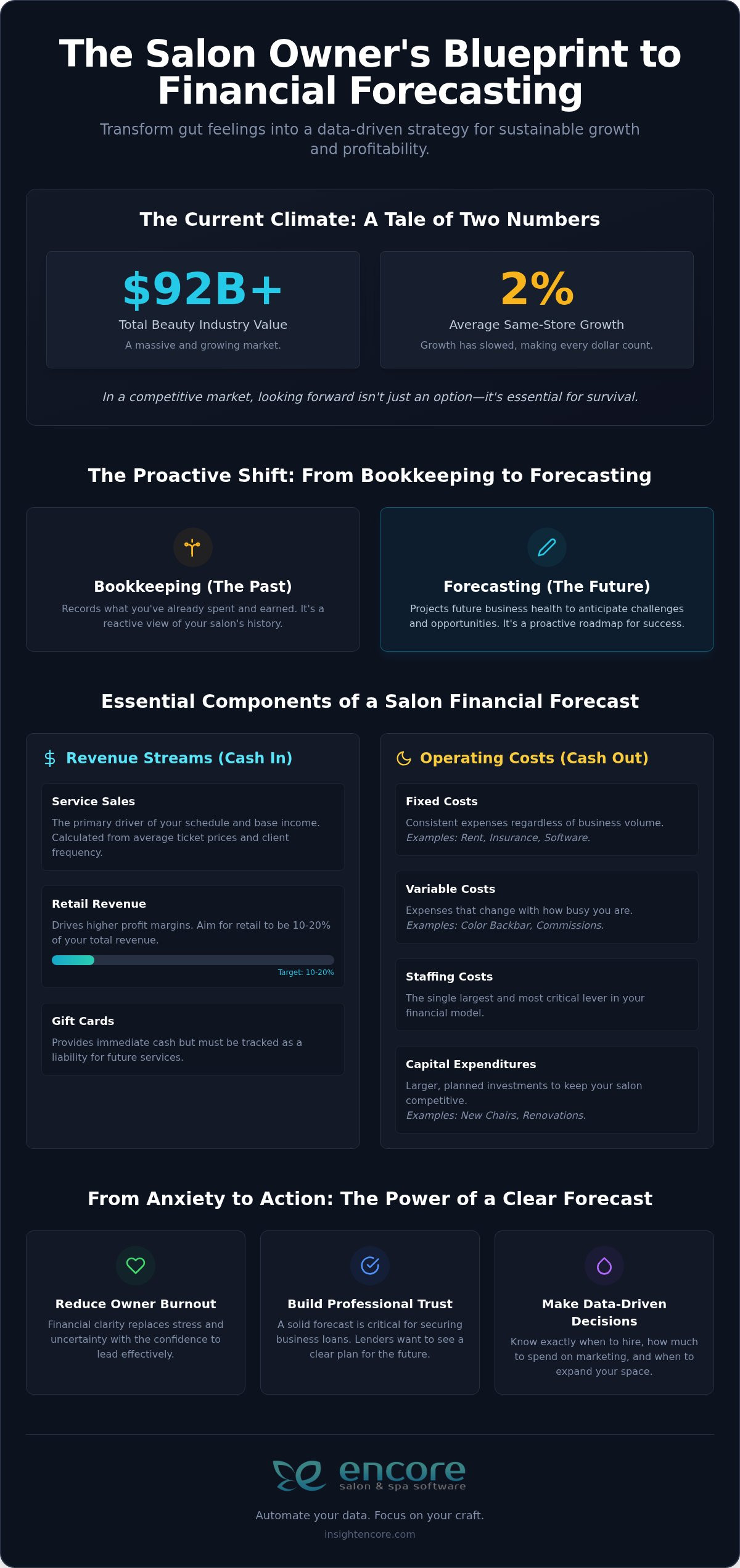
Did you know that while the beauty industry is worth over $92 billion, same-store growth for many salons has slowed to just 2%? It’s a sobering reality that makes every dollar count more than ever. You likely started your business to create beauty, not to spend your Sunday nights squinting at a confusing spreadsheet. It’s normal to feel a bit of anxiety when you’re deciding if you can afford a new hire or a second location. That’s why having a reliable salon financial forecasting template is so vital. It moves you away from “gut feelings” and toward a clear, data-backed strategy for your year ahead.

We understand that numbers can feel intimidating, but they don’t have to be. This guide provides a plug-and-play framework designed to wipe out cash flow uncertainty and replace it with professional confidence. You’ll learn how to build a living roadmap that accounts for everything from repeat client revenue to the latest 2026 economic shifts. We’ll show you how to automate your data tracking so you can stop worrying about manual errors and start focusing on your team. By the end of this article, you’ll have the tools to ensure your salon is sustainable, profitable, and ready for growth.

Key Takeaways

  • Shift your focus from past bookkeeping to future forecasting to identify potential cash flow dips before they happen.
  • Master the essential components of a salon financial forecasting template, including service sales, retail revenue, and the balance between fixed and variable costs.
  • Learn the step-by-step process of using your POS data to calculate average ticket prices and client frequency for a reliable 12-month roadmap.
  • Avoid expensive growth mistakes by accounting for staff turnover and setting realistic timelines for new guest acquisition.
  • Discover how Encore Salon Software removes the stress of manual data entry by generating instant reports for your financial planning.

Why Financial Forecasting is the Secret to Salon Longevity in 2026

Many salon owners mistake bookkeeping for financial planning. While bookkeeping tracks what you’ve already spent, it doesn’t tell you where you’re going. To understand what a financial forecast is, think of it as a projection of your future business health based on current trends. Using a salon financial forecasting template allows you to look forward. It helps you anticipate the slow months of 2026 before they happen. You’re no longer just recording history; you’re writing it.

A forecast acts as your business’s early warning system. With industry reports showing that same-store growth has leveled off at around 2%, you can’t afford to be reactive. If your forecast shows a potential cash flow dip in November, you have time to launch a loyalty campaign or adjust your inventory orders now. This proactive approach is what separates a thriving salon from one that’s constantly firefighting. It gives you the power to make adjustments while you still have the resources to do so.

The Emotional Benefit of Financial Clarity

Financial uncertainty is a leading cause of owner burnout. When you don’t know if you can cover rent next month, your creativity suffers. Clarity brings peace. A clear roadmap transforms you from a stressed manager into a confident leader. It also builds a professional image that matters to outside partners. If you’re looking at SBA 7(a) loans, which currently carry variable rates between 9.75% and 13.25%, lenders will want to see that you have a firm grip on your future numbers. Professionalism breeds trust.

Strategic Decision Making via Data

Data gives you the permission to grow. Instead of wondering if it’s time to hire a new stylist, your salon financial forecasting template will show you exactly when your current team will reach capacity. You can see the revenue impact of a new hire before they even start their first shift. This same logic applies to your marketing budget. You’ll know exactly how much you can spend to acquire a new guest while maintaining your margins. For more tips on protecting your bottom line, check out our guide on how to increase salon profit margin. Strategic growth isn’t about taking big risks; it’s about making informed choices.

Essential Components of a Salon Financial Forecasting Template

A salon financial forecast is a predictive model of cash inflows and outflows over a specific period. To build a resilient business, your salon financial forecasting template must go beyond simple estimates. It needs to reflect the reality of your daily operations. This means breaking your business down into manageable categories that show exactly where your money goes. You can’t plan for growth if you don’t know your starting point.

Revenue isn’t just about how many haircuts you perform. It includes retail product sales, which often carry higher profit margins, and gift card breakage. When you create a prospective financial outlook, you’re looking at the total potential of your brand. It’s about seeing the big picture of how different income streams work together to support your goals.

Costs usually fall into two buckets. Fixed costs like rent and insurance stay the same regardless of your volume. Variable costs, such as color backbar and stylist commissions, change based on how busy you are. Staffing costs remain the biggest lever in your financial model. Managing these properly is the difference between a profitable month and a stressful one. You also need to plan for capital expenditures. These are the larger investments, like new styling chairs or a front desk renovation, that keep your space competitive and fresh.

Predicting Revenue Beyond Service Sales

Service sales drive the schedule, but retail-to-service ratios drive the profit. A healthy salon often aims for retail to make up 10% to 20% of total revenue. Your forecast should also account for seasonal fluctuations, such as the “January dip” when client spending naturally cools after the holidays. Don’t overlook the impact of gift cards on your future cash flow. While they provide immediate cash, they represent a liability for future services that you must track carefully in your model.

Understanding Your True Operating Costs

Hidden costs can quietly erode your margins. Credit card processing fees and software subscriptions often go unexamined but add up quickly over a year. If you want to stop these fees from silently draining your profits, our guide on how to reduce credit card processing fees for small business breaks down exactly where the money goes and how to reclaim it. Treat your backbar inventory as a variable expense that scales with your service volume. If your color usage spikes, your revenue should too. For a deeper dive into balancing these numbers, read our guide on salon cash flow management. If you want to see these numbers in real-time without the manual math, you can explore our reporting tools to simplify your planning.

Step-by-Step: How to Forecast Salon Revenue and Expenses

Creating a salon financial forecasting template isn’t just about guessing. It’s about building a model based on what actually happens in your chairs. You need to follow a logical path to ensure your projections are grounded in reality. This process turns your messy data into a clear vision for the future of your business.

Start by gathering historical data from your POS system. Look at your performance from the last 12 months to find your baseline. This tells you your average ticket price and how often your clients return. If you’re following the SBA’s guide to financial projections, you know that historical accuracy is the foundation of any reliable outlook. Next, factor in your staff utilization. A chair that sits empty for half the day isn’t earning its keep. Layer in any planned price increases or upcoming marketing campaigns. These variables can significantly shift your revenue curve.

Finally, stress-test your model. Create a “worst-case” scenario where new guest acquisition drops by 10%, which was a common industry trend in late 2026. Knowing you can survive a dip gives you the confidence to push for the “best-case” results. It’s better to be prepared for a storm than to be surprised by one. To ensure your studio is truly ready for what’s ahead, it’s worth running through a comprehensive salon business health checklist that audits your financial, operational, and cultural vitality alongside your forecast.

The Role of Staff Utilization in Revenue

Your forecast will fail if you don’t track stylist performance. You need to calculate the revenue per hour for every chair in your salon. This metric reveals whether you’re truly at capacity or if you just have a scheduling bottleneck. If you aren’t sure where to start, check out our guide on how to calculate salon staff utilization rate. High utilization leads to higher profit margins without adding more overhead. It’s the most effective way to grow your income without expanding your footprint.

Projecting Retail and Upsell Growth

Retail isn’t just an extra on the side; it’s a core revenue driver. Set realistic benchmarks for your team based on their historical performance. Use your salon financial forecasting template to see how even a small 5% increase in retail sales impacts your year-end profit. Automated marketing tools can help here by sending rebooking reminders and personalized product offers. These systems boost your rebooking rates, making your future revenue more predictable and less reliant on finding new guests every month. Use your historical data to predict peak demand periods so you can stock up on inventory before the rush starts.
Ultimate Salon Financial Forecast Template & Guide 2026

Common Forecasting Mistakes and How to Avoid Them

Many owners feel a surge of relief once they first fill out a salon financial forecasting template. It feels like the hard part is over. However, the real value of a forecast lies in the accuracy of your assumptions. It’s easy to fall into traps that make your roadmap unreliable. One of the most frequent errors is overestimating how quickly you can acquire new clients. Industry data from 2026 shows that new guest visits declined by 10% across the board. If your model assumes a constant stream of new faces without a heavy marketing spend, your revenue projections will be inflated.

You also can’t ignore the impact of staff turnover. When a stylist leaves, they often take a portion of their clientele with them. This creates a massive revenue hole that can take months to fill with new hires. Additionally, many owners underestimate the “cost of goods” as they get busier. As your service volume increases, your backbar expenses and laundry costs scale right along with it. If you don’t account for this, your profit margin will shrink even as your total sales grow. Finally, a forecast is only useful if you update it. Failing to compare your actual results against your projections makes the whole exercise a waste of time.

The Danger of “Optimism Bias”

Everyone wants to be positive about their business, but your budget needs to be grounded in reality. Always include a 10% buffer for expenses in your salon financial forecasting template. Unexpected costs, like a broken HVAC system or a faulty water heater, can derail your cash flow if you aren’t prepared. Use real benchmarks to validate your goals. For example, a well-managed salon typically sees a profit margin between 8% and 15%. If your model predicts a 40% margin, it’s time to double-check your math and your assumptions.

Static vs. Rolling Forecasts

A yearly budget often feels irrelevant by February. The market moves too fast for static planning. Instead, adopt a 3-month rolling forecast. This allows you to stay agile and adjust your spending based on the previous quarter’s actual performance. By integrating real-time credit card processing data, you can see exactly how much cash is hitting your bank account every day. This clean data ensures your projections stay accurate and useful all year long, helping you make better decisions for your team’s future.

Get started with Encore to automate your data tracking today

Automating Your Forecast with Encore Salon Software

A manual salon financial forecasting template is a fantastic starting point, but the real magic happens when you stop typing and start leading. Manual data entry is the primary source of errors that lead to “messy spreadsheet” anxiety. Encore Salon Software eliminates this hurdle by connecting your POS and inventory management directly to your financial planning. Every service performed and every bottle of retail product sold flows into your records automatically. This shift moves you from a state of constant stress to a feeling of organized control.

Generic accounting tools often fall short because they don’t speak the language of beauty and wellness. They don’t understand the nuances of color waste or the complexities of tracking chair and booth renter financials in one unified platform. We’ve spent 35 years refining our tools to handle these specific industry hurdles. We aren’t just a distant service provider; we’re a supportive partner. Our human-centric approach ensures you have the reliability you need to master your numbers without feeling intimidated by the technology.

From Data to Insight: Encore’s Reporting Suite

Visualizing your business health should only take a few clicks, not a few hours. Encore allows you to generate instant performance reports that feed directly into your salon financial forecasting template. You can customize these reports for specialized environments, including tattoo studios, nail salons, or spas. This level of detail helps you see exactly which services are driving your profit and where your costs might be creeping up. You can explore the full range of Encore Salon Software features to see how we turn raw data into actionable insights for your growth.

Ready to Take Control of Your Numbers?

Predictable revenue is the foundation of a sustainable business. Our automated marketing and loyalty programs contribute to this by increasing client retention and boosting rebooking rates. When your revenue is predictable, your forecast becomes a powerful tool for expansion rather than just a way to track expenses. You’ll have the data-backed confidence to hire new stylists or invest in a renovation. We’re eager to help you reach that next level of success. If you’re ready to see how our system can transform your planning, contact our team for a personalized walkthrough of our platform today.

Build a Business That Lasts

Mastering your numbers is the most empowering thing you can do for your salon. It transforms daily financial anxiety into a clear, actionable roadmap for growth. By implementing a salon financial forecasting template, you’ve taken the first step toward true business sustainability. You’re no longer just reacting to your bank balance; you’re designing your future with data-backed confidence.

We’ve been a dedicated partner to salon owners since 1991, offering 35 years of industry expertise. Our all-in-one platform covers everything from POS to payroll, ensuring your data is always clean and ready for analysis. Whether you run a high-volume barbershop or a specialized wellness studio, we provide the human-centric tools you need to succeed. You’ve built something beautiful, and now it’s time to ensure it thrives for years to come.

See how Encore Salon Software automates your financial reporting—Book a Demo Today!

Your passion for your craft deserves a business that is as resilient as it is creative. Take the leap today and replace uncertainty with organized control. We’re here to guide you every step of the way toward the successful future you deserve.

Frequently Asked Questions

What is the difference between a salon budget and a financial forecast?

A budget is a spending plan that sets limits on your expenses; a financial forecast is a prediction of where your business is actually headed. While a budget is often static, a forecast uses current trends to show future outcomes. Using a salon financial forecasting template helps you bridge this gap. It allows you to see the real-world impact of your current bookings on next month’s bank balance.

How often should I update my salon financial forecasting template?

You should update your salon financial forecasting template at least once a month. This practice, known as a rolling forecast, ensures your projections stay relevant as market conditions change. If same-store growth stalls or new guest acquisition dips, a monthly update allows you to catch these trends early. Regular reviews transform your forecast from a static document into a living roadmap that guides your daily business decisions.

Do I need expensive software to start forecasting for my salon?

You don’t need expensive software to begin, but manual spreadsheets often lead to data entry errors. While a basic template is a great starting point, specialized tools like Encore Salon Software automate the process. Our platform pulls data directly from your POS and inventory records to feed your projections. This saves you hours of manual work and provides the professional confidence you need to make big expansion decisions.

How do I account for booth renters in my financial projections?

Booth renters should be projected as a steady stream of fixed rental income rather than variable service revenue. Unlike commission stylists, their contribution doesn’t fluctuate with service volume. Encore offers specialized modules for chair and booth renters to keep these financials separate and clear. This ensures your projections accurately reflect your overhead coverage without confusing your personal service sales with your rental income.

What is a realistic profit margin for a hair salon in 2026?

A realistic profit margin for a well-managed hair salon in 2026 typically falls between 8% and 15%. While your total revenue might be high, your net profit depends on how effectively you manage variable costs like backbar supplies and commissions. Monitoring your margin through a forecast helps you identify if costs are creeping up. This allows you to adjust your pricing or inventory management before your bottom line suffers.

Can I use a general accounting tool like QuickBooks for salon forecasting?

General tools like QuickBooks are excellent for bookkeeping and tax compliance, but they often lack the industry-specific depth needed for salon forecasting. They don’t naturally track metrics like stylist utilization or retail-to-service ratios. Encore is designed specifically for wellness businesses, offering integrated reporting that understands the nuances of your daily operations. This specialized focus provides a much clearer picture of your business health than generic accounting software can.

How do I factor in seasonal trends like the holiday rush?

Factoring in seasonal trends requires looking at your historical POS data to identify recurring patterns. Most salons experience a significant revenue peak in December followed by a natural cooling in January. Your forecast should adjust for these fluctuations by lowering revenue expectations during slow months and increasing them during high-demand periods. This ensures you have enough cash reserved from the busy season to comfortably cover your fixed costs during the dips.

What should I do if my actual numbers are significantly lower than my forecast?

If your actual numbers fall short, use the gap to identify exactly where the leakage is happening. Check if your new guest acquisition has dropped or if your staff turnover has increased. A forecast acts as an early warning system, giving you time to respond. You might launch an automated loyalty program or a targeted marketing campaign to boost rebooking rates and get your revenue back on track.

Disclaimer

This article is general in nature and may contain errors, please verify all claims with your sales rep

Categories
Uncategorized

Salon Cash Flow Management: 2026 Financial Guide

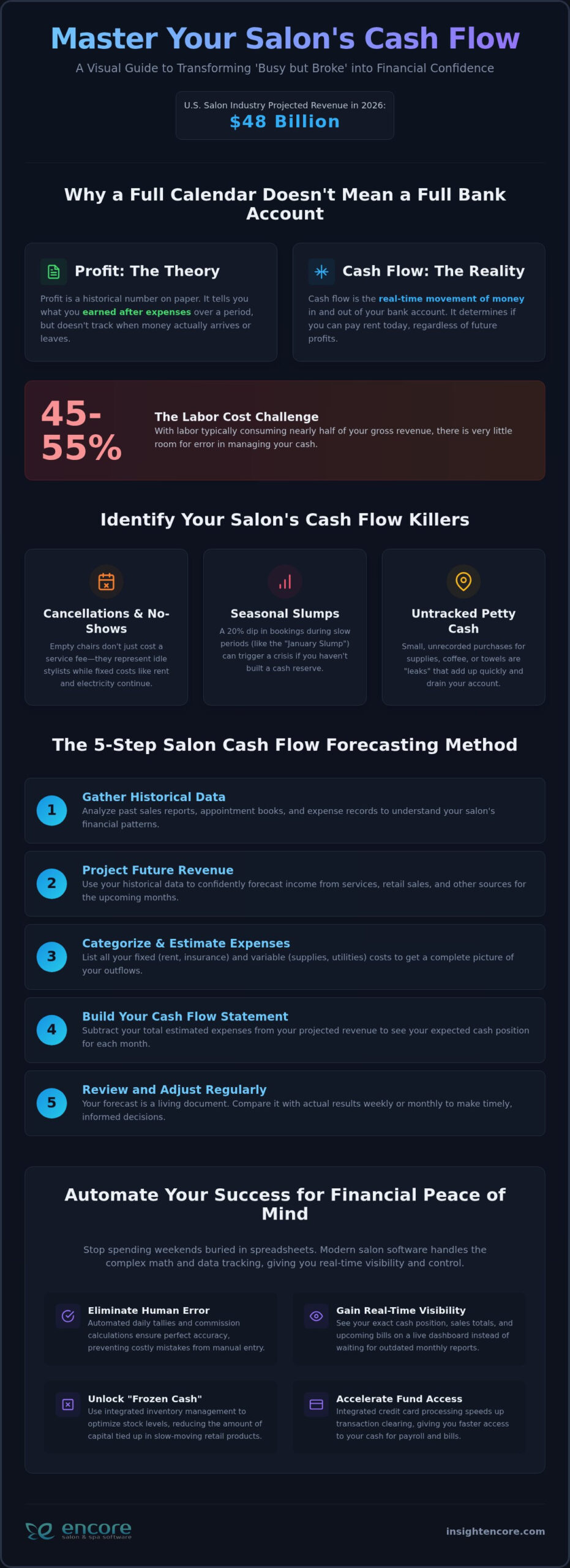
With the U.S. salon industry projected to generate $48 billion in revenue in 2026, why does it feel like your bank account is often running on empty? It’s a common frustration to see every chair full yet still worry about covering the next lease payment. You aren’t alone in feeling the sting of unpredictable slow seasons or the headache of tying up too much capital in retail stock that just won’t move. Learning how to manage salon cash flow effectively is the vital shift that transforms a talented artist into a confident, relaxed business owner.

We understand that you started this journey to create beauty, not to spend your weekends buried in complex spreadsheets. It’s exhausting to manually calculate staff commissions or wonder exactly where your profit disappeared. This guide is your roadmap to financial clarity. We will provide a step-by-step framework to stabilize your monthly income and automate the “math” that currently causes so much stress. You’re about to discover how to gain a clear understanding of your finances and ensure your business thrives in 2026 with systems that work as hard as you do.

Key Takeaways

  • Understand why a fully booked calendar doesn’t always mean a healthy bank account by mastering the difference between profit and real-time cash flow.
  • Stop “leaky” finances by categorizing fixed and variable expenses and implementing a simple daily reconciliation routine that keeps you in control.
  • Unlock “frozen cash” by optimizing your inventory levels and aligning staff schedules with your most productive hours to reduce unnecessary overhead.
  • Follow a proven five-step method on how to manage salon cash flow effectively by using historical data to project future revenue with confidence.
  • Learn how automated tools like Encore Salon Software handle complex math and data tracking for you, letting you focus on your clients instead of spreadsheets.

Profit vs. Cash Flow: Why Your Salon Can Be Busy but Broke

It’s a frustrating paradox. Your stylists are booked solid and you might even hit the industry average revenue of $245,000. Yet, when you look at your bank balance on Friday, there’s barely enough to cover the rent. This is the “Busy but Broke” trap. It happens because profit is just a theoretical number on paper, while cash flow is the cold, hard reality of your bank account. To understand what cash flow is, you have to look at the timing of every transaction. Profit tells you what you earned after expenses, but cash flow tracks exactly when that money arrives and when it leaves.

In a salon, managing this is uniquely complex. You’re balancing service revenue, which is immediate, with retail stock that might sit on a shelf for months. With labor costs typically eating up 45% to 55% of your gross revenue, there is very little room for error. You have to track three main types of movement:

  • Operating Cash Flow: The daily money from haircuts, colors, and product sales.
  • Investing Cash Flow: Money spent on long-term assets, like new salon chairs or high-end equipment.
  • Financing Cash Flow: Cash used for loans or business debt.

Learning how to manage salon cash flow effectively starts with recognizing that timing is everything. If your expenses hit on the 1st but your big color appointments aren’t until the 15th, you have a cash flow problem, even if you are profitable by the end of the month.

Common Cash Flow Killers in the Beauty Industry

Small leaks can sink a big ship. Last-minute cancellations and no-shows are the most immediate thieves. They don’t just cost you a service fee; they leave a stylist idle while your fixed costs, like electricity and rent, keep ticking. Then there’s the “January Slump.” If you haven’t built a reserve during the busy holiday season, a 20% dip in bookings can feel like a crisis. Finally, watch your petty cash. Those emergency trips to the store for extra towels or coffee pods add up quickly if they aren’t tracked daily.

The Role of Visibility in Financial Peace of Mind

You can’t fix what you can’t see. Many owners wait for a quarterly report from their accountant, but that’s like looking in the rearview mirror while driving. By the time you see a problem, it’s three months old. Real-time data gives you the power to make decisions today. Instead of relying on a gut feeling that the salon is doing well, you need to know your exact totals every evening. Automation is the key. It removes human error from daily tallies and ensures that your commission math is perfect. When you use integrated management features, the stress of the unknown disappears, replaced by a feeling of organized control.

Building a Foundation: Tracking Income and Expenses with Precision

Running a salon is deeply personal. Every dollar represents a client served or a product sold. To keep that money where it belongs, you need a crystal-clear map of your outflows. This starts with separating your fixed costs from your variable ones. Your fixed costs, like rent and insurance, are the anchors that stay the same every month. Variable costs, such as backbar supplies and utilities, are more fluid. Tracking these categories separately is how to manage salon cash flow effectively because it stops small, variable leaks before they become floods.

Daily reconciliation is your best defense against “leaky” cash flow. It’s tempting to wait until the end of the week, but small errors in manual entry or untracked petty cash purchases add up quickly. By spending ten minutes each evening balancing your till, you ensure your records match your bank account. This habit creates a reliable foundation for your morning check-in. A simple cash flow dashboard allows you to see your current balance and upcoming bills in just five minutes, giving you the confidence to start your day with a clear head.

Automating Revenue Tracking with POS Integration

Manual data entry is a magnet for human error. When you use integrated credit card processing, your sales data flows directly into your management system without you lifting a finger. This automation captures every detail, including digital tips and service add-ons that might otherwise slip through the cracks. It also speeds up fund availability. Instead of waiting days for transactions to clear, integrated systems often provide faster access to your cash, which is vital for meeting immediate payroll needs.

Managing Outflows: The ‘Envelope Method’ for the Digital Age

The “Envelope Method” isn’t just for physical cash; it’s a powerful digital strategy too. By allocating specific percentages of your daily revenue to separate “envelopes” or accounts, you ensure you’re never scrambling for tax or payroll money. For example, you might set aside 15 percent for taxes and 50 percent for labor costs immediately. This proactive approach allows you to implement strategies to strengthen your financial stability during the quieter seasons.

Modern software can even flag your account when variable expenses, like your monthly color order, exceed your set budget. There is a massive psychological benefit to seeing “saved” cash sitting in a dedicated account for future bills. It replaces the panic of the unknown with a sense of organized control. If you’re ready to see how simple this tracking can be, you can explore our all-in-one management tools today.

Optimizing Your Two Largest Outflows: Inventory and Labor

Inventory and labor are the two heaviest weights on your balance sheet. If they aren’t balanced perfectly, they can pull your entire business down. Many owners see a shelf full of products and feel a sense of security, but that’s a mistake. Think of your backbar and retail shelves as “frozen cash.” Every bottle sitting there is money that isn’t available to pay your team or your rent. Understanding the relationship between these two expenses is the next step in learning how to manage salon cash flow effectively.

Labor is your highest expense, typically accounting for 45% to 55% of gross revenue in 2026. If you have three stylists standing around during a Tuesday morning dead zone, you’re paying to keep the lights on for no return. This is especially critical for specialized businesses like tattoo studios or booth rental spaces. These “mini-cash flows” require precision to ensure the house stays profitable while the artists thrive. Commission structures also impact your weekly cash availability. If you pay out commissions before your credit card deposits fully clear, you create a temporary cash crunch that can be avoided with better timing.

Smart Inventory Management: Freeing Up Your Capital

Stop guessing what you need to order. You can implement “Par Levels” to trigger orders only when you hit a specific minimum. This ensures you aren’t overbuying “Dust-Gatherers,” which are products that haven’t moved in 90 days. When you use Encore’s inventory management, this process becomes automatic. The system tracks every ounce used in the backbar and every bottle sold at retail, keeping your capital fluid instead of trapped on a shelf.

Aligning Staff Performance with Financial Health

A busy salon isn’t always a productive one. You need to track your salon staff utilization rate to see if your team’s time is being used efficiently. If utilization is low, it’s time to adjust your scheduling or focus on automated marketing to fill those gaps. Automated commission calculations also prevent “human error” overages that can quietly drain your accounts. By incentivizing your staff to focus on high-margin services like color corrections or scalp treatments, you increase the amount of cash staying in the business after labor costs are paid.

Salon Cash Flow Management: 2026 Financial Guide

The 5-Step 2026 Salon Cash Flow Forecasting Method

Forecasting is your financial weather report. It tells you when to carry an umbrella and when to soak up the sun. If you’re tired of being surprised by a low bank balance, learning how to manage salon cash flow effectively requires a proactive look at the months ahead. This isn’t about being a math genius; it’s about using your existing data to make informed decisions. This 5-step method for 2026 simplifies the process so you can plan with total confidence. To take your planning even further, a dedicated salon financial forecasting template can give you a plug-and-play framework that moves you from gut feelings to a clear, data-backed strategy for the year ahead.

  • Step 1: Gather 12 months of historical data. This shows you the natural rhythm and seasonal cycles of your business.
  • Step 2: Project future revenue. Use your current booking trends and staff levels to estimate what’s coming in the next quarter.
  • Step 3: List known upcoming expenses. Include everything from license renewals to planned equipment upgrades and lease increases.
  • Step 4: Factor in seasonal peaks and valleys. Plan for the holiday rush and the January slump at the same time.
  • Step 5: Adjust your strategy. This is where you decide how to manage salon cash flow effectively by cutting unnecessary costs or launching a new marketing campaign.

Projecting Revenue in a Subscription and Service Economy

The beauty industry is leaning heavily into recurring revenue models. If you offer memberships, include that guaranteed income in your projections. It’s also helpful to estimate the lifetime value of a new client. A one-time visitor is a win, but a client who returns every six weeks is a financial pillar for your business. Don’t forget about gift card sales. These are fantastic immediate cash injections that can help bridge a gap during a slow week. Just remember to track these as liabilities so you’re ready when the client returns to redeem them later in the year.

Building the ‘Peace of Mind’ Cash Reserve

Every salon owner deserves to sleep soundly at night. We recommend following the “Rule of Three” as a core part of your financial strategy. Your goal is to have three months of operating expenses sitting in a separate business savings account. You don’t need to find this money all at once. Build this reserve incrementally by setting aside a small percentage of your weekly profit, perhaps just 2 or 3 percent. This habit ensures your business remains stable without hurting your daily operations or your ability to pay your team. This emergency fund is your shield against the unexpected, like a sudden equipment failure or a change in local regulations. Having this cushion allows you to lead your team with a sense of calm and control. Pairing this reserve-building habit with a thorough salon business health checklist gives you a complete picture of your studio’s financial and operational readiness for the year ahead.

Start your financial transformation today

Leveraging Encore Salon Software to Automate Your Success

You didn’t open your doors to become a full-time bookkeeper. You’re an artist, a mentor, and a leader. While the financial framework we’ve discussed is vital, you shouldn’t have to spend your Sunday nights manually entering data into a spreadsheet. This is where Encore acts as your friendly mentor, handling the heavy lifting of data tracking so you can stay focused on your team and your clients. Shifting your focus to how to manage salon cash flow effectively through automation is the single most impactful change you can make for your business in 2026.

One of the biggest mistakes owners make is “Frankenstein-ing” their business by using five different apps that don’t talk to each other. When your booking system, inventory tracker, and credit card processor all live under one roof, you eliminate the data gaps that lead to financial surprises. For specialized businesses like tattoo studios or niche wellness centers, this level of integration is even more critical. You need a system that understands the specific nuances of your craft, from tracking booth rental fees to managing high-ticket service deposits.

Integrated Tools That Drive Immediate Inflows

Waiting for money to arrive is the hardest part of the “Busy but Broke” cycle. Encore helps you break that cycle with tools designed to secure your income before the client even walks in. By setting automated deposit requirements for high-ticket services like extensions or complex color work, you protect your time and your cash. If your calendar shows a gap, you can use built-in marketing automation to send targeted offers to your most loyal clients, filling those empty chairs instantly. Best of all, our simplified financial reporting translates complex numbers into clear, actionable insights that you can actually understand at a glance.

Taking the Next Step Toward Financial Freedom

Upgrading your management system is about more than just better math; it’s an investment in your mental health. The constant low-level stress of “not knowing” is what leads to burnout. Transitioning from a state of surviving to thriving requires the visibility that only professional software can provide. You don’t have to be an accountant to run a highly profitable business. You just need the right partner to handle the details. Encore is the ultimate answer to how to manage salon cash flow effectively without the daily headache of manual tracking.

Explore Encore Salon Software features

Transforming Your Financial Future

Mastering the art of financial management is the bridge between being a busy stylist and becoming a thriving business owner. You’ve learned that profit on paper doesn’t always match the cash in your hand, and that visibility is your greatest tool for stability. By optimizing your inventory and aligning your labor costs with actual productivity, you’re already ahead of the curve. Learning how to manage salon cash flow effectively is a journey that replaces daily stress with organized control.

Since 1991, we’ve helped salons, spas, and tattoo studios across the globe simplify their operations. Our all-in-one management platform handles the complex data lifting, from integrated inventory tracking to automated payroll calculations. You don’t have to navigate these financial hurdles alone. With the right systems in place, you can focus on the creative work you love while your business grows with confidence.

Take Control of Your Salon's Finances with Encore Salon Software

Your path to a predictable monthly income and a thriving salon starts today. We’re here to guide you every step of the way toward the financial freedom you deserve. You’ve got the talent; now you have the framework to match it.

Frequently Asked Questions

What is the difference between profit and cash flow in a salon?

Profit is the surplus left over after all expenses are subtracted on paper, while cash flow is the actual timing of money entering and leaving your bank account. A salon can be profitable but still run out of cash if bills are due before client payments arrive. Understanding this distinction is key to learning how to manage salon cash flow effectively. It ensures you have liquid funds for daily operations regardless of your paper revenue.

How much cash reserve should a small salon ideally have?

A small salon should ideally aim for a cash reserve that covers at least three months of operating expenses. This “Rule of Three” provides a safety net for unexpected equipment repairs, sudden staff turnover, or seasonal dips. You can build this fund incrementally by setting aside a small percentage of your weekly intake. Having this cushion allows you to make calm, strategic decisions rather than reacting out of financial panic during a slow week.

Can salon software really help me save money on credit card fees?

Yes, integrated credit card processing can often reduce your total costs by eliminating the need for separate third-party hardware and reducing manual entry errors. While specific fees vary by provider, integrated systems streamline your reporting and speed up fund availability. This improved efficiency means your money reaches your bank account faster, which is a vital part of how to manage salon cash flow effectively and maintain steady business operations.

How often should I check my salon’s cash flow statement?

You should perform a quick five-minute check of your daily totals every evening and a more detailed review of your cash flow statement once a week. Daily reconciliation prevents small errors from ballooning into large discrepancies. The weekly review allows you to spot trends, such as rising backbar costs or underperforming shifts, before they impact your ability to pay upcoming bills like rent or payroll.

What are the biggest ‘hidden’ expenses in a spa or salon?

The biggest hidden expenses often include backbar waste, untracked petty cash spending, and credit card processing fees. Small, frequent purchases for salon supplies like coffee, towels, or cleaning products can quietly drain your profits if they aren’t logged. Additionally, “frozen cash” tied up in overstocked retail inventory that hasn’t moved in 90 days acts as a major hidden drain on your liquid capital and prevents you from investing in growth.

How do I handle cash flow if I’m a solo chair renter?

Solo chair renters should treat their business like a mini-salon by using specialized Chair/Booth Renter Software to track their individual inflows and outflows. You need to separate your personal and business finances strictly and set aside a fixed percentage of every service for taxes and rent immediately. This disciplined approach ensures you always have the funds ready for your overhead, even if your booking schedule varies from week to week.

What should I do if my salon’s cash flow becomes negative?

If your cash flow becomes negative, the first step is to identify where the money is “leaking” by reviewing your variable expenses. You may need to temporarily reduce inventory orders, adjust staff schedules to match peak hours, or offer high-margin service specials to drive immediate revenue. Focus on collecting deposits for high-ticket services to inject cash into the business quickly. Analyzing your data helps you determine if the issue is a temporary dip or a structural problem.

How can I improve cash flow during the slow post-holiday months?

To improve cash flow during slow periods, use automated marketing to fill empty chairs with loyal clients who haven’t visited recently. You can also promote gift card redemptions or launch specialized membership programs to create recurring, predictable income. Focusing on high-margin treatments, such as scalp treatments or deep conditioning, can increase the average ticket price without significantly increasing your product costs or labor time during these quieter weeks.

Disclaimer

This article is general in nature and may contain errors, please verify all claims with your sales rep

Categories
Uncategorized

Calculating Salon Staff Commission Automatically: The 2026 Efficiency Guide

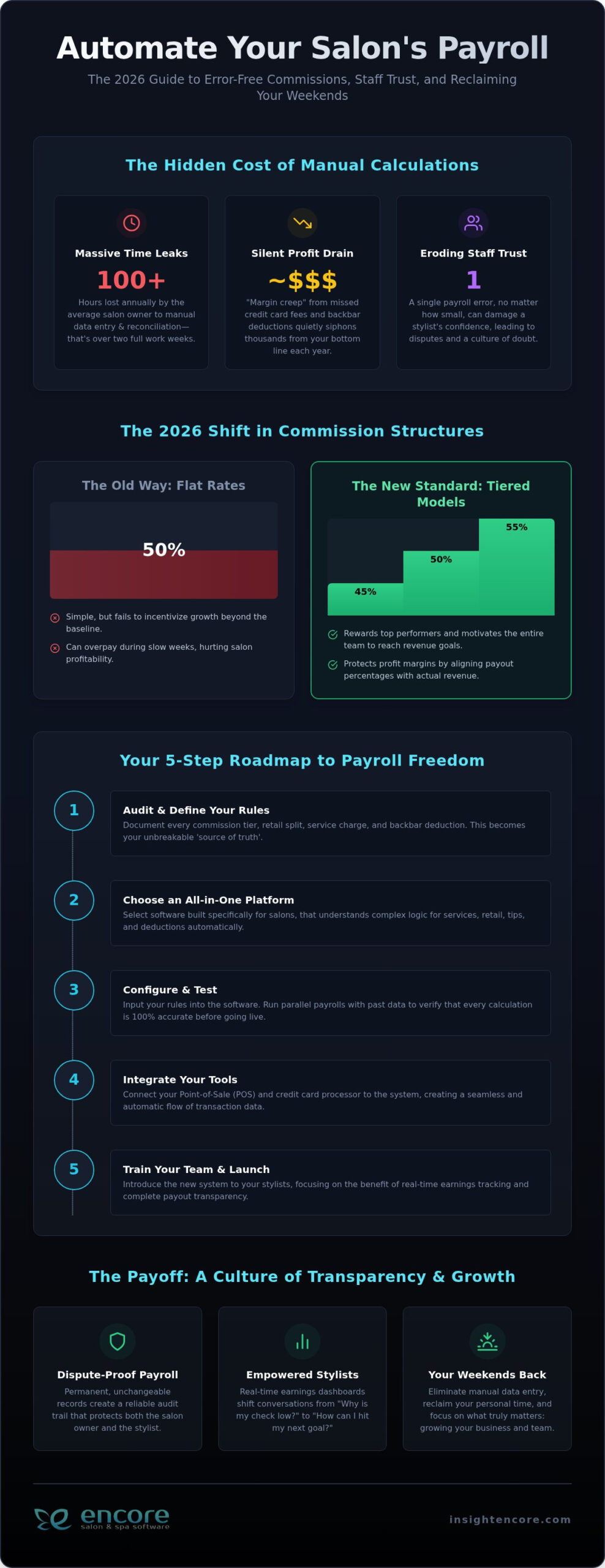
Imagine it’s late Sunday night. Instead of resting for the busy week ahead, you’re hunched over a laptop, cross-referencing messy spreadsheets with crumpled retail receipts. You know that one small typo could lead to a tense conversation with your top stylist on Tuesday morning. Calculating salon staff commission automatically isn’t just a luxury anymore; it’s a necessity for your peace of mind. We understand that the pressure of getting payroll exactly right, especially with complex tiered structures and new 2026 IRS tip reporting requirements, can feel like a second full-time job.

You’ve likely felt the frustration of manual entry errors and the awkwardness of stylist disputes over "missing" retail cuts. We agree that your time is better spent mentoring your team and growing your brand than playing accountant every weekend. This guide will show you how to eliminate those manual errors and build lasting staff trust through total automation. We’ll explore the latest 2026 efficiency strategies, from integrating your credit card processing to handling the new federal tip deductions, ensuring your payroll is both dispute-proof and lightning-fast.

Key Takeaways

  • Reclaim your Sunday nights by identifying the “time leaks” that cost the average salon owner over 100 hours of productivity every year.
  • Master the shift toward tiered and hybrid models to ensure your commission structure stays competitive and profitable in 2026.
  • Discover how calculating salon staff commission automatically eliminates payroll anxiety and creates a culture of transparency for your stylists.
  • Follow a clear, five-step roadmap to audit your current pay rules and move them into a reliable, automated “source of truth.”
  • Learn why all-in-one platforms provide better accuracy for niche businesses, including specific logic for tattoo studios and nail salons.

The Hidden Cost of Manual Commission Calculations

Managing a salon is hard enough without playing part-time forensic accountant every Sunday night. Many owners view manual entry as a standard part of the job, but the true cost is hidden in plain sight. Calculating salon staff commission automatically is the process of syncing your point-of-sale data directly with your payroll engine. It removes the middleman, usually a stressed-out owner with a calculator, and ensures that every dollar is accounted for the moment a transaction closes.

Consider the math. If you spend just two hours every week reconciling tickets and retail sales, you’re losing over 100 hours a year. That is more than two full work weeks dedicated to data entry. It’s time you could spend on education, marketing, or simply resting to avoid burnout. When you automate, you aren’t just buying software. You’re buying your weekends back.

Then there is the trust gap. A single manual error, even if it’s just a ten-dollar mistake, can damage a stylist’s confidence in your leadership for months. Beyond trust, manual math often leads to "margin creep." When you calculate by hand, it’s easy to overlook small deductions like integrated credit card processing fees or backbar costs. These tiny leaks can quietly drain thousands from your bottom line over a fiscal year because the math doesn’t account for the true cost of doing business.

Why Spreadsheets Are Your Salon’s Silent Profit Killer

Spreadsheets feel safe because they’re familiar, but they’re incredibly fragile. A single broken formula in a hidden cell can ripple through your entire staff’s pay without anyone noticing until the bank accounts don’t balance. You also face the nightmare of version control. Is "Commission_Final" the right file, or is it "Commission_Final_v2_Updated"? Without a central system, you lack an audit trail. If a stylist questions a payout from three months ago, finding the "why" behind the number becomes a digital needle in a haystack. Calculating salon staff commission automatically provides a permanent, unchangeable record that protects both you and your team.

The Psychology of Payroll Transparency

Waiting until payday to see earnings creates unnecessary anxiety for your team. When stylists can’t track their progress in real time, they feel disconnected from their performance. Transitioning to an automated system allows for a culture of self-management. Stylists can check their daily totals, see their retail progress, and adjust their effort mid-week to hit their goals. This transparency reduces end-of-month arguments because the data is visible and verified every single day. It shifts the conversation from "why is my check low?" to "how can I sell more retail tomorrow?"

Modern Salon Staff Commission Structures in 2026

The industry is moving away from the old-school 50/50 split. In 2026, salon owners are adopting structures that protect their margins while rewarding their hardest workers. Whether you use a flat rate, a tiered "slab" model, or a sliding scale, the goal remains the same: sustainability. We’re also seeing a rise in "Hybrid Models" where stylists receive a guaranteed base hourly pay plus performance incentives. Calculating salon staff commission automatically allows you to run these complex numbers accurately without needing a degree in finance or spending your entire weekend with a calculator.

Tiered vs. Flat: Which Protects Your Margins Better?

Flat rates are simple to understand, but they don’t always incentivize growth. Tiered models are now the gold standard for high-growth salons. In this structure, a stylist might move from a 45% to a 50% commission once they hit a specific weekly revenue goal. A sliding scale takes this a step further by applying different percentages to different revenue brackets. This ensures you aren’t overpaying during slow weeks while still generously rewarding high-performance periods. Using Encore Salon Software, you can simulate these changes to see how they impact your bottom line before you roll them out to the team. It’s a professional way to find the sweet spot where your stylists feel valued and your business remains healthy.

Handling Retail and Backbar Deductions

This is where many owners lose money without realizing it. Service revenue looks great on paper, but the cost of hair color, lightener, and specialized treatments can eat your profit alive if you aren’t careful. In 2026, smart salons are automating the deduction of these "backbar" product costs before the commission is calculated. This ensures the stylist is paid on the actual profit rather than just the gross ticket. Retail sales require a different approach entirely. Standard retail commission rates currently sit between 10% and 15%. By linking your inventory management directly to your payouts, you can set higher incentives for high-margin products without manually tracking every single bottle of shampoo. If you’re unsure which model fits your culture, you can connect with our support team to explore how different rules might work for your specific business.

How Automation Software Thinks: The Mechanics of Payouts

To understand the power of a modern system, you have to look at it as the ultimate "Source of Truth." In a busy salon, a single transaction involves more than just swiping a card. It triggers a chain reaction of data. When you are calculating salon staff commission automatically, the software looks at the service performed, the stylist’s specific tier, and any applicable deductions in milliseconds. In 2026, stylists expect instant visibility into their earnings. They want to see their commission balance grow on their personal dashboard the moment the client walks out the door. This real-time tracking eliminates the "payday surprise" and keeps your team motivated throughout the shift.

Modern automation also solves the headache of complex service splits. If a senior stylist performs a cut but an assistant handles the specialized color application, the software can automatically divide the commission based on your pre-set rules. It also factors in the nitty-gritty details that manual math often misses, such as integrated credit card processing fees. By deducting these small costs at the point of sale, you ensure that your salon’s profit margins remain protected without having to do the heavy lifting yourself.

From Appointment to Payout: The Data Journey

The journey starts long before the client sits in the chair. An online booking module captures the service type and assigned staff member, setting the foundation for accurate tracking. To prevent "stolen" commission or accidental double-entry, top-tier systems use unique staff logins or even RFID tech to verify who actually performed the work. Automated Sync is the digital bridge that carries transaction data from the chair directly to the bank account without human intervention. This seamless flow ensures that by the time you sit down to run payroll, the work is already 99% finished. For barbershop owners looking to eliminate no-shows and chaotic scheduling alongside their commission tracking, a dedicated barbershop scheduling app can work hand-in-hand with your payroll automation to turn every empty slot into a revenue opportunity.

Calculating Salon Staff Commission Automatically: The 2026 Efficiency Guide

5 Steps to Automating Your Salon Commission Today

Transitioning from a manual system to software is a significant milestone for your business. It’s the moment you stop being a data entry clerk and start being a CEO. However, the move shouldn’t be a "flip of the switch" overnight. Calculating salon staff commission automatically requires a thoughtful approach to ensure your data is clean and your team is ready for the change. Follow these five steps to make the transition smooth and stress-free for everyone involved.

  • Audit your current structure: Document every rule you currently use. Is it consistent across the team, or are there "special deals" that need to be standardized? Consistency is the foundation of trust.
  • Choose a flexible platform: Look for software that supports multiple rule sets. Calculating salon staff commission automatically is only effective if the system understands your unique business logic. We recommend looking for a partner that offers human-centric support during this critical setup phase.
  • Clean your data: Ensure every service and retail product has an assigned cost. This is essential for accurate backbar deductions. When your inventory tracking is integrated, these deductions happen without you lifting a finger.
  • Run a "Beta" cycle: For one pay period, run your automation alongside your manual spreadsheet. This verifies the software is configured correctly and gives you a safety net while you gain confidence in the new system.
  • Train your staff: Show your stylists how to access their personal performance dashboards. When they see their earnings grow in real-time, their skepticism usually turns into excitement.

Defining Your Commission Rules in the System

Every salon has unique needs that a basic spreadsheet just can’t handle. You might want to offer a higher percentage for specialty color services or trigger a "Step-Up" bonus when a stylist hits a specific monthly revenue goal. A professional system allows you to set these granular overrides without breaking the main payroll logic. You can see how Encore’s features provide the flexibility to handle these specific rules, ensuring your high-performers are always rewarded correctly for their hard work.

Book a personalized walkthrough of our commission engine

Onboarding Your Team Without the Friction

Change can be intimidating for stylists who are used to the old way of doing things. To make it easier, focus your communication on the "Why." Explain that this move is about two things: 100% paycheck accuracy and faster payouts. Providing a "Commission FAQ" helps address common concerns about retail splits or backbar costs before they turn into disputes. This transparency builds a culture of self-management. You can even use the data from these reports during your regular performance reviews to show stylists exactly where they can grow their income.

Why Encore is the Solution for Automated Salon Management

Using separate apps for booking and payroll creates data silos that lead to friction. If your transaction data doesn’t talk to your payroll engine, you’re forced to act as the middleman. Encore removes this barrier by serving as your all-in-one partner. Calculating salon staff commission automatically becomes a seamless part of your daily operations. This integration ensures that every haircut, color service, or retail sale is tracked accurately from the moment the client checks out. You don’t have to worry about missing tickets or manual entry errors ever again.

We understand that every business is unique. That’s why we’ve built specialized modules with tailored logic for tattoo studios and nail salons. These industries have specific needs that generic software often ignores. Whether you’re a solo artist or managing a large team, our platform scales with you. You can start with a single booth and grow into a multi-location franchise without ever needing to switch systems or learn new software from scratch. It’s a reliable foundation for your long-term growth.

The transition doesn’t have to be stressful. We pride ourselves on offering a human-centric support experience. When you move away from spreadsheets or older platforms, our experts are there to guide you through the setup. We act as a dedicated mentor, ensuring your commission rules are configured perfectly. It’s about providing you with professional confidence so you can focus on your craft instead of your computer screen. You’ll have a responsive ally by your side every step of the way.

Beyond Commission: The Full Management Suite

Commission tracking is just the beginning of what’s possible. Our suite ensures that gift cards and loyalty programs feed directly into your staff performance metrics. This gives you a clear view of which stylists are building long-term client value. Our automated marketing tools also work behind the scenes to re-engage clients, specifically targeting those who haven’t visited their favorite stylist in a while. This keeps your team’s books full and their commissions high without any extra effort on your part. It’s a complete ecosystem designed to empower your staff and grow your revenue.

Ready to Reclaim Your Sundays?

True peace of mind comes from knowing your payroll is dispute-proof. When you are calculating salon staff commission automatically, you eliminate the Sunday night spreadsheet fatigue that drains your energy. The ROI is clear. Saving just 8 hours of administrative work a month often pays for the system itself. You’re not just buying software; you’re investing in your own time and your team’s trust. We invite you to book a demo or view pricing today to see how easy automation can be for your business.

Take Command of Your Salon’s Financial Future

You’ve seen how manual math drains your energy and risks your team’s trust. By calculating salon staff commission automatically, you aren’t just modernizing your business; you’re protecting your peace of mind and your bottom line. Our integrated POS and inventory management systems ensure 100% accuracy, which means you can finally say goodbye to those awkward "missing retail" conversations with your stylists.

Since 1991, we’ve helped salon owners transition from spreadsheet fatigue to professional confidence. You can eliminate up to 90% of your payroll calculation time, giving those precious hours back to your family or your creative work. It’s time to stop surviving your Sunday nights and start thriving as a leader who prioritizes transparency and growth. We’re ready to help you build a more efficient, dispute-proof salon.

Start Automating Your Salon Payroll with Encore
We’re here to be your dedicated mentor through every step of this journey. Your success is our priority, and we can’t wait to see your business reach its full potential with a system that works as hard as you do. You’ve got this, and we’ve got you.

Frequently Asked Questions

Can salon software handle different commission rates for different stylists?

Yes, Encore is built to manage diverse team structures. You can assign unique commission percentages to every staff member based on their experience level or tenure. This granularity ensures that your senior stylists are rewarded for their expertise while new talent has a clear path for growth. Calculating salon staff commission automatically means the system recognizes these individual rule sets the moment a transaction is finalized at your point of sale.

How does automated commission handle product costs or backbar deductions?

Automation eliminates the guesswork of product costs by linking your inventory management system directly to your payroll engine. You can set specific "backbar" deductions for services like specialty color or keratin treatments. The software automatically subtracts these costs from the gross service revenue before applying the stylist’s commission percentage. This ensures your salon’s margins are always protected without you needing to manually cross-reference inventory usage or receipts every single weekend.

Is it possible to calculate commission for booth renters and employees in the same app?

Yes, you can manage both business models within a single platform using our specialized modules. For employees, the system tracks service and retail commissions based on your set percentages. For chair or booth renters, it can automatically deduct daily or weekly rent from their processed service earnings. This flexibility is perfect for hybrid salons that offer both employment and rental options, providing each professional with their own secure reporting dashboard for transparency. If you’re weighing the broader financial and legal implications of each approach, our guide on salon commission vs booth rental breaks down the key differences to help you choose the most profitable model for your business.

What happens if a client tips on a credit card? Does the software track that too?

Integrated credit card processing ensures that every tip is tracked and assigned to the correct staff member instantly. In 2026, this is critical for tax compliance. The software automatically prepares the data for reporting all employee tips in Box 12 of the W-2 form using the required code "TP". Stylists can see their tip totals in real-time on their personal dashboards, which builds trust and reduces questions about gratuities.

Can I set up tiered commission where the percentage increases after a sales target is met?

Absolutely. You can configure "Step-Up" triggers or sliding scale models that reward your high-performers. For example, a stylist might earn 45% on their first $1,000 of weekly revenue and 50% on everything after that. Calculating salon staff commission automatically removes the complexity of these calculations. The system monitors sales targets in the background and applies the higher rate the moment a stylist crosses their specific performance threshold for the month.

How do I prevent staff from seeing each other’s commission data in the software?

Security is a top priority, so the software uses unique staff logins and permission-based access levels. Stylists only have visibility into their own performance metrics, retail sales, and commission balances. They cannot see the earnings or client data of their coworkers. As the owner, you maintain full control over who sees what. This ensures a professional environment where sensitive financial information remains private and secure for every member of your team.

Will automating commission help me with my salon’s tax compliance?

Automating your commission significantly simplifies your tax reporting duties. The system maintains an unchangeable audit trail of all earnings, retail cuts, and tips. This is especially helpful for meeting 2026 IRS requirements, such as reporting employee tips in Box 12 with the new "TP" code. Having accurate, software-generated reports reduces the risk of manual filing errors and ensures you are ready for the new federal tip deduction rules that began in 2025. Before finalizing your staffing model, it’s also worth understanding the full financial picture by reviewing the 2026 owner’s guide to salon commission vs booth rental profitability, which covers how each model affects your tax obligations and overhead costs.

How long does it typically take to set up automated commission in Encore?

The initial setup time depends on the complexity of your current pay structure, but our team makes the transition smooth. Since we’ve been supporting salons since 1991, we provide human-centric guidance to help you configure your rules and import your data. Most owners find they can have their primary commission engine running within a few days, especially when utilizing our expert support to ensure every deduction and tier is set correctly from the start.

Disclaimer

This article is general in nature and may contain errors, please verify all claims with your sales rep