

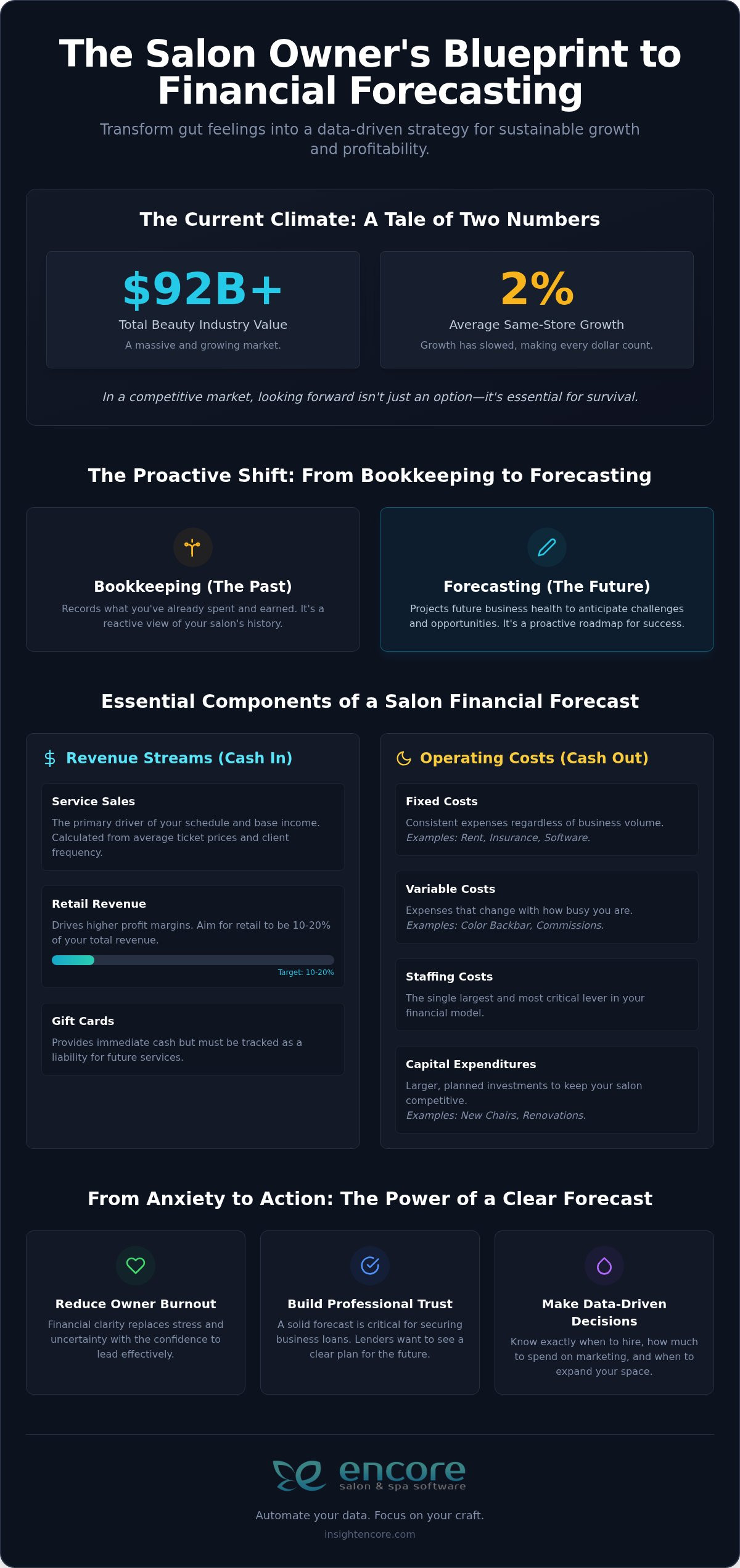
Did you know that while the beauty industry is worth over $92 billion, same-store growth for many salons has slowed to just 2%? It’s a sobering reality that makes every dollar count more than ever. You likely started your business to create beauty, not to spend your Sunday nights squinting at a confusing spreadsheet. It’s normal to feel a bit of anxiety when you’re deciding if you can afford a new hire or a second location. That’s why having a reliable salon financial forecasting template is so vital. It moves you away from “gut feelings” and toward a clear, data-backed strategy for your year ahead.
We understand that numbers can feel intimidating, but they don’t have to be. This guide provides a plug-and-play framework designed to wipe out cash flow uncertainty and replace it with professional confidence. You’ll learn how to build a living roadmap that accounts for everything from repeat client revenue to the latest 2026 economic shifts. We’ll show you how to automate your data tracking so you can stop worrying about manual errors and start focusing on your team. By the end of this article, you’ll have the tools to ensure your salon is sustainable, profitable, and ready for growth.
Key Takeaways
- Shift your focus from past bookkeeping to future forecasting to identify potential cash flow dips before they happen.
- Master the essential components of a salon financial forecasting template, including service sales, retail revenue, and the balance between fixed and variable costs.
- Learn the step-by-step process of using your POS data to calculate average ticket prices and client frequency for a reliable 12-month roadmap.
- Avoid expensive growth mistakes by accounting for staff turnover and setting realistic timelines for new guest acquisition.
- Discover how Encore Salon Software removes the stress of manual data entry by generating instant reports for your financial planning.
Why Financial Forecasting is the Secret to Salon Longevity in 2026
Many salon owners mistake bookkeeping for financial planning. While bookkeeping tracks what you’ve already spent, it doesn’t tell you where you’re going. To understand what a financial forecast is, think of it as a projection of your future business health based on current trends. Using a salon financial forecasting template allows you to look forward. It helps you anticipate the slow months of 2026 before they happen. You’re no longer just recording history; you’re writing it.
A forecast acts as your business’s early warning system. With industry reports showing that same-store growth has leveled off at around 2%, you can’t afford to be reactive. If your forecast shows a potential cash flow dip in November, you have time to launch a loyalty campaign or adjust your inventory orders now. This proactive approach is what separates a thriving salon from one that’s constantly firefighting. It gives you the power to make adjustments while you still have the resources to do so.
The Emotional Benefit of Financial Clarity
Financial uncertainty is a leading cause of owner burnout. When you don’t know if you can cover rent next month, your creativity suffers. Clarity brings peace. A clear roadmap transforms you from a stressed manager into a confident leader. It also builds a professional image that matters to outside partners. If you’re looking at SBA 7(a) loans, which currently carry variable rates between 9.75% and 13.25%, lenders will want to see that you have a firm grip on your future numbers. Professionalism breeds trust.
Strategic Decision Making via Data
Data gives you the permission to grow. Instead of wondering if it’s time to hire a new stylist, your salon financial forecasting template will show you exactly when your current team will reach capacity. You can see the revenue impact of a new hire before they even start their first shift. This same logic applies to your marketing budget. You’ll know exactly how much you can spend to acquire a new guest while maintaining your margins. For more tips on protecting your bottom line, check out our guide on how to increase salon profit margin. Strategic growth isn’t about taking big risks; it’s about making informed choices.
Essential Components of a Salon Financial Forecasting Template
A salon financial forecast is a predictive model of cash inflows and outflows over a specific period. To build a resilient business, your salon financial forecasting template must go beyond simple estimates. It needs to reflect the reality of your daily operations. This means breaking your business down into manageable categories that show exactly where your money goes. You can’t plan for growth if you don’t know your starting point.
Revenue isn’t just about how many haircuts you perform. It includes retail product sales, which often carry higher profit margins, and gift card breakage. When you create a prospective financial outlook, you’re looking at the total potential of your brand. It’s about seeing the big picture of how different income streams work together to support your goals.
Costs usually fall into two buckets. Fixed costs like rent and insurance stay the same regardless of your volume. Variable costs, such as color backbar and stylist commissions, change based on how busy you are. Staffing costs remain the biggest lever in your financial model. Managing these properly is the difference between a profitable month and a stressful one. You also need to plan for capital expenditures. These are the larger investments, like new styling chairs or a front desk renovation, that keep your space competitive and fresh.
Predicting Revenue Beyond Service Sales
Service sales drive the schedule, but retail-to-service ratios drive the profit. A healthy salon often aims for retail to make up 10% to 20% of total revenue. Your forecast should also account for seasonal fluctuations, such as the “January dip” when client spending naturally cools after the holidays. Don’t overlook the impact of gift cards on your future cash flow. While they provide immediate cash, they represent a liability for future services that you must track carefully in your model.
Understanding Your True Operating Costs
Hidden costs can quietly erode your margins. Credit card processing fees and software subscriptions often go unexamined but add up quickly over a year. If you want to stop these fees from silently draining your profits, our guide on how to reduce credit card processing fees for small business breaks down exactly where the money goes and how to reclaim it. Treat your backbar inventory as a variable expense that scales with your service volume. If your color usage spikes, your revenue should too. For a deeper dive into balancing these numbers, read our guide on salon cash flow management. If you want to see these numbers in real-time without the manual math, you can explore our reporting tools to simplify your planning.
Step-by-Step: How to Forecast Salon Revenue and Expenses
Creating a salon financial forecasting template isn’t just about guessing. It’s about building a model based on what actually happens in your chairs. You need to follow a logical path to ensure your projections are grounded in reality. This process turns your messy data into a clear vision for the future of your business.
Start by gathering historical data from your POS system. Look at your performance from the last 12 months to find your baseline. This tells you your average ticket price and how often your clients return. If you’re following the SBA’s guide to financial projections, you know that historical accuracy is the foundation of any reliable outlook. Next, factor in your staff utilization. A chair that sits empty for half the day isn’t earning its keep. Layer in any planned price increases or upcoming marketing campaigns. These variables can significantly shift your revenue curve.
Finally, stress-test your model. Create a “worst-case” scenario where new guest acquisition drops by 10%, which was a common industry trend in late 2026. Knowing you can survive a dip gives you the confidence to push for the “best-case” results. It’s better to be prepared for a storm than to be surprised by one. To ensure your studio is truly ready for what’s ahead, it’s worth running through a comprehensive salon business health checklist that audits your financial, operational, and cultural vitality alongside your forecast.
The Role of Staff Utilization in Revenue
Your forecast will fail if you don’t track stylist performance. You need to calculate the revenue per hour for every chair in your salon. This metric reveals whether you’re truly at capacity or if you just have a scheduling bottleneck. If you aren’t sure where to start, check out our guide on how to calculate salon staff utilization rate. High utilization leads to higher profit margins without adding more overhead. It’s the most effective way to grow your income without expanding your footprint.
Projecting Retail and Upsell Growth
Retail isn’t just an extra on the side; it’s a core revenue driver. Set realistic benchmarks for your team based on their historical performance. Use your salon financial forecasting template to see how even a small 5% increase in retail sales impacts your year-end profit. Automated marketing tools can help here by sending rebooking reminders and personalized product offers. These systems boost your rebooking rates, making your future revenue more predictable and less reliant on finding new guests every month. Use your historical data to predict peak demand periods so you can stock up on inventory before the rush starts.
Common Forecasting Mistakes and How to Avoid Them
Many owners feel a surge of relief once they first fill out a salon financial forecasting template. It feels like the hard part is over. However, the real value of a forecast lies in the accuracy of your assumptions. It’s easy to fall into traps that make your roadmap unreliable. One of the most frequent errors is overestimating how quickly you can acquire new clients. Industry data from 2026 shows that new guest visits declined by 10% across the board. If your model assumes a constant stream of new faces without a heavy marketing spend, your revenue projections will be inflated.
You also can’t ignore the impact of staff turnover. When a stylist leaves, they often take a portion of their clientele with them. This creates a massive revenue hole that can take months to fill with new hires. Additionally, many owners underestimate the “cost of goods” as they get busier. As your service volume increases, your backbar expenses and laundry costs scale right along with it. If you don’t account for this, your profit margin will shrink even as your total sales grow. Finally, a forecast is only useful if you update it. Failing to compare your actual results against your projections makes the whole exercise a waste of time.
The Danger of “Optimism Bias”
Everyone wants to be positive about their business, but your budget needs to be grounded in reality. Always include a 10% buffer for expenses in your salon financial forecasting template. Unexpected costs, like a broken HVAC system or a faulty water heater, can derail your cash flow if you aren’t prepared. Use real benchmarks to validate your goals. For example, a well-managed salon typically sees a profit margin between 8% and 15%. If your model predicts a 40% margin, it’s time to double-check your math and your assumptions.
Static vs. Rolling Forecasts
A yearly budget often feels irrelevant by February. The market moves too fast for static planning. Instead, adopt a 3-month rolling forecast. This allows you to stay agile and adjust your spending based on the previous quarter’s actual performance. By integrating real-time credit card processing data, you can see exactly how much cash is hitting your bank account every day. This clean data ensures your projections stay accurate and useful all year long, helping you make better decisions for your team’s future.
Automating Your Forecast with Encore Salon Software
A manual salon financial forecasting template is a fantastic starting point, but the real magic happens when you stop typing and start leading. Manual data entry is the primary source of errors that lead to “messy spreadsheet” anxiety. Encore Salon Software eliminates this hurdle by connecting your POS and inventory management directly to your financial planning. Every service performed and every bottle of retail product sold flows into your records automatically. This shift moves you from a state of constant stress to a feeling of organized control.
Generic accounting tools often fall short because they don’t speak the language of beauty and wellness. They don’t understand the nuances of color waste or the complexities of tracking chair and booth renter financials in one unified platform. We’ve spent 35 years refining our tools to handle these specific industry hurdles. We aren’t just a distant service provider; we’re a supportive partner. Our human-centric approach ensures you have the reliability you need to master your numbers without feeling intimidated by the technology.
From Data to Insight: Encore’s Reporting Suite
Visualizing your business health should only take a few clicks, not a few hours. Encore allows you to generate instant performance reports that feed directly into your salon financial forecasting template. You can customize these reports for specialized environments, including tattoo studios, nail salons, or spas. This level of detail helps you see exactly which services are driving your profit and where your costs might be creeping up. You can explore the full range of Encore Salon Software features to see how we turn raw data into actionable insights for your growth.
Ready to Take Control of Your Numbers?
Predictable revenue is the foundation of a sustainable business. Our automated marketing and loyalty programs contribute to this by increasing client retention and boosting rebooking rates. When your revenue is predictable, your forecast becomes a powerful tool for expansion rather than just a way to track expenses. You’ll have the data-backed confidence to hire new stylists or invest in a renovation. We’re eager to help you reach that next level of success. If you’re ready to see how our system can transform your planning, contact our team for a personalized walkthrough of our platform today.
Build a Business That Lasts
Mastering your numbers is the most empowering thing you can do for your salon. It transforms daily financial anxiety into a clear, actionable roadmap for growth. By implementing a salon financial forecasting template, you’ve taken the first step toward true business sustainability. You’re no longer just reacting to your bank balance; you’re designing your future with data-backed confidence.
We’ve been a dedicated partner to salon owners since 1991, offering 35 years of industry expertise. Our all-in-one platform covers everything from POS to payroll, ensuring your data is always clean and ready for analysis. Whether you run a high-volume barbershop or a specialized wellness studio, we provide the human-centric tools you need to succeed. You’ve built something beautiful, and now it’s time to ensure it thrives for years to come.
Your passion for your craft deserves a business that is as resilient as it is creative. Take the leap today and replace uncertainty with organized control. We’re here to guide you every step of the way toward the successful future you deserve.
Frequently Asked Questions
What is the difference between a salon budget and a financial forecast?
A budget is a spending plan that sets limits on your expenses; a financial forecast is a prediction of where your business is actually headed. While a budget is often static, a forecast uses current trends to show future outcomes. Using a salon financial forecasting template helps you bridge this gap. It allows you to see the real-world impact of your current bookings on next month’s bank balance.
How often should I update my salon financial forecasting template?
You should update your salon financial forecasting template at least once a month. This practice, known as a rolling forecast, ensures your projections stay relevant as market conditions change. If same-store growth stalls or new guest acquisition dips, a monthly update allows you to catch these trends early. Regular reviews transform your forecast from a static document into a living roadmap that guides your daily business decisions.
Do I need expensive software to start forecasting for my salon?
You don’t need expensive software to begin, but manual spreadsheets often lead to data entry errors. While a basic template is a great starting point, specialized tools like Encore Salon Software automate the process. Our platform pulls data directly from your POS and inventory records to feed your projections. This saves you hours of manual work and provides the professional confidence you need to make big expansion decisions.
How do I account for booth renters in my financial projections?
Booth renters should be projected as a steady stream of fixed rental income rather than variable service revenue. Unlike commission stylists, their contribution doesn’t fluctuate with service volume. Encore offers specialized modules for chair and booth renters to keep these financials separate and clear. This ensures your projections accurately reflect your overhead coverage without confusing your personal service sales with your rental income.
What is a realistic profit margin for a hair salon in 2026?
A realistic profit margin for a well-managed hair salon in 2026 typically falls between 8% and 15%. While your total revenue might be high, your net profit depends on how effectively you manage variable costs like backbar supplies and commissions. Monitoring your margin through a forecast helps you identify if costs are creeping up. This allows you to adjust your pricing or inventory management before your bottom line suffers.
Can I use a general accounting tool like QuickBooks for salon forecasting?
General tools like QuickBooks are excellent for bookkeeping and tax compliance, but they often lack the industry-specific depth needed for salon forecasting. They don’t naturally track metrics like stylist utilization or retail-to-service ratios. Encore is designed specifically for wellness businesses, offering integrated reporting that understands the nuances of your daily operations. This specialized focus provides a much clearer picture of your business health than generic accounting software can.
How do I factor in seasonal trends like the holiday rush?
Factoring in seasonal trends requires looking at your historical POS data to identify recurring patterns. Most salons experience a significant revenue peak in December followed by a natural cooling in January. Your forecast should adjust for these fluctuations by lowering revenue expectations during slow months and increasing them during high-demand periods. This ensures you have enough cash reserved from the busy season to comfortably cover your fixed costs during the dips.
What should I do if my actual numbers are significantly lower than my forecast?
If your actual numbers fall short, use the gap to identify exactly where the leakage is happening. Check if your new guest acquisition has dropped or if your staff turnover has increased. A forecast acts as an early warning system, giving you time to respond. You might launch an automated loyalty program or a targeted marketing campaign to boost rebooking rates and get your revenue back on track.
Disclaimer
This article is general in nature and may contain errors, please verify all claims with your sales rep