

window.dataLayer = window.dataLayer || []; function gtag(){dataLayer.push(arguments);} gtag('js', new Date()); gtag('config', 'UA-206511945-1');
Search
Categories
Uncategorized

Reducing Salon Operating Costs: A Practical 2026 Guide

Labor can account for 45% to 55% of a salon’s gross revenue, according to Booksy’s September 2026 industry guidance. That makes reducing salon operating costs less about slashing budgets and more about finding avoidable spending without weakening the client experience. Expenses can be hard to track across supplies, subscriptions, payroll, and daily operations. Small recurring purchases may disappear in the totals, while a blunt cut can leave clients waiting or staff stretched.

This guide shows you how to identify controllable costs, prioritize changes by likely impact and risk, and test adjustments before making them permanent. You’ll learn how to reduce avoidable waste, protect service quality, and track whether a change improves financial performance.

We’ll cover inventory, appointment flow, recurring tools, and other expense categories, then outline a simple routine for comparing spending with revenue. Better visibility, not guesswork, helps you make measured decisions and keep the salon running smoothly.

Key Takeaways

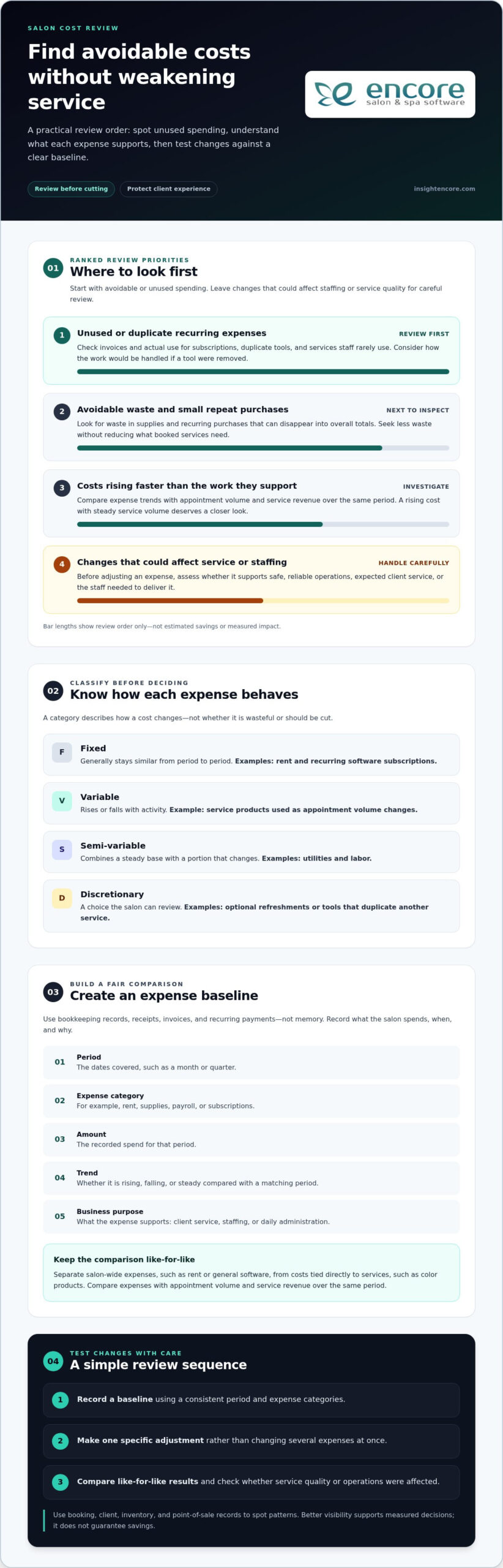
  • Classify expenses as fixed, variable, semi-variable, or discretionary before deciding what to adjust.
  • Review waste and unused recurring expenses before considering changes that could affect staffing or service quality.
  • To assess a cost change, record a baseline, make one specific adjustment, then compare like-for-like results.
  • Use booking, client, inventory, and point-of-sale records to spot patterns and guide operational decisions.
  • Salon management software can support clearer records and consistent processes, but it does not guarantee savings.

Reducing salon operating costs starts with knowing where the money goes

When bills rise, it’s natural to look for something to cut. But reducing salon operating costs works best when you first identify what is driving the pressure. A large expense may reflect overspending, or it may look larger because bookings and revenue have dipped while necessary costs stayed steady. Those situations call for different responses.

Operating costs are the expenses involved in running the salon day to day. The broader idea of operating expenses can help frame this review. Start by distinguishing recurring expenses, such as rent or software subscriptions; variable expenses, such as products used during services; one-time expenses, such as isolated purchases or repairs; and discretionary expenses, which may be adjusted. Categories can overlap: a subscription is recurring and often predictable.

Is the problem high expenses or too little booked work?

Compare expenses with appointment volume and service revenue over the same period. If bookings and revenue have fallen while core bills remain similar, the main issue may be a quieter schedule, not unusually high costs. Cutting supplies needed for booked services won’t fill open appointment slots and could affect the client experience.

If service volume is steady but a particular cost is rising faster than the work it supports, investigate that expense. Compare staff schedules with booked hours to distinguish a capacity issue from a cost issue. The salon staff utilization guide offers a related way to assess how scheduled time aligns with booked work.

Build a useful salon expense baseline

Review bookkeeping records, receipts, invoices, and recurring payments instead of relying on memory. Separate salon-wide expenses, such as rent or general software, from costs tied directly to services, such as color products. This helps show whether a change affects the whole business or a particular service.

An expense baseline is a consistent record of what the salon spends, when, and why. It gives you a fair point of comparison before and after a change. For each item, note:

  • Period: The dates covered, such as a month or quarter.
  • Expense category: For example, rent, supplies, payroll, or subscriptions.
  • Amount: The recorded spend for that period.
  • Trend: Whether it is rising, falling, or staying steady compared with a matching period.
  • Business purpose: What the expense supports, such as client service, staffing, or daily administration.

This review turns transactions into useful context. Once you know what each cost supports and how it changes alongside salon activity, you can decide what deserves a closer look without treating every expense as waste.

Classify salon expenses before deciding what to reduce

Once you’ve listed your spending, group each expense by how it behaves. The label helps you choose what to review, but it doesn’t prove a cost is wasteful. Rent may be fixed but essential; a discretionary purchase may be optional but valuable to the client experience. The goal is to understand each expense in the context of your services, staffing, and business needs.

Which salon expenses are fixed, variable, or semi-variable?

Fixed expenses generally stay similar from one period to the next, such as rent or a recurring software subscription. Variable expenses rise or fall with activity. Service products, for example, may be used more as appointment volume increases. Semi-variable expenses combine a steady base with a portion that changes. Utilities can include a regular charge plus usage, while labor may include scheduled hours as well as additional hours tied to demand.

Discretionary expenses are choices the salon can review, such as optional refreshments or tools that duplicate another service. They may also be recurring or variable. These categories describe how a cost behaves, not whether it should be cut.

Separate essential spending from reviewable spending

Assess expenses against your own records rather than treating industry averages as universal targets. A cost that makes sense for one salon’s service mix or staffing model may not suit another. Compare each expense’s trend with the services generating revenue, the people needed to deliver them, and any changes in operating needs.

For each item, consider:

  • Necessity: Does it support safe, reliable operations or a service clients expect?
  • Client impact: Could changing it affect service quality, comfort, or convenience?
  • Frequency: Is it a one-time purchase, a regular payment, or an expense that changes with bookings?
  • Alternatives: Is there a practical way to meet the same need with less waste or overlap?

Subscriptions, duplicate tools, and services staff rarely use are sensible candidates for an evidence-based review. Check invoices and actual use before making a change. If a tool supports booking, client records, or inventory visibility, consider how staff would handle that work if the tool were removed.

Management tools can bring appointment, client, inventory, and point-of-sale information together to support a clearer review. Encore salon management tools bring these operational records into one platform, helping you organize information for your own review.

Where salons can reduce operating costs without lowering service quality

The safest opportunities usually come from preventing waste or removing unused spending, not cutting whatever looks costly. Before making a change, weigh four factors: how much control you have, the likely effect on clients, the effort required, and how you’ll measure the result. This gives you a practical way to prioritize cost changes without treating every expense as equally adjustable.

  • High control, low client impact: Start with avoidable product waste or recurring tools staff no longer use.
  • Moderate control, moderate effort: Review purchasing routines, appointment workflows, and utility use, then test one adjustment.
  • Lower control, high client or staff impact: Take extra care with staffing levels and products essential to services. Don’t cut these without evidence that the current approach can change safely.

Choose a measure that fits each test. Track product use against services performed, for example, or compare subscription costs with actual use. A change is useful only if it improves spending without creating new problems.

Inventory, subscriptions, and everyday purchasing

Use stock counts, usage patterns, and reorder habits to spot products that sit unused, expire, or are reordered before existing stock is needed. Adjust purchasing gradually and monitor availability so popular services aren’t disrupted. For subscriptions, check which features staff use and whether another tool already covers the same task. Review invoices and actual use before removing anything that supports essential daily work.

Track service consistency alongside the change. If lower stock levels lead to missing products or last-minute replacements, the adjustment may not be helping the salon. Inventory records can connect purchasing decisions to product use and stock on hand.

Scheduling, labor, utilities, and payment processes

Review appointment gaps and administrative tasks for ways to improve coordination, not to leave the salon short-staffed. Better visibility into bookings can help align coverage with demand while preserving the capacity to serve clients. Compare utility bills over similar periods and look for low-disruption steps, such as switching off equipment when it isn’t needed, without compromising comfort or service routines.

A cost reduction is worthwhile only when its financial benefit outweighs any added burden on clients, staff, or service quality. Review payment processing statements, transaction patterns, and contract terms before changing a process or provider. Compare total costs and operational effects, not just a single rate. The credit card processing overview provides more context on payment processes.

Apply the same discipline to vendor and marketing changes. Review terms, actual use, and business outcomes before deciding. Test one change at a time, then keep, refine, or reverse it based on what your records show.
Reducing Salon Operating Costs: A Practical 2026 Guide

A salon cost-reduction checklist for testing changes and tracking results

A cost idea is useful only when you can tell what it changed. Test one adjustment at a time, compare it with a clear baseline, and check its effects on clients and staff as well as the accounts. This helps you see whether a change improves performance or simply shifts the burden elsewhere.

How to test one cost-saving change at a time

Use this checklist to make each test clear and repeatable:

  • Choose one expense. Pick a specific item, such as a recurring tool or product-ordering process, rather than changing several categories at once.
  • Record the baseline. Note current spending and process, plus a relevant activity measure, such as appointments served or product use.
  • Define the test. Write down the exact change, who will manage it, and its start date. For example, adjust reorder timing while monitoring stock and service needs.
  • Set success measures and guardrails. Track the expense alongside service quality, staff workload, and client feedback. A lower bill alone isn’t enough if the change creates delays or disrupts appointments.
  • Review and decide. Keep the change if records show a useful improvement without unacceptable trade-offs. Adjust it if results are mixed, or reverse it if costs or service problems worsen.

Choose a review period that fits the expense. Assess a recurring payment over a billing cycle, for example, while purchasing patterns may need a longer window to account for changes in appointment volume or service mix. Compare like with like: similar periods, categories, and operating conditions. Avoid making other major changes during the test, since they can make the result harder to interpret.

Turn expense tracking into a monthly routine

Set aside time each month to compare actual spending with your salon’s plan. Look for unexpected increases, confirm whether earlier adjustments are still working, and account for changes in bookings or services before drawing conclusions. A consistent routine is more useful than a complicated reporting process.

Keep a short decision log with the expense reviewed, the change made, the review date, and the outcome. These notes can help you avoid repeating unsuccessful experiments and make future decisions using your own results. Review expense changes alongside incoming payments and upcoming obligations, since cost control also affects available cash. For a broader perspective, connect this review to your salon’s overall cash flow and profitability analysis.

For a tool to organize booking, client, inventory, and point-of-sale records, see Encore salon management software.

Use salon management tools to keep operating costs visible

Once you’ve identified which expenses deserve attention, consistent records make them easier to monitor. Salon management software can bring booking, client, inventory, and point-of-sale information into everyday workflows, reducing the need to move details between separate records. That visibility can support better decisions, but software doesn’t guarantee savings. The value comes from using the information to spot patterns and act thoughtfully.

What salon software can help owners monitor

Inventory tracking can help you review stock movement, product use, and purchasing patterns. Compare what’s on hand and what’s being used with reorder decisions to identify opportunities to reduce waste without risking product availability. Appointment booking and client records can also make schedule and client information easier to review during daily operations.

Point-of-sale and payment functions bring transaction records into salon operations. When these records connect with other day-to-day information, it can be easier to understand business activity and reduce manual handoffs. Staff still need to review the information and make decisions, but consistent records can simplify that routine.

Choose practical next steps for your salon

Start with the expense category you’ve identified as most reviewable. If product purchasing is the focus, examine inventory use and stock movement. If appointment flow or administrative effort is the concern, review booking and client records. Choose tools that help answer the question you’re investigating, then measure the result against your own records.

Encore Salon & Spa Software brings together inventory tracking, appointment booking, client management, point-of-sale transactions, and integrated credit card processing to support salon operations. Its tools help organize information for consistent tracking. Assess any operational changes based on their actual effect on spending, staff workflow, and client service.

Learn more about the platform’s salon management software and how its tools support day-to-day operations.

Make your next cost decision with confidence

Reducing salon operating costs doesn’t mean making broad cuts. Start with clear records, separate essential spending from reviewable expenses, and test one change at a time. Then weigh the financial result alongside its effects on service quality, staff workload, and client experience.

Consistent tracking makes decisions easier to repeat and refine. Encore brings appointment booking, client management, inventory tracking, and point-of-sale tools together to support day-to-day operations. The platform serves salons, spas, barber shops, nail salons, and other beauty and wellness businesses. It can help keep information organized, while your records show which changes are working.

Small, measured steps can build a clearer picture of your costs and a steadier path toward sound business decisions.

Explore Encore salon management software

Frequently Asked Questions

What are the biggest operating costs for a salon?

Labor is often a salon’s largest operating cost, alongside rent, service products, utilities, payment processing, and software. Booksy’s September 2026 industry guidance estimates labor at 45% to 55% of gross revenue, but your own figures depend on your staffing model, services, and location. Review expenses against revenue and appointment activity rather than assuming another salon’s cost mix is the right benchmark for yours.

How can I reduce salon expenses without cutting staff?

Start by looking for waste and spending that doesn’t support current salon needs. Compare product use with purchasing, check for duplicate or rarely used subscriptions, and review utility patterns for low-disruption conservation opportunities. You can also look for ways to reduce manual administrative work or improve appointment coordination. Track each change alongside service quality and staff workload, so lower spending doesn’t create extra pressure for your team or clients.

How do I track salon operating expenses?

Record each expense by category, amount, period, and business purpose, then compare it with the same category in a comparable period. Use bookkeeping records, receipts, invoices, and recurring payment statements to build a complete baseline. Add context such as appointment volume and service revenue, especially for costs that change with activity. This makes cost reduction a measured process rather than a decision based on memory or one unusually high bill.

Which salon expenses should I review first?

Review expenses that appear controllable and have limited potential to affect service quality, such as unused subscriptions, overlapping tools, avoidable product waste, or purchasing habits that lead to excess stock. Check actual use and records before making a change. Be more cautious with staffing and products needed to deliver booked services. Rank potential adjustments by likely impact, effort, and client or staff effects, then test one change at a time.

Can salon software help reduce operating costs?

Salon software can make operational information easier to track, but it doesn’t guarantee lower costs. Booking and client records can support organized daily workflows, while inventory tracking can help you review stock movement and purchasing patterns. Point-of-sale tools can also keep transaction records within salon operations. Use these records to spot issues, reduce manual handoffs, and assess whether a change is helping your salon’s finances and service experience.

How often should a salon review its expenses?

Review spending monthly to catch unexpected changes and compare actual expenses with your salon’s plan. Some costs need a review period suited to their billing or usage pattern, so don’t judge a longer-term purchasing adjustment from a few days of data. Keep a short record of the change, review date, and outcome. Regular notes help you learn from past decisions and make future cost reviews more consistent.

Should a salon cut marketing costs to save money?

Not automatically. First, review what each marketing activity costs and what business outcome it supports, such as inquiries, bookings, or repeat visits. Compare results over a suitable period and avoid judging a campaign by spending alone. If an activity has unclear value, adjust or test it before removing it entirely. Automated marketing tools can help organize outreach, but your salon’s records should guide whether the approach is worthwhile.

Disclaimer

This article is general in nature and may contain errors, please verify all claims with your sales rep


Categories
Uncategorized

Salon Cash Flow Management: 2026 Financial Guide

With the U.S. salon industry projected to generate $48 billion in revenue in 2026, why does it feel like your bank account is often running on empty? It’s a common frustration to see every chair full yet still worry about covering the next lease payment. You aren’t alone in feeling the sting of unpredictable slow seasons or the headache of tying up too much capital in retail stock that just won’t move. Learning how to manage salon cash flow effectively is the vital shift that transforms a talented artist into a confident, relaxed business owner.

We understand that you started this journey to create beauty, not to spend your weekends buried in complex spreadsheets. It’s exhausting to manually calculate staff commissions or wonder exactly where your profit disappeared. This guide is your roadmap to financial clarity. We will provide a step-by-step framework to stabilize your monthly income and automate the “math” that currently causes so much stress. You’re about to discover how to gain a clear understanding of your finances and ensure your business thrives in 2026 with systems that work as hard as you do.

Key Takeaways

  • Understand why a fully booked calendar doesn’t always mean a healthy bank account by mastering the difference between profit and real-time cash flow.
  • Stop “leaky” finances by categorizing fixed and variable expenses and implementing a simple daily reconciliation routine that keeps you in control.
  • Unlock “frozen cash” by optimizing your inventory levels and aligning staff schedules with your most productive hours to reduce unnecessary overhead.
  • Follow a proven five-step method on how to manage salon cash flow effectively by using historical data to project future revenue with confidence.
  • Learn how automated tools like Encore Salon Software handle complex math and data tracking for you, letting you focus on your clients instead of spreadsheets.

Profit vs. Cash Flow: Why Your Salon Can Be Busy but Broke

It’s a frustrating paradox. Your stylists are booked solid and you might even hit the industry average revenue of $245,000. Yet, when you look at your bank balance on Friday, there’s barely enough to cover the rent. This is the “Busy but Broke” trap. It happens because profit is just a theoretical number on paper, while cash flow is the cold, hard reality of your bank account. To understand what cash flow is, you have to look at the timing of every transaction. Profit tells you what you earned after expenses, but cash flow tracks exactly when that money arrives and when it leaves.

In a salon, managing this is uniquely complex. You’re balancing service revenue, which is immediate, with retail stock that might sit on a shelf for months. With labor costs typically eating up 45% to 55% of your gross revenue, there is very little room for error. You have to track three main types of movement:

  • Operating Cash Flow: The daily money from haircuts, colors, and product sales.
  • Investing Cash Flow: Money spent on long-term assets, like new salon chairs or high-end equipment.
  • Financing Cash Flow: Cash used for loans or business debt.

Learning how to manage salon cash flow effectively starts with recognizing that timing is everything. If your expenses hit on the 1st but your big color appointments aren’t until the 15th, you have a cash flow problem, even if you are profitable by the end of the month.

Common Cash Flow Killers in the Beauty Industry

Small leaks can sink a big ship. Last-minute cancellations and no-shows are the most immediate thieves. They don’t just cost you a service fee; they leave a stylist idle while your fixed costs, like electricity and rent, keep ticking. Then there’s the “January Slump.” If you haven’t built a reserve during the busy holiday season, a 20% dip in bookings can feel like a crisis. Finally, watch your petty cash. Those emergency trips to the store for extra towels or coffee pods add up quickly if they aren’t tracked daily.

The Role of Visibility in Financial Peace of Mind

You can’t fix what you can’t see. Many owners wait for a quarterly report from their accountant, but that’s like looking in the rearview mirror while driving. By the time you see a problem, it’s three months old. Real-time data gives you the power to make decisions today. Instead of relying on a gut feeling that the salon is doing well, you need to know your exact totals every evening. Automation is the key. It removes human error from daily tallies and ensures that your commission math is perfect. When you use integrated management features, the stress of the unknown disappears, replaced by a feeling of organized control.

Building a Foundation: Tracking Income and Expenses with Precision

Running a salon is deeply personal. Every dollar represents a client served or a product sold. To keep that money where it belongs, you need a crystal-clear map of your outflows. This starts with separating your fixed costs from your variable ones. Your fixed costs, like rent and insurance, are the anchors that stay the same every month. Variable costs, such as backbar supplies and utilities, are more fluid. Tracking these categories separately is how to manage salon cash flow effectively because it stops small, variable leaks before they become floods.

Daily reconciliation is your best defense against “leaky” cash flow. It’s tempting to wait until the end of the week, but small errors in manual entry or untracked petty cash purchases add up quickly. By spending ten minutes each evening balancing your till, you ensure your records match your bank account. This habit creates a reliable foundation for your morning check-in. A simple cash flow dashboard allows you to see your current balance and upcoming bills in just five minutes, giving you the confidence to start your day with a clear head.

Automating Revenue Tracking with POS Integration

Manual data entry is a magnet for human error. When you use integrated credit card processing, your sales data flows directly into your management system without you lifting a finger. This automation captures every detail, including digital tips and service add-ons that might otherwise slip through the cracks. It also speeds up fund availability. Instead of waiting days for transactions to clear, integrated systems often provide faster access to your cash, which is vital for meeting immediate payroll needs.

Managing Outflows: The ‘Envelope Method’ for the Digital Age

The “Envelope Method” isn’t just for physical cash; it’s a powerful digital strategy too. By allocating specific percentages of your daily revenue to separate “envelopes” or accounts, you ensure you’re never scrambling for tax or payroll money. For example, you might set aside 15 percent for taxes and 50 percent for labor costs immediately. This proactive approach allows you to implement strategies to strengthen your financial stability during the quieter seasons.

Modern software can even flag your account when variable expenses, like your monthly color order, exceed your set budget. There is a massive psychological benefit to seeing “saved” cash sitting in a dedicated account for future bills. It replaces the panic of the unknown with a sense of organized control. If you’re ready to see how simple this tracking can be, you can explore our all-in-one management tools today.

Optimizing Your Two Largest Outflows: Inventory and Labor

Inventory and labor are the two heaviest weights on your balance sheet. If they aren’t balanced perfectly, they can pull your entire business down. Many owners see a shelf full of products and feel a sense of security, but that’s a mistake. Think of your backbar and retail shelves as “frozen cash.” Every bottle sitting there is money that isn’t available to pay your team or your rent. Understanding the relationship between these two expenses is the next step in learning how to manage salon cash flow effectively.

Labor is your highest expense, typically accounting for 45% to 55% of gross revenue in 2026. If you have three stylists standing around during a Tuesday morning dead zone, you’re paying to keep the lights on for no return. This is especially critical for specialized businesses like tattoo studios or booth rental spaces. These “mini-cash flows” require precision to ensure the house stays profitable while the artists thrive. Commission structures also impact your weekly cash availability. If you pay out commissions before your credit card deposits fully clear, you create a temporary cash crunch that can be avoided with better timing.

Smart Inventory Management: Freeing Up Your Capital

Stop guessing what you need to order. You can implement “Par Levels” to trigger orders only when you hit a specific minimum. This ensures you aren’t overbuying “Dust-Gatherers,” which are products that haven’t moved in 90 days. When you use Encore’s inventory management, this process becomes automatic. The system tracks every ounce used in the backbar and every bottle sold at retail, keeping your capital fluid instead of trapped on a shelf.

Aligning Staff Performance with Financial Health

A busy salon isn’t always a productive one. You need to track your salon staff utilization rate to see if your team’s time is being used efficiently. If utilization is low, it’s time to adjust your scheduling or focus on automated marketing to fill those gaps. Automated commission calculations also prevent “human error” overages that can quietly drain your accounts. By incentivizing your staff to focus on high-margin services like color corrections or scalp treatments, you increase the amount of cash staying in the business after labor costs are paid.

Salon Cash Flow Management: 2026 Financial Guide

The 5-Step 2026 Salon Cash Flow Forecasting Method

Forecasting is your financial weather report. It tells you when to carry an umbrella and when to soak up the sun. If you’re tired of being surprised by a low bank balance, learning how to manage salon cash flow effectively requires a proactive look at the months ahead. This isn’t about being a math genius; it’s about using your existing data to make informed decisions. This 5-step method for 2026 simplifies the process so you can plan with total confidence. To take your planning even further, a dedicated salon financial forecasting template can give you a plug-and-play framework that moves you from gut feelings to a clear, data-backed strategy for the year ahead.

  • Step 1: Gather 12 months of historical data. This shows you the natural rhythm and seasonal cycles of your business.
  • Step 2: Project future revenue. Use your current booking trends and staff levels to estimate what’s coming in the next quarter.
  • Step 3: List known upcoming expenses. Include everything from license renewals to planned equipment upgrades and lease increases.
  • Step 4: Factor in seasonal peaks and valleys. Plan for the holiday rush and the January slump at the same time.
  • Step 5: Adjust your strategy. This is where you decide how to manage salon cash flow effectively by cutting unnecessary costs or launching a new marketing campaign.

Projecting Revenue in a Subscription and Service Economy

The beauty industry is leaning heavily into recurring revenue models. If you offer memberships, include that guaranteed income in your projections. It’s also helpful to estimate the lifetime value of a new client. A one-time visitor is a win, but a client who returns every six weeks is a financial pillar for your business. Don’t forget about gift card sales. These are fantastic immediate cash injections that can help bridge a gap during a slow week. Just remember to track these as liabilities so you’re ready when the client returns to redeem them later in the year.

Building the ‘Peace of Mind’ Cash Reserve

Every salon owner deserves to sleep soundly at night. We recommend following the “Rule of Three” as a core part of your financial strategy. Your goal is to have three months of operating expenses sitting in a separate business savings account. You don’t need to find this money all at once. Build this reserve incrementally by setting aside a small percentage of your weekly profit, perhaps just 2 or 3 percent. This habit ensures your business remains stable without hurting your daily operations or your ability to pay your team. This emergency fund is your shield against the unexpected, like a sudden equipment failure or a change in local regulations. Having this cushion allows you to lead your team with a sense of calm and control. Pairing this reserve-building habit with a thorough salon business health checklist gives you a complete picture of your studio’s financial and operational readiness for the year ahead.

Start your financial transformation today

Leveraging Encore Salon Software to Automate Your Success

You didn’t open your doors to become a full-time bookkeeper. You’re an artist, a mentor, and a leader. While the financial framework we’ve discussed is vital, you shouldn’t have to spend your Sunday nights manually entering data into a spreadsheet. This is where Encore acts as your friendly mentor, handling the heavy lifting of data tracking so you can stay focused on your team and your clients. Shifting your focus to how to manage salon cash flow effectively through automation is the single most impactful change you can make for your business in 2026.

One of the biggest mistakes owners make is “Frankenstein-ing” their business by using five different apps that don’t talk to each other. When your booking system, inventory tracker, and credit card processor all live under one roof, you eliminate the data gaps that lead to financial surprises. For specialized businesses like tattoo studios or niche wellness centers, this level of integration is even more critical. You need a system that understands the specific nuances of your craft, from tracking booth rental fees to managing high-ticket service deposits.

Integrated Tools That Drive Immediate Inflows

Waiting for money to arrive is the hardest part of the “Busy but Broke” cycle. Encore helps you break that cycle with tools designed to secure your income before the client even walks in. By setting automated deposit requirements for high-ticket services like extensions or complex color work, you protect your time and your cash. If your calendar shows a gap, you can use built-in marketing automation to send targeted offers to your most loyal clients, filling those empty chairs instantly. Best of all, our simplified financial reporting translates complex numbers into clear, actionable insights that you can actually understand at a glance.

Taking the Next Step Toward Financial Freedom

Upgrading your management system is about more than just better math; it’s an investment in your mental health. The constant low-level stress of “not knowing” is what leads to burnout. Transitioning from a state of surviving to thriving requires the visibility that only professional software can provide. You don’t have to be an accountant to run a highly profitable business. You just need the right partner to handle the details. Encore is the ultimate answer to how to manage salon cash flow effectively without the daily headache of manual tracking.

Explore Encore Salon Software features

Transforming Your Financial Future

Mastering the art of financial management is the bridge between being a busy stylist and becoming a thriving business owner. You’ve learned that profit on paper doesn’t always match the cash in your hand, and that visibility is your greatest tool for stability. By optimizing your inventory and aligning your labor costs with actual productivity, you’re already ahead of the curve. Learning how to manage salon cash flow effectively is a journey that replaces daily stress with organized control.

Since 1991, we’ve helped salons, spas, and tattoo studios across the globe simplify their operations. Our all-in-one management platform handles the complex data lifting, from integrated inventory tracking to automated payroll calculations. You don’t have to navigate these financial hurdles alone. With the right systems in place, you can focus on the creative work you love while your business grows with confidence.

Take Control of Your Salon's Finances with Encore Salon Software

Your path to a predictable monthly income and a thriving salon starts today. We’re here to guide you every step of the way toward the financial freedom you deserve. You’ve got the talent; now you have the framework to match it.

Frequently Asked Questions

What is the difference between profit and cash flow in a salon?

Profit is the surplus left over after all expenses are subtracted on paper, while cash flow is the actual timing of money entering and leaving your bank account. A salon can be profitable but still run out of cash if bills are due before client payments arrive. Understanding this distinction is key to learning how to manage salon cash flow effectively. It ensures you have liquid funds for daily operations regardless of your paper revenue.

How much cash reserve should a small salon ideally have?

A small salon should ideally aim for a cash reserve that covers at least three months of operating expenses. This “Rule of Three” provides a safety net for unexpected equipment repairs, sudden staff turnover, or seasonal dips. You can build this fund incrementally by setting aside a small percentage of your weekly intake. Having this cushion allows you to make calm, strategic decisions rather than reacting out of financial panic during a slow week.

Can salon software really help me save money on credit card fees?

Yes, integrated credit card processing can often reduce your total costs by eliminating the need for separate third-party hardware and reducing manual entry errors. While specific fees vary by provider, integrated systems streamline your reporting and speed up fund availability. This improved efficiency means your money reaches your bank account faster, which is a vital part of how to manage salon cash flow effectively and maintain steady business operations.

How often should I check my salon’s cash flow statement?

You should perform a quick five-minute check of your daily totals every evening and a more detailed review of your cash flow statement once a week. Daily reconciliation prevents small errors from ballooning into large discrepancies. The weekly review allows you to spot trends, such as rising backbar costs or underperforming shifts, before they impact your ability to pay upcoming bills like rent or payroll.

What are the biggest ‘hidden’ expenses in a spa or salon?

The biggest hidden expenses often include backbar waste, untracked petty cash spending, and credit card processing fees. Small, frequent purchases for salon supplies like coffee, towels, or cleaning products can quietly drain your profits if they aren’t logged. Additionally, “frozen cash” tied up in overstocked retail inventory that hasn’t moved in 90 days acts as a major hidden drain on your liquid capital and prevents you from investing in growth.

How do I handle cash flow if I’m a solo chair renter?

Solo chair renters should treat their business like a mini-salon by using specialized Chair/Booth Renter Software to track their individual inflows and outflows. You need to separate your personal and business finances strictly and set aside a fixed percentage of every service for taxes and rent immediately. This disciplined approach ensures you always have the funds ready for your overhead, even if your booking schedule varies from week to week.

What should I do if my salon’s cash flow becomes negative?

If your cash flow becomes negative, the first step is to identify where the money is “leaking” by reviewing your variable expenses. You may need to temporarily reduce inventory orders, adjust staff schedules to match peak hours, or offer high-margin service specials to drive immediate revenue. Focus on collecting deposits for high-ticket services to inject cash into the business quickly. Analyzing your data helps you determine if the issue is a temporary dip or a structural problem.

How can I improve cash flow during the slow post-holiday months?

To improve cash flow during slow periods, use automated marketing to fill empty chairs with loyal clients who haven’t visited recently. You can also promote gift card redemptions or launch specialized membership programs to create recurring, predictable income. Focusing on high-margin treatments, such as scalp treatments or deep conditioning, can increase the average ticket price without significantly increasing your product costs or labor time during these quieter weeks.

Disclaimer

This article is general in nature and may contain errors, please verify all claims with your sales rep