

window.dataLayer = window.dataLayer || []; function gtag(){dataLayer.push(arguments);} gtag('js', new Date()); gtag('config', 'UA-206511945-1');
Search
Categories
Uncategorized

Salon Client Acquisition Cost: What Each New Client Costs

That makes salon client acquisition cost more than a marketing metric: it helps you judge whether your spending and effort attract clients who return.

It’s easy to focus on how many new appointments a campaign generates. But a first visit doesn’t tell the whole story, especially when some clients rebook and others don’t. Compare marketing channels by considering what each new client may contribute over time, too.

This guide explains how to calculate acquisition cost, compare common ways salons attract new clients, and weigh that spending against client lifetime value. You’ll learn which measures make the numbers meaningful and help you assess whether your marketing supports lasting salon growth.

Key Takeaways

  • Calculate what you spend to bring in each new client, then compare results across marketing channels.
  • Look beyond first-visit revenue by tracking rebooking, visit frequency, and the value clients bring over time.
  • Assess referral incentives, digital ads, and directory listings by both their acquisition cost and the clients they attract.
  • Use new-client and retention trends to see whether marketing is supporting steady salon growth.
  • Consider client management software when you need a clearer way to organize client details and follow-up.

Client lifetime value

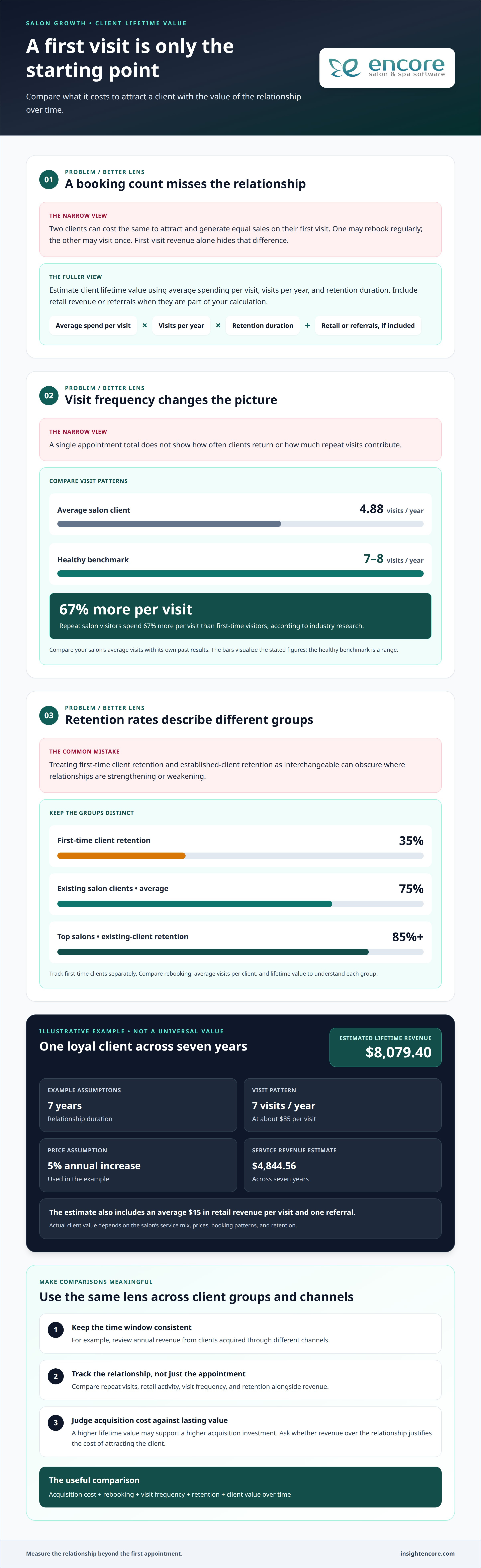
Client lifetime value estimates the revenue a salon earns from one client over the course of the relationship. It shifts attention from the first appointment to repeat visits, retail purchases, and referrals. For example, two clients may cost the same to attract, but one may rebook regularly while the other visits once. Their long-term value differs, even if their first appointments generate equal sales.

Start with three measures: average spending per visit, visits per year, and retention duration. Multiply average spending by visit frequency, then account for how long clients continue booking. Include retail revenue or referrals if they’re part of your calculation. Apply the same method across channels to keep comparisons useful. Tracking these measures annually also shows whether visit frequency or retention changes over time.

One illustrative seven-year example estimates a loyal client’s lifetime revenue at $8,079.40. Its assumptions include seven visits per year, about $85 per visit, and 5% annual price increases. The example estimates $4,844.56 in service revenue across seven years. It also includes an average $15 in retail revenue per visit and one referral. Treat this as an example, not a universal client value. Your salon’s actual result depends on its service mix, prices, booking patterns, and retention.

Frequency can change the calculation substantially. The average salon client visits 4.88 times per year, while a healthy benchmark is 7 to 8 visits annually. Compare your salon’s average visits with its own past results. A client who books one additional appointment contributes another service opportunity. Industry research reports that repeat salon visitors spend 67% more per visit than first-time visitors. This makes return behavior relevant to both visit count and average transaction value.

Retention figures add context, but they need careful interpretation. Existing salon clients have an average retention rate of 75%, while top salons reach 85% or higher. The average first-time client retention rate is 35%. These figures describe different groups, so don’t treat them as interchangeable. Track first-time clients separately from established clients. Then compare rebooking rates, average visits per client, and lifetime value to see where relationships are strengthening or weakening.

Use the same time window when comparing client groups. For example, review annual revenue from clients acquired through different channels, then compare their repeat visits and retail activity. A higher lifetime value may support a higher acquisition investment, while a one-time visit may not. The key question is whether the revenue generated over the relationship justifies the cost of attracting that client.

Consistent records make these comparisons clearer. Encore Salon & Spa Software can organize client history, visit frequency, and spending patterns. Review those measures together rather than relying on appointment totals alone. When clients visit more often and keep returning, lifetime value may rise without needing a new client for every appointment.

Digital ads, referral incentives, and directory listings

Salons can lower acquisition costs by comparing channel spending with completed new bookings and repeat visits. Clear follow-up can also give first-time clients a reason to return.

Using Digital Ads and Directory Listings

Digital ads promote salon services to prospective clients online, while directory listings help people discover local services. Both can bring a salon to someone’s attention when they’re deciding where to book. Track campaign spending alongside inquiries, completed bookings, and service revenue to see which results follow.

SEO and targeted Google Ads can help prospective clients find a salon online. Listings can also make the salon visible to people comparing options. Keep service descriptions and booking details clear wherever clients discover you. Then track which source new clients mention and whether they complete an appointment. This distinguishes clicks or profile views from bookings that generate revenue.

Offering Referral Incentives

A referral incentive rewards an existing client for introducing someone new. Referred clients are estimated to have 18% lower churn than clients acquired through advertising. For a stylist, referrals can connect a trusted recommendation directly to an available service and booking.

Nearly half of salon clients choose where to book based on someone they know. Make the referral process easy to explain, and record which new bookings came through it. Compare incentive spending with the new clients who actually visit. A referral that results in a booking offers a more useful measure than counting recommendations alone.

Compare each channel over the same monthly period. Divide its spending by the number of new clients who completed appointments, not by clicks, messages, or inquiries. For example, if an ad campaign gets many profile visits but few bookings, its cost per actual client may be less favorable. Track referrals, directories, and ads separately to see the difference.

Then connect acquisition results with return behavior. Record each new client’s source, first booking, and subsequent visits. If one channel brings in clients who return, its longer-term value may outweigh a higher initial cost. If clients from another source rarely rebook, review the service match, booking process, and follow-up experience.

Consistent records make those comparisons easier to act on. A clear booking and client follow-up workflow can help keep source and return-visit details organized. Review the numbers monthly, then adjust the channel mix or referral approach based on completed appointments and repeat bookings, not visibility alone.

New-client acquisition and salon growth

New-client acquisition supports growth when it fills available appointment capacity and builds lasting relationships. Track new clients per month, spending per client, and referrals. Together, these measures show whether marketing generates bookings and whether those clients return. They also distinguish a busy campaign from one that contributes to stable salon revenue.

Calculate acquisition cost by dividing the marketing spend for a period by the number of new clients gained in that period. The same example estimates $375 in first-week revenue, based on five appointments at $75 each. That early revenue is useful context, but it doesn’t show whether clients rebook.

The figure can vary by channel, campaign, and the number of clients who complete bookings. Compare like with like: use the same measurement period and count new clients, not clicks or inquiries. Tracking salon client acquisition cost this way grounds marketing decisions in completed appointments.

Growth also depends on how new clients fit into the salon’s schedule. Acquiring clients can help fill chairs for newer stylists. Review appointment availability alongside new-client numbers. If a stylist has open slots, new bookings can put that capacity to use. If appointments are already full, the same campaign may create demand the salon can’t accommodate promptly.

Retention changes the economics. Acquiring a new salon client costs 5-7 times as much as retaining an existing client. That makes repeat visits a key part of sustainable growth, not a separate concern. Compare new-client totals with rebooking and retention patterns. A campaign may bring in more first-time appointments, while follow-up and a positive service experience influence whether those clients return.

Consider the cost of losing a loyal client, too. That potential loss shows why growth plans should include retention, not just new-client targets. If existing clients stop booking, increased acquisition activity may only replace lost revenue rather than expand it.

Retail purchases and referrals can add value beyond the first service. Record them alongside appointment history, then include them when assessing lifetime value. A new client who returns, buys products, or recommends the salon contributes differently from a one-time booking. Reviewing these outcomes by acquisition source helps show which marketing activities support broader growth.

Google search visibility can help prospective clients discover a salon. SEO and targeted Google Ads are two ways to support that discovery. Track completed bookings by source, then compare them with monthly marketing spend and client return patterns. A simple monthly review of acquisition, retention, and retail can show whether growth comes from new traffic alone or stronger client relationships.
Salon Client Acquisition Cost: What Each New Client Costs

How does salon client acquisition cost compare with customer lifetime value?

Acquisition cost measures the investment required to gain a new client. Customer lifetime value estimates the revenue generated over that client’s relationship with your salon. Compare the two to judge whether revenue over time can justify the initial marketing expense. Use the same client group and measurement period for both figures. Otherwise, you may unfairly compare a short-term campaign cost with years of revenue.

A useful comparison starts with revenue, but revenue isn’t profit. Service and retail sales must cover the costs of delivering those services and products, and acquisition spending is another expense. Treat lifetime revenue as a guide, not as an amount available to spend freely. The client’s visit pattern, spending, retention, and referrals all shape the longer-term picture.

One 90-day example compares five newly acquired clients with five existing clients who rebook. The new clients generate $600 in total revenue, while the returning clients generate $975. That difference illustrates why a first appointment alone can understate a client’s value. Rebooking creates additional revenue within the same period, even though those clients weren’t newly acquired.

Use that comparison to guide channel decisions. First, group new clients by how they found your salon. Next, compare the acquisition spending for each group with its revenue over a consistent period. Then review which clients returned and how often. A channel with a higher initial cost may still contribute value if its clients rebook. Base the comparison on actual bookings, not inquiries or potential interest.

Retail can add another layer to the calculation. One example estimates $854.84 in retail revenue from a client over seven years, assuming retail prices increase by 5% annually. That figure is illustrative, not a forecast for every salon. A client’s retail purchases depend on what they buy and how consistently they visit. Include retail only when your records capture it clearly.

Referrals can also extend value beyond the original client. If a client recommends your salon, that introduction may lead to another booking and a separate client relationship. Keep referral revenue distinct from the original client’s service and retail revenue. This avoids attributing another client’s sales to the person who made the referral.

Review the comparison regularly, using a consistent period such as 90 days or an annual view. Track acquisition cost, returning visits, service revenue, and retail revenue by client group. If repeat revenue grows, the original acquisition spending may look more worthwhile. If clients rarely return, examine the booking experience and follow-up before increasing marketing spend. This keeps decisions tied to observed client behavior rather than assumptions.

What factors increase or decrease a salon’s client acquisition cost?

Acquisition costs vary with how a salon reaches prospective clients and turns interest into appointments. A campaign that attracts broad attention may generate many inquiries but few completed bookings. Clear service descriptions and a straightforward booking path can help close that gap. Compare campaign inquiries with the clients who actually attend to see whether visibility is turning into new business.

Audience fit matters, too. Ads aimed at people outside a salon’s service area can spend money without generating useful bookings. Promote services to clients the salon can serve, then compare results by channel and audience. A campaign that reaches fewer people may still use its budget more effectively if those people become clients.

Available appointment capacity also affects the value of acquisition spending. If a salon has open chair time, new bookings can put that capacity to work. If the schedule is already full, additional promotion may not lead to more completed appointments. Review each stylist’s availability before increasing campaign activity. Matching demand with open appointments makes marketing results easier to evaluate.

A salon’s starting position can shape its need for paid marketing. A salon suite with an established clientele may need to spend little on marketing. A newer business without that client base may rely more on outreach to build awareness. In either case, align acquisition activity with the number of appointments the salon wants to fill. The right approach depends on its existing clientele and schedule.

Referrals can also affect acquisition spending. Existing clients may introduce friends and family, creating a source of new bookings alongside paid promotion. Record referrals separately from advertising and directory listings, then compare how each source contributes to appointments and repeat visits. If referrals bring in suitable clients, a salon may choose to strengthen that approach rather than simply increasing paid reach.

Measurement choices can make costs appear higher or lower. Including brand-awareness work in one campaign’s spending but excluding it from another makes the comparison uneven. Apply consistent rules to what counts as acquisition spending and which clients count as new. Review the same time period across channels. Separate first-time appointments from returning clients so retention activity doesn’t distort acquisition results.

Finally, revisit the factors behind changes in results. If acquisition cost rises, look at audience fit, completed bookings, appointment availability, and the mix of paid and referral sources. If it falls, check whether new clients are still a good fit and return for services. This helps distinguish lower spending from genuinely efficient client growth.

Explore tools for managing salon clients

A salon suite with an established clientele may need little marketing spend, while a newer business without that client base may rely more on outreach. The section provides no basis for comparing acquisition costs by location.

Encore Salon and Spa Software: Client Management System

Encore Salon & Spa Software’s Client Management System helps organize client relationships alongside salon operations. When comparing acquisition spending with repeat bookings, keeping client information and appointment activity together can make patterns easier to review. Encore Salon Software and Encore Spa Software support salon and spa businesses, while Chair/Booth Renter Software is designed for renter-based operations.

Consider a client management system when scattered records make it hard to understand booking history or follow client relationships over time. Organized information supports consistent client management and clearer reviews of acquisition and retention. It also puts the calculations in this article into a practical operating context.

To discuss how Encore Salon & Spa Software can fit your business, contact Encore Salon & Spa Software.

Make your next growth decision with confidence

Let salon client acquisition cost guide decisions, not define success on its own. Use it as an operating signal: consider whether your marketing fits available appointments and supports the client relationships you want to build. A regular review can help you spot changing patterns and make thoughtful adjustments before small inefficiencies become habits.

Encore Salon and Spa Software offers Encore Salon Software, Encore Spa Software, and Chair/Booth Renter Software. These options support different salon and spa business models, while the Client Management System helps organize client information. Choose the option that fits how your business manages clients and appointments.

Explore Encore Salon and Spa Software

Keep learning from each booking and returning client. Clearer information can help you make your next growth decision with greater confidence.

Frequently Asked Questions

What is the average client acquisition cost for a salon in the United States?

Treat this as a benchmark, not a fixed average for every U.S. salon. Your result depends on which marketing expenses you include and how many new clients actually book and attend. For a more relevant comparison, calculate your own figure by channel and compare it across consistent reporting periods.

How do salons calculate client acquisition cost?

Divide the marketing expenses tied to gaining new clients by the number of new clients acquired during the same period. Include the spending you attribute to those efforts, such as advertising or referral rewards. Count clients who completed appointments, not clicks or inquiries. Before calculating, separate first-time visitors from returning clients in your booking records so retention activity doesn’t distort the result.

What is a good customer acquisition cost for a hair salon?

A good acquisition cost is one that a client’s revenue over time can support after accounting for the cost of delivering services. There isn’t one target that suits every hair salon. A client who rebooks and purchases retail may contribute more than someone who visits once. Compare acquisition spending with client revenue and repeat behavior, then set a target that fits your salon’s service mix and margins.

How much do salon marketing channels cost per new client, such as Google Ads, social media, and referrals?

These figures don’t provide separate prices for Google Ads or social media. To compare those channels, calculate each one’s spending against completed first-time bookings, and track referral clients separately from paid campaigns.

Disclaimer

This article is general in nature and may contain errors, please verify all claims with your sales rep
Categories
Uncategorized

15 Creative Salon Gift Card Promotion Ideas to Skyrocket Revenue in 2026

Did you know that 61% of consumers spend more than their gift card’s value when they finally sit in your chair? It’s a staggering figure that proves your credits are much more than just pre-paid services; they’re powerful engines for growth. If you’ve struggled with inconsistent cash flow, implementing the right salon gift card promotion ideas can be the bridge that carries your business through quiet months. We understand the frustration of manual tracking and the worry of unredeemed balances. It shouldn’t be a chore to offer your clients a way to share their love for your work.

You deserve a system that works as hard as you do. We’ll show you how to design, market, and automate a gift card program that drives immediate revenue and sparks new client referrals. We’ve gathered 15 creative strategies to help you move past paper certificates and into a professional, digital experience. From leveraging 2026’s wellness trends to mastering seasonal outreach, you’re about to learn how to turn every gift card into a long-term relationship. Let’s look at how you can regain control and watch your salon thrive.

Key Takeaways

  • Learn how to turn gift cards into a high-leverage data acquisition tool that creates a self-sustaining marketing loop for your salon.
  • Discover 15 high-converting salon gift card promotion ideas like “BOGO” bonuses and retail bundling to increase your upfront revenue.
  • Master the essential accounting and legal requirements for 2026, including how to track outstanding liability without the stress.
  • Build a seasonal marketing calendar that targets the “Big Five” holidays and “Self-Care January” to ensure consistent cash flow.
  • See how Encore Salon & Spa Software automates your digital gifting experience to create a 24/7 sales engine that works while you sleep.

The Strategic Value of Gift Card Promotions for Modern Salons

Think of your gift card program as more than a simple convenience for last-minute shoppers. It’s a high-leverage marketing tool that requires very little overhead but offers massive returns. When you look at what is a gift card in the modern beauty industry, it’s clear these tools have evolved from paper certificates into sophisticated digital assets. Effective salon gift card promotion ideas don’t just sell services; they secure your future revenue while building a foundation of trust with your community.

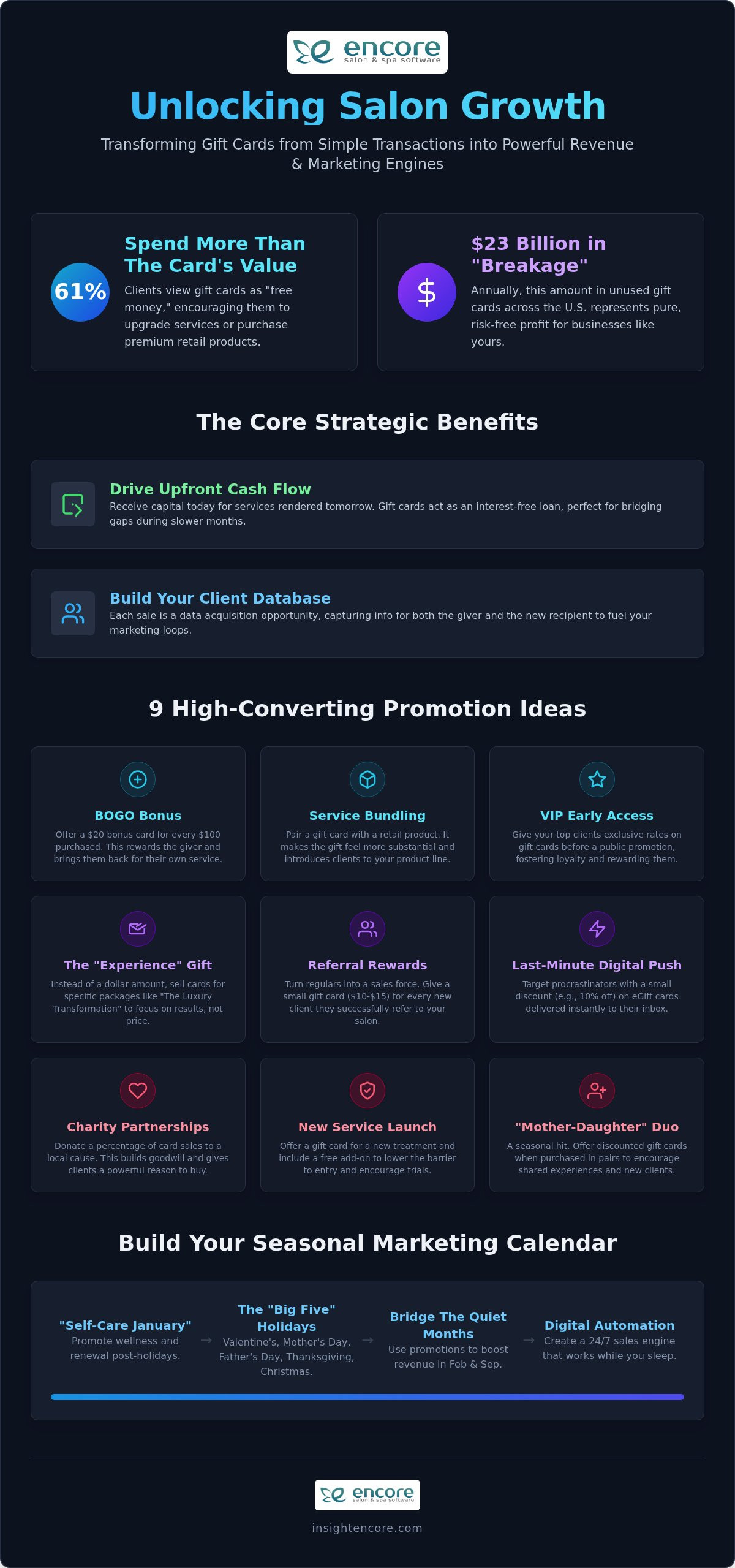
The financial benefits go beyond the initial sale. Research shows a significant "breakage" benefit, with an estimated $23 billion in unused gift cards existing in the U.S. annually. While you always want your clients to visit, these unredeemed balances represent pure profit for your business. Even more exciting is the psychological shift that happens when a client walks in with a card. Statistics from August 2026 indicate that 61% of consumers spend more than the card’s balance during their visit. They view the card as "free money," which encourages them to upgrade their service or try that premium retail product they’ve been eyeing.

Driving Upfront Cash Flow

Cash flow is the lifeblood of any salon, yet it’s often the biggest source of stress. Gift cards act like an interest-free loan from your clients to your business. You receive the capital today, which you can use to upgrade equipment, stock up on inventory, or cover overhead during slower seasons. These promotions are perfect for bridging the gap during quiet months like February or September. By securing revenue before you even pick up a pair of shears, you create a financial safety net that allows you to focus on your craft rather than your bank balance.

Building a High-Quality Client Database

Every gift card sold is an opportunity to gather valuable data. You aren’t just selling to the giver; you’re gaining access to a brand-new recipient who might never have found your salon otherwise. By capturing contact information for both parties, you can fuel your Automated Marketing & Loyalty Programs. This data allows you to follow up with personalized offers that turn a one-time visitor into a regular. Focusing on improving salon client experience from the very first interaction ensures that the "gift" leads to a long-term relationship. It’s about using your salon gift card promotion ideas to build a community, not just a transaction list.

15 High-Converting Salon Gift Card Promotion Ideas

Many articles offer five basic tips and call it a day. We know your business is more diverse than that. To truly move the needle, you need salon gift card promotion ideas that resonate with your specific clientele and business model. Whether you run a high-end hair studio or a busy pet grooming shop, these strategies help you capture attention and drive sales. Start with the "BOGO" Bonus. It’s a classic for a reason. Offer a $20 bonus card for every $100 purchased. This rewards the giver and often brings them back for their own service.

For those looking to increase retail sales, try Service Bundling. Pair a gift card with a professional shampoo set for a "Complete Care" kit. It makes the gift feel substantial and introduces clients to your product line. You can also offer VIP Early Access. Give your top 10% of clients exclusive rates on gift cards before the general public. Finally, consider the "Experience" Gift. Instead of a dollar amount, sell cards for specific high-end packages like "The Luxury Transformation." This shifts the focus from price to the result.

Incentive-Based Promotions

Don’t wait for clients to come to you. Use Referral Rewards to turn your regulars into a sales force. Giving a $10 gift card for every new client referred is a low-cost way to grow your book. If you’re seeing a dip in mid-week sales, a "Last-Minute" Digital Push works wonders. Target procrastinators with 10% off eGift cards delivered instantly to their inbox. You can also build community goodwill through Charity Partnerships. Donating a percentage of card sales to a local cause gives people a powerful reason to choose your salon over a big-box retailer.

Service-Specific and Seasonal Ideas

Launching a new treatment? Offer a gift card specifically for that service and include a free add-on. This lowers the barrier to entry for something new. For holidays, the "Mother-Daughter" Duo is a hit. Offer discounted cards when purchased in pairs to encourage shared experiences. If you want to build momentum, a Holiday Countdown featuring 12 days of different gift card surprises keeps your brand top-of-mind throughout December. These salon gift card promotion ideas create urgency without devaluing your primary services.

Niche Promotions for Spas, Tattoos, and Groomers

Customizing your approach is key to success. Tattoo studios can offer discounts for pre-paying a 4-hour session, which helps secure large projects. Pet groomers might sell "Puppy’s First Year" multi-card packages to ensure repeat business as the dog grows. Spas can thrive by selling "Stress-Relief" cards in bulk to local corporate offices for employee rewards. Managing these diverse offers doesn’t have to be a headache. You can see how Encore automates these promotions to keep your business running smoothly while you focus on your clients.

While brainstorming creative salon gift card promotion ideas is the exciting part of business growth, the backend details are what protect your profit. You shouldn’t treat gift card sales like a typical service transaction. When you sell a card, that cash is "deferred revenue." It’s a liability on your books because you still owe the client a service. You haven’t "earned" that money until they actually sit in your chair. Tracking this outstanding liability is vital for clean accounting. If you don’t have real-time reporting, you’re flying blind and risking a surprise at tax time.

Escheatment laws in 2026 are also a critical factor for modern owners. These regulations determine what happens to "abandoned" property, which includes unredeemed gift card balances. Depending on your region, you might eventually be required to turn these funds over to the state. Digital tracking and unique identification numbers are your best defense against fraud. They stop double-redemption and ensure that once a card is used, it’s instantly updated across your entire system. This level of security gives you peace of mind and protects your bottom line from simple human errors.

Managing Your Books with Ease

Categorizing your gift card sales correctly for tax purposes saves hours of frustration later. You need a system that handles partial redemptions automatically. If a client uses half a card today, your software should calculate the remaining balance without manual math. This is where Integrated Credit Card Processing becomes a game changer. It ensures every transaction is secure and instantly logged in your financial reports. It’s about removing the "accounting nightmare" and replacing it with organized control.

Expiration Dates and Fees

Navigating the legal landscape of expiration dates requires careful attention to current laws. Under the federal CARD Act, gift cards generally cannot expire for at least five years from the date of activation. However, some states have even stricter rules. For example, effective April 1, 2026, California law requires businesses to provide a cash refund for gift card balances under $15 if a client asks. Using "No Expiration" policies for your salon gift card promotion ideas often builds more brand trust. It shows you value the client’s investment and aren’t looking for "gotcha" moments. Transparency in your terms ensures a positive experience for every recipient.

15 Creative Salon Gift Card Promotion Ideas to Skyrocket Revenue in 2026

Designing Your Marketing Calendar: When and How to Promote

A successful year doesn’t happen by accident. It requires a clear roadmap that aligns your salon gift card promotion ideas with the natural rhythm of the beauty industry. You should focus your heaviest efforts on the "Big Five" holidays: Valentine’s, Mother’s Day, Graduations, Weddings, and Christmas. These peaks represent the highest consumer demand for thoughtful, easy-to-buy gifts. By planning your creative themes months in advance, you avoid the stress of last-minute scrambling and ensure your messaging is consistent across all platforms.

Don’t overlook the potential of a "Self-Care January" push. With 2026 trends shifting heavily toward wellness and scalp health, clients are often looking for a fresh start after the holiday rush. Position your gift cards as the perfect investment in a new self-care resolution. Your salon client booking portal is prime digital real estate for these offers. Ensure your active promos are visible the moment a client logs in to book their next appointment. At the physical salon, place attractive displays at the checkout counter to capture impulse buys as clients finish their services.

Digital Outreach Strategies

Your digital presence should act as a 24/7 sales engine. Email marketing remains incredibly effective when you use conversion-focused subject lines. Try something direct like "Give the Gift of Glow" or "Last-Minute Solutions for Mom." On social media, use Instagram Stories to film a short "unboxing" of your gift cards. Show the premium packaging or the sleek, mobile-friendly digital delivery to make the experience feel tangible. For those final hours before a holiday, a punchy SMS reminder can be the helpful nudge a busy client needs to complete their shopping.

Staff Training and Incentives

Your team is your most valuable marketing asset. Teach your stylists and front desk staff to mention gift cards as a genuine solution for "gift-giving" stress. If a client mentions a friend’s upcoming birthday or a sister’s wedding, it’s the perfect time to offer a luxury package. You can keep energy high by running internal contests. Reward the staff member who sells the most cards in a month with a bonus or a professional tool upgrade. Providing simple scripts helps them bring up the topic naturally during a consultation without feeling like a pushy salesperson.

Start planning your marketing calendar today

Automating Your Success with Encore’s Integrated Gift Card Suite

Implementing these salon gift card promotion ideas shouldn’t create more work for your team. If you’re still using paper certificates or disconnected systems, you’re missing out on the full potential of your program. Encore provides a total integration that links your gift cards directly to Encore Salon Software. This means every sale, redemption, and balance adjustment happens in one place. You don’t have to worry about manual entry or errors at the front desk. It’s about giving you the organized control you need to scale your business without the headache.

Your salon can become a 24/7 sales engine. With our eGift card module, your clients can purchase gifts while you sleep. The digital card is delivered instantly to their inbox, making it the perfect solution for last-minute shoppers. When they come in to redeem it, verification is instant at the point of sale. This prevents disputes and ensures a professional experience for every guest. When tax season rolls around, your accountant will thank you. You can generate one-click liability and breakage reports that keep your books crystal clear and compliant.

Setting Up Your Program in Encore

Customizing your program is simple and intuitive. You can design digital cards that match your luxury brand’s aesthetic. This ensures a consistent experience from the first click to the final service. By linking your sales to our Client Management System, you’re building a robust database of both givers and recipients. This data is gold for your future salon gift card promotion ideas. You can also set up automated promo codes for your seasonal campaigns. This allows you to track which offers are driving the most revenue without any manual math or tracking sheets.

Ready to Transform Your Revenue?

We’ve been a trusted partner in the beauty industry since 1991. Thousands of businesses rely on Encore because we combine powerful technology with a human-centric approach. You’re never just a number to us. We understand the daily hurdles you face and are dedicated to your individual success. Our support team is here to help you move from a state of stress to a feeling of total control. You deserve a partner that cares as much about your growth as you do. Let’s build a more profitable future together.

Start your stress-free gift card journey with Encore today!

Secure Your Salon’s Financial Future Today

You’ve seen how the right salon gift card promotion ideas can transform your revenue from unpredictable to unstoppable. By mapping your marketing to the natural rhythms of the industry and embracing 2026’s wellness trends, you create a self-sustaining growth loop. It’s time to leave behind the stress of manual tracking and the anxiety of accounting errors. Your expertise in the chair combined with a professional, automated gifting experience is a winning formula for long-term client loyalty.

As an industry leader in beauty and wellness software since 1991, we provide the integrated POS and real-time liability reporting you need to stay compliant and profitable. Whether you’re managing a busy hair studio or a high-end spa, the right tools make all the difference in your daily peace of mind. We’re committed to your success and ready to support your business as it reaches new heights. Let’s make this your most organized and profitable year yet.

Try Encore Now and Automate Your Gift Card Sales
You have the talent and the vision to succeed. Let us handle the technical heavy lifting so you can focus on what you do best: making your clients look and feel incredible. You’ve got this, and we’re here to help every step of the way.

Frequently Asked Questions

Do salon gift cards expire in 2026?

Under the federal CARD Act, gift cards generally cannot expire for at least five years from activation. However, you must check your specific state laws as some are even stricter. For instance, as of April 1, 2026, California requires businesses to provide cash refunds for balances under $15. Providing a "no expiration" policy is often the best of your salon gift card promotion ideas because it builds lasting trust with your clients.

How do I account for gift card sales for taxes?

Gift card sales are recorded as deferred revenue, which is a liability on your balance sheet until the service is performed. You only recognize it as earned revenue once the client redeems the card. This distinction is vital for accurate tax filing and prevents you from overpaying on income you haven’t technically earned yet. Using integrated software ensures these categories are tracked automatically, removing the risk of manual accounting errors during tax season.

Is it better to offer physical or digital gift cards?

Offering both is the most effective strategy for modern salons. While physical cards are popular for traditional gift-giving, digital eGift cards are projected to grow at a much faster rate through 2026. Digital options provide 24/7 sales potential and instant delivery, making them perfect for last-minute shoppers. Physical cards, on the other hand, serve as a tangible marketing tool in your retail space and can drive impulse buys at the checkout counter.

How can I prevent gift card fraud in my spa?

You can prevent fraud by using unique identification numbers and real-time digital tracking for every card sold. This stops double-redemption and ensures that once a card is used, the balance updates instantly across your system. Avoid using generic paper certificates that are easily duplicated. Integrated systems like Encore provide a secure environment where every transaction is logged, giving you peace of mind and protecting your business from unauthorized or fraudulent redemptions.

What is ‘breakage’ in gift card accounting?

Breakage refers to the portion of gift card balances that are never redeemed by the consumer. This unused value eventually becomes pure profit for your salon, though you must follow state escheatment laws regarding "abandoned" property. In the U.S., billions of dollars in gift cards go unused annually. Tracking breakage through your software helps you understand your true liability and provides a clearer picture of your long-term financial health and overall profitability.

Should I offer discounts on gift card purchases?

While direct discounts can drive quick cash flow, they can sometimes devalue your services. Instead, consider value-added salon gift card promotion ideas, such as a $20 bonus card for every $100 spent. This keeps your service price points intact while providing an incentive for the client to spend more. These "BOGO" style offers are highly effective because 61% of clients typically spend more than the card’s original value during their visit anyway.

How does Encore track gift card liability?

Encore tracks gift card liability through a fully integrated module that records every sale and redemption in real-time. You can generate liability reports that show exactly how much outstanding credit exists on your books. This removes the "accounting nightmare" of manual tracking and ensures your financial data is always accurate for your accountant. The system also handles partial redemptions automatically, updating the client’s remaining balance instantly at the point of sale.

Disclaimer

This article is general in nature and may contain errors, please verify all claims with your sales rep