window.dataLayer = window.dataLayer || []; function gtag(){dataLayer.push(arguments);} gtag('js', new Date()); gtag('config', 'UA-206511945-1');
Search
Categories
Uncategorized

Reducing Client Wait Times in a Salon: A Practical 2026 Guide

Asking your team to move faster is one of the quickest ways to make a busy salon feel more stressful. Reducing client wait times in a salon starts with fixing the appointment flow, not rushing the service. When clients arrive on time but still wait, and small delays ripple through the day, the problem often lies in the handoffs and scheduling around each appointment.

You shouldn’t have to choose between keeping the day on track and giving every client the attention they deserve. A calmer schedule begins with understanding where waiting starts, whether it’s an unrealistic service duration, a slow transition, or a booking pattern that leaves too little breathing room. Once you can see the bottleneck, you can choose a practical fix that fits your services and staffing.

This guide will help you spot common sources of avoidable waiting, make changes without overloading your team, and keep clients informed and welcomed when delays happen. We’ll also look at how online booking and client management tools can support a more organized appointment flow, while recognizing that smooth service still depends on thoughtful day-to-day workflows.

Key Takeaways

  • Define the wait clearly by comparing each appointment’s scheduled start with when service actually begins.
  • Track delays by service, day, time, and handoff to uncover patterns instead of guessing at the cause.
  • Compare schedule buffers, service-time estimates, staffing coordination, and client communication to find a fix that suits your salon.
  • Make reducing client wait times in a salon manageable by testing one workflow change at a time and assigning clear responsibilities.
  • Use online booking and client management tools to support an organized flow, while keeping staffing and service routines in view.

Reducing client wait times in a salon starts with finding where delays begin

A late start can unsettle a client who planned their day around an appointment, put pressure on the stylist, and push the next booking off schedule. But “the salon is running behind” doesn’t explain where the delay began. Before changing the schedule or asking anyone to work faster, trace what happened from the client’s expected start time to the moment service actually began.

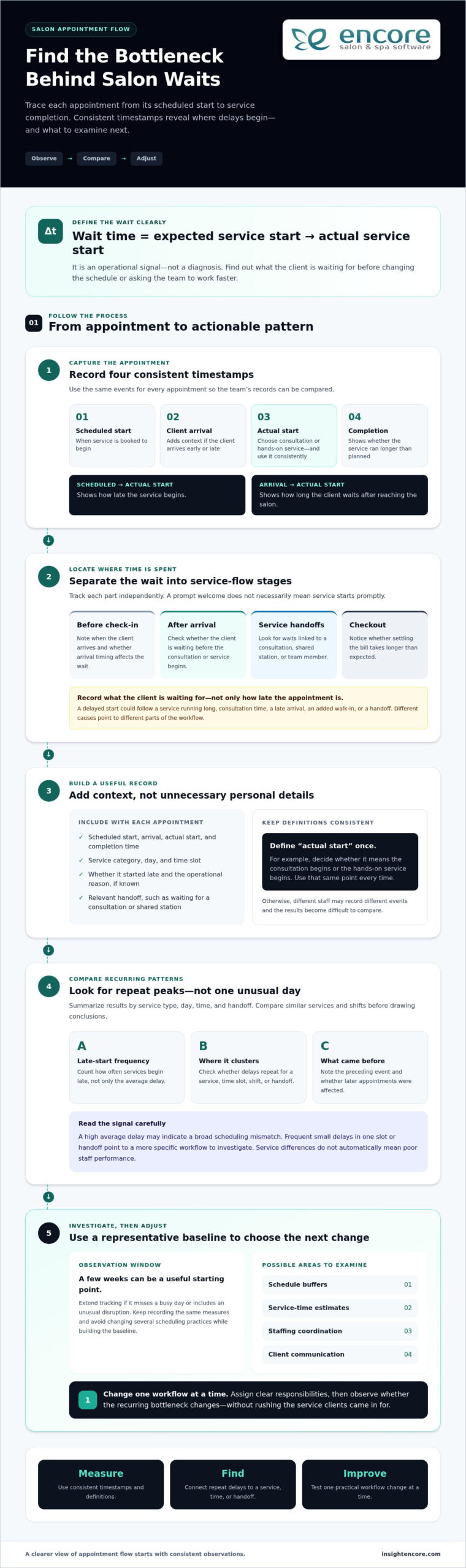
Salon wait time is the gap between a client’s expected service start and the actual start. It’s an operational signal that shows where appointment flow needs attention. To understand that signal, separate the wait into stages: before check-in, after arrival, between service handoffs, and at checkout. A client may be welcomed promptly but wait for a consultation, or finish their service on time but spend longer than expected settling the bill. Each points to a different part of the day.

Record what the client is waiting for, not just how late the appointment is. A delayed start might come from the previous service running long, a stylist needing consultation time, or a transition that depends on another team member. That distinction helps you focus on the process instead of treating every delay as a performance problem.

Which salon waits frustrate clients most?

A waiting-room delay and a late service start can feel different. A client may arrive at the scheduled time and see their stylist still finishing with someone else, or they may be checked in promptly but wait before the consultation begins. Uncertainty can make either pause feel longer, especially if the client doesn’t know what’s happening. Track check-in, consultation, processing, and checkout separately to see where time is spent and where a simple explanation could improve the experience.

What causes appointment delays to snowball?

One service that takes longer than planned can shift the next appointment, then the one after it. The cause might be a complex service, a late arrival, a walk-in added to an already full schedule, or a handoff that relies on a shared chair or team member. Delays can also reflect normal differences in service needs, not poor staff performance. Look for recurring patterns before deciding what to change.

It can help to think of the salon as a series of connected arrivals and services. Queueing Theory studies how waiting lines form, offering a useful way to consider how appointment timing and available staff interact. You don’t need a mathematical model to begin: note when each wait occurs, what was happening just before it, and whether later appointments were affected. That gives you a clearer starting point for reducing client wait times in a salon without rushing the work clients came in for.

Measure salon wait times to pinpoint the real bottleneck

Once you know where a client’s wait occurs, record it consistently. Start with three timestamps for each appointment: the scheduled service start, the actual service start, and service completion. Together, they show whether the issue is a late start, a service running long, or both.

Scheduled start, actual start, and service completion reveal whether a salon bottleneck begins before service, during the appointment, or at a transition. Keep the measures distinct. Scheduled-to-actual start time shows how late the service begins, while arrival-to-service-start time shows how long the client waits after reaching the salon. If a client arrives early or late, that context helps you interpret both figures fairly.

Which wait-time measures should a salon track?

Alongside those timestamps, count how often services begin late, not just the average delay. An average can look manageable even if the same service or time slot repeatedly starts behind. Note the service type, day, time, and relevant handoff, such as waiting for a consultation or a shared station. Keep the record focused on operations by avoiding unnecessary personal information.

A simple log can include:

  • Scheduled start, client arrival, actual start, and completion time.
  • Service category and the day or time slot.
  • Whether the appointment started late and the operational reason, if known.

Keep the definitions consistent across the team. For example, decide whether “actual start” means the consultation begins or the hands-on service begins, then use that same point every time. Otherwise, two staff members may record different events and make the results difficult to compare.

How can managers interpret the patterns?

Look for repeated peaks, not conclusions based on one unusual day. Compare similar services and shifts, since a complex appointment and a quick trim may involve different steps. If late starts cluster around a particular handoff or time slot, investigate that part of the workflow before changing the whole schedule. Comparing these patterns with your salon staff utilization rate can also help you understand how staff capacity lines up with demand.

Choose an observation window that covers the salon’s normal range of days, shifts, and services. A few weeks can be a useful starting point, but extend the tracking if the period misses a busy day or includes an unusual disruption. The goal is a representative picture, not a perfect dataset. Record the same measures throughout, and avoid changing several scheduling practices while you’re building the baseline.

Then summarize the results by service type, day, time, and handoff. A high average delay may point to a broad scheduling mismatch; frequent small delays in one slot may call for a more targeted adjustment. This gives you evidence to guide the next step in reducing client wait times in a salon, rather than asking the team to move faster without knowing what’s causing the wait.

Compare salon wait-time fixes before changing the schedule

Once you’ve identified where delays recur, match the solution to the cause. Adding time everywhere may protect the schedule, but it can also leave avoidable gaps. Packing appointments closer together may appear efficient, yet even small variations in service time can quickly push later clients behind. Choose a targeted adjustment that supports quality service and fits the way your salon works.

Consider the effort and trade-off of each option:

  • Schedule buffers: Add breathing room around services that regularly run over or need a more involved transition. This is simple to test, but broad buffers may create unused time.
  • Service-duration estimates: Review the time allowed for different services against observed durations. Updating estimates can improve the fit, though the team may need to revisit them as service needs vary.
  • Staffing coordination: Clarify who handles consultations, shared stations, or other handoffs during busy periods. This can address workflow gaps, but requires clear team communication.
  • Client communication: Set realistic expectations about appointment timing and explain delays promptly. This won’t remove the underlying bottleneck, but it can reduce uncertainty while the salon addresses it.

When do buffers and appointment-duration changes help?

Use your recorded service times to identify where a modest allowance may help, rather than adding the same buffer to every booking. A complex consultation or a transition between services may need different time from the hands-on appointment itself. The trade-off is capacity: protect time where variation is real, but avoid turning the entire schedule into idle space.

If a service routinely takes longer than its booking duration, update the estimate and observe what changes. If only certain appointments run over, consider whether consultation needs, finishing steps, or preparation explain the difference. More accurate durations can help clients select a suitable slot and give staff a schedule that better reflects the work. Avoid shortening estimates just to fit more appointments; tighter scheduling can magnify the effect of normal variation.

How should a salon balance walk-ins and booked appointments?

Walk-ins can serve clients who want flexibility, but accepting them when staff are fully committed may delay people with bookings. A designated walk-in period or capacity can make demand easier to manage, while protecting booked slots prioritizes appointments already on the schedule. Either approach needs a clear boundary so the team can make consistent decisions.

Set expectations honestly. If a walk-in can’t begin right away, explain that timing depends on service availability rather than promising immediate attention. Online booking can help clients choose from available appointment times instead of relying on a call or arriving without a slot. A clear salon client booking portal can support that choice, but it won’t resolve staffing or service-flow issues on its own.

There’s no single fix for reducing client wait times in a salon. Compare the likely benefit, effort, and trade-off, then test the option that best matches the delay pattern you observed.
Reducing Client Wait Times in a Salon: A Practical 2026 Guide

Reduce salon waiting with a practical workflow improvement plan

A useful improvement plan doesn’t need a major schedule overhaul. Start with a recurring bottleneck you’ve observed, make one focused change, and review what happens. Keeping the test small helps you see whether the change addressed the cause or simply moved the delay somewhere else.

Choose one bottleneck, test one change, and compare the same measures before and after. Your team can adapt this sequence to the salon’s services and staffing:

  1. Choose the pattern. Select a recurring issue, such as a certain appointment type regularly starting late or a specific handoff slowing down the next service.
  2. Assign ownership. Decide who greets and checks in clients, who updates the schedule when timing changes, and who coordinates service transitions. Clear roles reduce confusion during busy periods.
  3. Test one adjustment. For example, revise the time allowed for a service that often runs over, or give one team member responsibility for communicating schedule changes.
  4. Review the results. Compare the same start-time and completion measures you used for your baseline. Keep, adjust, or reverse the change based on what the records show and what staff experience.

This gives everyone a shared action sequence: spot the pattern, name an owner, try one change, and review the evidence. It keeps the focus on improving the flow rather than asking the team to rush through services or absorb a poorly planned schedule.

How can a salon test a schedule change?

Use the delay pattern from your observations to choose a change that addresses its likely cause. If a particular service repeatedly overruns, adjust its scheduled duration rather than adding time to every appointment. Keep other practices steady during the trial, then compare the same measures from similar services, days, and shifts. If the pattern doesn’t improve, revisit the cause before expanding the change.

What should staff say when a client is waiting?

Acknowledge the delay promptly, apologize for the wait, and share a realistic update if the team has one. If timing is still uncertain, say so rather than guessing at a new start time. For example: “I’m sorry we’re running behind. We’re checking the schedule and will update you as soon as we have a clearer estimate.” A warm, direct message helps clients feel seen without promising a time the team can’t meet.

Agree on who gives updates and how schedule changes reach the rest of the team. The person at check-in may not know what’s happening in the service area, so establish a simple handoff for sharing current timing. Consistency matters: clients should receive a clear update, not conflicting estimates from different staff members. Small communication habits can make an unavoidable delay feel more considered while the team works on its underlying cause.

With a repeatable test and clear ownership, reducing client wait times in a salon becomes a practical workflow effort, not a demand to work faster.

Explore Encore salon software

Use salon software to support a more organized client flow

Once you’ve identified which parts of the day create friction, consider whether software could simplify the administrative work around appointments. Online booking can present available appointment times so clients can choose a suitable slot without relying on staff to coordinate every booking manually. That can make appointment selection more organized, but it won’t fix a schedule that underestimates service time or lacks enough capacity.

Software supports the flow. Your service timings, staffing decisions, and communication practices still shape the client experience. If an appointment routinely takes longer than its scheduled slot, a booking tool won’t create the missing time. Likewise, a system can help organize information and transactions, but staff still need clear responsibilities for service transitions and updates when the day runs behind.

Which software capabilities can support appointment flow?

Think about the practical steps in a client visit. Online appointment booking lets clients select from the availability you present. Client management helps staff access client records as they prepare for scheduled visits. Point-of-sale tools support transactions at checkout, making this part of the visit easier to organize. Together, these capabilities can support the appointment journey without replacing the team’s day-to-day workflow.

Encore salon software brings online booking, client management, point-of-sale transactions, and integrated credit card processing together. Match each capability to a specific friction point. If the team spends time coordinating appointment requests, online booking may help. If staff need a more organized way to manage client information, client management can support their preparation. If checkout adds friction, point-of-sale transactions and integrated credit card processing can help organize that part of the visit.

Keep schedule design and client communication in your improvement plan. These tools support booking, client information, and transactions, while your team remains responsible for service timing, capacity, and the flow between appointments.

How can a salon decide whether to explore software?

Start with the recurring administrative task that takes time or creates confusion, then define what a better process would look like. For example, your goal might be to let clients select from available appointment times online or make client records easier for staff to access when preparing for visits. A clear goal makes it easier to assess whether a software change matches the salon’s needs.

Next, connect the capability to the workflow. Identify who will use it, which step it supports, and what still requires a staff decision. Then review whether the process feels more organized without assuming that software alone will reduce delays. This keeps the focus on a practical fit, not on adding technology for its own sake.

Reducing client wait times in a salon takes realistic service timing, appropriate capacity, and consistent communication. Software can support those efforts by organizing booking, client information, and checkout, while your team remains responsible for the service flow.

Explore Encore salon software

Build a calmer appointment day, one step at a time

Better appointment flow doesn’t require a perfect schedule from day one. Choose one recurring delay to address, make a focused adjustment, and give your team a clear way to keep clients informed. Small, thoughtful changes can help create a visit that feels more welcoming for clients and more manageable for staff, without rushing the service.

If administrative friction is part of the problem, Encore brings online booking, client management, and point-of-sale transactions together to support an organized client journey. Encore’s parent company, Syntec Business Systems, was founded in 1991. These tools can support your process, while your team’s service timing and communication remain essential to reducing client wait times in a salon.

Keep learning from each appointment, and build a salon flow that gives both your clients and your team room to feel at ease.

Try Encore salon software

Frequently Asked Questions

How can I reduce client wait times in a salon?

Start by identifying the point where appointments most often lose time, then make one manageable change. For example, if consultations frequently delay hands-on work, decide who will conduct them and how that time fits into the booking. Tell the team what to watch during the trial, such as whether later appointments still start behind. This keeps reducing client wait times in a salon focused on a fix the team can observe and maintain.

What is an acceptable wait time at a salon?

There’s no universal wait-time limit that suits every salon, service, or client. Set expectations around the appointment experience your salon can reliably provide, then pay attention to whether clients understand what’s happening if the schedule shifts. A brief wait with a clear explanation may feel different from an unexplained delay. Review client feedback alongside appointment records, and use recurring concerns to refine your service standards rather than relying on one fixed number of minutes.

Can appointment scheduling software reduce salon wait times?

It can help organize appointment selection when it offers online booking, but it can’t correct every source of delay. For instance, online availability may reduce back-and-forth booking coordination, while an appointment duration that doesn’t match the service can still throw off the day. Identify the administrative task causing friction before changing tools. Then decide what success should look like, such as fewer manual booking exchanges, while separately addressing staffing, timing, and service handoffs.

How do salons prevent appointments from running late?

Salons can reduce avoidable overruns by matching booking details to the service planned and preparing for known steps before the client arrives. If a booking may involve an add-on or a more involved consultation, clarify the plan early so the appointment isn’t unexpectedly extended. Keep transitions clear, too: the next team member should know when their part begins. Preserve realistic service time, because squeezing appointments together can spread one overrun across the schedule.

Should a salon leave buffer time between appointments?

Use buffers where your schedule shows a specific need, rather than inserting the same gap after every service. A consultation-heavy appointment or a transition that requires resetting a station may benefit from added flexibility. But widespread gaps can limit appointment availability without addressing the actual cause of delays. Try a targeted allowance on the relevant service or time slot, then compare how the day flows before deciding whether to keep or adjust it.

How should a salon handle a client who is waiting?

Acknowledge the wait directly and let the client know what you can say with confidence. For example: “I’m sorry for the delay. We’re checking the timing and will update you when we have a clearer estimate.” Don’t offer a start time just to reassure them if you’re unsure. If the estimate changes, share another update rather than leaving the client to ask. A respectful tone and consistent information help maintain trust during an imperfect day.

Do walk-ins increase wait times for salon clients with appointments?

They can, particularly if a walk-in takes a stylist or station already needed for a booked service. The effect depends on the service requested and the capacity available at that moment. Set a clear rule for accepting walk-ins, such as only offering them when they fit without displacing booked appointments. Explain that availability depends on the day’s schedule, and give walk-in clients a realistic expectation rather than implying they can be seen immediately.

Disclaimer

This article is general in nature and may contain errors, please verify all claims with your sales rep
Categories
Uncategorized

How to Make My Salon Look More Professional: The 2026 Front Desk Guide

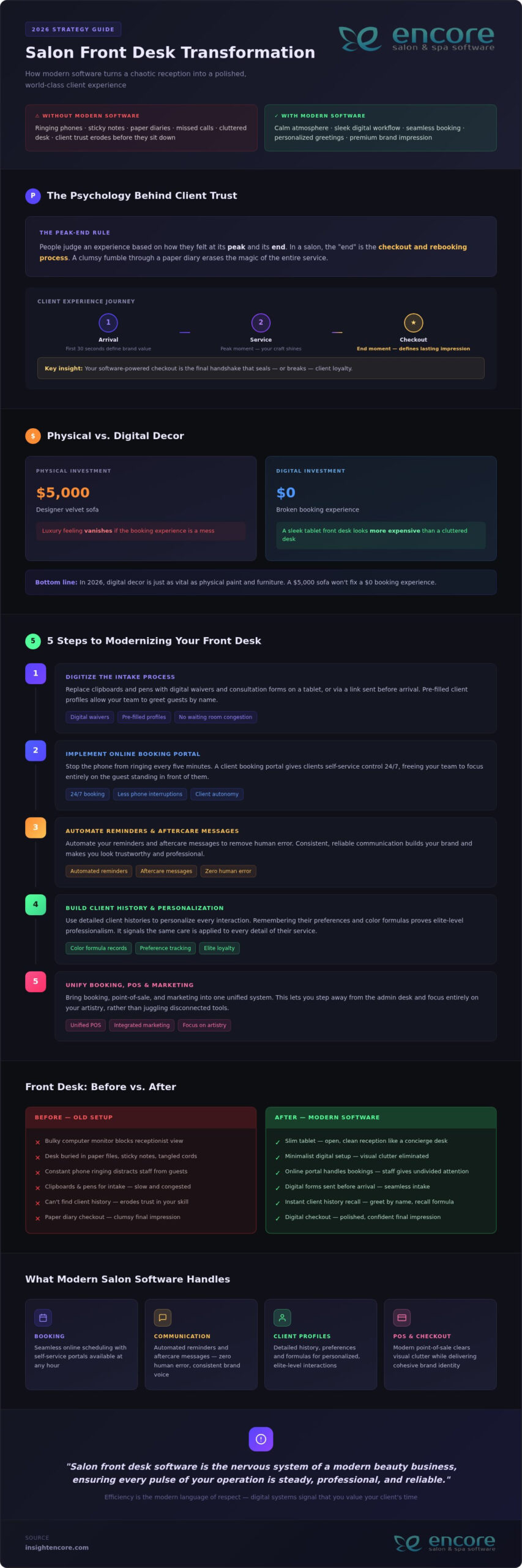
Imagine a client walks through your doors, ready for a luxury experience, but they’re greeted by a ringing phone, a desk buried in sticky notes, and a "just a minute" finger. It isn’t the high-end vibe you worked so hard to create. You’ve likely felt that sinking feeling when a cluttered desk or a missed call makes your business look disorganized. It’s frustrating because your talent is world-class, but your administrative setup is holding you back. You know that the first thirty seconds of a visit define your brand’s value. When you implement modern salon front desk software, you replace that chaos with a sense of calm and professional confidence.

This guide will show you how to flip the script and transform your entryway into a polished, world-class experience. We’ll explore the 2026 strategies that replace paper clutter with sleek automation and manual scheduling with seamless online booking. You’ll learn how to build deep client trust through reliable communication while reclaiming your time. By the end of this article, you’ll have a clear roadmap to a more professional salon that lets you focus on your craft instead of your calendar. It’s time to let your front desk reflect the high quality of the services you provide every day.

Key Takeaways

  • Discover how to use the “Peak-End Rule” to ensure your clients leave with a world-class impression. Your front desk sets the tone for every visit.
  • Learn why upgrading to modern salon front desk software is the fastest way to replace bulky hardware and messy paperwork. It creates a sleek, digital experience that builds immediate trust.
  • Master the art of consistent communication by automating your reminders and aftercare messages. This removes the risk of human error and keeps your brand looking reliable.
  • Build elite-level loyalty by using detailed client histories to personalize every interaction. When you remember their preferences and formulas, you prove your professionalism.
  • Streamline your entire operation by bringing booking, POS, and marketing into one unified system. This allows you to step away from the admin desk and focus on your artistry.

Defining Professionalism: Why Your Front Desk is the Face of Your Brand

Professionalism isn’t just about a clean floor or a polite greeting. In 2026, it’s the perfect intersection of aesthetics, efficiency, and deep-seated trust. Think of your front desk as the physical handshake of your brand. If that handshake feels cluttered, slow, or disorganized, the client’s perception of your skill drops before they even sit in the chair. This is where the "Peak-End Rule" comes into play. Psychologists suggest that people judge an experience largely based on how they felt at its peak and its end. In a salon setting, the "end" is the checkout and rebooking process. If that final moment is a clumsy fumble through a paper diary, it erases the magic of the service provided. Simply put, salon front desk software is the nervous system of a modern beauty business, ensuring every pulse of your operation is steady, professional, and reliable.

The Psychology of Client Trust in 2026

Efficiency is the modern language of respect. When you use digital systems, you signal to your clients that you value their time as much as your own. There’s a direct, psychological link between how organized your systems appear and how high a client perceives your technical service quality to be. If a stylist can’t find a client’s history or a receptionist struggles with a calendar, the client might wonder if the same lack of care applies to their hair color formula. Today’s clients also crave a sense of control and autonomy. They expect "self-service" options, such as online booking portals, that let them manage their appointments on their own terms at any hour. It isn’t just a convenience anymore; it’s a standard of elite-level service that builds lasting confidence.

Physical vs. Digital Decor: What Matters More?

You might spend thousands on a designer velvet sofa or high-end lighting, but that luxury feeling vanishes if the booking experience is a mess. A $5,000 sofa won’t fix a $0 booking experience. In the modern era, digital decor is just as vital as physical paint and furniture. A minimalist, tech-forward reception area with a sleek tablet looks more expensive and capable than a desk overflowing with pens, post-its, and tangled cords. Modern point-of-sale systems allow you to clear the visual clutter while creating a cohesive brand identity through every digital touchpoint. By focusing on modern features and clean interfaces, you ensure your salon feels like a world-class destination from the first click to the final payment. This digital presence becomes a seamless extension of your physical space, reinforcing your status as a top-tier professional.

2 Steps to Modernizing Your Salon Front Desk Experience

Modernizing your salon starts with a simple audit of your current client flow. Walk through your front door as if you’re a guest for the first time. If you’re met with a bulky computer monitor that blocks your view of the receptionist or a desk buried in paper files, the professional illusion breaks. High-end spaces in 2026 prioritize open, clean lines. By replacing outdated towers with slim tablets or laptops, you create a reception area that feels like a concierge desk rather than a cubicle. This physical shift, powered by the right salon front desk software, immediately signals to your clients that they’ve entered a premium space.

To keep the atmosphere calm, you need to reduce the constant "white noise" of a busy salon. One of the most effective ways to do this is to implement a salon client booking portal. This allows your phone to stop ringing every five minutes, giving your front desk team the freedom to focus entirely on the guest standing in front of them. When your staff isn’t distracted by holding a handset, they can provide the undivided attention that defines world-class service.

Step 1: Digitizing the Intake Process

Clipboards and pens are relics of the past. Using digital waivers and consultation forms makes your business look high-end and technologically savvy. When guests fill out their information on a tablet, or better yet, via a link sent before they arrive, you eliminate the awkward waiting room congestion. Pre-filled client profiles allow your team to greet guests by name and verify details in seconds. This streamlined approach ensures that the transition from the front door to the stylist’s chair is fast and flawless. If you’re looking for a way to simplify this transition, you can explore a modern setup today to see how it fits your workflow.

Step 2: Mastering the Seamless Checkout

Checkout friction is a silent killer of client retention. If a guest has to wait for a slow printer or deal with a glitchy card reader, that’s the last thing they’ll remember. Using integrated credit card processing ensures that the final step of the visit is as smooth as the service itself. It allows for contactless payments and digital receipts sent directly to their phone, which is a much more professional look than crumpled thermal paper. This level of organization is also essential for managing your small business finances because it syncs your sales data automatically. During this seamless flow, your salon front desk software can prompt for tips and re-booking, ensuring your stylists stay busy without any awkward "salesy" pressure at the desk.

Consistency is Key: Professionalism via Automated Communication

Consistency is the secret sauce of elite branding. When your communication is hit or miss, your business feels amateur. Manual appointment reminders are a gamble; they’re prone to human error and often get forgotten during a busy shift. One missed text or a late phone call can make your brand look unreliable. By using salon front desk software, you ensure that every client receives the same "white glove" treatment every single time. This automation doesn’t just save you time; it builds a reputation for being organized and dependable. From automated "Thank You" notes to detailed "Aftercare" instructions, these touchpoints keep your brand at the front of your client’s mind long after they leave the salon.

Your brand voice should remain steady across every message. Whether it’s a booking confirmation or a holiday greeting, the tone should reflect the warm, professional atmosphere of your physical space. Offering professional retail options, such as integrated gift cards, further cements this high-end image. It shows that your business is a complete, well-oiled machine capable of handling more than just the service in the chair.

The Power of Automated Reminders

Professionalism means respecting your client’s schedule as much as your own. Automated reminders are the most effective way to reduce no-shows while appearing "on top of it." In 2026, the timing of these messages is crucial. A good rule of thumb is an email confirmation at the time of booking, followed by an SMS reminder 24 to 48 hours before the appointment. Salon front desk software allows you to personalize these alerts with the client’s name and specific service details. This makes the automation feel human and thoughtful rather than cold or robotic. It’s a simple way to provide a premium experience without adding a single task to your to-do list.

Professional Marketing and Loyalty Programs

It’s time to move beyond the tattered paper punch cards. Digital loyalty tracking is the modern standard for elite salons. It allows you to reward your best guests automatically, without anyone having to dig through a wallet for a card. You can set up automated birthday greetings or "we miss you" campaigns that trigger when a client hasn’t visited in a few months. These proactive moves prove you value the relationship. Using specialized salon software features from Encore Salon & Spa Software ensures these programs run smoothly in the background. This level of data-driven care is what separates a basic shop from a world-class brand that clients trust and recommend to others.

How to Make My Salon Look More Professional: The 2026 Front Desk Guide

Behind the Scenes: Data-Driven Professionalism

True professionalism isn’t just about what your clients see. It’s about what you know. When you have the right data at your fingertips, you can anticipate a client’s needs before they even speak. This level of preparation is what separates a good salon from a world-class brand. By using salon front desk software to track every detail, you create an environment where nothing falls through the cracks. It’s about building a foundation of reliability that your clients can feel in every interaction. You’re not just guessing; you’re operating with certainty.

Data security is a critical part of this foundation. In 2026, clients are more aware of their digital privacy than ever. Protecting their contact information and payment details isn’t just a legal requirement. It’s an elite-level trust builder. When you can confidently tell a guest that their information is secure in a professional system, you reinforce your status as a serious business owner. Additionally, calculating salon staff utilization allows you to manage your team’s time effectively, projecting an image of a busy, successful, and high-demand studio.

Client Notes and Formula History

There is a specific kind of magic in remembering the small details. Maybe it’s a client’s favorite beverage or the fact that they prefer a specific chair. A digital CRM allows you to store these "wow" moments so they’re ready for every visit. For your service providers, this data is even more vital. Professional stylists never have to ask, "What did we do last time?" Instead, they can pull up a complete formula history and service record in seconds. This standardizes the experience across your entire team. Even if a client sees a different stylist, the transition is seamless because the knowledge stays with the house, not just the individual.

Inventory Management as a Professional Standard

Few things break the professional spell faster than an "out of stock" apology. If a stylist realizes halfway through a service that they’re out of a specific toner, it creates unnecessary stress for everyone. Real-time inventory tracking ensures you always have professional-grade products ready for use and for sale. Your retail displays should be backed by data, showing you exactly what’s moving and what needs a restock. Automated ordering systems keep your front desk stocked and ready, so you never have to scramble at the last minute. It’s a simple way to maintain high-end standards without the headache of manual counting.

Upgrade your salon management today

Transform Your Salon with Encore Salon Front Desk Software

Transitioning to a world-class image doesn’t happen by accident. It requires a partner that understands the heartbeat of your business. Encore Salon & Spa Software is built to be that partner, guiding you through every step of your professionalism journey. By bringing your online booking, point-of-sale, client management, and marketing into one unified system, you eliminate the friction that often holds salon owners back. You don’t need to be a tech expert to look like an industry leader. We’ve designed our platform to be intuitive and accessible, ensuring that your transition to a digital front desk is a relief, not a burden.

Professionalism should feel effortless. When your salon front desk software handles the heavy lifting of reminders and inventory, you gain the freedom to focus on your clients. It’s about moving from a state of constant admin stress to a feeling of organized, calm control. This shift doesn’t just improve your workflow; it completely transforms how the world sees your brand. You’re invited to take this next step toward a world-class salon image, knowing you have a reliable system supporting every move you make.

Specialized Solutions for Every Professional

No two beauty businesses are exactly alike. Whether you run a high-end medical spa or one of the busiest tattoo studios in the city, you need tools that fit your specific craft. Encore Salon & Spa Software offers specialized modules that cater to the unique needs of different industry niches. We even support independent booth renters, giving them the digital power to look like a full-scale business with a dedicated reception team. This flexibility comes from 35 years of industry experience. We’ve spent over three decades listening to owners and refining our features to solve real-world problems. When you choose Encore Salon & Spa Software, you’re choosing a seasoned mentor that’s deeply invested in your individual success.

Get Started Today

The impact of switching to modern salon front desk software is immediate. You’ll notice the silence that comes with fewer phone calls and the pride that comes with a clean, paperless desk. Our transition process is designed to be simple, guided, and fully supportive. You won’t have to figure it out on your own. We’re here to help you set up your systems so you can start impressing clients from day one. It’s time to stop letting administrative chaos dim your artistic talent. Take the next step toward the world-class image you deserve and see the difference that reliable, human-centric technology can make.

Try Encore now and elevate your salon’s professional image

Step Into Your Most Professional Era Yet

Your salon’s first impression is the physical handshake that defines your brand’s value. By moving away from paper clutter and embracing digital efficiency, you ensure every client feels prioritized from the moment they book. Professionalism in 2026 is the intersection of aesthetics and reliable systems. When you choose an all-in-one management tool, you simplify everything from booking to payroll. This allows your team to focus on their artistry while the technology handles the administrative heavy lifting.

Implementing the right salon front desk software is the final piece of the puzzle for a truly elite brand image. With over 35 years of beauty industry expertise, Encore is trusted by salons, spas, and tattoo studios worldwide to remove administrative chaos. You don’t have to handle the transition alone. You have a partner ready to help you grow every step of the way.

Elevate your brand image and try Encore now
It’s time to let your front desk reflect the world-class talent you bring to every service. You’ve built something incredible, and now you have the tools to make sure every guest sees it the moment they walk through your doors.

Frequently Asked Questions

How does salon front desk software make me look more professional?

It replaces manual, error-prone tasks with sleek, digital precision. Clients see an organized environment where their appointments are confirmed instantly and their preferences are remembered. This technology removes the visible clutter of paper books and sticky notes, replacing it with a modern interface that signals your business is forward-thinking. Using salon front desk software proves you value their time and manage your business with elite-level care.

Is professional salon software hard to set up for a small business?

Modern systems are designed specifically to be intuitive and user-friendly for businesses of all sizes. While switching systems might feel intimidating at first, a supportive partner will guide you through every step. Most owners find that the initial setup pays off almost immediately by removing daily administrative frustrations. It is about simplifying your life, not adding more technical hurdles to your already busy to-do list.

Can I use salon software on a tablet to save space at my front desk?

Yes, using a tablet is one of the best ways to create a minimalist, high-end reception area. By removing bulky computer towers and monitors, you open up the physical space and create a more welcoming environment for guests. A sleek tablet running your salon front desk software allows for a concierge-style check-in experience. This feels far more professional and modern than a traditional office-style desk setup.

What is the most important feature for a professional salon front desk?

An integrated system that connects your booking, client records, and payments is the most vital feature. When these elements talk to each other, you avoid the awkwardness of asking a client for information you should already have. This seamless flow ensures that checkout is fast and that every guest receives consistent communication. It is the true hallmark of a world-class beauty business that values efficiency and trust.

How much does salon management software typically cost in 2026?

Pricing varies based on the specific features and the number of service providers in your business. Most providers offer tiered plans so you only pay for what you actually need. Instead of looking at it as a flat expense, many owners view it as an investment that pays for itself by reducing no-shows and increasing retail sales. It is best to check current plans to find the right fit for your budget.

Does using software take away the personal touch from my salon?

It actually enhances the personal touch by giving you more time to focus on the human connection. When you aren’t stuck on the phone or buried in paperwork, you can engage more deeply with the guest in front of you. The software stores small details like their favorite beverage or previous formulas. This allows you to provide a tailored experience that feels deeply personal, thoughtful, and professional.

How do I handle client data security to look more professional?

Protecting client information is an elite-level trust builder in the digital age. Professional software uses secure encryption to store contact details and payment history safely. By moving away from paper files that anyone could see, you prove to your clients that you take their privacy seriously. This commitment to security shows that you are a seasoned professional who respects their guests’ boundaries and sensitive data.

What is the best alternative to using a paper appointment book?

A cloud-based digital system is the most reliable alternative to paper. Unlike a physical book, digital calendars can be accessed from anywhere and are protected against loss or damage. They also allow for automatic updates and online booking, which paper simply cannot do. This transition ensures your schedule is always accurate and gives your business a much more polished, tech-forward image that clients expect.

Disclaimer

This article is general in nature and may contain errors, please verify all claims with your sales rep

Categories
Uncategorized

Automated Salon Client Retention Strategies: The 2026 Reference Guide

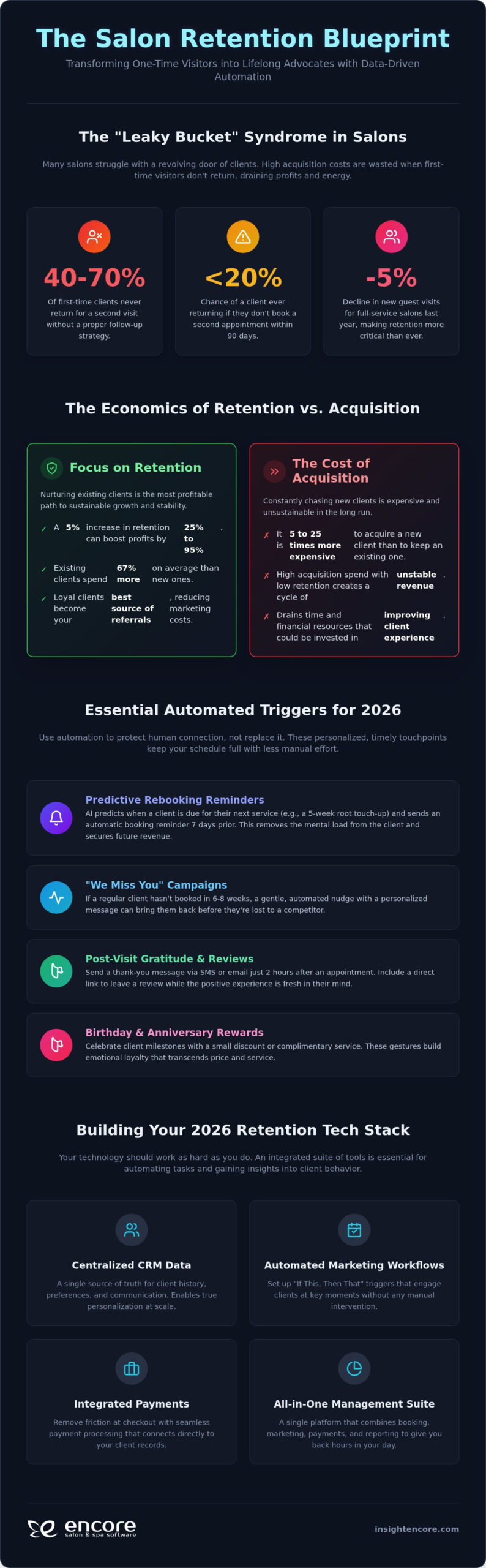
Did you know that between 40% and 70% of first-time salon clients never come back for a second visit if you don’t follow up? It’s a frustrating reality for many owners who pour their hearts into every service. You work hard on improving salon client experience, yet the gap between a great appointment and a loyal regular often remains stubbornly wide. Acquiring a new guest is five to twenty-five times more expensive than keeping the ones you already have. If your books feel like a revolving door, it’s time for a change.

We understand the exhaustion of manual rebooking and marketing tasks that get lost in the shuffle of a busy Saturday. You deserve a system that works as hard as you do. This guide promises to show you how to transform those one-time visitors into lifelong advocates using modern automation and data-driven loyalty frameworks. We’ll explore how to build a predictable, automated re-engagement system that increases your client lifetime value and keeps your chairs full with much less manual effort.

Key Takeaways

  • Learn why 90-day return rates are the new gold standard for success and why chasing new traffic won’t fix a “leaky bucket” retention problem.
  • Discover how to set up automated marketing triggers that keep your schedule full while improving salon client experience through personalized, human-feeling touchpoints.
  • Explore why traditional punch cards are being replaced by experiential rewards and points-based systems that build genuine long-term value.
  • Identify the must-have features for your 2026 tech stack, from centralized CRM data to integrated payments that remove friction at checkout.
  • See how an all-in-one management suite can automate your most time-consuming tasks, giving you back hours of your day while your business grows.

The Economics of Salon Client Retention in 2026

In the beauty industry, we often celebrate the “new.” We love new trends, new products, and especially new clients. However, the data for 2026 tells a different story. With new guest visits for full-service salons falling by 5% last year, the focus has shifted toward what customer retention is and why it’s the primary engine for your growth. In 2026, we define successful retention by 90-day return rates. If a client doesn’t return within three months, the likelihood of them ever coming back drops to less than 20%.

Many owners suffer from “Leaky Bucket” syndrome. They spend heavily on social media ads to bring people in, but those guests never return. It’s a cycle that drains your energy and your bank account. Improving salon client experience starts by realizing that a 5% increase in retention can boost your profits by 25% to 95%. Existing clients spend 67% more on average than new ones. When you stop chasing the next stranger and start nurturing the person in your chair, your business finally finds its rhythm.

This shift requires moving from transactional visits to intentional relationship management. You’re not just selling a haircut or a facial; you’re providing a consistent sanctuary. Focusing on improving salon client experience through personalized care is what turns a casual visitor into a brand advocate.

Key Retention Metrics You Must Track

To fix your retention, you have to see the gaps. You should track new guest retention separately from repeat guest retention. If your “One and Done” rate is high, it means guests aren’t finding a reason to return after that first visit. This often happens when the rebooking process feels like a chore. By monitoring your average visit frequency, you can turn a “twice-a-year” client into a “six-times-a-year” regular. This shift creates predictable, stable revenue that allows you to breathe easier during the slow seasons.

The 2026 Cost of Acquisition vs. Retention

Digital advertising costs have reached a point where retention is the only sustainable way to scale. It’s five to twenty-five times more expensive to acquire a new client than to keep an existing one. Loyal clients don’t just spend more; they also become your unpaid marketing team. They refer friends and leave the reviews that drive organic growth without costing you a cent in ad spend. Client Lifetime Value (LTV) is the total revenue a client generates throughout their relationship. By focusing on LTV, you prioritize long-term stability over the stress of the daily hustle.

Leveraging Automated Marketing for Seamless Retention

Automation isn’t about replacing human connection. It’s about protecting it. When you’re behind the chair, you can’t be at your desk sending follow-up texts. Automated marketing ensures that no guest feels forgotten. By establishing “If This, Then That” workflows, your software acts as a silent assistant that never sleeps. This consistency is a cornerstone of the economics of client retention, turning sporadic visits into a steady rhythm. It removes the stress of manual outreach and lets you focus on the person sitting in front of you.

Success comes down to personalization at scale. Use your CRM data to include specific details, like a client’s preferred stylist or their last hair color formula. This makes an automated text feel like a thoughtful note from a friend. To keep the relationship healthy, implement frequency capping. You want to stay top-of-mind without crowding their digital space. An omnichannel approach, using SMS for quick alerts and email for deeper stories, ensures your message gets through. By balancing these channels, you respect the client’s boundaries while maintaining a presence that feels supportive rather than intrusive.

Essential Automated Triggers for 2026

Start with a “We Miss You” campaign. If a guest hasn’t booked in 6 to 8 weeks, an automatic nudge can bring them back before they look elsewhere. Post-visit gratitude is equally powerful. Sending a thank-you note just two hours after an appointment is a simple way of improving salon client experience. Include a direct link to leave a review while their positive feelings are still fresh. Celebrating birthdays or anniversaries with a small gift or discount builds emotional loyalty that transcends price. These small gestures prove you value them as a person, not just a transaction.

Predictive Rebooking Reminders

Modern software now uses AI to predict exactly when a client needs maintenance. If a guest gets a root touch-up every five weeks, the system knows. It can send a rebooking reminder seven days before that likely need. This proactive approach removes the mental load from the client. By linking these reminders directly to your salon client booking portal, you make the path to the next appointment effortless. It also prevents “calendar inflation,” where your books look full but are actually prone to gaps because people forgot to schedule their upkeep. This is a vital step in improving salon client experience by making their life easier.

Transitioning to these workflows doesn’t have to be intimidating. You can start small and watch your books fill up with minimal effort. If you’re ready to see how these tools work in action, explore our automated marketing features.

Comparing High-Impact Loyalty and Referral Program Models

In 2026, the traditional “Buy 10, Get 1 Free” punch card is a relic of the past. It’s easily lost, hard to track, and doesn’t actually drive emotional connection. Modern loyalty programs focus on improving salon client experience by offering experiential rewards instead of just deep discounts. Think about offering a complimentary paraffin wax treatment or early access to a popular stylist’s holiday schedule. These perks feel more like a gift and less like a coupon, which protects your margins and elevates your brand’s perceived value.

A points-based system is a powerful way to make every dollar a client spends feel like an investment in their future self. When guests see their points balance grow, they’re less likely to wander to a competitor. You can take this further with tiered loyalty structures. By creating an “Elite” or “VIP” tier for your top-spending 10%, you foster a sense of exclusivity that rewards your most dedicated patrons. Adding gamification elements, like digital badges for trying a new service category or hitting a milestone of five visits, keeps the interaction fun and engaging within your client app. Pairing these loyalty efforts with well-timed salon gift card promotion ideas can further boost revenue during slower seasons while giving loyal clients a meaningful way to share your services with friends and family.

The Membership Model: Guaranteed Recurring Revenue

Memberships provide the ultimate business stability. Whether you offer monthly blow-dry packages or skin maintenance plans, recurring revenue allows you to forecast your income with precision. You can manage auto-billing seamlessly through your nail salon POS system, which removes the need for awkward payment conversations at every visit. The psychology of pre-paid services is clear. Members tend to visit about 20% more often because the service is already “accounted for.” It becomes a regular part of their lifestyle rather than an occasional luxury.

Referral Automation: Turning Clients into Influencers

Your loyal regulars are your best marketing team. You can turn them into active influencers by automating the referral process. Set up a trigger that sends a “Refer a Friend” discount code immediately after a client leaves a 5-star review. This captures them at their peak moment of satisfaction. Your client management system should track these referrals automatically, so you don’t have to guess who brought in whom. Rewarding both the referrer and the new guest lowers social friction and makes the recommendation feel like a generous gift. This proactive approach is a simple way of improving salon client experience while growing your books organically.

Automated Salon Client Retention Strategies: The 2026 Reference Guide

Building Your 2026 Client Retention Tech Stack

Great service isn’t just about soft skills. It’s about the technical infrastructure that supports your team. A centralized CRM acts as the brain of your business, ensuring that every piece of client data lives in one accessible place. When any staff member can pull up a guest’s history, color formulas, and personal preferences, the service remains consistent. This reliability is a fundamental part of improving salon client experience. Your data shouldn’t be scattered across paper cards or disconnected apps; it needs to be at your fingertips.

The checkout process is your last chance to leave a positive impression. Integrated credit card processing allows for a frictionless experience where the client doesn’t have to wait. If they can tap and go, or use a stored card for a “silent” checkout, the visit ends on a high note. Mobile-first booking is another essential tool for reducing the barrier to re-entry. Busy clients often remember to book at odd hours. If you provide a seamless way to schedule from their phone, you respect their time. Finally, prioritizing data security builds long-term trust. When guests know their profiles and payment details are safe, they feel secure returning to your business year after year.

Inventory Integration and Product Retention

Retail sales are a retention superpower. Using an integrated spa inventory management system helps you track exactly what your clients are buying. You can set up your software to automate restock reminders for professional skincare or hair products right when they’re likely to run out. Bundling retail products with specific services also increases the “stickiness” of the visit. A client who uses your recommended home care is significantly more likely to return for professional maintenance because they see better results between appointments.

Staff Performance Dashboards

Your team is your greatest asset in improving salon client experience. Staff dashboards allow you to track retention rates by individual stylist to identify who is thriving and who needs more training. This data-driven approach lets you set automated commission bonuses for high-retention employees, rewarding the behaviors that grow your business. By empowering your staff with detailed client notes, you ensure they can personalize every future visit. When a stylist remembers a client’s preferred beverage or a small detail about their life, that guest feels valued and understood.

Build your retention tech stack with Encore today.

Scaling Success with Encore’s Automated Management Suite

Managing a business shouldn’t feel like a second full-time job. You already have enough on your plate with daily operations and team management. Encore Salon & Spa Software is designed to take the weight off your shoulders by simplifying complex marketing workflows. The “Set it and Forget it” philosophy means you can build your loyalty frameworks once and let the software handle the heavy lifting. This allows you to focus on what you do best: improving salon client experience and growing your craft.

One-size-fits-all solutions don’t work in a diverse industry. Whether you need specialized nail salon client management or a dedicated module for tattoo studios and pet groomers, Encore Salon & Spa Software provides tools that understand your specific industry hurdles. You aren’t just another user to us. You’re a partner. Our team provides the human support you need to ensure your transition to automation is smooth and successful. We’re here to help you remove the frustrations that hold your business back.

The Encore Advantage: All-in-One Integration

App fatigue is a real problem for modern owners. Jumping between a booking site, a separate POS, and a marketing tool leads to errors and missed opportunities. Encore Salon & Spa Software houses everything in one accessible place. You get real-time syncing between your online portals and in-salon management, so your books are always accurate. This unified approach is essential for improving salon client experience because it ensures every interaction is seamless. Take a look at our pricing to find a plan that grows alongside your business.

Ready to Stop the Leaky Bucket?

Stopping the “Leaky Bucket” syndrome starts with a single step. Transitioning your existing client data to Encore Salon & Spa Software is straightforward. We’re here to help you do it without any downtime. You can see these automated marketing tools in action by booking a personalized demo with our team. It’s time to take control of your growth and build a business that thrives on loyalty rather than the stress of constant acquisition. Try Encore Now to build your custom retention strategy.

Build a Business That Thrives on Loyalty

The transition from manual marketing to a streamlined growth engine is within your reach. We’ve explored how data-driven triggers and memberships protect your revenue while improving salon client experience. It’s about moving from a state of constant stress to one of organized control. Encore Salon & Spa Software provides the integrated automated marketing and specialized tools needed for barbers, tattoo artists, and pet groomers to thrive.

Since 1991, we’ve focused on providing empathy-driven support from industry experts who understand your daily hurdles. Let technology handle the rebooking reminders so you can focus on the artistry that brought you into this industry. You deserve a system that works as hard as you do.

Try Encore Now to automate your client experience

Your path to a more predictable and rewarding future starts with a single decision. We’re excited to partner with you as you build a business that values every guest relationship.

Frequently Asked Questions

How do I calculate my salon’s client retention rate?

To calculate your retention rate, divide the number of clients who returned within a specific period by the total number of unique clients from the previous period, then multiply by 100. For example, if 100 clients visited in January and 60 of them returned by April, your 90-day retention rate is 60%. Most modern management systems will track these figures for you in real-time, allowing you to monitor your growth without manual math.

Can automated marketing messages really feel personal to my clients?

Automation actually enhances personalization when you use your CRM data effectively. By using smart placeholders, your software can automatically insert a client’s name, their last service, and even their favorite beverage. This makes a text feel like a thoughtful note from a friend rather than a mass broadcast. Prioritizing these human details is a powerful way of improving salon client experience, ensuring your marketing always feels supportive and relevant to their needs.

What is a good retention rate for a high-end hair salon in 2026?

A retention rate between 60% and 70% is considered healthy for a high-end salon in 2026. While it’s tempting to aim for 100%, some natural turnover is expected as people move or change lifestyles. High-end clients often have higher expectations for consistency. If your rate falls below 50%, it’s usually a sign that your rebooking process needs more automation or that your service-level consistency needs attention from your leadership team.

How often should I send We Miss You automated emails?

You should send your first “We Miss You” nudge around the 6-week mark, followed by a second message at 8 weeks if they haven’t booked. This cadence respects the client’s space while ensuring you’re there right when they start noticing they need maintenance. Avoid sending these messages more than once a month. A two-step approach is more effective than a single blast, as it builds momentum without becoming an annoyance in their inbox.

Is it better to offer points or cash discounts in a loyalty program?

Points are almost always better than cash discounts because they encourage higher spend without devaluing your brand. When guests earn points toward experiential rewards, like a scalp massage or a retail gift, they view the program as an investment. Cash discounts can attract bargain hunters who aren’t loyal. Points-based systems are a more sustainable method of improving salon client experience, as they reward the relationship rather than just the transaction.

How does salon software help prevent one-and-done visits?

Software prevents “one-and-done” visits by ensuring every new guest receives a consistent follow-up. Since up to 70% of first-time visitors don’t return without a nudge, an automated thank-you note sent hours after the visit is critical. By setting up a sequence that includes a rebooking reminder two weeks later, you bridge the gap between that first appointment and becoming a regular. This removes the risk of manual tasks falling through the cracks during busy shifts.

Can I run a loyalty program if I only rent a chair or booth?

Yes, you can absolutely run a loyalty program as an independent renter. Modern software for chair and booth renters includes the same automated marketing and loyalty tools used by large salons. You can manage your own points system and referral rewards to build your personal brand. This independence allows you to cultivate a loyal following that stays with you, regardless of where you work. It’s a professional way to scale your business with minimal manual effort.

What are the best automated marketing triggers for a pet grooming business?

The best triggers for a pet grooming business focus on the unique health and hygiene needs of the animal. You should set up reminders based on breed-specific grooming cycles, which typically range from 6 to 8 weeks. Seasonal alerts for de-shedding in the spring or coat protection in the winter also add value. Sending a post-visit text with a photo of the pet is a simple, high-impact way to build trust with pet parents who value consistent care.

Disclaimer

This article is general in nature and may contain errors, please verify all claims with your sales rep
Categories
Uncategorized

Software for High-End Nail Salons: A 2026 Case Study in Luxury Operations

Imagine walking into your boutique where the air smells of lavender, but your front desk is a frantic mess of "no-show" notifications for two-hour appointments. You’ve built a luxury brand, yet your digital presence feels like a discount shop. It’s frustrating when elite clients expect a concierge experience but meet a generic booking page that doesn’t match your aesthetic. Finding the right software for high-end nail salons isn’t just about scheduling. It’s about mirroring the excellence of your artistry in every digital touchpoint. You’ve created a sanctuary, and your management system should reflect that same level of care.

We know that running a top-tier studio involves more than just beautiful manicures. It’s about protecting your revenue from late cancellations and tracking every bottle of your premium gel systems. This 2026 case study reveals how specialized tools transform operational chaos into a seamless, high-revenue flow. You’ll discover how to automate personalized client communication, master your high-end inventory, and use detailed reporting to accurately reward your technicians. Let’s look at how to turn your boutique into a truly automated luxury experience.

Key Takeaways

  • Learn why a concierge-first approach is vital for high-net-worth clients and how it differs from basic transactional booking.
  • See how specialized software for high-end nail salons helped one premium studio eliminate scheduling chaos and scale past $1M in revenue.
  • Discover how to implement “invisible” checkout experiences and use advanced CRM tools for a truly personalized guest journey.
  • Master the tracking of expensive inventory like premium gel systems while automating complex commission structures for your team.
  • Learn the best way to transition from legacy systems and customize your digital interface to perfectly mirror your boutique’s luxury brand.

The Luxury Standard: Why High-End Nail Salons Need Specialized Software

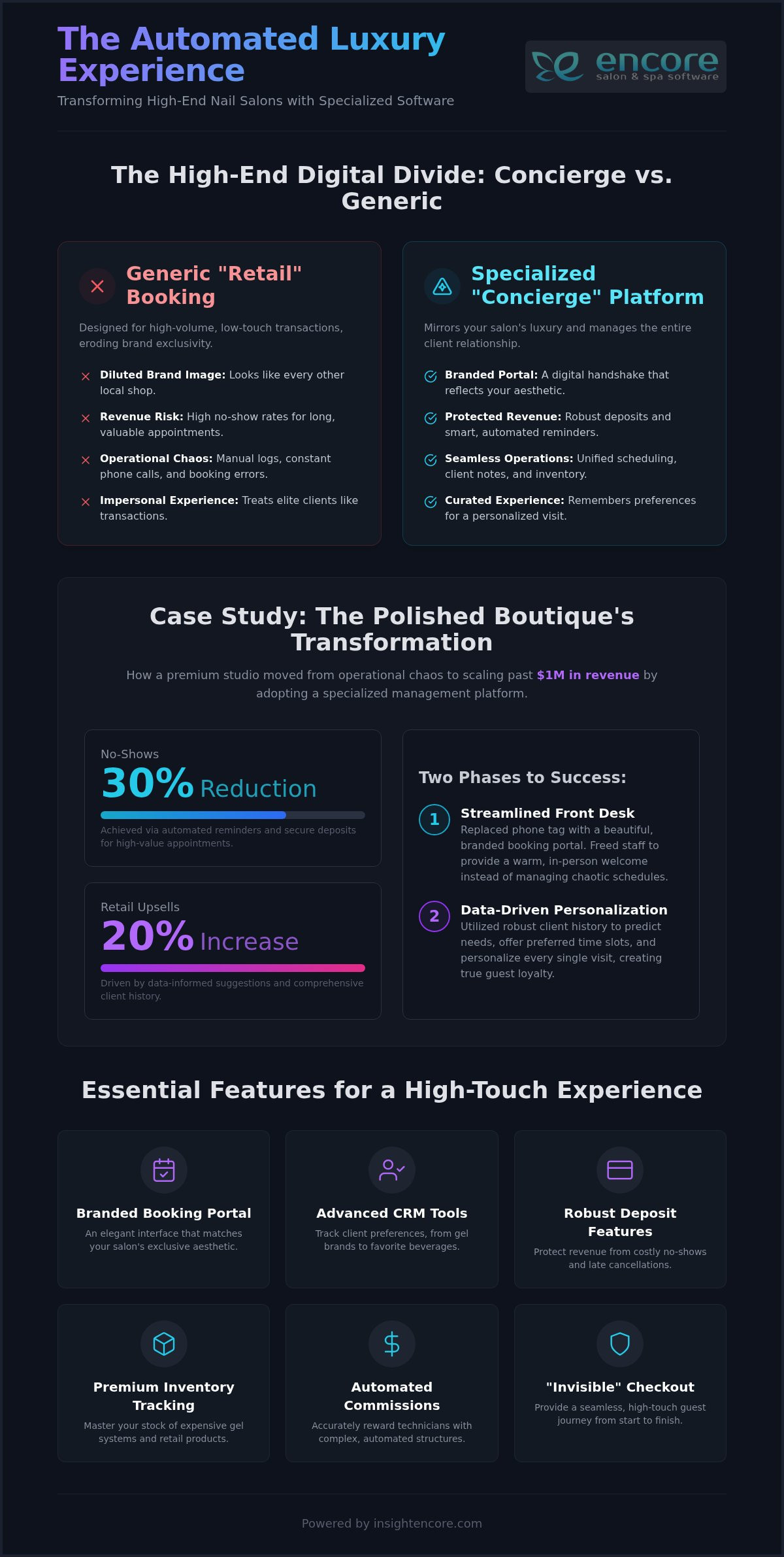
Luxury isn’t just about the marble floors or the quality of your seating. It’s about the feeling of being seen and understood. Many owners make the mistake of using generic appointment scheduling software designed for quick, high-volume transactions. But a high-end salon operates on a different frequency. It’s a concierge-first model. This means your digital tools don’t just fill a gap in a calendar; they manage an ongoing relationship. When a client spends hundreds on a single visit, they expect every interaction to feel intentional.

When you choose software for high-end nail salons, you’re investing in your brand’s digital handshake. A branded booking portal tells your client that their time is valuable and their preferences matter. It creates a psychological sense of security and belonging before they even arrive. In 2026, the shift is moving toward AI-driven personalization. Imagine a system that suggests a specific technician because it knows your client prefers a quiet, meditative environment during their service. This technology doesn’t replace your staff. It empowers them to be better hosts by providing the data they need to excel.

Concierge vs. Retail: Understanding the Digital Divide

In the retail world, speed is everything. We’re used to "Amazon Prime" efficiency where the goal is to get in and out. In luxury beauty, however, rushing feels cheap. Your digital communication needs to balance automation with a human touch. Using specialized software for high-end nail salons allows for deep customization that generic tools miss. You need custom fields to track whether a client prefers a specific brand of premium gel or if they always enjoy a glass of sparkling water. This level of detail turns a simple appointment into a curated, high-touch experience. If you’re still managing bookings manually, learning how to implement reliable salon scheduling software can help you reclaim the hours lost to administrative chaos and redirect that energy toward your clients.

The Cost of "Free" or Generic Booking Systems

Generic systems often lack the aesthetic flexibility your brand requires. If your booking page looks like every other local shop, you’re diluting your exclusivity. There’s also a significant financial risk. High-end services often take two or three hours. A single no-show can cost hundreds in lost revenue. You need robust deposit features and automated, yet personalized, reminders to protect your bottom line. Before committing to any platform, it’s worth understanding the hidden costs of a free salon online booking system that can quietly drain your revenue through transaction fees and lost opportunities. Transitioning to Encore Salon Software ensures your operational backend matches the sophistication of your physical space. It removes the friction that often plagues "one-size-fits-all" platforms, giving you back your peace of mind.

Case Study: How a Premium Studio Scaled to $1M+ with Smart Management

Success in the luxury market often hides behind a veneer of calm, but for "The Polished Boutique," the reality was anything but peaceful. Before adopting specialized software for high-end nail salons, this high-traffic studio relied on manual paper logs and a constantly ringing phone. Their bottleneck was clear. Inconsistent client records led to double bookings, while manual scheduling left no time for the front desk to actually greet guests. They were losing money and, more importantly, they were losing the "luxury" feel their brand promised.

Transitioning to Encore’s specialized nail module allowed them to step away from the chaos. By moving to an all-in-one management platform, they unified their scheduling, client notes, and inventory. The results were immediate and measurable. They saw a 30% reduction in no-shows and a 20% increase in retail upsells within the first six months. This wasn’t just luck. It was the direct result of having the right tools to support their growth. It’s about having a partner that understands your daily hurdles.

Phase 1: Streamlining the Front Desk Concierge

The first step was implementing a salon client booking portal that matched their high-end aesthetic. Instead of a generic list of services, clients were greeted with a beautiful, branded interface. Automated reminders were set up to secure high-value, long-duration appointments. This simple change drastically reduced phone time for the staff. Instead of playing phone tag, the team focused on providing a warm, in-person welcome to every guest who walked through the door. It made the studio feel like a sanctuary again.

Phase 2: Data-Driven Personalization

With a robust database, the boutique began using client history to predict and offer preferred time slots before the client even asked. They also leveraged automated marketing to send "VIP-only" seasonal previews of new luxury lacquer collections. By treating every client interaction as a data point for future comfort, they created a cycle of loyalty that felt effortless. Detailed client profiles ensured that every technician knew exactly how a guest liked their coffee or which specific gel brand they preferred. By leveraging historical data to personalize every visit, the boutique successfully turned one-time guests into lifelong regulars who wouldn’t dream of going anywhere else. If you’re ready to see how these tools can work for your business, you can explore our specialized features today.

Beyond the Basics: Essential Features for a High-Touch Client Experience

Luxury clients don’t just pay for a service; they pay for a narrative. In the 2026 market, your CRM is the brain of that narrative. Using specialized nail salon client management software allows you to store more than just phone numbers. You can track anniversaries, favorite scent profiles, and even the specific pressure they prefer during a hand massage. This is the foundation of high-touch service. It’s about remembering the things your clients haven’t even said out loud yet. When your team has this data at their fingertips, every guest feels like the only guest in the room.

The right software for high-end nail salons acts as a silent partner in your success. It removes the technical friction that often interrupts a relaxing environment. By automating the backend, you give your staff the freedom to focus entirely on the person in their chair. This shift from "managing tasks" to "managing experiences" is what defines a truly elite boutique. It’s a transition that requires reliable tools and a clear vision for your brand’s future.

The "Invisible Checkout" and Integrated Payments

Nothing ruins a post-massage glow quite like fumbling for a credit card at a busy front desk. The "invisible checkout" is a hallmark of luxury operations. By utilizing card-on-file features, you allow your guests to simply walk out when their service is complete, knowing the transaction is handled. This requires integrated credit card processing that communicates directly with your booking system. It handles complex tipping and technician commissions automatically. It’s fast, it’s secure, and it keeps the focus on the luxury experience rather than the bill.

Membership Tiers and Exclusive Loyalty Programs

Forget the "buy ten get one free" punch cards. High-end loyalty should feel like an exclusive club. Your software should help you design and manage sophisticated membership tiers that offer real value. Consider these options for your boutique:

  • The Unlimited Tier: A monthly subscription for unlimited basic manicures and priority booking.
  • The VIP Preview: Early access to new seasonal lacquer collections and limited-edition gel systems.
  • The Concierge Club: Complimentary beverage service and a dedicated booking line for your top 1% of clients.

Automating the billing for these recurring revenue models ensures your cash flow remains steady without manual intervention. It allows you to track and reward your most loyal guests with surgical precision. When a client feels like they belong to something exclusive, their retention rate skyrockets. You aren’t just selling a service anymore; you’re providing a lifestyle they don’t want to give up.

Software for High-End Nail Salons: A 2026 Case Study in Luxury Operations

Operational Excellence: Managing Inventory and Staff in a High-End Environment

A luxury boutique is only as strong as its backend operations. While your clients enjoy the serene atmosphere you’ve created, your team needs a high-precision engine running behind the scenes. Managing a premium studio means juggling high-cost supplies and a talented team of artists who expect fair, transparent compensation. Relying on manual spreadsheets for these tasks is a recipe for burnout. The right software for high-end nail salons turns these complex operational hurdles into a streamlined, automated process that gives you back your peace of mind.

True operational excellence comes from moving away from "guessing" and toward real-time data. You need to know your exact profit margins on every service, from a basic manicure to a complex, multi-service afternoon. Optimizing your nail salon POS system ensures that every transaction feeds into a larger picture of your business health. This allows you to make confident decisions about growth, hiring, and product investments without the stress of missing information.

Precision Inventory Management for Luxury Brands

In a high-end environment, your inventory isn’t just "stock." It’s a collection of professional-grade gel systems and luxury lacquers that represent a significant investment. Losing a few bottles to waste or theft can quietly erode your margins. Specialized software for high-end nail salons allows you to set "Low Stock" alerts for your most essential premium products. This ensures you never have to tell a VIP client that their favorite shade is unavailable.

You can also track back-bar usage versus retail sales with surgical precision. By mapping specific products to specific services, you’ll see exactly how much product your technicians are using. This transparency reduces waste and helps you understand the true cost of every service you offer. It’s about having total control over your resources so you can focus on the artistry.

Staff Performance and Retention

Your technicians are the heart of your brand. In the luxury market, retaining top-tier talent is vital. You need to track productivity without making your artists feel micromanaged. A modern management system provides staff with mobile access to their own schedules and goals. This empowers them to take ownership of their day and see their progress in real-time. It fosters a culture of professional confidence and growth.

Automating complex commission structures is another major win for retention. Whether you have senior artists on a higher percentage or junior technicians on a base plus commission, the software handles the math for you. It even accounts for multi-service appointments where different commission rates might apply. This eliminates "payday friction" and ensures your team feels valued and respected for their hard work. If you’re ready to simplify your operations, you can start your Encore journey today and see the difference for yourself.

Elevating Your Brand: Implementing Encore for Your Luxury Nail Boutique

Switching your management system is often the most daunting hurdle for an established boutique owner. You worry about losing a decade of client history or confusing your regulars with a new interface. But staying with a platform that limits your growth is a much bigger risk. Modern software for high-end nail salons is built to handle this transition with empathy and precision. It’s about moving from a tool that simply functions to one that actually inspires your team and delights your guests.

Your brand is your signature. Every digital touchpoint must reflect the same aesthetic as your physical studio. With Encore, you don’t have to settle for a generic booking page. You can customize the user interface to match your boutique’s specific brand colors and professional tone. This ensures a consistent, high-end experience from the moment a client clicks "book" to the moment they leave with a fresh set. It’s about building trust through visual excellence.

Staff training is the final piece of the puzzle. Software should be a supportive partner, not a technical barrier that hinders service. We focus on training your artists to use the system to enhance the guest journey. When your team spends less time on manual entry and more time on their artistry, everyone wins. A confident staff creates a confident client base.

Seamless Data Migration and Setup

The transition process doesn’t have to be a solo journey. Human-led support is essential during the migration phase to ensure every client note and appointment record transfers securely. We work with you to set up your service menu for maximum "bookability," ensuring your most profitable services are front and center. A dedicated onboarding specialist can typically have a busy boutique fully migrated and ready for launch within fourteen to twenty-one days without interrupting your daily operations. This structured approach removes the guesswork and allows you to focus on your clients.

Measuring Success: Your First 90 Days

Once your new system is live, it’s time to monitor your progress. Keep a close eye on key performance indicators like rebooking rates and average ticket values. These metrics will show you exactly how the new system is impacting your bottom line. Gathering direct client feedback on the new booking experience is also vital. Most luxury guests appreciate the ease of a modern portal, and their positive reviews will confirm you made the right choice. You can check out our pricing and features to see how we support luxury scaling at every stage.

Ready to see how a specialized system can transform your studio? It is time to move beyond the limitations of generic tools and embrace a platform designed for your specific needs. Try Encore Now to see the luxury difference and take the first step toward a more organized, high-revenue future.

Securing the Future of Your Luxury Boutique

Managing a high-end studio is an art form that requires the right tools to truly flourish. We’ve explored how specialized software for high-end nail salons moves beyond simple transactions to create a digital concierge experience. By automating complex commissions and precision inventory, you free your team to focus on the luxury services that define your brand. You don’t have to choose between operational control and a high-touch guest experience. With the right system, you can have both.

From Syntec Business Systems, founded in 1991, Encore brings decades of industry expertise to your front desk. Our specialized modules are designed specifically for the luxury beauty niche, featuring integrated marketing and loyalty tools built right into the platform. We’re here to help you remove the technical friction that holds your business back. It’s time to give your boutique the professional foundation it deserves.

Ready to elevate your boutique? Try Encore Now for your high-end nail salon.

Your journey toward a more organized, high-revenue studio starts with a single step. We’re excited to be your partner in this next chapter of growth and success.

Frequently Asked Questions

What is the best software for high-end nail salons in 2026?

Encore Nail Salon Software is the premier choice because it prioritizes a concierge-first experience over simple transactions. It offers specialized modules that handle the complex scheduling and high-end client management required in luxury environments. Unlike generic apps, it allows for deep branding and personalization. This ensures your digital presence matches your boutique’s physical aesthetic perfectly while providing a supportive backend for your team.

Can nail salon software help reduce no-shows for luxury services?

Yes, the right system reduces no-shows by using automated, personalized reminders and robust deposit features. Since luxury services often involve long durations and expensive materials, protecting your time is vital. You can require card-on-file or partial payments during the booking process. This professional boundary encourages client commitment and protects your studio’s revenue from late cancellations, giving you total peace of mind.

How does integrated payment processing improve the luxury client experience?

Integrated credit card processing creates an "invisible checkout" where clients don’t have to fumble for cards after a relaxing service. By keeping a card on file securely, you allow guests to simply walk out while the system handles the bill and tips. This removes the friction of a traditional transaction. It keeps the focus on the pampering they just received rather than the financial cost of the visit.

Is it difficult to switch from a generic salon app to Encore?

Switching is a streamlined process with our human-led support team guiding you through every step. We prioritize your peace of mind by ensuring a secure data migration of your existing client records and service history. Most boutiques are fully operational on the new system within fourteen to twenty-one days. We help you set up your menu for maximum bookability and ease of use from day one.

Does Encore support membership programs for nail boutiques?

Yes, Encore includes specialized tools for creating and managing tiered membership programs that feel like exclusive clubs. You can automate recurring billing for "unlimited" tiers or offer exclusive VIP early access to new collections. This turns a standard service into a lifestyle choice for your guests. It provides your boutique with steady, predictable revenue while building deeper loyalty with your most valuable, top-tier clients.

Can I manage multiple luxury salon locations with one software account?

You can certainly manage multiple locations through a centralized dashboard that provides a bird’s-eye view of your entire business. This allows you to track inventory, staff performance, and client history across all your boutiques simultaneously. It ensures a consistent luxury standard regardless of which location a guest visits. You’ll have total control over your brand’s growth without the administrative headache of separate systems.

How does software help with high-end nail inventory management?

The software tracks professional back-bar usage versus retail sales to ensure you never run out of essential premium products. You can set "Low Stock" alerts for high-cost items like specialized gel systems or luxury lacquers. By mapping products to specific services, you’ll see exactly where your inventory is going. This precision reduces waste and helps you maintain healthy profit margins for your high-end nail salon.

Can my nail technicians see their commissions in real-time?

Yes, your team can access their own schedules and commission goals through a mobile-friendly interface. This transparency empowers your artists and removes "payday friction" by showing them exactly what they’ve earned. The system automatically calculates complex commissions for senior versus junior technicians. It’s a great tool for staff retention because it makes your team feel valued and respected for their professional artistry.

Disclaimer

This article is general in nature and may contain errors, please verify all claims with your sales rep