
window.dataLayer = window.dataLayer || []; function gtag(){dataLayer.push(arguments);} gtag('js', new Date()); gtag('config', 'UA-206511945-1');
Search
Categories
Uncategorized

Spa client management for repeat business with practical rebooking ideas

Repeat bookings are built between appointments, not just at checkout. Effective spa client management for repeat business combines a thoughtful rebooking offer with easy scheduling and personal follow-up, so clients have a clear reason and a simple way to return.

It makes sense to focus on the treatment itself, but the experience around it matters too. A timely reminder, a relevant milestone message, or a note based on a client’s preferences can make the next visit feel like a natural part of their care. In this guide, you’ll find practical ways to use rebooking incentives, booking tools, client records, and milestone messages to encourage return visits. You’ll also learn how management software can bring these details together, making it easier to manage client relationships and follow up consistently without adding unnecessary complexity.

Key Takeaways

  • Choose rebooking incentives that fit your services and give clients a clear reason to schedule again.
  • Make it easy to book the next visit and use timely reminders to bring the appointment back to mind.
  • Keep useful client preferences and service notes together so follow-ups feel relevant and personal.
  • Use meaningful milestones as a natural reason to reconnect, rather than sending messages that feel generic.
  • Management software can help organize client details, booking activity, and follow-up in one workflow.

1. Discounts and incentives to encourage rebooking

The most useful spa loyalty programs give clients a clear reward for returning. A points system, a visit-based reward, or a targeted rebooking discount can all encourage another appointment. For example, a program might award 10 points for every dollar spent, then let clients redeem 1,000 points for a complimentary treatment or 20% off their next booking. Another option is a complimentary manicure or pedicure after every tenth visit.

Choose an incentive that fits the services clients already enjoy. A discount can introduce a complementary treatment, while a loyalty reward can recognize regular visits. Keep the rules easy to explain: tell clients what earns a reward, when they can use it, and how to redeem it. A complicated program can make the benefit harder to understand. A simple explanation at checkout helps clients decide whether to book again.

Make rebooking part of the service flow, not an afterthought. Before a client leaves, the provider can explain a suitable maintenance interval and offer to schedule the next appointment. For example, after a skin service, staff might discuss a follow-up around two months later, based on the client’s needs and treatment plan. If the client would rather decide later, explain how to book and what reminder to expect.

Checkout creates a natural moment to confirm a return visit. After payment, staff can offer available times, apply any eligible reward, and note the client’s preferred appointment window. This clarifies the next step without pressuring the client. A reward should support a useful treatment plan, not replace a conversation about what the client wants or needs.

Track retention and rebooking separately to understand where the process works. New-guest retention measures whether clients return within 90 days. For example, if 80 of 100 new clients return within that period, the retention rate is 80%. Repeat-client retention focuses on clients who return after their second visit. Rebooking rate, meanwhile, shows how often clients schedule another appointment before leaving.

Review these measures together with reward use. If clients redeem points but don’t book again, the reward may not match their interests or timing. If clients accept a next appointment but later miss it, review reminders and cancellation patterns. Top-performing salons and spas reach rebooking rates of 70% or higher, so a consistent checkout offer and a clear loyalty program give teams practical steps to improve their process.

Strategic discounts can invite clients to try a new service or rebook a previous treatment, and an incentive may encourage someone considering rebooking to return sooner. After a skin service, propose a follow-up appointment about two months later. A salon can offer a free manicure or pedicure after every tenth visit; one customer says a loyalty card with that reward would encourage her to visit the same salon every two weeks. Using tools like Encore Salon & Spa Software helps track these metrics effectively, noting that an increase in customer retention rates of 5% is associated with a 25% to 95% increase in profits.

2. Online booking and appointment reminders

Online booking lets clients schedule at a convenient time without waiting for a call back. Keep the booking process clear: show available services and appointment times, along with the information clients need before confirming. When clients can quickly find a suitable slot, they are less likely to put off scheduling. Make rescheduling instructions easy to find too, since plans can change.

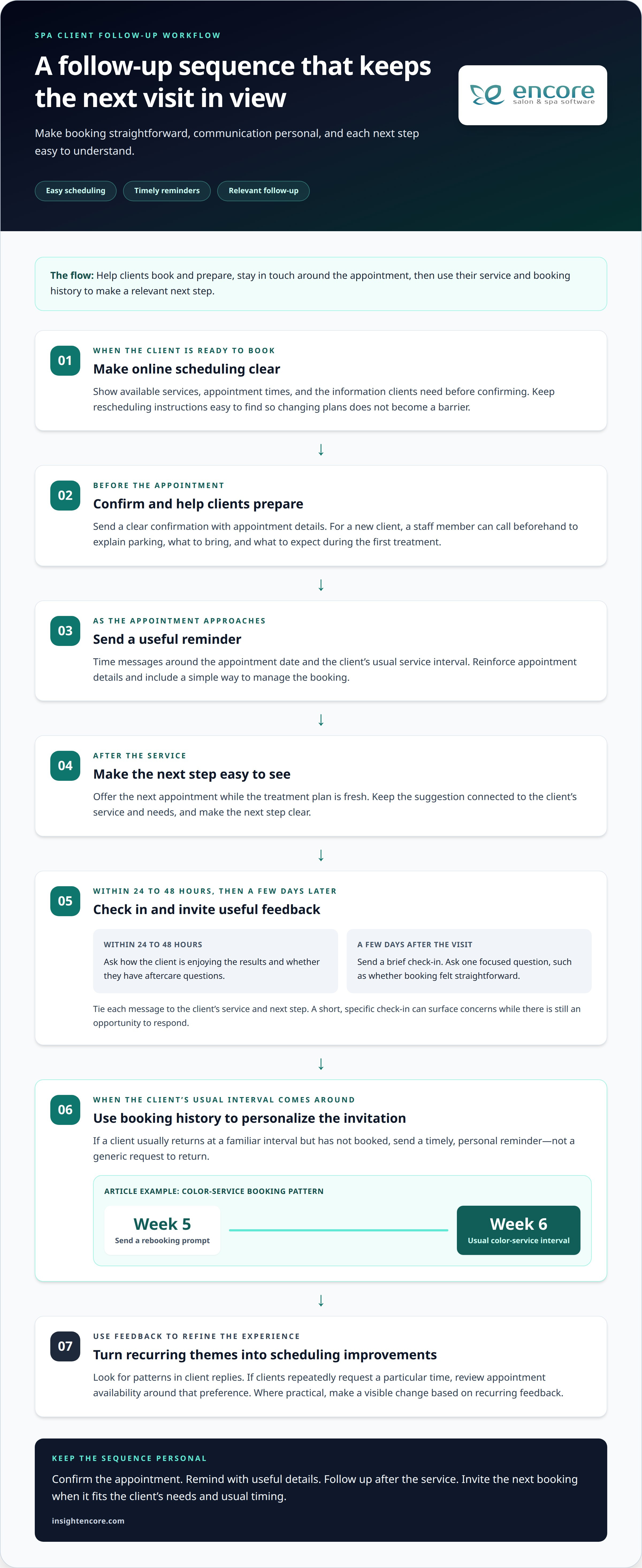
To automate reminders and rebooking follow-ups, time messages around the appointment date and each client’s usual service interval. Include appointment details and a simple way to manage the booking. For example, send a rebooking prompt around week five to a client who usually books color services every six weeks. Make the message specific and useful, rather than a generic request to return.

Reduce no-shows with convenient booking and clear confirmation messages. For a new client, a staff member can call beforehand to explain parking, what to bring, and what to expect during the first treatment. A reminder can then reinforce the appointment details. After the service, offer the next appointment and an easy way to book while the treatment plan is still fresh.

Follow up after the appointment with a short, helpful message. Spa staff can contact clients within 24 to 48 hours to ask how they’re enjoying their results and whether they have aftercare questions. A few days after the visit, a brief check-in can surface concerns before they become reasons not to return. Keep each message tied to that client’s service and next step.

Feedback works best when it is easy to give and clients can see that their input matters. Ask one focused question after a visit, such as whether booking felt straightforward or what could improve the treatment experience. Look for recurring themes in replies, then make a visible change where practical. If clients say it is hard to find appointments, adjust how available times are presented.

Use the feedback and booking history together to improve scheduling. If clients repeatedly request a particular time, review appointment availability around that preference. If a client usually returns at a familiar interval but hasn’t booked, send a timely, personal reminder. Consistent communication helps staff anticipate client needs and support steady business growth without making every message feel like a sales pitch.

Build a simple sequence: confirm the appointment, send a useful reminder, follow up after the service, and invite the client to book again when appropriate. Keep the tone warm and the next action clear. For a more streamlined way to handle bookings and reminders, simplify online booking and follow-up.

3. Keeping useful client records and preferences

Useful client records help staff make every return visit feel considered. After a treatment, note the service provided, products used, the client’s stated preferences, and any requested follow-up. For example, record that a guest prefers a quiet appointment and a particular room temperature. Keep notes factual and relevant so another team member can use them without guessing.

Separate lasting preferences from details that may change. A client might consistently prefer a certain booking time, while their service goals or product choices may shift. At the next visit, confirm that an older preference still applies before relying on it. This small step helps staff avoid treating past choices as permanent instructions.

Capture client history in a consistent format. A short template can prompt staff to record the service, date, preferences, and agreed next steps. Use clear wording such as “prefers minimal conversation during treatment,” rather than subjective labels. For a special occasion, note the client’s request only if it helps tailor the experience, then update or remove it when it no longer applies.

In the United States, privacy and marketing requirements can vary by state, information type, and communication channel. Keep records focused on service needs, restrict access appropriately, and review consent and opt-out practices for the locations and channels you use.

Make records useful throughout the client journey. Before an appointment, staff can review the last service and relevant preferences. During the visit, they can confirm what the client wants today and update the record afterward. If a client mentions that a fragrance bothered them, for example, document that preference and refer to it when discussing suitable products or treatments later.

Good notes can strengthen client retention because returning clients do not have to repeat every preference. They also help staff offer relevant choices instead of generic suggestions. A record might show that someone enjoyed a particular massage pressure but asked to avoid a certain product scent. Use those details to guide a conversation, not to assume the client wants the same service every time.

Review client records regularly for accuracy and usefulness. Correct outdated preferences, remove duplicate notes, and make sure important details are easy for the team to find. Clear, current records support a more personal experience at each visit and give staff a practical basis for thoughtful recommendations.

commendations, while leaving room for clients to revise what they want. A Forbes Business Council contributor says customers under 40 will want automation, while older clients may prefer a personal touch. Treat this as a reason to offer different ways to communicate, not as a substitute for asking each client what works for them. Record a stated preference when it helps staff support the client, and check that it still applies at the next visit.

Keep automated messages consistent with the preferences and consent recorded for each client. If a client would rather discuss choices with a staff member, make that conversation part of the experience. If they prefer an automated step, use it to simplify routine interactions while leaving room for questions or updates. In either case, let the client’s current request guide the service, and keep the record clear enough for the team to follow.
Spa client management for repeat business with practical rebooking ideas

4. Personalized messages for client milestones

A personal message can turn a birthday, anniversary, or new job into a thoughtful reason to reconnect. Keep the note focused on the client, not just a promotion. For example, acknowledge a birthday and suggest a service that suits a preference they have shared. A message about an upcoming vacation could mention a treatment they previously enjoyed before traveling.

Use client data carefully to make every interaction feel relevant. Review service history and recorded preferences before drafting a message. If a client usually books massage appointments and once asked about a complementary service, suggest that option instead of sending a broad spa-wide offer. Confirm that the detail still applies during the next visit, and update the record if their interests have changed.

Personalized email campaigns work best when each group receives a message with a clear purpose. Create separate audiences for birthday greetings, service anniversaries, and clients who have not returned after a treatment. Then write a short message for each occasion. A birthday email might offer a warm greeting and invite the client to explore a suitable service, while an anniversary note can thank them for returning.

Make each offer useful and easy to understand. A milestone email can suggest a treatment, share relevant service news, or invite the client to book at their convenience. Avoid packing a message with several unrelated offers. Before sending, check that the greeting, service suggestion, and booking instructions fit the intended audience. Clear, personal details make the message feel like a continuation of the relationship.

In-person conversations can add context that an email cannot. During a visit, ask what the client hopes to maintain or change, then listen before recommending a next step. For example, someone preparing for a vacation may want a different service than someone returning to a familiar routine. Record useful preferences afterward so the next staff member can continue the conversation naturally.

Keep milestone outreach consistent without making it feel automatic. Use a simple process: identify the occasion, review the client’s relevant history, choose one helpful message, and record the response. If a client says they are not interested, respect that preference. If they ask for a recommendation, follow up with a specific option suited to their needs.

Review replies and bookings to improve future messages. If birthday notes prompt questions about a particular service, adjust the next campaign to answer those questions clearly. If clients respond better to personal calls, use that approach for suitable milestones. Thoughtful, relevant touchpoints strengthen relationships and give clients a welcoming reason to consider returning.

5. Client management software

Client management software connects client details with a spa’s daily operations. Instead of searching through separate notes, staff can use a profile to review services, visit history, and preferences. Before a returning guest arrives, for example, the team can check relevant notes and prepare for a more informed conversation. Effective spa client management for repeat business makes those details easy to use throughout the client journey.

Booking and client management platforms vary in what they emphasize. Some focus mainly on appointment scheduling, while others combine booking with client records, marketing, loyalty tools, or business management features. Compare options against your workflow: what information staff need, how clients book, and which follow-up tasks take the most time. The right fit supports those priorities consistently.

Use intake information to guide useful conversations. If a client describes a specific goal during an intake interview, staff can explain the value of repeat treatments or discuss a complementary service. Keep recommendations relevant to the client’s stated needs. This turns profile information into a service conversation, rather than a reason to send a generic offer.

Software can also connect service history with retail and loyalty activity. Staff can review products a client has purchased before discussing a suitable item for home care, for example. Loyalty tools help organize rewards and show whether a client has earned or used one. Keep the offer clear and suited to the client’s interests.

Make client details useful across the team. A profile should help staff answer practical questions, such as which service a client booked previously or what preference they shared. Clear records can also give managers a direct view of client activity and highlight ways to improve the experience.

Implementation works best when the team agrees on a simple routine. Decide which details belong in a profile, who updates them after a visit, and how staff should use them. For instance, record a client’s service goal and preferred products, then review those notes before their next appointment. Effective spa client management for repeat business turns this routine into a shared process, not a collection of disconnected notes.

Choose software based on the work it helps your spa complete. If scheduling, client details, loyalty activity, and follow-up feel disconnected, a system that brings these tasks together can support smoother daily management. Start by identifying the steps staff repeat most often, then consider how a connected workflow could make them easier.

Explore spa client management software

Encore Salon & Spa Software: Client Management System

Encore Salon & Spa Software offers a Client Management System to help organize client relationships and support repeat business. If booking activity, client information, and follow-up are difficult to manage across separate processes, a dedicated system can bring them into a more consistent workflow.

Encore Salon & Spa Software provides a management platform for spa operations. Use its client management tools to keep useful details accessible and support informed service conversations. The practical goal is to help staff manage client information and maintain relationships between visits.

If you’re ready to discuss how a client management system could fit your spa, contact Encore Salon & Spa Software.

Build a repeat-visit approach that fits your spa

Strong spa client management for repeat business starts with a clear, consistent approach that suits your team and clients. Choose one improvement to focus on, then build it into everyday service. As the process becomes familiar, review how clients respond and adjust your approach to their needs.

Encore Salon and Spa Software offers Encore Salon Software, Encore Spa Software, and Chair/Booth Renter Software. These solutions support different business settings, while a Client Management System helps organize client relationships. Consider which parts of your workflow need better coordination, then explore the option that aligns with those needs.

Contact Encore Salon and Spa Software

Every lasting client relationship starts with a thoughtful experience and grows through attention over time. Improve one practical step at a time, and make each return feel like a natural choice.

Frequently Asked Questions

What spa client management software features help increase repeat bookings?

Look for tools that connect appointment scheduling with client profiles and follow-up. Service history can help staff prepare a relevant recommendation, while email and text marketing can support birthday or anniversary messages. Loyalty program tools can organize rewards too. Together, these features turn client information into timely, relevant reasons to return, rather than relying on generic promotions or staff memory alone.

How can spas use client profiles and treatment histories to personalize services?

Use profiles to guide conversations, not make assumptions. Before a treatment, staff can review previous services, recorded preferences, and any formulas or products noted in the client’s history. They can then ask whether the client wants the same approach or a change. For example, a returning guest may prefer a familiar treatment but want to discuss a different product or service goal.

What spa client retention metrics should businesses track?

Track how often clients book again, how many complete a subsequent visit, and which services bring them back. Compare these measures across service categories or booking periods to spot patterns. You can also monitor whether clients act on follow-up messages or loyalty offers. Reviewing the results together helps distinguish a strong initial booking rate from lasting return visits and shows where the client journey may need attention.

Disclaimer

This article is general in nature and may contain errors, please verify all claims with your sales rep

Categories
Uncategorized

Best Spa Booking Software in 2026: The Ultimate Buyer’s Guide

Why is the software meant to simplify your life actually stealing your weekends? You started your business to care for people, not to wrestle with clunky spa booking software or chase down lost revenue from last-minute no-shows. It’s exhausting to spend more time on manual admin than you do with your clients. We understand that frustration. You deserve a system that feels like a supportive partner, not a technical hurdle your staff refuses to use.

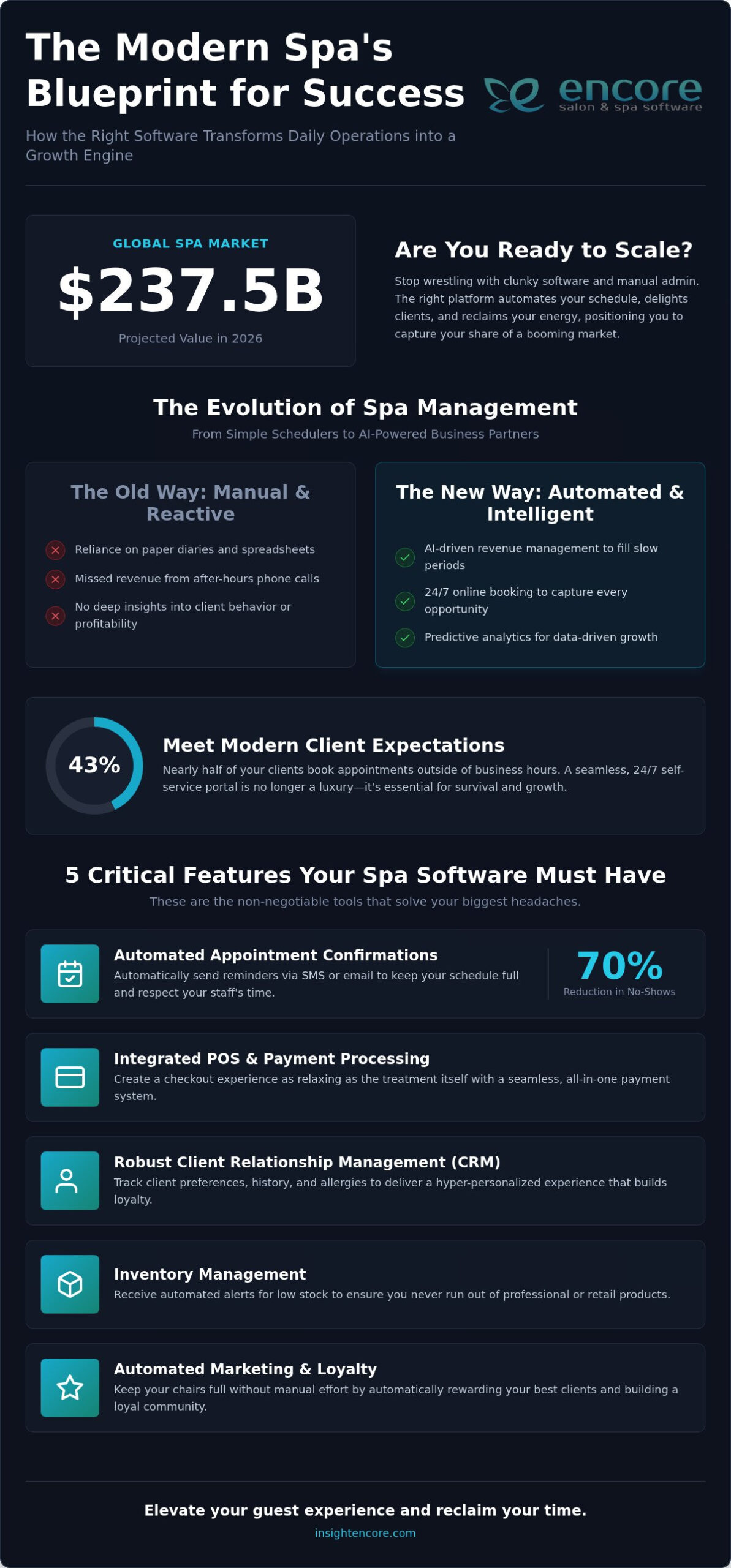
The good news is that the right platform can transform your daily grind into a streamlined success story. With the global spa market projected to reach $237.50 billion in 2026, there has never been a better time to scale your operations. This guide is here to help you choose a solution that automates your schedule, delights your clients, and reclaims your energy. We will look at the top-rated options for this year, including specialized tools like Encore Salon & Spa Software, to ensure you regain organized control of your business. Let’s find the perfect fit so you can get back to what you do best.

Key Takeaways

  • Understand how modern management tools have evolved from simple calendars into AI-driven business partners that handle your heavy lifting.
  • Identify the essential features in spa booking software that reduce no-shows and remove friction at checkout.
  • Navigate the hidden costs of marketplace platforms versus the long-term benefits of owning your own private branded software.
  • Follow a step-by-step roadmap to migrate your client history and service menus safely without interrupting your daily operations.
  • Learn how consolidating your booking, marketing, and payments into one system creates a seamless experience for both your staff and guests.

What is Spa Booking Software and Why is it Essential in 2026?

Your spa is more than just a place for relaxation; it’s a complex machine with many moving parts. In 2026, spa booking software has evolved from a digital version of a paper diary into a full business management ecosystem. It’s the central nervous system of your operation. It handles everything from the first click on your website to the final payment at the desk. By automating repetitive tasks, this technology allows you to step away from the front desk and focus on what truly matters: your clients’ well-being. It helps eliminate the "owner burnout" that comes from juggling spreadsheets and missed phone calls.

We’ve moved far beyond simple calendars. Modern systems now use AI-driven revenue management to optimize your day. Imagine a tool that knows exactly when your slow periods are and automatically reaches out to your loyal clients with a personalized offer to fill those gaps. This isn’t just about filling slots; it’s about maximizing every hour your staff is on the clock. It’s about working smarter, not harder. With the global spa market projected to reach $237.50 billion this year, staying competitive means embracing these advanced all-in-one features.

Client expectations have shifted dramatically. Research shows that approximately 43% of clients now book their appointments outside of traditional business hours. If you’re still relying on a phone line and a voicemail box, you’re likely losing nearly half of your potential revenue. Providing a seamless 24/7 booking experience isn’t a luxury anymore; it’s a requirement for survival. It ensures your calendar stays full while you sleep.

The Evolution from Scheduling to Business Intelligence

The shift from basic appointment scheduling software to true business intelligence is a game changer for owners. These systems do more than just record a time and date. They predict trends. They analyze which services are your most profitable and which staff members have the highest rebooking rates. This data is the key to client retention. When you have centralized information, you can stop guessing and start growing. While "free" tools might seem tempting, they often lack these deep insights. They end up costing you more in lost time and missed opportunities for expansion.

Meeting the 2026 Guest Expectation

Today’s guest wants control. They expect instant confirmations and easy-to-use self-service portals where they can manage their own schedules. A mobile-first approach is essential. Your clients are booking while they’re on the train, during their lunch break, or late at night from their couch. By offering a sleek, intuitive booking interface, you provide a luxury experience before they even step through your doors. This level of professionalism builds trust. It sets the tone for the high-quality care they will receive at your spa. It’s about removing every bit of friction from their journey.

5 Critical Features Your Spa Management System Must Have

Choosing the right spa booking software isn’t just about picking a pretty interface. It’s about finding a silent business partner that solves your biggest headaches. A top-tier system handles the heavy lifting so you don’t have to. It should feel like an extension of your team, working behind the scenes to keep things running smoothly and allowing you to focus on your guests.

Automated appointment confirmations are a lifesaver for busy owners. Industry data suggests that these automated reminders can reduce no-shows by up to 70%. This keeps your revenue steady and respects your staff’s time. Beyond the calendar, your system needs integrated POS and payment processing. Checkout should be as relaxing as the treatment itself. When payments "just work," you remove friction for the client and the front desk staff alike.

A robust CRM is another essential. It tracks client preferences like their favorite essential oils or past allergies. This allows you to provide a hyper-personalized experience every time they visit. For the back of the house, inventory management with automated alerts ensures you never run out of professional-grade products during a busy week. Many modern systems now incorporate AI-driven tools to help you manage these complex tasks with ease and precision.

Finally, automated marketing and loyalty programs keep your chairs full without manual effort. Whether you’re managing a team of employees or specialized booth renters, having a system that rewards your best clients automatically is key to long-term growth. Independent professionals renting space in your facility can especially benefit from a dedicated booth renter client management app to handle their own bookings and client communications seamlessly. It builds a community of loyal guests who feel valued and appreciated.

Seamless Online Booking & Client Portals

A professional online booking portal is a non-negotiable for growth. It allows you to customize the booking experience to match your brand’s luxury aesthetic. You can enable deposits and prepayments to secure your revenue before the guest even arrives. This level of self-service empowers your clients to book on their own terms, day or night. You can explore how these tools work by visiting our dedicated software page.

Integrated Payments and Financial Reporting

Choosing a spa booking software with built-in Integrated Credit Card Processing makes end-of-day reconciliation a breeze. You can generate real-time reports on staff performance and track gift card balances instantly. This transparency is vital for scaling your business. It allows you to see which services are driving your profit and which areas need more focus. If you’re ready to see how these features can streamline your business, you can get in touch with our team to learn more.

Comparing Top Spa Software Solutions: Finding Your Fit

Finding the right spa booking software means looking past the flashy marketing and understanding how a platform handles your specific revenue model. While many systems look identical on a demo screen, the operational reality varies wildly between a solo suite and a multi-location facility. You need to evaluate whether a tool is designed to grow your business or simply tax your existing success. Look for a partner that prioritizes your brand ownership over their own marketplace visibility.

Generic POS systems often fall short because they treat a massage or a facial as a simple product sale. They don’t account for the "resource triangle": the therapist, the specialized room, and the equipment. If your software doesn’t automatically block all three, you’ll end up with double bookings that frustrate staff and guests alike. Specialized solutions solve this by building their logic around these spa-specific constraints, ensuring that your resources are never over-committed. Learning how to optimize your spa appointment scheduling software for growth can help you avoid these common pitfalls and build a more resilient operation.

The true cost of ownership is another area where many owners get caught off guard. Some platforms offer low entry prices but take a larger cut of every transaction through high processing rates. Others charge per user, which can make scaling your team unexpectedly expensive. As of late 2026, the industry standard has shifted toward more transparent, per-location pricing models. Always calculate your total monthly volume against the processing fees to see the real impact on your margins and long-term profitability. To stay ahead of what’s coming next, it’s worth exploring the best spa management software trends shaping the industry in 2026.

The Problem with Generic Marketplace Software

Marketplace apps often lure owners with the promise of "new client discovery." However, this visibility comes at a steep price. Many of these platforms charge a significant commission, sometimes reaching 20% for every new guest they "find" for you. Even worse, they often display your competitors on the very same page where your clients are trying to book. This dilutes your brand and forces you to compete for your own loyal customers within a crowded app ecosystem.

Owning your guest journey is vital for building a lasting legacy. When you use a private branded system like Encore Salon & Spa Software, you keep 100% of your data and your brand identity. You don’t pay a "discovery tax" on your hard-earned reputation. This approach ensures that your marketing efforts build your business, not someone else’s platform. You can find a detailed breakdown of how this affects your bottom line on our pricing page.

Specialized Tools for Niche Service Providers

Niche providers, such as medical spas or high-end wellness centers, have requirements that go far beyond a simple calendar. You might need to manage complex service bundles that span multiple days or track professional inventory usage for medical-grade products. Independent contractors and booth renters also require specific permission levels to keep their financial data private while still using the house system. For these professionals, choosing the right booth renter client management app ensures they can own their client relationships and data without disrupting the host salon’s operations. A one-size-fits-all tool rarely has the depth to handle these professional nuances.

Whether you are running a high-volume nail studio or a serene holistic retreat, your spa booking software must adapt to your workflow. High-volume nail studios in particular can benefit from dedicated nail salon client management software that eliminates double-bookings and automates client reminders to protect daily revenue. Systems like Encore Salon & Spa Software provide the flexibility needed for these specialized environments. From tracking gift card liabilities to managing multi-room transitions, the right tool ensures your operations remain as calm as your treatment rooms. If you’re ready to see how a tailored fit can change your business, we invite you to reach out for a consultation.

Best Spa Booking Software in 2026: The Ultimate Buyer’s Guide

The Implementation Roadmap: Switching Without the Stress

The thought of moving your entire business to a new platform can feel overwhelming. You’ve spent years building your client lists and service menus. The last thing you want is a technical glitch that disrupts your schedule or loses sensitive data. We understand that hesitation. However, staying with a clunky system often costs you more in daily frustration than a well-planned transition ever will. By following a structured roadmap, you can upgrade your spa booking software with confidence and minimal downtime.

The first step is a thorough audit of your current data. This is the perfect time to "clean house." Remove duplicate client profiles and archive service items you no longer offer. Starting fresh with clean data ensures your new system runs at peak efficiency from day one. Once your lists are polished, the migration phase begins. This involves moving client history, detailed notes, and future bookings safely into your new home. It’s a delicate process, but with the right guidance, it’s entirely manageable.

Transitioning your clients is just as important as the technical move. Clear communication is key. Send out a welcoming email or text message introducing your new booking portal. Highlight the benefits they will enjoy, such as faster checkout and 24/7 scheduling. Most guests appreciate the upgrade to a more modern, luxury experience. Finally, monitor your first 30 days closely. This "go-live" period is for optimizing your settings and ensuring every automated reminder is firing exactly as intended.

Ensuring a Secure Data Migration

Security is our top priority during any data move. Protecting client privacy and maintaining GDPR or HIPAA compliance isn’t just a legal requirement; it’s about maintaining the trust you’ve built. You must verify that gift card balances and loyalty points transfer with 100% accuracy. Because these details represent real money, there’s no room for error. This is why choosing a partner with a human-centric support team is vital. You need real experts who can walk you through the migration and answer your questions in real-time, rather than leaving you to figure it out alone.

Training Your Team for Success

Even the best spa booking software is only effective if your team actually uses it. To overcome "software fatigue," focus on the intuitive nature of the new interface. Show your staff how the system makes their lives easier by automating their schedules. Setting up role-based permissions is a smart way to simplify their view. It protects sensitive business data while ensuring therapists only see the information they need for their specific tasks. Encourage them to use mobile apps for schedule management on the go. When your team feels empowered by the technology, they can provide better care to your guests. If you are ready to see how a seamless transition looks, you can book a personalized demo today.

Elevate Your Guest Experience with Encore Salon & Spa Software

Choosing spa booking software shouldn’t feel like a gamble. It should feel like a relief. You’ve spent this guide learning about the strategies that drive success in 2026. Now, it’s about finding the team that will stand by you during every step of your journey. Since 1991, Syntec Business Systems has been that supportive partner for wellness professionals. We’ve combined decades of industry heritage with modern, cloud-based power to create a system that actually serves the person behind the desk. You’re never just a ticket number or an automated response to us. Your success is our mission.

Our "All-in-One" approach is designed to remove the noise from your workday. When your management tools live in one ecosystem, you gain a level of clarity that disconnected subscriptions simply can’t provide. This centralized visibility is the foundation for mastering your business. It allows you to make informed decisions that lead to sustainable, long-term growth. We want you to stop wrestling with technology and start enjoying the operational freedom you deserve. It’s about creating a business that runs smoothly whether you’re at the front desk or taking a well-earned break.

Why 30+ Years of Industry Expertise Matters

Experience is the best teacher. Encore Salon & Spa Software has evolved alongside the beauty and wellness industry for over 35 years. We’ve seen how guest expectations have shifted and how technology has transformed the service experience. This deep history, backed by Syntec Business Systems, ensures that our platform is both reliable and forward-thinking. We don’t just build features; we build solutions for the real-world hurdles you face every day. We understand the nuances of your craft because we’ve been part of this community for decades. For more tips on how to scale your success this year, check out our Master Your Business Guide.

Taking the Next Step Toward Operational Freedom

Operational freedom is within your reach. Think about the peace of mind that comes with a streamlined system and actionable business data. These aren’t just goals; they’re the standard results of choosing a partner that understands your craft. You’ve done the research and identified what your business needs to thrive. Now, the next step is to see how these tools feel in your own hands. We’re here to guide you through the transition and help you reclaim your time. We believe that when you have the right support, there’s no limit to what your spa can achieve. Ready to transform your spa? Try Encore Now.

Take Control of Your Business and Your Future

You’ve seen how the right technology can turn a chaotic calendar into a streamlined success story. By focusing on essential features and a clear implementation plan, you can eliminate the burnout that comes from manual admin. Finding the right spa booking software isn’t just about scheduling. It’s about securing your revenue, delighting your guests, and protecting your peace of mind. You now have the tools to move beyond clunky systems and hidden fees.

Syntec has been a dedicated partner to wellness professionals since 1991. We provide an all-in-one platform that includes integrated payments and marketing tools to help you scale without the technical headaches. Our human-centric support model ensures you’ll always have a mentor in your corner to guide you through every update. You deserve a system that works as hard as you do. It’s time to reclaim your weekends and focus on the clients who make your work rewarding.

Start your stress-free journey with Encore Spa Software today. We’re eager to help you build the thriving, organized business you’ve always imagined.

Frequently Asked Questions

Is spa booking software difficult to set up for a small business?

Setting up spa booking software shouldn’t be a headache for small business owners. Modern platforms are designed with intuitive interfaces that guide you through the process step by step. When you work with a provider like Encore, you also get the benefit of human-centric support to help with initial configuration. This ensures your service menus and staff schedules are optimized for success right from the start.

How does spa software help reduce appointment no-shows?

Automated reminders are the most effective way to reduce no-shows. By sending SMS and email confirmations, you keep your services top-of-mind for your guests. Industry data shows these reminders can cut no-shows by up to 70%. This simple automation protects your revenue and respects your staff’s time, allowing you to focus on providing a high-quality guest experience instead of chasing missed appointments.

Can I migrate my existing client data from another software platform?

Yes, migrating your data is a standard part of the transition process. Most professional systems allow you to move client history, detailed notes, and future bookings safely. It’s important to choose a partner that offers dedicated migration assistance to ensure every detail transfers accurately. This human-centric approach prevents data loss and ensures your client relationships continue seamlessly on the new platform.

Do I need separate hardware for integrated payment processing?

You typically don’t need complex hardware for integrated payment processing. Most modern systems work with your existing computers, tablets, or smartphones. You may choose to add a small, portable card reader for physical transactions, but the software handles the heavy lifting. This integration simplifies your end-of-day reconciliation and removes friction at checkout, making the experience better for both your team and your guests.

Is it possible to manage multiple spa locations from one software account?

Centralized management for multiple locations is a key feature of cloud-based systems. You can view schedules, run reports, and manage inventory for every branch from a single login. This high-level overview is essential for owners looking to scale their operations without losing control. It allows you to maintain consistent brand standards and staff performance across your entire business footprint with ease.

Does spa booking software offer automated marketing tools?

Automated marketing tools are built into professional management systems to help keep your chairs full. These tools can automatically manage loyalty programs, send birthday rewards, or reach out to clients who haven’t visited in a while. By automating these interactions, you can maintain a full calendar without spending hours on manual outreach. It’s a smart way to grow your business while you focus on your craft.

What is the typical cost of a professional spa management system in 2026?

Pricing for spa management systems in 2026 varies based on your business size and needs. Entry-level plans for solo practitioners often start around $24 to $79 per month. For larger teams or multi-location businesses, costs can range from $120 to over $499 per month depending on the features included. It’s important to evaluate the total cost of ownership, including payment processing rates and any per-user fees, to find the best fit. You can also review the best spa management software trends for 2026 to understand how evolving features may affect your investment decisions.

Can my staff manage their own schedules through the software?

Staff members can easily manage their own schedules through dedicated mobile apps and secure portals. You can set role-based permissions so they only see the information relevant to their tasks. This empowerment allows therapists to check their upcoming appointments or manage their availability on the go. It reduces the administrative burden on you and gives your team the flexibility they need to perform at their best. For a deeper look at maximizing these capabilities, explore our guide on how to optimize your spa appointment scheduling software for growth in 2026.

Disclaimer

This article is general in nature and may contain errors, please verify all claims with your sales rep