
window.dataLayer = window.dataLayer || []; function gtag(){dataLayer.push(arguments);} gtag('js', new Date()); gtag('config', 'UA-206511945-1');
Search
Categories
Uncategorized

Barbershop POS With Inventory for Walk-Ins and Appointments

More than one barbershop doesn’t have to mean separate systems and scattered stock counts. A barbershop POS with inventory can help you manage multiple locations when it keeps each shop’s appointments, walk-ins, client records, sales, and stock organized while showing you the bigger picture across the business.

The system also needs to fit how your team works: barbers need a clear way to serve booked clients and walk-ins, take payments, and record product sales while keeping track of inventory. The right setup can make these daily tasks easier to manage, whether you run one shop or several.

This article explains how a POS can coordinate locations, bookings, client profiles, payments, and inventory, as well as what affects software and hardware costs. You’ll also learn which features help connect the front desk, barbers, and stockroom, so you can identify what your barbershop needs before choosing a system.

Key Takeaways

  • Keep walk-in and appointment sales organized by recording services and retail products together, with stock updates tied to product sales.
  • Assess software, payment processing, and hardware as separate cost factors to understand what shapes your POS budget.
  • Use client profiles and visit history to keep haircut preferences accessible and support more personal service.
  • Connect online bookings with checkout so appointments and payments flow through a more consistent process.
  • Consider how cloud-based access can help you view sales and inventory across your shop’s operations.

Can a barber shop POS handle both walk-ins and appointments?

Yes. A POS can bring walk-ins, scheduled services, retail sales, and staff activity into one checkout workflow. For example, a barber can add a walk-in haircut, record a client’s shampoo purchase, and assign both transactions to the correct shift. Booked appointments can follow the same payment process, keeping daily sales and stock records connected. A barbershop POS with inventory links checkout records to product quantities.

A useful barbershop POS combines appointment handling, service sales, product tracking, and staff reporting. Prioritize a clear checkout that separates haircut revenue from retail sales, links product sales to inventory, and records which barber served each client. The right fit depends on how well these tasks work together, not on the length of a feature list. A barbershop POS with inventory should make these connected tasks straightforward for your team.

Set up each service and product as a separate item. Add the haircut name, service price, and assigned barber; then create product entries with names, prices, and starting stock. A shop carrying 50 grooming products, for example, can use categories such as styling products and beard care to make checkout and inventory searches easier.

After setup, record each retail sale through the POS rather than adjusting stock separately. When a barber sells a styling product, the transaction should link the sale to the item and reduce its available quantity. Low-stock alerts can flag products at a chosen threshold, helping staff notice items that need attention before the shelf is empty.

Stock visibility matters during a busy shift. A POS should show current quantities and product sales, so staff can distinguish a fast-moving item from one that rarely sells. Many barbershops carry fewer than 100 retail product SKUs, making a simple list with clear names and categories practical. A count and adjustment process can correct records after damaged or missing stock.

Can barbershop POS software manage appointments, staff commissions, and inventory together? Yes, when it connects appointment and checkout records with staff and product sales. A barber’s shift report can show service revenue, retail sales, and tips. Per-barber totals also give owners useful figures for commission or payroll calculations.

For U.S. retail sales, receipt and tax settings should reflect the shop’s applicable requirements. A POS can record the product, price, tax field, payment method, and transaction details on the receipt. Exact settings depend on the shop’s jurisdiction, so one setup should not be treated as universal.

Before moving to a new POS, organize product names, prices, stock counts, service records, and staff assignments. Review sample migrated records against the old system, then reconcile the opening stock count. These steps can catch duplicate products, mismatched prices, or missing sales history before the new system becomes your main record.

POS software, payment processing, and hardware costs

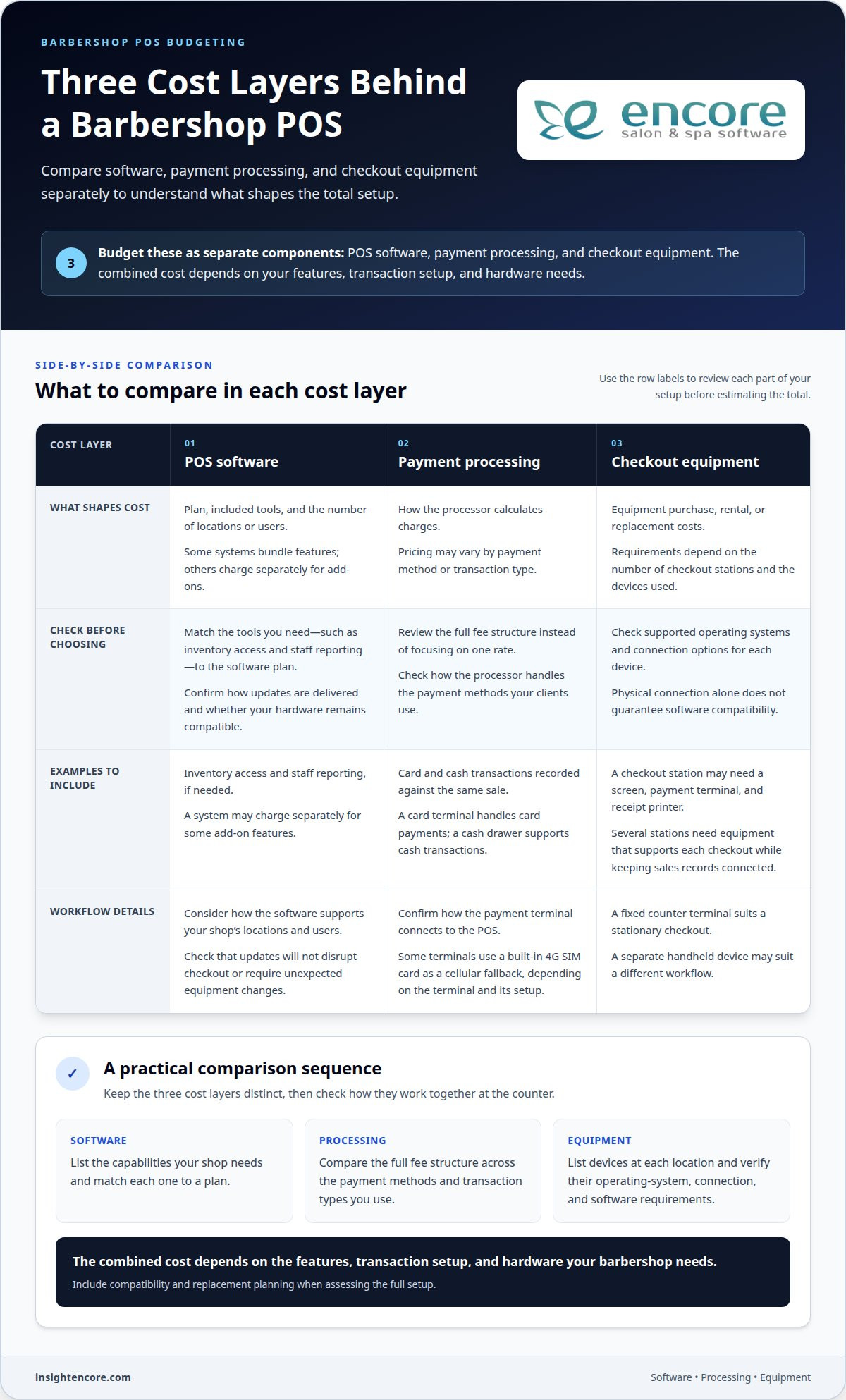
Budget for three components: POS software, payment processing, and checkout equipment. The combined cost depends on the features, transaction setup, and hardware your barbershop needs.

Hardware Compatibility and Requirements

Compatibility determines whether your POS software can work with the devices already at the counter. Check the software’s supported operating systems and connection options for each terminal, receipt printer, cash drawer, or barcode scanner. A device may connect physically but still require compatible software or configuration.

Start by listing the equipment each location uses, then match each item to the system’s requirements. For example, a shop with one checkout station may need a screen, payment terminal, and receipt printer. A shop with several stations needs equipment that supports each checkout while keeping sales records connected.

Payment Options and Hardware Setup

Payment options shape the checkout equipment and processing setup. A card terminal handles card payments, while a cash drawer supports cash transactions. The POS should record both against the same sale. Confirm how the terminal connects to the POS and whether the setup supports the payment methods your clients use.

Some POS hardware terminals use built-in 4G SIM cards as a cellular fallback. That feature may help maintain connectivity when the primary network is unavailable, depending on the terminal and its setup. Also consider where each device sits: a fixed counter terminal suits a stationary checkout, while a separate handheld device may suit a different workflow.

Payment processing fees affect how much card revenue the shop retains. Review how the processor calculates charges, including whether pricing varies by payment method or transaction type. Compare the full fee structure rather than focusing on one rate. Include equipment purchase, rental, or replacement costs when planning the total setup.

Software costs can depend on the plan, included tools, and number of locations or users. Some systems bundle features, while others charge separately for add-ons. List the capabilities you need, such as inventory access and staff reporting, then match each one to the software plan before estimating ongoing costs.

Updates matter, too. Find out how software updates are delivered and whether compatible hardware can keep working after an update. A mismatch can disrupt checkout or require equipment changes, so include compatibility and replacement planning in your budget.

For a clearer view of the full setup, compare the software plan, payment processing terms, and hardware requirements side by side. This makes it easier to see which combination fits your shop’s checkout and revenue needs. Explore a POS setup for your barbershop.

Client profiles, haircut preferences, and visit history

A client profile gives barbers a quick reference before each service. Keep practical details together, such as the client’s preferred cut, guard length, beard shape, and product preferences. For example, a note that someone prefers a low taper and a specific styling paste can help the barber prepare without relying on memory or searching old messages.

Use consistent fields so records remain useful across appointments and staff shifts. After each visit, add the service date, barber, service performed, and relevant preference notes. Separate lasting preferences from one-time requests: “keep the top longer” may guide future cuts, while “shorter for an event” may apply only to that appointment. Clear notes help make service more consistent for returning clients.

Visit history can also support thoughtful rebooking. If a client usually returns every 3 weeks, the POS can help the team recognize that cadence and suggest a suitable next appointment. A barber can mention the timing at checkout, while a rebooking reminder can prompt the client later. The interval is a starting point, not a substitute for the client’s own preference.

Automated marketing works best when it reflects a client’s service history. For example, a shop could group clients who book beard trims and send them relevant updates instead of sending every offer to every profile. Keep messages tied to useful services or products, and use clear audience groups. This helps the shop communicate purposefully while keeping appointment reminders separate from promotions.

Loyalty points can connect repeat visits with a simple reward structure. Decide which purchases or services earn points, how clients can see their balance, and which redemption options are available. For example, a client might earn points on a haircut and later apply them toward a qualifying retail purchase. Clear checkout rules help staff explain the program consistently.

Profiles can support useful reporting without turning every client interaction into a sales pitch. Review return visits, popular services, and retail purchases by client or service category. A barber’s history can help owners understand performance alongside commission records, while keeping client preferences separate from payroll data. Use reports to spot patterns, then adjust appointment availability or product recommendations accordingly.

To build reliable records, start with the fields staff need at checkout: contact details, haircut preferences, visit notes, and appointment history. Train the team to update these fields after each service, correct outdated notes, and avoid duplicate profiles. A consistent routine keeps client records practical, so the next barber can find relevant details before an appointment.
Barbershop POS With Inventory for Walk-Ins and Appointments

Integrated booking and payment processing

A connected shop POS system can carry an appointment from online booking through checkout and into sales records. The key is linking the calendar, payment workflow, and accounting records without entering the same transaction twice.

When a client books online, the appointment should appear in the shop’s calendar and remain identifiable at checkout. Staff can select it, confirm the service, add retail items, and process one transaction. For a walk-in, they can create a sale without a prior booking. Both workflows should record the service, products, payment method, and responsible barber.

Deposits and cancellation policies need clear handling. A POS that stores a client’s card can collect an upfront deposit or process a cancellation or no-show fee. The booking flow should make the applicable terms clear before the client confirms. At checkout, staff should be able to see whether a deposit has been paid and apply it to the final balance.

Accounting connections can reduce duplicate entry between daily sales and bookkeeping records. Check which details transfer, such as service revenue, retail sales, taxes, tips, refunds, and payment fees. For example, a daily summary that separates card and cash totals can help an owner reconcile deposits against the shop’s sales report. Keep each transaction traceable by date and location.

Booth renters may need payment ownership to be recorded separately from shop employees. A useful setup identifies who performed each service and who receives its payment, rather than treating all revenue as one total. Agree on how shared retail sales, booking deposits, refunds, and tips appear in records. Clear categories make reporting easier when a barber rents a chair but the shop processes checkout.

Split payments can help when clients divide a bill across payment methods or people. For instance, a client might pay part by card and the rest in cash. The POS should keep the full sale together while recording each payment separately. That makes the receipt, drawer reconciliation, and payment report easier to understand.

Card processing fees directly affect the net revenue from each sale. Barbershop card processing fees typically range from 1.5% to 3.5% per transaction, depending on card type. Review how fees apply to refunds, deposits, and different payment methods. If a system supports surcharges, it should disclose them before payment and show them as a separate receipt line item.

Before choosing a setup, map one appointment, one walk-in, and one booth-renter transaction from booking to accounting. This simple walkthrough can reveal duplicate entry or unclear ownership. Explore integrated card payment processing as part of that workflow review.

Cloud-based sales and inventory access

A cloud-based POS can bring sales and stock records into one shared view across locations. For an owner with two shops, reviewing each register’s activity in one place can make it easier to spot differences in product movement and daily sales.

Keep records separate by location before using combined reports. Each sale should include its shop, date, items, and payment details, so managers can distinguish one location’s activity from another’s. For example, if one shop sells more beard-care products, location-specific records can help show whether the pattern reflects local demand or a stock transfer.

Access controls matter, too. Give each team member the access needed for their role, such as recording a sale or reviewing a report. A manager responsible for both locations may need broader visibility than a barber using checkout. Clear permissions keep routine register tasks separate from administrative changes.

For inventory, establish a consistent process for recording deliveries, sales, returns, and adjustments. If a shipment arrives at one shop, record where the items were received before updating available stock. If products move between locations, document both the outgoing and incoming quantities. This creates a traceable record instead of relying on manual notes or memory.

Cloud-based reporting can help owners review sales without collecting separate end-of-day summaries from each register. Compare a location’s service revenue, retail sales, and payment totals for the same period. If a report shows an unexpected change, use its transaction details to identify whether it came from a product sale, refund, or other recorded activity.

Some cloud functions depend on network access. Cloud-based POS systems need connectivity for real-time calendar synchronization and secure remote EMV payment clearing. An internet disruption can affect current calendar updates or remote payment processing. Plan a clear staff procedure for recording transactions during interruptions and reconciling them when service returns.

Hardware setup affects how consistently each shop records activity. Use compatible checkout devices at each location and keep the register workflow consistent. For example, if one shop records product returns under a different category, combined inventory and revenue reports become harder to interpret. Document shared naming and adjustment practices for both teams.

Review a scheduled report regularly and compare it with a physical stock count. Investigate mismatches by checking recent sales, deliveries, returns, and transfers. This routine can help distinguish a data-entry issue from a genuine stock shortage, giving managers a clearer basis for ordering and location-level decisions.

Explore a cloud-based POS setup

Encore Salon & Spa Software: Inventory Management System

Encore Salon & Spa Software offers an Inventory Management System for barbershops to manage product stock as part of daily operations. Paired with Encore Barber Software, it provides tools for barber businesses, including inventory tracking, client management, bookings, and point-of-sale transactions.

Consider an inventory management system if retail stock, appointments, and checkout records are currently spread across separate systems or require repeated manual updates. It can organize product records alongside everyday shop activity, giving your team a clearer view of sales and stock.

If you’re ready to discuss a setup for your barbershop, contact Encore Salon & Spa Software.

Choose a Setup That Fits Your Next Stage

Choose a barbershop POS with inventory that fits how your team works now and supports your plans for the future. A practical next step is to identify which daily decisions need clearer records, then assess how a system can support those priorities.

Encore Salon and Spa Software offers Encore Salon Software, Encore Spa Software, and Chair/Booth Renter Software. These options serve different business setups, while Encore Barber Software is tailored to barbershop operations. Choose the fit that matches your business model and the workflows you want to bring together.

When you’re ready to explore a system for your shop, take the next step at your own pace.

Explore Encore software options

A thoughtful fit can help your team work with greater clarity and confidence.

Frequently Asked Questions

Can I manage more than one barber shop location?

Yes. Multi-location management can bring separate shop operations into a shared system while keeping each location’s records identifiable. Encore offers multi-location management as an add-on. Assign transactions, stock changes, and staff activity to the location where they occurred. That helps you review each shop’s performance without mixing its daily records with another location’s.

Does POS support both registered and walk-in client handling?

Yes. A POS can serve clients with existing profiles and those who arrive without a booking or saved record. For a registered client, staff can pull up the profile and add the service to its history. For a walk-in, they can complete the transaction and create a profile if useful. Consistent name and contact details help prevent duplicate records.

How does barber shop POS software prevent no-show revenue losses?

Appointment confirmations can remind clients of upcoming visits, while deposits collect part of the payment before an appointment. Encore supports appointment scheduling with email and SMS confirmations. Some POS platforms also support saved cards for cancellation or no-show fees. Clear booking terms and reminders help staff manage missed appointments, but can’t ensure every client attends.

What is an integrated barber shop POS system?

An integrated barber shop POS brings related business tasks into one connected platform. For example, appointment scheduling, client records, point-of-sale transactions, inventory tracking, and credit card processing can share operational information. This can reduce duplicate entry between separate tools. Encore’s management software includes these core functions for beauty and wellness businesses, including barber shops.

Can I precisely track grooming product stock through the POS?

Yes, inventory tools can track product quantities and record adjustments as stock is used or sold. Encore’s inventory control includes product levels, partial use, and back-bar products. Those details matter when a shop uses products during services rather than selling every item at retail. Keep product names and stock adjustments consistent so records remain useful for replenishment decisions.

Can a barbershop POS system handle booth rental and commission models?

It can support these arrangements by keeping renter or barber transactions distinguishable in business records. Encore offers Chair/Booth Renter Software, and its employee management includes payroll and commission tracking. Booth rent and commission are different payment arrangements, so record the right basis for each person. Clear staff records help owners understand who performed a service and how its revenue is handled.

Can multiple barbers have separate access levels?

Yes. Staff management can use password-protected data access, allowing shop owners to manage who can view or change records. For example, a barber may need access to their schedule and checkout tasks, while a manager handles broader business records. Set permissions around actual job responsibilities, then review them when staff roles change.

Can my barbers track their daily tips and payroll percentages directly from the POS interface?

A POS can record tips and payroll or commission information, giving managers transaction records for staff reporting. Encore includes payroll and commission tracking in its employee management features. Whether barbers can view specific figures depends on the system’s user access settings. Keep tip records separate from service revenue so reports show each amount clearly.

Disclaimer

This article is general in nature and may contain errors, please verify all claims with your sales rep

Categories
Uncategorized

How to Sell More Retail Products in a Salon: A 2026 Guide

What if selling more retail didn’t mean selling harder? If you’re working out how to sell more retail products in a salon, you may already know the challenges: appointments get busy, recommendations can feel awkward, and products can sit on the shelf while you try to figure out what’s working. Retail doesn’t have to feel pushy or become one more task to squeeze into the day.

The most useful recommendations support the results clients want from their service. When staff explain what they’re using and why, product suggestions can feel like a natural part of the appointment, not a sales pitch. A simple, repeatable approach can also help your team recommend products consistently, keep useful items in stock, and follow up thoughtfully.

This guide shows how to connect recommendations, product visibility, availability, and follow-up so salon visits can lead to repeat retail purchases. You’ll find practical ways to build staff confidence, reduce slow-moving stock, and track which efforts are helping. You’ll also see how client, inventory, and point-of-sale tools can support an organized retail routine without losing the personal service your clients value.

Key Takeaways

  • Learn how to sell more retail products in a salon by matching recommendations to client needs, not adding pressure.
  • Use a simple ask, listen, match, explain, and invite routine to make product conversations easier to repeat.
  • Compare displays, service-linked recommendations, bundles, and follow-up to choose tactics that fit your salon and clients.
  • Track retail sales, units sold, and product sell-through consistently to guide stock decisions and assess what’s working.
  • Use inventory, client records, and checkout tools to help keep retail routines organized and trackable.

How to Sell More Retail Products in a Salon Without Making Clients Feel Pressured

Back-to-back appointments make it easy to focus on the service in front of you and leave retail for later. By checkout, the next client may be waiting, and there’s little time to explain what could help someone maintain or recreate their salon result. The answer isn’t to push harder. It’s to make relevant recommendations a natural part of client care.

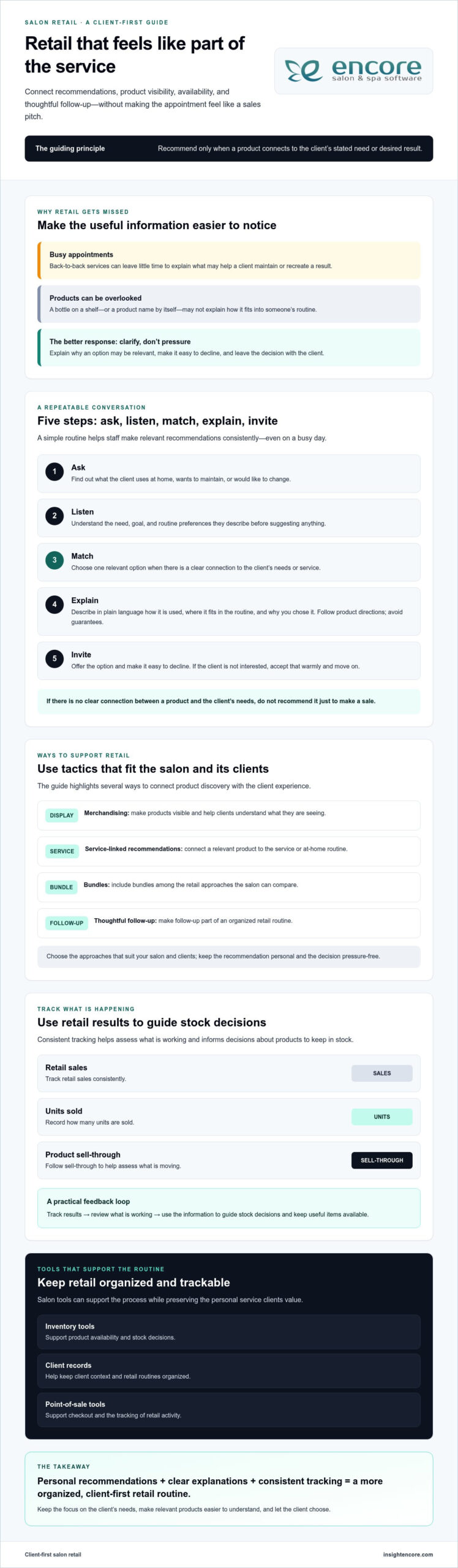
Client-first retail means recommending a product only when it connects to a client’s stated need or the result they want to maintain.

This approach gives clients useful information for their at-home routine and creates an opportunity for salon retail revenue. A clear explanation matters: the retail marketing mix includes product, place, promotion, price, personnel, and presentation. In a salon, the recommendation and the professional explaining it are part of that experience, alongside how products are displayed and offered.

Why salon clients may leave without the products they need

A client may leave without a product because nobody had time to mention it or because its benefit wasn’t clear. A bottle on a shelf can be easy to overlook, and a product name alone doesn’t explain how it fits into someone’s routine. That’s an opportunity to make the information clearer, not a client or staff failure. An informed recommendation explains the connection and leaves the decision with the client. Pressure makes a purchase feel expected.

Set a helpful standard for retail conversations

Keep conversations brief and specific. Ask what the client uses at home, what they want to achieve, and what they prefer in a routine. Listen before suggesting anything, then connect one relevant option to a service or need. After a blowout, for example, you might explain how a styling product could fit into recreating the look at home, without promising the same result for everyone.

Make the next step easy to understand and easy to decline. Explain how the product is typically used, where it fits into the routine, and why you chose it. For example: “You mentioned wanting a simpler styling routine. This could be one option to consider. Would you like me to show you how it’s used?” If the client isn’t interested, accept that warmly and move on.

  • Ask: Find out about the client’s routine and preferences.
  • Listen: Identify the need or goal they’ve described.
  • Match: Choose a relevant product, if there’s a clear fit.
  • Explain: Connect it to the service or routine in plain language.
  • Invite: Offer the option without making a purchase feel expected.

A consistent, low-pressure standard helps staff speak confidently without turning every appointment into a sales pitch. The focus stays on the client’s needs, and retail becomes part of the service conversation rather than an awkward add-on at checkout.

Build a Salon Retail Recommendation Process Around the Client

A repeatable process helps stylists make recommendations feel personal, even on a busy day. Use five simple steps: ask, listen, match, explain, and invite. The goal isn’t to deliver a perfect sales line. It’s to understand what the client wants, share a relevant option clearly, and let them decide.

Match retail products to a client’s service and routine

Start with questions that uncover context: “What are you using at home?” or “Is there anything you’d like to maintain or change about your routine?” Listen for the client’s priorities before connecting a product to the service. After a colour appointment, for example, a stylist might discuss an at-home product intended for colour-treated hair if it fits the client’s needs. After a haircut, the conversation could focus on how the client likes to style their hair day to day.

Explain the product’s use in plain language. Describe when it fits into the routine and how to use it according to its directions. Avoid guarantees or claims that every client will get the same result. If there’s no clear connection between a product and the client’s needs, don’t recommend it just to make a sale.

Help stylists recommend products with confidence

Confidence comes from knowing what a product is designed for, how it’s used, and where its limits are. Make product education practical: discuss a few common use cases, demonstrate the application when appropriate, and invite questions during team meetings. Short role-play can help, too. One stylist plays a client describing a routine or concern; another practices asking follow-up questions and explaining a relevant option in their own words.

Keep the framework consistent, not the wording. Rigid scripts can sound impersonal, while a shared approach gives stylists room to speak naturally. Recognize good consultations as well as completed purchases. When a stylist listens carefully, makes a suitable suggestion, and respects a client’s decision to pass, they’ve supported trust even if no product leaves the salon that day.

  • Ask and listen: Learn the client’s routine, goals, and preferences.
  • Match and explain: Connect a relevant option to their service or stated need, then describe its use clearly.
  • Invite: Offer the product without pressure and accept the client’s answer.

Client records can help a salon team keep track of relevant preferences and support more consistent conversations, while staff still use their judgment in the moment. Explore how salon client management tools can support client and retail workflows alongside your team’s recommendation process.

These conversations work best when they feel like useful guidance, not a transaction. With a shared process and regular practice, stylists can make thoughtful recommendations in a way that suits both the client and their own communication style.

Compare Salon Retail Tactics: Merchandising, Bundles, and Follow-Up

Retail tactics work best when they address a real barrier, such as products going unnoticed, clients being unsure what fits their routine, or forgetting to restock after an appointment. Before adding a tactic, consider the effort involved and how it will feel from the client’s perspective.

Visibility helps clients discover what’s available, while relevant recommendations help them understand what may suit their needs. Use both, but keep the selection focused and the conversation useful.

Tactic Effort Client experience Best suited to
Display improvements Low to moderate: arrange and refresh products Self-directed browsing Products that are easy to miss or hard to understand
Service-linked recommendations Moderate: explain a relevant option during the visit Personal guidance tied to a service or stated need Clients who need help choosing or understanding product use
Bundles Moderate: select compatible products and explain the pairing A convenient option, if each item has a clear purpose Clients already considering more than one related product
Follow-up Moderate: prepare and send a relevant message A reminder or helpful next step after the visit Clients who may need a prompt to restock or revisit a recommendation

Choose salon merchandising that makes products easy to notice

Set out a focused selection where clients can browse without interrupting a service or blocking the checkout flow. Clear labels can explain what a product is for, who might consider it, or how it fits into a routine. Refresh the display based on client questions and available inventory. If a product is out of stock, avoid making it the centrepiece of the display.

Use follow-up and gift cards thoughtfully

A follow-up can remind a client about an option discussed during their visit, but it should fit the relationship and any consent or communication preferences you have on record. Keep the message relevant and easy to act on. Don’t treat every client as a sales lead. Loyalty rewards can be an optional thank-you, not a promise that someone will purchase. Gift cards may also suit clients looking for a flexible gift. Explore salon gift card management as part of planning how your salon handles them.

Bundles should follow the same client-first principle. Pair products only when each item serves a purpose for the client, and present the combination as a convenience, not a requirement. To decide how to sell more retail products in a salon, test one tactic at a time and observe client questions, product interest, and stock movement. That gives you a clearer sense of what belongs in your routine.

How to Sell More Retail Products in a Salon: A 2026 Guide

Track Salon Retail Results and Improve Stock Decisions

Retail figures are most useful when they help you choose a next step. Start with a small set of measures, define each one, and review them over comparable periods. This makes it easier to judge whether a change in recommendations or product placement is worth keeping, without overwhelming the team with reports.

Measure retail performance without overwhelming the team

Choose measures that match your current goal and the information your salon can reliably record. If you’re checking whether clients are buying more often, review units sold. If you’re assessing retail income, track sales on the same basis each time, such as gross or net sales, and apply that definition consistently.

  • Retail sales: The value of retail transactions during a set period. Decide how you’ll treat returns and discounts.
  • Units sold: The number of individual products sold in that period.
  • Sell-through: Units sold divided by units available for sale during the period, expressed as a percentage. Use the same inventory method each time.

Compare like-for-like periods, such as one month with the previous month, and note changes that could affect the result. A stylist’s sales total, for example, may reflect different hours worked, appointment volume, or client mix. Avoid treating the number as a standalone performance score. Where records allow, review trends by product category as well as across the salon. For the wider business picture, see How to Increase Salon Profit Margin: The 2026 Operational Checklist.

Keep useful products available and reduce guesswork

Sales totals don’t explain every missed opportunity. Keep a simple record of client questions, requests for unavailable products, and recurring stockouts. If clients often ask for an item that’s missing, check whether the timing or quantity of replenishment needs attention. If a product moves slowly, review its sales alongside display location, staff recommendations, and available stock before deciding whether to reorder.

Set a regular stock review and flag products that haven’t moved or may no longer suit your salon’s focus. Inventory records can help your team check what’s on hand and spot repeat gaps; point-of-sale records can help connect transactions with product movement. Confirm that your software reporting supports the measures you plan to use. Salon inventory and point-of-sale features can support a more organized review process.

Tracking gives you a clearer way to assess how to sell more retail products in a salon: look for patterns, consider the context, and make one practical adjustment at a time.

Explore tools for salon retail and inventory workflows

Use Salon Software to Support a Consistent Retail Routine

Software can connect parts of a retail routine that are easy to lose track of during a busy day: the client conversation, the checkout, and what remains in stock. It can organize records and make information easier to review. It can’t replace a stylist’s product knowledge or judgment about whether a recommendation fits the client.

Connect point-of-sale records with inventory checks

A simple review sequence can help the team close the loop: discuss the client’s needs, offer a relevant option, record the purchase at checkout, then check inventory to see whether stock needs attention. Point-of-sale records can help managers review product movement, while inventory tracking can help teams monitor what’s on hand. Check which reporting and inventory functions are included in your software before relying on a specific workflow.

Client records may also help staff keep useful context for future visits, where the system and your salon’s practices support it. This can connect retail conversations to broader client workflows, such as booking and service history. For a closer look at connected client journeys, read The Ultimate Guide to Setting Up a Salon Client Booking Portal in 2026. Encore’s salon inventory and POS features are relevant tools to consider when deciding how records and checkout can fit into your process.

Keep the human part central. A system may help surface a client’s previous purchase or show that an item needs restocking, but the stylist still needs to ask, listen, and decide whether a new recommendation makes sense. Use records to support a thoughtful conversation, not to make assumptions about what someone should buy.

Build a manageable retail improvement plan

Don’t change every part of the retail routine at once. Choose one recommendation behavior, such as asking each client about their at-home routine, and one merchandising improvement, such as making a focused product display easier to browse. Assign someone to own each change and set a review date. Then look at relevant sales and stock information alongside staff observations and client questions.

At the review, decide whether to keep, adjust, or stop each tactic. If a display draws questions but few purchases, staff may need clearer product information. If recommendations are happening but stock is often unavailable, review replenishment. This measured approach helps you learn how to sell more retail products in a salon without making the process harder to manage.

See how Encore can support your salon’s retail workflow

Make Your Salon’s Retail Routine Easier to Repeat

Learning how to sell more retail products in a salon starts with a client-first habit: recommend products that connect to a client’s needs, make useful options easy to notice, and review what sells before adjusting your stock. A simple process gives your team room to offer helpful guidance without making every appointment feel like a sales pitch.

Salon software can support the work behind that routine. Encore Salon & Spa Software includes inventory tracking and point-of-sale transactions, along with client management, automated marketing, loyalty programs, and gift card management. These tools can help organize retail activity and client follow-up, while your team’s knowledge and personal service guide each recommendation. Encore’s parent company was founded in 1991.

Start with one practical improvement, review how it works for your salon, and build from there. Consistent small steps can make retail easier to manage and more useful for clients.

Explore Encore for your salon

Your team can create a retail experience that feels thoughtful, organized, and true to the service your clients value.

Frequently Asked Questions

How can a salon sell more retail products without being pushy?

Make recommendations that connect directly to a client’s needs or service, and leave the choice to them. To learn how to sell more retail products in a salon, build a habit of asking about the client’s routine, listening to their goals, and explaining why a product might be relevant. Keep the suggestion optional, answer questions honestly, and accept a “no” graciously. Helpful advice supports trust, even when the client doesn’t buy.

What should salon staff say when recommending a product?

Start with a question, such as, “What are you using at home?” Then connect a product to what the client has shared: “You mentioned wanting to recreate this style. Would you like to see an option that could fit your routine?” Explain how and when to use it in plain language, following the product directions. Avoid promising a particular result, and make it easy for the client to decline.

Where should retail products be displayed in a salon?

Place a focused selection where clients can notice and browse it without interrupting services or blocking the checkout area. Use clear labels to explain each product’s purpose, who might consider it, or how it fits into a routine. Keep the display aligned with current stock, and refresh it based on client questions and observed interest. A tidy, understandable display can invite browsing without making clients feel pressured to buy.

How do you train salon staff to recommend retail products?

Give staff practical product education, including what each product is intended for, how it’s used, and any relevant limitations. Practice short role-plays in team discussions: one person describes a routine or concern, and another asks follow-up questions before suggesting an option. Encourage stylists to use their own words rather than memorize a rigid script. Recognize thoughtful consultations as well as sales, so staff know that client trust matters.

Which salon retail metrics should I track?

Start with retail sales, units sold, and product sell-through. Define each measure consistently, including how you’ll account for returns or discounts in sales totals. Compare similar periods and, where your records allow, review results by product category. Add context such as appointment volume, staff schedules, client questions, and stockouts before drawing conclusions. A small, consistent set of measures is usually easier to act on than a long list of changing reports.

Can salon software help increase retail product sales?

Salon software can support a more organized retail routine, but it can’t guarantee higher sales or replace staff knowledge. Inventory tracking can help teams monitor product availability, point-of-sale transactions can record purchases, and client management can support organized client records. Check which features and reports are included before choosing a workflow. Use the information to guide stock reviews and follow-up, while letting client needs and professional judgment shape recommendations.

Should salons bundle retail products with services?

Offer bundles as an optional convenience, not as a requirement or a way to move products clients don’t need. A combination makes sense when each item has a clear purpose related to the service or the client’s stated routine. Explain what each product does and let the client choose individual items instead. Review whether clients show interest and whether the products move, then adjust the bundle if it doesn’t fit their needs.

How can a salon avoid overstocking retail products?

Review inventory and sales records before reordering, and pay attention to products that move slowly or repeatedly run out. Track units sold over consistent periods, note client requests for unavailable items, and review stock on hand at a regular interval. Avoid treating one quiet period as the whole story; consider display changes, staff recommendations, and appointment patterns too. Use those observations to adjust order quantities and reconsider products that no longer suit your salon.

Disclaimer

This article is general in nature and may contain errors, please verify all claims with your sales rep