

That makes salon client acquisition cost more than a marketing metric: it helps you judge whether your spending and effort attract clients who return.
It’s easy to focus on how many new appointments a campaign generates. But a first visit doesn’t tell the whole story, especially when some clients rebook and others don’t. Compare marketing channels by considering what each new client may contribute over time, too.
This guide explains how to calculate acquisition cost, compare common ways salons attract new clients, and weigh that spending against client lifetime value. You’ll learn which measures make the numbers meaningful and help you assess whether your marketing supports lasting salon growth.
Key Takeaways
- Calculate what you spend to bring in each new client, then compare results across marketing channels.
- Look beyond first-visit revenue by tracking rebooking, visit frequency, and the value clients bring over time.
- Assess referral incentives, digital ads, and directory listings by both their acquisition cost and the clients they attract.
- Use new-client and retention trends to see whether marketing is supporting steady salon growth.
- Consider client management software when you need a clearer way to organize client details and follow-up.
Client lifetime value
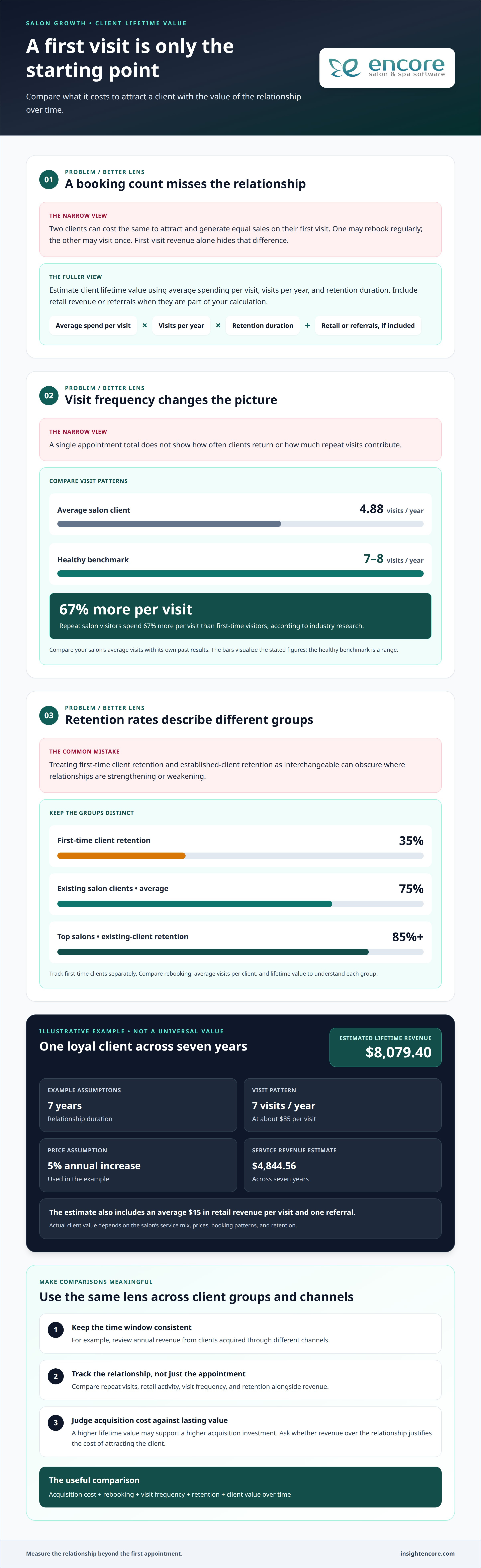
Client lifetime value estimates the revenue a salon earns from one client over the course of the relationship. It shifts attention from the first appointment to repeat visits, retail purchases, and referrals. For example, two clients may cost the same to attract, but one may rebook regularly while the other visits once. Their long-term value differs, even if their first appointments generate equal sales.
Start with three measures: average spending per visit, visits per year, and retention duration. Multiply average spending by visit frequency, then account for how long clients continue booking. Include retail revenue or referrals if they’re part of your calculation. Apply the same method across channels to keep comparisons useful. Tracking these measures annually also shows whether visit frequency or retention changes over time.
One illustrative seven-year example estimates a loyal client’s lifetime revenue at $8,079.40. Its assumptions include seven visits per year, about $85 per visit, and 5% annual price increases. The example estimates $4,844.56 in service revenue across seven years. It also includes an average $15 in retail revenue per visit and one referral. Treat this as an example, not a universal client value. Your salon’s actual result depends on its service mix, prices, booking patterns, and retention.
Frequency can change the calculation substantially. The average salon client visits 4.88 times per year, while a healthy benchmark is 7 to 8 visits annually. Compare your salon’s average visits with its own past results. A client who books one additional appointment contributes another service opportunity. Industry research reports that repeat salon visitors spend 67% more per visit than first-time visitors. This makes return behavior relevant to both visit count and average transaction value.
Retention figures add context, but they need careful interpretation. Existing salon clients have an average retention rate of 75%, while top salons reach 85% or higher. The average first-time client retention rate is 35%. These figures describe different groups, so don’t treat them as interchangeable. Track first-time clients separately from established clients. Then compare rebooking rates, average visits per client, and lifetime value to see where relationships are strengthening or weakening.
Use the same time window when comparing client groups. For example, review annual revenue from clients acquired through different channels, then compare their repeat visits and retail activity. A higher lifetime value may support a higher acquisition investment, while a one-time visit may not. The key question is whether the revenue generated over the relationship justifies the cost of attracting that client.
Consistent records make these comparisons clearer. Encore Salon & Spa Software can organize client history, visit frequency, and spending patterns. Review those measures together rather than relying on appointment totals alone. When clients visit more often and keep returning, lifetime value may rise without needing a new client for every appointment.
Digital ads, referral incentives, and directory listings
Salons can lower acquisition costs by comparing channel spending with completed new bookings and repeat visits. Clear follow-up can also give first-time clients a reason to return.
Using Digital Ads and Directory Listings
Digital ads promote salon services to prospective clients online, while directory listings help people discover local services. Both can bring a salon to someone’s attention when they’re deciding where to book. Track campaign spending alongside inquiries, completed bookings, and service revenue to see which results follow.
SEO and targeted Google Ads can help prospective clients find a salon online. Listings can also make the salon visible to people comparing options. Keep service descriptions and booking details clear wherever clients discover you. Then track which source new clients mention and whether they complete an appointment. This distinguishes clicks or profile views from bookings that generate revenue.
Offering Referral Incentives
A referral incentive rewards an existing client for introducing someone new. Referred clients are estimated to have 18% lower churn than clients acquired through advertising. For a stylist, referrals can connect a trusted recommendation directly to an available service and booking.
Nearly half of salon clients choose where to book based on someone they know. Make the referral process easy to explain, and record which new bookings came through it. Compare incentive spending with the new clients who actually visit. A referral that results in a booking offers a more useful measure than counting recommendations alone.
Compare each channel over the same monthly period. Divide its spending by the number of new clients who completed appointments, not by clicks, messages, or inquiries. For example, if an ad campaign gets many profile visits but few bookings, its cost per actual client may be less favorable. Track referrals, directories, and ads separately to see the difference.
Then connect acquisition results with return behavior. Record each new client’s source, first booking, and subsequent visits. If one channel brings in clients who return, its longer-term value may outweigh a higher initial cost. If clients from another source rarely rebook, review the service match, booking process, and follow-up experience.
Consistent records make those comparisons easier to act on. A clear booking and client follow-up workflow can help keep source and return-visit details organized. Review the numbers monthly, then adjust the channel mix or referral approach based on completed appointments and repeat bookings, not visibility alone.
New-client acquisition and salon growth
New-client acquisition supports growth when it fills available appointment capacity and builds lasting relationships. Track new clients per month, spending per client, and referrals. Together, these measures show whether marketing generates bookings and whether those clients return. They also distinguish a busy campaign from one that contributes to stable salon revenue.
Calculate acquisition cost by dividing the marketing spend for a period by the number of new clients gained in that period. The same example estimates $375 in first-week revenue, based on five appointments at $75 each. That early revenue is useful context, but it doesn’t show whether clients rebook.
The figure can vary by channel, campaign, and the number of clients who complete bookings. Compare like with like: use the same measurement period and count new clients, not clicks or inquiries. Tracking salon client acquisition cost this way grounds marketing decisions in completed appointments.
Growth also depends on how new clients fit into the salon’s schedule. Acquiring clients can help fill chairs for newer stylists. Review appointment availability alongside new-client numbers. If a stylist has open slots, new bookings can put that capacity to use. If appointments are already full, the same campaign may create demand the salon can’t accommodate promptly.
Retention changes the economics. Acquiring a new salon client costs 5-7 times as much as retaining an existing client. That makes repeat visits a key part of sustainable growth, not a separate concern. Compare new-client totals with rebooking and retention patterns. A campaign may bring in more first-time appointments, while follow-up and a positive service experience influence whether those clients return.
Consider the cost of losing a loyal client, too. That potential loss shows why growth plans should include retention, not just new-client targets. If existing clients stop booking, increased acquisition activity may only replace lost revenue rather than expand it.
Retail purchases and referrals can add value beyond the first service. Record them alongside appointment history, then include them when assessing lifetime value. A new client who returns, buys products, or recommends the salon contributes differently from a one-time booking. Reviewing these outcomes by acquisition source helps show which marketing activities support broader growth.
Google search visibility can help prospective clients discover a salon. SEO and targeted Google Ads are two ways to support that discovery. Track completed bookings by source, then compare them with monthly marketing spend and client return patterns. A simple monthly review of acquisition, retention, and retail can show whether growth comes from new traffic alone or stronger client relationships.
How does salon client acquisition cost compare with customer lifetime value?
Acquisition cost measures the investment required to gain a new client. Customer lifetime value estimates the revenue generated over that client’s relationship with your salon. Compare the two to judge whether revenue over time can justify the initial marketing expense. Use the same client group and measurement period for both figures. Otherwise, you may unfairly compare a short-term campaign cost with years of revenue.
A useful comparison starts with revenue, but revenue isn’t profit. Service and retail sales must cover the costs of delivering those services and products, and acquisition spending is another expense. Treat lifetime revenue as a guide, not as an amount available to spend freely. The client’s visit pattern, spending, retention, and referrals all shape the longer-term picture.
One 90-day example compares five newly acquired clients with five existing clients who rebook. The new clients generate $600 in total revenue, while the returning clients generate $975. That difference illustrates why a first appointment alone can understate a client’s value. Rebooking creates additional revenue within the same period, even though those clients weren’t newly acquired.
Use that comparison to guide channel decisions. First, group new clients by how they found your salon. Next, compare the acquisition spending for each group with its revenue over a consistent period. Then review which clients returned and how often. A channel with a higher initial cost may still contribute value if its clients rebook. Base the comparison on actual bookings, not inquiries or potential interest.
Retail can add another layer to the calculation. One example estimates $854.84 in retail revenue from a client over seven years, assuming retail prices increase by 5% annually. That figure is illustrative, not a forecast for every salon. A client’s retail purchases depend on what they buy and how consistently they visit. Include retail only when your records capture it clearly.
Referrals can also extend value beyond the original client. If a client recommends your salon, that introduction may lead to another booking and a separate client relationship. Keep referral revenue distinct from the original client’s service and retail revenue. This avoids attributing another client’s sales to the person who made the referral.
Review the comparison regularly, using a consistent period such as 90 days or an annual view. Track acquisition cost, returning visits, service revenue, and retail revenue by client group. If repeat revenue grows, the original acquisition spending may look more worthwhile. If clients rarely return, examine the booking experience and follow-up before increasing marketing spend. This keeps decisions tied to observed client behavior rather than assumptions.
What factors increase or decrease a salon’s client acquisition cost?
Acquisition costs vary with how a salon reaches prospective clients and turns interest into appointments. A campaign that attracts broad attention may generate many inquiries but few completed bookings. Clear service descriptions and a straightforward booking path can help close that gap. Compare campaign inquiries with the clients who actually attend to see whether visibility is turning into new business.
Audience fit matters, too. Ads aimed at people outside a salon’s service area can spend money without generating useful bookings. Promote services to clients the salon can serve, then compare results by channel and audience. A campaign that reaches fewer people may still use its budget more effectively if those people become clients.
Available appointment capacity also affects the value of acquisition spending. If a salon has open chair time, new bookings can put that capacity to work. If the schedule is already full, additional promotion may not lead to more completed appointments. Review each stylist’s availability before increasing campaign activity. Matching demand with open appointments makes marketing results easier to evaluate.
A salon’s starting position can shape its need for paid marketing. A salon suite with an established clientele may need to spend little on marketing. A newer business without that client base may rely more on outreach to build awareness. In either case, align acquisition activity with the number of appointments the salon wants to fill. The right approach depends on its existing clientele and schedule.
Referrals can also affect acquisition spending. Existing clients may introduce friends and family, creating a source of new bookings alongside paid promotion. Record referrals separately from advertising and directory listings, then compare how each source contributes to appointments and repeat visits. If referrals bring in suitable clients, a salon may choose to strengthen that approach rather than simply increasing paid reach.
Measurement choices can make costs appear higher or lower. Including brand-awareness work in one campaign’s spending but excluding it from another makes the comparison uneven. Apply consistent rules to what counts as acquisition spending and which clients count as new. Review the same time period across channels. Separate first-time appointments from returning clients so retention activity doesn’t distort acquisition results.
Finally, revisit the factors behind changes in results. If acquisition cost rises, look at audience fit, completed bookings, appointment availability, and the mix of paid and referral sources. If it falls, check whether new clients are still a good fit and return for services. This helps distinguish lower spending from genuinely efficient client growth.
A salon suite with an established clientele may need little marketing spend, while a newer business without that client base may rely more on outreach. The section provides no basis for comparing acquisition costs by location.
Encore Salon and Spa Software: Client Management System
Encore Salon & Spa Software’s Client Management System helps organize client relationships alongside salon operations. When comparing acquisition spending with repeat bookings, keeping client information and appointment activity together can make patterns easier to review. Encore Salon Software and Encore Spa Software support salon and spa businesses, while Chair/Booth Renter Software is designed for renter-based operations.
Consider a client management system when scattered records make it hard to understand booking history or follow client relationships over time. Organized information supports consistent client management and clearer reviews of acquisition and retention. It also puts the calculations in this article into a practical operating context.
To discuss how Encore Salon & Spa Software can fit your business, contact Encore Salon & Spa Software.
Make your next growth decision with confidence
Let salon client acquisition cost guide decisions, not define success on its own. Use it as an operating signal: consider whether your marketing fits available appointments and supports the client relationships you want to build. A regular review can help you spot changing patterns and make thoughtful adjustments before small inefficiencies become habits.
Encore Salon and Spa Software offers Encore Salon Software, Encore Spa Software, and Chair/Booth Renter Software. These options support different salon and spa business models, while the Client Management System helps organize client information. Choose the option that fits how your business manages clients and appointments.
Keep learning from each booking and returning client. Clearer information can help you make your next growth decision with greater confidence.
Frequently Asked Questions
What is the average client acquisition cost for a salon in the United States?
Treat this as a benchmark, not a fixed average for every U.S. salon. Your result depends on which marketing expenses you include and how many new clients actually book and attend. For a more relevant comparison, calculate your own figure by channel and compare it across consistent reporting periods.
How do salons calculate client acquisition cost?
Divide the marketing expenses tied to gaining new clients by the number of new clients acquired during the same period. Include the spending you attribute to those efforts, such as advertising or referral rewards. Count clients who completed appointments, not clicks or inquiries. Before calculating, separate first-time visitors from returning clients in your booking records so retention activity doesn’t distort the result.
What is a good customer acquisition cost for a hair salon?
A good acquisition cost is one that a client’s revenue over time can support after accounting for the cost of delivering services. There isn’t one target that suits every hair salon. A client who rebooks and purchases retail may contribute more than someone who visits once. Compare acquisition spending with client revenue and repeat behavior, then set a target that fits your salon’s service mix and margins.
How much do salon marketing channels cost per new client, such as Google Ads, social media, and referrals?
These figures don’t provide separate prices for Google Ads or social media. To compare those channels, calculate each one’s spending against completed first-time bookings, and track referral clients separately from paid campaigns.
Disclaimer
This article is general in nature and may contain errors, please verify all claims with your sales rep