

Reliable salon payroll starts with clean records, not last-minute calculations. When hours are in one place, tips in checkout activity, commissions in service notes, and adjustments in messages, figuring out how to manage salon payroll can feel like rebuilding the pay period from scratch. Missing details lead to corrections, and the rules that apply can vary by worker and location.
A dependable routine makes payday more predictable. This guide explains how to organize pay inputs for each worker and pay period, assign review responsibilities, and check the information before payroll is finalized. You’ll learn how to build a workflow around different pay arrangements, from hourly wages and commissions to tips and adjustments, while verifying current requirements for your jurisdiction. Organized scheduling and transaction activity in salon management tools such as Encore Salon & Spa Software can help you review payroll inputs, without replacing payroll processing. The goal is fewer surprises and records you can check with confidence.
Key Takeaways
- Learn how to manage salon payroll with a repeatable pay-period workflow, from setting a cutoff to retaining final records.
- Build a checklist that traces each pay detail to its source and a named reviewer.
- Use discrepancy checks to spot mismatches before approving pay.
- Separate payroll processing from salon-management tools that help organize scheduling and transaction activity.
- Choose operational software around the records and workflows your salon needs to manage.
How to Manage Salon Payroll Without the Pay-Period Scramble
The salon is busy, clients are checking in, and payday is approaching. You’re matching time records with service activity, tips, commissions, and adjustments, often gathered from different places. A single missing detail can turn a routine task into a stressful review.
A calmer approach starts before payday: set a consistent cutoff, gather records through one process, and review them before approval. Learning how to manage salon payroll means building a routine around your salon’s actual pay arrangements, rather than relying on memory or rushing through calculations. The aim is to make each pay period easier to check and explain.
What does salon payroll management include?
Salon payroll management is the process of gathering, checking, approving, and recording the information used to determine worker pay for a pay period. It includes collecting records, applying documented pay terms, reviewing discrepancies, securing approval, and retaining final records. These preparation steps are distinct from paying workers and filing payroll taxes, which have separate processes and deadlines. Requirements vary by jurisdiction, so verify current official guidance for your location and worker arrangements. For broader context, payroll management involves compensation, benefits, and tax withholdings.
Why salon pay can be harder to organize
Salon pay may draw on several kinds of activity, each recorded differently. Appointments can show who performed a service, point-of-sale records may capture service or retail transactions, time records track hours, and tip records document gratuities. The pay terms in place determine which inputs matter for each worker. Don’t assume every person is paid the same way or has the same classification.
Small process gaps can add up. If time records close on one date but service or tip information is reviewed on another, the totals may cover different periods. A missing adjustment or unclear entry can send the reviewer searching through notes and transactions after the cutoff. Set a clear period and source for each input, then record who checks it.
A simple responsibility map can get the routine started:
- Time: Identify the record used for hours and who checks missing or unusual entries.
- Service and retail activity: Choose the transaction records used to verify eligible activity under documented pay terms.
- Tips and adjustments: Specify where approved details are recorded and who reviews exceptions.
- Pay terms: Keep each worker’s current written terms accessible to the person preparing payroll.
Organized appointment and transaction records can make payroll preparation easier to review, but they don’t replace payroll processing or tax filing. The next sections provide a checklist, common mismatch checks, and a repeatable routine for your salon.
Which Salon Payroll Records and Pay Details Should You Gather?
A useful payroll checklist does more than name the numbers to collect. It shows where each number comes from, which pay period it belongs to, and who reviews it. Keep the source record separate from the rule used to calculate pay: a service transaction documents activity, while the worker’s written terms determine whether that activity affects commission.
Gather hours, tips, and salon activity records
Start with records that cover the same pay-period dates. Compare scheduled shifts with actual time records, then document approved corrections rather than silently changing an entry. Keep tip records separate from service and retail sales because they support different information. Source documents and recordkeeping requirements vary by location, so check current official guidance for your jurisdiction.
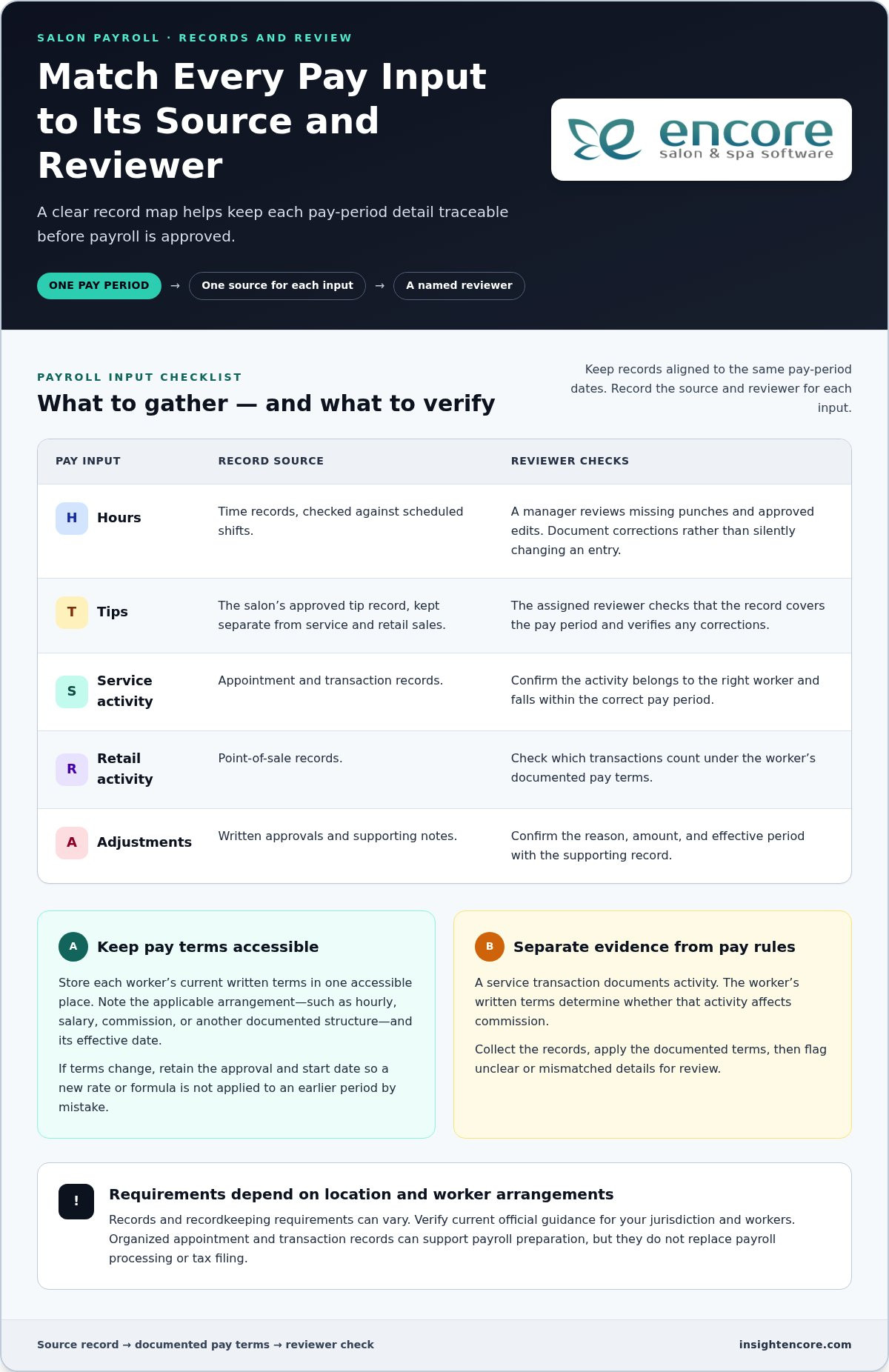
For each input, note its source and reviewer. A checklist might look like this:
- Hours: Time records, checked against scheduled shifts; a manager reviews missing punches and approved edits.
- Tips: The salon’s approved tip record; the assigned reviewer checks the period and any corrections.
- Service activity: Appointment and transaction records; the reviewer confirms the activity belongs to the right worker and period.
- Retail activity: Point-of-sale records; the reviewer checks which transactions count under the worker’s documented terms.
- Adjustments: Written approvals and supporting notes; the reviewer confirms the reason, amount, and effective period.
These records help explain what happened. They don’t, on their own, determine what someone is owed. Federal and local requirements may affect how hours and pay are handled. The U.S. Department of Labor’s overview of federal wage and hour laws is a starting point for understanding federal rules, including minimum wage and overtime. Verify current requirements for your location and workers.
Document pay arrangements before calculating
Before using the records, keep each worker’s current written pay terms in one accessible place. Record the applicable arrangement, such as hourly, salary, commission, or another documented structure, along with its effective date. If terms change, save the approval and start date so you don’t apply a new rate or formula to an earlier period by mistake.
Next, match each input to the terms that govern it. A service or retail total may be relevant to one commission plan but not another. Handle tips and hours according to applicable terms and rules. For commission structures and calculation methods, see salon staff commission calculations.
That separation is central to how to manage salon payroll: collect evidence first, apply documented terms second, and flag anything unclear before approval. Salon tools that organize appointments and point-of-sale activity can help keep operational records in view during preparation, without replacing payroll processing. Explore Encore’s salon management tools as part of your operations routine.
How to Check Salon Payroll for Errors Before Approval
Payroll software can help organize calculations, but it can’t confirm that every input is complete, correctly assigned, or consistent with a worker’s documented pay terms. A wrong time entry or unapproved adjustment can still produce a polished-looking result. Before approval, compare pay-period totals with source records and investigate exceptions rather than assuming the system has resolved them.
Keep the review focused by identifying the evidence you expect for each record, the mismatch to watch for, and the follow-up needed.
Common salon payroll discrepancies to catch
Look for missing or duplicate shifts, unusual time entries, adjustments without approval, and service activity assigned to the wrong worker or period. Compare tips and commission inputs with the salon’s documented policies and supporting records. Checking source records matters because payroll calculations can only be as reliable as the information and pay terms behind them.
| Record | Expected evidence | Common mismatch | Follow-up |
|---|---|---|---|
| Time records | Entries covering the full pay period | Missing shift, duplicate entry, or unexplained edit | Compare with scheduling records and document an approved correction. |
| Service activity | Transactions assigned to the correct worker and dates | Duplicate, missing, or misassigned service | Review the source transaction and apply the documented commission terms. |
| Tips | Approved tip record for the period | Amount differs from the supporting record or policy | Trace the difference and record how it was resolved. |
| Adjustments and deductions | Written reason, approval, and applicable period | Unapproved change or unclear basis | Pause the item and verify the applicable rules before processing. |
Build a review and approval checkpoint
Where staffing allows, have one person prepare the pay inputs and another review them. A second reviewer can compare totals with source records and catch a mismatch the preparer may overlook. In a small salon where roles overlap, separate the steps in time: prepare first, then review the records and exceptions before approval.
Keep a brief review log for each pay period. Note the record checked, discrepancy found, correction made, who approved it, and any question still unresolved. Don’t treat an open question about classification, overtime, minimum-pay requirements, tips, or deductions as a routine data fix. These issues depend on worker circumstances and jurisdiction, so verify them using current official wage, employment, and tax guidance for your location before finalizing pay.
A consistent checkpoint makes how to manage salon payroll more reviewable: confirm the inputs, reconcile differences, document decisions, then approve. If a discrepancy can’t be supported by a source record or documented term, hold it for clarification rather than guessing.
How to Manage Salon Payroll Step by Step Each Pay Period
A reliable payroll routine works like a closing checklist: each task has an owner, a source record, and a clear sign that it’s complete. Use the same sequence for every pay period, leaving time between input collection and approval so missing details don’t become rushed guesses.
Create a repeatable payroll calendar
Choose recurring dates for time entry, tip reporting, record review, approval, and payment. Share the cutoff and each person’s responsibility in plain language, including how staff should submit corrections. Build in reminders for holidays, schedule changes, and location-specific deadlines. Confirm official deadlines for your jurisdiction because requirements vary.
- Set the cutoff. The payroll coordinator owns the calendar, and the pay-period schedule is the source. Mark the period’s start, end, and submission deadline as complete when they’ve been shared with everyone who provides inputs.
- Collect time and activity records. The designated preparer gathers time entries, tip details, and relevant service or retail activity from their source records. Check that each item covers the same dates and is assigned to the right worker before marking collection complete.
- Apply documented pay terms. The preparer uses each worker’s current written terms and any approved changes, including effective dates. Confirm the terms match the period being prepared and flag unclear or missing documentation instead of assuming.
- Reconcile exceptions. The preparer compares inputs with supporting records and logs missing entries, duplicates, corrections, or other differences. Mark an item resolved only when its supporting evidence and decision are recorded.
- Review the prepared information. A separate reviewer, where staffing allows, checks the records, calculations, and documented terms. Give the reviewer time to ask questions and receive evidence before approval, rather than leaving the review until the cutoff.
- Approve and complete the pay run. The authorized approver confirms that required inputs are present and discrepancies are resolved or appropriately addressed. Record approval and completion according to the salon’s established process.
- Retain final records securely. The assigned records owner stores final records using approved access and retention practices. Confirm the files are complete, organized by pay period, and accessible only to appropriate people.
Close the pay period and improve the next one
After the run, note which corrections took the most time and why. If a shift entry repeatedly arrives late, clarify who submits it and by when. If service activity needs repeated checking, review how staffing patterns and appointment flow affect planning. A salon staff utilization guide can help connect staffing patterns with operational planning. Update the checklist or calendar so the next cycle benefits from what you learned.
This sequence makes how to manage salon payroll a defined routine, not a last-minute scramble. Salon management tools can help organize appointment and transaction activity as part of that workflow, while payroll preparation, processing, and recordkeeping remain distinct tasks.
Choose Salon Software That Supports an Organized Payroll Routine
Salon software can help organize the business records that inform payroll preparation, but that doesn’t make it a payroll processor. Keep the roles clear: payroll tools handle tasks such as calculating pay or processing payments, while salon-management tools support daily operations such as scheduling appointments and recording transactions. The right setup depends on where your information currently lives and which handoffs create friction.
What to look for in a salon management platform
Start with the work your team does every day, not a long feature list. Ask where appointments are scheduled, where client details are managed, how service and retail transactions are recorded, and whether inventory tracking would support your routine. Then identify which operational records your payroll preparer needs to review separately. This helps you choose tools for real workflow needs without assuming that salon software calculates pay or connects automatically to payroll.
Encore salon software brings together salon operations capabilities such as appointment booking, client management, inventory tracking, and point-of-sale transactions. These records can provide useful context as you organize payroll inputs, but payroll preparation and processing remain distinct tasks. The Encore features overview summarizes operational tools to consider for your salon’s needs.
Use a simple fit check before choosing or changing tools:
- Scheduling: Would a more organized appointment workflow help your team understand staffing and service activity?
- Client management: Do you need a central way to manage client information as part of salon operations?
- Point of sale: Would clearer transaction records help staff review service and retail activity during payroll preparation?
- Inventory: Would inventory tracking support the way your salon manages products and day-to-day work?
- Payroll: Which separate system or process handles pay calculations, payment, tax responsibilities, and required records?
That last question matters. An organized appointment calendar or transaction record may make operational information easier to find, but don’t treat it as a payroll calculation, payroll-ready report, or tax filing unless a system explicitly provides that function.
Make the next step manageable
Before adopting a new platform, map the current route for each payroll input: who creates it, where it’s recorded, who reviews it, and how it reaches the person preparing payroll. Mark the handoffs that cause repeated searching or corrections. This makes it easier to assess whether salon-management tools could improve the operational records around those handoffs, without changing payroll responsibilities by assumption.
Then evaluate the platform using familiar tasks. Consider how appointment booking, client management, inventory tracking, and point-of-sale activity fit your actual routine. A practical evaluation helps you decide whether the tools support your salon’s operations and the information-gathering process around payroll. It’s one useful step toward a more organized approach to how to manage salon payroll.
Make Your Next Pay Period Easier to Prepare
A dependable approach to how to manage salon payroll is built one pay period at a time. Keep refining handoffs, clarify who owns each record, and make room to review questions before approval. With a steady routine, you can spend less time chasing information and more time supporting your team and clients.
Salon operations software can help bring everyday activity into a more organized view. Encore provides tools for appointment booking, client management, inventory tracking, and point-of-sale transactions. Explore how those capabilities could fit the way your salon works.
Start with one practical improvement, then build from there. A clear routine can make payroll easier to prepare and repeat.
Frequently Asked Questions
How often should a salon run payroll?
There’s no single payroll schedule that applies to every salon. Pay frequency depends on local requirements, employment terms, and the business’s payroll setup. Choose a consistent calendar that gives staff clear expectations about pay periods and payment dates, then communicate it in writing. Before setting or changing the schedule, check current official rules for your jurisdiction and confirm that the arrangement fits each worker’s terms.
Can salon employees be paid on commission only?
Commission-only pay may be subject to wage and employment rules, so it isn’t automatically suitable for every worker or situation. Document the agreement clearly, including how commission is earned and which services or sales count. Then verify local minimum-pay, overtime, and other applicable requirements using official guidance or a qualified professional. If a worker’s pay could fall below a required amount, resolve how the rules apply before relying on the commission arrangement.
How should a salon track tips for payroll?
Keep dated tip records separate from service revenue and retail sales. For example, use a consistent staff process to submit or confirm tip details for each pay period, and record corrections with their dates and reasons. Tip reporting, allocation, and payroll treatment can depend on local rules and the salon’s arrangement. Review the process against current official guidance so staff know what information to report and how the salon handles it.
What payroll records should a salon keep?
Keep organized records that support each pay period, such as hours, written pay terms, tip and commission details, adjustments, approvals, and final payroll outcomes, as applicable. A dated note explaining a correction can help clarify why a record changed later. Required records and retention periods vary by jurisdiction and worker arrangement. Limit access to appropriate people, use a consistent filing method, and verify current local requirements for what to retain and for how long.
Do booth renters go through salon employee payroll?
Not necessarily. Booth rental and employment are different business arrangements, but the correct classification depends on the working facts and applicable law, not just the label in a contract. Before deciding how to handle someone’s pay, check current classification rules for your location using official guidance or a qualified professional. Keep rental payments and salon employee payroll records clearly separated, with supporting agreements and financial records organized for review.
Can salon management software replace payroll software?
Usually, these tools serve different purposes. Salon management software can organize appointment booking, client information, inventory, or point-of-sale activity, while payroll systems handle separate pay-processing functions and requirements. For example, transaction records may help you review salon activity, but don’t assume they calculate wages or complete tax tasks. Map where information is created and who uses it, then confirm each tool’s role before relying on it in your payroll routine.
Disclaimer
This article is general in nature and may contain errors, please verify all claims with your sales rep