

The best massage therapist scheduling software for iPad isn’t necessarily the one with the most features. It’s the one that makes booking and managing client visits easier without adding unnecessary steps to your day.
Appointments are a natural starting point, but client records and payment processing also affect how well a system fits your practice. Whether you work solo or manage a clinic, the right tools can help organize your day and make it easier for clients to book.
This comparison focuses on iPad scheduling for massage therapists, including client management, solo and clinic workflows, pricing structures, and payment processing. Use the criteria below to weigh your options against the way your practice operates.
Key Takeaways
- Compare scheduling tools by how smoothly they handle online booking and the day-to-day needs of a massage practice.
- Look at how client forms, profiles, and notes fit into your appointment workflow and support continuity between visits.
- Match solo-practitioner or clinic features to the way your team manages calendars and client records.
- Assess the full cost structure by considering subscription plans alongside payment-processing fees.
- Understand the practical difference between a dedicated iPad app and a browser-based interface before choosing how you’ll work.
What is the best scheduling software for massage therapists?
The right fit keeps booking, availability, and client visits manageable on your iPad. Compare how each system handles online scheduling, reminders, calendar updates, and recurring appointments before deciding.
IPad App and Browser Interfaces
A dedicated iPad app is designed for tablet use, while a browser-based service opens in a web browser. Either approach can support massage booking, but the experience depends on the interface and booking steps. Try viewing a full day, adding an appointment, and adjusting availability to see how easily each task works.
For a solo practice, a clear appointment calendar may be enough. A clinic may need staff calendars and a shared view of bookings. Consider whether the iPad is your main work device or one of several devices you use to manage scheduling.
Booking, Reminders, and Calendar Sync
Online booking lets clients choose from the appointment times you make available, reducing the need to arrange every visit by phone. Massage therapy software can send appointment reminders 24-48 hours before appointments. Look for scheduling tools that connect booking changes with the calendar you use, so a new appointment or edit is reflected in the right place.
App-based and browser-based platforms may offer online booking, reminders, and calendar syncing on iPad. Compare the booking flow and calendar tools together, and consider how client information is protected. Use access controls and keep records focused on information needed for scheduling and care.
Offline and Internet-Dependent Scheduling
Offline access depends on the app and its features. A calendar stored on a device may remain visible without a connection, but online booking and live syncing require updates to pass between the iPad and the service. Opening an app offline does not necessarily mean clients can book or changes will sync.
If your massage practice relies on online bookings, internet access is essential for keeping availability current. Find out how the scheduling workflow handles a lost connection, including whether an appointment edit waits to sync or must be entered again.
IPad Booking Setup and Availability
Set up booking by adding the services clients can schedule and defining available appointment times. Block breaks and other unavailable periods so clients can’t select times you can’t accept. Then review the booking page on your iPad and test a sample appointment from the client’s perspective.
Recurring massage appointments can suit clients who prefer regular visits. Scheduling tools may support repeat visits every 2, 3, or 4 weeks. For a salon or spa that also manages appointments, salon and spa management software can bring booking into a broader business workflow.
| Option | Booking access | Calendar use | Best fit |
|---|---|---|---|
| Dedicated iPad app | App-based booking tools | Designed for tablet use | Practitioners who work mainly on iPad |
| Browser-based platform | Booking through a web browser | Access through the browser | Practices using different device types |
| Practice management software | Booking alongside practice tools | May connect scheduling with other workflows | Clinics coordinating more than appointments |
Choose the option whose booking, reminder, and calendar workflow best matches how you manage appointments on iPad.
Client intake forms, profiles, and notes
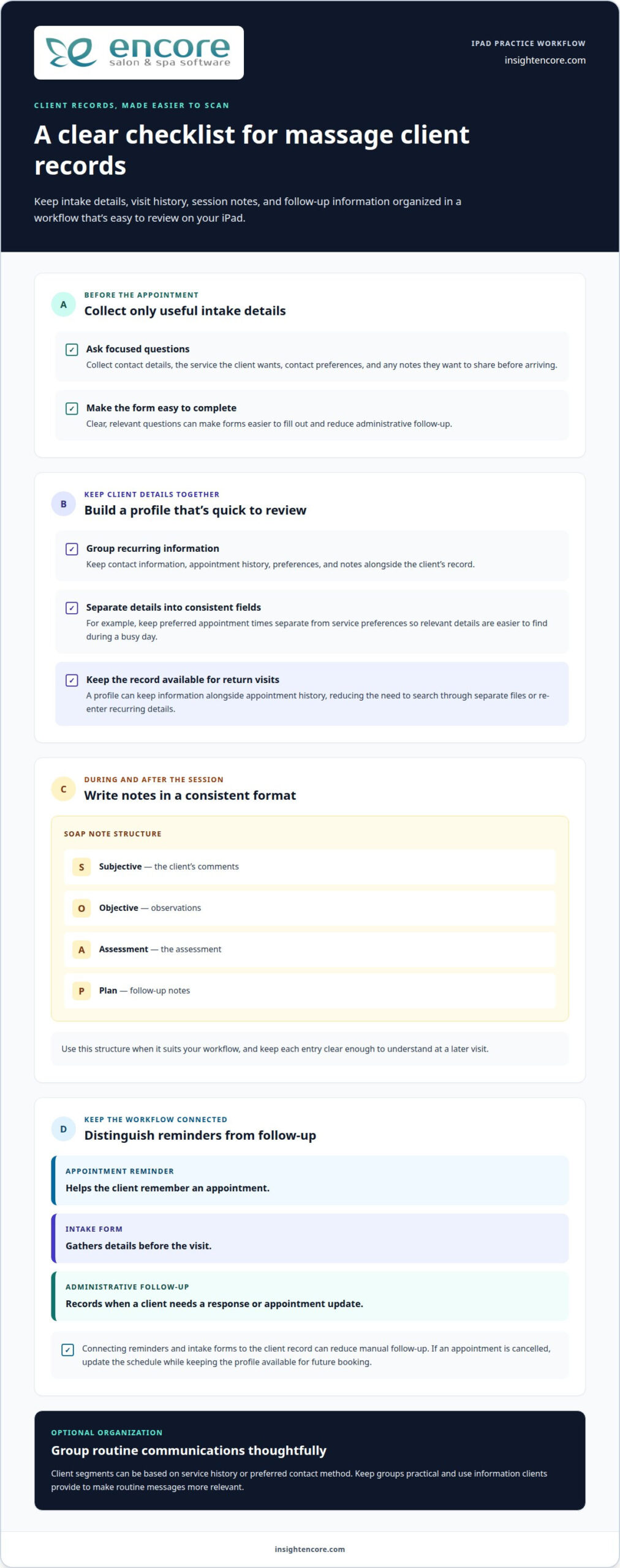
An organized client record makes it easier to prepare for a return visit. An intake form can collect contact details and service preferences, while a profile keeps information alongside appointment history. On an iPad, you can review the profile before a session instead of searching through separate files.
Keep intake forms focused on information that helps with appointments and the requested service. Ask how clients prefer to be contacted, which service they want, and whether they have notes to share before arriving. Clear questions make forms easier to complete and reduce administrative follow-up.
Profiles are most useful when key details are easy to scan. Organize contact information, appointment history, preferences, and notes into consistent fields. For example, record preferred appointment times separately from service preferences so staff can find relevant details during a busy day.
SOAP notes organize session documentation into subjective, objective, assessment, and plan sections. This structure can distinguish a client’s comments from observations and follow-up notes. Use it when it suits your workflow, and write each entry clearly enough to understand at a later visit.
- Intake: Collect contact details and relevant preferences before the appointment.
- Profile: Keep recurring details together instead of re-entering them for each visit.
- Session note: Record concise details using a consistent format, such as SOAP.
- Follow-up: Add an administrative reminder when a client needs a response or appointment update.
Reminders and intake forms have different jobs: a reminder helps clients remember an appointment, while an intake form gathers details before the visit. Connecting both to the client record can reduce manual follow-up. If an appointment is cancelled, update the schedule while keeping the profile available for future booking.
Client segmentation can make routine communications more relevant. A practice might group clients by service history or preferred contact method, then tailor messages to those groups. Keep segments practical and based on information clients provide. A client management system can bring profiles and related administrative tasks into one workflow.
Choose software that makes records easy to update on the iPad and supports the way you document visits. If you want to see how client management fits into a broader workflow, explore Encore’s software.
Software options for solo therapists and clinics
A solo therapist and a clinic need different levels of control. A solo practitioner may manage a calendar, appointments, and client records on an iPad. A clinic may need shared scheduling, staff access, room assignments, and team reports. The right fit depends on who uses the system and which tasks they handle.
For a solo practice, start with the daily workflow. Can you view appointments, update availability, and find a client record without switching between tools? A straightforward interface keeps routine administration manageable. If you work in multiple locations, consider whether the calendar can distinguish appointments by location.
Clinic software has more to coordinate. A receptionist might manage bookings while therapists view their own schedules and client details. Staff permissions define who can see or change particular records. Set access by role so handling scheduling does not automatically give every employee the same controls.
Reports can help clinic owners see how appointments translate into business activity. Reports by therapist, service, or location can reveal open capacity. Revenue reports offer another view of operations, while cancellation records show how schedule changes affect the day. Look for reports that make these details easy to interpret.
Multi-location clinics need to manage separate calendars while retaining an overall view. A manager may review availability across branches while each team sees its daily schedule. Look for location filters, consistent service names, and clear staff assignments to help spot conflicts and coordinate coverage.
Integrations matter when a clinic uses separate tools for payments, client records, or reporting. Connecting scheduling with payment processing can reduce duplicate entry. Map a common task, such as booking a client, recording payment, and reviewing the appointment later. Fewer disconnected steps make it easier to keep records aligned.
- Solo therapist: Prioritize a manageable calendar, client access, and simple appointment updates.
- Small clinic: Compare team calendars, role-based permissions, and therapist-level reports.
- Multi-location clinic: Look for branch-specific views alongside an overall schedule.
Software plans also differ in how they support a business. Some focus on individual scheduling, while others support multi-location operations and broader staff coordination. Compare included features, such as reporting, permissions, and integrations, rather than choosing by plan label alone.
To narrow your choices, list who needs access, which calendars they manage, and what the clinic needs to report. Then compare each option against those tasks using the same sample appointment workflow.
Starting prices and payment-processing costs
Compare the full cost of scheduling software, not just its advertised starting price. A subscription may cover appointment management, while payment processing adds transaction costs. For a fair comparison, list the plan, included features, billing period, and payment charges for each platform.
Can iPad scheduling software process payments, deposits, and cancellation fees? It can when the platform includes those functions. Compare each payment feature separately: accepting a session payment does not automatically mean the system handles deposits or cancellation charges.
Plans may differ in their focus, from core scheduling to tools for teams, reporting, or multiple locations. Choose based on what your practice will use. A solo therapist may need appointment booking and payment records, while a clinic may also need staff access and revenue reports.
Payment processing may involve a fee for each card transaction. Rates and other charges depend on the processor and account terms, so compare them alongside the software subscription. Even a small difference can matter when card payments are a regular part of checkout.
For each option, map a client visit from booking to billing. Check whether the client can pay a deposit online, how the remaining balance is recorded, and where the receipt appears in the client’s account. Include a cancellation in the comparison to spot extra tools or manual steps that could affect the total cost.
- Subscription: Identify the billing period and which scheduling features the plan includes.
- Processing: Separate card transaction charges from the software subscription.
- Checkout: Compare deposits, session payments, receipts, and cancellation handling.
- Growth: Consider whether adding staff or locations changes the plan you need.
Review point-of-sale (POS) payments separately. A therapist might take payment after a session, while another practice collects a deposit at booking. Compare how each workflow records the transaction and links it to the appointment. If your business also uses Google Calendar, include calendar handling in the comparison, separate from payment costs.
Before choosing a platform, make a cost worksheet covering subscription charges, processing fees, and any paid features your workflow requires. Compare the same booking and checkout example across options for a clearer picture than starting prices alone can provide.
Which massage scheduling apps offer a dedicated iPad app versus a browser-based interface?
The iPad experience depends on how you access each scheduling platform. A dedicated app is installed on the device; a browser-based interface opens in a browser such as Safari. Compare each option’s access method rather than assuming every massage scheduling service offers both.
With a dedicated app, test the actual appointment workflow on iPad. Open the calendar, view a client record, and edit an appointment. Check that controls are easy to reach and the screen shows the information you need without unnecessary steps. An app icon alone says little about how smoothly those tasks work.
A browser-based interface can help if you manage scheduling across devices. Sign in through your iPad browser and try the same tasks: find a client, adjust an appointment, and review the day’s schedule. Compare its display and navigation with the dedicated-app experience. Browser access may suit a practice that values consistency across devices.
An app does not mean scheduling works without internet access. Access to live bookings, client records, and calendar changes depends on the service’s design and connection requirements. Test what happens if the iPad loses connectivity, then reconnect and check that any saved changes appear correctly. This matters if you rely on the iPad during sessions or between rooms.
| Access type | How it opens | What to compare |
|---|---|---|
| Dedicated iPad app | Installed on the iPad | Calendar readability, navigation, appointment edits |
| Browser-based interface | Opened in a browser such as Safari | Page layout, sign-in flow, device-to-device access |
| Both access methods | App or browser, depending on the service | Whether records and schedule changes stay aligned |
Use the same sample appointment to compare options fairly. Start with a booking, open the client details, change the schedule, and review the updated calendar. Repeat the sequence in the app and browser if both are available. Note differences in visibility, editing, and access to the information you need.
Choose based on how you use the iPad, not just the interface label. A therapist who works from one device may prefer an app-based workflow; a clinic using different device types may favor browser access. Either way, compare appointment management and client information through the same practical test.
Encore Salon and Spa Software
Encore Salon & Spa Software helps massage businesses manage appointment booking, client records, and point-of-sale tasks in one platform. Encore Spa Software and Encore Salon Software support businesses coordinating services alongside broader spa or salon operations. Chair/Booth Renter Software is designed for independent professionals managing their own business workflow.
Consider Encore when you want scheduling to work alongside client records and transactions, rather than as a standalone calendar. The right setup depends on how your practice operates and which tasks you want to manage together. Explore an option that fits your business, then contact Encore Salon & Spa Software to discuss your needs.
Make your next scheduling choice with confidence
Choose a system that fits the way you want your practice to run, then plan the transition around a real appointment workflow. Consider what clients and staff need to do and how you want to manage those tasks on your iPad. Starting with a clear workflow makes it easier to build a more organized routine.
If you’re comparing massage therapist scheduling software for iPad with broader salon or spa management, Encore Salon and Spa Software offers Encore Salon Software, Encore Spa Software, and Chair/Booth Renter Software. These options support different setups, from salon and spa operations to independent renters.
Take the next step at a pace that feels right for your business.
A more manageable schedule starts with a system that fits your work.
Frequently Asked Questions
Can massage booking software help grow a massage practice?
Yes, booking software can help new and returning clients schedule without coordinating by phone. After a first visit, for example, a therapist can share an online booking page and use appointment history to plan relevant follow-up messages. Software organizes booking and communication, but growth also depends on available appointment capacity and the experience clients receive.
What scheduling software for massage therapists works well on iPad?
Choose massage therapist scheduling software for iPad based on how comfortably you can use its calendar, booking tools, and client records on a tablet. Encore works in a current browser on iPad and requires an internet connection. Test a routine task, such as moving a client visit to another available time, to assess the workflow.
How much do massage therapist scheduling software plans cost?
Plan costs depend on the software tier and the practice’s setup, while payment processing may add separate transaction costs. For a useful comparison, estimate the subscription and processing expenses together using your typical booking and checkout workflow. Encore pricing is based on location and employee count, so the plan structure depends on the business rather than iPad use alone.
Which massage scheduling software includes client records, intake forms, and SOAP notes?
Feature sets vary. Encore includes client management tools, and Client Intake Forms are available as an add-on. SOAP notes are a distinct documentation format, so compare whether a platform has separate subjective, objective, assessment, and plan fields. General client notes are not necessarily a structured SOAP template; choose a record layout that suits your documentation workflow.
How do massage practice scheduling platforms compare on ease of use and features?
Compare platforms by completing the same real task in each, such as changing an appointment after a client requests another time. Notice how many screens it takes and how easy the updated booking is to find. Then consider the tools you’ll use regularly, such as client records, reports, or payment tracking, rather than choosing by feature count alone.
Which scheduling apps support multiple therapists, rooms, and locations?
Look for scheduling tools that show separate therapist calendars and assign appointments to treatment rooms. Multi-location support helps manage branch schedules, but room assignments and staff views are separate capabilities. A clinic, for example, may need to see which therapist and room are available at a particular location before offering an appointment.
Disclaimer
This article is general in nature and may contain errors, please verify all claims with your sales rep