

A full appointment book can make a promotion look successful, even when many clients would have booked anyway. That’s why measuring salon marketing roi starts with a more useful question: which bookings and revenue can you reasonably connect to the campaign?
It’s frustrating to see likes, clicks, and appointments without knowing what your marketing contributed. Discounts can muddy the picture, too. A campaign may bring in bookings while leaving little profit behind. You don’t need perfect tracking to make a more confident decision, but you do need to separate campaign-driven visits from business that was already likely to happen.
This guide explains how to calculate a useful ROI measure, account for campaign costs and discounts, and compare channels using consistent data. It also covers how to treat repeat bookings carefully, so one promotion doesn’t get credit for a client’s ongoing loyalty. Use your salon’s own results to decide what to keep, change, or stop, rather than relying on a generic industry benchmark.
Key Takeaways
- Choose one clear outcome for each campaign, such as first-time bookings or redeemed offers, to make results easier to interpret.
- Measuring salon marketing roi means looking beyond clicks and bookings to compare attributable revenue with the full campaign cost.
- Track campaign spend, attributed bookings, and revenue consistently so you can compare channels without relying on generic benchmarks.
- Check seasonality, appointment capacity, cancellations, and repeat-client behavior before deciding whether a campaign contributed to a change.
- Bring booking, client, and transaction records together where possible, then use the results to choose what to keep, adjust, or stop.
What Measuring Salon Marketing ROI Really Tells You
A campaign can fill appointments and still fall short financially. To judge its contribution, measuring salon marketing roi means comparing the revenue you can reasonably attribute to the campaign with the cost of running it. The result is a decision-making measure, not proof that every new booking came from marketing.
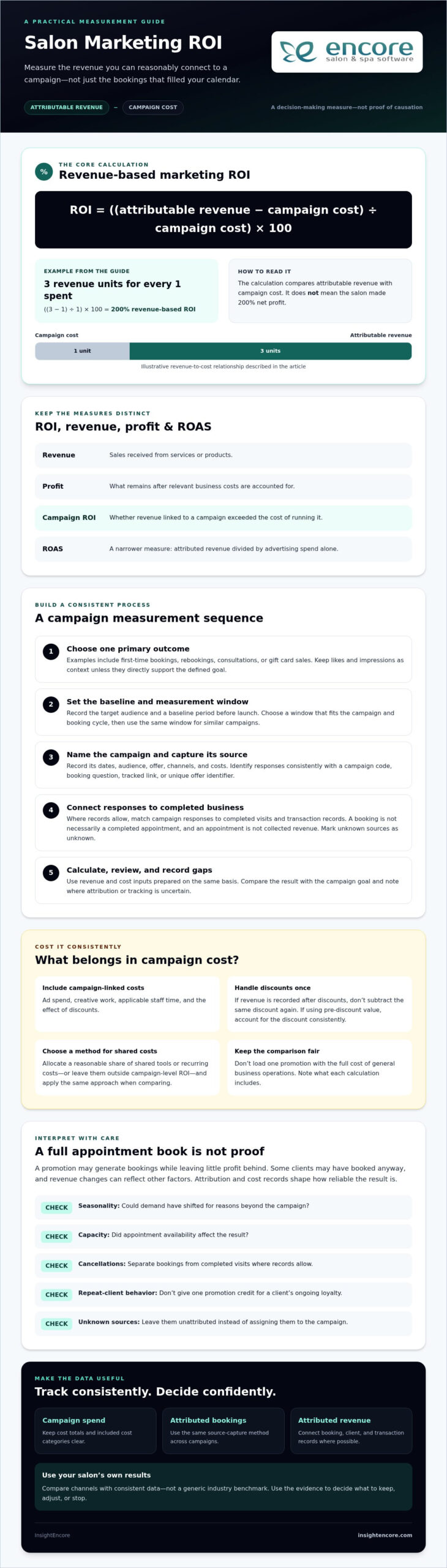
Salon marketing ROI is the percentage return from campaign-attributed revenue after campaign costs are deducted. Use this formula:
Marketing ROI = ((attributable revenue − campaign cost) ÷ campaign cost) × 100
For example, if a campaign generates three units of attributable revenue for every one unit spent, its revenue-based ROI is 200%. That does not mean the salon made 200% net profit. The calculation compares revenue with campaign costs, not with every cost of delivering the services sold.
Marketing ROI versus salon revenue and profit
Revenue is the sales received; profit is what remains after relevant business costs are accounted for. Campaign ROI sits between those ideas: it asks whether the revenue linked to a campaign exceeded the cost of that campaign. Return on ad spend (ROAS) is narrower, dividing attributed revenue by advertising spend alone. For background on the broader metric, see Return on Marketing Investment (ROMI).
A revenue increase after a promotion doesn’t prove the promotion caused it. Clients may have already planned to visit, or demand may have shifted for other reasons. Your calculation is only as reliable as the attribution and cost information behind it.
Which marketing costs belong in the calculation?
Include costs tied to the campaign, such as ad spend, creative work, applicable staff time, and the effect of discounts. If you record revenue after discounts, don’t subtract the same discount again as a separate cost. If you use the pre-discount value instead, account for the discount consistently.
Shared tools or recurring costs also need a consistent approach. You might allocate a reasonable share to each campaign or leave them outside campaign-level ROI, as long as you use the same method when comparing results. Don’t load one promotion with the full cost of general business operations. Keep campaign costs distinct, and note what your calculation includes so you can compare like with like.
How to Measure Salon Marketing ROI Step by Step
A repeatable process makes campaign results easier to compare and less dependent on guesswork. Before launching, decide what success means, how you’ll identify campaign-driven activity, and when you’ll review the results.
Set one goal and a measurement window
Choose one primary outcome for each campaign, such as first-time bookings, rebookings, consultations, or gift card sales. Record the target audience and a baseline period before launch, then set a measurement window that fits the campaign and booking cycle. Use the same window when comparing similar campaigns. Impressions and likes can help explain reach, but they aren’t sales unless they directly support a defined goal.
Aligning a metric with a business objective helps you measure marketing effectiveness, rather than just activity. Keep secondary measures for context, but don’t change the main success measure after the campaign has started.
Define the campaign and capture its source
Give each promotion a clear name and record its dates, audience, offer, channels, and costs. Then choose a practical way to identify responses: a campaign code, a booking question, a tracked link, or a unique offer identifier. Apply the method consistently so you can identify bookings or sales associated with the campaign.
Connect the source to the outcome as far as your records allow. A booking is not necessarily a completed appointment, and an appointment is not the same as collected revenue. Match campaign responses to completed visits and transaction records where possible. If a client’s source is unknown, mark it as unknown instead of assigning it to the promotion.
Calculate and review the result
Campaign ROI is ((attributable revenue minus campaign cost) divided by campaign cost) multiplied by 100. It requires a consistent cost total and revenue linked to campaign responses within your pre-set measurement window.
Use revenue and cost inputs prepared on the same basis, including discounts and applicable campaign labor. Then compare the result with the campaign’s goal and note any gaps in tracking. The calculation won’t resolve uncertain attribution, but a consistent process can show where the evidence is strong and where it needs improvement.
Booking, client, and transaction records can provide useful inputs when they’re connected appropriately. Salon management tools such as Encore Salon & Spa Software bring online booking, client management, and POS transactions together, but you’ll still need to confirm how campaign sources can be captured and matched to outcomes. Use what the records support, then refine your tracking for the next campaign.
Which Salon Marketing Metrics Help Explain ROI?
ROI is the result you’re trying to understand, while supporting metrics help explain what happened along the way. Separate outcome metrics, such as completed appointments and sales, from activity metrics, such as impressions, clicks, and likes. Activity can show that people noticed a campaign. On its own, it can’t show that the campaign was profitable.
For a useful comparison, keep a simple record for each campaign. Measuring salon marketing roi becomes more meaningful when you use the same fields and definitions from one campaign to the next.
| Campaign | Spend | Attributed bookings | Attributed revenue | Estimated ROI |
|---|---|---|---|---|
| Campaign name and dates | Costs included | Bookings linked to campaign | Revenue linked to those bookings | Calculated using your stated method |
Bookings, new clients, repeat visits, and average transaction value
Bookings show a response, but they don’t confirm that appointments were completed or paid for. Separate first-time clients from returning clients: a promotion that attracts new guests has a different purpose from one that encourages existing clients to return. Repeat visits can signal ongoing engagement, but they don’t prove which campaign caused the visit.
Average transaction value shows the typical revenue per completed transaction. It can help explain whether campaign-linked visits generated higher or lower sales, but it doesn’t reveal campaign costs or profit on its own. Read these measures together, and define each one consistently.
Attribution challenges in salon marketing
A client might see a social post, receive an email, and later book after a reminder. Three common approaches assign credit differently: first-touch credits the earliest recorded interaction, last-touch credits the final one before booking, and self-reported attribution asks clients how they heard about the salon. Each offers a useful view, but none captures every influence.
Write your attribution method beside the results. Compare campaigns only when their goals, measurement windows, and tracking methods are reasonably alike. A campaign focused on new-client bookings shouldn’t be ranked directly against one designed to encourage repeat visits. Channel performance depends on your objective and the quality of your tracking, not a universal winner.
How to Interpret Salon Marketing ROI Without Misleading Yourself
A strong month is encouraging, but it doesn’t prove a campaign caused growth. Clients may already have planned their visits, demand may have shifted with the season, or your team may have had more availability than usual. When measuring salon marketing roi, treat the calculation as evidence to assess, not a verdict on its own.
Put campaign results in context. Check whether appointment capacity changed, whether cancellations affected completed visits, and whether revenue came from first-time clients or repeat guests. A campaign may prompt an existing client to book earlier without creating a new visit. That distinction matters when you assess whether the promotion achieved its intended goal.
Discounts need a closer look, too. An offer can increase bookings while lowering the amount collected per appointment. Compare campaign-linked revenue after discounts with campaign costs, and consider whether the service mix or margin changed. More appointments don’t automatically mean a better financial result.
Common salon ROI calculation mistakes
Before acting on a result, check for omitted campaign costs, revenue counted more than once, and offers redeemed without a trackable identifier. Don’t credit every sale during a campaign period to that campaign. Small booking counts can swing sharply from one appointment, while inconsistent comparison periods can make a routine seasonal change look like campaign impact. Note these limitations beside the result.
Use a practical review cycle to improve campaigns
Review results after the measurement window you chose before launch. Record what the data supports, what remains uncertain, and whether the campaign met its primary goal. When the evidence is limited, test again rather than treating one result as conclusive. When practical, change one meaningful element at a time, such as the offer or audience. That makes it easier to see what may have influenced the next result.
- Continue when tracking is credible and the campaign supports its goal.
- Adjust when results are mixed and you can identify a clear issue to address.
- Test again when results look promising but sample size or attribution is weak.
- Stop when reliable evidence shows the campaign repeatedly misses its goal.
Keep the decision proportional to the evidence. Organized booking, client, and transaction records can help you review outcomes, but they don’t establish campaign attribution by themselves. Use them alongside your source-tracking method, and note any gaps before deciding what to change.
To see how Encore’s tools bring booking, client, and transaction information together, explore Encore Salon Software.
Build a Salon Marketing ROI Tracking Routine with the Right Tools
A simple routine is easier to maintain than a complicated dashboard. For each campaign, record its goal, dates, audience, tracking method, and costs. After the measurement window closes, capture the relevant outcomes, calculate the result using the same definitions, and decide what to do next. This steady process makes measuring salon marketing roi more useful over time because it lets you compare campaigns on consistent terms.
- Record: Note the campaign details and which costs are included.
- Capture: Connect campaign sources with bookings and completed sales where possible.
- Calculate: Apply your chosen ROI formula consistently.
- Decide: Keep, adjust, test, or stop based on the strength of the evidence.
What to look for in salon marketing and management software
Online booking, client records, POS transactions, and marketing tools can each contribute useful information. Together, they may help you organize campaign activity alongside bookings and sales, but they don’t automatically establish which campaign caused a transaction. Before choosing a system, ask how campaign sources can be recorded and whether booking and completed-sale information can be reviewed or exported together. If your salon is still relying on a basic cash register for transactions, it may also be worth reviewing what’s involved in upgrading from a cash register to a POS system to better connect sales data with client and booking records.
Encore Salon Software combines online booking, client management, POS transactions, and automated marketing tools. Explore Encore salon software features, and confirm which records or exports support the tracking process you plan to use.
Turn campaign results into a confident next step
Start with one campaign and a small tracking sheet. Include the campaign name, goal, dates, spend, source, attributed bookings, completed sales, revenue, and any limitations in the data. A spreadsheet can be enough to establish a consistent method before you add more tools or campaigns.
Software can help keep operational information organized, but it can’t replace clear goals, consistent attribution, or careful interpretation. Build the method first, then decide whether a platform’s records and reporting options fit your needs.
To explore whether Encore fits your salon’s tracking routine, learn more about Encore.
Make Your Next Marketing Decision with Confidence
Strong campaign decisions don’t depend on perfect data or a universal benchmark. They come from a consistent way to connect marketing activity with bookings, completed sales, and campaign costs. Measuring salon marketing roi becomes more useful when you set a clear goal, track where responses came from, and interpret results alongside repeat visits, cancellations, and discounts.
Start with one campaign and a simple tracking routine. Record what you can verify, note where attribution is uncertain, and use the findings to decide whether to continue, adjust, test again, or stop. Over time, organized records can help you identify which activities are worth another look.
Encore brings together online booking, client management, and POS tools, alongside automated marketing, loyalty programs, and gift card management. These tools can help organize salon activity, while your chosen tracking method remains essential to measuring campaign results.
Take it one campaign at a time. A clearer view of your results can help you make your next marketing decision with greater confidence.
Frequently Asked Questions
What is a good marketing ROI for a salon?
There’s no single marketing ROI benchmark that applies to every salon or campaign. A useful result depends on the goal, which costs you include, and how confidently you can connect bookings or sales to the campaign. Compare similar campaigns over comparable periods, and treat early results as directional if the sample is small. Consider profit and available appointment capacity alongside attributed revenue before deciding whether a result is strong.
How do you calculate salon marketing ROI?
Subtract campaign costs from the revenue reasonably attributed to the campaign, divide by those costs, then multiply by 100. For example: ((attributed revenue − campaign cost) ÷ campaign cost) × 100. Include relevant expenses, such as advertising, discounts, and campaign labor, consistently. Measuring salon marketing roi also requires you to state how you attributed revenue. The formula organizes the calculation, but it can’t make uncertain source data reliable.
How can a salon track which marketing campaign generated a booking?
Use a trackable link, campaign-specific code, booking question, or unique offer identifier, then connect the recorded source to completed appointments and transactions where possible. Choose a method staff can use consistently. A client may see several promotions before booking, so tracking won’t always identify a single cause. Record the attribution approach you use, and mark the source as unknown when the available information doesn’t support a confident match.
Should salons measure revenue or profit when calculating marketing ROI?
Revenue is often easier to connect to campaign-linked bookings, but it doesn’t account for the costs of delivering services or running the promotion. Profit gives a fuller financial picture when those costs can be estimated reliably. Choose the measure that fits the decision you’re making, clearly state what it includes, and apply it consistently. Don’t compare a revenue-based calculation with a profit-based one as if they measure the same result.
Can a salon measure social media marketing ROI?
Yes, if you define a business outcome and have a way to connect social activity to bookings or sales. Use tracked links, campaign codes, or a booking-source question where practical, then compare the attributed outcome with campaign costs. Likes, views, and comments can help show engagement, but they don’t establish revenue or profit on their own. Be transparent about any sales or bookings whose source you can’t confirm.
How often should a salon review marketing ROI?
Set a review period before each campaign and allow enough time for its intended outcome, such as a booking followed by a completed appointment. A weekly check can help catch tracking gaps while the campaign is running; make the final assessment using the window and method chosen at launch. Compare campaigns with similar goals and timing, and account for changes in seasonality, appointment capacity, or cancellations.
What if a salon cannot identify which campaign caused a sale?
Report the sale as unattributed or uncertain rather than assigning it to a campaign without evidence. You can still review overall booking and sales trends, but keep those observations separate from campaign-attributed results. For the next promotion, try a unique link, offer code, or booking-source question, and make the tracking step clear for staff and clients. Better source records can strengthen future comparisons without guaranteeing perfect attribution.
Disclaimer
This article is general in nature and may contain errors, please verify all claims with your sales rep