

The supplies you use most deserve close attention, not just a place on a shelf list. A nail salon inventory checklist template can record each product’s name, brand, size, purchase date, and quantity on hand, while helping you note its condition and plan restocking.
Tracking inventory takes time, especially when products are spread across workstations, shelves, and storage. A simple routine helps you spot low supplies and identify products that may need to be removed before anyone uses them.
This guide explains what to include in your checklist, how to inspect products, and how to plan restocking and backups. It also shows why checking frequently used essentials each week can help prevent everyday items from running out between full counts.
Key Takeaways
- Count products on shelves and in storage so your inventory reflects what’s actually on hand.
- Record each item’s name, brand, size, purchase date if known, and current quantity.
- Inspect products for expiration, changes in smell or texture, and condition; remove items that are no longer suitable.
- Set a review rhythm that fits your salon, from weekly checks of high-use essentials to monthly or quarterly inventory updates.
- Plan restocking by how quickly items are used, and keep at least two backup supplies of your most-used products.
Planning restocking and backup supplies
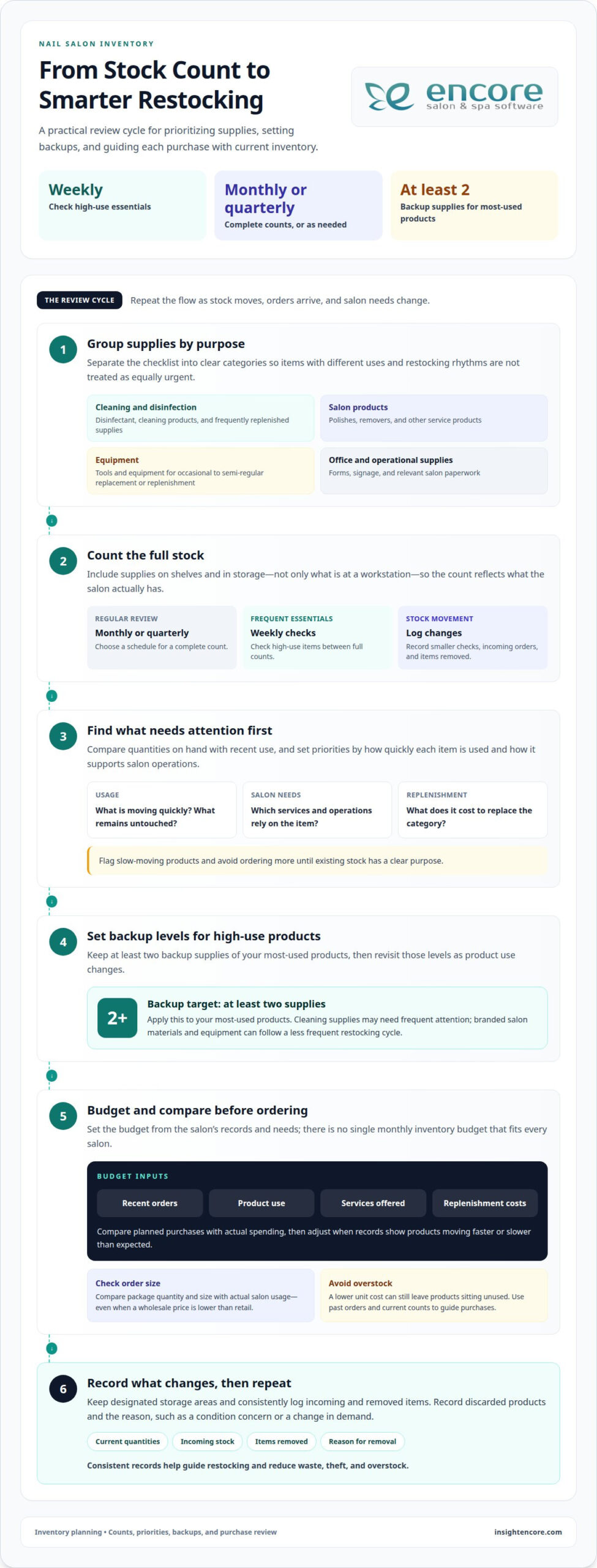
There is no single monthly inventory budget that fits every nail salon. Set yours by reviewing recent orders, product use, services offered, and the cost of replenishing each category. Compare planned purchases with actual spending, then adjust the budget when records show products are moving faster or slower than expected.
Organize the checklist around how each item supports salon operations. Group products with similar uses and give each group a clear restocking rhythm. For example, separate cleaning supplies from nail products, equipment, office supplies, and legal or operational items. This makes it easier to spot priorities without treating every item as equally urgent.
- Cleaning and disinfection: Track disinfectant, cleaning products, and other supplies that need frequent restocking.
- Salon products: Group polishes, removers, and other service products by type or use.
- Equipment: List tools and equipment separately; these may need occasional to semi-regular replacement or replenishment.
- Office, legal, and operational supplies: Include items such as forms, signage, and relevant salon paperwork, organized around the needs and requirements of your location.
Count inventory monthly, quarterly, or as needed, and check high-use essentials weekly. Choose a regular schedule for a complete count, then record smaller checks when a product runs low or an order arrives. Include supplies on shelves and in storage so reorder decisions reflect the salon’s full stock, not just what is at one workstation.
Use inventory counts to prevent waste, theft, and overstock. Compare quantities on hand with recent use, flag products that remain untouched, and avoid ordering more until existing stock has a clear purpose. Record discarded products and the reason, such as a condition concern or a change in demand. Keep stock in designated storage areas, and consistently log incoming and removed items.
Set backup levels for your most-used products. Keep at least two backup supplies of high-use items, then review those levels as usage changes. Cleaning supplies may need frequent attention, while branded salon materials and equipment can follow a less frequent restocking cycle. Inventory records can also help you anticipate purchases and assess whether service pricing reflects product use.
Wholesale distributors may offer salon supplies at lower prices than retail purchasing. Before ordering, compare the quantity and package size with your salon’s actual usage. A lower unit cost can still result in overstock if products sit unused, so use past orders and current counts to guide each purchase.
Set the monthly budget using recent orders, product use, the services you offer, and replenishment costs. Compare planned purchases with actual spending, then adjust as inventory use changes.
Checking expiration dates and product condition
To track nail polish colors, lot numbers, and expiration dates, create a separate record for each shade. Note the brand, color name or code, lot number, expiration date, and purchase date when available. Update the record when a new bottle arrives so older stock is not confused with a newer batch.
Inspect the container and product together during each inventory review. Read the label for an expiration date, then check the polish for changes in smell, separation, or other visible differences. Compare its color with the recorded shade, especially when bottles from the same brand look similar. A product may appear usable at a glance but still show signs that warrant removal.
- Expiration: Record the printed date, and flag products that have reached it.
- Smell: Notice unexpected changes, and mark the item for removal.
- Separation: Look for a changed texture or layers that don’t appear consistent with the product’s usual condition.
- Style: Identify shades or products that are no longer in style and unlikely to be used.
Use the same inspection steps for other nail products. Set aside items with an expiration concern, unusual smell, separation, or change in condition. Discard products identified for removal rather than returning them to active stock. Record what was removed and why, so the inventory stays accurate and the item is not mistakenly counted at the next review.
Keep records easy to update. A spreadsheet can use one row per product and columns for brand, shade, lot number, expiration date, purchase date, condition, and status. Use consistent statuses such as “in use,” “inspect,” or “removed.” If the manufacturer prints a lot number on the bottle or packaging, copy it exactly rather than substituting a shade name or purchase date.
Arrange physical bottles to match the inventory record. Separate shades by brand or color family, and keep labels visible so staff can find the correct entry. When appropriate, place newer stock behind older stock to make older products easier to notice. Keep products with condition concerns apart from usable inventory while they are being assessed.
During each inventory review, compare the shelf with the records. Confirm that listed colors are present, dates remain legible, and flagged products haven’t returned to active stock. A shared digital record can make updates easier to maintain; organize salon inventory records as part of a consistent review routine.
Review each item’s condition, not just its printed date. Expiration, smell, separation, and whether a product is still in style all belong in the assessment. Any one of these may warrant attention, so a legible date alone does not complete the inspection. Apply the same checks across the products being reviewed and clearly record the outcome. Discard items identified for removal rather than leaving them among products available for use. This keeps the review focused on each product’s condition and whether it remains appropriate to retain.
Listing product names, brands, sizes, purchase dates, and quantities
Give every inventory item its own clear record. For example, a nail polish entry should identify the shade and brand, not just say “polish.” Record the product name, brand, size, purchase date if known, and quantity on hand. These details distinguish similar products and show what the salon has available.
A printable PDF can serve as a paper checklist if it includes the same fields as a digital record. Print a fresh copy for each count, then enter changes in the salon’s master inventory file to keep records consistent.
Use columns for the details staff need to identify and count each item:
- Product name: Write a specific name, such as “cuticle oil,” rather than “nail product.”
- Brand: Record the label’s brand name to distinguish products with similar uses.
- Size: Include the package size, such as the volume printed on a bottle.
- Purchase date: Enter the date when known, especially for newly received stock.
- Quantity on hand: Count usable units across shelves, workstations, and storage.
- Location: Note where the item is stored, such as a retail shelf or back-room cabinet.
Keep product names consistent across entries. If one record says “gel polish” and another says “gel color,” staff may count the same category differently. Use the wording printed on the product when possible. For several shades from one brand, create a separate entry for each color so the count shows exactly which shades need replenishing.
For each count, compare the recorded quantity with physical stock. Count sealed and open containers consistently, and define which units qualify as usable inventory. For example, record unopened retail bottles separately from products reserved for service use. This makes totals easier to interpret and helps prevent a shelf count from overlooking stock stored elsewhere.
Update the record whenever products arrive or leave inventory. Enter received quantities after unpacking an order, and adjust counts when items are used, sold, damaged, or discarded. If the purchase date is unknown, leave that field blank rather than estimating it. Keep the product name and brand intact so the item remains identifiable.
Check for duplicate entries before finalizing a count. A “red polish” entry and a brand-specific shade entry may refer to the same bottle. Merge duplicates, retaining the clearest name, size, and location. A tidy list turns each count into a useful snapshot of what the salon owns and where staff can find it.
Checking frequently used essentials
High-use items can run low between full counts, so check them separately. Review essential supplies weekly, compare shelf quantities with recent use, and note what needs replenishing. This focused routine can catch a shortage before it disrupts a scheduled manicure or pedicure. A nail salon inventory checklist template makes the weekly review easier to repeat.
- Acetone: Check the amount of 100% acetone available for removing remnants of a client’s previous manicure.
- Toe separators: Count pairs used to keep toes apart while polish dries, reducing the chance of smudging.
- Foot files: Check available files and grits, since technicians use them to remove dead skin.
- Gel products: Track gel polish, base coat, and top coat alongside the UV/LED lamp needed to cure gel polish.
- Cuticle nippers: Check condition and quantity, and keep worn or damaged tools out of active use.
Make each weekly check quick and repeatable. Visit the same storage locations, such as the manicure station, pedicure area, and supply cabinet. Count each item and record its current quantity. If supplies are stored in several places, add those counts together so the total reflects what staff can access.
Use the service schedule to identify essentials that need closer attention. A day with several gel appointments may use more gel base coat than a day focused on regular polish. A busy pedicure schedule can increase demand for toe separators and foot files. Compare upcoming bookings with current stock, then prioritize items needed for scheduled services.
Keep tools and disposable supplies separate on the checklist. For example, list foot files separately from reusable implements, and record replacement tools as equipment rather than consumable stock. For salon tools requiring disinfection, note the liquid disinfectant used and whether supplies are available for the salon’s process. Inventory tracking supports readiness, but it does not replace proper cleaning and disinfection procedures.
Check related sanitation supplies during the same weekly round. Confirm that hand-washing and disinfection supplies are available for technicians between clients. If the salon uses foot bath liners, count them separately and include replacements in the pedicure area’s stock review.
When an essential runs low, record the item and update its quantity after restocking. A note such as “toe separators, pedicure station” is more useful than a general reminder to order supplies. A nail salon inventory checklist template also keeps item-level notes consistent as staff record what needs attention.
What items should a nail salon inventory checklist include?
A useful checklist covers more than polish and service products. Include everything the salon needs to provide services, keep work areas clean, manage daily operations, and support retail sales. Count products on shelves and in storage so the record reflects the salon’s full stock.
Start with the product groups technicians use during manicures and pedicures. List each product type separately, then identify brands, sizes, and shades when those differences matter. A single “polish” line hides which colors are available; separate shade entries make the count more useful.
- Nail products: Include polish, gel products, base coats, top coats, removers, and nail preparation products.
- Manicure and pedicure supplies: List files, buffers, toe separators, cotton products, and other items used during services.
- Tools and equipment: Record reusable implements, lamps, electric files, dust collectors, and pedicure equipment.
- Cleaning supplies: Include cleaning products, liquid disinfectant, hand-washing supplies, and foot bath liners used by the salon.
- Retail stock: Track products offered for clients to purchase separately from supplies reserved for services.
Include office and management items that support daily operations. Examples include appointment or client forms, printed service menus, receipt paper, and supplies used to record orders. These items may not be used during a manicure, but running low can still interrupt routine work. Give each item a location and quantity field.
Add legal and operational items under a separate checklist category. This may include salon licenses, required signage, and documents related to retail sales. Include license renewals when they apply. State requirements differ, so organize these records around the salon’s location rather than assuming every checklist is identical.
For retail sales, include the operational records relevant to the salon’s process. Retail sales may involve additional administrative requirements, so include applicable records on the checklist. In states that collect sales tax, salons selling retail products need to register for a tax identification number through the state tax office. Keep applicable records identifiable and track renewal or review dates when needed.
Make every category easy to use during a physical count. Use clear labels, note storage locations, and separate service stock from retail products. Distinguishing a retail polish from a service bottle gives staff a clearer count and helps identify which items need attention.
Set restocking expectations by category as well as by quantity. The checklist categorizes hair styling tools as items that need semi-regular to frequent restocking, while legal and operational salon items need occasional restocking. For the most-used items, a nail artist recommends keeping at least 2 backup supplies. A quantity field can make the backup supply count clear for each frequently used item. These categories can guide how often staff review each entry.
Check your state’s guidelines for required signage and operational items, because requirements differ by state. Renew licenses when needed. Keep a record of products discarded during inventory, since they may qualify as a tax write-off, and consult a tax professional.
Encore Salon and Spa Software: Nail Salon Software
Encore Salon & Spa Software offers Nail Salon Software and an Inventory Management System to help salons manage inventory alongside daily operations. A checklist is a useful starting point; a management system can help keep product information organized as items are received, used, and reordered.
Consider this next step if paper counts or separate spreadsheets make it difficult to maintain a clear view of salon stock. Use the inventory process you have built to organize product records and restocking decisions in a system suited to nail salons.
Contact Encore Salon & Spa Software to discuss your salon’s inventory management needs.
Make inventory part of your next business decision
Use a nail salon inventory checklist template as a working tool, not a document that disappears after a stock count. Over time, consistent records can help you make informed decisions about what to order, what to keep available, and where your inventory process needs attention. This gives you a practical starting point for adapting as services, client preferences, and product use change.
When your salon is ready to connect inventory routines with broader business management, choose software that fits the way your team works. Encore Salon and Spa Software also offers Encore Salon Software, Encore Spa Software, and Chair/Booth Renter Software.
Keep improving a system that supports your team’s day-to-day work. Small, steady changes can make inventory easier to manage as your salon grows.
Frequently Asked Questions
How to calculate nail salon inventory reorder points and par levels?
Calculate a reorder point by multiplying average daily use by supplier lead time, then adding safety stock: (daily use × lead time) + buffer. Set the par level to cover expected use until the next planned order, plus a buffer. Track products separately because base coat and disposable files may have different usage patterns. Encore’s Inventory Management System can help track stock and product use.
Disclaimer
This article is general in nature and may contain errors, please verify all claims with your sales rep